maheswaran shanmugasundaram, FI
support team, WL Chennai
Asset Accounting
SAP Best Practices
Purpose, Benefits, and Key Process Steps
 Purpose
 The Asset Accounting (FI-AA) component is used for managing and supervising fixed
assets with the SAP System. In Financial Accounting, it serves as a subsidiary ledger to
the General Ledger, providing detailed information on transactions involving fixed assets.
 Benefits
 Entire lifetime of the asset from purchase order or the initial acquisition (possibly managed
as an asset under construction) through its retirement.
 Calculate values for depreciation and interest
 Depreciation forecast
 Key Process Steps
 Acquisition from purchase with vendor
 Acquisition with Automatic Offsetting Entry
 Retirement with revenue
 Asset Sale without customer
 Post-Capitalization
 Write-Ups
 Settlement Assets Under Construction
 Down Payment Request for Assets under Construction
 Depreciation Posting Run
 Depreciation Simulation/Primary Cost Planning
 Income Tax Depreciation for India
maheswaran shanmugasundaram, FI support
team, WL Chennai
Required SAP Applications and Company Roles
 Required SAP Applications
 Enhancement package 5 for SAP ERP 6.0
 Company Roles
 Assets Accountant
 Accounts Payable Accountant
 Finance Manager
maheswaran shanmugasundaram, FI support
team, WL Chennai
Detailed Process Description
 Acquisition from purchase with vendor
 An external asset acquisition is a business transaction resulting from the
acquisition of an asset from a business partner. The acquisition can post
integrated with Accounts payable or without Accounts payable.
 Acquisition with Automatic Offsetting Entry
 The asset can be posted automatically against the Clearing account fixed
asset acquisition.
 Retirement with revenue
 An asset is sold, resulting in revenue. The sale is posted with a customer.
 An asset is sold, resulting in revenue. The sale is posted against a
clearing account.
 An asset had to be scrapped, with no revenue.
 Asset Sale without customer
 Asset Sale with partial retirement without customer
maheswaran shanmugasundaram, FI support
team, WL Chennai
Detailed Process Description
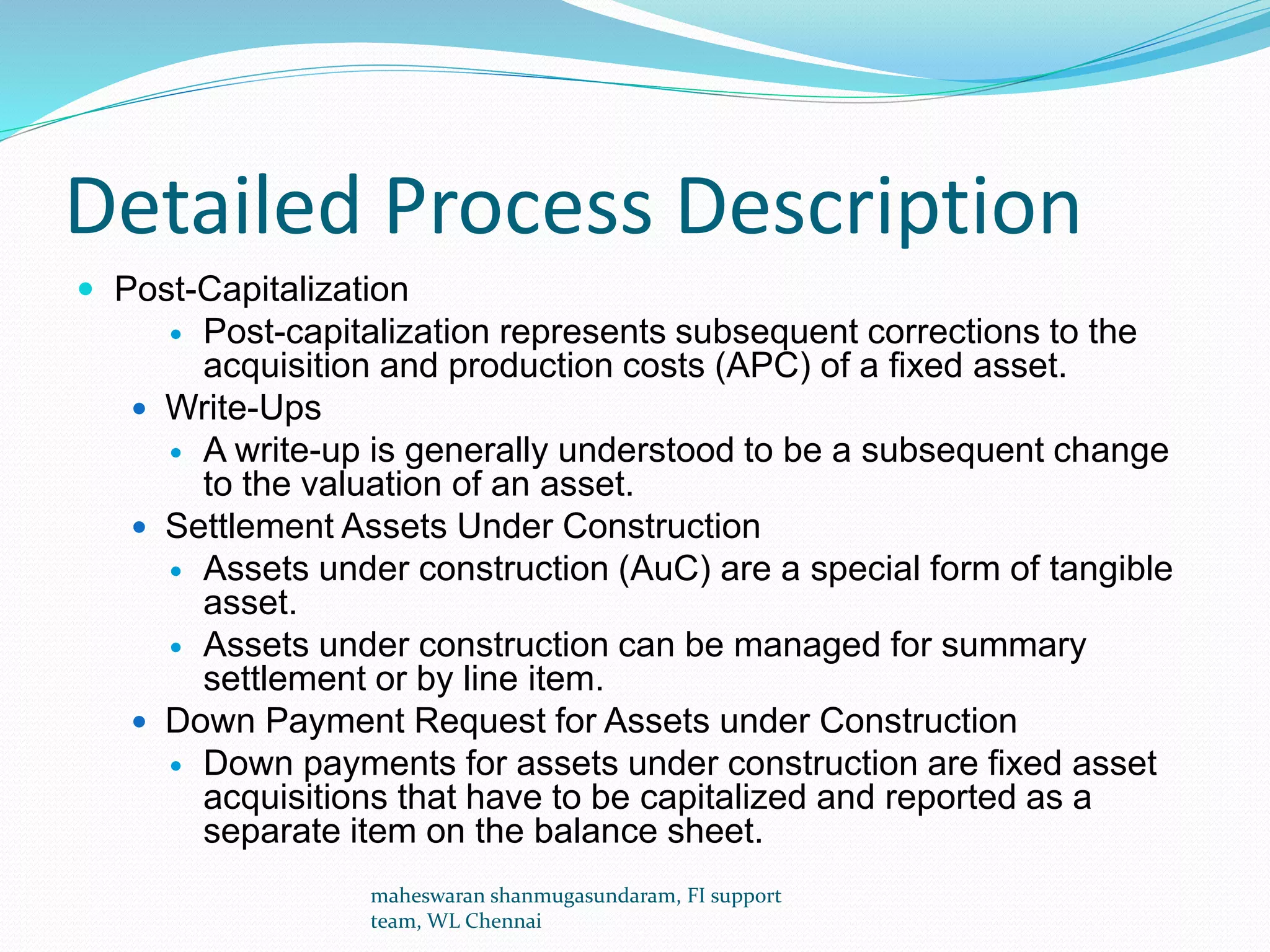
 Post-Capitalization
 Post-capitalization represents subsequent corrections to the
acquisition and production costs (APC) of a fixed asset.
 Write-Ups
 A write-up is generally understood to be a subsequent change
to the valuation of an asset.
 Settlement Assets Under Construction
 Assets under construction (AuC) are a special form of tangible
asset.
 Assets under construction can be managed for summary
settlement or by line item.
 Down Payment Request for Assets under Construction
 Down payments for assets under construction are fixed asset
acquisitions that have to be capitalized and reported as a
separate item on the balance sheet.
maheswaran shanmugasundaram, FI support
team, WL Chennai
Detailed Process Description
continuation
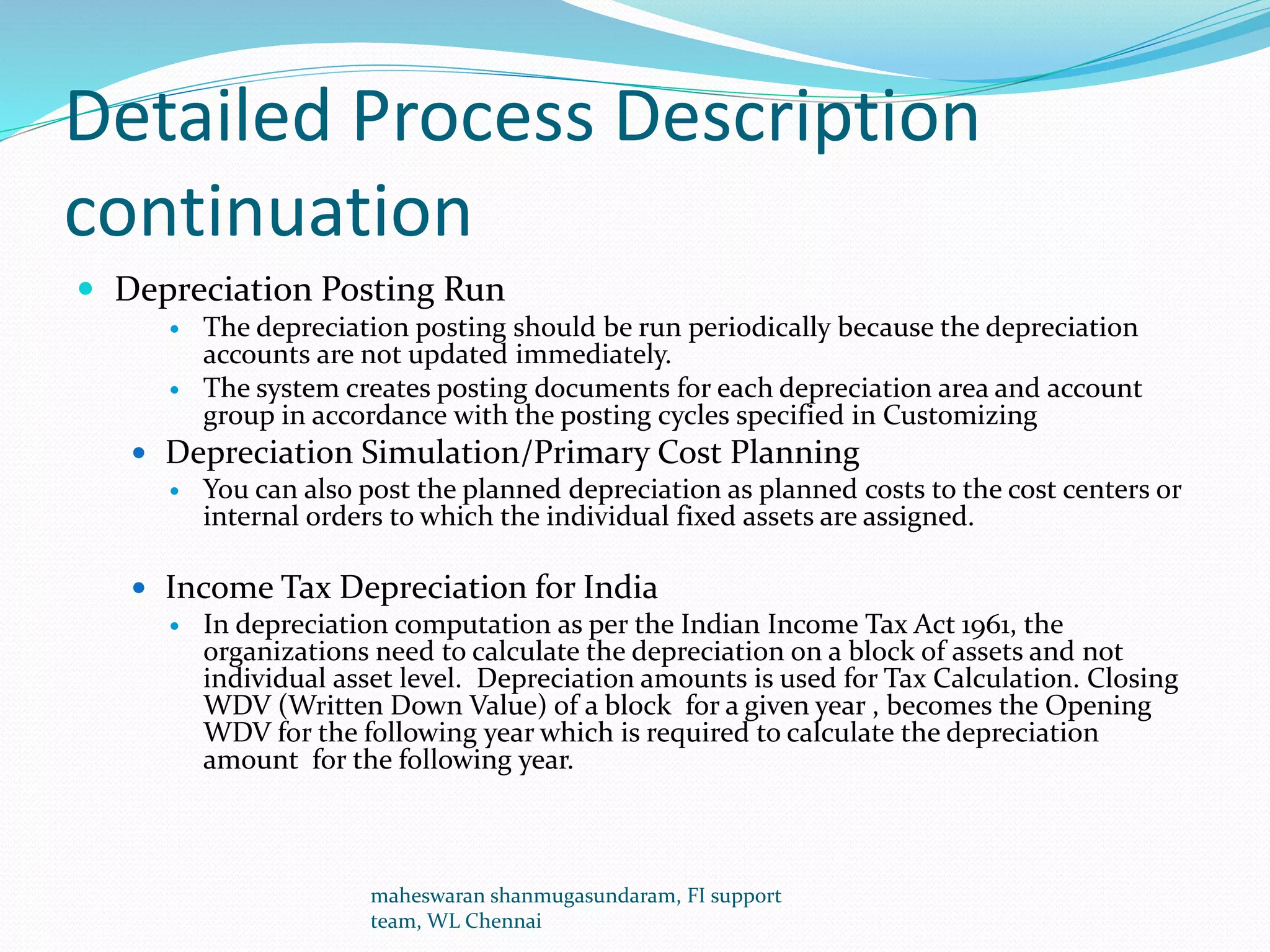
 Depreciation Posting Run
 The depreciation posting should be run periodically because the depreciation
accounts are not updated immediately.
 The system creates posting documents for each depreciation area and account
group in accordance with the posting cycles specified in Customizing
 Depreciation Simulation/Primary Cost Planning
 You can also post the planned depreciation as planned costs to the cost centers or
internal orders to which the individual fixed assets are assigned.
 Income Tax Depreciation for India
 In depreciation computation as per the Indian Income Tax Act 1961, the
organizations need to calculate the depreciation on a block of assets and not
individual asset level. Depreciation amounts is used for Tax Calculation. Closing
WDV (Written Down Value) of a block for a given year , becomes the Opening
WDV for the following year which is required to calculate the depreciation
amount for the following year.
maheswaran shanmugasundaram, FI support
team, WL Chennai
maheswaran shanmugasundaram, FI support
team, WL Chennai
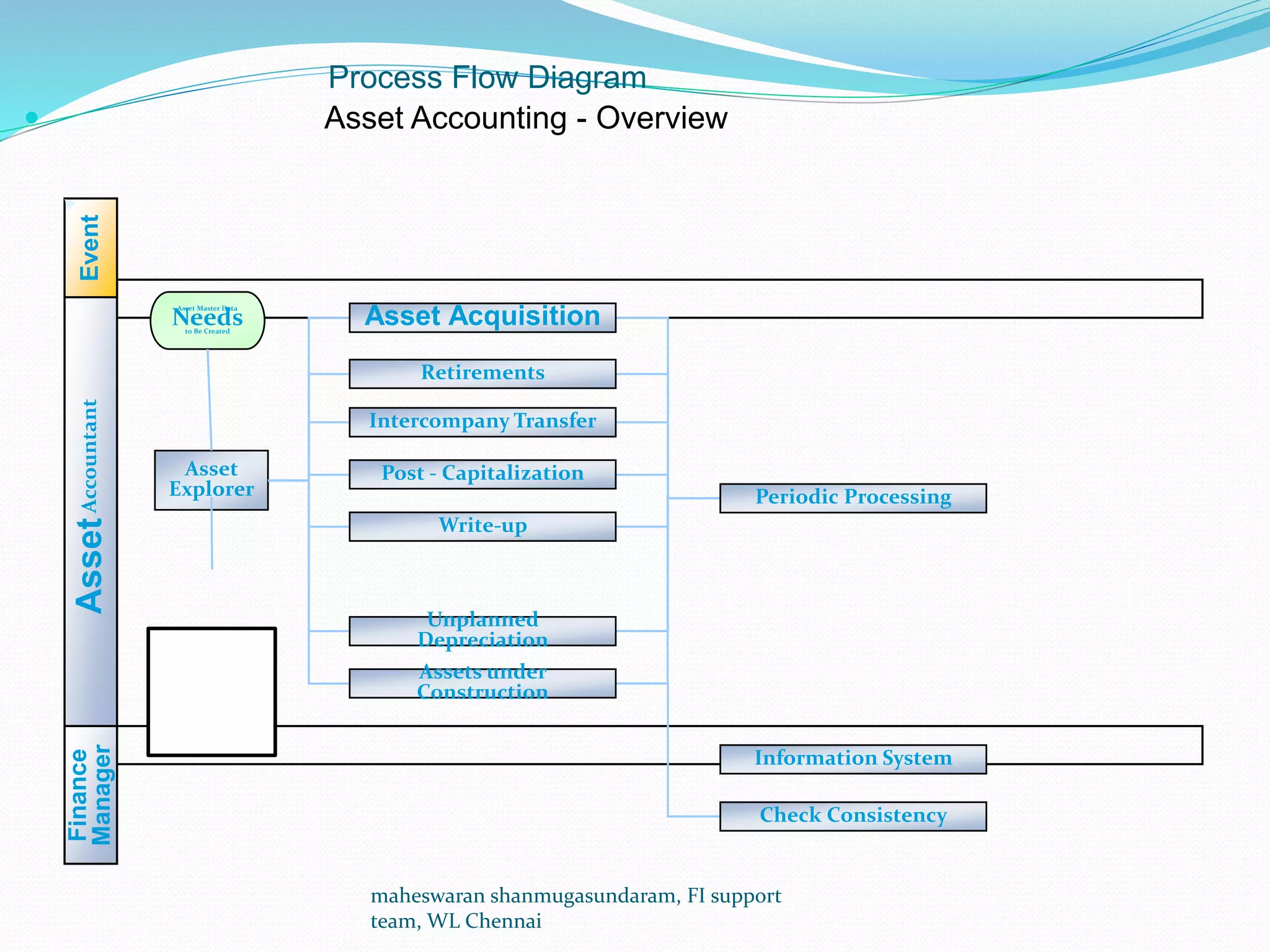
Process Flow Diagram
 Asset Accounting - Overview
AssetAccountantEvent
Asset
Explorer
Asset Master Data
Needsto Be Created
Finance
Manager
Asset Acquisition
Retirements
Intercompany Transfer
Post - Capitalization
Write-up
Unplanned
Depreciation
Assets under
Construction
Periodic Processing
Information System
Check Consistency

SAP FIXED ASSETS ACCOUNTING

  • 1.
    maheswaran shanmugasundaram, FI supportteam, WL Chennai Asset Accounting SAP Best Practices
  • 2.
    Purpose, Benefits, andKey Process Steps  Purpose  The Asset Accounting (FI-AA) component is used for managing and supervising fixed assets with the SAP System. In Financial Accounting, it serves as a subsidiary ledger to the General Ledger, providing detailed information on transactions involving fixed assets.  Benefits  Entire lifetime of the asset from purchase order or the initial acquisition (possibly managed as an asset under construction) through its retirement.  Calculate values for depreciation and interest  Depreciation forecast  Key Process Steps  Acquisition from purchase with vendor  Acquisition with Automatic Offsetting Entry  Retirement with revenue  Asset Sale without customer  Post-Capitalization  Write-Ups  Settlement Assets Under Construction  Down Payment Request for Assets under Construction  Depreciation Posting Run  Depreciation Simulation/Primary Cost Planning  Income Tax Depreciation for India maheswaran shanmugasundaram, FI support team, WL Chennai
  • 3.
    Required SAP Applicationsand Company Roles  Required SAP Applications  Enhancement package 5 for SAP ERP 6.0  Company Roles  Assets Accountant  Accounts Payable Accountant  Finance Manager maheswaran shanmugasundaram, FI support team, WL Chennai
  • 4.
    Detailed Process Description Acquisition from purchase with vendor  An external asset acquisition is a business transaction resulting from the acquisition of an asset from a business partner. The acquisition can post integrated with Accounts payable or without Accounts payable.  Acquisition with Automatic Offsetting Entry  The asset can be posted automatically against the Clearing account fixed asset acquisition.  Retirement with revenue  An asset is sold, resulting in revenue. The sale is posted with a customer.  An asset is sold, resulting in revenue. The sale is posted against a clearing account.  An asset had to be scrapped, with no revenue.  Asset Sale without customer  Asset Sale with partial retirement without customer maheswaran shanmugasundaram, FI support team, WL Chennai
  • 5.
    Detailed Process Description Post-Capitalization  Post-capitalization represents subsequent corrections to the acquisition and production costs (APC) of a fixed asset.  Write-Ups  A write-up is generally understood to be a subsequent change to the valuation of an asset.  Settlement Assets Under Construction  Assets under construction (AuC) are a special form of tangible asset.  Assets under construction can be managed for summary settlement or by line item.  Down Payment Request for Assets under Construction  Down payments for assets under construction are fixed asset acquisitions that have to be capitalized and reported as a separate item on the balance sheet. maheswaran shanmugasundaram, FI support team, WL Chennai
  • 6.
    Detailed Process Description continuation Depreciation Posting Run  The depreciation posting should be run periodically because the depreciation accounts are not updated immediately.  The system creates posting documents for each depreciation area and account group in accordance with the posting cycles specified in Customizing  Depreciation Simulation/Primary Cost Planning  You can also post the planned depreciation as planned costs to the cost centers or internal orders to which the individual fixed assets are assigned.  Income Tax Depreciation for India  In depreciation computation as per the Indian Income Tax Act 1961, the organizations need to calculate the depreciation on a block of assets and not individual asset level. Depreciation amounts is used for Tax Calculation. Closing WDV (Written Down Value) of a block for a given year , becomes the Opening WDV for the following year which is required to calculate the depreciation amount for the following year. maheswaran shanmugasundaram, FI support team, WL Chennai
  • 7.
    maheswaran shanmugasundaram, FIsupport team, WL Chennai Process Flow Diagram  Asset Accounting - Overview AssetAccountantEvent Asset Explorer Asset Master Data Needsto Be Created Finance Manager Asset Acquisition Retirements Intercompany Transfer Post - Capitalization Write-up Unplanned Depreciation Assets under Construction Periodic Processing Information System Check Consistency