
A Multiobjective Memetic Ant Colony OptimizationAlgorithm for the 1/3 Variant of the Time andSpace Assembly Line Balancing Problem12th April 2011Manuel Chica, ÓscarCordón, Sergio Damas, Joaquín Bautista
SummaryIntroductionSALBP and TSALBPThe memetic MACS proposalGeneral structureThe MACS global searchLocal search operatorsExperimentsConclusions and future work01020304050607
Introduction02030405060708The optimization of assembly lines is of great importance in the production and operation research context.The time and space assembly line balancing problem (TSALBP) is a realistic extension of the well-known simple assembly line balancing problem (SALBP).We present a memetic MACS proposal with two multiobjective (MO) local search (LS) methods to solve the 1/3 variant of the TSALBP.The new proposal results are compared with a GRASP algorithm using multiobjective performance indicators in 9 problem instances.
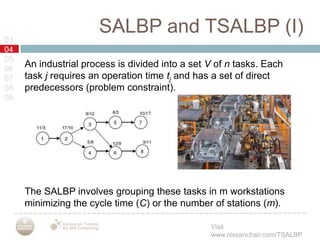
SALBP and TSALBP (I)An industrial process is divided into a set V of n tasks. Each task j requires an operation time tjand has a set of direct predecessors (problem constraint).The SALBP involves grouping these tasks in m workstationsminimizing the cycle time (C) or the number of stations (m).03040506070809
SALBP and TSALBP (II)Importance of the area in assembly line balancing.TSALBP formulations include: The area of each task, aj ; j=1,…,n The available area for any station, AHence, TSALBP has a multicriteria nature involving three different objectives: The cycle time of the plant (C) The number of stations (m) The available area (A)04050607080910
SALBP and TSALBP (III)The existence of these three objectives creates the following problem taxonomy:05060708091011There are 4 TSALBP multiobjective variantsOne of the most realisticvariants in the automotive industry: TSALBP-1/3 (A and m)
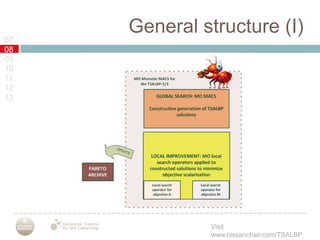
Memeticmetaheuristicshave demonstrated its good performance because of the combination of global search behaviour and the local optimizer.We present a multiobjective memetic algorithm: With a powerful global search metaheuristic: MACS.A MO local search approach with two local search methods, one per objective.The set of constraints associated to TSALBP encourages the use of constructive memeticmetaheuristics to solve it.06070809101112Thememetic MACS proposal
07080910111213General structure (I)
General structure (II)The function to be optimised by the local search is a scalarization of the objective function vector:Weights are created at randomforsolution:λ1, λ2Ifλ1 > λ2then LS operatorforobjectiveAisapplied. Otherwise, LS operatorforobjectivem. If no minimization, theotherisalsolaunchedafterwards.08091011121314
A TSALBP solution is an assignment of tasks to different stations satisfying the constraints.We have to give a sequence of tasks and how these tasks are split up into different stations to fully specify the assignment.09101112131415The MACS global search (I)
The MACS global search (II)10111213141516Pareto-based MOACO algorithms have shown good performance in several problems.MACS is an extension of the ACS which considers an external Pareto archive. The pseudo-random transition rule is considered:Sametransition rules as ACS
The MACS global search (III)11121314151617The pheromone trail information is associated to a pair (task, station). The initial pheromone value 0 is obtained from two single-objective greedy algorithms.No heuristic information used!
	A new mechanism to close a station is used to induce diversity, following a multi-colony approach:The MACS global search (IV)12131415161718
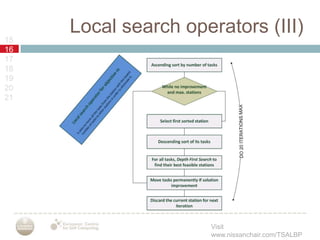
Local search operators (I)13141516171819Both LS operators are based on movements of tasks between their feasible stations. Repeated 20 iterations on each solution obtained by MACS.
Local search operators (II)14151617181920
Local search operators (III)15161718192021
Experiments (I)Nine real-like problem instances with different features have been selected: arc111, barthol2, barthold, scholl…Multiobjective performance indicators: unary HVR, binary C, and graphical representation of the aggregated Pareto fronts.16171819202122
Experiments (II)We compare the new proposal with MACS (no memetic). Also against a multiobjectiveGRASP algorithm : Builds the solution with a random selection of the next task to be included in the current station between the candidates using heuristic information. Makes use of an external Pareto archive and a restricted candidate list (RCL) . A mechanism to close stations using different thresholds. Two similar LS operators applied when solution is built.17181920212223
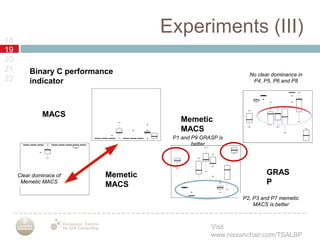
Experiments (III)18192021222324Binary C performance indicatorNo cleardominance in P4, P5, P6 and P8MACSMemetic MACSP1 and P9 GRASP isbetterGRASPMemetic MACSClear dominace of Memetic MACSP2, P3 and P7 memetic MACS isbetter
Experiments (IV)According to HVR,  memetic MACS and GRASP are the best algorithms depending on the problem instance.Memetic MACS is better than GRASP in P2, P3, P7 and P8. But worse in P1, P4, P5, and P6.MACS is obviously worse than GRASP and memetic MACS.192021222324HVR performance indicator
Experiments (V)20212223242122
A novel memetic MACS was developed and applied to tackle the TSALBP-1/3. Its behaviour is clearly superior to the MACS global search. However, thereis no clearconclusionaboutwhichalgorithmisbetterregardingthecomparisonbetween GRASP and memetic MACS. As future work, we will consider:Designing new EMO and memetic algorithms.Adding interactive procedures to include preferences.Application of Wilcoxon statistical tests to the results.Conclusions and futurework21222021222122
Thanks for your attention

Memetic MO Ant Colony Algorithm for TSALBP

  • 1.
    A Multiobjective MemeticAnt Colony OptimizationAlgorithm for the 1/3 Variant of the Time andSpace Assembly Line Balancing Problem12th April 2011Manuel Chica, ÓscarCordón, Sergio Damas, Joaquín Bautista
  • 2.
    SummaryIntroductionSALBP and TSALBPThememetic MACS proposalGeneral structureThe MACS global searchLocal search operatorsExperimentsConclusions and future work01020304050607
  • 3.
    Introduction02030405060708The optimization ofassembly lines is of great importance in the production and operation research context.The time and space assembly line balancing problem (TSALBP) is a realistic extension of the well-known simple assembly line balancing problem (SALBP).We present a memetic MACS proposal with two multiobjective (MO) local search (LS) methods to solve the 1/3 variant of the TSALBP.The new proposal results are compared with a GRASP algorithm using multiobjective performance indicators in 9 problem instances.
  • 4.
    SALBP and TSALBP(I)An industrial process is divided into a set V of n tasks. Each task j requires an operation time tjand has a set of direct predecessors (problem constraint).The SALBP involves grouping these tasks in m workstationsminimizing the cycle time (C) or the number of stations (m).03040506070809
  • 5.
    SALBP and TSALBP(II)Importance of the area in assembly line balancing.TSALBP formulations include: The area of each task, aj ; j=1,…,n The available area for any station, AHence, TSALBP has a multicriteria nature involving three different objectives: The cycle time of the plant (C) The number of stations (m) The available area (A)04050607080910
  • 6.
    SALBP and TSALBP(III)The existence of these three objectives creates the following problem taxonomy:05060708091011There are 4 TSALBP multiobjective variantsOne of the most realisticvariants in the automotive industry: TSALBP-1/3 (A and m)
  • 7.
    Memeticmetaheuristicshave demonstrated itsgood performance because of the combination of global search behaviour and the local optimizer.We present a multiobjective memetic algorithm: With a powerful global search metaheuristic: MACS.A MO local search approach with two local search methods, one per objective.The set of constraints associated to TSALBP encourages the use of constructive memeticmetaheuristics to solve it.06070809101112Thememetic MACS proposal
  • 8.
  • 9.
    General structure (II)Thefunction to be optimised by the local search is a scalarization of the objective function vector:Weights are created at randomforsolution:λ1, λ2Ifλ1 > λ2then LS operatorforobjectiveAisapplied. Otherwise, LS operatorforobjectivem. If no minimization, theotherisalsolaunchedafterwards.08091011121314
  • 10.
    A TSALBP solutionis an assignment of tasks to different stations satisfying the constraints.We have to give a sequence of tasks and how these tasks are split up into different stations to fully specify the assignment.09101112131415The MACS global search (I)
  • 11.
    The MACS globalsearch (II)10111213141516Pareto-based MOACO algorithms have shown good performance in several problems.MACS is an extension of the ACS which considers an external Pareto archive. The pseudo-random transition rule is considered:Sametransition rules as ACS
  • 12.
    The MACS globalsearch (III)11121314151617The pheromone trail information is associated to a pair (task, station). The initial pheromone value 0 is obtained from two single-objective greedy algorithms.No heuristic information used!
  • 13.
    A new mechanismto close a station is used to induce diversity, following a multi-colony approach:The MACS global search (IV)12131415161718
  • 14.
    Local search operators(I)13141516171819Both LS operators are based on movements of tasks between their feasible stations. Repeated 20 iterations on each solution obtained by MACS.
  • 15.
    Local search operators(II)14151617181920
  • 16.
    Local search operators(III)15161718192021
  • 17.
    Experiments (I)Nine real-likeproblem instances with different features have been selected: arc111, barthol2, barthold, scholl…Multiobjective performance indicators: unary HVR, binary C, and graphical representation of the aggregated Pareto fronts.16171819202122
  • 18.
    Experiments (II)We comparethe new proposal with MACS (no memetic). Also against a multiobjectiveGRASP algorithm : Builds the solution with a random selection of the next task to be included in the current station between the candidates using heuristic information. Makes use of an external Pareto archive and a restricted candidate list (RCL) . A mechanism to close stations using different thresholds. Two similar LS operators applied when solution is built.17181920212223
  • 19.
    Experiments (III)18192021222324Binary Cperformance indicatorNo cleardominance in P4, P5, P6 and P8MACSMemetic MACSP1 and P9 GRASP isbetterGRASPMemetic MACSClear dominace of Memetic MACSP2, P3 and P7 memetic MACS isbetter
  • 20.
    Experiments (IV)According toHVR, memetic MACS and GRASP are the best algorithms depending on the problem instance.Memetic MACS is better than GRASP in P2, P3, P7 and P8. But worse in P1, P4, P5, and P6.MACS is obviously worse than GRASP and memetic MACS.192021222324HVR performance indicator
  • 21.
  • 22.
    A novel memeticMACS was developed and applied to tackle the TSALBP-1/3. Its behaviour is clearly superior to the MACS global search. However, thereis no clearconclusionaboutwhichalgorithmisbetterregardingthecomparisonbetween GRASP and memetic MACS. As future work, we will consider:Designing new EMO and memetic algorithms.Adding interactive procedures to include preferences.Application of Wilcoxon statistical tests to the results.Conclusions and futurework21222021222122
  • 23.