Naïve Bayes Classifier
Ke Chen
http://intranet.cs.man.ac.uk/mlo/comp20411/
Modified and extended by Longin Jan Latecki
latecki@temple.edu
2
Outline
• Background
• Probability Basics
• Probabilistic Classification
• Naïve Bayes
• Example: Play Tennis
• Relevant Issues
• Conclusions
3
Background
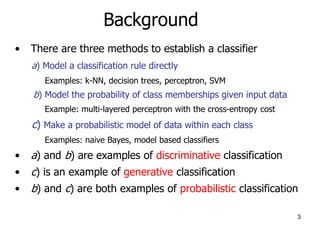
• There are three methods to establish a classifier
a) Model a classification rule directly
Examples: k-NN, decision trees, perceptron, SVM
b) Model the probability of class memberships given input data
Example: multi-layered perceptron with the cross-entropy cost
c) Make a probabilistic model of data within each class
Examples: naive Bayes, model based classifiers
• a) and b) are examples of discriminative classification
• c) is an example of generative classification
• b) and c) are both examples of probabilistic classification
4
Probability Basics
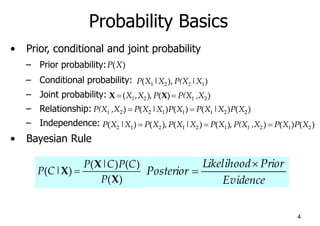
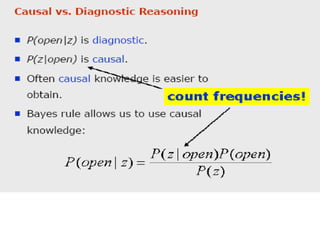
• Prior, conditional and joint probability
– Prior probability:
– Conditional probability:
– Joint probability:
– Relationship:
– Independence:
• Bayesian Rule
)
|
,
)
( 1
2
1 X
P(X
X
|
X
P 2
)
(
)
(
)
(
)
(
X
X
X
P
C
P
C
|
P
|
C
P 
)
(X
P
)
)
(
),
,
( 2
2 ,X
P(X
P
X
X 1
1 
 X
X
)
(
)
|
(
)
(
)
|
(
) 2
2
1
1
1
2
2 X
P
X
X
P
X
P
X
X
P
,X
P(X1 

)
(
)
(
)
),
(
)
|
(
),
(
)
|
( 2
1
2
1
2
1
2
1
2 X
P
X
P
,X
P(X
X
P
X
X
P
X
P
X
X
P 1 


Evidence
Prior
Likelihood
Posterior


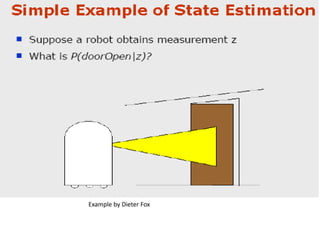
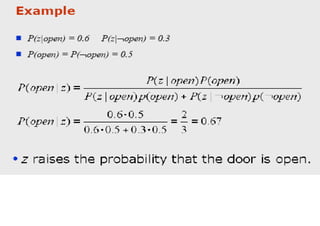
Example by Dieter Fox
8
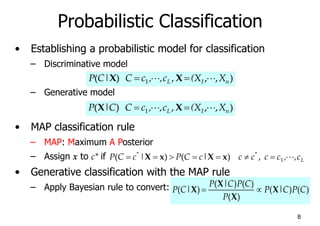
Probabilistic Classification
• Establishing a probabilistic model for classification
– Discriminative model
– Generative model
• MAP classification rule
– MAP: Maximum A Posterior
– Assign x to c* if
• Generative classification with the MAP rule
– Apply Bayesian rule to convert:
)
,
,
,
)
( 1 n
1
L X
(X
c
,
,
c
C
|
C
P 






 X
X
)
,
,
,
)
( 1 n
1
L X
(X
c
,
,
c
C
C
|
P 






 X
X
L
c
,
,
c
c
c
c
|
c
C
P
|
c
C
P 








 1
*
*
,
)
(
)
( x
X
x
X
)
(
)
(
)
(
)
(
)
(
)
( C
P
C
|
P
P
C
P
C
|
P
|
C
P X
X
X
X 

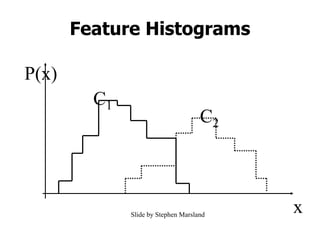
Feature Histograms
x
C1
C2
P(x)
Slide by Stephen Marsland
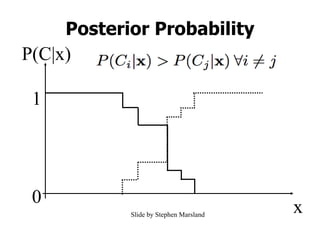
Posterior Probability
x
P(C|x)
1
0
Slide by Stephen Marsland
11
Naïve Bayes
• Bayes classification
Difficulty: learning the joint probability
• Naïve Bayes classification
– Making the assumption that all input attributes are independent
– MAP classification rule
)
(
)
|
,
,
(
)
(
)
(
)
( 1 C
P
C
X
X
P
C
P
C
|
P
|
C
P n




 X
X
)
|
,
,
( 1 C
X
X
P n



)
|
(
)
|
(
)
|
(
)
|
,
,
(
)
|
(
)
|
,
,
(
)
;
,
,
|
(
)
|
,
,
,
(
2
1
2
1
2
2
1
2
1
C
X
P
C
X
P
C
X
P
C
X
X
P
C
X
P
C
X
X
P
C
X
X
X
P
C
X
X
X
P
n
n
n
n
n


















L
n
n c
c
c
c
c
c
P
c
x
P
c
x
P
c
P
c
x
P
c
x
P ,
,
,
),
(
)]
|
(
)
|
(
[
)
(
)]
|
(
)
|
(
[ 1
*
1
*
*
*
1 











12
Naïve Bayes
• Naïve Bayes Algorithm (for discrete input attributes)
– Learning Phase: Given a training set S,
Output: conditional probability tables; for elements
– Test Phase: Given an unknown instance ,
Look up tables to assign the label c* to X’ if
;
in
examples
with
)
|
(
estimate
)
|
(
ˆ
)
,
1
;
,
,
1
(
attribute
each
of
value
attribute
every
For
;
in
examples
with
)
(
estimate
)
(
ˆ
of
value
target
each
For 1
S
S
i
jk
j
i
jk
j
j
j
jk
i
i
L
i
i
c
C
a
X
P
c
C
a
X
P
N
,
k
n
j
x
a
c
C
P
c
C
P
)
c
,
,
c
(c
c




















L
n
n c
c
c
c
c
c
P
c
a
P
c
a
P
c
P
c
a
P
c
a
P ,
,
,
),
(
ˆ
)]
|
(
ˆ
)
|
(
ˆ
[
)
(
ˆ
)]
|
(
ˆ
)
|
(
ˆ
[ 1
*
1
*
*
*
1 















)
,
,
( 1 n
a
a 






X
L
N
x j
j 
,
13
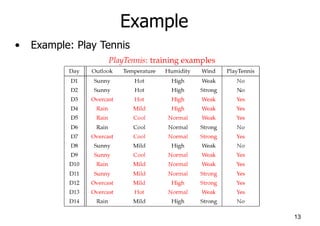
Example
• Example: Play Tennis
14
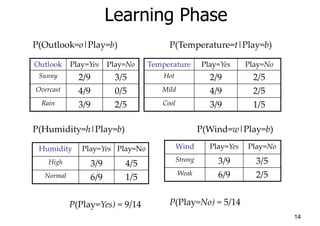
Learning Phase
Outlook Play=Yes Play=No
Sunny 2/9 3/5
Overcast 4/9 0/5
Rain 3/9 2/5
Temperature Play=Yes Play=No
Hot 2/9 2/5
Mild 4/9 2/5
Cool 3/9 1/5
Humidity Play=Yes Play=No
High 3/9 4/5
Normal 6/9 1/5
Wind Play=Yes Play=No
Strong 3/9 3/5
Weak 6/9 2/5
P(Play=Yes) = 9/14 P(Play=No) = 5/14
P(Outlook=o|Play=b) P(Temperature=t|Play=b)
P(Humidity=h|Play=b) P(Wind=w|Play=b)
15
Example
• Test Phase
– Given a new instance,
x’=(Outlook=Sunny, Temperature=Cool, Humidity=High, Wind=Strong)
– Look up tables
– MAP rule
P(Outlook=Sunny|Play=No) = 3/5
P(Temperature=Cool|Play==No) = 1/5
P(Huminity=High|Play=No) = 4/5
P(Wind=Strong|Play=No) = 3/5
P(Play=No) = 5/14
P(Outlook=Sunny|Play=Yes) = 2/9
P(Temperature=Cool|Play=Yes) = 3/9
P(Huminity=High|Play=Yes) = 3/9
P(Wind=Strong|Play=Yes) = 3/9
P(Play=Yes) = 9/14
P(Yes|x’): [P(Sunny|Yes)P(Cool|Yes)P(High|Yes)P(Strong|Yes)]P(Play=Yes) = 0.0053
P(No|x’): [P(Sunny|No) P(Cool|No)P(High|No)P(Strong|No)]P(Play=No) = 0.0206
Given the fact P(Yes|x’) < P(No|x’), we label x’ to be “No”.
16
Relevant Issues
• Violation of Independence Assumption
– For many real world tasks,
– Nevertheless, naïve Bayes works surprisingly well anyway!
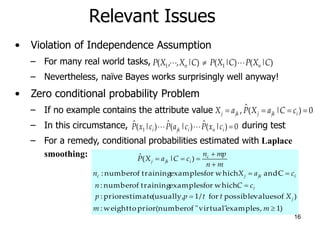
• Zero conditional probability Problem
– If no example contains the attribute value
– In this circumstance, during test
– For a remedy, conditional probabilities estimated with Laplace
smoothing:
)
|
(
)
|
(
)
|
,
,
( 1
1 C
X
P
C
X
P
C
X
X
P n
n 






0
)
|
(
ˆ
, 


 i
jk
j
jk
j c
C
a
X
P
a
X
0
)
|
(
ˆ
)
|
(
ˆ
)
|
(
ˆ
1 





 i
n
i
jk
i c
x
P
c
a
P
c
x
P
)
1
examples,
virtual"
"
of
(number
prior
to
weight
:
)
of
values
possible
for
/
1
(usually,
estimate
prior
:
which
for
examples
training
of
number
:
C
and
which
for
examples
training
of
number
:
)
|
(
ˆ










m
m
X
t
t
p
p
c
C
n
c
a
X
n
m
n
mp
n
c
C
a
X
P
j
i
i
jk
j
c
c
i
jk
j
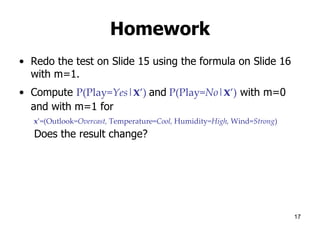
Homework
• Redo the test on Slide 15 using the formula on Slide 16
with m=1.
• Compute P(Play=Yes|x’) and P(Play=No|x’) with m=0
and with m=1 for
x’=(Outlook=Overcast, Temperature=Cool, Humidity=High, Wind=Strong)
Does the result change?
17
18
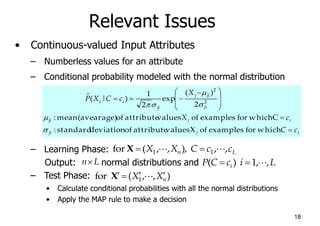
Relevant Issues
• Continuous-valued Input Attributes
– Numberless values for an attribute
– Conditional probability modeled with the normal distribution
– Learning Phase:
Output: normal distributions and
– Test Phase:
• Calculate conditional probabilities with all the normal distributions
• Apply the MAP rule to make a decision
i
j
ji
i
j
ji
ji
ji
j
ji
i
j
c
C
c
X
X
c
C
X
P









 



which
for
examples
of
X
values
attribute
of
deviation
standard
:
C
which
for
examples
of
values
attribute
of
(avearage)
mean
:
2
)
(
exp
2
1
)
|
(
ˆ
2
2






L
n c
c
C
X
X ,
,
),
,
,
(
for 1
1 







X
L
n
)
,
,
(
for 1 n
X
X 






X
L
i
c
C
P i ,
,
1
)
( 




19
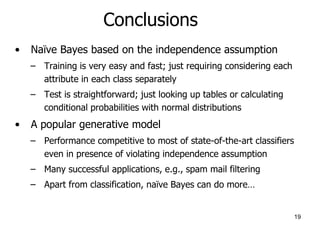
Conclusions
• Naïve Bayes based on the independence assumption
– Training is very easy and fast; just requiring considering each
attribute in each class separately
– Test is straightforward; just looking up tables or calculating
conditional probabilities with normal distributions
• A popular generative model
– Performance competitive to most of state-of-the-art classifiers
even in presence of violating independence assumption
– Many successful applications, e.g., spam mail filtering
– Apart from classification, naïve Bayes can do more…

ch8Bayes.ppt

  • 1.
    Naïve Bayes Classifier KeChen http://intranet.cs.man.ac.uk/mlo/comp20411/ Modified and extended by Longin Jan Latecki latecki@temple.edu
  • 2.
    2 Outline • Background • ProbabilityBasics • Probabilistic Classification • Naïve Bayes • Example: Play Tennis • Relevant Issues • Conclusions
  • 3.
    3 Background • There arethree methods to establish a classifier a) Model a classification rule directly Examples: k-NN, decision trees, perceptron, SVM b) Model the probability of class memberships given input data Example: multi-layered perceptron with the cross-entropy cost c) Make a probabilistic model of data within each class Examples: naive Bayes, model based classifiers • a) and b) are examples of discriminative classification • c) is an example of generative classification • b) and c) are both examples of probabilistic classification
  • 4.
    4 Probability Basics • Prior,conditional and joint probability – Prior probability: – Conditional probability: – Joint probability: – Relationship: – Independence: • Bayesian Rule ) | , ) ( 1 2 1 X P(X X | X P 2 ) ( ) ( ) ( ) ( X X X P C P C | P | C P  ) (X P ) ) ( ), , ( 2 2 ,X P(X P X X 1 1   X X ) ( ) | ( ) ( ) | ( ) 2 2 1 1 1 2 2 X P X X P X P X X P ,X P(X1   ) ( ) ( ) ), ( ) | ( ), ( ) | ( 2 1 2 1 2 1 2 1 2 X P X P ,X P(X X P X X P X P X X P 1    Evidence Prior Likelihood Posterior  
  • 5.
  • 8.
    8 Probabilistic Classification • Establishinga probabilistic model for classification – Discriminative model – Generative model • MAP classification rule – MAP: Maximum A Posterior – Assign x to c* if • Generative classification with the MAP rule – Apply Bayesian rule to convert: ) , , , ) ( 1 n 1 L X (X c , , c C | C P         X X ) , , , ) ( 1 n 1 L X (X c , , c C C | P         X X L c , , c c c c | c C P | c C P           1 * * , ) ( ) ( x X x X ) ( ) ( ) ( ) ( ) ( ) ( C P C | P P C P C | P | C P X X X X  
  • 9.
  • 10.
  • 11.
    11 Naïve Bayes • Bayesclassification Difficulty: learning the joint probability • Naïve Bayes classification – Making the assumption that all input attributes are independent – MAP classification rule ) ( ) | , , ( ) ( ) ( ) ( 1 C P C X X P C P C | P | C P n      X X ) | , , ( 1 C X X P n    ) | ( ) | ( ) | ( ) | , , ( ) | ( ) | , , ( ) ; , , | ( ) | , , , ( 2 1 2 1 2 2 1 2 1 C X P C X P C X P C X X P C X P C X X P C X X X P C X X X P n n n n n                   L n n c c c c c c P c x P c x P c P c x P c x P , , , ), ( )] | ( ) | ( [ ) ( )] | ( ) | ( [ 1 * 1 * * * 1            
  • 12.
    12 Naïve Bayes • NaïveBayes Algorithm (for discrete input attributes) – Learning Phase: Given a training set S, Output: conditional probability tables; for elements – Test Phase: Given an unknown instance , Look up tables to assign the label c* to X’ if ; in examples with ) | ( estimate ) | ( ˆ ) , 1 ; , , 1 ( attribute each of value attribute every For ; in examples with ) ( estimate ) ( ˆ of value target each For 1 S S i jk j i jk j j j jk i i L i i c C a X P c C a X P N , k n j x a c C P c C P ) c , , c (c c                     L n n c c c c c c P c a P c a P c P c a P c a P , , , ), ( ˆ )] | ( ˆ ) | ( ˆ [ ) ( ˆ )] | ( ˆ ) | ( ˆ [ 1 * 1 * * * 1                 ) , , ( 1 n a a        X L N x j j  ,
  • 13.
  • 14.
    14 Learning Phase Outlook Play=YesPlay=No Sunny 2/9 3/5 Overcast 4/9 0/5 Rain 3/9 2/5 Temperature Play=Yes Play=No Hot 2/9 2/5 Mild 4/9 2/5 Cool 3/9 1/5 Humidity Play=Yes Play=No High 3/9 4/5 Normal 6/9 1/5 Wind Play=Yes Play=No Strong 3/9 3/5 Weak 6/9 2/5 P(Play=Yes) = 9/14 P(Play=No) = 5/14 P(Outlook=o|Play=b) P(Temperature=t|Play=b) P(Humidity=h|Play=b) P(Wind=w|Play=b)
  • 15.
    15 Example • Test Phase –Given a new instance, x’=(Outlook=Sunny, Temperature=Cool, Humidity=High, Wind=Strong) – Look up tables – MAP rule P(Outlook=Sunny|Play=No) = 3/5 P(Temperature=Cool|Play==No) = 1/5 P(Huminity=High|Play=No) = 4/5 P(Wind=Strong|Play=No) = 3/5 P(Play=No) = 5/14 P(Outlook=Sunny|Play=Yes) = 2/9 P(Temperature=Cool|Play=Yes) = 3/9 P(Huminity=High|Play=Yes) = 3/9 P(Wind=Strong|Play=Yes) = 3/9 P(Play=Yes) = 9/14 P(Yes|x’): [P(Sunny|Yes)P(Cool|Yes)P(High|Yes)P(Strong|Yes)]P(Play=Yes) = 0.0053 P(No|x’): [P(Sunny|No) P(Cool|No)P(High|No)P(Strong|No)]P(Play=No) = 0.0206 Given the fact P(Yes|x’) < P(No|x’), we label x’ to be “No”.
  • 16.
    16 Relevant Issues • Violationof Independence Assumption – For many real world tasks, – Nevertheless, naïve Bayes works surprisingly well anyway! • Zero conditional probability Problem – If no example contains the attribute value – In this circumstance, during test – For a remedy, conditional probabilities estimated with Laplace smoothing: ) | ( ) | ( ) | , , ( 1 1 C X P C X P C X X P n n        0 ) | ( ˆ ,     i jk j jk j c C a X P a X 0 ) | ( ˆ ) | ( ˆ ) | ( ˆ 1        i n i jk i c x P c a P c x P ) 1 examples, virtual" " of (number prior to weight : ) of values possible for / 1 (usually, estimate prior : which for examples training of number : C and which for examples training of number : ) | ( ˆ           m m X t t p p c C n c a X n m n mp n c C a X P j i i jk j c c i jk j
  • 17.
    Homework • Redo thetest on Slide 15 using the formula on Slide 16 with m=1. • Compute P(Play=Yes|x’) and P(Play=No|x’) with m=0 and with m=1 for x’=(Outlook=Overcast, Temperature=Cool, Humidity=High, Wind=Strong) Does the result change? 17
  • 18.
    18 Relevant Issues • Continuous-valuedInput Attributes – Numberless values for an attribute – Conditional probability modeled with the normal distribution – Learning Phase: Output: normal distributions and – Test Phase: • Calculate conditional probabilities with all the normal distributions • Apply the MAP rule to make a decision i j ji i j ji ji ji j ji i j c C c X X c C X P               which for examples of X values attribute of deviation standard : C which for examples of values attribute of (avearage) mean : 2 ) ( exp 2 1 ) | ( ˆ 2 2       L n c c C X X , , ), , , ( for 1 1         X L n ) , , ( for 1 n X X        X L i c C P i , , 1 ) (     
  • 19.
    19 Conclusions • Naïve Bayesbased on the independence assumption – Training is very easy and fast; just requiring considering each attribute in each class separately – Test is straightforward; just looking up tables or calculating conditional probabilities with normal distributions • A popular generative model – Performance competitive to most of state-of-the-art classifiers even in presence of violating independence assumption – Many successful applications, e.g., spam mail filtering – Apart from classification, naïve Bayes can do more…