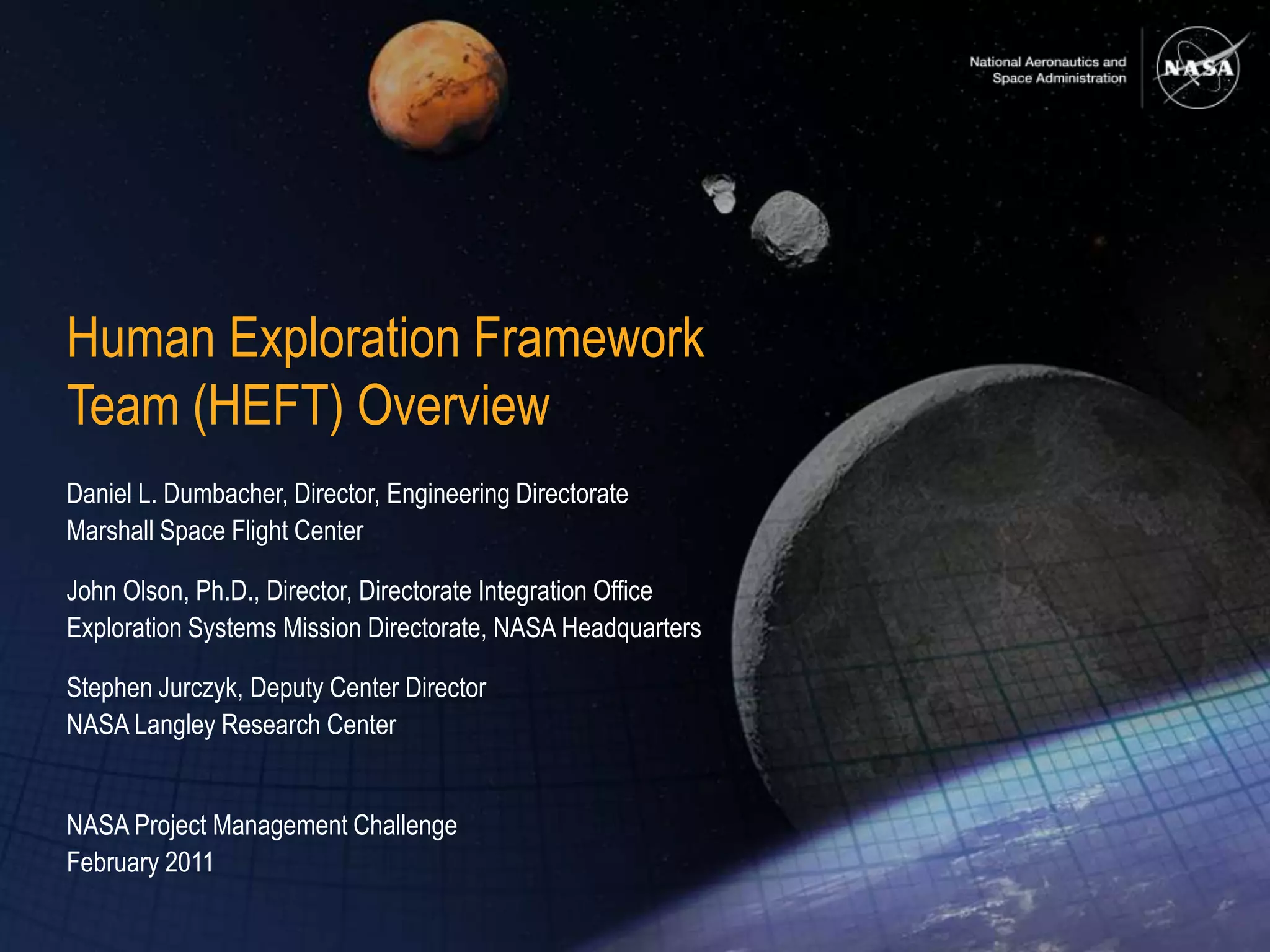
Human Exploration Framework
Team (HEFT) Overview
Daniel L. Dumbacher, Director, Engineering Directorate
Marshall Space Flight Center

John Olson, Ph.D., Director, Directorate Integration Office
Exploration Systems Mission Directorate, NASA Headquarters

Stephen Jurczyk, Deputy Center Director
NASA Langley Research Center


NASA Project Management Challenge
February 2011
Agenda
•     HEFT Overview
•     Benefit Figures of Merit
•     Constraint Figures of Merit
•     Key Outcomes
•     General Findings
•     Human Space Flight Cost and Schedule History
•     HEFT I Integrated Cost Assessment Comparison
•     What Needs to Be Addressed to Be Affordable
•     History of Lean Developments
•     Lean Cost and Schedule Implementation Approaches
•     Summary


5-486373                                                 2
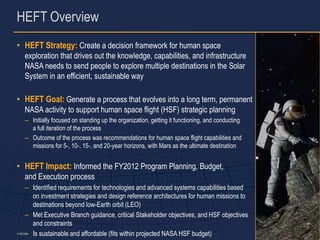
HEFT Overview
• HEFT Strategy: Create a decision framework for human space
   exploration that drives out the knowledge, capabilities, and infrastructure
   NASA needs to send people to explore multiple destinations in the Solar
   System in an efficient, sustainable way

• HEFT Goal: Generate a process that evolves into a long term, permanent
   NASA activity to support human space flight (HSF) strategic planning
   – Initially focused on standing up the organization, getting it functioning, and conducting
     a full iteration of the process
   – Outcome of the process was recommendations for human space flight capabilities and
     missions for 5-, 10-, 15-, and 20-year horizons, with Mars as the ultimate destination


• HEFT Impact: Informed the FY2012 Program Planning, Budget,
   and Execution process
      – Identified requirements for technologies and advanced systems capabilities based
         on investment strategies and design reference architectures for human missions to
         destinations beyond low-Earth orbit (LEO)
      – Met Executive Branch guidance, critical Stakeholder objectives, and HSF objectives
         and constraints
      – Is sustainable and affordable (fits within projected NASA HSF budget)
5-486373                                                                                         3
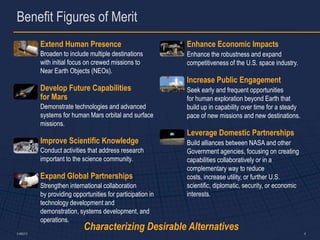
Benefit Figures of Merit
           Extend Human Presence                             Enhance Economic Impacts
           Broaden to include multiple destinations          Enhance the robustness and expand
           with initial focus on crewed missions to          competitiveness of the U.S. space industry.
           Near Earth Objects (NEOs).
                                                             Increase Public Engagement
           Develop Future Capabilities                       Seek early and frequent opportunities
           for Mars                                          for human exploration beyond Earth that
           Demonstrate technologies and advanced             build up in capability over time for a steady
           systems for human Mars orbital and surface        pace of new missions and new destinations.
           missions.
                                                             Leverage Domestic Partnerships
           Improve Scientific Knowledge                      Build alliances between NASA and other
           Conduct activities that address research          Government agencies, focusing on creating
           important to the science community.               capabilities collaboratively or in a
                                                             complementary way to reduce
           Expand Global Partnerships                        costs, increase utility, or further U.S.
           Strengthen international collaboration            scientific, diplomatic, security, or economic
           by providing opportunities for participation in   interests.
           technology development and
           demonstration, systems development, and
           operations.
5-486373
                             Characterizing Desirable Alternatives                                           4
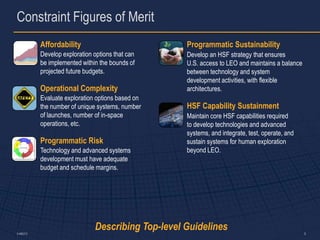
Constraint Figures of Merit
           Affordability                            Programmatic Sustainability
           Develop exploration options that can     Develop an HSF strategy that ensures
           be implemented within the bounds of      U.S. access to LEO and maintains a balance
           projected future budgets.                between technology and system
                                                    development activities, with flexible
           Operational Complexity                   architectures.
           Evaluate exploration options based on
           the number of unique systems, number     HSF Capability Sustainment
           of launches, number of in-space          Maintain core HSF capabilities required
           operations, etc.                         to develop technologies and advanced
                                                    systems, and integrate, test, operate, and
           Programmatic Risk                        sustain systems for human exploration
           Technology and advanced systems          beyond LEO.
           development must have adequate
           budget and schedule margins.


5-486373
                               Describing Top-level Guidelines                                   5
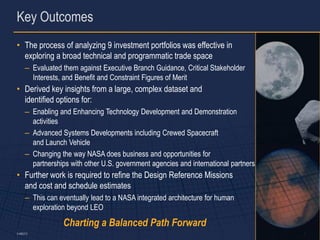
Key Outcomes
• The process of analyzing 9 investment portfolios was effective in
  exploring a broad technical and programmatic trade space
      – Evaluated them against Executive Branch Guidance, Critical Stakeholder
        Interests, and Benefit and Constraint Figures of Merit
• Derived key insights from a large, complex dataset and
  identified options for:
      – Enabling and Enhancing Technology Development and Demonstration
        activities
      – Advanced Systems Developments including Crewed Spacecraft
        and Launch Vehicle
      – Changing the way NASA does business and opportunities for
        partnerships with other U.S. government agencies and international partners
• Further work is required to refine the Design Reference Missions
  and cost and schedule estimates
      – This can eventually lead to a NASA integrated architecture for human
        exploration beyond LEO

                  Charting a Balanced Path Forward
5-486373                                                                              6
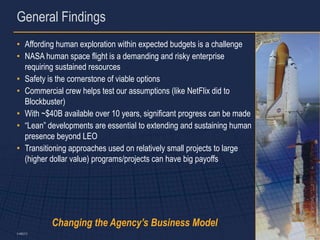
General Findings
• Affording human exploration within expected budgets is a challenge
• NASA human space flight is a demanding and risky enterprise
  requiring sustained resources
• Safety is the cornerstone of viable options
• Commercial crew helps test our assumptions (like NetFlix did to
  Blockbuster)
• With ~$40B available over 10 years, significant progress can be made
• “Lean” developments are essential to extending and sustaining human
  presence beyond LEO
• Transitioning approaches used on relatively small projects to large
  (higher dollar value) programs/projects can have big payoffs


           Changing the Agency’s Business Model
5-486373                                                                 7
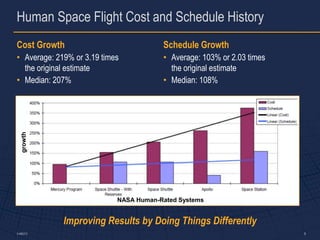
Human Space Flight Cost and Schedule History
Cost Growth                             Schedule Growth
• Average: 219% or 3.19 times           • Average: 103% or 2.03 times
  the original estimate                   the original estimate
• Median: 207%                          • Median: 108%
   growth


                            NASA Human-Rated Systems


             Improving Results by Doing Things Differently
5-486373                                                                8
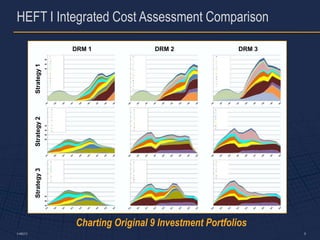
HEFT I Integrated Cost Assessment Comparison

                        DRM 1             DRM 2                DRM 3
           Strategy 1
           Strategy 2
           Strategy 3


                        Charting Original 9 Investment Portfolios
5-486373                                                               9
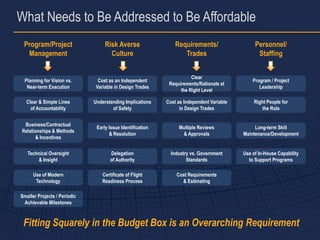
What Needs to Be Addressed to Be Affordable
 Program/Project                   Risk Averse                  Requirements/                   Personnel/
  Management                         Culture                       Trades                        Staffing


                                                                       Clear
  Planning for Vision vs.       Cost as an Independent                                         Program / Project
                                                             Requirements/Rationale at
   Near-term Execution         Variable in Design Trades                                          Leadership
                                                                  the Right Level

  Clear & Simple Lines        Understanding Implications    Cost as Independent Variable        Right People for
    of Accountability                 of Safety                   in Design Trades                 the Role


 Business/Contractual
                               Early Issue Identification        Multiple Reviews               Long-term Skill
Relationships & Methods
                                     & Resolution                 & Approvals              Maintenance/Development
      & Incentives

   Technical Oversight                Delegation              Industry vs. Government      Use of In-House Capability
        & Insight                     of Authority                   Standards               to Support Programs

      Use of Modern               Certificate of Flight         Cost Requirements
       Technology                 Readiness Process               & Estimating

Smaller Projects / Periodic
 Achievable Milestones


 Fitting Squarely in the Budget Box is an Overarching Requirement
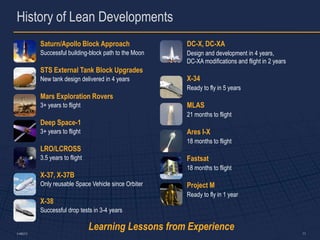
History of Lean Developments
           Saturn/Apollo Block Approach                 DC-X, DC-XA
           Successful building-block path to the Moon   Design and development in 4 years,
                                                        DC-XA modifications and flight in 2 years
           STS External Tank Block Upgrades
           New tank design delivered in 4 years         X-34
                                                        Ready to fly in 5 years
           Mars Exploration Rovers
           3+ years to flight                           MLAS
                                                        21 months to flight
           Deep Space-1
           3+ years to flight                           Ares I-X
                                                        18 months to flight
           LRO/LCROSS
           3.5 years to flight                          Fastsat
                                                        18 months to flight
           X-37, X-37B
           Only reusable Space Vehicle since Orbiter    Project M
                                                        Ready to fly in 1 year
           X-38
           Successful drop tests in 3-4 years


5-486373
                                 Learning Lessons from Experience                                   11
Lean Cost and Schedule Implementation Approaches
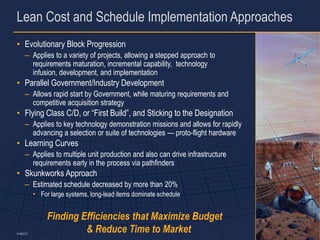
• Evolutionary Block Progression
      – Applies to a variety of projects, allowing a stepped approach to
        requirements maturation, incremental capability, technology
        infusion, development, and implementation
• Parallel Government/Industry Development
      – Allows rapid start by Government, while maturing requirements and
        competitive acquisition strategy
• Flying Class C/D, or “First Build”, and Sticking to the Designation
      – Applies to key technology demonstration missions and allows for rapidly
        advancing a selection or suite of technologies — proto-flight hardware
• Learning Curves
      – Applies to multiple unit production and also can drive infrastructure
        requirements early in the process via pathfinders
• Skunkworks Approach
      – Estimated schedule decreased by more than 20%
           • For large systems, long-lead items dominate schedule


                Finding Efficiencies that Maximize Budget
5-486373
                         & Reduce Time to Market                                  12
Summary
• NASA and the Nation will be in a constrained budget environment
  for the foreseeable future

• NASA’s program management and technical community must find
  ways to meet objectives with more efficient use of resources

• The future of human exploration is in the balance


     Living Within Our Means While Delivering Excellence
5-486373                                                            13
For more information:
               www.nasa.gov


5-486373                           14

Dumbacher

  • 1.
    Human Exploration Framework Team(HEFT) Overview Daniel L. Dumbacher, Director, Engineering Directorate Marshall Space Flight Center John Olson, Ph.D., Director, Directorate Integration Office Exploration Systems Mission Directorate, NASA Headquarters Stephen Jurczyk, Deputy Center Director NASA Langley Research Center NASA Project Management Challenge February 2011
  • 2.
    Agenda • HEFT Overview • Benefit Figures of Merit • Constraint Figures of Merit • Key Outcomes • General Findings • Human Space Flight Cost and Schedule History • HEFT I Integrated Cost Assessment Comparison • What Needs to Be Addressed to Be Affordable • History of Lean Developments • Lean Cost and Schedule Implementation Approaches • Summary 5-486373 2
  • 3.
    HEFT Overview • HEFTStrategy: Create a decision framework for human space exploration that drives out the knowledge, capabilities, and infrastructure NASA needs to send people to explore multiple destinations in the Solar System in an efficient, sustainable way • HEFT Goal: Generate a process that evolves into a long term, permanent NASA activity to support human space flight (HSF) strategic planning – Initially focused on standing up the organization, getting it functioning, and conducting a full iteration of the process – Outcome of the process was recommendations for human space flight capabilities and missions for 5-, 10-, 15-, and 20-year horizons, with Mars as the ultimate destination • HEFT Impact: Informed the FY2012 Program Planning, Budget, and Execution process – Identified requirements for technologies and advanced systems capabilities based on investment strategies and design reference architectures for human missions to destinations beyond low-Earth orbit (LEO) – Met Executive Branch guidance, critical Stakeholder objectives, and HSF objectives and constraints – Is sustainable and affordable (fits within projected NASA HSF budget) 5-486373 3
  • 4.
    Benefit Figures ofMerit Extend Human Presence Enhance Economic Impacts Broaden to include multiple destinations Enhance the robustness and expand with initial focus on crewed missions to competitiveness of the U.S. space industry. Near Earth Objects (NEOs). Increase Public Engagement Develop Future Capabilities Seek early and frequent opportunities for Mars for human exploration beyond Earth that Demonstrate technologies and advanced build up in capability over time for a steady systems for human Mars orbital and surface pace of new missions and new destinations. missions. Leverage Domestic Partnerships Improve Scientific Knowledge Build alliances between NASA and other Conduct activities that address research Government agencies, focusing on creating important to the science community. capabilities collaboratively or in a complementary way to reduce Expand Global Partnerships costs, increase utility, or further U.S. Strengthen international collaboration scientific, diplomatic, security, or economic by providing opportunities for participation in interests. technology development and demonstration, systems development, and operations. 5-486373 Characterizing Desirable Alternatives 4
  • 5.
    Constraint Figures ofMerit Affordability Programmatic Sustainability Develop exploration options that can Develop an HSF strategy that ensures be implemented within the bounds of U.S. access to LEO and maintains a balance projected future budgets. between technology and system development activities, with flexible Operational Complexity architectures. Evaluate exploration options based on the number of unique systems, number HSF Capability Sustainment of launches, number of in-space Maintain core HSF capabilities required operations, etc. to develop technologies and advanced systems, and integrate, test, operate, and Programmatic Risk sustain systems for human exploration Technology and advanced systems beyond LEO. development must have adequate budget and schedule margins. 5-486373 Describing Top-level Guidelines 5
  • 6.
    Key Outcomes • Theprocess of analyzing 9 investment portfolios was effective in exploring a broad technical and programmatic trade space – Evaluated them against Executive Branch Guidance, Critical Stakeholder Interests, and Benefit and Constraint Figures of Merit • Derived key insights from a large, complex dataset and identified options for: – Enabling and Enhancing Technology Development and Demonstration activities – Advanced Systems Developments including Crewed Spacecraft and Launch Vehicle – Changing the way NASA does business and opportunities for partnerships with other U.S. government agencies and international partners • Further work is required to refine the Design Reference Missions and cost and schedule estimates – This can eventually lead to a NASA integrated architecture for human exploration beyond LEO Charting a Balanced Path Forward 5-486373 6
  • 7.
    General Findings • Affordinghuman exploration within expected budgets is a challenge • NASA human space flight is a demanding and risky enterprise requiring sustained resources • Safety is the cornerstone of viable options • Commercial crew helps test our assumptions (like NetFlix did to Blockbuster) • With ~$40B available over 10 years, significant progress can be made • “Lean” developments are essential to extending and sustaining human presence beyond LEO • Transitioning approaches used on relatively small projects to large (higher dollar value) programs/projects can have big payoffs Changing the Agency’s Business Model 5-486373 7
  • 8.
    Human Space FlightCost and Schedule History Cost Growth Schedule Growth • Average: 219% or 3.19 times • Average: 103% or 2.03 times the original estimate the original estimate • Median: 207% • Median: 108% growth NASA Human-Rated Systems Improving Results by Doing Things Differently 5-486373 8
  • 9.
    HEFT I IntegratedCost Assessment Comparison DRM 1 DRM 2 DRM 3 Strategy 1 Strategy 2 Strategy 3 Charting Original 9 Investment Portfolios 5-486373 9
  • 10.
    What Needs toBe Addressed to Be Affordable Program/Project Risk Averse Requirements/ Personnel/ Management Culture Trades Staffing Clear Planning for Vision vs. Cost as an Independent Program / Project Requirements/Rationale at Near-term Execution Variable in Design Trades Leadership the Right Level Clear & Simple Lines Understanding Implications Cost as Independent Variable Right People for of Accountability of Safety in Design Trades the Role Business/Contractual Early Issue Identification Multiple Reviews Long-term Skill Relationships & Methods & Resolution & Approvals Maintenance/Development & Incentives Technical Oversight Delegation Industry vs. Government Use of In-House Capability & Insight of Authority Standards to Support Programs Use of Modern Certificate of Flight Cost Requirements Technology Readiness Process & Estimating Smaller Projects / Periodic Achievable Milestones Fitting Squarely in the Budget Box is an Overarching Requirement
  • 11.
    History of LeanDevelopments Saturn/Apollo Block Approach DC-X, DC-XA Successful building-block path to the Moon Design and development in 4 years, DC-XA modifications and flight in 2 years STS External Tank Block Upgrades New tank design delivered in 4 years X-34 Ready to fly in 5 years Mars Exploration Rovers 3+ years to flight MLAS 21 months to flight Deep Space-1 3+ years to flight Ares I-X 18 months to flight LRO/LCROSS 3.5 years to flight Fastsat 18 months to flight X-37, X-37B Only reusable Space Vehicle since Orbiter Project M Ready to fly in 1 year X-38 Successful drop tests in 3-4 years 5-486373 Learning Lessons from Experience 11
  • 12.
    Lean Cost andSchedule Implementation Approaches • Evolutionary Block Progression – Applies to a variety of projects, allowing a stepped approach to requirements maturation, incremental capability, technology infusion, development, and implementation • Parallel Government/Industry Development – Allows rapid start by Government, while maturing requirements and competitive acquisition strategy • Flying Class C/D, or “First Build”, and Sticking to the Designation – Applies to key technology demonstration missions and allows for rapidly advancing a selection or suite of technologies — proto-flight hardware • Learning Curves – Applies to multiple unit production and also can drive infrastructure requirements early in the process via pathfinders • Skunkworks Approach – Estimated schedule decreased by more than 20% • For large systems, long-lead items dominate schedule Finding Efficiencies that Maximize Budget 5-486373 & Reduce Time to Market 12
  • 13.
    Summary • NASA andthe Nation will be in a constrained budget environment for the foreseeable future • NASA’s program management and technical community must find ways to meet objectives with more efficient use of resources • The future of human exploration is in the balance Living Within Our Means While Delivering Excellence 5-486373 13
  • 14.
    For more information: www.nasa.gov 5-486373 14