Battle of the Codecs
     In Digital Film and TV

              James Uren
          Independent Training Consultant,

           Senior Lecturer Broadcasting,

           Creative Director 3D Stories


          Optimisation and Compression

  Ravensbourne College of Design & Communication


         24 November 2011
Demistifying Codecs


 The technologies of digital film
 So many codecs...
 The technology behind compression
 The future...


                                        2
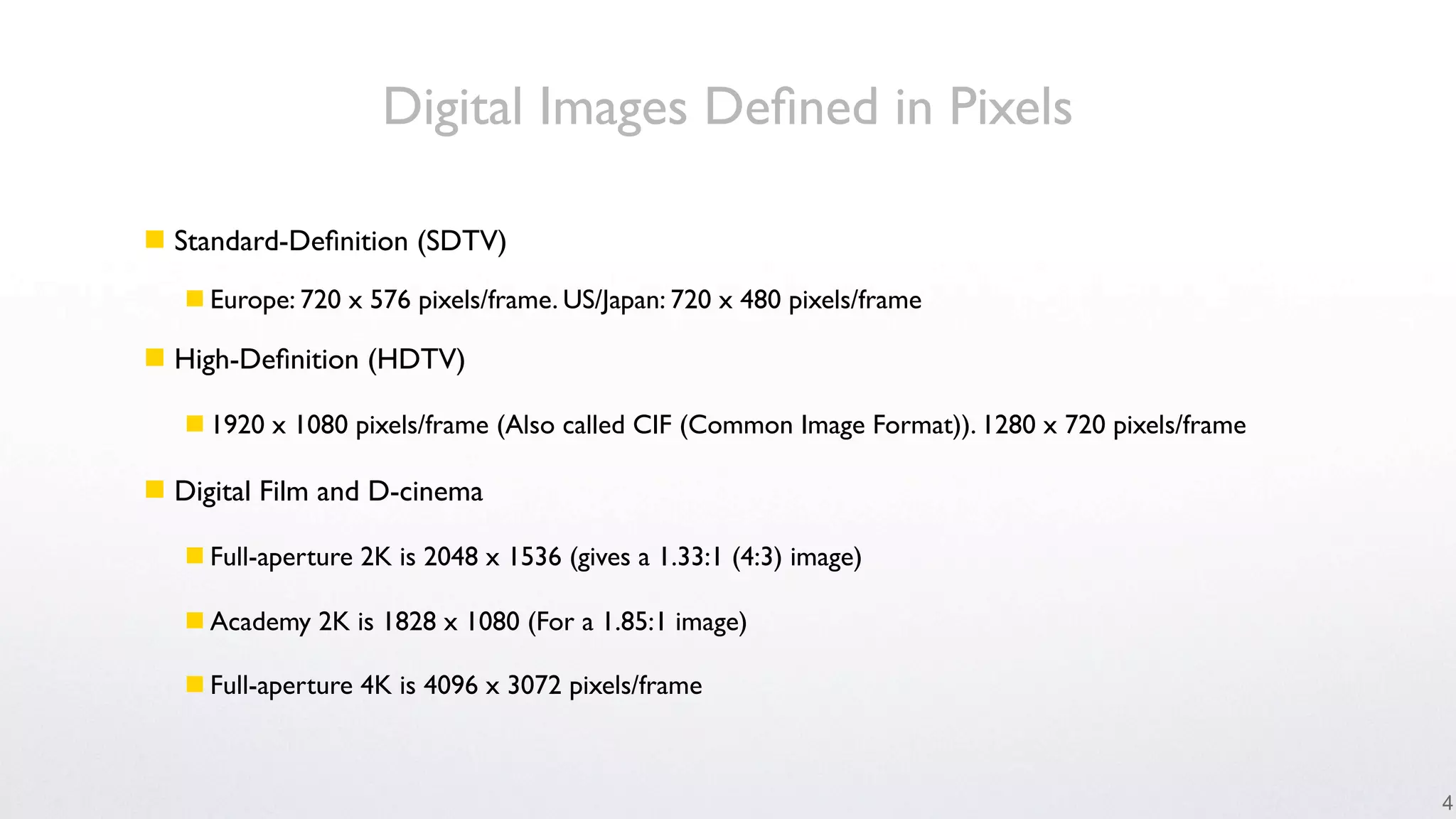
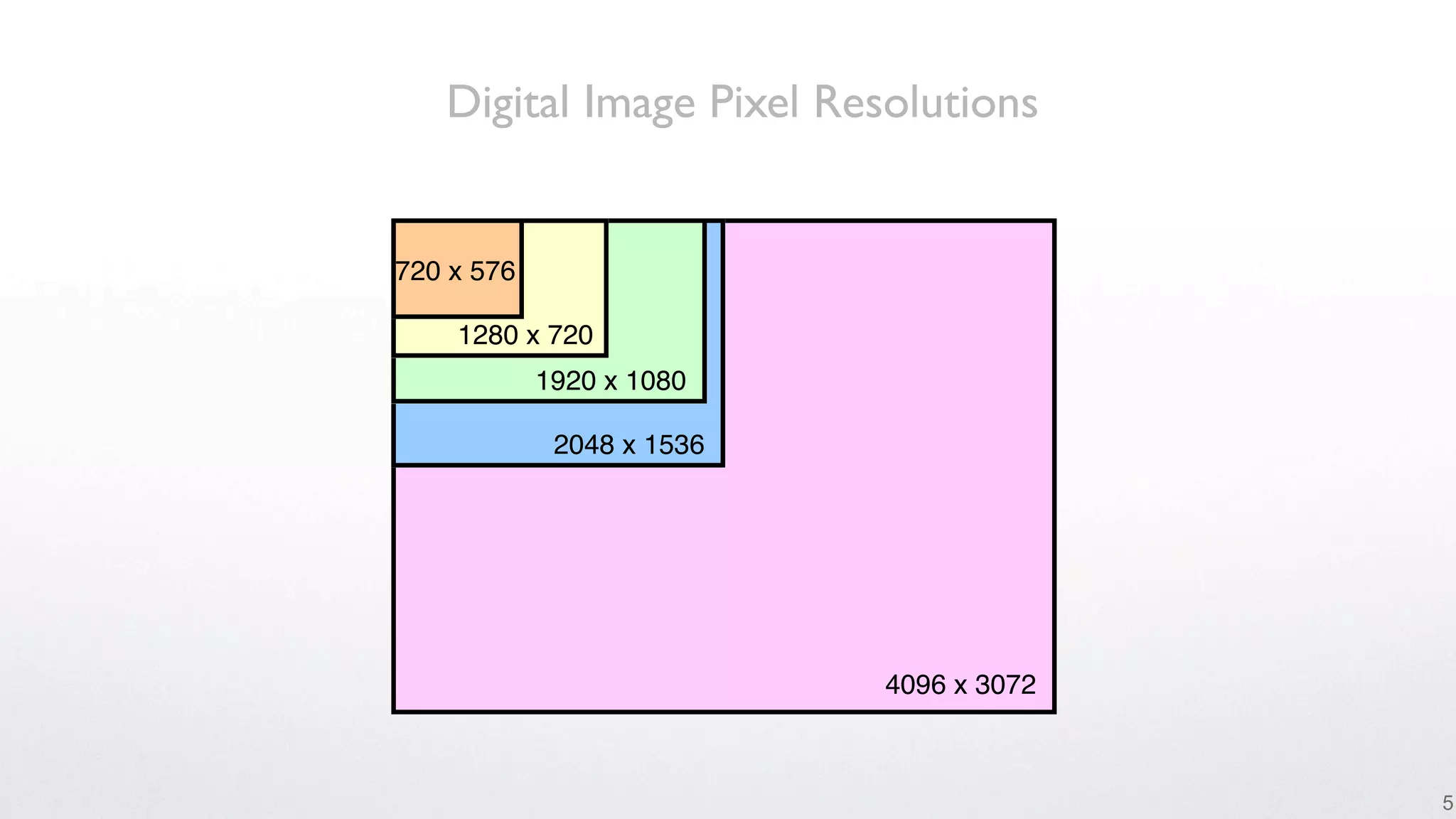
Digital Images Defined in Pixels

 Standard-Definition (SDTV)
    Europe: 720 x 576 pixels/frame. US/Japan: 720 x 480 pixels/frame

 High-Definition (HDTV)

    1920 x 1080 pixels/frame (Also called CIF (Common Image Format)). 1280 x 720 pixels/frame

 Digital Film and D-cinema

    Full-aperture 2K is 2048 x 1536 (gives a 1.33:1 (4:3) image)

    Academy 2K is 1828 x 1080 (For a 1.85:1 image)

    Full-aperture 4K is 4096 x 3072 pixels/frame


                                                                                                 4
Digital Image Pixel Resolutions


720 x 576

    1280 x 720
            1920 x 1080

             2048 x 1536


                           4096 x 3072


                                         5
Film?


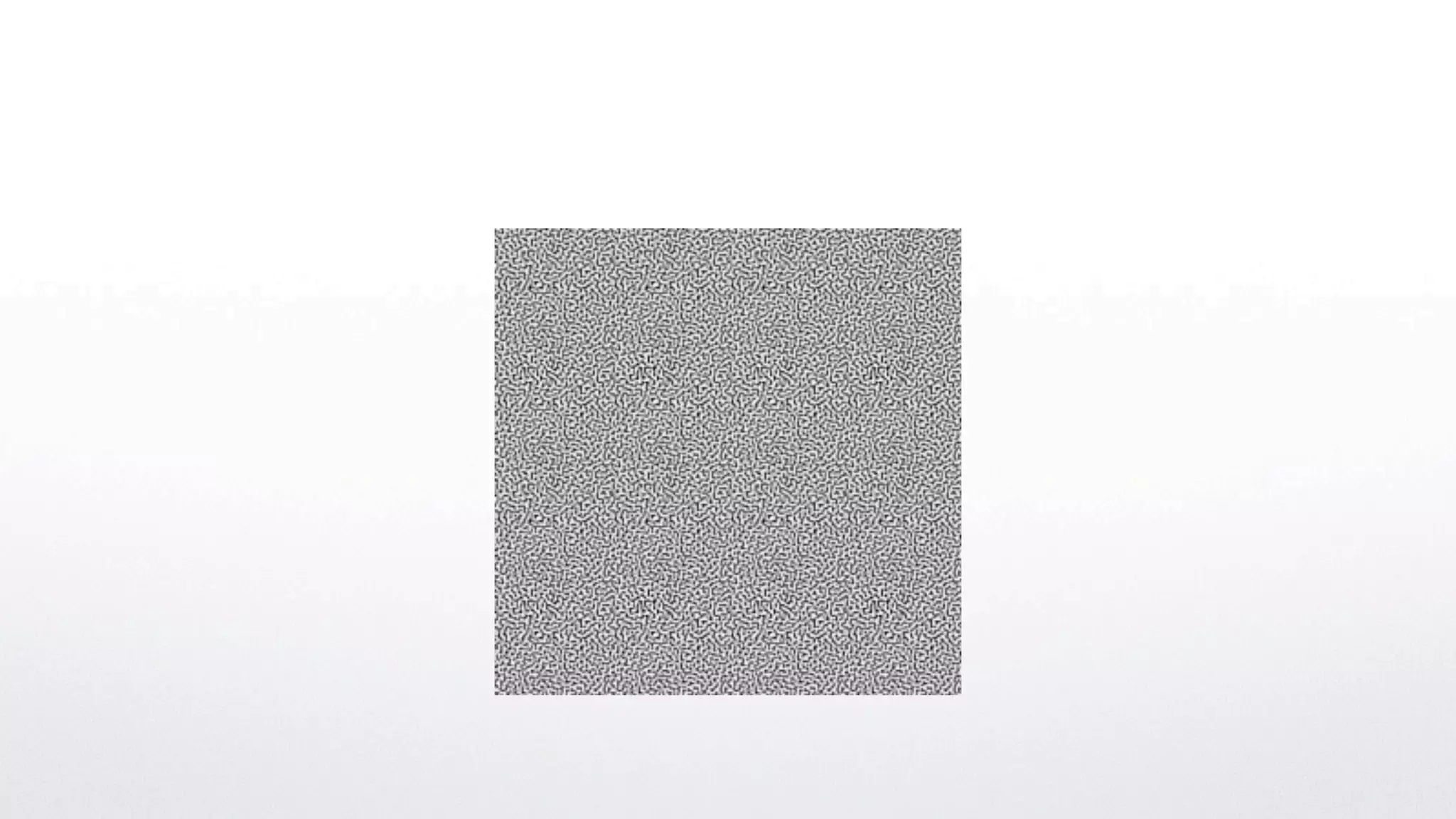
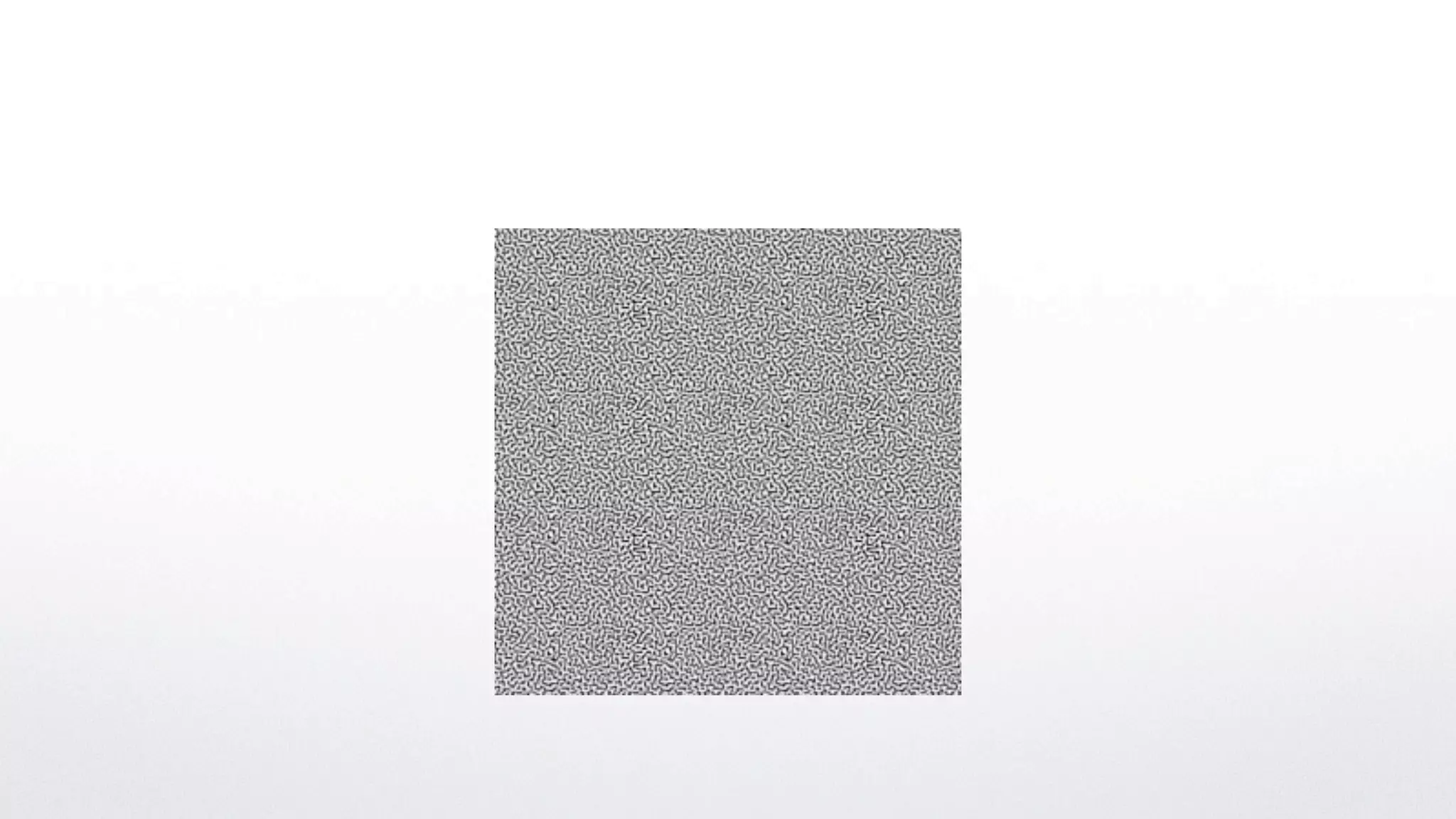
•   What resolution is film? Grain...
Film?


•   So resolution unknown - is 4K enough?

•   So in film we have:

    •   Digital Intermediate (DI) for post-production

    •   Digital cinema projection

•   Digital Capture - the last piece of the puzzle.
HD Capture
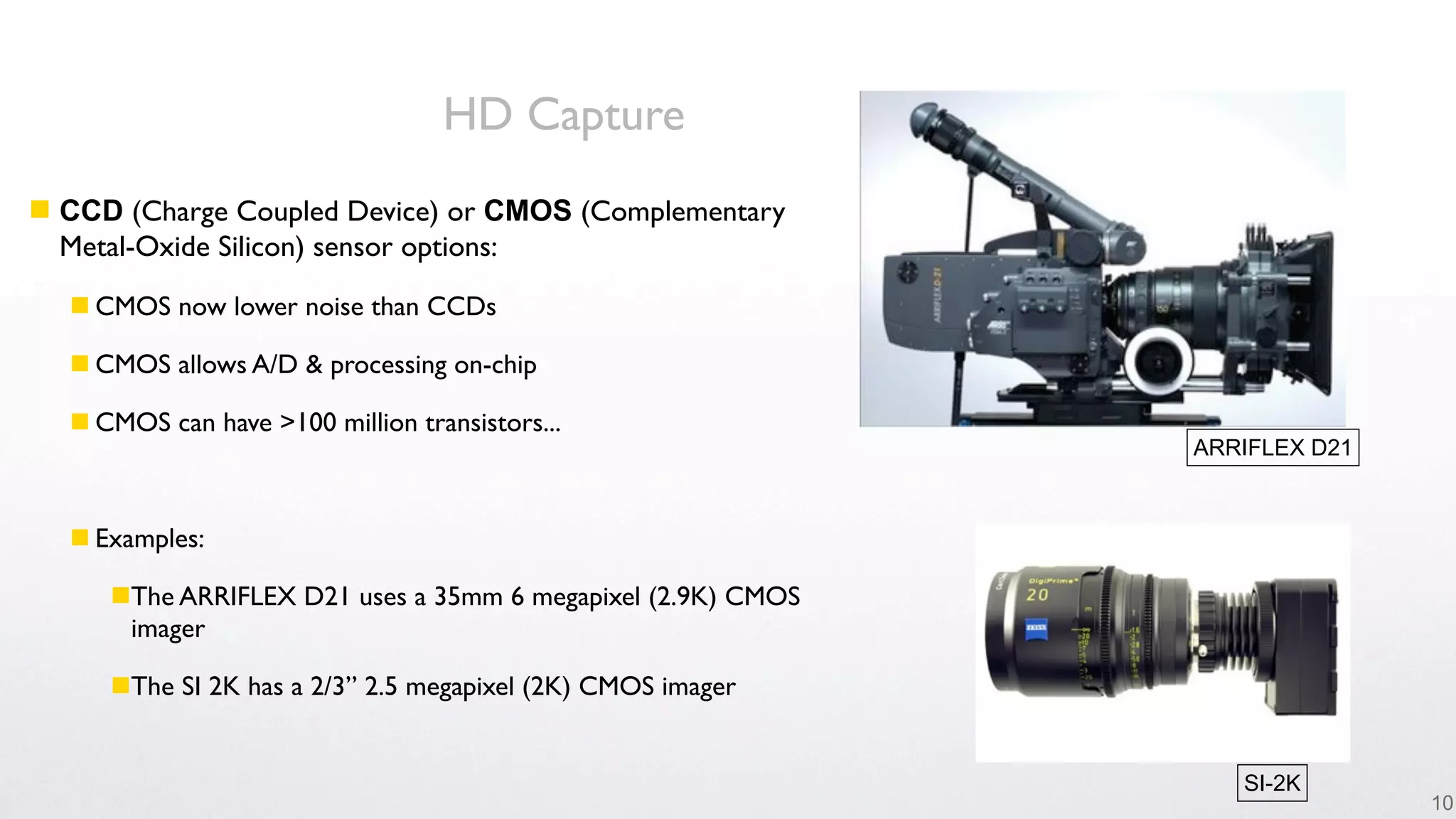
 CCD (Charge Coupled Device) or CMOS (Complementary
  Metal-Oxide Silicon) sensor options:
   CMOS now lower noise than CCDs

   CMOS allows A/D & processing on-chip

   CMOS can have >100 million transistors...
                                                             ARRIFLEX D21


   Examples:

     The ARRIFLEX D21 uses a 35mm 6 megapixel (2.9K) CMOS
      imager

     The SI 2K has a 2/3” 2.5 megapixel (2K) CMOS imager


                                                                SI-2K
                                                                            10
HD, 2K 4K + Imaging


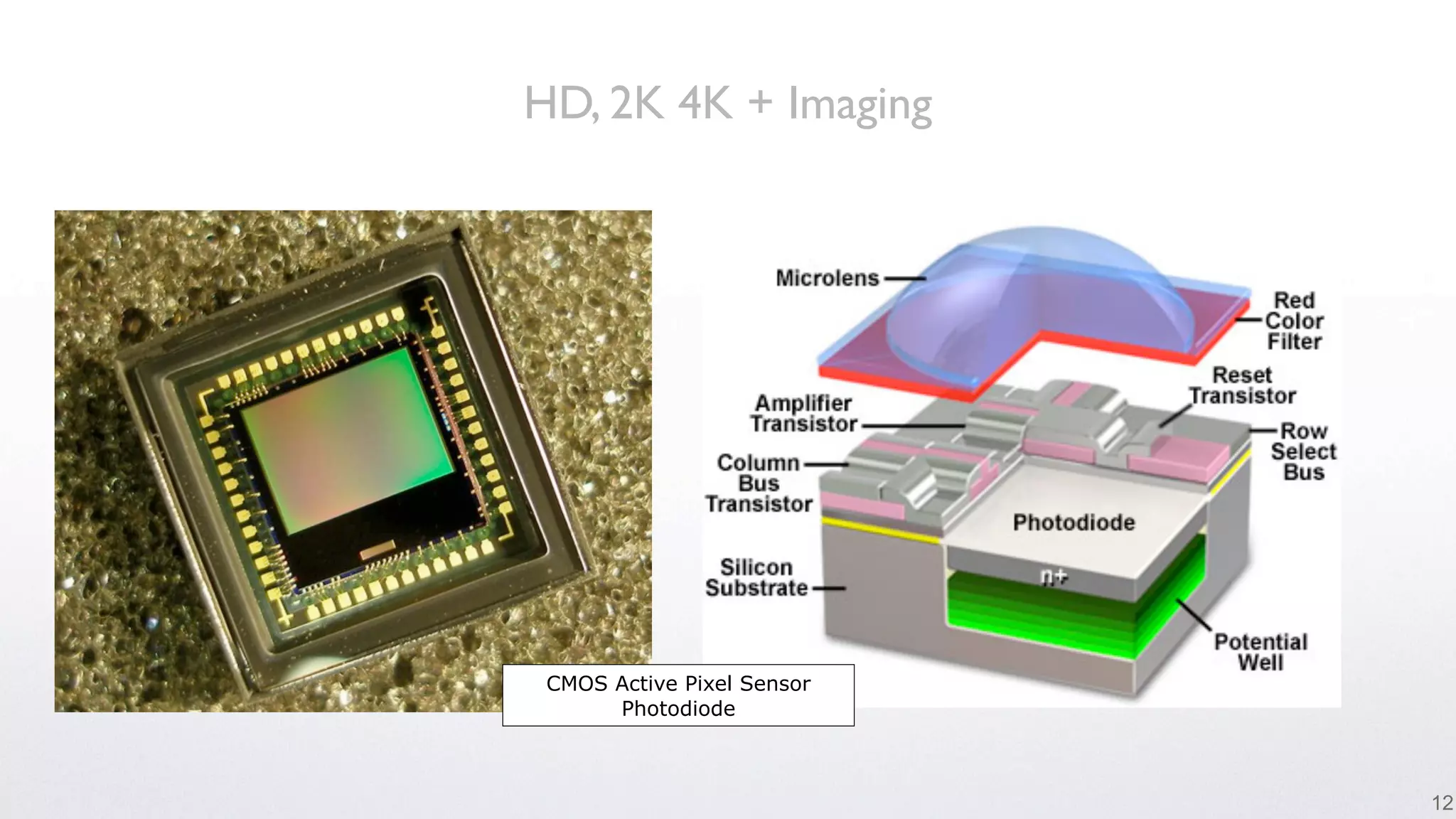
 CMOS Active Pixel Sensor
      Photodiode


                            12
HD, 2K 4K + Imaging


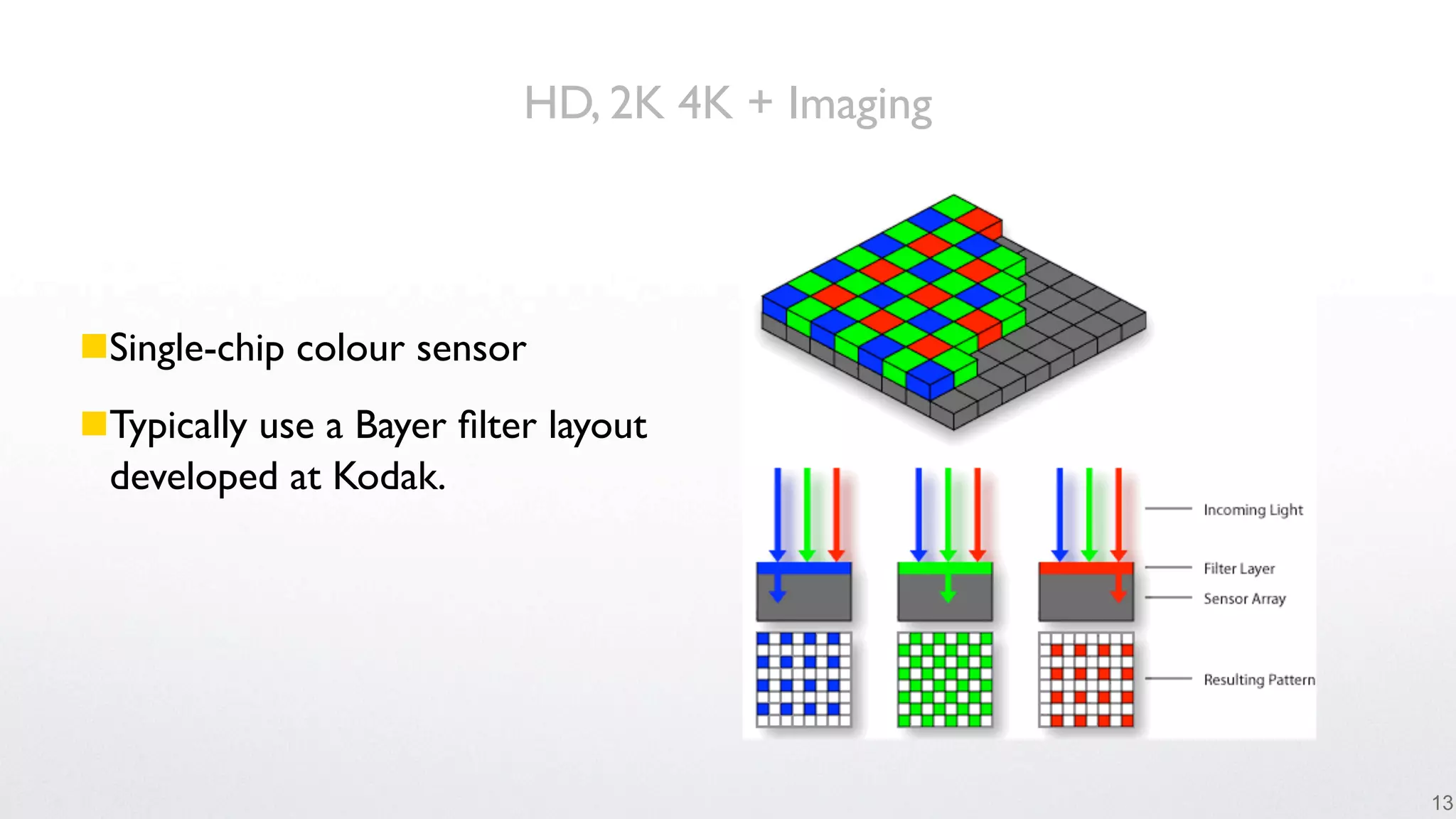
Single-chip colour sensor
Typically use a Bayer filter layout
 developed at Kodak.


                                                 13
HD, 2K 4K + Imaging


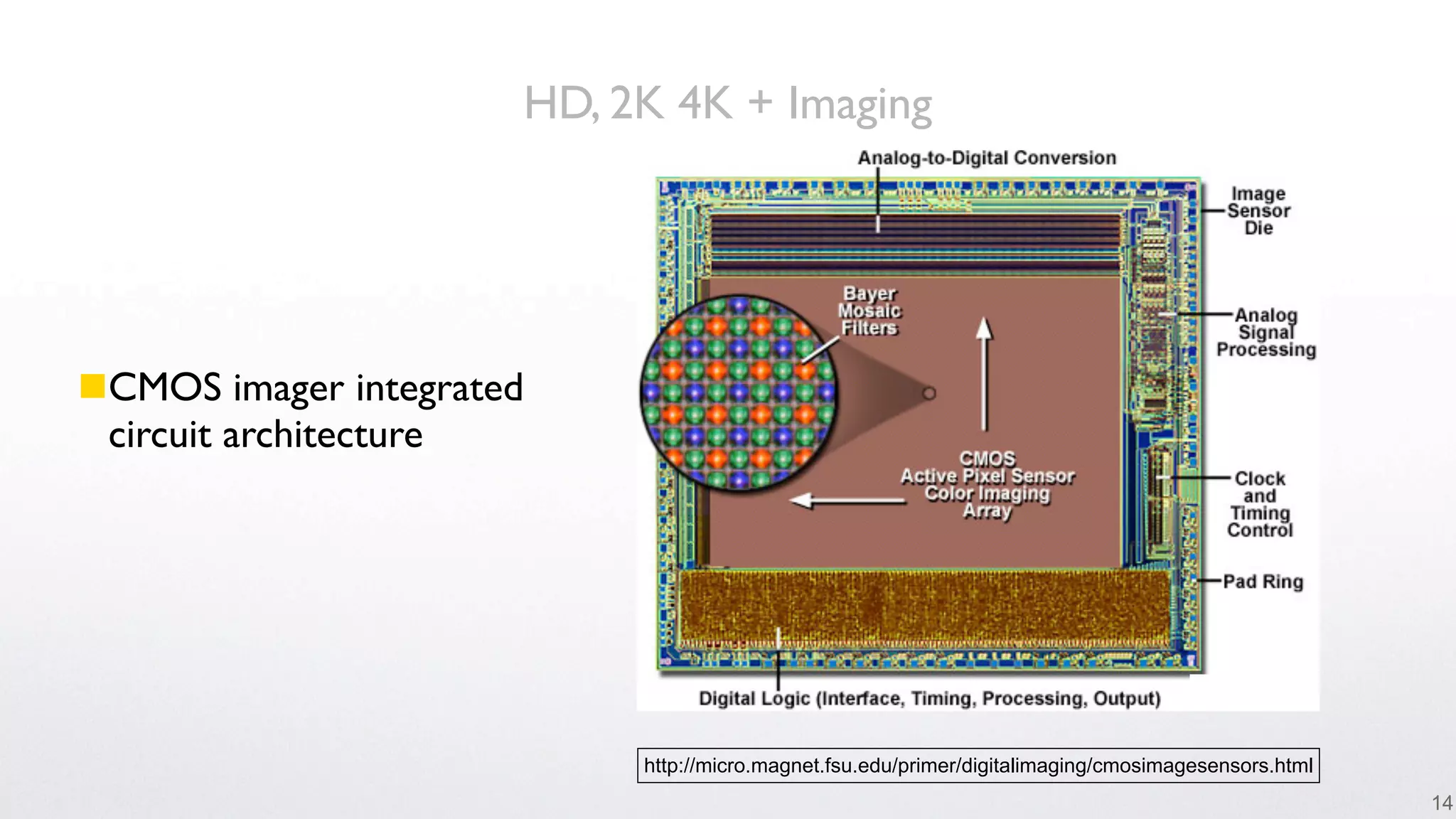
CMOS imager integrated
 circuit architecture


                           http://micro.magnet.fsu.edu/primer/digitalimaging/cmosimagesensors.html
                                                                                                     14
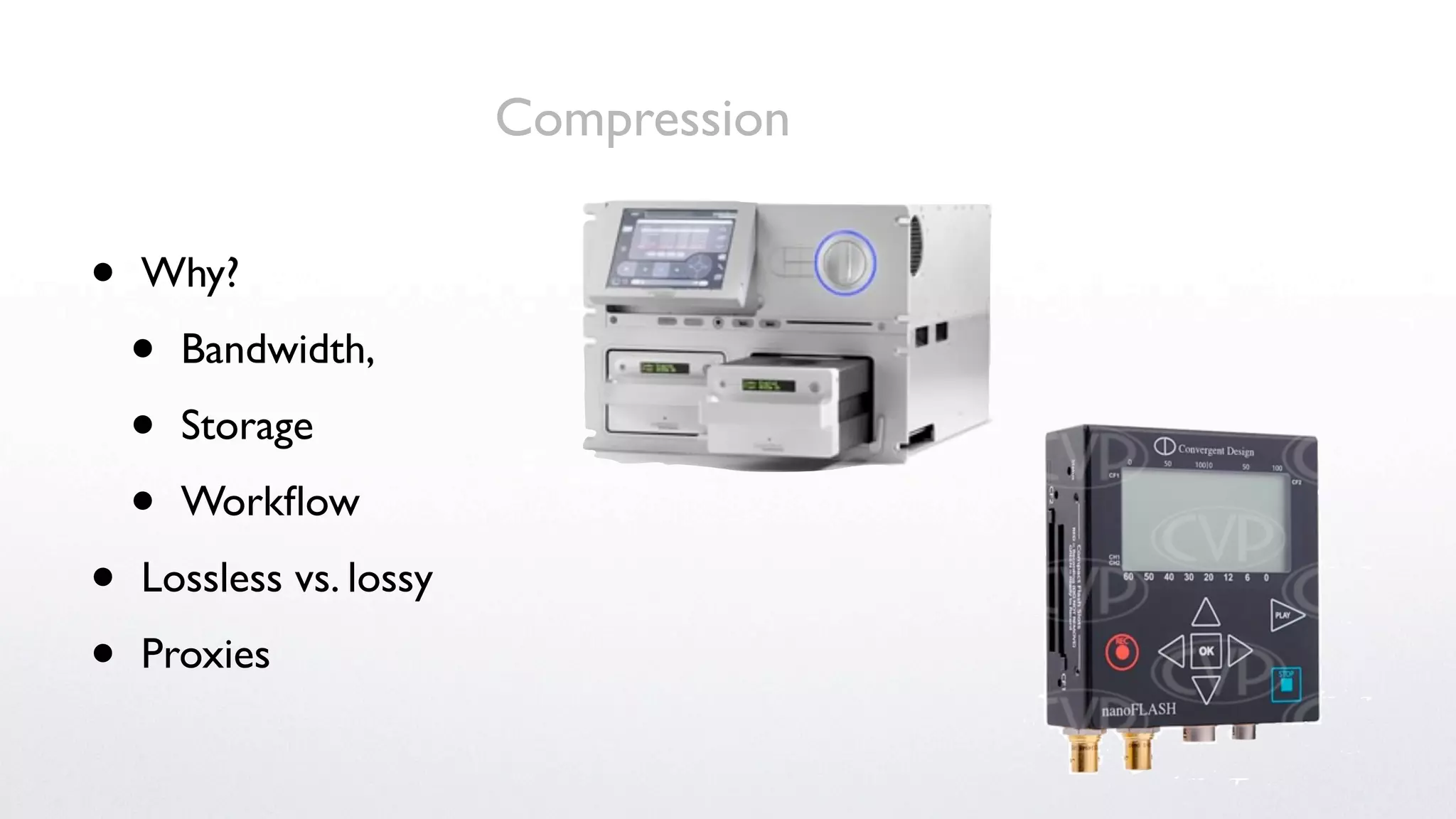
Compression

•   Why?

    •   Bandwidth,

    •   Storage

    •   Workflow

•   Lossless vs. lossy

•   Proxies
Inter-Frame Compression


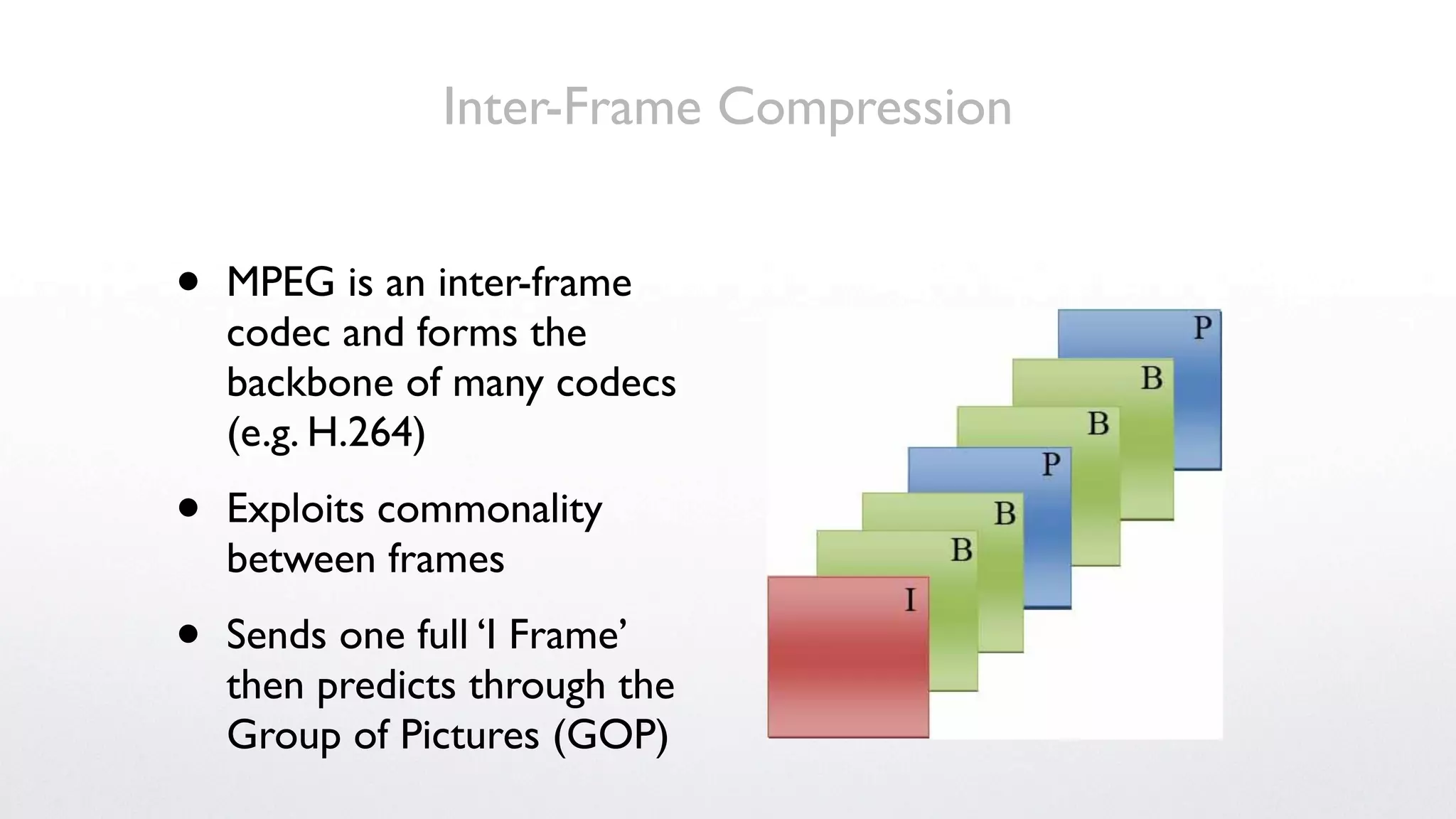
•   MPEG is an inter-frame
    codec and forms the
    backbone of many codecs
    (e.g. H.264)

•   Exploits commonality
    between frames

•   Sends one full ‘I Frame’
    then predicts through the
    Group of Pictures (GOP)
Intra-Frame Compression


•   Compressing each frame independently

•   Also known as ‘I Frame only’

•   Examples include ProRes, DNxHD

•   Best for offline editing as no GOP reconstruction required
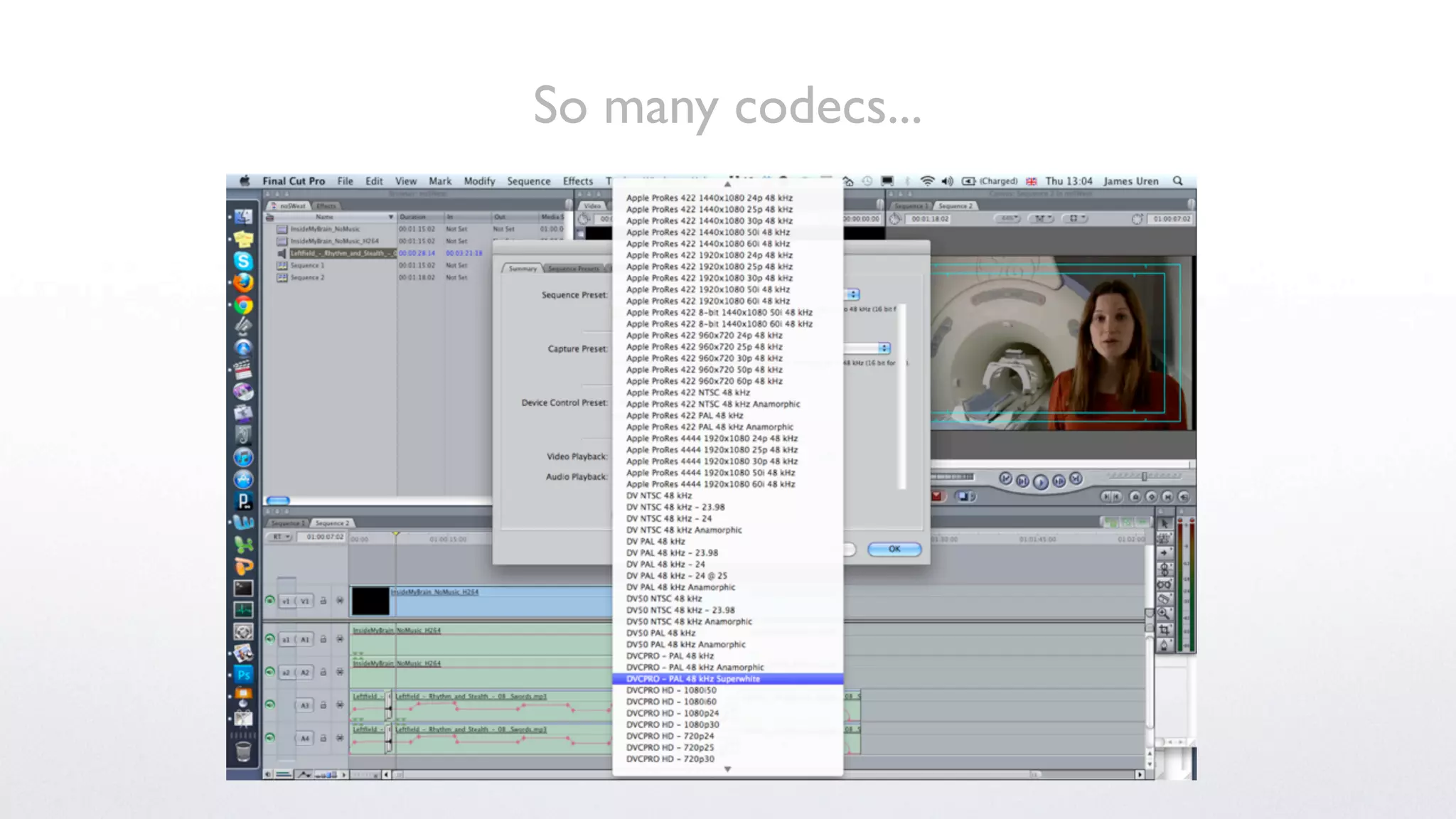
So many codecs...
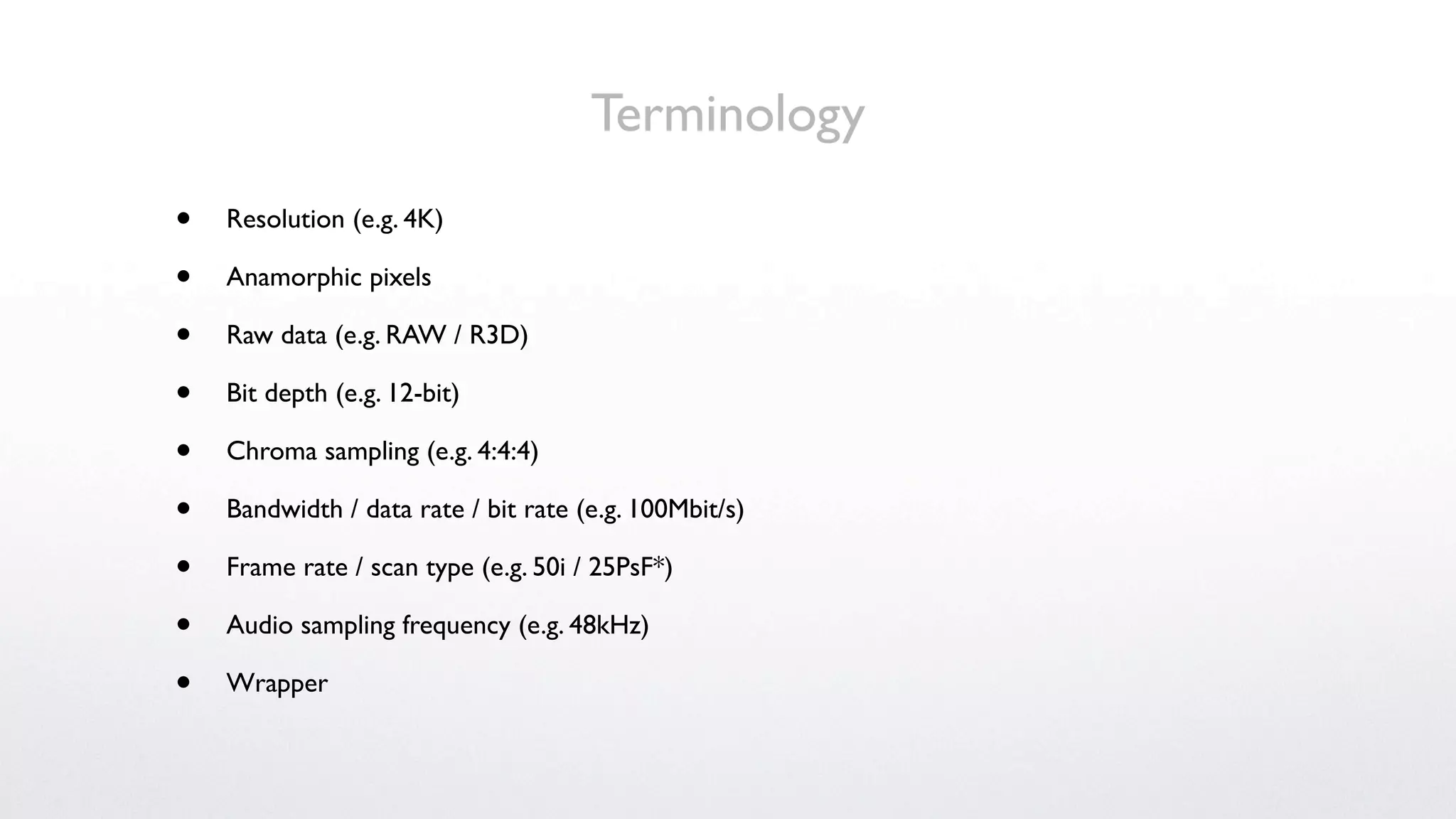
Terminology
•   Resolution (e.g. 4K)

•   Anamorphic pixels

•   Raw data (e.g. RAW / R3D)

•   Bit depth (e.g. 12-bit)

•   Chroma sampling (e.g. 4:4:4)

•   Bandwidth / data rate / bit rate (e.g. 100Mbit/s)

•   Frame rate / scan type (e.g. 50i / 25PsF*)

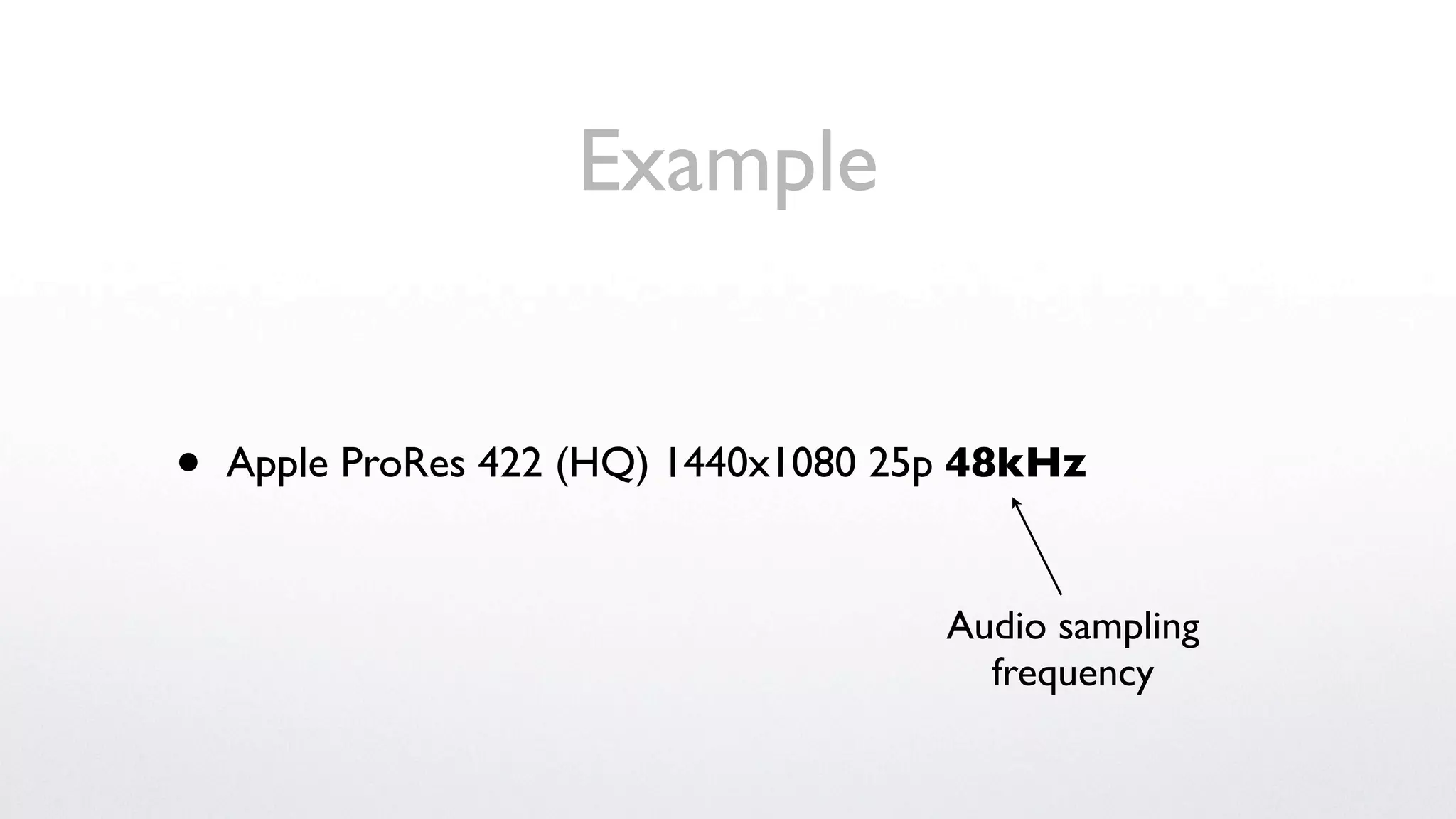
•   Audio sampling frequency (e.g. 48kHz)

•   Wrapper
Example Codec


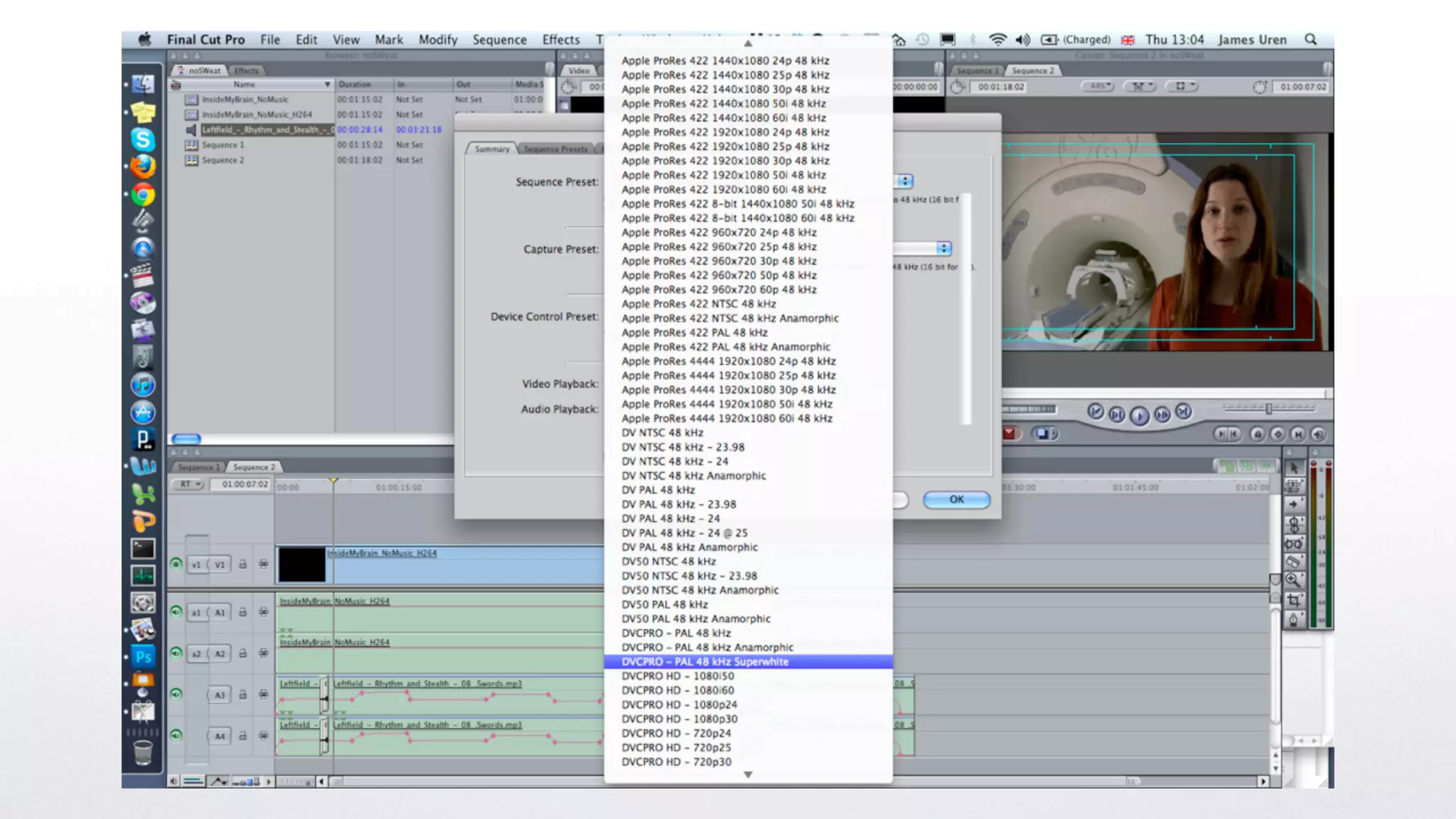
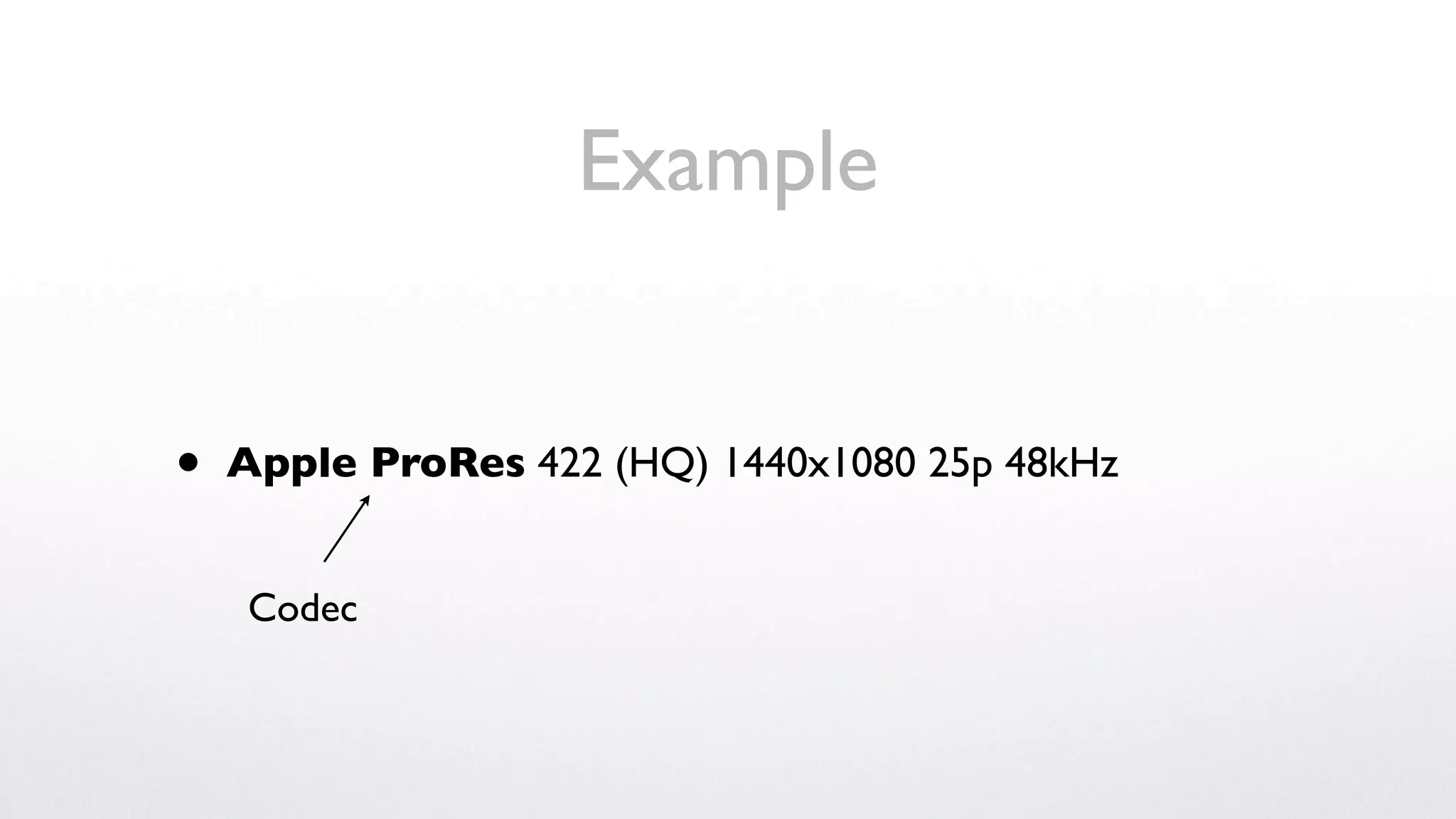
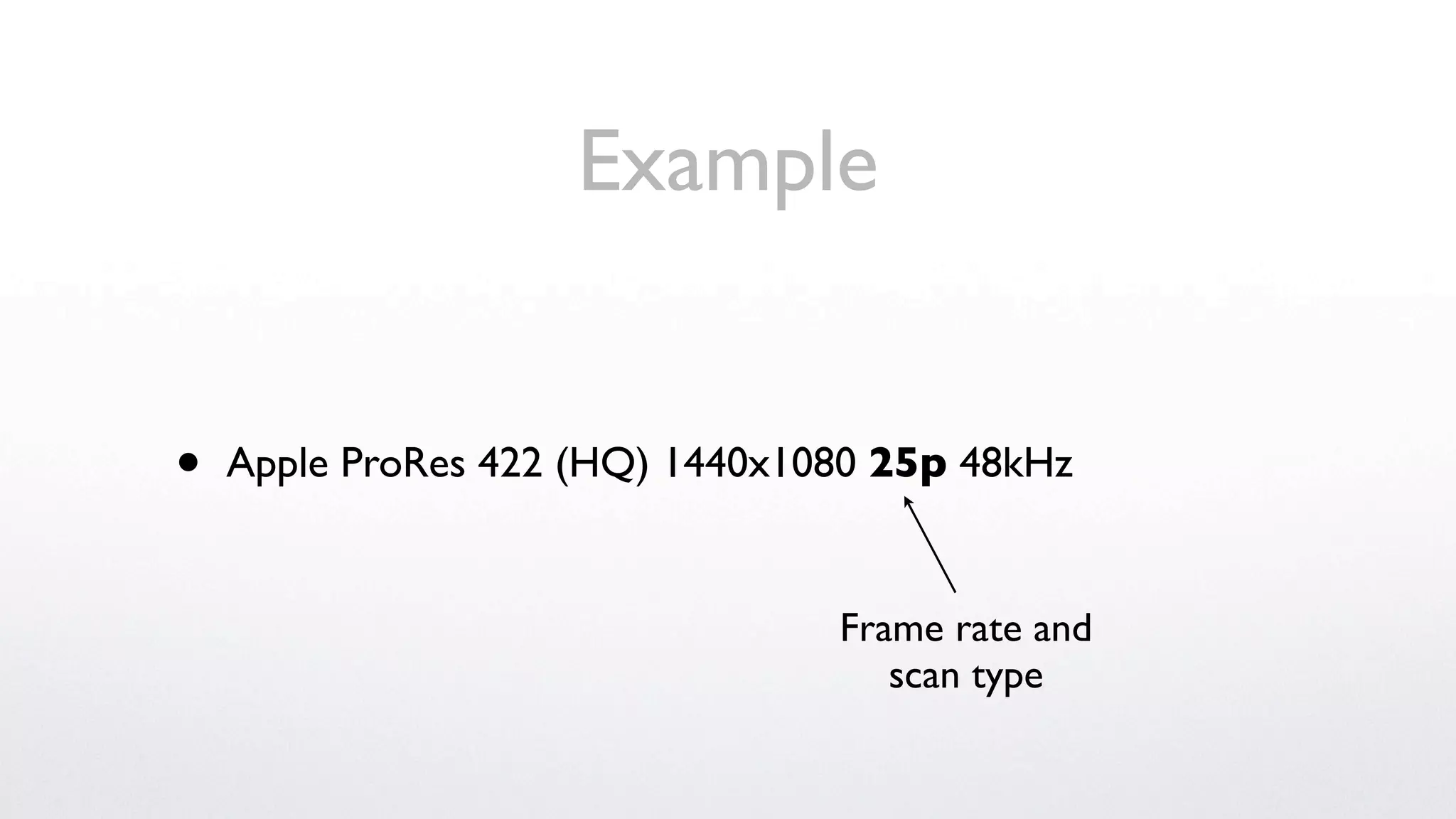
•   Apple ProRes 422 (HQ) 1440x1080 25p 48kHz
Example


•   Apple ProRes 422 (HQ) 1440x1080 25p 48kHz


    Codec
Example


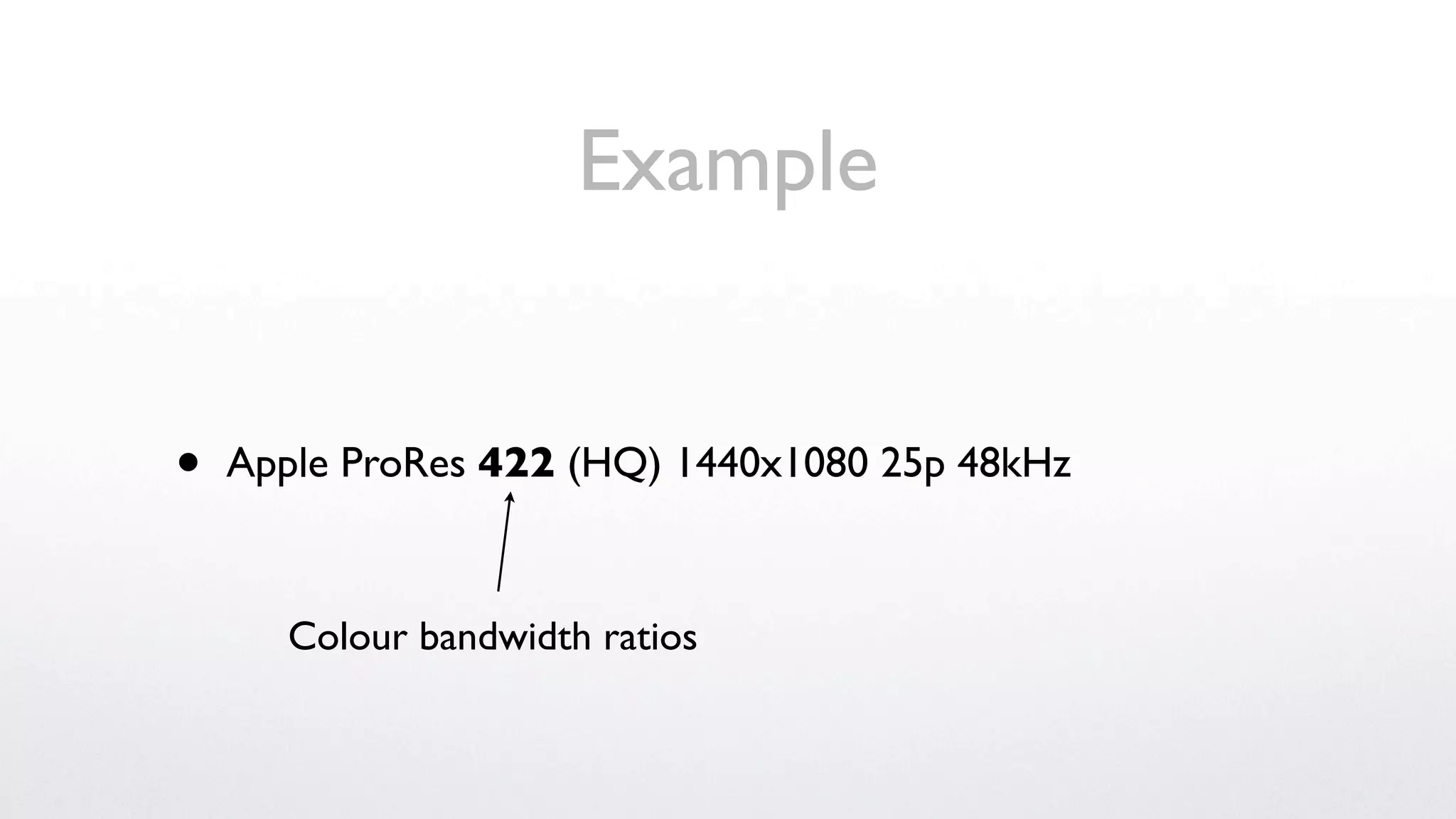
•   Apple ProRes 422 (HQ) 1440x1080 25p 48kHz


      Colour bandwidth ratios
Example


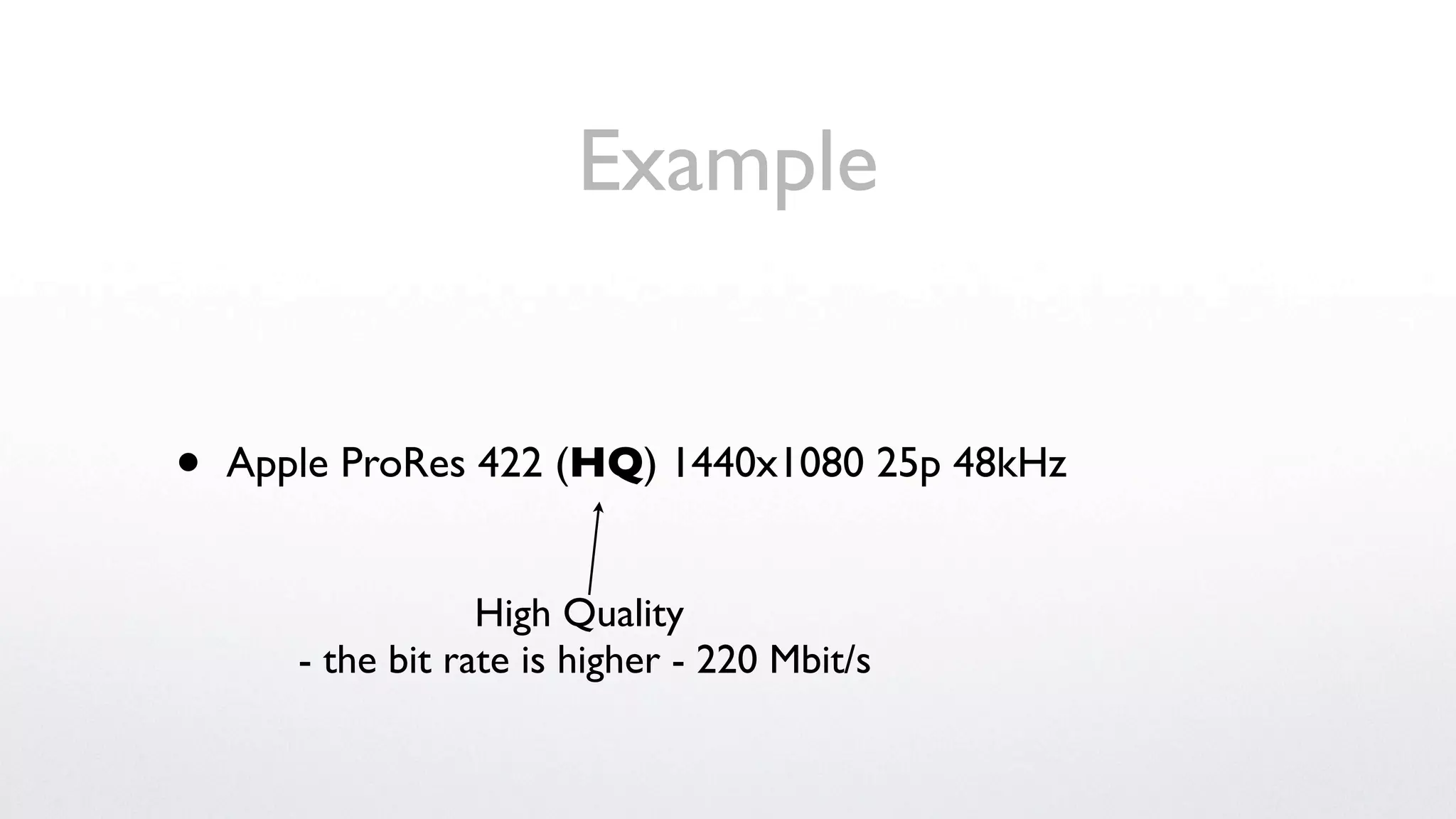
•   Apple ProRes 422 (HQ) 1440x1080 25p 48kHz


                   High Quality
       - the bit rate is higher - 220 Mbit/s
Example


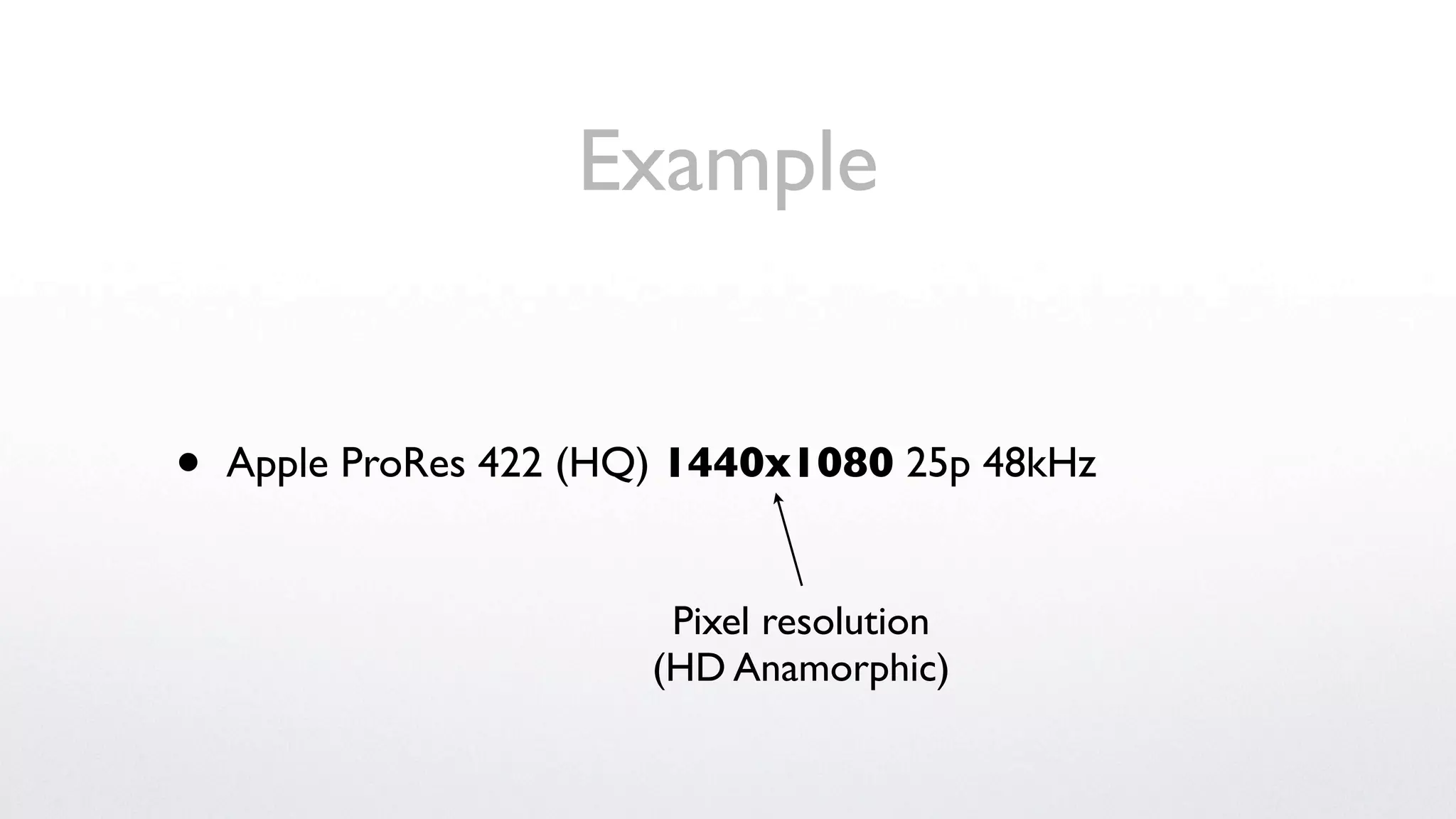
•   Apple ProRes 422 (HQ) 1440x1080 25p 48kHz


                         Pixel resolution
                        (HD Anamorphic)
Example


•   Apple ProRes 422 (HQ) 1440x1080 25p 48kHz


                                 Frame rate and
                                    scan type
Example


•   Apple ProRes 422 (HQ) 1440x1080 25p 48kHz


                                      Audio sampling
                                        frequency
Interlaced or Progressive?

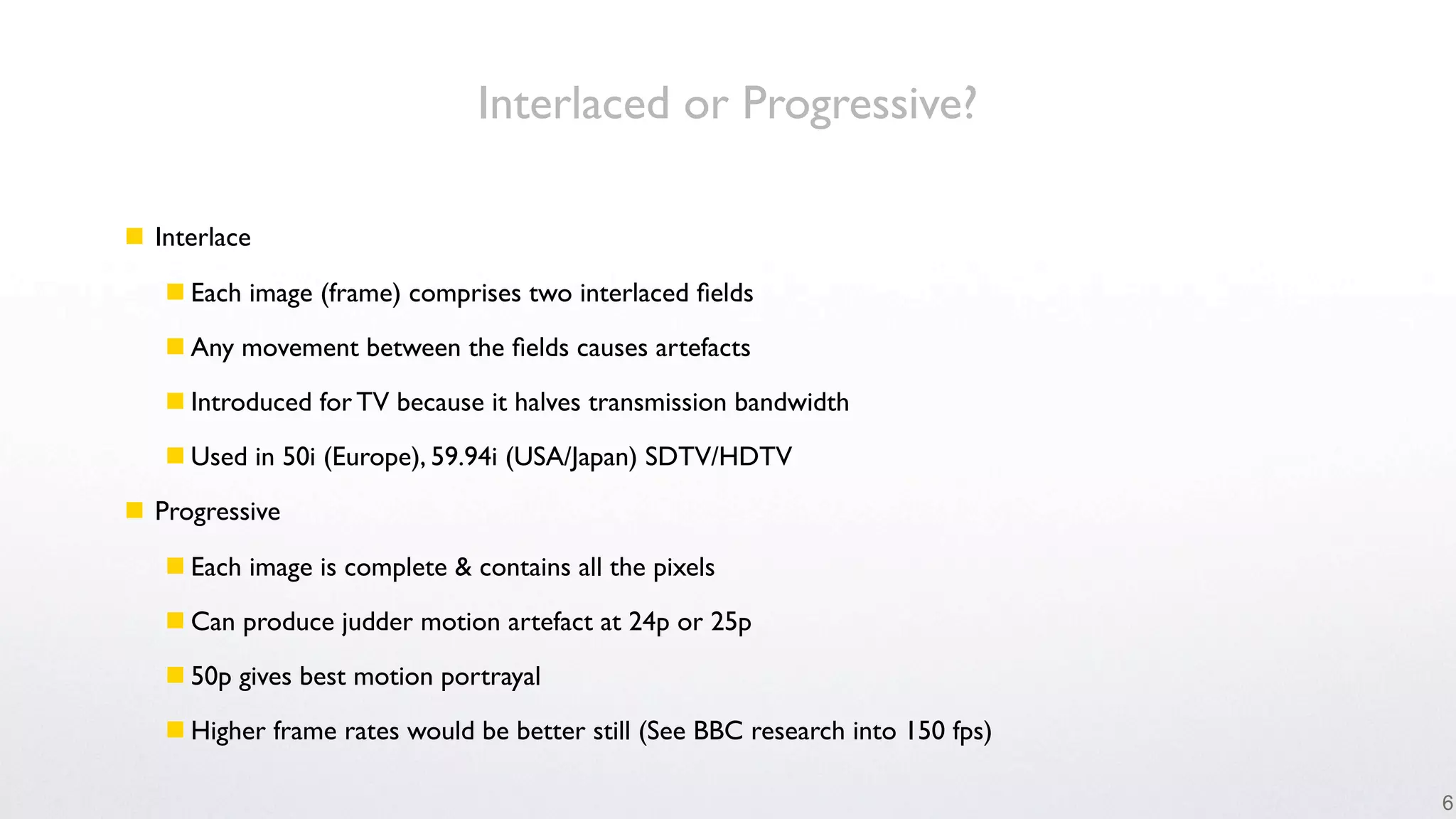
 Interlace

    Each image (frame) comprises two interlaced fields

    Any movement between the fields causes artefacts

    Introduced for TV because it halves transmission bandwidth

    Used in 50i (Europe), 59.94i (USA/Japan) SDTV/HDTV

 Progressive

    Each image is complete & contains all the pixels

    Can produce judder motion artefact at 24p or 25p

    50p gives best motion portrayal

    Higher frame rates would be better still (See BBC research into 150 fps)

                                                                                6
Interlaced or Progressive?


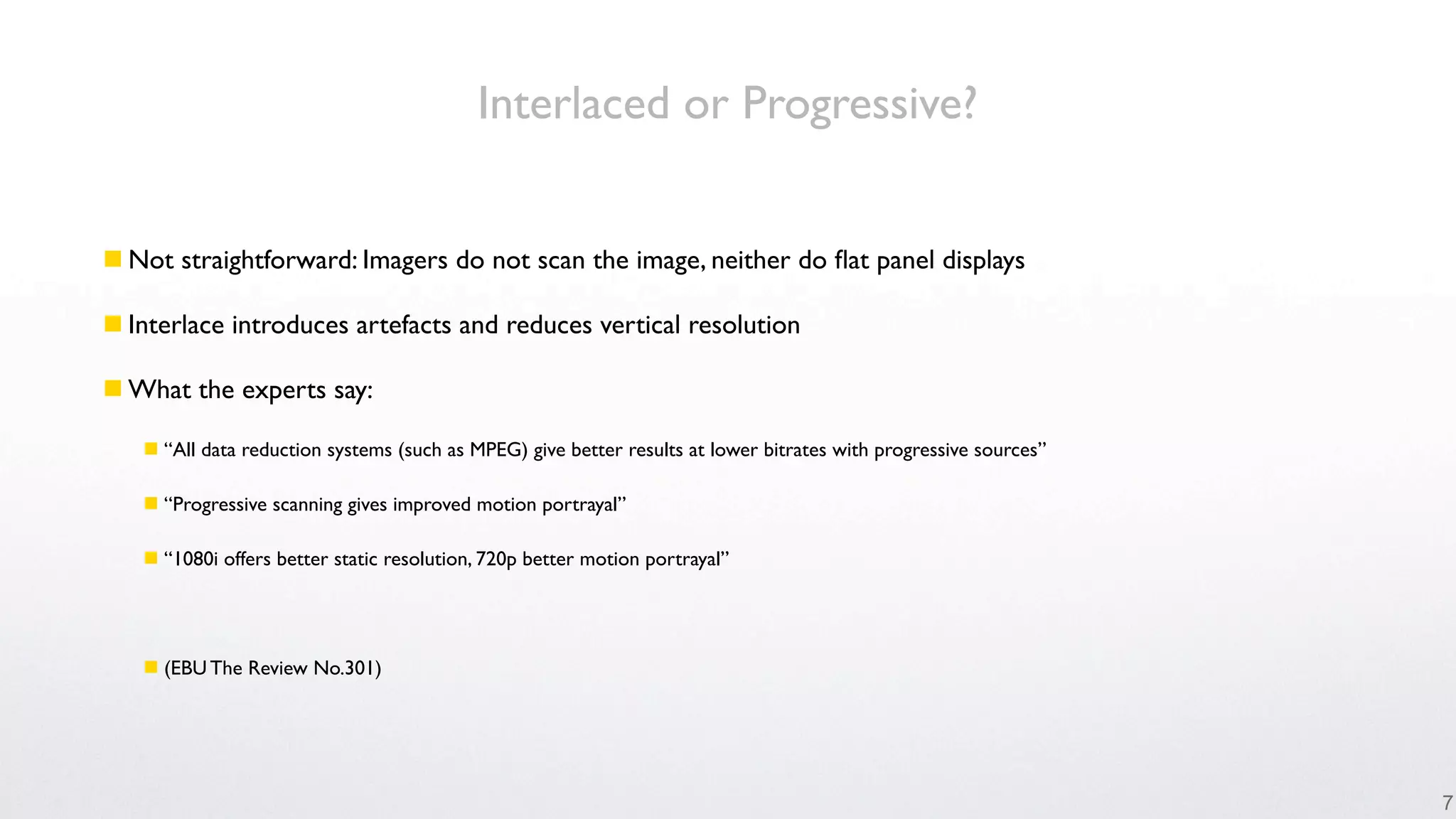
 Not straightforward: Imagers do not scan the image, neither do flat panel displays

 Interlace introduces artefacts and reduces vertical resolution

 What the experts say:

    “All data reduction systems (such as MPEG) give better results at lower bitrates with progressive sources”

    “Progressive scanning gives improved motion portrayal”

    “1080i offers better static resolution, 720p better motion portrayal”


    (EBU The Review No.301)


                                                                                                                  7
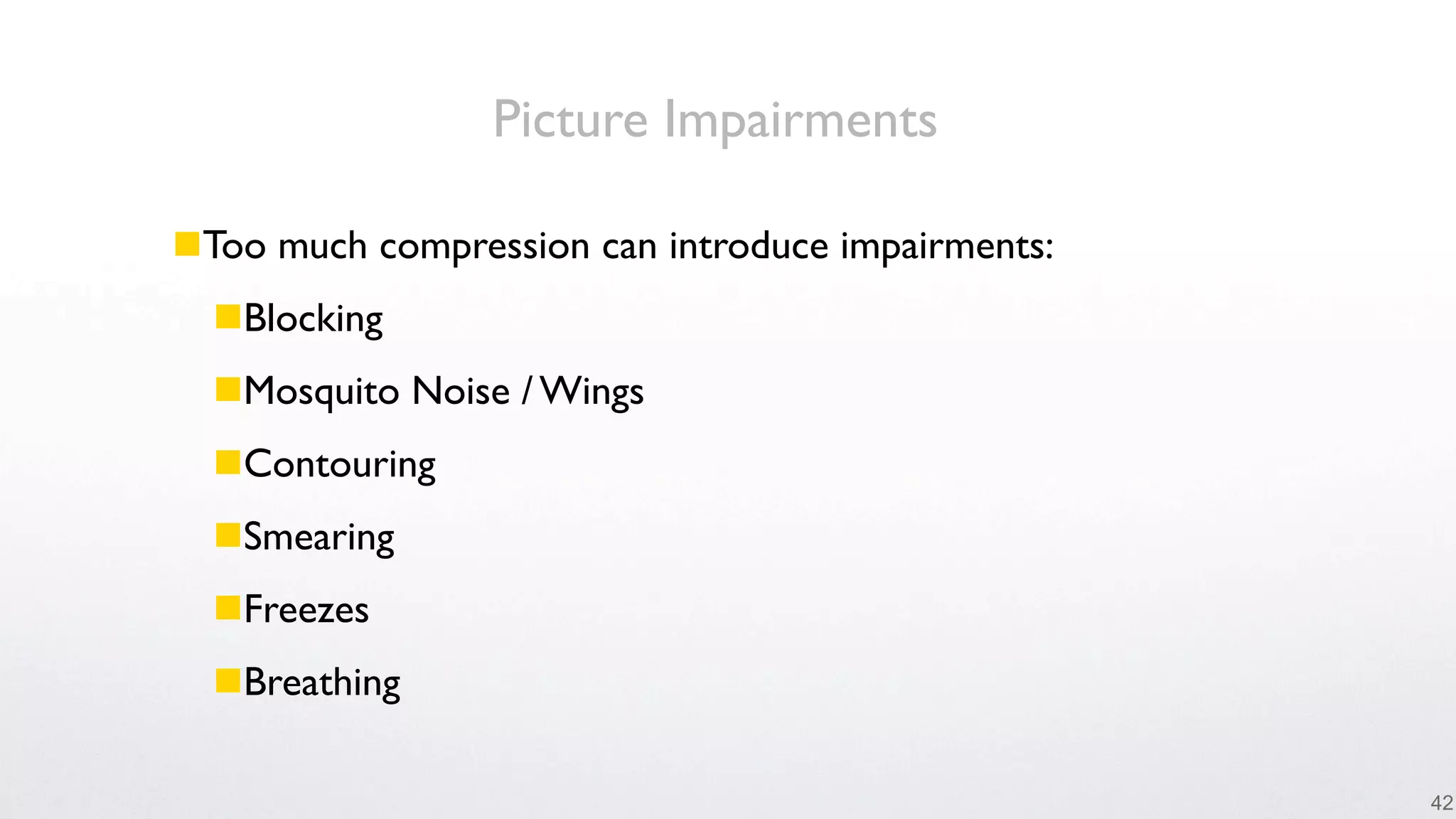
Picture Impairments

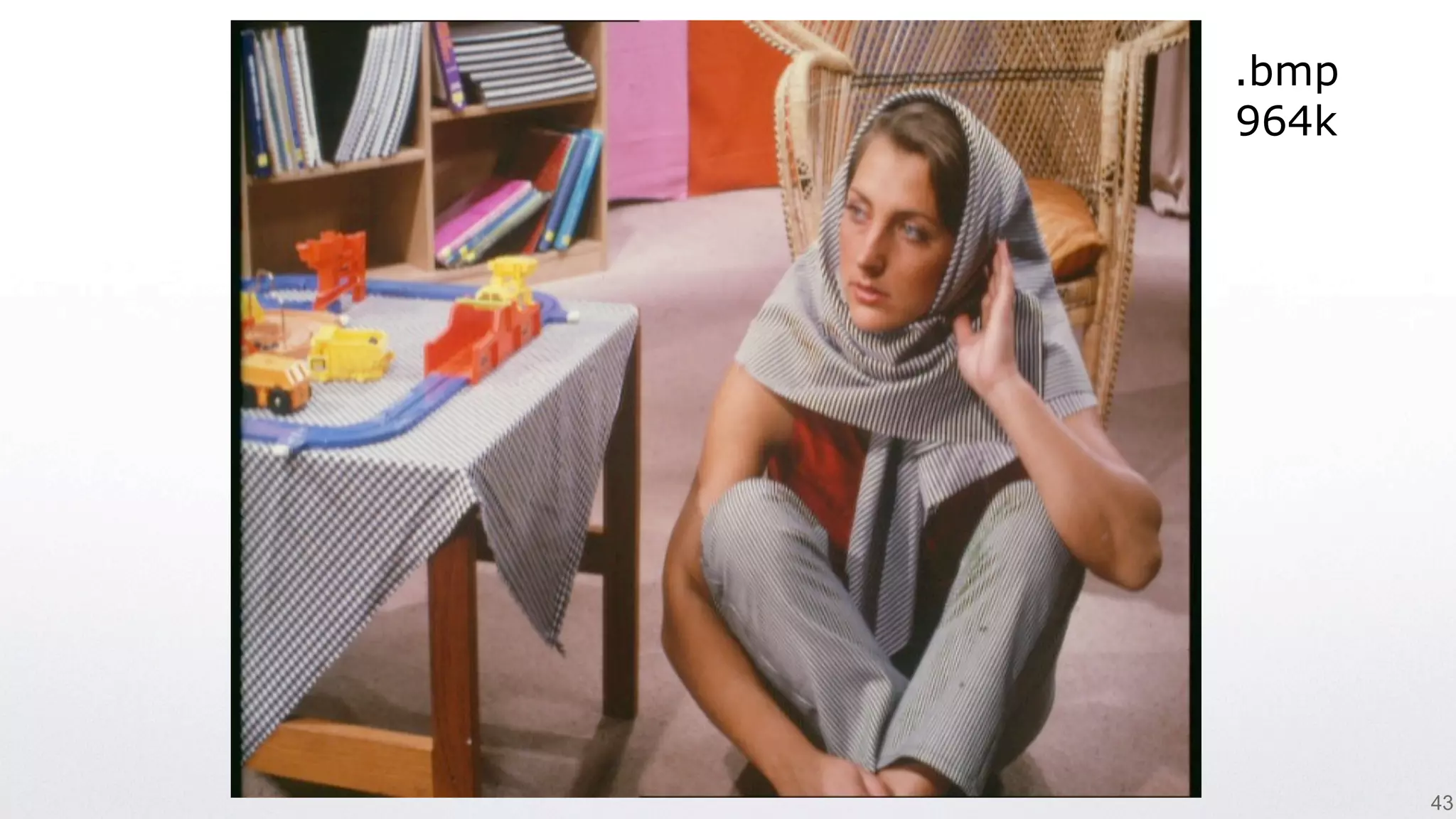
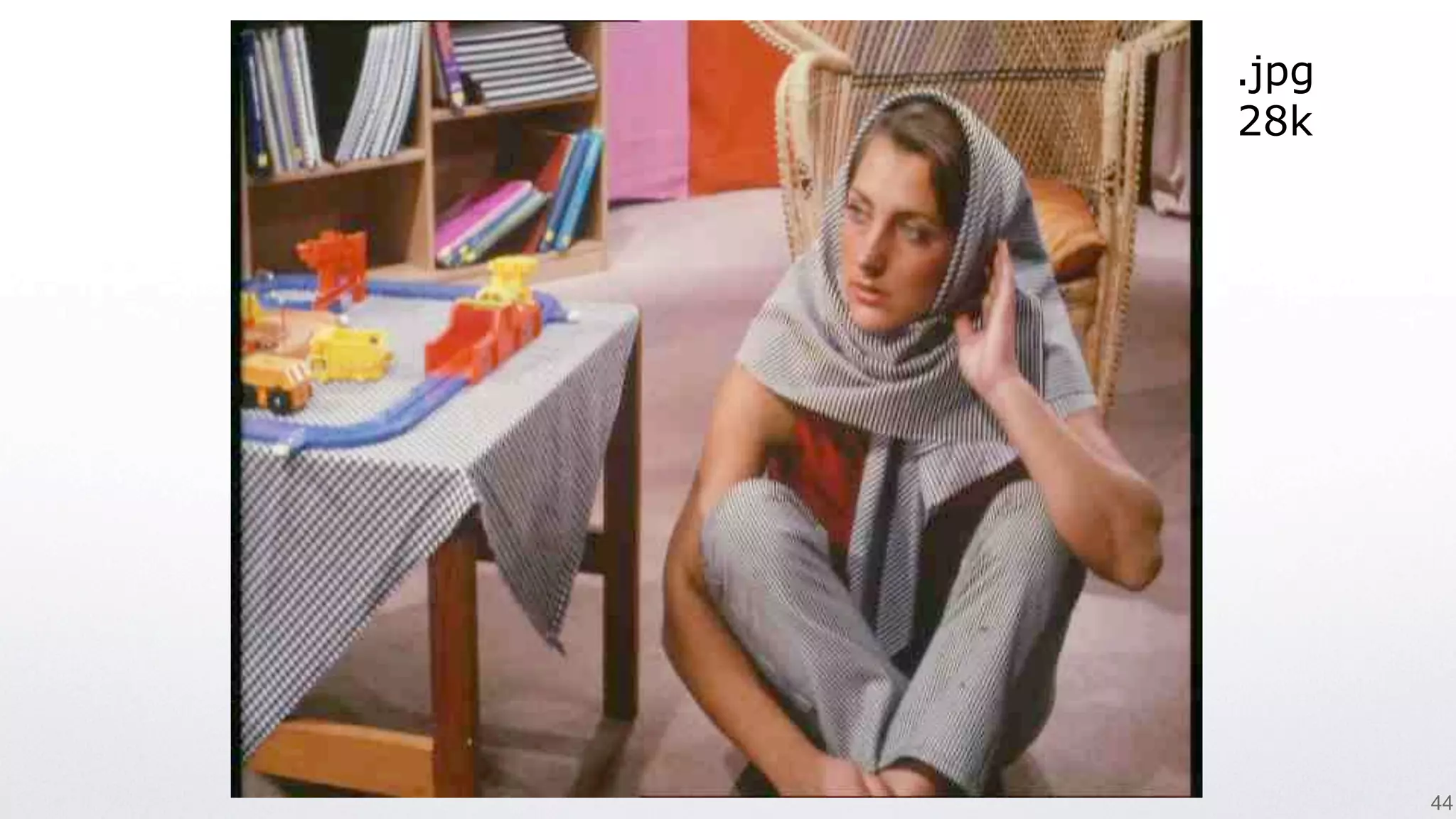
Too much compression can introduce impairments:
  Blocking
  Mosquito Noise / Wings
  Contouring
  Smearing
  Freezes
  Breathing

                                                   42
.bmp
964k


       43
.jpg
28k


       44
But...
•   ...this is only if you compress to much.

•   ProRes 4444 at 250Mbit/s is indistinguishable from
    uncompressed...


•   ...and much less data
D-Cinema


The DCI (Digital Cinema Initiatives) was set up in 2002

Aim was to set standards for a viable D-Cinema system

Members include Disney, Fox, MGM, Paramount, Sony Pictures Entertainment
 (Columbia), Universal & Warner Bros.

Adopted JPEG2000 compression


                                                                            36
D-Cinema


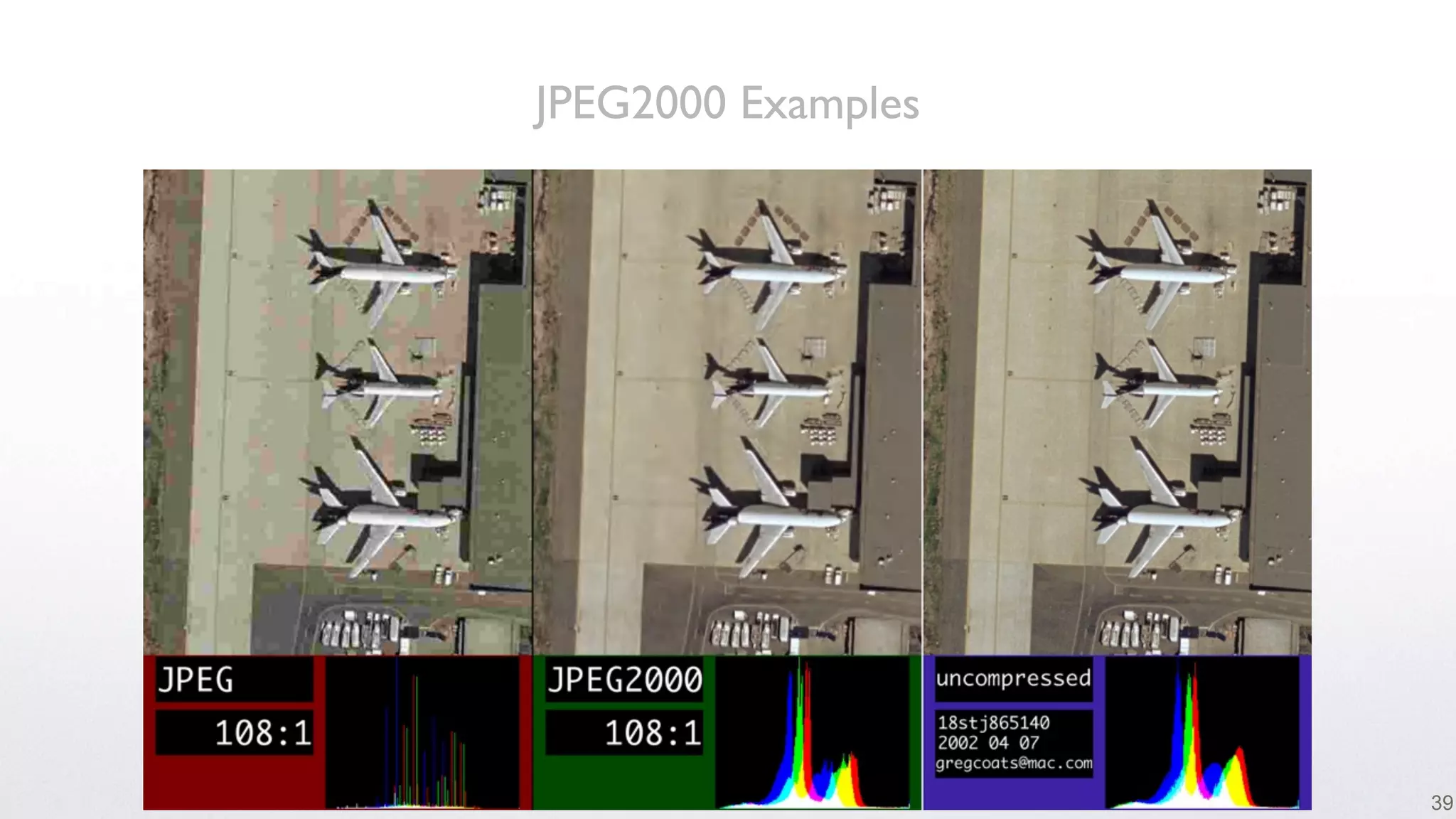
JPEG2000 uses wavelet compression

JPEG2000 does not divide the picture into discrete blocks

D-cinema uses a mild level of compression to avoid artefacts (~250Mbit/s)


                                                                             37
JPEG2000 Examples


                    39
The Future
•   Requirements on compression reduces with Moore’s Law

•   But this is countered by increasing resolutions and frame
    rates

•   Compression is here to stay, but offline and online continue
    to blur
Round-Up


•   A complete digital pipeline from capture to display

•   Don’t fear compression

•   Great pictures mean a high bitrate end-to-end, but too high and
    your pipeline starts to get expensive... But not for long.
Battle of the Codecs
     In Digital Film and TV


              James Uren
          Independent Training Consultant,

           Senior Lecturer Broadcasting,

           Creative Director 3D Stories


  Ravensbourne College of Design & Communication

Battle of the Codecs

  • 1.
    Battle of theCodecs In Digital Film and TV James Uren Independent Training Consultant, Senior Lecturer Broadcasting, Creative Director 3D Stories Optimisation and Compression Ravensbourne College of Design & Communication 24 November 2011
  • 3.
    Demistifying Codecs  Thetechnologies of digital film  So many codecs...  The technology behind compression  The future... 2
  • 4.
    Digital Images Definedin Pixels  Standard-Definition (SDTV)  Europe: 720 x 576 pixels/frame. US/Japan: 720 x 480 pixels/frame  High-Definition (HDTV)  1920 x 1080 pixels/frame (Also called CIF (Common Image Format)). 1280 x 720 pixels/frame  Digital Film and D-cinema  Full-aperture 2K is 2048 x 1536 (gives a 1.33:1 (4:3) image)  Academy 2K is 1828 x 1080 (For a 1.85:1 image)  Full-aperture 4K is 4096 x 3072 pixels/frame 4
  • 5.
    Digital Image PixelResolutions 720 x 576 1280 x 720 1920 x 1080 2048 x 1536 4096 x 3072 5
  • 6.
    Film? • What resolution is film? Grain...
  • 11.
    Film? • So resolution unknown - is 4K enough? • So in film we have: • Digital Intermediate (DI) for post-production • Digital cinema projection • Digital Capture - the last piece of the puzzle.
  • 12.
    HD Capture  CCD(Charge Coupled Device) or CMOS (Complementary Metal-Oxide Silicon) sensor options:  CMOS now lower noise than CCDs  CMOS allows A/D & processing on-chip  CMOS can have >100 million transistors... ARRIFLEX D21  Examples: The ARRIFLEX D21 uses a 35mm 6 megapixel (2.9K) CMOS imager The SI 2K has a 2/3” 2.5 megapixel (2K) CMOS imager SI-2K 10
  • 13.
    HD, 2K 4K+ Imaging CMOS Active Pixel Sensor Photodiode 12
  • 14.
    HD, 2K 4K+ Imaging Single-chip colour sensor Typically use a Bayer filter layout developed at Kodak. 13
  • 15.
    HD, 2K 4K+ Imaging CMOS imager integrated circuit architecture http://micro.magnet.fsu.edu/primer/digitalimaging/cmosimagesensors.html 14
  • 16.
    Compression • Why? • Bandwidth, • Storage • Workflow • Lossless vs. lossy • Proxies
  • 17.
    Inter-Frame Compression • MPEG is an inter-frame codec and forms the backbone of many codecs (e.g. H.264) • Exploits commonality between frames • Sends one full ‘I Frame’ then predicts through the Group of Pictures (GOP)
  • 18.
    Intra-Frame Compression • Compressing each frame independently • Also known as ‘I Frame only’ • Examples include ProRes, DNxHD • Best for offline editing as no GOP reconstruction required
  • 19.
  • 20.
    Terminology • Resolution (e.g. 4K) • Anamorphic pixels • Raw data (e.g. RAW / R3D) • Bit depth (e.g. 12-bit) • Chroma sampling (e.g. 4:4:4) • Bandwidth / data rate / bit rate (e.g. 100Mbit/s) • Frame rate / scan type (e.g. 50i / 25PsF*) • Audio sampling frequency (e.g. 48kHz) • Wrapper
  • 21.
    Example Codec • Apple ProRes 422 (HQ) 1440x1080 25p 48kHz
  • 22.
    Example • Apple ProRes 422 (HQ) 1440x1080 25p 48kHz Codec
  • 23.
    Example • Apple ProRes 422 (HQ) 1440x1080 25p 48kHz Colour bandwidth ratios
  • 24.
    Example • Apple ProRes 422 (HQ) 1440x1080 25p 48kHz High Quality - the bit rate is higher - 220 Mbit/s
  • 25.
    Example • Apple ProRes 422 (HQ) 1440x1080 25p 48kHz Pixel resolution (HD Anamorphic)
  • 26.
    Example • Apple ProRes 422 (HQ) 1440x1080 25p 48kHz Frame rate and scan type
  • 27.
    Example • Apple ProRes 422 (HQ) 1440x1080 25p 48kHz Audio sampling frequency
  • 28.
    Interlaced or Progressive? Interlace  Each image (frame) comprises two interlaced fields  Any movement between the fields causes artefacts  Introduced for TV because it halves transmission bandwidth  Used in 50i (Europe), 59.94i (USA/Japan) SDTV/HDTV  Progressive  Each image is complete & contains all the pixels  Can produce judder motion artefact at 24p or 25p  50p gives best motion portrayal  Higher frame rates would be better still (See BBC research into 150 fps) 6
  • 29.
    Interlaced or Progressive? Not straightforward: Imagers do not scan the image, neither do flat panel displays  Interlace introduces artefacts and reduces vertical resolution  What the experts say:  “All data reduction systems (such as MPEG) give better results at lower bitrates with progressive sources”  “Progressive scanning gives improved motion portrayal”  “1080i offers better static resolution, 720p better motion portrayal”  (EBU The Review No.301) 7
  • 30.
    Picture Impairments Too muchcompression can introduce impairments: Blocking Mosquito Noise / Wings Contouring Smearing Freezes Breathing 42
  • 31.
  • 32.
  • 33.
    But... • ...this is only if you compress to much. • ProRes 4444 at 250Mbit/s is indistinguishable from uncompressed... • ...and much less data
  • 34.
    D-Cinema The DCI (DigitalCinema Initiatives) was set up in 2002 Aim was to set standards for a viable D-Cinema system Members include Disney, Fox, MGM, Paramount, Sony Pictures Entertainment (Columbia), Universal & Warner Bros. Adopted JPEG2000 compression 36
  • 35.
    D-Cinema JPEG2000 uses waveletcompression JPEG2000 does not divide the picture into discrete blocks D-cinema uses a mild level of compression to avoid artefacts (~250Mbit/s) 37
  • 36.
  • 37.
    The Future • Requirements on compression reduces with Moore’s Law • But this is countered by increasing resolutions and frame rates • Compression is here to stay, but offline and online continue to blur
  • 38.
    Round-Up • A complete digital pipeline from capture to display • Don’t fear compression • Great pictures mean a high bitrate end-to-end, but too high and your pipeline starts to get expensive... But not for long.
  • 39.
    Battle of theCodecs In Digital Film and TV James Uren Independent Training Consultant, Senior Lecturer Broadcasting, Creative Director 3D Stories Ravensbourne College of Design & Communication