Salford City College
Eccles Centre
Creative Media Production


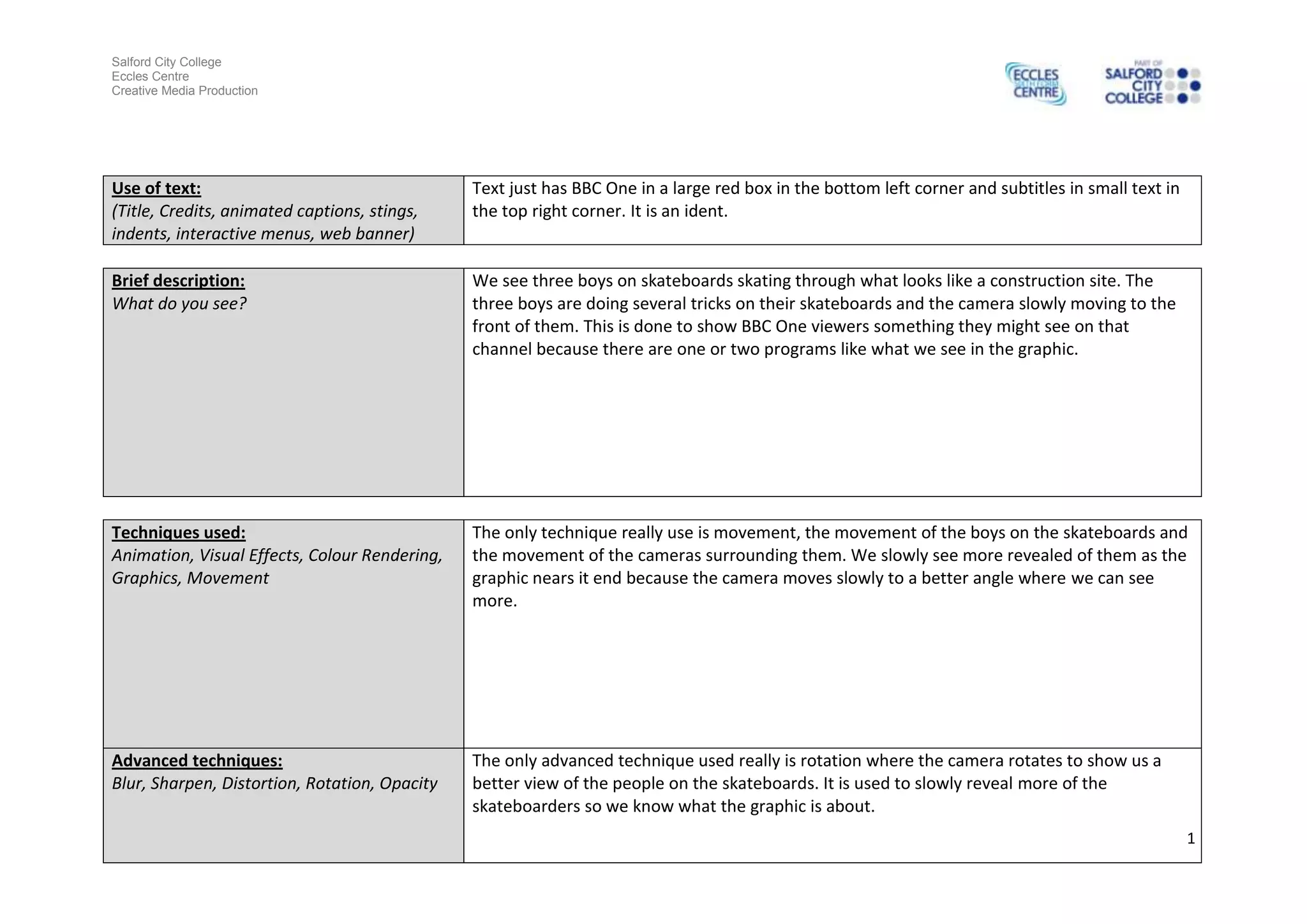
Use of text:                                   Text just has BBC One in a large red box in the bottom left corner and subtitles in small text in
(Title, Credits, animated captions, stings,    the top right corner. It is an ident.
indents, interactive menus, web banner)

Brief description:                             We see three boys on skateboards skating through what looks like a construction site. The
What do you see?                               three boys are doing several tricks on their skateboards and the camera slowly moving to the
                                               front of them. This is done to show BBC One viewers something they might see on that
                                               channel because there are one or two programs like what we see in the graphic.


Techniques used:                               The only technique really use is movement, the movement of the boys on the skateboards and
Animation, Visual Effects, Colour Rendering,   the movement of the cameras surrounding them. We slowly see more revealed of them as the
Graphics, Movement                             graphic nears it end because the camera moves slowly to a better angle where we can see
                                               more.


Advanced techniques:                           The only advanced technique used really is rotation where the camera rotates to show us a
Blur, Sharpen, Distortion, Rotation, Opacity   better view of the people on the skateboards. It is used to slowly reveal more of the
                                               skateboarders so we know what the graphic is about.
                                                                                                                                                   1
Salford City College
Eccles Centre
Creative Media Production


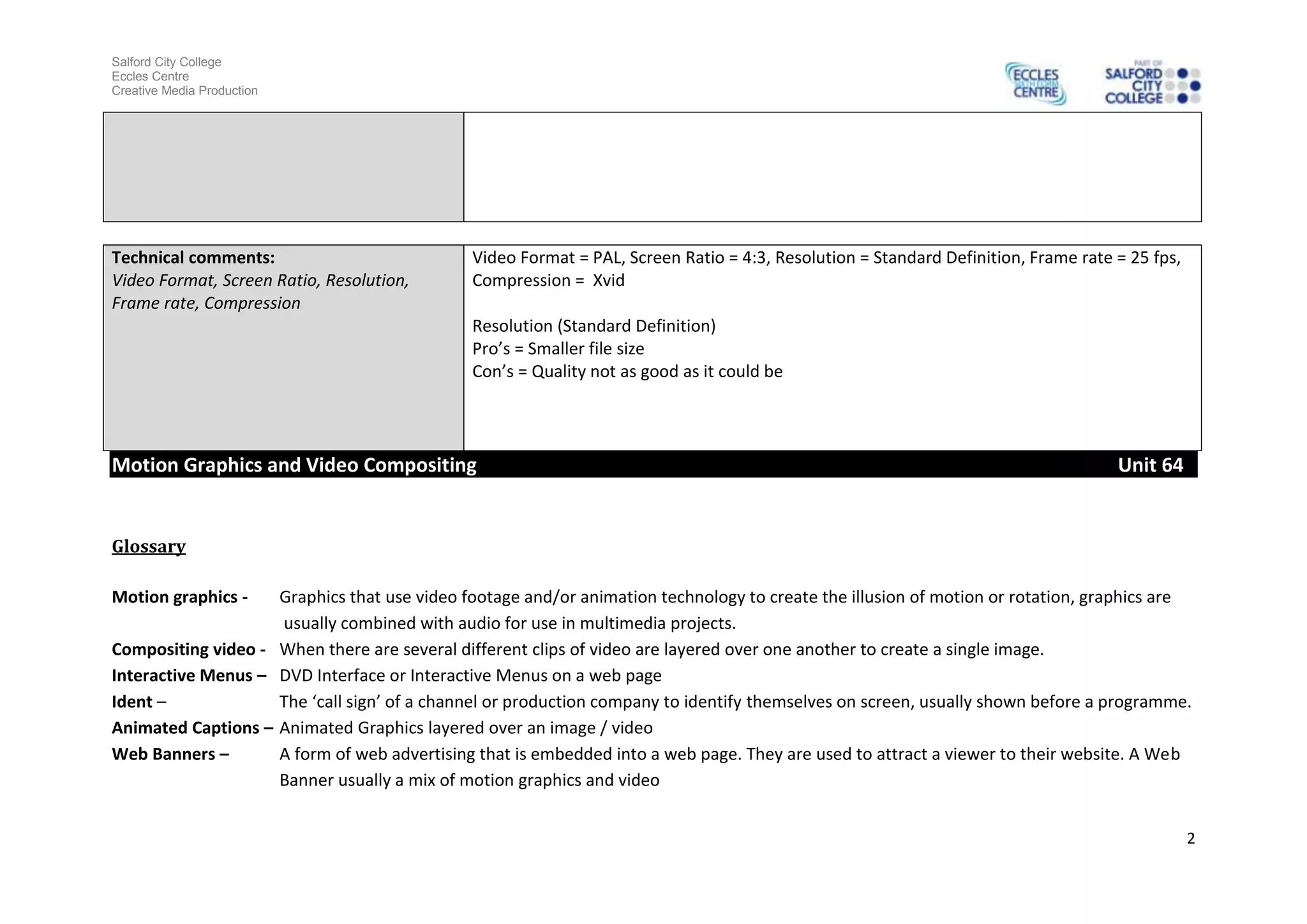
Technical comments:                           Video Format = PAL, Screen Ratio = 4:3, Resolution = Standard Definition, Frame rate = 25 fps,
Video Format, Screen Ratio, Resolution,       Compression = Xvid
Frame rate, Compression
                                              Resolution (Standard Definition)
                                              Pro’s = Smaller file size
                                              Con’s = Quality not as good as it could be


Motion Graphics and Video Compositing                                                                                              Unit 64


Glossary

Motion graphics -   Graphics that use video footage and/or animation technology to create the illusion of motion or rotation, graphics are
                    usually combined with audio for use in multimedia projects.
Compositing video - When there are several different clips of video are layered over one another to create a single image.
Interactive Menus – DVD Interface or Interactive Menus on a web page
Ident –             The ‘call sign’ of a channel or production company to identify themselves on screen, usually shown before a programme.
Animated Captions – Animated Graphics layered over an image / video
Web Banners –       A form of web advertising that is embedded into a web page. They are used to attract a viewer to their website. A Web
                    Banner usually a mix of motion graphics and video


                                                                                                                                               2
Salford City College
Eccles Centre
Creative Media Production

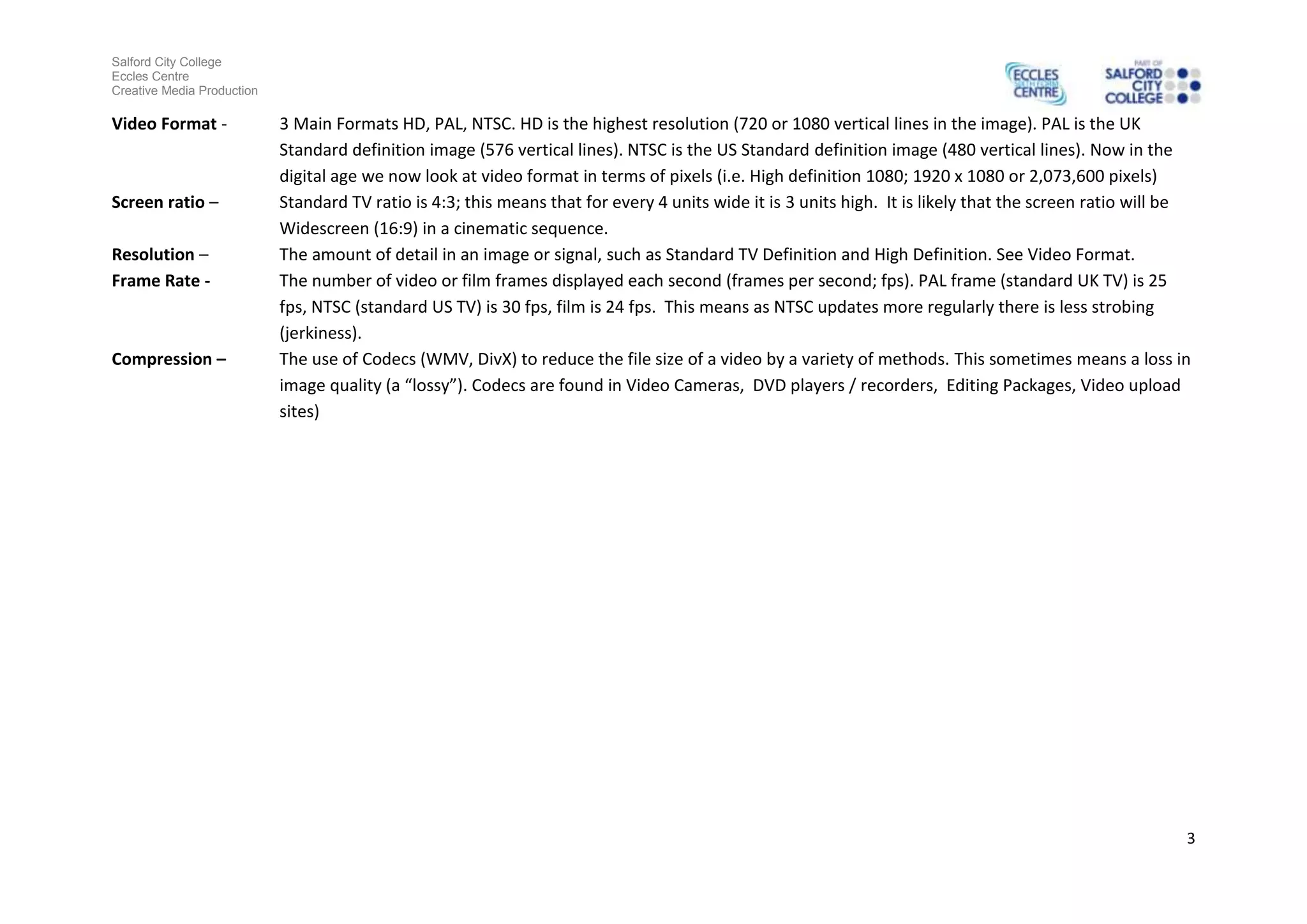
Video Format -              3 Main Formats HD, PAL, NTSC. HD is the highest resolution (720 or 1080 vertical lines in the image). PAL is the UK
                            Standard definition image (576 vertical lines). NTSC is the US Standard definition image (480 vertical lines). Now in the
                            digital age we now look at video format in terms of pixels (i.e. High definition 1080; 1920 x 1080 or 2,073,600 pixels)
Screen ratio –              Standard TV ratio is 4:3; this means that for every 4 units wide it is 3 units high. It is likely that the screen ratio will be
                            Widescreen (16:9) in a cinematic sequence.
Resolution –                The amount of detail in an image or signal, such as Standard TV Definition and High Definition. See Video Format.
Frame Rate -                The number of video or film frames displayed each second (frames per second; fps). PAL frame (standard UK TV) is 25
                            fps, NTSC (standard US TV) is 30 fps, film is 24 fps. This means as NTSC updates more regularly there is less strobing
                            (jerkiness).
Compression –               The use of Codecs (WMV, DivX) to reduce the file size of a video by a variety of methods. This sometimes means a loss in
                            image quality (a “lossy”). Codecs are found in Video Cameras, DVD players / recorders, Editing Packages, Video upload
                            sites)


                                                                                                                                                          3

Motion graphics and_compositing_video_analysis_worksheet 2

  • 1.
    Salford City College EcclesCentre Creative Media Production Use of text: Text just has BBC One in a large red box in the bottom left corner and subtitles in small text in (Title, Credits, animated captions, stings, the top right corner. It is an ident. indents, interactive menus, web banner) Brief description: We see three boys on skateboards skating through what looks like a construction site. The What do you see? three boys are doing several tricks on their skateboards and the camera slowly moving to the front of them. This is done to show BBC One viewers something they might see on that channel because there are one or two programs like what we see in the graphic. Techniques used: The only technique really use is movement, the movement of the boys on the skateboards and Animation, Visual Effects, Colour Rendering, the movement of the cameras surrounding them. We slowly see more revealed of them as the Graphics, Movement graphic nears it end because the camera moves slowly to a better angle where we can see more. Advanced techniques: The only advanced technique used really is rotation where the camera rotates to show us a Blur, Sharpen, Distortion, Rotation, Opacity better view of the people on the skateboards. It is used to slowly reveal more of the skateboarders so we know what the graphic is about. 1
  • 2.
    Salford City College EcclesCentre Creative Media Production Technical comments: Video Format = PAL, Screen Ratio = 4:3, Resolution = Standard Definition, Frame rate = 25 fps, Video Format, Screen Ratio, Resolution, Compression = Xvid Frame rate, Compression Resolution (Standard Definition) Pro’s = Smaller file size Con’s = Quality not as good as it could be Motion Graphics and Video Compositing Unit 64 Glossary Motion graphics - Graphics that use video footage and/or animation technology to create the illusion of motion or rotation, graphics are usually combined with audio for use in multimedia projects. Compositing video - When there are several different clips of video are layered over one another to create a single image. Interactive Menus – DVD Interface or Interactive Menus on a web page Ident – The ‘call sign’ of a channel or production company to identify themselves on screen, usually shown before a programme. Animated Captions – Animated Graphics layered over an image / video Web Banners – A form of web advertising that is embedded into a web page. They are used to attract a viewer to their website. A Web Banner usually a mix of motion graphics and video 2
  • 3.
    Salford City College EcclesCentre Creative Media Production Video Format - 3 Main Formats HD, PAL, NTSC. HD is the highest resolution (720 or 1080 vertical lines in the image). PAL is the UK Standard definition image (576 vertical lines). NTSC is the US Standard definition image (480 vertical lines). Now in the digital age we now look at video format in terms of pixels (i.e. High definition 1080; 1920 x 1080 or 2,073,600 pixels) Screen ratio – Standard TV ratio is 4:3; this means that for every 4 units wide it is 3 units high. It is likely that the screen ratio will be Widescreen (16:9) in a cinematic sequence. Resolution – The amount of detail in an image or signal, such as Standard TV Definition and High Definition. See Video Format. Frame Rate - The number of video or film frames displayed each second (frames per second; fps). PAL frame (standard UK TV) is 25 fps, NTSC (standard US TV) is 30 fps, film is 24 fps. This means as NTSC updates more regularly there is less strobing (jerkiness). Compression – The use of Codecs (WMV, DivX) to reduce the file size of a video by a variety of methods. This sometimes means a loss in image quality (a “lossy”). Codecs are found in Video Cameras, DVD players / recorders, Editing Packages, Video upload sites) 3