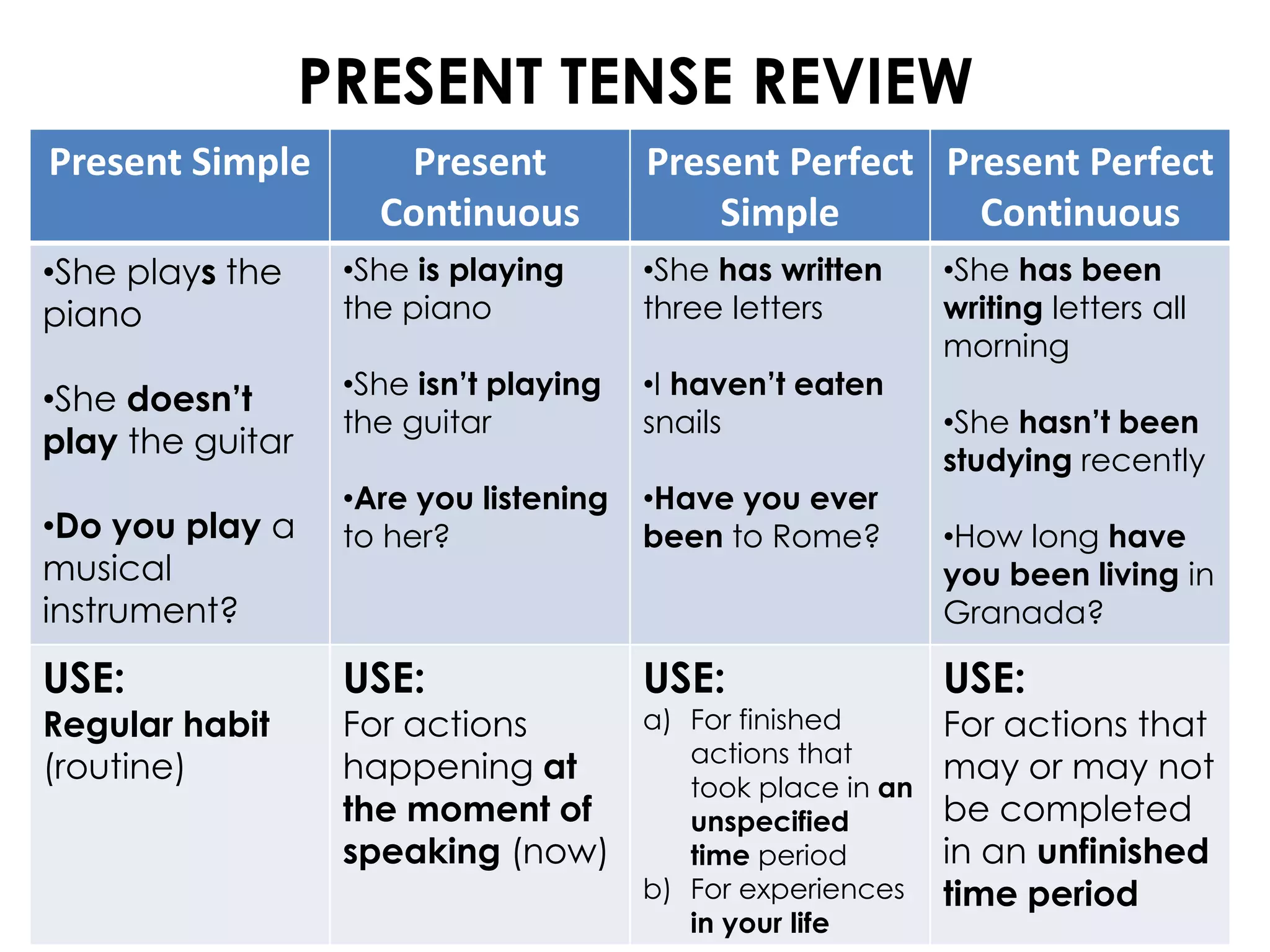
PRESENT TENSE REVIEW
Present Simple Present
Continuous
Present Perfect
Simple
Present Perfect
Continuous
•She plays the
piano
•She doesn’t
play the guitar
•Do you play a
musical
instrument?
•She is playing
the piano
•She isn’t playing
the guitar
•Are you listening
to her?
•She has written
three letters
•I haven’t eaten
snails
•Have you ever
been to Rome?
•She has been
writing letters all
morning
•She hasn’t been
studying recently
•How long have
you been living in
Granada?
USE:
Regular habit
(routine)
USE:
For actions
happening at
the moment of
speaking (now)
USE:
a) For finished
actions that
took place in an
unspecified
time period
b) For experiences
in your life
USE:
For actions that
may or may not
be completed
in an unfinished
time period
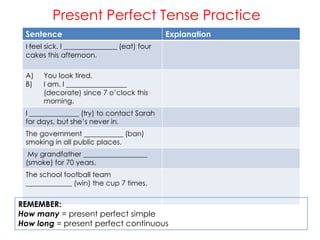
Present Perfect Tense Practice
Sentence Explanation
I feel sick. I _______________ (eat) four
cakes this afternoon.
A) You look tired.
B) I am. I _________________
(decorate) since 7 o’clock this
morning.
I ______________ (try) to contact Sarah
for days, but she’s never in.
The government ___________ (ban)
smoking in all public places.
My grandfather __________________
(smoke) for 70 years.
The school football team
_____________ (win) the cup 7 times.
REMEMBER:
How many = present perfect simple
How long = present perfect continuous
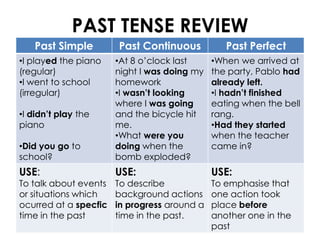
PAST TENSE REVIEW
Past Simple Past Continuous Past Perfect
•I played the piano
(regular)
•I went to school
(irregular)
•I didn’t play the
piano
•Did you go to
school?
•At 8 o’clock last
night I was doing my
homework
•I wasn’t looking
where I was going
and the bicycle hit
me.
•What were you
doing when the
bomb exploded?
•When we arrived at
the party, Pablo had
already left.
•I hadn’t finished
eating when the bell
rang.
•Had they started
when the teacher
came in?
USE:
To talk about events
or situations which
ocurred at a specfic
time in the past
USE:
To describe
background actions
in progress around a
time in the past.
USE:
To emphasise that
one action took
place before
another one in the
past
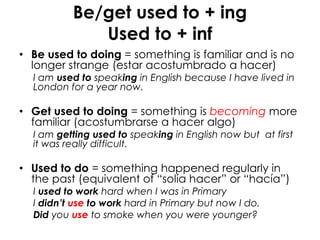
Be/get used to + ing
Used to + inf
• Be used to doing = something is familiar and is no
longer strange (estar acostumbrado a hacer)
I am used to speaking in English because I have lived in
London for a year now.
• Get used to doing = something is becoming more
familiar (acostumbrarse a hacer algo)
I am getting used to speaking in English now but at first
it was really difficult.
• Used to do = something happened regularly in
the past (equivalent of “solía hacer” or “hacía”)
I used to work hard when I was in Primary
I didn’t use to work hard in Primary but now I do.
Did you use to smoke when you were younger?
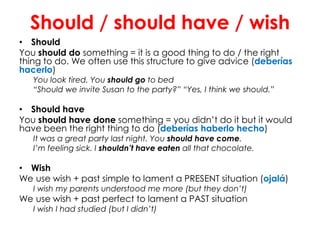
Should / should have / wish
• Should
You should do something = it is a good thing to do / the right
thing to do. We often use this structure to give advice (deberías
hacerlo)
You look tired. You should go to bed
“Should we invite Susan to the party?” “Yes, I think we should.”
• Should have
You should have done something = you didn’t do it but it would
have been the right thing to do (deberías haberlo hecho)
It was a great party last night. You should have come.
I’m feeling sick. I shouldn’t have eaten all that chocolate.
• Wish
We use wish + past simple to lament a PRESENT situation (ojalá)
I wish my parents understood me more (but they don’t)
We use wish + past perfect to lament a PAST situation
I wish I had studied (but I didn’t)

Welcome Section A

  • 1.
    PRESENT TENSE REVIEW PresentSimple Present Continuous Present Perfect Simple Present Perfect Continuous •She plays the piano •She doesn’t play the guitar •Do you play a musical instrument? •She is playing the piano •She isn’t playing the guitar •Are you listening to her? •She has written three letters •I haven’t eaten snails •Have you ever been to Rome? •She has been writing letters all morning •She hasn’t been studying recently •How long have you been living in Granada? USE: Regular habit (routine) USE: For actions happening at the moment of speaking (now) USE: a) For finished actions that took place in an unspecified time period b) For experiences in your life USE: For actions that may or may not be completed in an unfinished time period
  • 2.
    Present Perfect TensePractice Sentence Explanation I feel sick. I _______________ (eat) four cakes this afternoon. A) You look tired. B) I am. I _________________ (decorate) since 7 o’clock this morning. I ______________ (try) to contact Sarah for days, but she’s never in. The government ___________ (ban) smoking in all public places. My grandfather __________________ (smoke) for 70 years. The school football team _____________ (win) the cup 7 times. REMEMBER: How many = present perfect simple How long = present perfect continuous
  • 3.
    PAST TENSE REVIEW PastSimple Past Continuous Past Perfect •I played the piano (regular) •I went to school (irregular) •I didn’t play the piano •Did you go to school? •At 8 o’clock last night I was doing my homework •I wasn’t looking where I was going and the bicycle hit me. •What were you doing when the bomb exploded? •When we arrived at the party, Pablo had already left. •I hadn’t finished eating when the bell rang. •Had they started when the teacher came in? USE: To talk about events or situations which ocurred at a specfic time in the past USE: To describe background actions in progress around a time in the past. USE: To emphasise that one action took place before another one in the past
  • 4.
    Be/get used to+ ing Used to + inf • Be used to doing = something is familiar and is no longer strange (estar acostumbrado a hacer) I am used to speaking in English because I have lived in London for a year now. • Get used to doing = something is becoming more familiar (acostumbrarse a hacer algo) I am getting used to speaking in English now but at first it was really difficult. • Used to do = something happened regularly in the past (equivalent of “solía hacer” or “hacía”) I used to work hard when I was in Primary I didn’t use to work hard in Primary but now I do. Did you use to smoke when you were younger?
  • 5.
    Should / shouldhave / wish • Should You should do something = it is a good thing to do / the right thing to do. We often use this structure to give advice (deberías hacerlo) You look tired. You should go to bed “Should we invite Susan to the party?” “Yes, I think we should.” • Should have You should have done something = you didn’t do it but it would have been the right thing to do (deberías haberlo hecho) It was a great party last night. You should have come. I’m feeling sick. I shouldn’t have eaten all that chocolate. • Wish We use wish + past simple to lament a PRESENT situation (ojalá) I wish my parents understood me more (but they don’t) We use wish + past perfect to lament a PAST situation I wish I had studied (but I didn’t)