Situations and habits in the
present and past
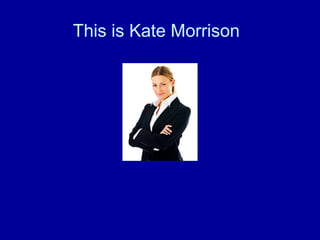
This is Kate Morrison
Now
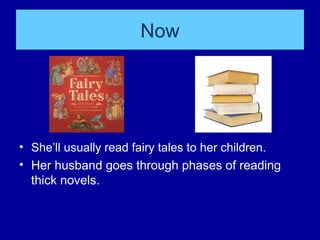
• She’ll usually read fairy tales to her children.
• Her husband goes through phases of reading
thick novels.
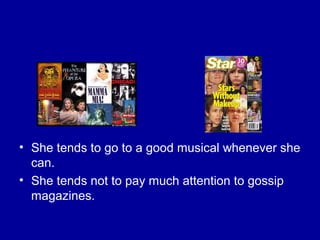
• She tends to go to a good musical whenever she
can.
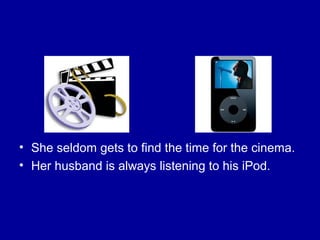
• She tends not to pay much attention to gossip
magazines.
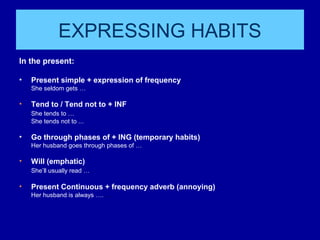
• She seldom gets to find the time for the cinema.
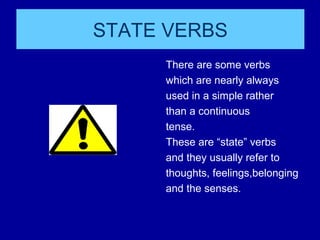
• Her husband is always listening to his iPod.
EXPRESSING HABITS
In the present:
• Present simple + expression of frequency
She seldom gets …
• Tend to / Tend not to + INF
She tends to …
She tends not to ...
• Go through phases of + ING (temporary habits)
Her husband goes through phases of …
• Will (emphatic)
She’ll usually read …
• Present Continuous + frequency adverb (annoying)
Her husband is always …. …
STATE VERBS
There are some verbs
which are nearly always
used in a simple rather
than a continuous
tense.
These are “state” verbs
and they usually refer to
thoughts, feelings,belonging
and the senses.
THOUGHTS:
believe, know, mean, realise, recognise,
remember, suppose, understand, feel, think.
FEELINGS:
adore, dislike, despise, hate, love, want, wish,
prefer,…
BELONGING:
belong, have/have got (=posses), own, posses,…
SENSES:
smell, taste, hear, see.
OTHER STATE VERBS:
seem, look, look like, matter,…
Some verbs have a stative meaning and
a different active meaning:
She’s got a beautiful house
 We’re having an interesting conversation.
It tastes delicious
I’m tasting the sauce.
I think you’ll pass your exam
I’m thinking about you.
Ten years ago…
• She went to University from Monday to Friday.
• She used to study with some friends at the
library.
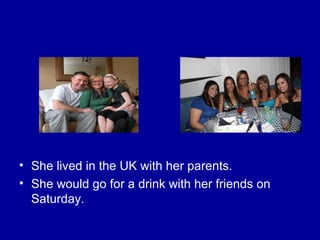
• She lived in the UK with her parents.
• She would go for a drink with her friends on
Saturday.
PAST SIMPLE
We use “past simple” to:
 Talk about permanent, long-term situations in the
past:
She lived with her family.
 Refer to past habits:
She went to University from Monday to Friday.
USED TO / WOULD
We can use both “used to” and “would” to
talk about past habits when we are
emphasising that they are no longer true:
 She used to study at the library
 She would go for a drink with her friends
on Saturday.
“Used to” is much more common than would
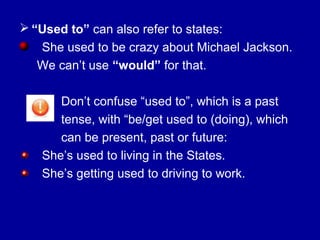
 “Used to” can also refer to states:
She used to be crazy about Michael Jackson.
We can’t use “would” for that.
Don’t confuse “used to”, which is a past
tense, with “be/get used to (doing), which
can be present, past or future:
She’s used to living in the States.
She’s getting used to driving to work.
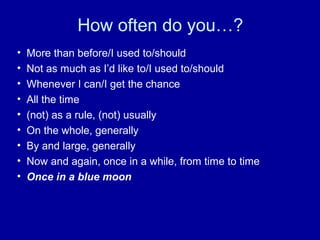
How often do you…?
• More than before/I used to/should
• Not as much as I’d like to/I used to/should
• Whenever I can/I get the chance
• All the time
• (not) as a rule, (not) usually
• On the whole, generally
• By and large, generally
• Now and again, once in a while, from time to time
• Once in a blue moon
Customs
BE/ GET USED TO + ing:
What’s the difference between these two
sentences?
“I have to get used to going to bed earlier”
“I’m used to going to bed before 10”
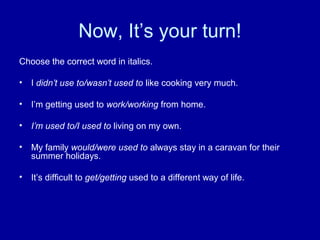
Now, It’s your turn!
Choose the correct word in italics.
• I didn’t use to/wasn’t used to like cooking very much.
• I’m getting used to work/working from home.
• I’m used to/I used to living on my own.
• My family would/were used to always stay in a caravan for their
summer holidays.
• It’s difficult to get/getting used to a different way of life.
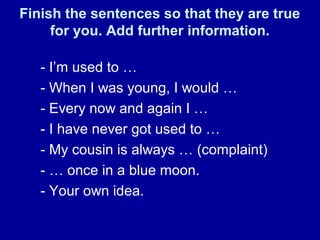
Finish the sentences so that they are true
for you. Add further information.
- I’m used to …
- When I was young, I would …
- Every now and again I …
- I have never got used to …
- My cousin is always … (complaint)
- … once in a blue moon.
- Your own idea.
Tell your partner about…
• a singer/band you used to like when you were younger
(and now you are embarrased about).
• what you would do after school when you were a child.
• a machine you would use a lot but now you don’t.
• a change at work/school/family that was a problem at first
but now you are used to .
• a piece of technology you found difficult to use at first but
now you are used to using.

Now and then new 2014 15

  • 1.
    Situations and habitsin the present and past
  • 2.
    This is KateMorrison
  • 3.
    Now • She’ll usuallyread fairy tales to her children. • Her husband goes through phases of reading thick novels.
  • 4.
    • She tendsto go to a good musical whenever she can. • She tends not to pay much attention to gossip magazines.
  • 5.
    • She seldomgets to find the time for the cinema. • Her husband is always listening to his iPod.
  • 6.
    EXPRESSING HABITS In thepresent: • Present simple + expression of frequency She seldom gets … • Tend to / Tend not to + INF She tends to … She tends not to ... • Go through phases of + ING (temporary habits) Her husband goes through phases of … • Will (emphatic) She’ll usually read … • Present Continuous + frequency adverb (annoying) Her husband is always …. …
  • 7.
    STATE VERBS There aresome verbs which are nearly always used in a simple rather than a continuous tense. These are “state” verbs and they usually refer to thoughts, feelings,belonging and the senses.
  • 8.
    THOUGHTS: believe, know, mean,realise, recognise, remember, suppose, understand, feel, think. FEELINGS: adore, dislike, despise, hate, love, want, wish, prefer,… BELONGING: belong, have/have got (=posses), own, posses,… SENSES: smell, taste, hear, see. OTHER STATE VERBS: seem, look, look like, matter,…
  • 9.
    Some verbs havea stative meaning and a different active meaning: She’s got a beautiful house  We’re having an interesting conversation. It tastes delicious I’m tasting the sauce. I think you’ll pass your exam I’m thinking about you.
  • 10.
    Ten years ago… •She went to University from Monday to Friday. • She used to study with some friends at the library.
  • 11.
    • She livedin the UK with her parents. • She would go for a drink with her friends on Saturday.
  • 12.
    PAST SIMPLE We use“past simple” to:  Talk about permanent, long-term situations in the past: She lived with her family.  Refer to past habits: She went to University from Monday to Friday.
  • 13.
    USED TO /WOULD We can use both “used to” and “would” to talk about past habits when we are emphasising that they are no longer true:  She used to study at the library  She would go for a drink with her friends on Saturday. “Used to” is much more common than would
  • 14.
     “Used to”can also refer to states: She used to be crazy about Michael Jackson. We can’t use “would” for that. Don’t confuse “used to”, which is a past tense, with “be/get used to (doing), which can be present, past or future: She’s used to living in the States. She’s getting used to driving to work.
  • 15.
    How often doyou…? • More than before/I used to/should • Not as much as I’d like to/I used to/should • Whenever I can/I get the chance • All the time • (not) as a rule, (not) usually • On the whole, generally • By and large, generally • Now and again, once in a while, from time to time • Once in a blue moon
  • 16.
    Customs BE/ GET USEDTO + ing: What’s the difference between these two sentences? “I have to get used to going to bed earlier” “I’m used to going to bed before 10”
  • 17.
    Now, It’s yourturn! Choose the correct word in italics. • I didn’t use to/wasn’t used to like cooking very much. • I’m getting used to work/working from home. • I’m used to/I used to living on my own. • My family would/were used to always stay in a caravan for their summer holidays. • It’s difficult to get/getting used to a different way of life.
  • 18.
    Finish the sentencesso that they are true for you. Add further information. - I’m used to … - When I was young, I would … - Every now and again I … - I have never got used to … - My cousin is always … (complaint) - … once in a blue moon. - Your own idea.
  • 19.
    Tell your partnerabout… • a singer/band you used to like when you were younger (and now you are embarrased about). • what you would do after school when you were a child. • a machine you would use a lot but now you don’t. • a change at work/school/family that was a problem at first but now you are used to . • a piece of technology you found difficult to use at first but now you are used to using.