GRAMMAR
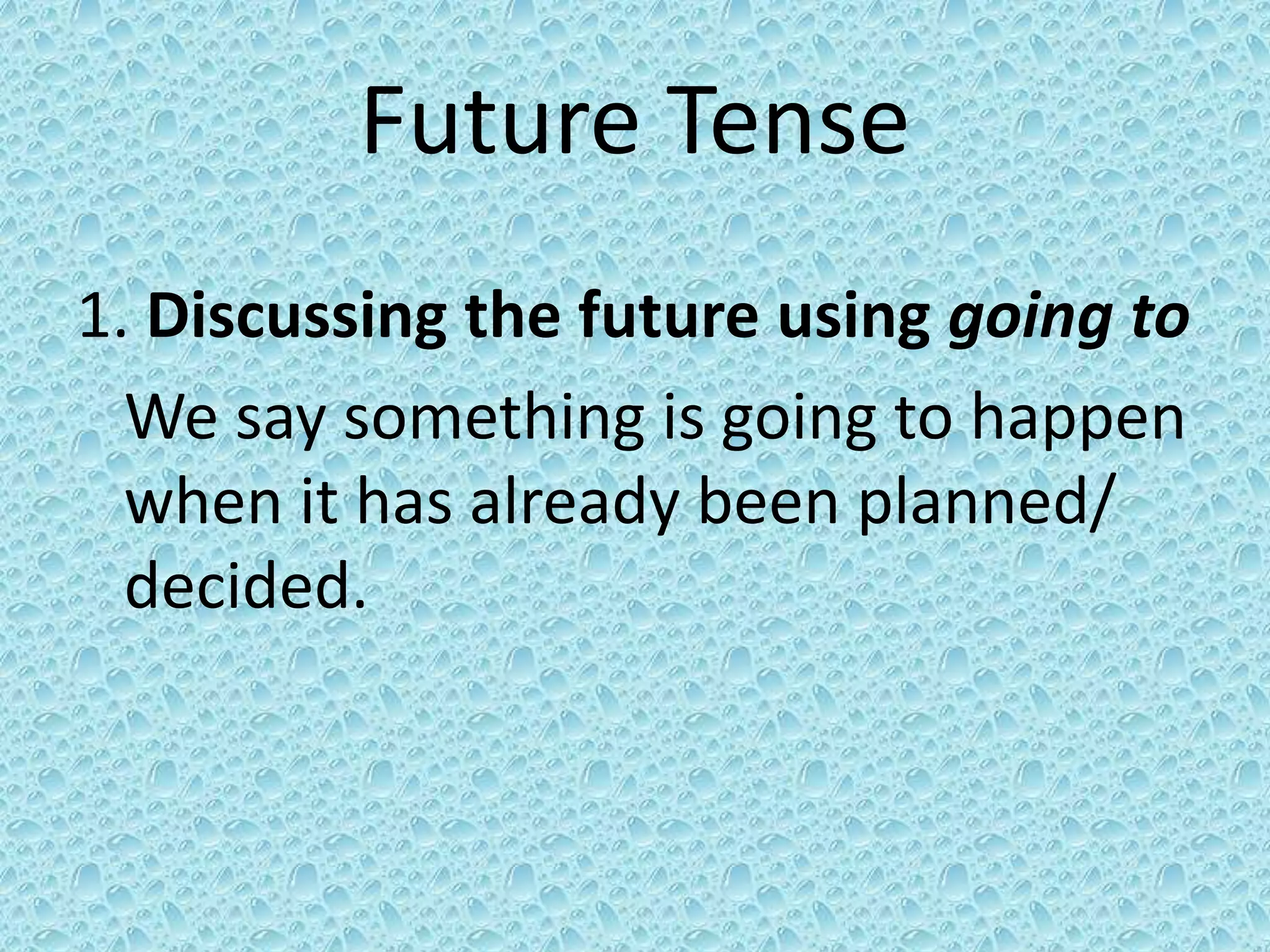
Future Tense 
1. Discussing the future using going to 
We say something is going to happen 
when it has already been planned/ 
decided.
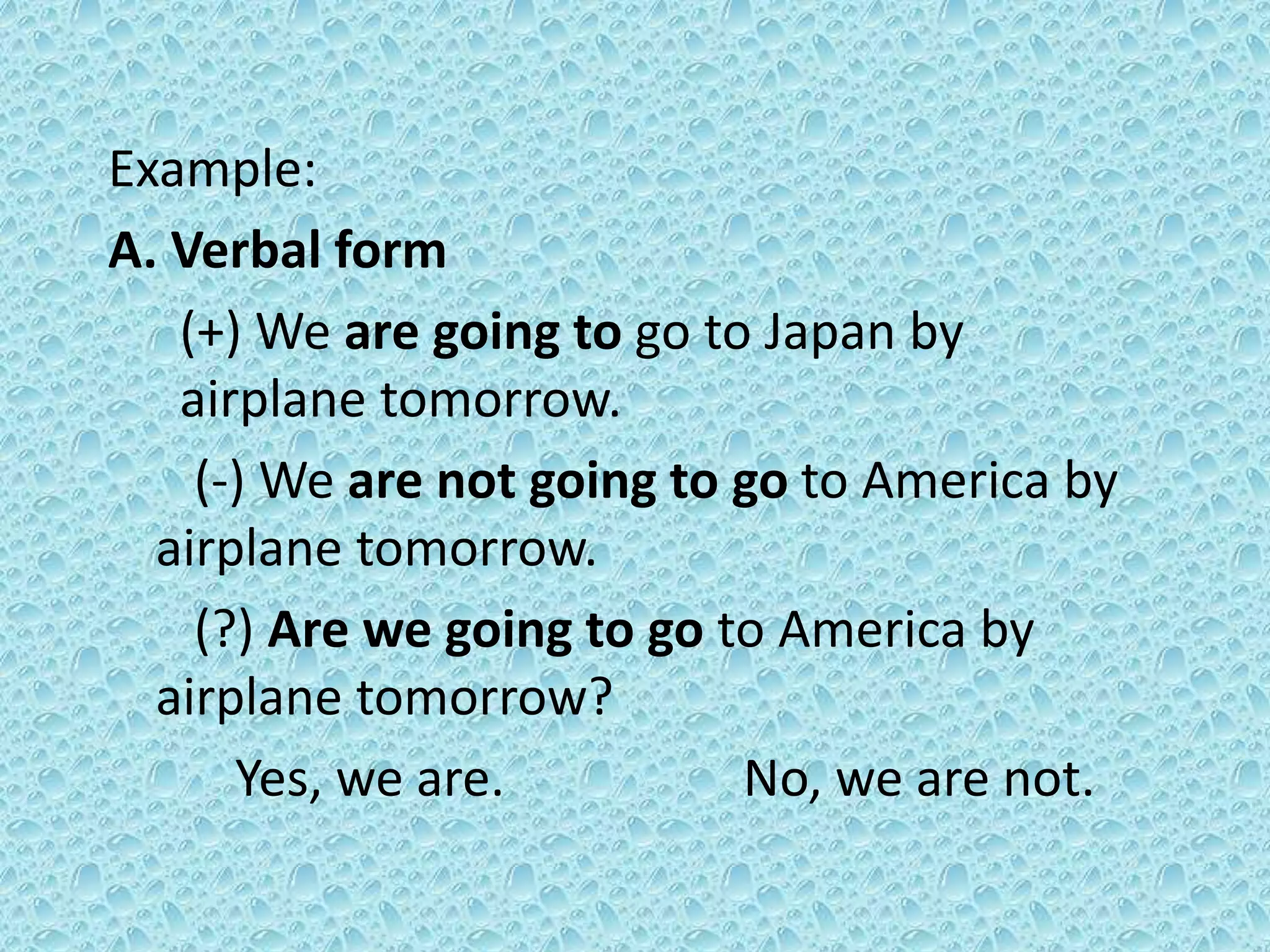
Example: 
A. Verbal form 
(+) We are going to go to Japan by 
airplane tomorrow. 
(-) We are not going to go to America by 
airplane tomorrow. 
(?) Are we going to go to America by 
airplane tomorrow? 
Yes, we are. No, we are not.
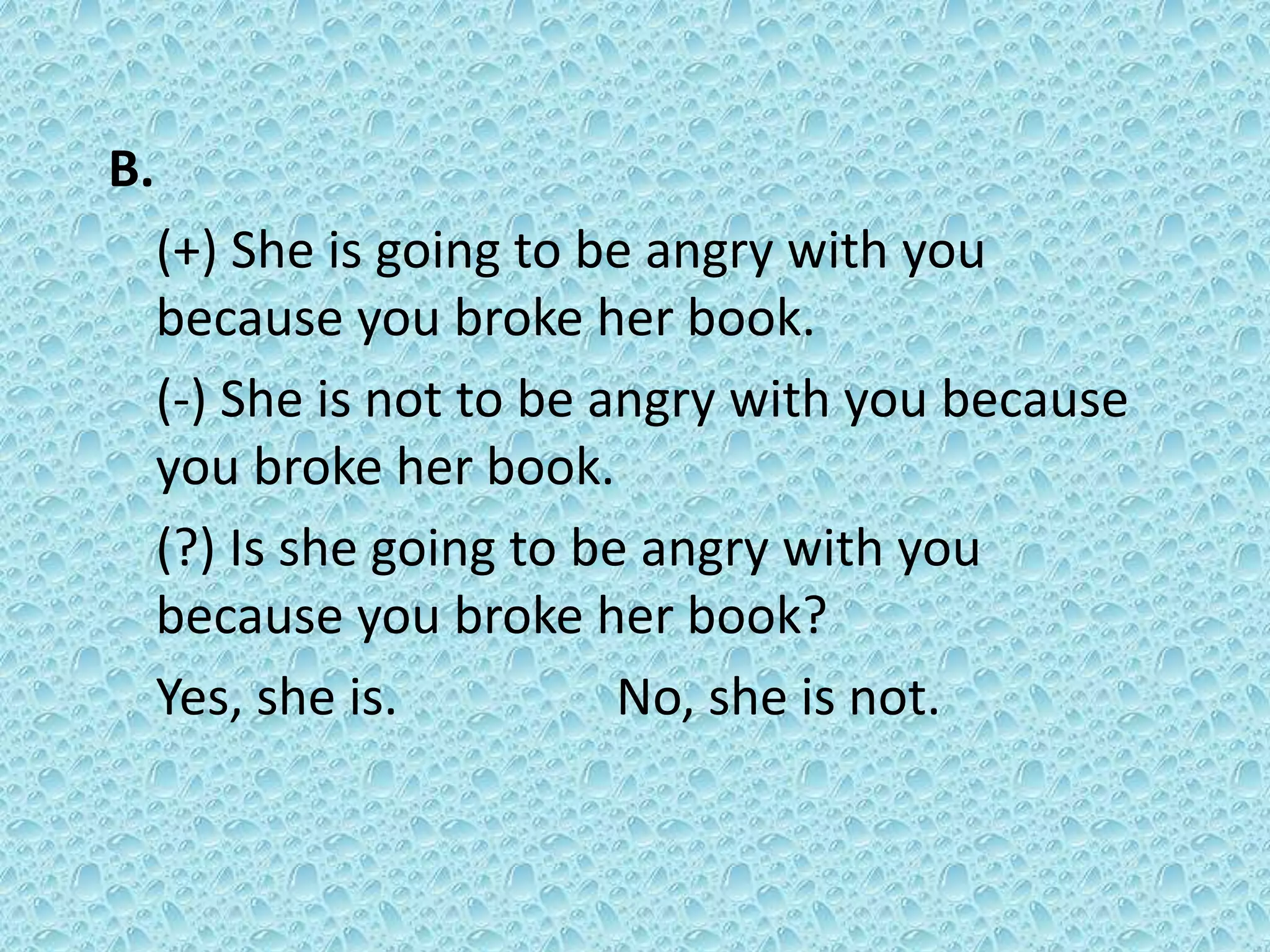
B. 
(+) She is going to be angry with you 
because you broke her book. 
(-) She is not to be angry with you because 
you broke her book. 
(?) Is she going to be angry with you 
because you broke her book? 
Yes, she is. No, she is not.
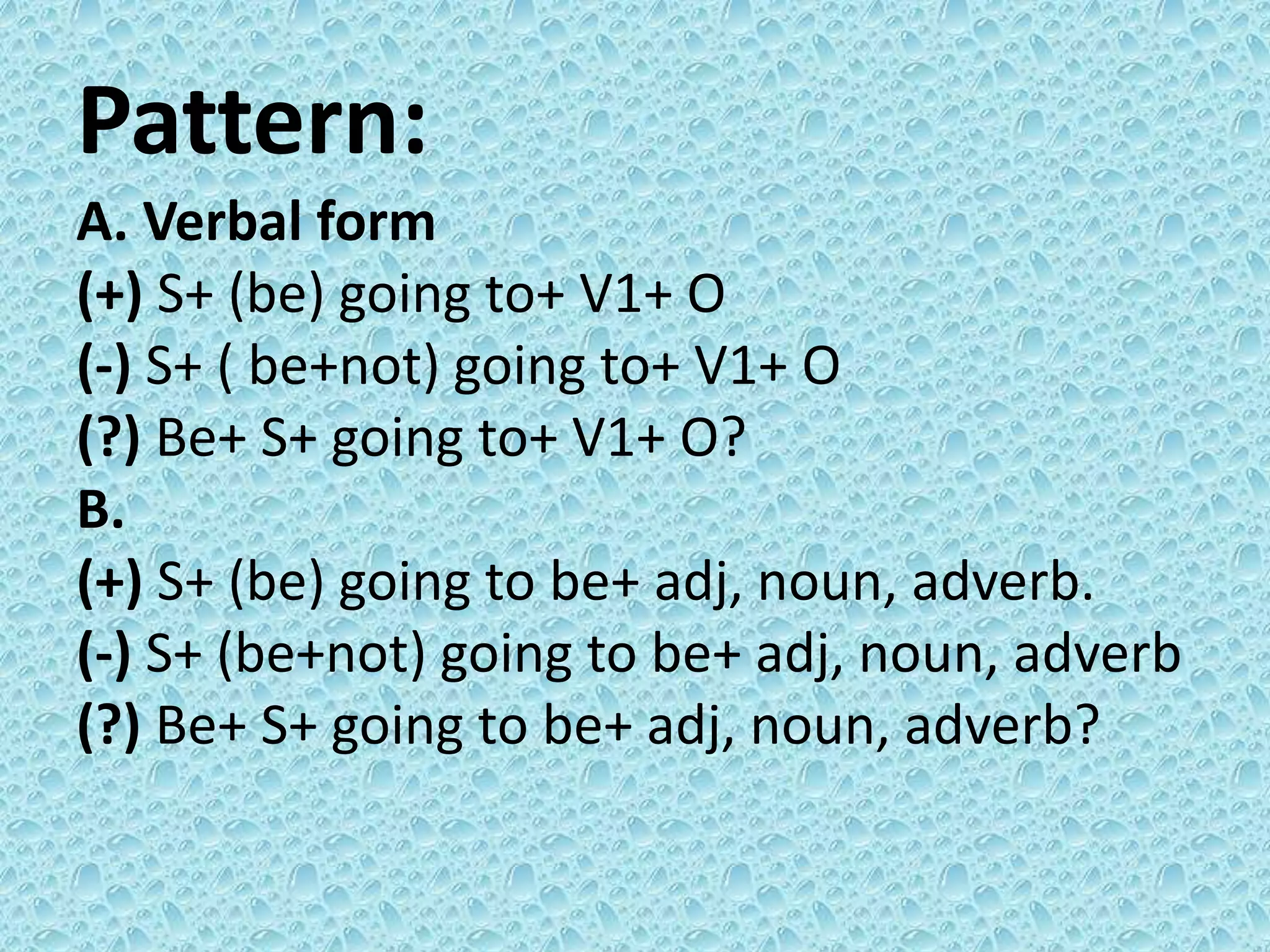
Pattern: 
A. Verbal form 
(+) S+ (be) going to+ V1+ O 
(-) S+ ( be+not) going to+ V1+ O 
(?) Be+ S+ going to+ V1+ O? 
B. 
(+) S+ (be) going to be+ adj, noun, adverb. 
(-) S+ (be+not) going to be+ adj, noun, adverb 
(?) Be+ S+ going to be+ adj, noun, adverb?
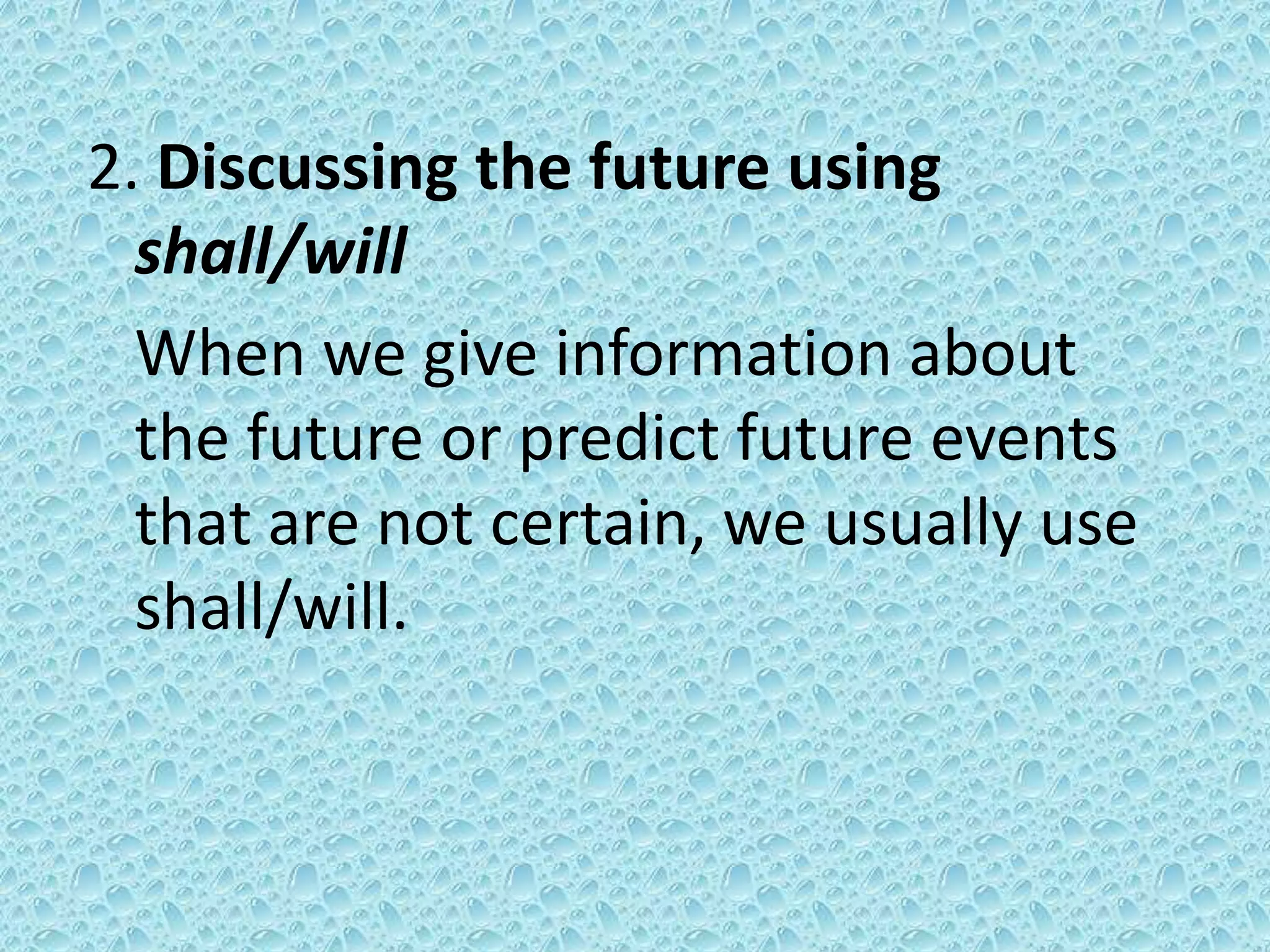
2. Discussing the future using 
shall/will 
When we give information about 
the future or predict future events 
that are not certain, we usually use 
shall/will.
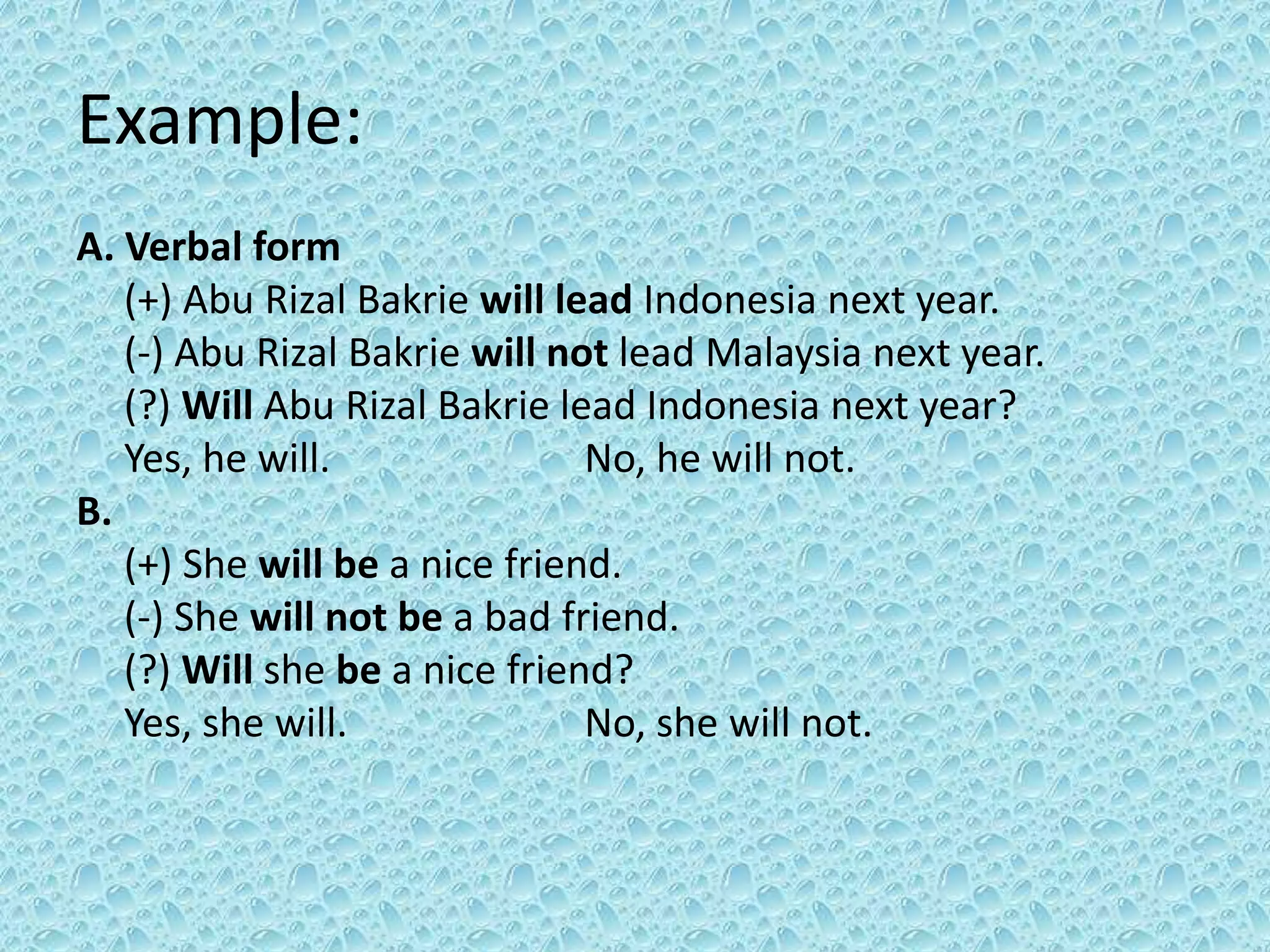
Example: 
A. Verbal form 
(+) Abu Rizal Bakrie will lead Indonesia next year. 
(-) Abu Rizal Bakrie will not lead Malaysia next year. 
(?) Will Abu Rizal Bakrie lead Indonesia next year? 
Yes, he will. No, he will not. 
B. 
(+) She will be a nice friend. 
(-) She will not be a bad friend. 
(?) Will she be a nice friend? 
Yes, she will. No, she will not.
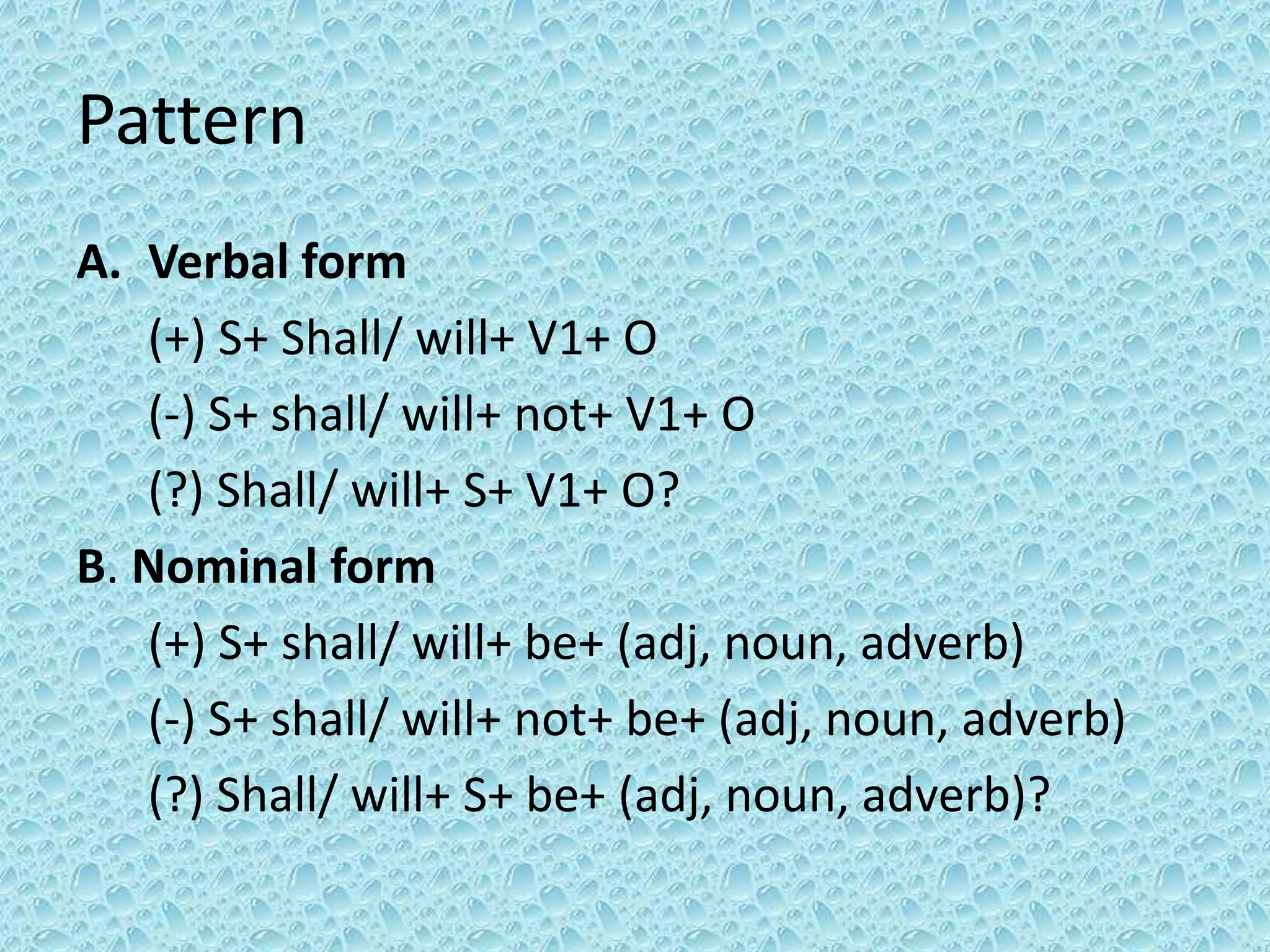
Pattern 
A. Verbal form 
(+) S+ Shall/ will+ V1+ O 
(-) S+ shall/ will+ not+ V1+ O 
(?) Shall/ will+ S+ V1+ O? 
B. Nominal form 
(+) S+ shall/ will+ be+ (adj, noun, adverb) 
(-) S+ shall/ will+ not+ be+ (adj, noun, adverb) 
(?) Shall/ will+ S+ be+ (adj, noun, adverb)?
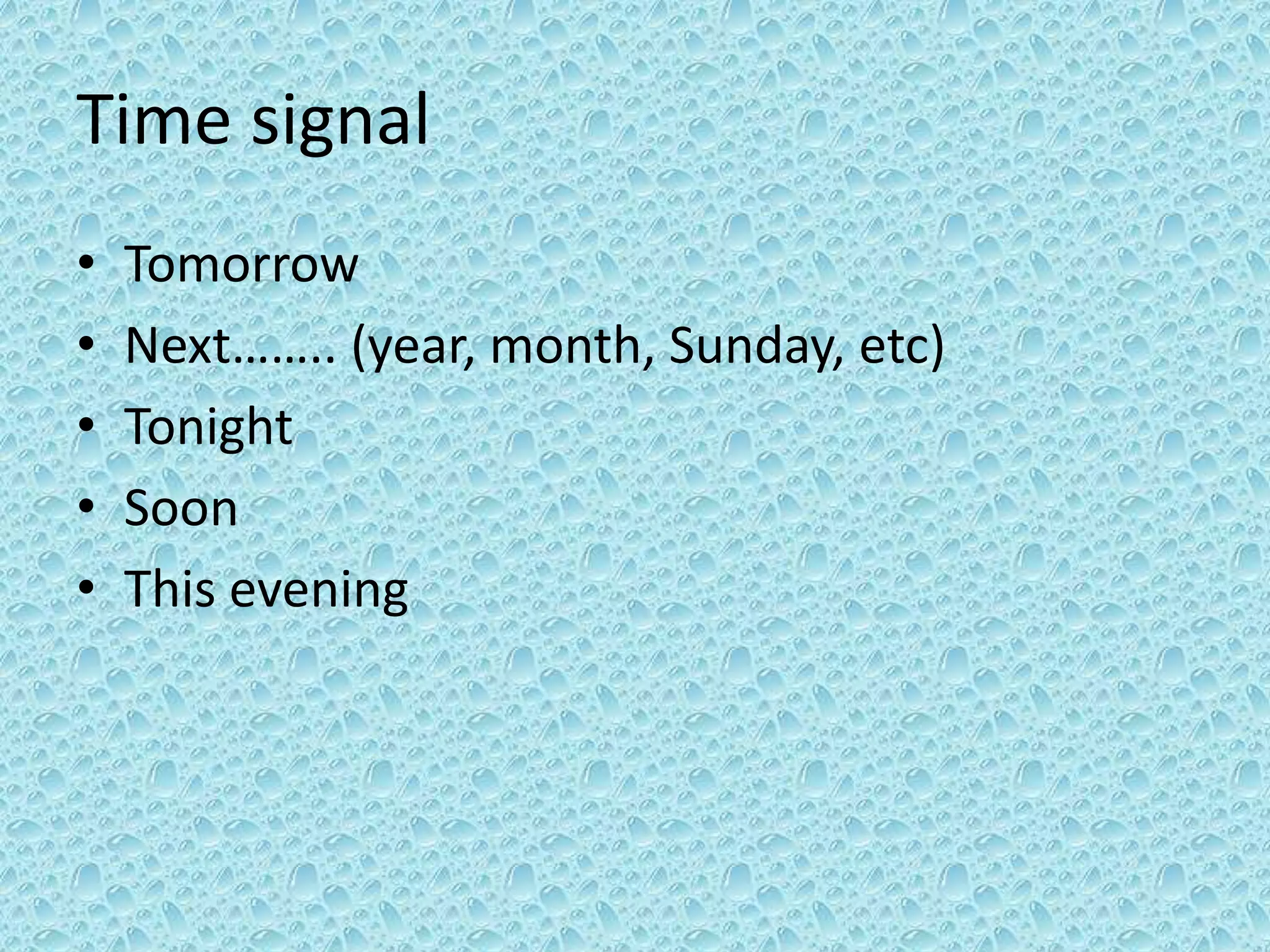
Time signal 
• Tomorrow 
• Next…….. (year, month, Sunday, etc) 
• Tonight 
• Soon 
• This evening
Present Perfect Tense 
Present perfect tense is used to 
talk about a past time, which has 
very strong meaning for the 
present.
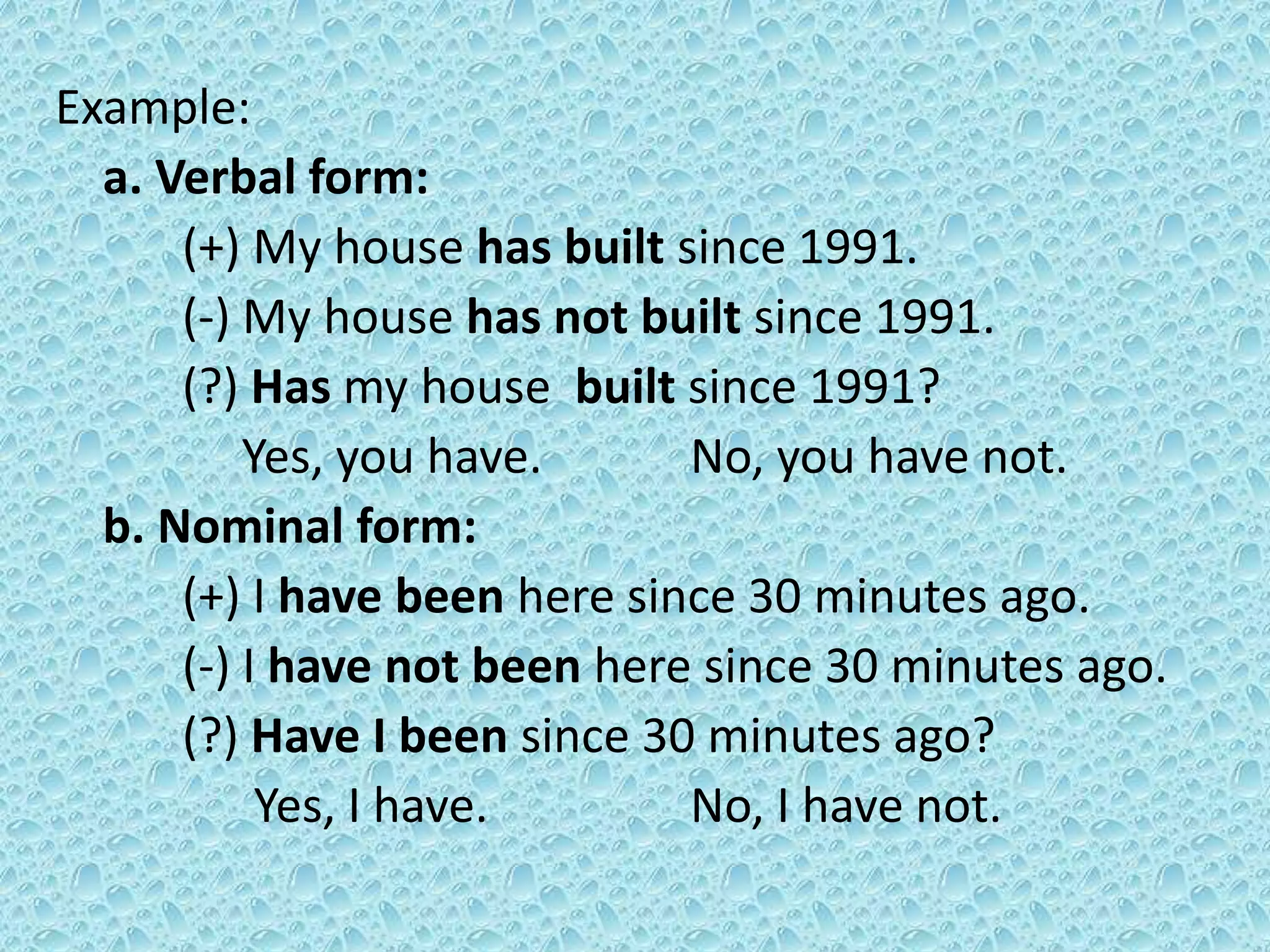
Example: 
a. Verbal form: 
(+) My house has built since 1991. 
(-) My house has not built since 1991. 
(?) Has my house built since 1991? 
Yes, you have. No, you have not. 
b. Nominal form: 
(+) I have been here since 30 minutes ago. 
(-) I have not been here since 30 minutes ago. 
(?) Have I been since 30 minutes ago? 
Yes, I have. No, I have not.
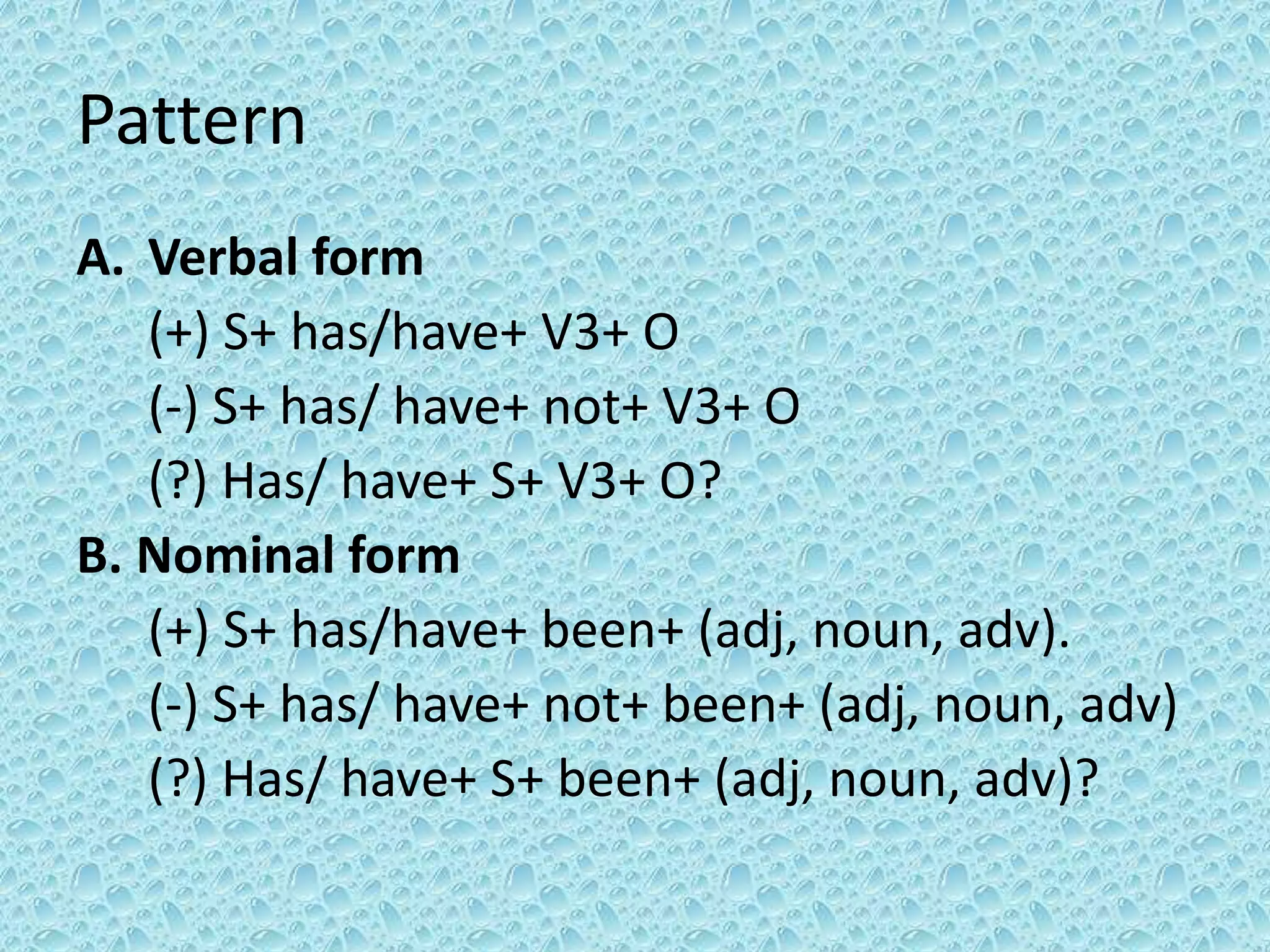
Pattern 
A. Verbal form 
(+) S+ has/have+ V3+ O 
(-) S+ has/ have+ not+ V3+ O 
(?) Has/ have+ S+ V3+ O? 
B. Nominal form 
(+) S+ has/have+ been+ (adj, noun, adv). 
(-) S+ has/ have+ not+ been+ (adj, noun, adv) 
(?) Has/ have+ S+ been+ (adj, noun, adv)?
Time Signal 
• Since 
• For 
• Already 
• Recently 
• Lately
Present Perfect Continuous Tense 
Present perfect continuous tense is 
often used (with for or since) to 
describe how long something has 
been happening up to now.
Example: 
(+) She has been living in Jember since 2010. 
(-) She has not been living in Jember since 
2010. 
(?) Has she been living in Jember since 2010? 
Yes, she has. No, she has not.
Pattern 
(+) S+ has/ have+ been+ Ving+ O 
(-) S+ has/have+ not+ been+ Ving+ O 
(?) Has/ have+ S+ been+ Ving+ O?
Time Signal 
• For…… 
• Since …. 
• By last…….
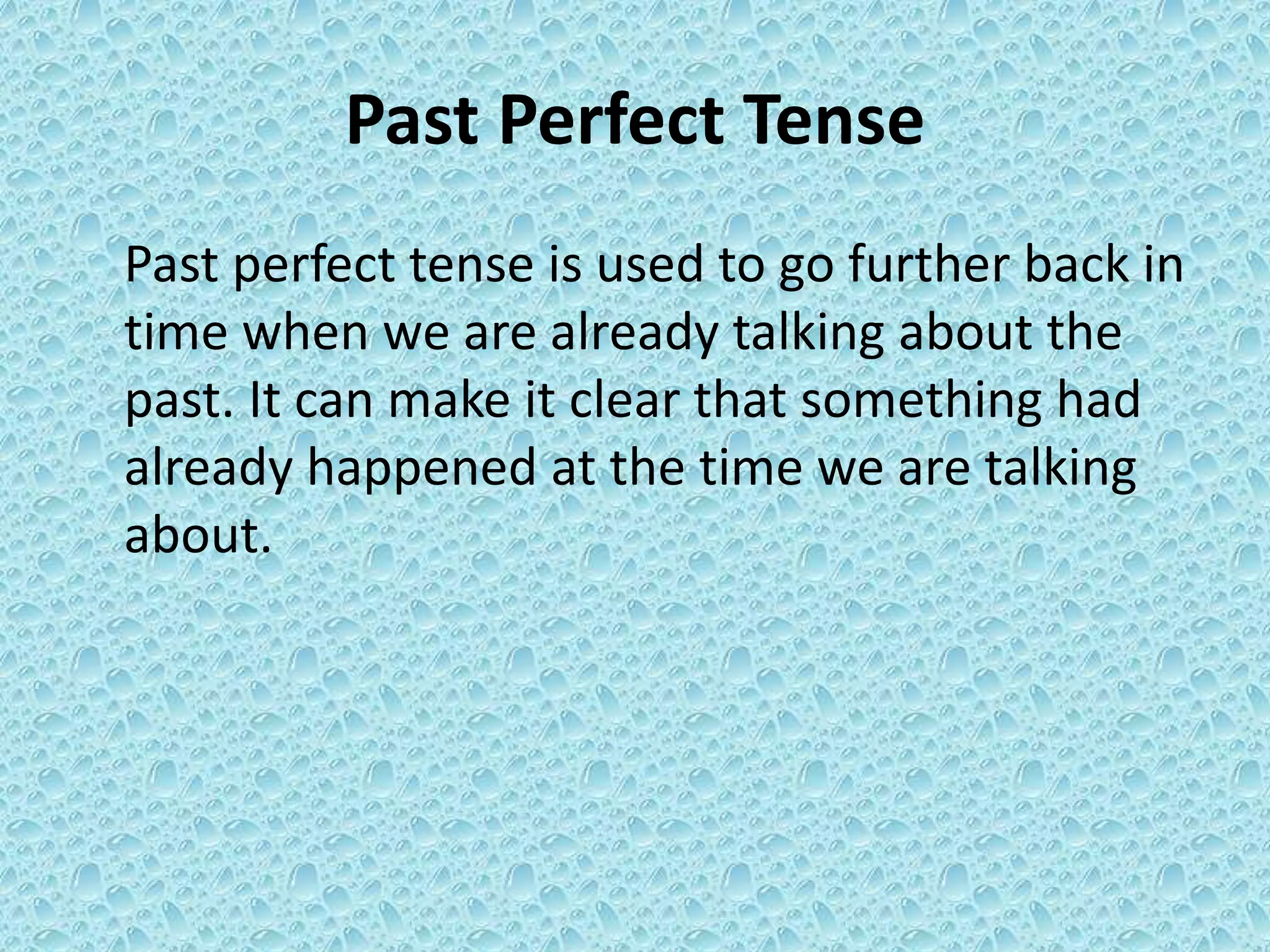
Past Perfect Tense 
Past perfect tense is used to go further back in 
time when we are already talking about the 
past. It can make it clear that something had 
already happened at the time we are talking 
about.
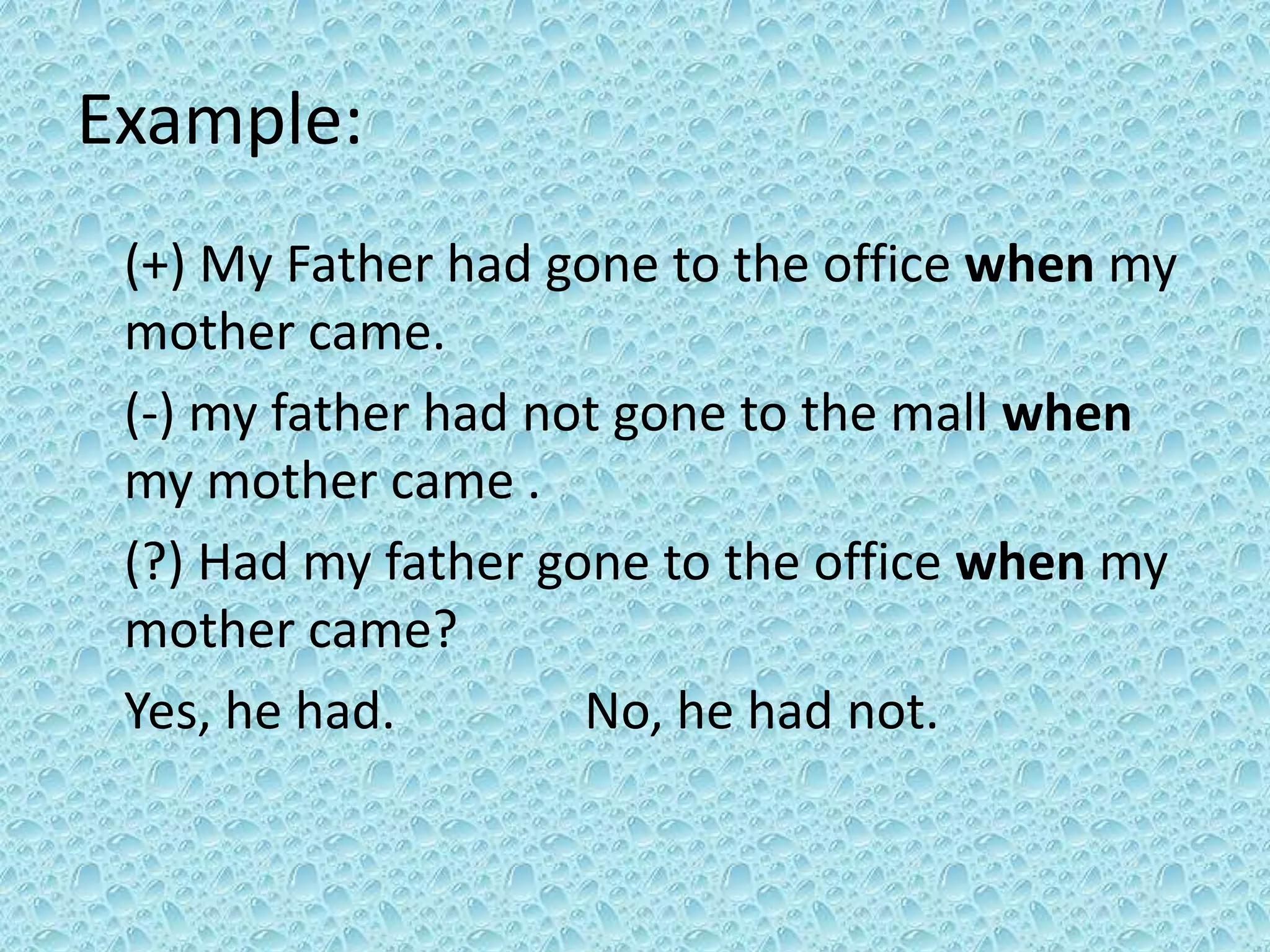
Example: 
(+) My Father had gone to the office when my 
mother came. 
(-) my father had not gone to the mall when 
my mother came . 
(?) Had my father gone to the office when my 
mother came? 
Yes, he had. No, he had not.
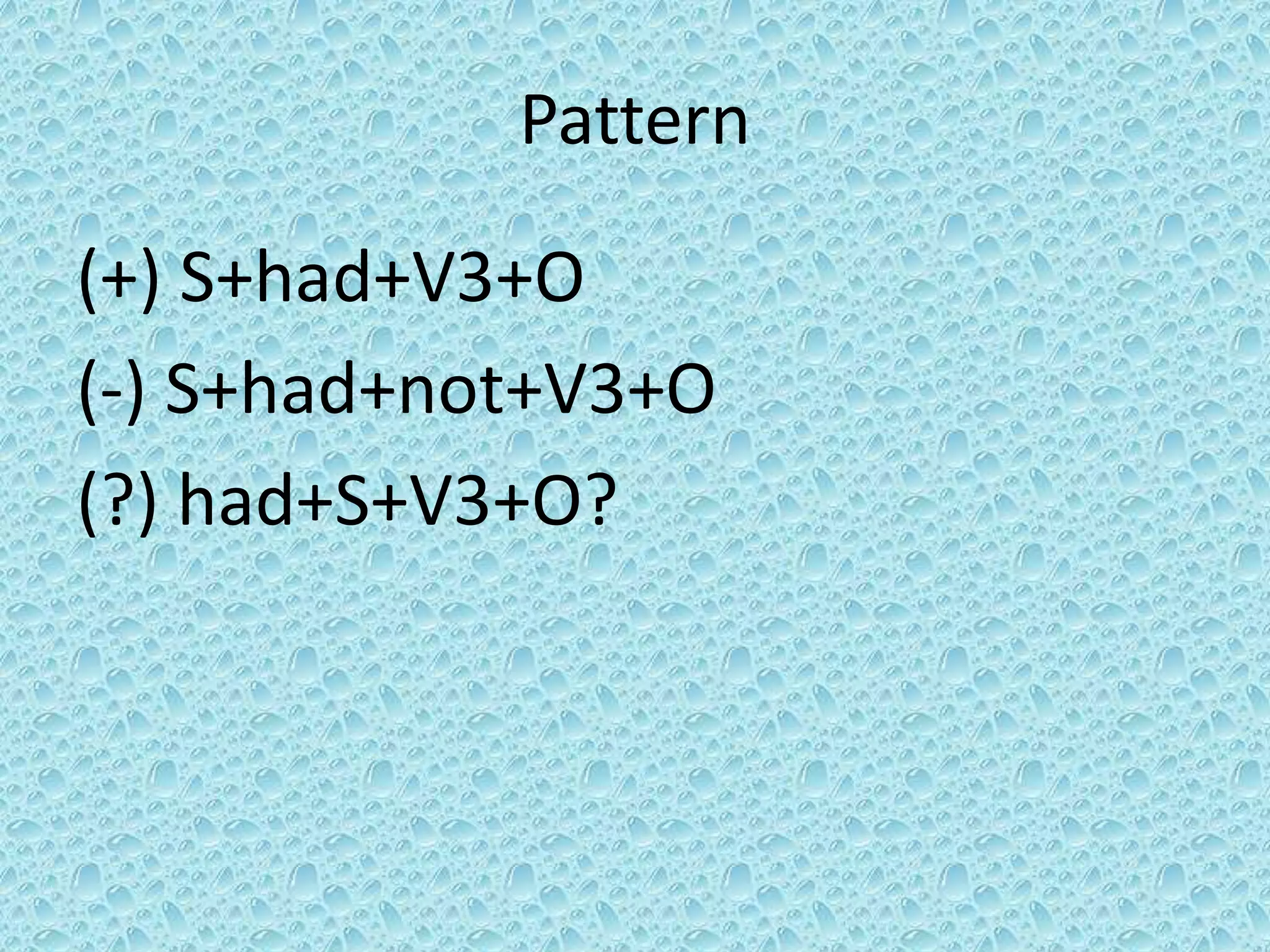
Pattern 
(+) S+had+V3+O 
(-) S+had+not+V3+O 
(?) had+S+V3+O?
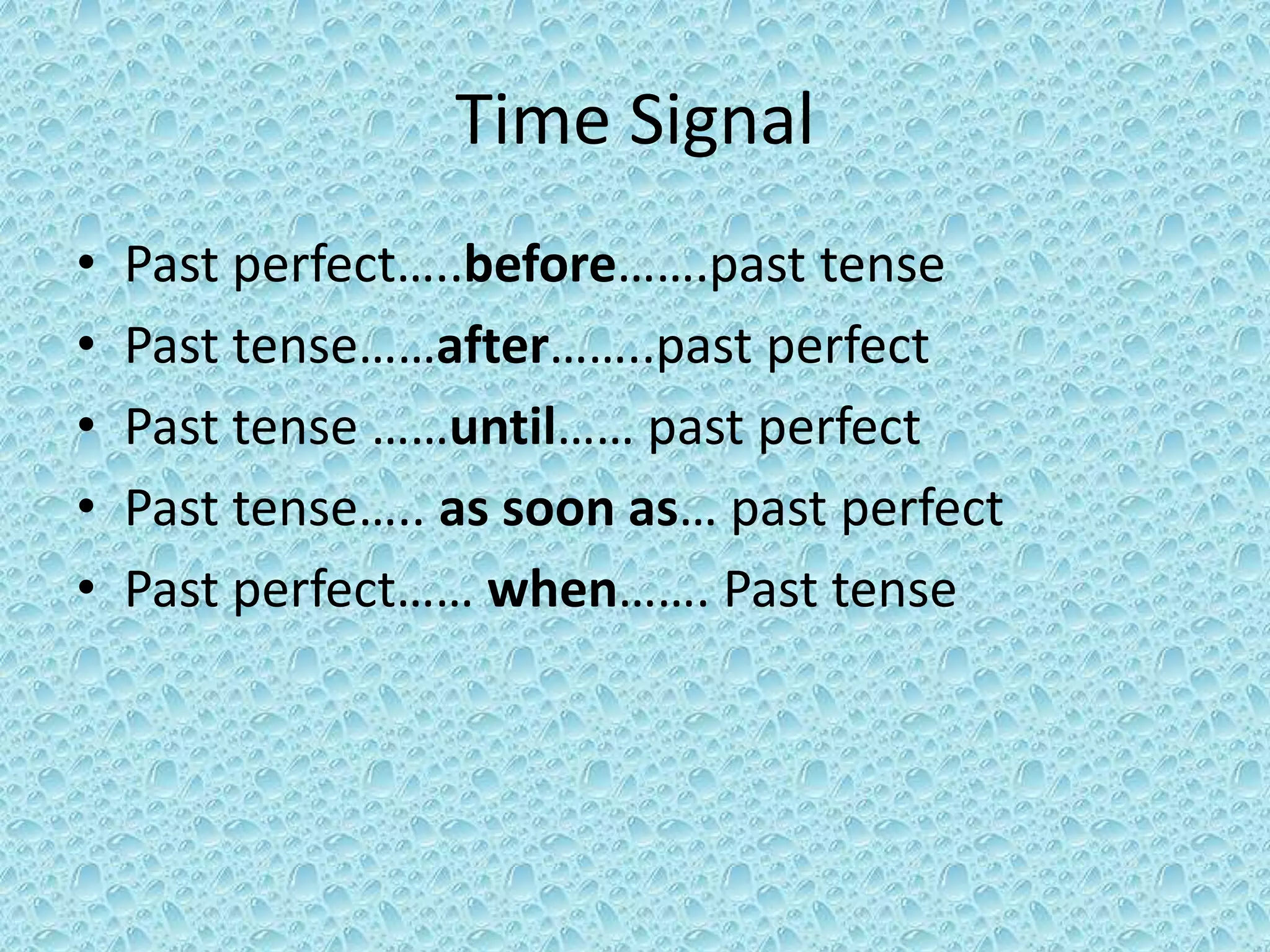
Time Signal 
• Past perfect…..before…….past tense 
• Past tense……after……..past perfect 
• Past tense ……until…… past perfect 
• Past tense….. as soon as… past perfect 
• Past perfect…… when……. Past tense
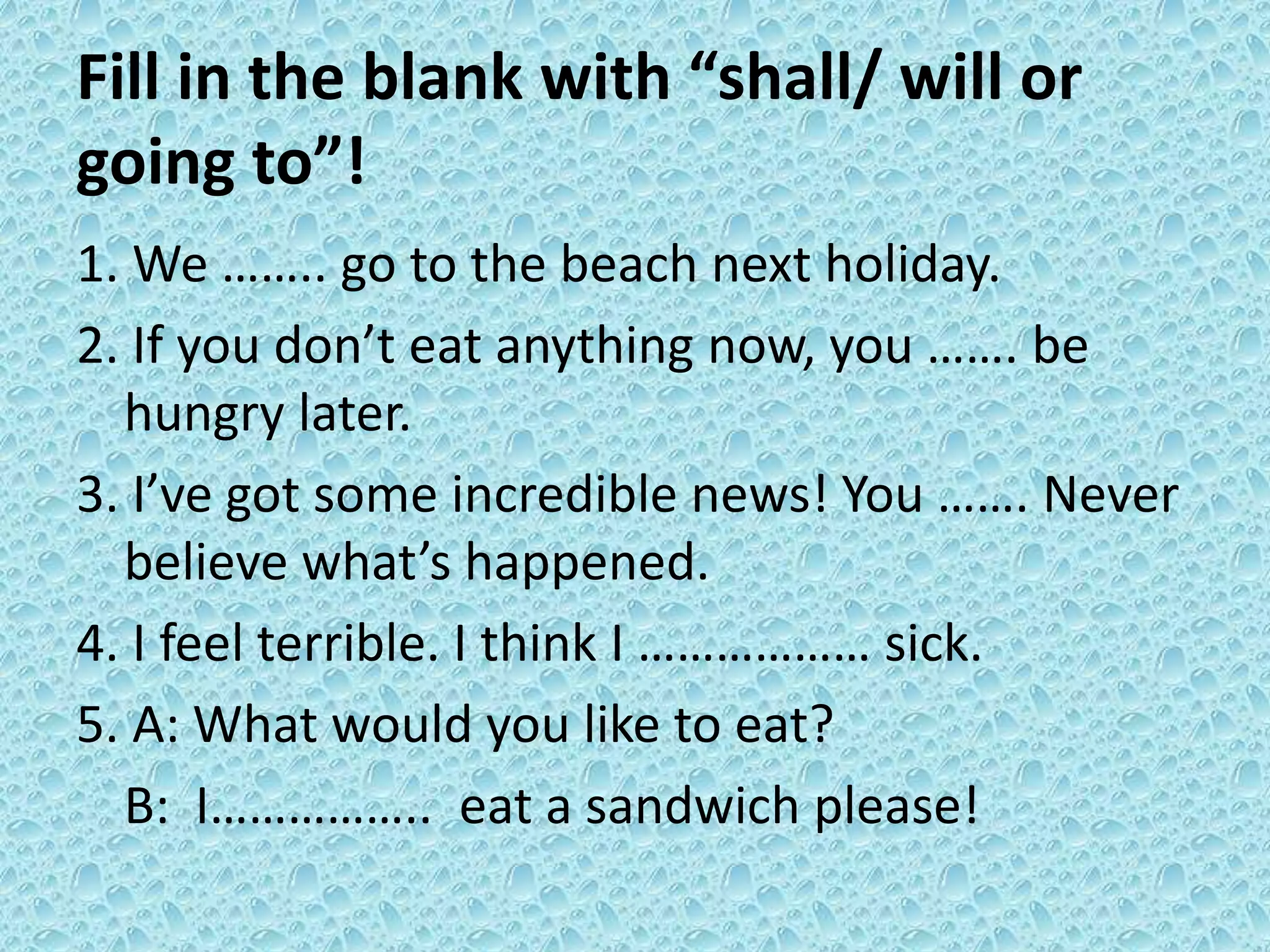
Fill in the blank with “shall/ will or 
going to”! 
1. We …….. go to the beach next holiday. 
2. If you don’t eat anything now, you ……. be 
hungry later. 
3. I’ve got some incredible news! You ……. Never 
believe what’s happened. 
4. I feel terrible. I think I ……………… sick. 
5. A: What would you like to eat? 
B: I…………….. eat a sandwich please!
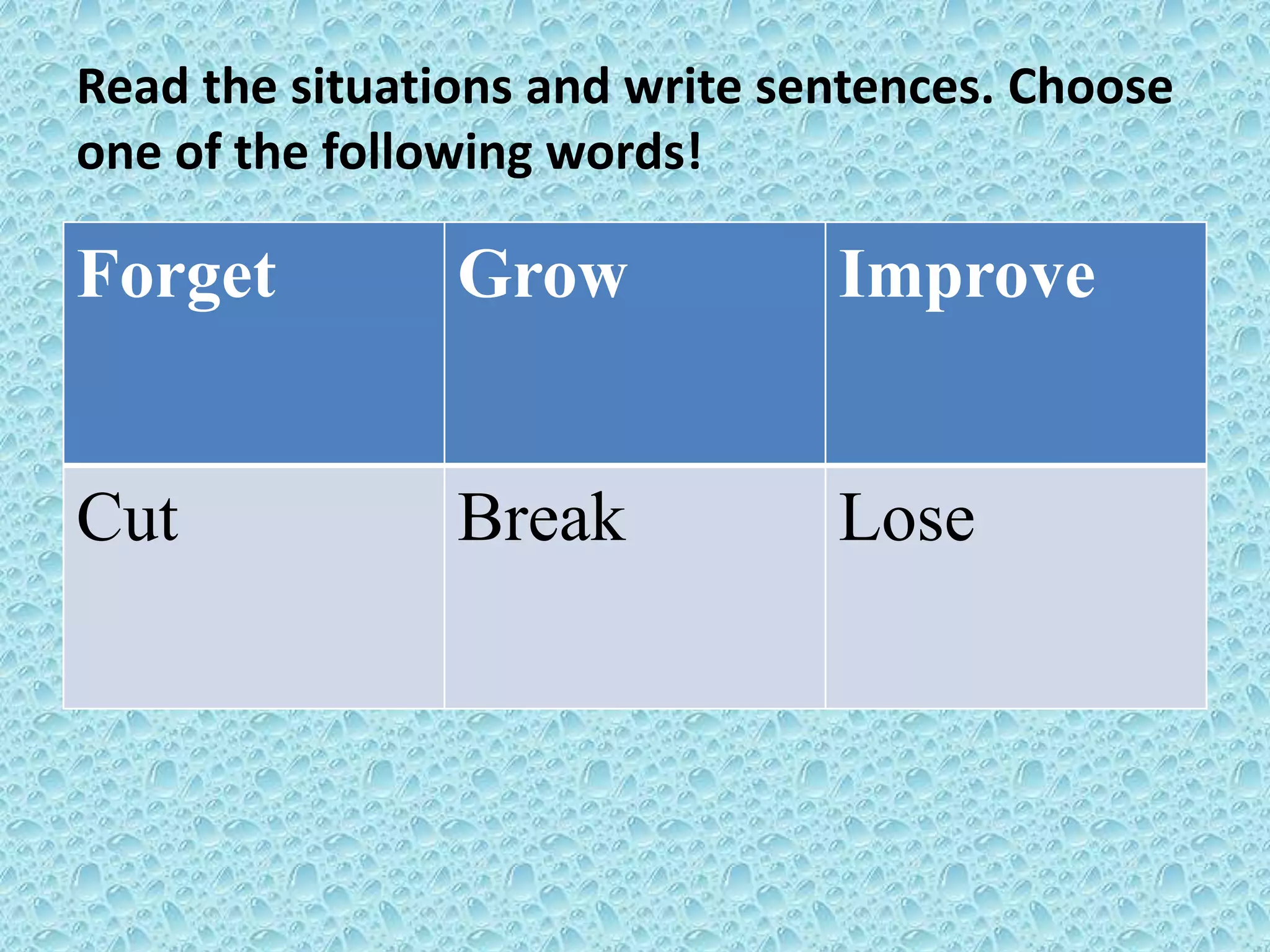
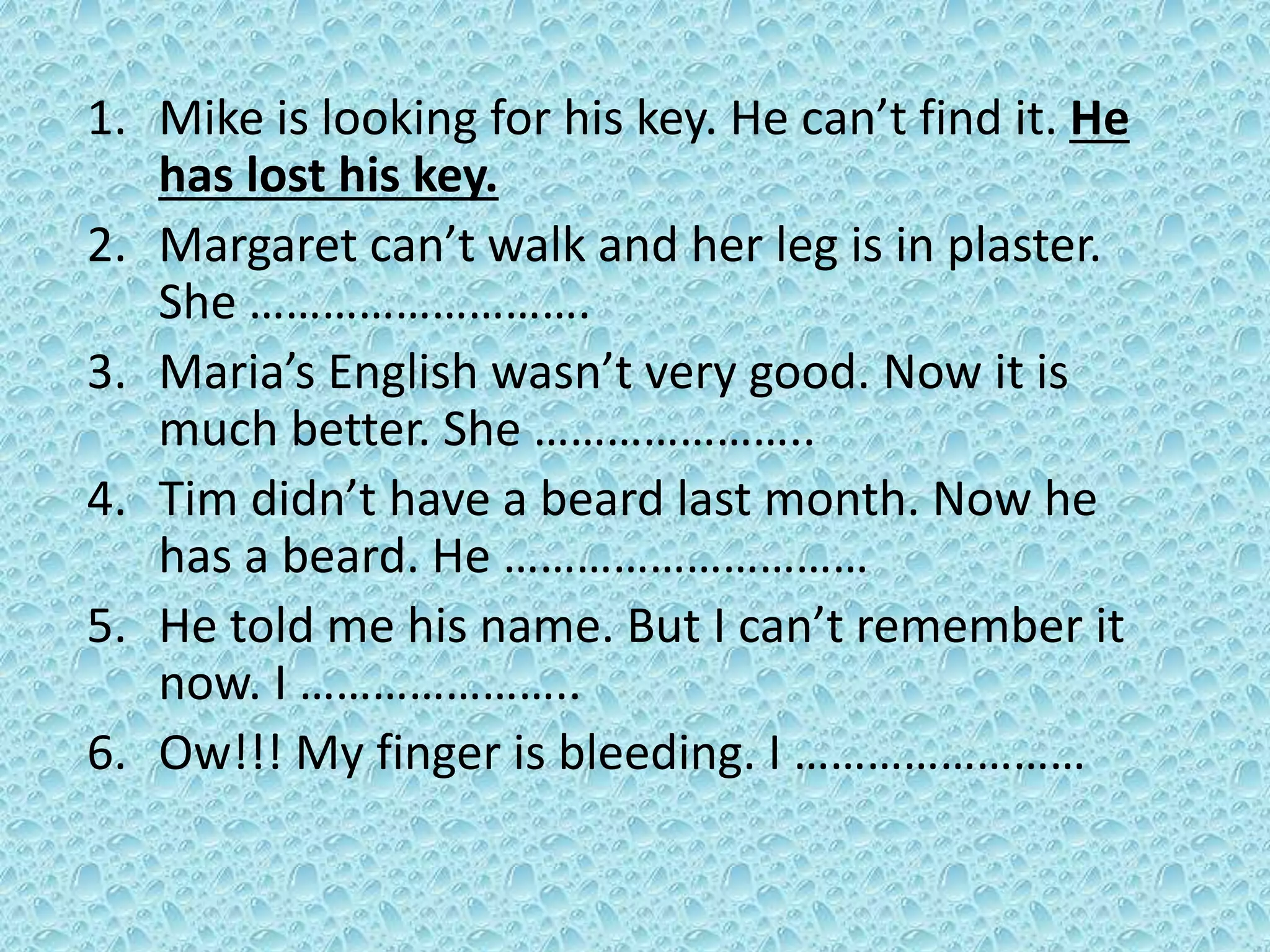
Read the situations and write sentences. Choose 
one of the following words! 
Forget Grow Improve 
Cut Break Lose
1. Mike is looking for his key. He can’t find it. He 
has lost his key. 
2. Margaret can’t walk and her leg is in plaster. 
She ………………………. 
3. Maria’s English wasn’t very good. Now it is 
much better. She ………………….. 
4. Tim didn’t have a beard last month. Now he 
has a beard. He ………………………… 
5. He told me his name. But I can’t remember it 
now. I ………………….. 
6. Ow!!! My finger is bleeding. I ……………………
EXERCISES 
Read the situations and complete the sentences with Present Perfect 
Continuous! 
• The rain started two hours ago. It’s still raining now. It has been 
raining for two hours. 
1. We started waiting for the bus 20 minutes ago. We’re still 
waiting now. 
We …………………………….for 20 minutes. 
2. I started Spanish classes in December. I’m still learning Spanish 
now. 
I ………………. Since Desember. 
3. Ann began looking for a job six months ago. She’s still looking 
now. 
…………………………………………………… for six months. 
4. Mary started working in London on 18 January. She’s still looking 
now. 
………………………………………………………………… since 18 January. 
5. Years ago you started writing to a penfriend. You still write to 
each other regularly now. 
We ……………………………………………………….. For years.
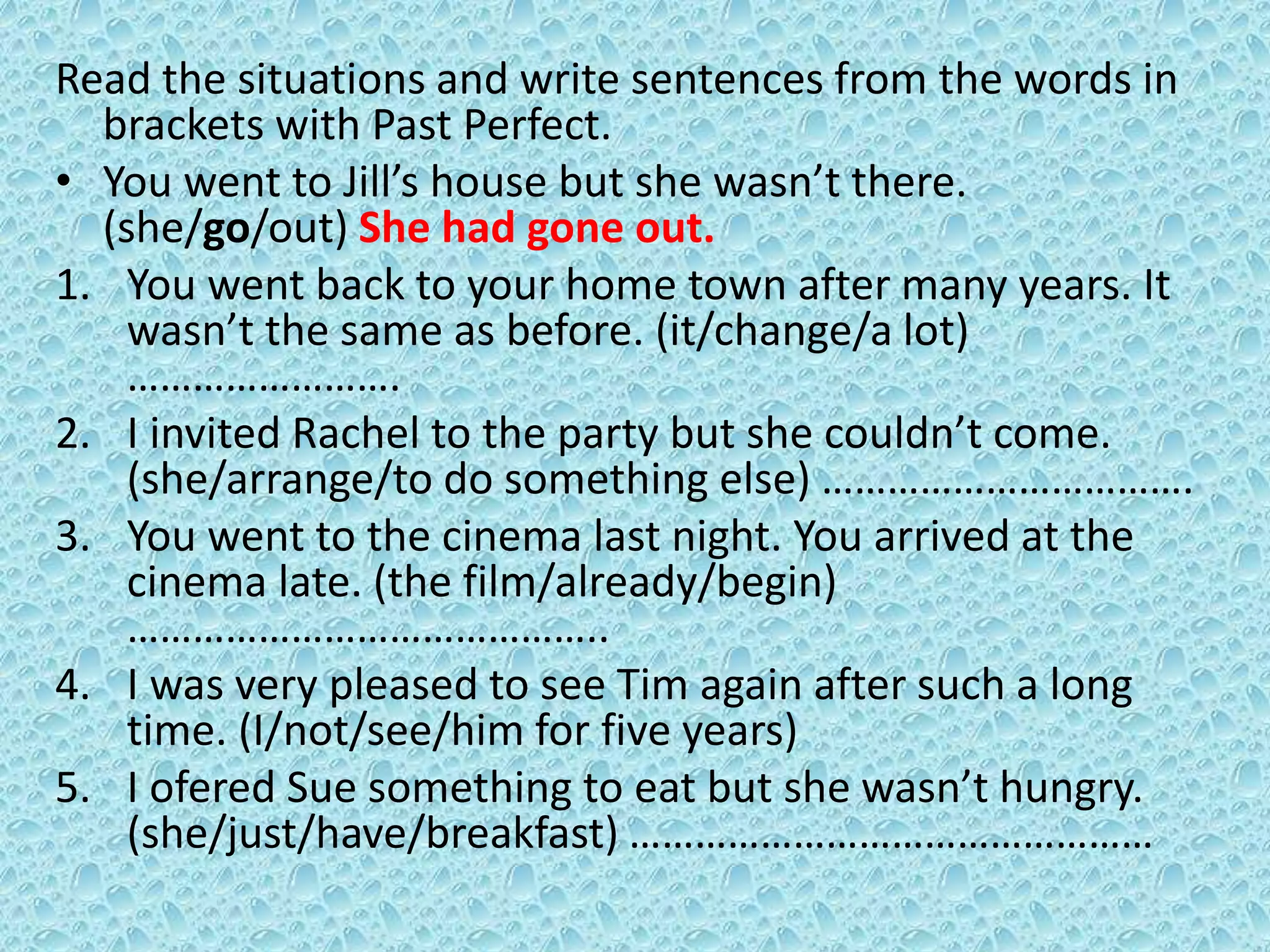
Read the situations and write sentences from the words in 
brackets with Past Perfect. 
• You went to Jill’s house but she wasn’t there. 
(she/go/out) She had gone out. 
1. You went back to your home town after many years. It 
wasn’t the same as before. (it/change/a lot) 
……………………. 
2. I invited Rachel to the party but she couldn’t come. 
(she/arrange/to do something else) ……………………………. 
3. You went to the cinema last night. You arrived at the 
cinema late. (the film/already/begin) 
…………………………………….. 
4. I was very pleased to see Tim again after such a long 
time. (I/not/see/him for five years) 
5. I ofered Sue something to eat but she wasn’t hungry. 
(she/just/have/breakfast) …………………………………………

Tenses ppt

  • 1.
  • 2.
    Future Tense 1.Discussing the future using going to We say something is going to happen when it has already been planned/ decided.
  • 3.
    Example: A. Verbalform (+) We are going to go to Japan by airplane tomorrow. (-) We are not going to go to America by airplane tomorrow. (?) Are we going to go to America by airplane tomorrow? Yes, we are. No, we are not.
  • 4.
    B. (+) Sheis going to be angry with you because you broke her book. (-) She is not to be angry with you because you broke her book. (?) Is she going to be angry with you because you broke her book? Yes, she is. No, she is not.
  • 5.
    Pattern: A. Verbalform (+) S+ (be) going to+ V1+ O (-) S+ ( be+not) going to+ V1+ O (?) Be+ S+ going to+ V1+ O? B. (+) S+ (be) going to be+ adj, noun, adverb. (-) S+ (be+not) going to be+ adj, noun, adverb (?) Be+ S+ going to be+ adj, noun, adverb?
  • 6.
    2. Discussing thefuture using shall/will When we give information about the future or predict future events that are not certain, we usually use shall/will.
  • 7.
    Example: A. Verbalform (+) Abu Rizal Bakrie will lead Indonesia next year. (-) Abu Rizal Bakrie will not lead Malaysia next year. (?) Will Abu Rizal Bakrie lead Indonesia next year? Yes, he will. No, he will not. B. (+) She will be a nice friend. (-) She will not be a bad friend. (?) Will she be a nice friend? Yes, she will. No, she will not.
  • 8.
    Pattern A. Verbalform (+) S+ Shall/ will+ V1+ O (-) S+ shall/ will+ not+ V1+ O (?) Shall/ will+ S+ V1+ O? B. Nominal form (+) S+ shall/ will+ be+ (adj, noun, adverb) (-) S+ shall/ will+ not+ be+ (adj, noun, adverb) (?) Shall/ will+ S+ be+ (adj, noun, adverb)?
  • 9.
    Time signal •Tomorrow • Next…….. (year, month, Sunday, etc) • Tonight • Soon • This evening
  • 10.
    Present Perfect Tense Present perfect tense is used to talk about a past time, which has very strong meaning for the present.
  • 11.
    Example: a. Verbalform: (+) My house has built since 1991. (-) My house has not built since 1991. (?) Has my house built since 1991? Yes, you have. No, you have not. b. Nominal form: (+) I have been here since 30 minutes ago. (-) I have not been here since 30 minutes ago. (?) Have I been since 30 minutes ago? Yes, I have. No, I have not.
  • 12.
    Pattern A. Verbalform (+) S+ has/have+ V3+ O (-) S+ has/ have+ not+ V3+ O (?) Has/ have+ S+ V3+ O? B. Nominal form (+) S+ has/have+ been+ (adj, noun, adv). (-) S+ has/ have+ not+ been+ (adj, noun, adv) (?) Has/ have+ S+ been+ (adj, noun, adv)?
  • 13.
    Time Signal •Since • For • Already • Recently • Lately
  • 14.
    Present Perfect ContinuousTense Present perfect continuous tense is often used (with for or since) to describe how long something has been happening up to now.
  • 15.
    Example: (+) Shehas been living in Jember since 2010. (-) She has not been living in Jember since 2010. (?) Has she been living in Jember since 2010? Yes, she has. No, she has not.
  • 16.
    Pattern (+) S+has/ have+ been+ Ving+ O (-) S+ has/have+ not+ been+ Ving+ O (?) Has/ have+ S+ been+ Ving+ O?
  • 17.
    Time Signal •For…… • Since …. • By last…….
  • 18.
    Past Perfect Tense Past perfect tense is used to go further back in time when we are already talking about the past. It can make it clear that something had already happened at the time we are talking about.
  • 19.
    Example: (+) MyFather had gone to the office when my mother came. (-) my father had not gone to the mall when my mother came . (?) Had my father gone to the office when my mother came? Yes, he had. No, he had not.
  • 20.
    Pattern (+) S+had+V3+O (-) S+had+not+V3+O (?) had+S+V3+O?
  • 21.
    Time Signal •Past perfect…..before…….past tense • Past tense……after……..past perfect • Past tense ……until…… past perfect • Past tense….. as soon as… past perfect • Past perfect…… when……. Past tense
  • 22.
    Fill in theblank with “shall/ will or going to”! 1. We …….. go to the beach next holiday. 2. If you don’t eat anything now, you ……. be hungry later. 3. I’ve got some incredible news! You ……. Never believe what’s happened. 4. I feel terrible. I think I ……………… sick. 5. A: What would you like to eat? B: I…………….. eat a sandwich please!
  • 23.
    Read the situationsand write sentences. Choose one of the following words! Forget Grow Improve Cut Break Lose
  • 24.
    1. Mike islooking for his key. He can’t find it. He has lost his key. 2. Margaret can’t walk and her leg is in plaster. She ………………………. 3. Maria’s English wasn’t very good. Now it is much better. She ………………….. 4. Tim didn’t have a beard last month. Now he has a beard. He ………………………… 5. He told me his name. But I can’t remember it now. I ………………….. 6. Ow!!! My finger is bleeding. I ……………………
  • 25.
    EXERCISES Read thesituations and complete the sentences with Present Perfect Continuous! • The rain started two hours ago. It’s still raining now. It has been raining for two hours. 1. We started waiting for the bus 20 minutes ago. We’re still waiting now. We …………………………….for 20 minutes. 2. I started Spanish classes in December. I’m still learning Spanish now. I ………………. Since Desember. 3. Ann began looking for a job six months ago. She’s still looking now. …………………………………………………… for six months. 4. Mary started working in London on 18 January. She’s still looking now. ………………………………………………………………… since 18 January. 5. Years ago you started writing to a penfriend. You still write to each other regularly now. We ……………………………………………………….. For years.
  • 26.
    Read the situationsand write sentences from the words in brackets with Past Perfect. • You went to Jill’s house but she wasn’t there. (she/go/out) She had gone out. 1. You went back to your home town after many years. It wasn’t the same as before. (it/change/a lot) ……………………. 2. I invited Rachel to the party but she couldn’t come. (she/arrange/to do something else) ……………………………. 3. You went to the cinema last night. You arrived at the cinema late. (the film/already/begin) …………………………………….. 4. I was very pleased to see Tim again after such a long time. (I/not/see/him for five years) 5. I ofered Sue something to eat but she wasn’t hungry. (she/just/have/breakfast) …………………………………………