Sai Myurika .J
2023018131
Tree form and form
factors
Tree Form
• Form is defined as the rate of taper of a log or stem .Taper is the decrease
in diameter of stem of tree or of log from base upwards
• The tree forms are very important in the silviculture and regenerating the
forests.
• The taper varies not only with species, ages , site and crop density but also
in the different parts of the same tree.
THEORIES OF TREE FORMS
• Nutritional theory
• Water conducting theory
• Hormonal theory
• Mechanistic theory or Metzger's beam theory
Nutritional theory and Water conducting theory
Nutritional theory and Water conducting theory are based on ideas
that deal with the movement of liquids through pipes. They relate
tree bole shape to the need of the tree to transport water or
nutrients within the tree .
Hormonal theory
The hormonal theory envisages that growth substances, originating in the
crown, are distributed around and down the bole to control the activity of
the cambium. These substances would reduce or enhance radial growth at
specific locations on the bole and thus affect bole shape.
Mechanistic theory or Metzger's beam theory or Grider
theory
 This theory is most widely accepted theory.
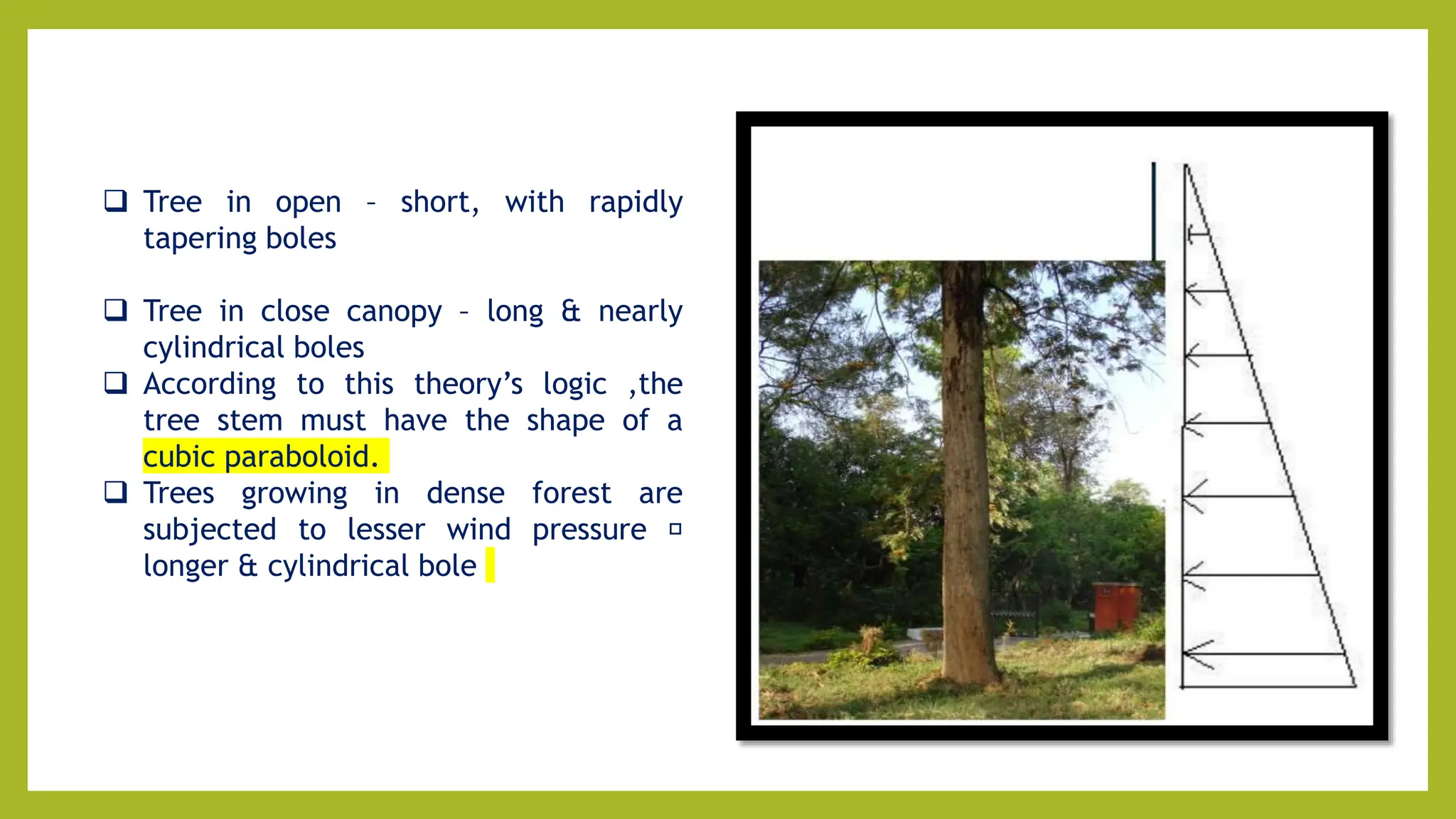
 Tree stem was considered as the cantilever beam of uniform size against the bending
force of the wind.
 We can also say that the stem of the tree is made up of minimum material that
withstand stresses subjected.
 The wind pressure acts on crown and is conveyed to the lower parts of the stem in an
increase in length of the bole
 Greatest pressure is exerted at the base of tree leads to danger of the tree snapping
at base.
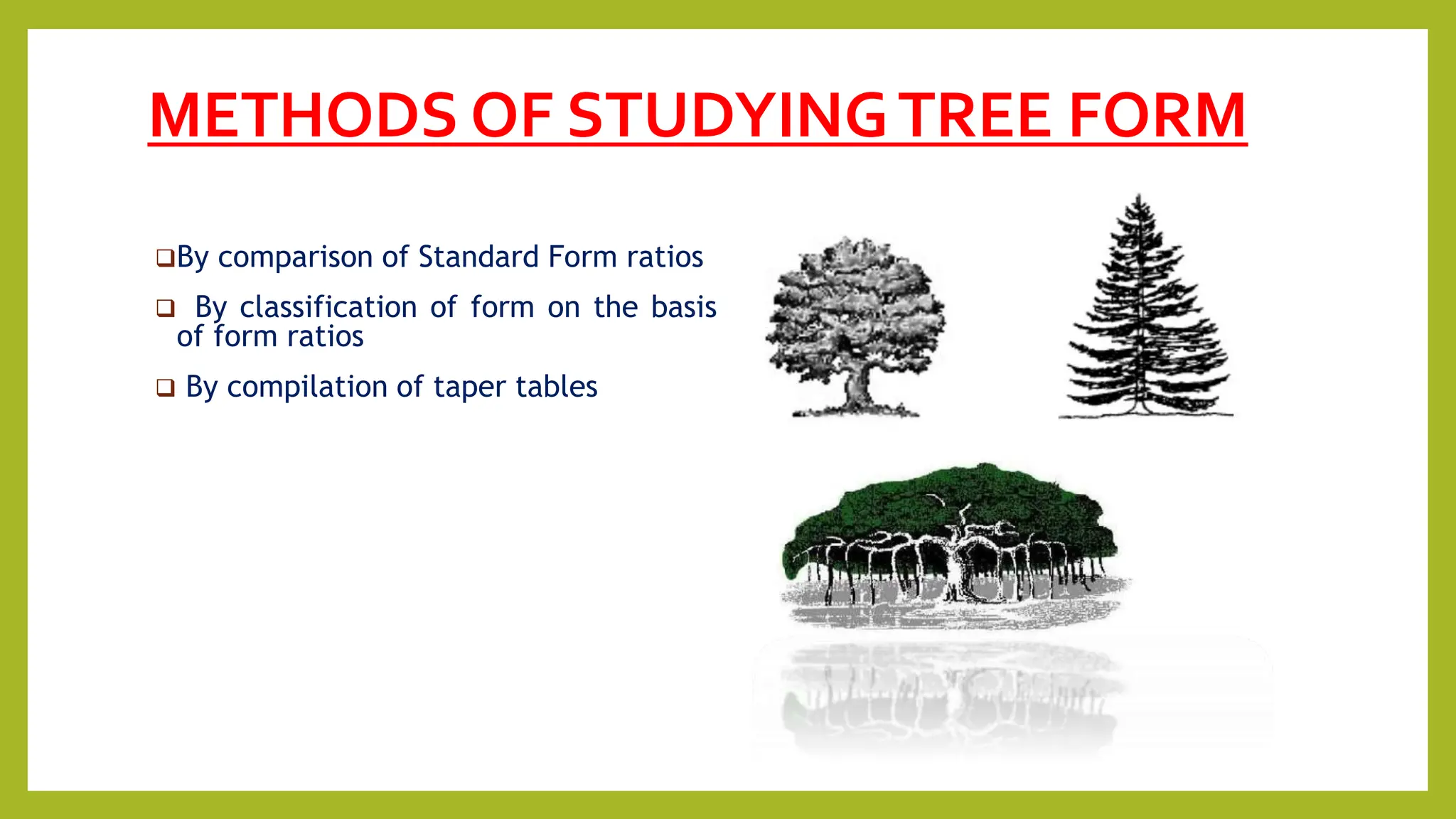
 Tree in open – short, with rapidly
tapering boles
 Tree in close canopy – long & nearly
cylindrical boles
 According to this theory’s logic ,the
tree stem must have the shape of a
cubic paraboloid.
 Trees growing in dense forest are
subjected to lesser wind pressure
longer & cylindrical bole
METHODS OF STUDYINGTREE FORM
By comparison of Standard Form ratios
 By classification of form on the basis
of form ratios
 By compilation of taper tables
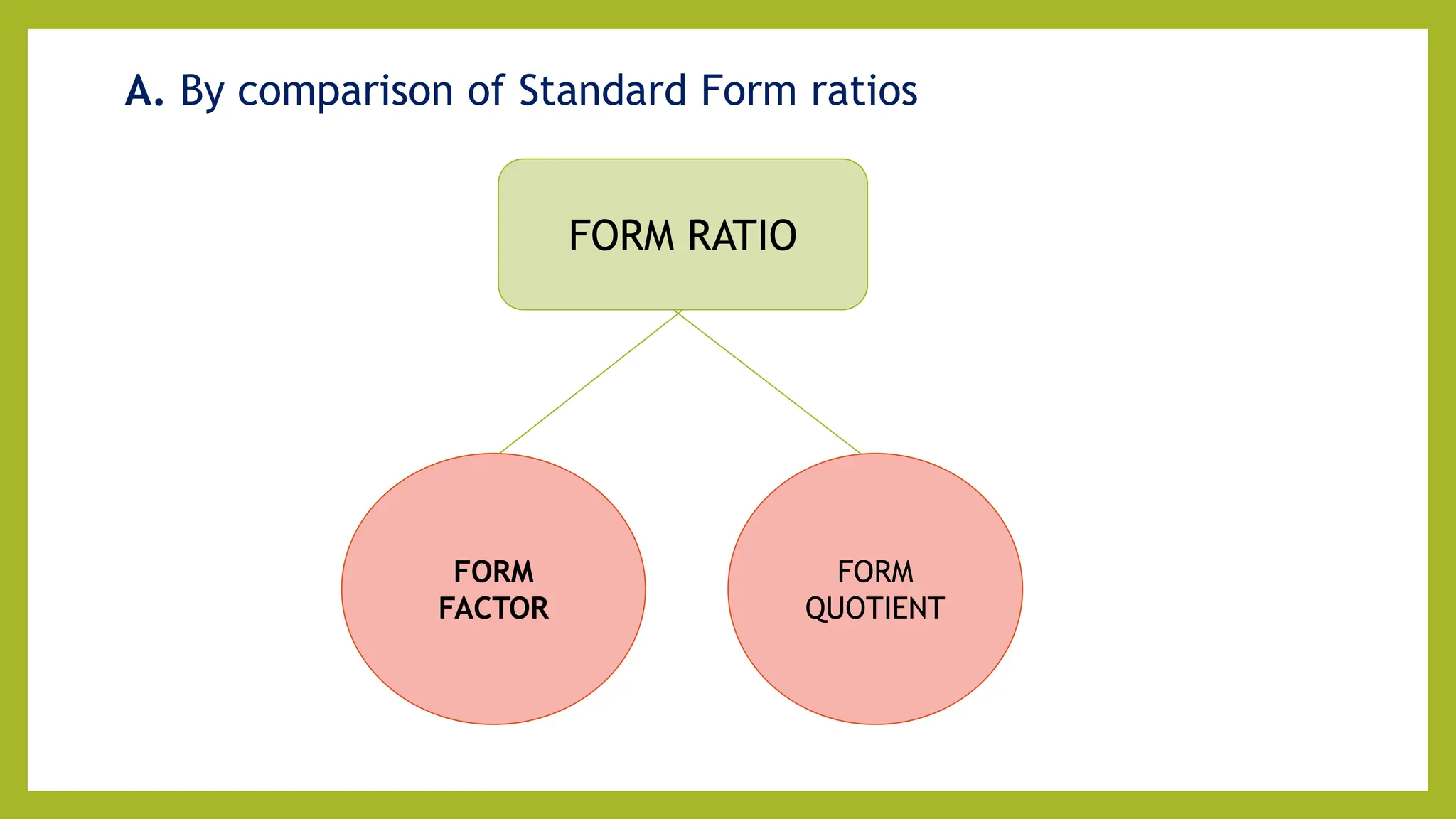
FORM RATIO
FORM
FACTOR
FORM
QUOTIENT
A. By comparison of Standard Form ratios
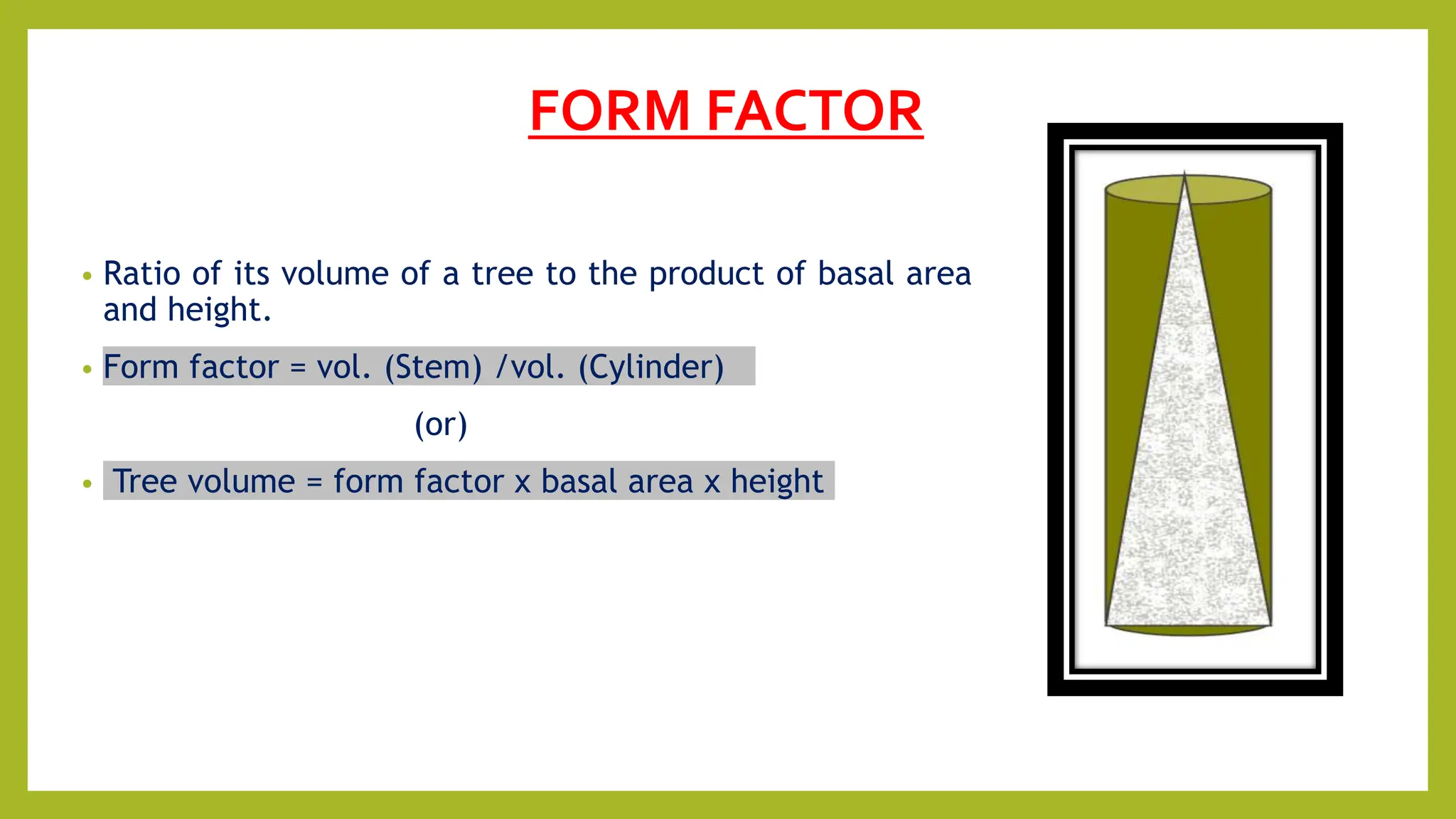
FORM FACTOR
• Ratio of its volume of a tree to the product of basal area
and height.
• Form factor = vol. (Stem) /vol. (Cylinder)
(or)
• Tree volume = form factor x basal area x height
Absolute form factor
• This form factor basal area is measured at any convenient height and the
volume is measured at only one part of tree above the point of
measurement .
• Not used
NORMAL FORM FACTOR / TRUE FORM
FACTOR
• In this form factor the basal area measured at a constant
proportion of the tree height of the tree, e.g., 1/10 of the total
height and volume refers to the whole tree above the ground
level.
• Not much used.
ARTIFICIAL FORM FACTOR OR BREAST HEIGHT FORM
FACTOR
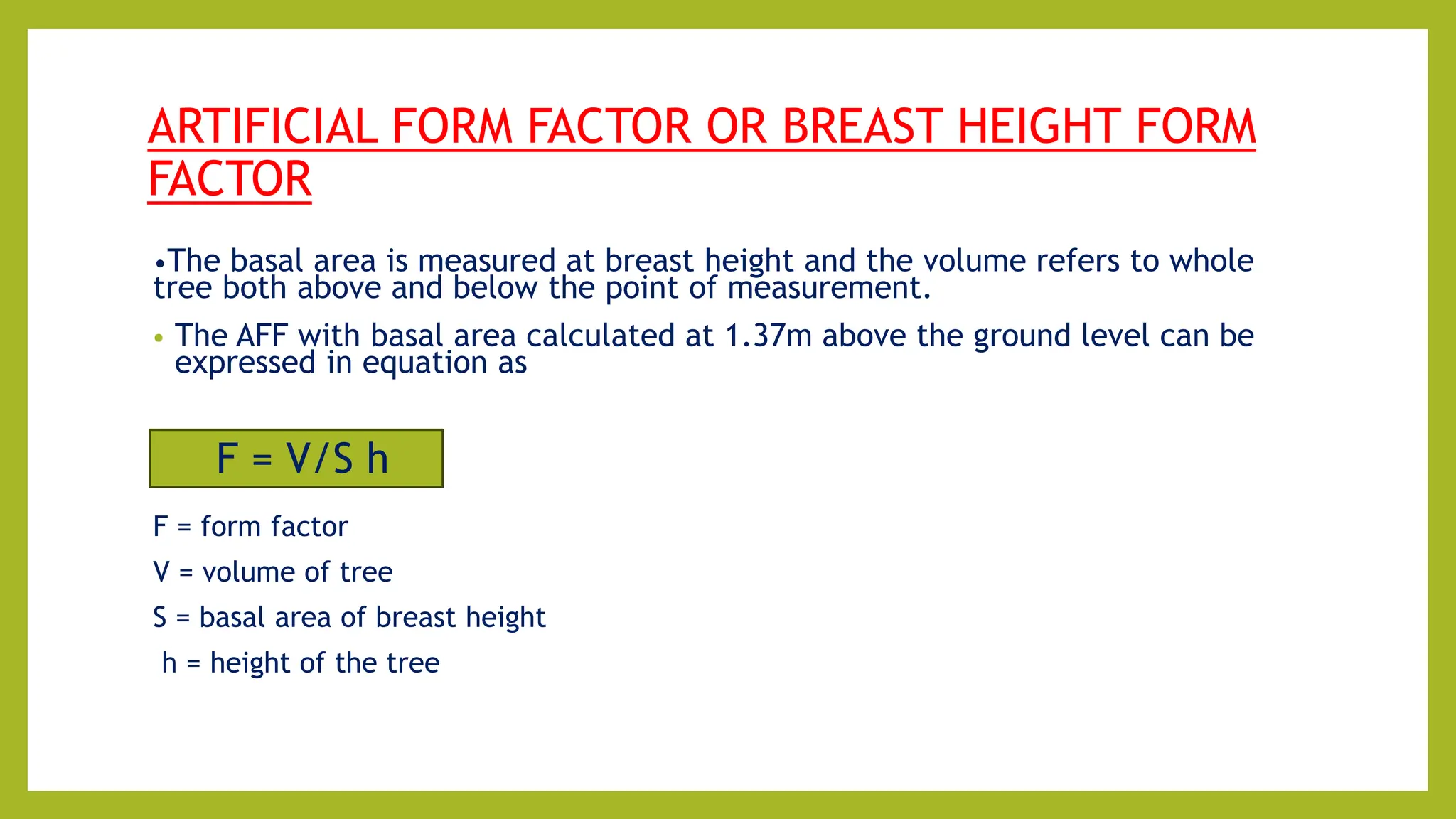
•The basal area is measured at breast height and the volume refers to whole
tree both above and below the point of measurement.
• The AFF with basal area calculated at 1.37m above the ground level can be
expressed in equation as
F = form factor
V = volume of tree
S = basal area of breast height
h = height of the tree
F = V/S h
USES OF FORM FACTOR
To estimate the volume of
standing trees.
To study laws of growth.
KINDS OF FORM FACTOR
:Depending on the volume
represented
• Tree form factor
• Stem timber form factor
• Stem small wood form factor
FORM HEIGHT
• Form height is defined as the product of form factor and total height of
tree.
• This can be expressed as formula as follows :
Form factor F= V/S h
Form height F h=V/S
Where F h is form height
V =Volume of tree
S=Basal area
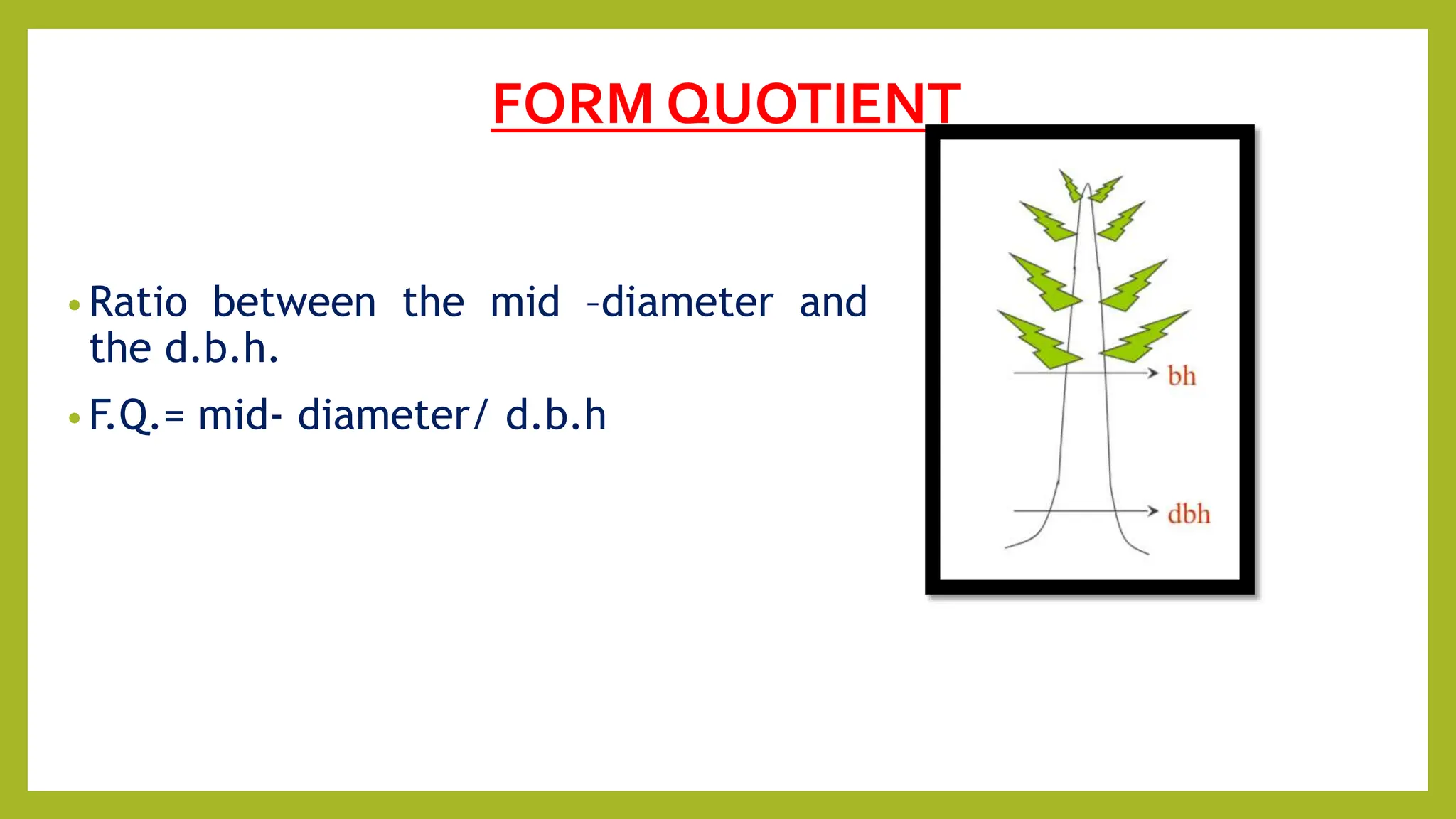
FORM QUOTIENT
• Ratio between the mid –diameter and
the d.b.h.
• F.Q.= mid- diameter/ d.b.h
NORMAL FORM QUOTIENT
• It is the ratio of mid-diameter or mid grith of a tree to it’s diameter at
breast height
ABSOLUTE FORM QUOTIENT
• Absolute from quotient is defined as the ratio of diameter or grith of stem
at one half it’s height above the breast height to the diameter at breast
height.
B. BY CLASSIFICATION OF FORM ON THE BASIS OF FORM
RATIOS
1.Form class
• Defined as one of the intervals in which the range of form
quotients of trees is divided for classification and use
• Form quotient interval such as 0.50 to 0.55, 0.55 to 0.60 … or
mid-points of these intervals e.g. 0.525, 0.575 …
FORM POINT RATIO
• The point in the crown’s wind pressure is estimated to be centred .
• It is expressed in ‘%’, height of the form point from the ground level to
total height of the tree.
• Form quotient and form class can be determined in the form point is
known.
C.BY COMPILATION OF THE TAPER TABLES
• It gives the actual form by diameters at fixed points from base to tip of a tree
• They are used for the following purpose :
1. Volume of average tree for diameter and height class can be found
readily in office without direct measurement ,only (d .b .h ) diameter breast
height and height of standing tree measurement is needed.
2.Volume tables can be prepared from taper tables in desired units,
(i)Ordinary taper tables or diameter taper tables :These tables give the
tapper directly for diameter at breast height without reference to the tree
form.
(ii) Form class taper tables : These tables give for different form classes
the diameters at fixed points on the stem they are expressed in % of d .b. h.
Tree form factor forestry ppt agroforestry

Tree form factor forestry ppt agroforestry

  • 1.
    Sai Myurika .J 2023018131 Treeform and form factors
  • 2.
    Tree Form • Formis defined as the rate of taper of a log or stem .Taper is the decrease in diameter of stem of tree or of log from base upwards • The tree forms are very important in the silviculture and regenerating the forests. • The taper varies not only with species, ages , site and crop density but also in the different parts of the same tree.
  • 3.
    THEORIES OF TREEFORMS • Nutritional theory • Water conducting theory • Hormonal theory • Mechanistic theory or Metzger's beam theory
  • 4.
    Nutritional theory andWater conducting theory Nutritional theory and Water conducting theory are based on ideas that deal with the movement of liquids through pipes. They relate tree bole shape to the need of the tree to transport water or nutrients within the tree .
  • 5.
    Hormonal theory The hormonaltheory envisages that growth substances, originating in the crown, are distributed around and down the bole to control the activity of the cambium. These substances would reduce or enhance radial growth at specific locations on the bole and thus affect bole shape.
  • 6.
    Mechanistic theory orMetzger's beam theory or Grider theory  This theory is most widely accepted theory.  Tree stem was considered as the cantilever beam of uniform size against the bending force of the wind.  We can also say that the stem of the tree is made up of minimum material that withstand stresses subjected.  The wind pressure acts on crown and is conveyed to the lower parts of the stem in an increase in length of the bole  Greatest pressure is exerted at the base of tree leads to danger of the tree snapping at base.
  • 7.
     Tree inopen – short, with rapidly tapering boles  Tree in close canopy – long & nearly cylindrical boles  According to this theory’s logic ,the tree stem must have the shape of a cubic paraboloid.  Trees growing in dense forest are subjected to lesser wind pressure longer & cylindrical bole
  • 8.
    METHODS OF STUDYINGTREEFORM By comparison of Standard Form ratios  By classification of form on the basis of form ratios  By compilation of taper tables
  • 9.
    FORM RATIO FORM FACTOR FORM QUOTIENT A. Bycomparison of Standard Form ratios
  • 10.
    FORM FACTOR • Ratioof its volume of a tree to the product of basal area and height. • Form factor = vol. (Stem) /vol. (Cylinder) (or) • Tree volume = form factor x basal area x height
  • 11.
    Absolute form factor •This form factor basal area is measured at any convenient height and the volume is measured at only one part of tree above the point of measurement . • Not used
  • 12.
    NORMAL FORM FACTOR/ TRUE FORM FACTOR • In this form factor the basal area measured at a constant proportion of the tree height of the tree, e.g., 1/10 of the total height and volume refers to the whole tree above the ground level. • Not much used.
  • 13.
    ARTIFICIAL FORM FACTOROR BREAST HEIGHT FORM FACTOR •The basal area is measured at breast height and the volume refers to whole tree both above and below the point of measurement. • The AFF with basal area calculated at 1.37m above the ground level can be expressed in equation as F = form factor V = volume of tree S = basal area of breast height h = height of the tree F = V/S h
  • 14.
    USES OF FORMFACTOR To estimate the volume of standing trees. To study laws of growth. KINDS OF FORM FACTOR :Depending on the volume represented • Tree form factor • Stem timber form factor • Stem small wood form factor
  • 15.
    FORM HEIGHT • Formheight is defined as the product of form factor and total height of tree. • This can be expressed as formula as follows : Form factor F= V/S h Form height F h=V/S Where F h is form height V =Volume of tree S=Basal area
  • 16.
    FORM QUOTIENT • Ratiobetween the mid –diameter and the d.b.h. • F.Q.= mid- diameter/ d.b.h
  • 17.
    NORMAL FORM QUOTIENT •It is the ratio of mid-diameter or mid grith of a tree to it’s diameter at breast height ABSOLUTE FORM QUOTIENT • Absolute from quotient is defined as the ratio of diameter or grith of stem at one half it’s height above the breast height to the diameter at breast height.
  • 18.
    B. BY CLASSIFICATIONOF FORM ON THE BASIS OF FORM RATIOS 1.Form class • Defined as one of the intervals in which the range of form quotients of trees is divided for classification and use • Form quotient interval such as 0.50 to 0.55, 0.55 to 0.60 … or mid-points of these intervals e.g. 0.525, 0.575 …
  • 19.
    FORM POINT RATIO •The point in the crown’s wind pressure is estimated to be centred . • It is expressed in ‘%’, height of the form point from the ground level to total height of the tree. • Form quotient and form class can be determined in the form point is known.
  • 20.
    C.BY COMPILATION OFTHE TAPER TABLES • It gives the actual form by diameters at fixed points from base to tip of a tree • They are used for the following purpose : 1. Volume of average tree for diameter and height class can be found readily in office without direct measurement ,only (d .b .h ) diameter breast height and height of standing tree measurement is needed. 2.Volume tables can be prepared from taper tables in desired units, (i)Ordinary taper tables or diameter taper tables :These tables give the tapper directly for diameter at breast height without reference to the tree form. (ii) Form class taper tables : These tables give for different form classes the diameters at fixed points on the stem they are expressed in % of d .b. h.