Submitted by:
SUDHIR PATEL
Mechanical engineering
3rd year
1900520400058
Submitted to:
Mr. Vipul kumar pathak
INSTITUTE OF ENGINEERING AND
TECHNOLOGY , LUCKNOW
DEPARTMENT OF MECHANICAL ENGINEERING
Aerodynamics in Cars
 Aerodynamics is itself a part of fluid dynamics,
which is the study of the properties of a solid object
displace a fluid such as air.
 For the performance of a typical passenger car,
aerodynamics is an important consideration in the
achievement of maximum fuel economy, as well as in
creating auto body styling that is visually appealing.
Terms to Know-
Aerodynamics
 Fluid
 Mass
 Aerodynamics
 Drag
 Lift
 Rear Suction
 Down Force
 Frontal Area
Fluid
 Air-
 Is a type of fluid such as water that can be directed or
displaced;
 Has mass and is measured in terms of pressure;
 Applies direct and frictional forces to objects in
motion;
Principles
 One should be aware of four aerodynamic
principles-
 Drag
 Lift/Down Force
 Drag Coefficient
 Frontal Area
Drag
 Drag is a combination of two forces that
will work against the acceleration of your
car.
 Frontal Pressure occurs when tiny molecules of
air hit the front of your car and is forced away to
make room for other molecules to hit it.
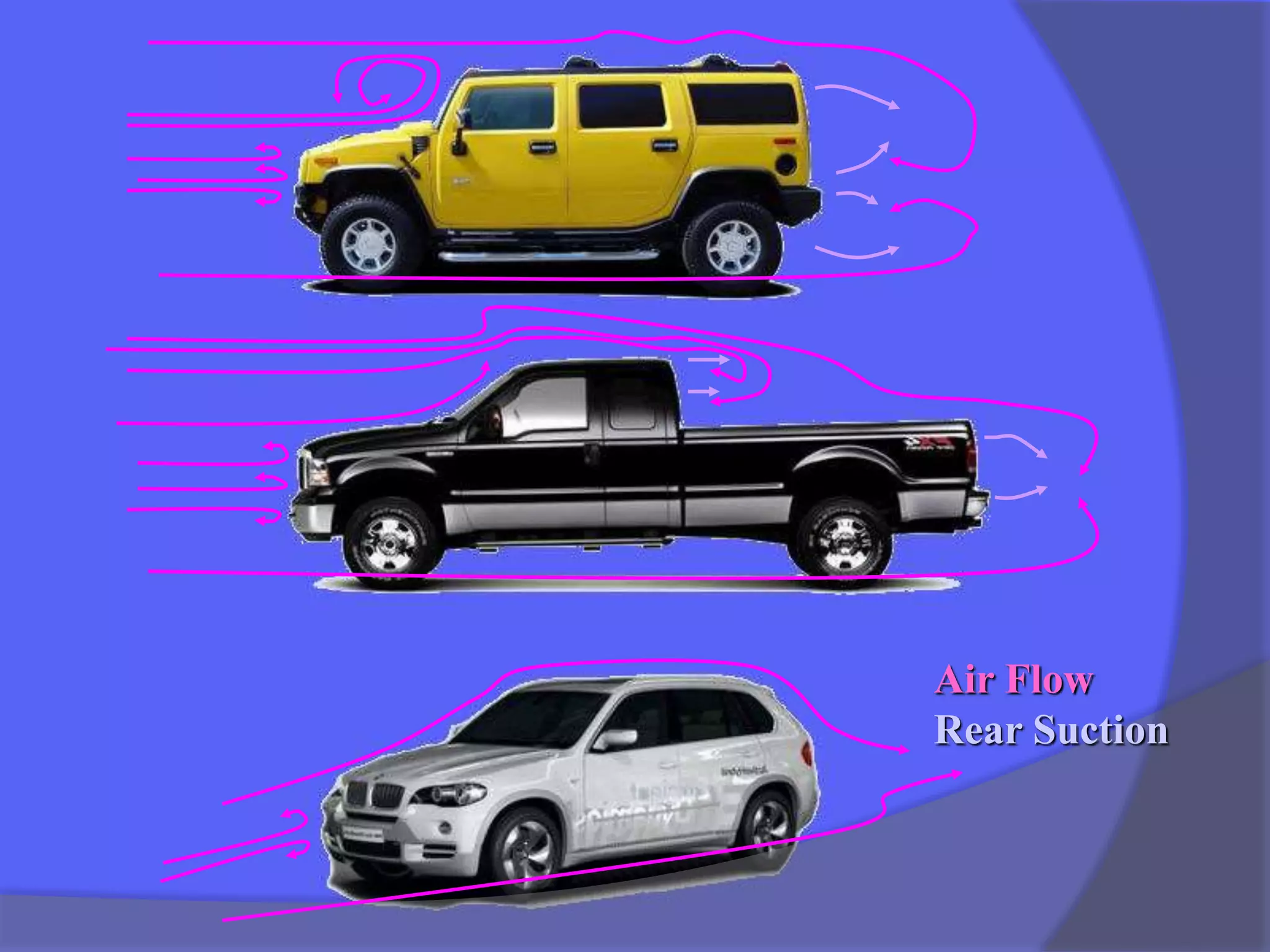
 Rear Suction occurs when an empty pocket of air
is created in the back of your car resulting in a
vacuum cleaner effect that tries to pull your car
backward.
Air Flow
Rear Suction
Lift and Down Force
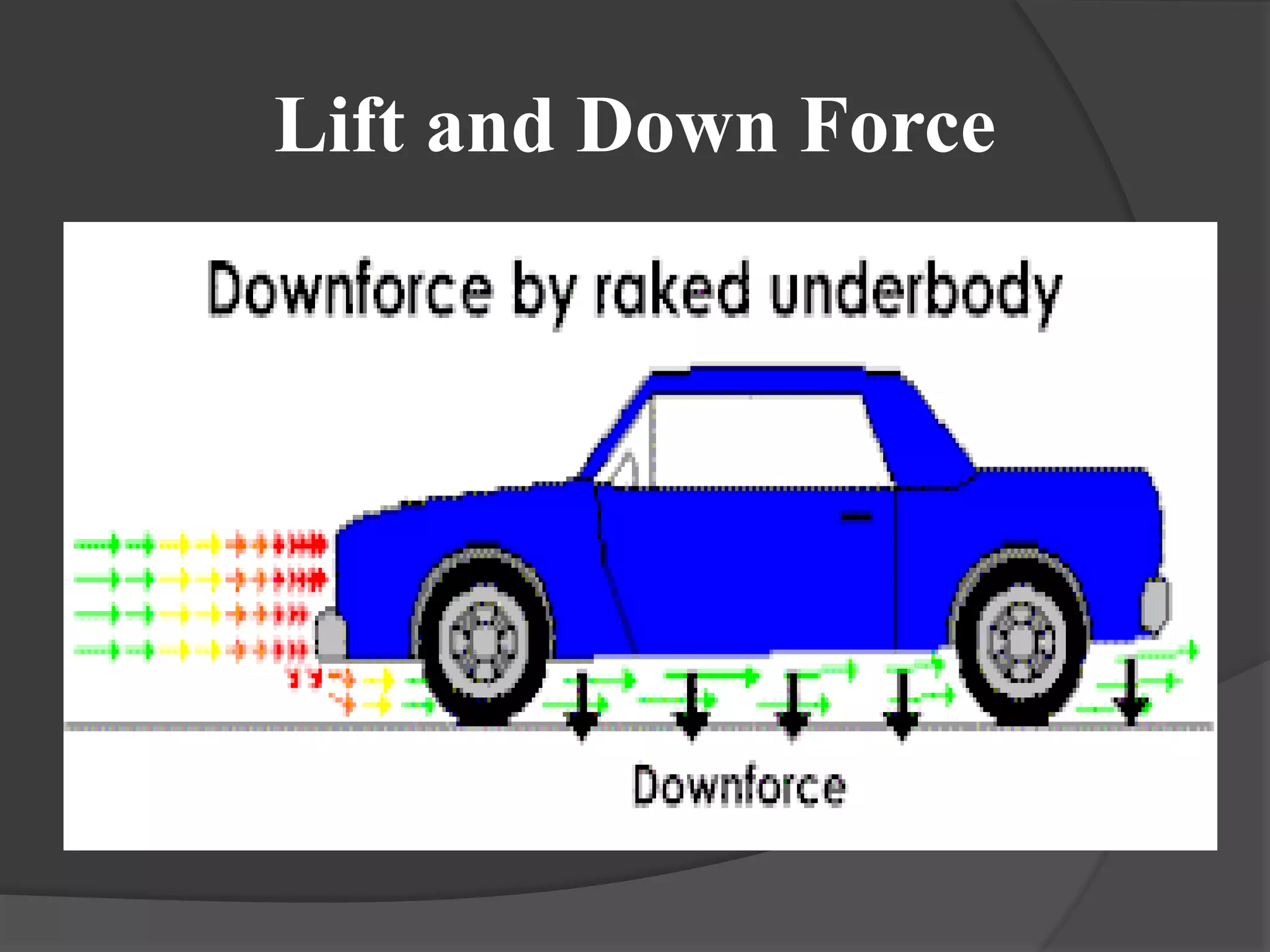
 Lift is similar to rear suction in that a thin
empty pocket occurs as air passes over a
flat surface causing the car to lift.
 Down Force is due to high pressure in
curved surfaces that causes the car to be
pushed down.
Lift and Down Force
Drag Coefficient
 Drag Coefficient is a way of expressing
how slippery a car is.
 The drag coefficient (CD) is a measure of
the vehicle's aerodynamic efficiency.
FRONT END
Frontal Pressure
Pressure Difference
Minimize Frontal Area
REDUCE Coefficient of Drag
Frontal Area
 Frontal Area is the total of all surfaces in the front of
your vehicle which cause drag.
Area = Length x Width
Aerodynamic drag
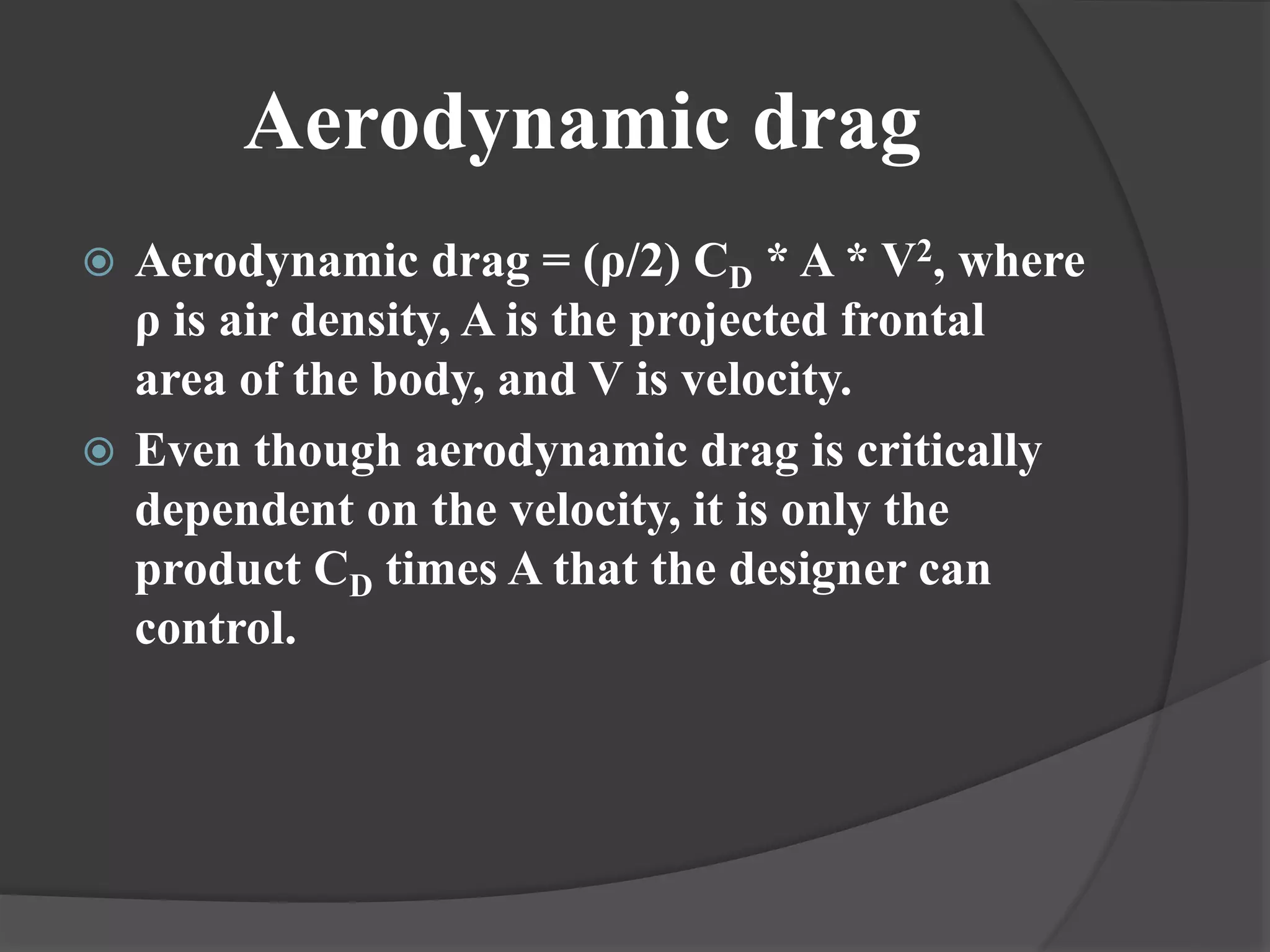
 Aerodynamic drag = (ρ/2) CD * A * V2, where
ρ is air density, A is the projected frontal
area of the body, and V is velocity.
 Even though aerodynamic drag is critically
dependent on the velocity, it is only the
product CD times A that the designer can
control.
Past of Aerodynamics
A = frontal
area, b = wheelbase,
CD = drag coefficient
REAR END
 Rear Vacuum
Flow Detachment
Turbulence
Vehicle Body
 Ergonomics is more and more important in new
cars and for instance the height of new models is
growing. Thus the accessibility is improved.
AERODYNAMIC DEVICES
 NASA DUCTS
 Increase rate of flow
 To expose air to areas not exposed to direct air
flow.
 SCOOPS
 Engine Cooling
 Increases Flow Rate of Air
 WINGS
 Produce Down Force
 Reduce Drag
SOFTWARES
DEVELOPMENTS IN CFD
ANSYS, CATIA,ALIAS STUDIO
ANALYZE CHANGES DURING DESIGN
PHASE AND DEVELOPMENT
REDUCES TIME TO DEVELOP OPTIMAL
DESIGN
ABLE TO STUDY INDIVIDUAL
ELEMENTS, MORE EFFECTIVE
AERODYNAMIC IMPROVEMNTS IN
THE CAR THAT WE ALREADY OWN
Keep your vehicle washed and
waxed
Remove mud flaps behind
wheels
Place license plate out of air flow
Avoid roof-racks or carriers
Close windows, close sunroof
Rear View Mirror
A CFD (Computational Fluid
Dynamics) program can be
very useful to optimize the
shape of the rear view mirror.
The pressure distribution on
the side shows clearly how the
rear view mirror influences
the air flow on the side of the
car
Conclusion
 This short report leads actually to one major idea
which is that the body of a car only contributes to
roughly half of the total drag.
 The major improvement for future vehicles can be
reached by a smoother design of the underside.
 Another important issue for drag reduction,
certainly later on, will the replacement of rear view
mirrors with cameras for instance.
 New passenger seat configurations, like the driver
seat in the front, two passenger seats in the middle
and one at the rear, would make it possible to design
more streamlined vehicles, paying attention to the
fact that a suitable ergonomics remains.
REFERENCES
WEBSITES
www.wikipedia.com
www.cardesignonline.com
[1] Y. Okada et al., “Aerodynamics Evaluation of Road Vehicles in Dynamic
Maneuvering,” in SAE Technical Papers, 2016.
[2] M. Drelas Flight Vehicle Aerodynamics. 2014
Thank You for your time !!

58.Aerodynamics-in-Cars. report ppt.ppt

  • 1.
    Submitted by: SUDHIR PATEL Mechanicalengineering 3rd year 1900520400058 Submitted to: Mr. Vipul kumar pathak INSTITUTE OF ENGINEERING AND TECHNOLOGY , LUCKNOW DEPARTMENT OF MECHANICAL ENGINEERING
  • 2.
    Aerodynamics in Cars Aerodynamics is itself a part of fluid dynamics, which is the study of the properties of a solid object displace a fluid such as air.  For the performance of a typical passenger car, aerodynamics is an important consideration in the achievement of maximum fuel economy, as well as in creating auto body styling that is visually appealing.
  • 3.
    Terms to Know- Aerodynamics Fluid  Mass  Aerodynamics  Drag  Lift  Rear Suction  Down Force  Frontal Area
  • 4.
    Fluid  Air-  Isa type of fluid such as water that can be directed or displaced;  Has mass and is measured in terms of pressure;  Applies direct and frictional forces to objects in motion;
  • 5.
    Principles  One shouldbe aware of four aerodynamic principles-  Drag  Lift/Down Force  Drag Coefficient  Frontal Area
  • 6.
    Drag  Drag isa combination of two forces that will work against the acceleration of your car.  Frontal Pressure occurs when tiny molecules of air hit the front of your car and is forced away to make room for other molecules to hit it.  Rear Suction occurs when an empty pocket of air is created in the back of your car resulting in a vacuum cleaner effect that tries to pull your car backward.
  • 7.
  • 8.
    Lift and DownForce  Lift is similar to rear suction in that a thin empty pocket occurs as air passes over a flat surface causing the car to lift.  Down Force is due to high pressure in curved surfaces that causes the car to be pushed down.
  • 9.
  • 10.
    Drag Coefficient  DragCoefficient is a way of expressing how slippery a car is.  The drag coefficient (CD) is a measure of the vehicle's aerodynamic efficiency.
  • 11.
    FRONT END Frontal Pressure PressureDifference Minimize Frontal Area REDUCE Coefficient of Drag
  • 12.
    Frontal Area  FrontalArea is the total of all surfaces in the front of your vehicle which cause drag. Area = Length x Width
  • 13.
    Aerodynamic drag  Aerodynamicdrag = (ρ/2) CD * A * V2, where ρ is air density, A is the projected frontal area of the body, and V is velocity.  Even though aerodynamic drag is critically dependent on the velocity, it is only the product CD times A that the designer can control.
  • 14.
    Past of Aerodynamics A= frontal area, b = wheelbase, CD = drag coefficient
  • 15.
    REAR END  RearVacuum Flow Detachment Turbulence
  • 16.
    Vehicle Body  Ergonomicsis more and more important in new cars and for instance the height of new models is growing. Thus the accessibility is improved.
  • 17.
    AERODYNAMIC DEVICES  NASADUCTS  Increase rate of flow  To expose air to areas not exposed to direct air flow.  SCOOPS  Engine Cooling  Increases Flow Rate of Air  WINGS  Produce Down Force  Reduce Drag
  • 18.
    SOFTWARES DEVELOPMENTS IN CFD ANSYS,CATIA,ALIAS STUDIO ANALYZE CHANGES DURING DESIGN PHASE AND DEVELOPMENT REDUCES TIME TO DEVELOP OPTIMAL DESIGN ABLE TO STUDY INDIVIDUAL ELEMENTS, MORE EFFECTIVE
  • 19.
    AERODYNAMIC IMPROVEMNTS IN THECAR THAT WE ALREADY OWN Keep your vehicle washed and waxed Remove mud flaps behind wheels Place license plate out of air flow Avoid roof-racks or carriers Close windows, close sunroof
  • 20.
    Rear View Mirror ACFD (Computational Fluid Dynamics) program can be very useful to optimize the shape of the rear view mirror. The pressure distribution on the side shows clearly how the rear view mirror influences the air flow on the side of the car
  • 21.
    Conclusion  This shortreport leads actually to one major idea which is that the body of a car only contributes to roughly half of the total drag.  The major improvement for future vehicles can be reached by a smoother design of the underside.  Another important issue for drag reduction, certainly later on, will the replacement of rear view mirrors with cameras for instance.  New passenger seat configurations, like the driver seat in the front, two passenger seats in the middle and one at the rear, would make it possible to design more streamlined vehicles, paying attention to the fact that a suitable ergonomics remains.
  • 22.
    REFERENCES WEBSITES www.wikipedia.com www.cardesignonline.com [1] Y. Okadaet al., “Aerodynamics Evaluation of Road Vehicles in Dynamic Maneuvering,” in SAE Technical Papers, 2016. [2] M. Drelas Flight Vehicle Aerodynamics. 2014 Thank You for your time !!