Basics of Economic Impact Analysis
Prepared By:
1
Prepared For:
Siena College Economics of Travel and Tourism Course
2
Agenda
• About Camoin Associates
• Why do an economic impact analysis?
• Key terms
• How to do an economic impact study: step-by-step
• Other examples
• Discussion
2
3
Introduction to Camoin Associates
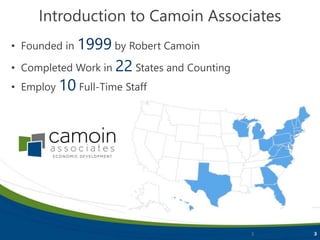
• Founded in 1999 by Robert Camoin
• Completed Work in 22 States and Counting
• Employ 10 Full-Time Staff
3
4
Start-to-Finish
Economic Development Solutions
• Economic Development Strategic Planning
• Market Analysis & Financial Feasibility
• Economic & Fiscal Impact Analysis
• Evaluation & Benchmarking Indicators
• ED Communication & Marketing Recommendations
• Workforce Development
• Stakeholder Engagement
4
5
What is Economic Impact Analysis?
• Examine effect of event on the economy of a
specified geography
• Measures change in jobs, sales, and earnings –
can be positive or negative
6
What’s the point?
Why do an economic impact study
anyway?
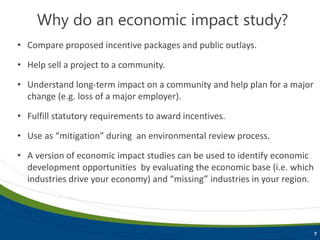
• Compare proposed incentive packages and public outlays.
• Help sell a project to a community.
• Understand long-term impact on a community and help plan for a major
change (e.g. loss of a major employer).
• Fulfill statutory requirements to award incentives.
• Use as “mitigation” during an environmental review process.
• A version of economic impact studies can be used to identify economic
development opportunities by evaluating the economic base (i.e. which
industries drive your economy) and “missing” industries in your region.
Why do an economic impact study?
7
8
Key terms
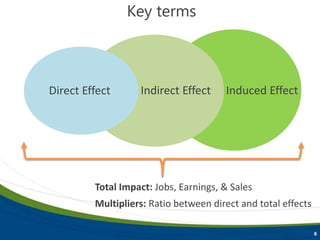
Direct Effect Indirect Effect Induced Effect
Total Impact: Jobs, Earnings, & Sales
Multipliers: Ratio between direct and total effects
9
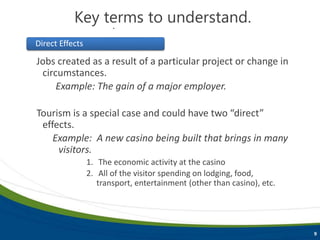
Key terms to understand.
Jobs created as a result of a particular project or change in
circumstances.
Example: The gain of a major employer.
Tourism is a special case and could have two “direct”
effects.
Example: A new casino being built that brings in many
visitors.
1. The economic activity at the casino
2. All of the visitor spending on lodging, food,
transport, entertainment (other than casino), etc.
Direct Effects
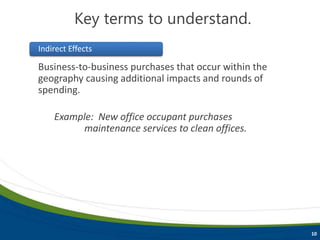
Key terms to understand.
Business-to-business purchases that occur within the
geography causing additional impacts and rounds of
spending.
Example: New office occupant purchases
maintenance services to clean offices.
Indirect Effects
Key terms to understand.
10
Key terms to understand.
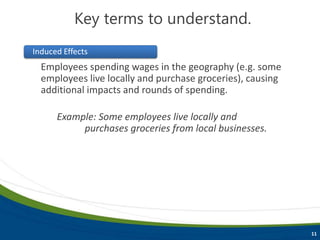
Employees spending wages in the geography (e.g. some
employees live locally and purchase groceries), causing
additional impacts and rounds of spending.
Example: Some employees live locally and
purchases groceries from local businesses.
Induced Effects
Key terms to understand.
11
Key terms to understand.
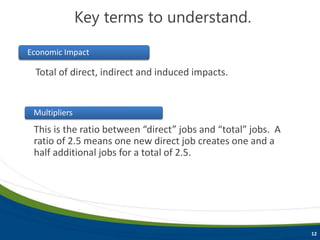
Total of direct, indirect and induced impacts.
Economic Impact
12
This is the ratio between “direct” jobs and “total” jobs. A
ratio of 2.5 means one new direct job creates one and a
half additional jobs for a total of 2.5.
Multipliers
Key terms to understand.
13
So what are we really measuring?
“Exogenous Change” - Money is coming in from
somewhere outside of your community.
Usually occurs when:
• Community exports a good or service elsewhere
• Tourism or Retail: People bringing outside dollars into
your community - “visitor spending”
Change in Final Demand
Key terms to understand.
14
Key terms to understand.
15
But…what if I’m going to visit the
community regardless of the project?
Can you count my spending?
Single biggest pitfall to impact studies is failing to
correctly calculate “net new” when thinking about
change in final demand.
“Net new” is the change in final demand once you
have eliminated and accounted for all other changes.
Key terms to understand.
16
Key terms to understand.It’s all about the
Net New!
17
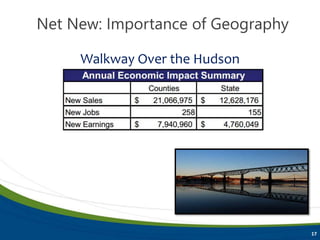
Net New: Importance of Geography
Walkway Over the Hudson
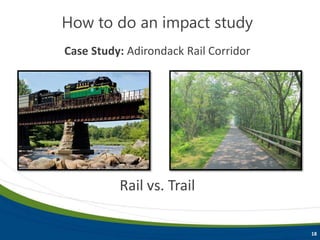
How to do an impact study
18
Rail vs. Trail
Case Study: Adirondack Rail Corridor
Step 1
Select Geography
• Typically a single or
multi-county
geography is used.
• Can also use MSAs
and even ZIP Codes
(not all models allow
this).
• Think about the
project’s logical
economic reach.
19
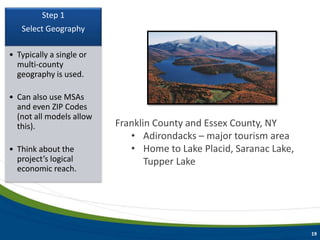
Franklin County and Essex County, NY
• Adirondacks – major tourism area
• Home to Lake Placid, Saranac Lake,
Tupper Lake
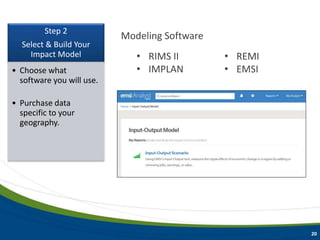
Step 2
Select & Build Your
Impact Model
• Choose what
software you will use.
• Purchase data
specific to your
geography.
20
Modeling Software
• RIMS II
• IMPLAN
• REMI
• EMSI
Step 3
Data Gathering &
Qualitative Analysis
• Discuss project with
stakeholders and project
sponsor to gather
information for basic
inputs to model –
customize the model
based on results.
21
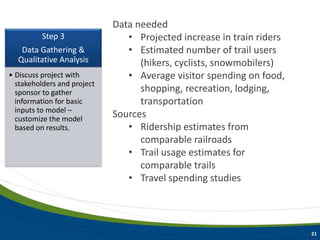
Data needed
• Projected increase in train riders
• Estimated number of trail users
(hikers, cyclists, snowmobilers)
• Average visitor spending on food,
shopping, recreation, lodging,
transportation
Sources
• Ridership estimates from
comparable railroads
• Trail usage estimates for
comparable trails
• Travel spending studies
Step 4
Estimate Direct Impacts
• Figure out how initial
economic output
levels will change in
the industry affected
in your economy.
• “Net New”
22
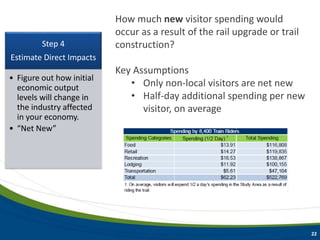
How much new visitor spending would
occur as a result of the rail upgrade or trail
construction?
Key Assumptions
• Only non-local visitors are net new
• Half-day additional spending per new
visitor, on average
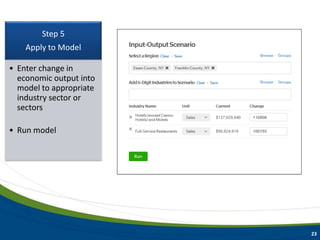
Step 5
Apply to Model
• Enter change in
economic output into
model to appropriate
industry sector or
sectors
• Run model
23
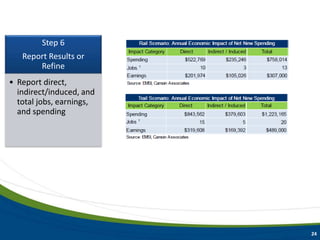
Step 6
Report Results or
Refine
• Report direct,
indirect/induced, and
total jobs, earnings,
and spending
24
Recent Tourism-Based Impact Studies
25
• Nevele Casino & Resort
• North Hampton (MGM Springfield Casino)
• Erie County Fairgrounds & Raceway
• Walkway Over the Hudson
• Friends of Old 7 (7-Mile Bridge)
• Nassau Coliseum: Islanders
• Bangor Arena & Conference Center
• Tug Hill ATV
• Omega Institute
?
Christa Franzi: christa@camoinassociates.com
Tom Dworetsky: tom@camoinassociates.com
Questions?
26

Basics of economic impact analysis

  • 1.
    Basics of EconomicImpact Analysis Prepared By: 1 Prepared For: Siena College Economics of Travel and Tourism Course
  • 2.
    2 Agenda • About CamoinAssociates • Why do an economic impact analysis? • Key terms • How to do an economic impact study: step-by-step • Other examples • Discussion 2
  • 3.
    3 Introduction to CamoinAssociates • Founded in 1999 by Robert Camoin • Completed Work in 22 States and Counting • Employ 10 Full-Time Staff 3
  • 4.
    4 Start-to-Finish Economic Development Solutions •Economic Development Strategic Planning • Market Analysis & Financial Feasibility • Economic & Fiscal Impact Analysis • Evaluation & Benchmarking Indicators • ED Communication & Marketing Recommendations • Workforce Development • Stakeholder Engagement 4
  • 5.
    5 What is EconomicImpact Analysis? • Examine effect of event on the economy of a specified geography • Measures change in jobs, sales, and earnings – can be positive or negative
  • 6.
    6 What’s the point? Whydo an economic impact study anyway?
  • 7.
    • Compare proposedincentive packages and public outlays. • Help sell a project to a community. • Understand long-term impact on a community and help plan for a major change (e.g. loss of a major employer). • Fulfill statutory requirements to award incentives. • Use as “mitigation” during an environmental review process. • A version of economic impact studies can be used to identify economic development opportunities by evaluating the economic base (i.e. which industries drive your economy) and “missing” industries in your region. Why do an economic impact study? 7
  • 8.
    8 Key terms Direct EffectIndirect Effect Induced Effect Total Impact: Jobs, Earnings, & Sales Multipliers: Ratio between direct and total effects
  • 9.
    9 Key terms tounderstand. Jobs created as a result of a particular project or change in circumstances. Example: The gain of a major employer. Tourism is a special case and could have two “direct” effects. Example: A new casino being built that brings in many visitors. 1. The economic activity at the casino 2. All of the visitor spending on lodging, food, transport, entertainment (other than casino), etc. Direct Effects Key terms to understand.
  • 10.
    Business-to-business purchases thatoccur within the geography causing additional impacts and rounds of spending. Example: New office occupant purchases maintenance services to clean offices. Indirect Effects Key terms to understand. 10 Key terms to understand.
  • 11.
    Employees spending wagesin the geography (e.g. some employees live locally and purchase groceries), causing additional impacts and rounds of spending. Example: Some employees live locally and purchases groceries from local businesses. Induced Effects Key terms to understand. 11 Key terms to understand.
  • 12.
    Total of direct,indirect and induced impacts. Economic Impact 12 This is the ratio between “direct” jobs and “total” jobs. A ratio of 2.5 means one new direct job creates one and a half additional jobs for a total of 2.5. Multipliers Key terms to understand.
  • 13.
    13 So what arewe really measuring?
  • 14.
    “Exogenous Change” -Money is coming in from somewhere outside of your community. Usually occurs when: • Community exports a good or service elsewhere • Tourism or Retail: People bringing outside dollars into your community - “visitor spending” Change in Final Demand Key terms to understand. 14 Key terms to understand.
  • 15.
    15 But…what if I’mgoing to visit the community regardless of the project? Can you count my spending?
  • 16.
    Single biggest pitfallto impact studies is failing to correctly calculate “net new” when thinking about change in final demand. “Net new” is the change in final demand once you have eliminated and accounted for all other changes. Key terms to understand. 16 Key terms to understand.It’s all about the Net New!
  • 17.
    17 Net New: Importanceof Geography Walkway Over the Hudson
  • 18.
    How to doan impact study 18 Rail vs. Trail Case Study: Adirondack Rail Corridor
  • 19.
    Step 1 Select Geography •Typically a single or multi-county geography is used. • Can also use MSAs and even ZIP Codes (not all models allow this). • Think about the project’s logical economic reach. 19 Franklin County and Essex County, NY • Adirondacks – major tourism area • Home to Lake Placid, Saranac Lake, Tupper Lake
  • 20.
    Step 2 Select &Build Your Impact Model • Choose what software you will use. • Purchase data specific to your geography. 20 Modeling Software • RIMS II • IMPLAN • REMI • EMSI
  • 21.
    Step 3 Data Gathering& Qualitative Analysis • Discuss project with stakeholders and project sponsor to gather information for basic inputs to model – customize the model based on results. 21 Data needed • Projected increase in train riders • Estimated number of trail users (hikers, cyclists, snowmobilers) • Average visitor spending on food, shopping, recreation, lodging, transportation Sources • Ridership estimates from comparable railroads • Trail usage estimates for comparable trails • Travel spending studies
  • 22.
    Step 4 Estimate DirectImpacts • Figure out how initial economic output levels will change in the industry affected in your economy. • “Net New” 22 How much new visitor spending would occur as a result of the rail upgrade or trail construction? Key Assumptions • Only non-local visitors are net new • Half-day additional spending per new visitor, on average
  • 23.
    Step 5 Apply toModel • Enter change in economic output into model to appropriate industry sector or sectors • Run model 23
  • 24.
    Step 6 Report Resultsor Refine • Report direct, indirect/induced, and total jobs, earnings, and spending 24
  • 25.
    Recent Tourism-Based ImpactStudies 25 • Nevele Casino & Resort • North Hampton (MGM Springfield Casino) • Erie County Fairgrounds & Raceway • Walkway Over the Hudson • Friends of Old 7 (7-Mile Bridge) • Nassau Coliseum: Islanders • Bangor Arena & Conference Center • Tug Hill ATV • Omega Institute
  • 26.
    ? Christa Franzi: christa@camoinassociates.com TomDworetsky: tom@camoinassociates.com Questions? 26

Editor's Notes

  • #26 Before we give you chance to ask question, give you a list of other projects we’ve done recently