







Accountancy- Basics
Prof. Saptarshi Mukherjee
ISBR, Bangalore
Introduction to Accounting
The American Accounting Association defines accounting as
follows:
"The process of identifying, measuring and communicating
economic information to permit informed judgments and
decisions by users of the information”.
Definition of Accountancy
• The process of recording, classifying,
summarizing and Interpretation of financial
data and operations in terms of time and
money.
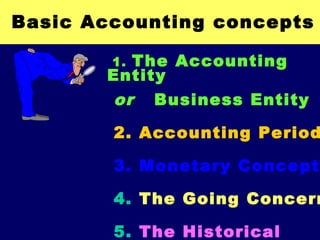
Basic Accounting concepts
1. The Accounting
Entity
or Business Entity
2. Accounting Period
3. Monetary Concept
4. The Going Concern
5. The Historical
The Accounting Entity
Or Business Entity
concept
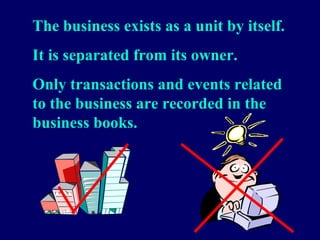
The business exists as a unit by itself.
It is separated from its owner.
Only transactions and events related
to the business are recorded in the
business books.
Accounting Period
The life of a business is divided into
many equal and fixed periods of
time. Eg one year
Monetary Concept
Click
me!
Monetary Concept
-To be measured by Money.
Interpretation possible when measured in monetary terms.
Going Concern
Imagine you just set up a new company.
Do you think you want to sell off your
business next year?
Assumption: The business entity will
continue to operate and it will not close
down.
All assets owned by the business are
assumed to be used into the
unknown future.
Historical Cost
Market Cost changes all the time!
Therefore…
All transactions/assets of a
business entity are recorded at
the original cost price which is
also known as Historical Cost.
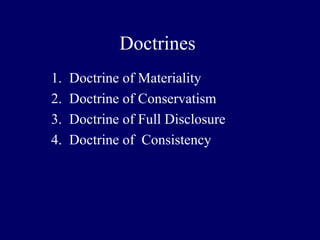
Doctrines
1. Doctrine of Materiality
2. Doctrine of Conservatism
3. Doctrine of Full Disclosure
4. Doctrine of Consistency
Need of Accountancy
• Accounting provides information on the
(1)resources available to a firm,
(2) the means employed to finance those
resources, and
(3) the results achieved through their use.
Branches of Accounting
• Financial Accounting
• Management Accounting
• Cost Accounting
• Tax Accounting
Financial AccountingFinancial Accounting
Financial Accounting…
Financial accounting
– Primarily prepared for users external to the
company.
• Revenues, assets, etc.
Financial accounting is the field of accountancy
concerned with the preparation of financial
statements for decision makers.
Management AccountingManagement Accounting
 Management Accounting is
“The process of identification,
measurement, accumulation,
analysis, preparation, interpretation
& communication of information
used by management to plan,
evaluate & control within an entity &
to assure use of & accountability for
its resources”.
What is management Accounting?What is management Accounting?
Management AccountingManagement Accounting
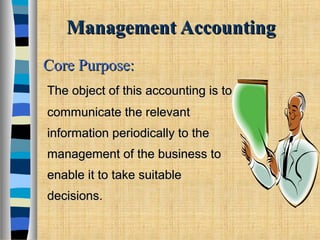
The object of this accounting is toThe object of this accounting is to
communicate the relevantcommunicate the relevant
information periodically to theinformation periodically to the
management of the business tomanagement of the business to
enable it to take suitableenable it to take suitable
decisions.decisions.
Core Purpose:Core Purpose:
Focus of Management
Accounting
Thus main focus of managerial accounting
is to help the managers for making better
decisions.
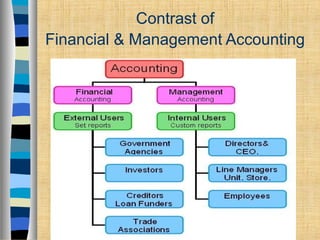
Contrast of
Financial & Management Accounting
Managerial Accounting
Benefits:
 Determining performance
 Dropping or managing costs
 Examining the prices for products and
services
 Choosing to approve, change or suspend
a plan or action
Cost AccountingCost Accounting
Cost Accounting….Cost Accounting….
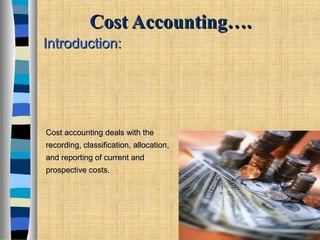
Introduction:Introduction:
Cost accounting deals with theCost accounting deals with the
recording, classification, allocation,recording, classification, allocation,
and reporting of current andand reporting of current and
prospective costs.prospective costs.
Cost Accounting…Cost Accounting…
Purpose:
 The main object of cost accounting is to
determine the cost of goods manufactured or
produced by the business.
 It helps the management of the business in
controlling the costs by indicating avoidable
losses and wastage
Cost Accounting Benefits
 Analyze costs relevant to
your business and
business model
 Powerful allocation
schemes matching your
business model
 Plan and calculate future
cost based on budgets
and forecasts
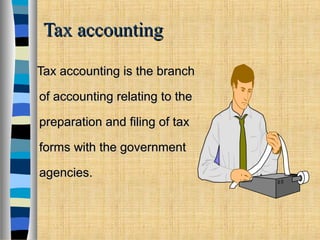
Tax accountingTax accounting
Tax accounting is the branchTax accounting is the branch
of accounting relating to theof accounting relating to the
preparation and filing of taxpreparation and filing of tax
forms with the governmentforms with the government
agencies.agencies.
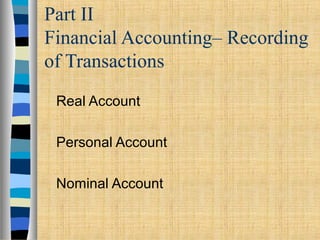
Part II
Financial Accounting– Recording
of Transactions
Real Account
Personal Account
Nominal Account
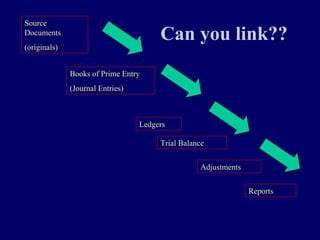
Source
Documents
(originals)
Books of Prime Entry
(Journal Entries)
Ledgers
Trial Balance
Adjustments
Reports
Can you link??
Basics Accountancy

Basics Accountancy

Editor's Notes

  • #5 Doctrine of Consistency, Full Disclosure, Conservatism, Materiality.