CONGESTIVE HEART
FAILURE
By: ARYENDU KUMAR SAINI
M.Pharm ( PHARMACOLOGY)
Ist year
P.S.I.T.
Heart Failure
Heart failure (HF), often referred to
as congestive heart failure (CHF), occurs when
the heart is unable to pump sufficiently to
maintain blood flow to meet the body's needs.
Why the word “Congestion”?
The term [“congestive” heart failure] is often
used as one of the common symptoms is
congestion that means there is accumulation of
fluid in tissues.
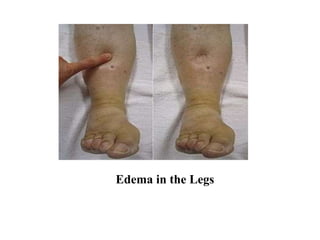
Specifically, congestion takes the form of
water retention and swelling (edema)
peripheral edema and pulmonary edema as
well as ascites.
Edema in the Legs
Major Causes
• High blood pressure: If there is high blood
pressure for a long time, this will lead to heart
muscle too weak to effectively pump the
blood.
• Cardiomyopathy: Causes like infections,
alcohol abuse, and the toxic effects of the drug,
such as cocaine. These cause damage to the
heart muscle.
• Abnormal Heart Rhythms: A slow heart rate
may lead to heart failure.
• Coronary artery disease: The most common
cause of the heart failure.
• Faulty Heart valves: A damaged heart valve
forces the heart to work harder, which can
weaken it over the time.
CLASSIFICATION
The New York Heart Association (NYHA) classification
system categorizes heart failure on a scale of I to IV, as
follows:
Class I: No limitation of physical activity. Ordinary
physical activity does not cause fatigue, palpitation.
Class II: Slight limitation of physical activity. Ordinary
physical activity results in fatigue, palpitation.
Class III: Marked limitation of physical activity. Less than
ordinary activity causes fatigue, palpitation, or anginal
pain.
Class IV: Symptoms occur even at rest; discomfort with
any physical activity.
CLINICAL PRESENTATION
IMPORTANT TERMINOLOGIES
• End diastolic volume: The amount of blood
present in the left ventricle just before
contraction.
• Stroke volume: The amount of blood that is
ejected out of the left ventricle during
contraction or systole.
• End Systolic volume: The amount of blood
that is left after the systole or the contraction
of left ventricle
So, If we subtract the end systolic volume
from the end diastolic volume, it will give us
stroke volume.
SV= EDV-ESV
SV= Stroke Volume
EDV= End Diastolic Volume
ESV= End Systolic Volume
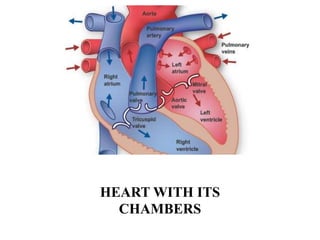
HEART WITH ITS
CHAMBERS
EJECTION FRACTION
EF= SV/EDV*100, where SV=Stroke Volume
and EDV is End Diastolic Volume
SV= The amount of the blood that ejects out
from the left ventricle.
EDV= The amount of the blood that fills during
the diastole.
PRELOAD AND AFTERLOAD
(Most important terminologies ever)
• Very important to understand the working of
the heart.
• Without knowing this, we can not understand
pharmacological treatment.
PRE-LOAD
Preload is the (end diastolic volume) that stretches the
right or left ventricle of the heart.
Simply, we can think of the preload as the End-diastolic
volume.
So, Preload= End diastolic volume
End diastolic volume is the amount of blood
present in the left ventricle just before
contraction.
Greater is the preload, greater will be pressure,
and greater will be the radius of ventricle.
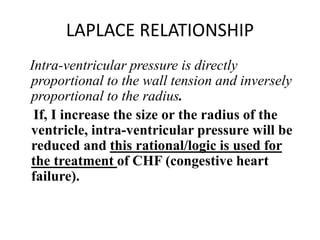
LAPLACE RELATIONSHIP
Intra-ventricular pressure is directly
proportional to the wall tension and inversely
proportional to the radius.
If, I increase the size or the radius of the
ventricle, intra-ventricular pressure will be
reduced and this rational/logic is used for
the treatment of CHF (congestive heart
failure).
Why to reduce Preload?
• By reducing the preload, one is reducing
the ventricle radius, thus, increasing the
intra-ventricular pressure.
• So, if intra-ventricular pressure is
increased, more cardiac output will be
generated.
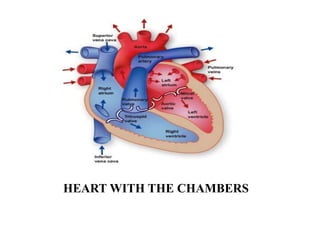
HEART WITH THE CHAMBERS
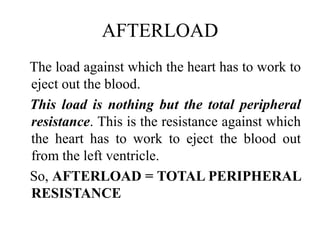
AFTERLOAD
The load against which the heart has to work to
eject out the blood.
This load is nothing but the total peripheral
resistance. This is the resistance against which
the heart has to work to eject the blood out
from the left ventricle.
So, AFTERLOAD = TOTAL PERIPHERAL
RESISTANCE
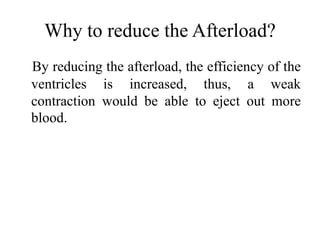
Why to reduce the Afterload?
By reducing the afterload, the efficiency of the
ventricles is increased, thus, a weak
contraction would be able to eject out more
blood.
(NON PHARMACOLOGICAL
THERAPY)
Non-pharmacological therapy: Dietary sodium
and fluid restriction, physical activity as
appropriate, and attention to weight gain.
(PHARMACOLOGICAL THERAPY)
There are two different goals of drug therapy in
the congestive heart failure:
• Relief of congestive/ low output symptoms and
restoration of the cardiac performance.
• Reversal of disease progression and
prolongation of survival by the use of drugs.
Relief of Congestive/ low output
symptoms
• Inotropic drugs: Digitoxin,
dobutamine/dopamine, amrinone/milrinone
• Diuretics: Furosemide, thiazides
• RAS inhibitors: ACE inhibitors/ ARBs
• Vasodilators: Hydralazine, nitrate
• Beta blocker: Metoprolol
Reversal of disease progression
ACE inhibitors/ ARBs, beta blockers
Aldosterone antagonist: Spironolactone
Beta Blocker for the CHF
• The majority of patients in heart failure have a
form that is called systolic dysfunction, which
means that the contractile function of the heart
is depressed (loss of ionotropy).
• Clinical studies have shown quite
conclusively that some specific beta-
blockers actually improve cardiac function.
• They reduce the mortality.
Beta blocker (Contd.)
• Immediate action of beta blockers is to
depress the contractility and ejection fraction
but these factors improve over the weeks.
• They have shown to reduce the deleterious
cardiac remodeling, ventricular hypertrophy,
enhanced arrhythmogenesis that occurs in
CHF due to excessive sympathetic activity.
• Metoprolol, Nebivolol, and non selective beta
plus the alpha 1 blocker i.e. carvedilol.
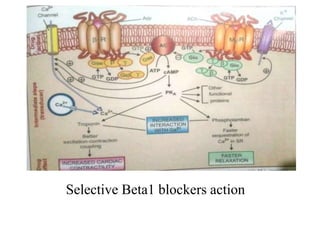
Selective Beta1 blockers action
ADVERSE EFFECTS
• Bradycardia
• Fluid retention
• Headache
• Diarrhea
If the bradycardia is accompanied by dizziness or if the
second or third degree of heart block occurs, dose is
reduced.
Inotropic and adrenergic drugs
These are the drugs that have the beta agonist
activity and little alpha activity.
The drugs are Dopamine and Dobutamine (having
the beta adrenergic activity).
Dopamine :
• In lower dose, it reduces the total peripheral
resistance and is preferred in CHF.
• Low rates of dopamine infusion (~2mcg/kg/min)
cause selective vasodilatation which enhances
the renal perfusion.
ADVERSE EFFECTS
• Due to the development of tolerance and
toxicity when used regularly, these drugs have
no role in the long term management of CHF.
• A major side effect of β-agonists is
cardiac arrhythmia. Because these drugs
increase myocardial oxygen demand, they can
precipitate angina in patients with coronary
artery disease.
RAS inhibitors (The sheet anchors of
drug therapy)
• Since, RAS activation is important for the
development of disease and disease
progression in CHF, that’s why ACE
inhibitors and ARBs are the sheet anchor of
drug therapy in the CHF.
• They confer the symptomatic as well as
disease modifying benefits in CHF.
• Levels of kinins are increased by the ACE
inhibitors, hence stimulate the generation of
cardio protective NO and PGs.
ADVERSE EFFECTS
• A common, annoying side effect of ACE
inhibitors is the dry cough appearing in about
10% of patients. It appears to be related to the
elevation in bradykinin level.
• ACE inhibitors are contraindicated in the
pregnancy.
Digitalis
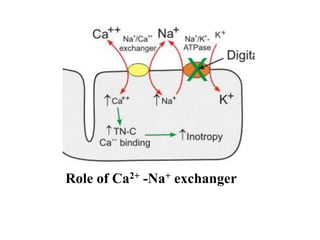
This plant contains cardiac glycosides that
have the power to increase the inotropy.
The other action of these glycoside is the
negative chronotropy action.
Digoxin ( from Digitalis lanata) is the example.
The next useful action of digitalis is the
diuresis.
A NOTICEABLE THING
A very important thing to understand is that
Troponin C is responsible for the contraction
of the cardiac smooth muscle and the skeletal
muscle whereas sliding of actin and myosin is
responsible for the smooth muscle contraction.
Mechanism of Inotropic drugs
Role of Ca2+ -Na+ exchanger
Diuretics
Most patients in heart failure are prescribed
with a loop diuretic because they are more
effective in unloading sodium and water than
thiazide diuretics.
In mild heart failure, a thiazide diuretic may
be used. Aldosterone-blocking diuretics (e.g.,
spironolactone) are being used increasingly in
heart failure.
• It has lessen the need for i.v. digitalisation.
• It decreases the preload and improve the
ventricular efficiency.
ADVERSE EFFECTS
• Alkalosis
• Carbohydrate intolerance
• Hypovolemia (that can trigger the RAS).
THIS IS THE MOST SUBSTANTIAL
REASON FOR DOSE TITRATION OF
DIURETIC.
Vasodilators
• Most commonly used vasodilators are arteriole
dilators, venous dilators (Nitrates) and mixed
dilators (sodium nitroprusside and ACE
inhibitors).
• They work by decreasing primarily preload or
the after load or both.
• Hydralazine (potassium channel opener)
decreases the total peripheral resistance and hence
the after load, this confer relief to cardiac muscle.
Mechanism of action of Nitrodilators
Nitrate reduces the venous return thus pooling
of blood. So, preload is lowered.
Adverse Effects
• The most common side effects of nitrodilators
are headache (caused by cerebral vasodilation)
and cutaneous flushing (must not be confused
with blushing).
• Other side effects include postural
hypotension.
• Example: Glyceryl trinitrate
Phosphodiesterase 3 Inhibitors
• This enzyme (phosphodiesterase) is responsible
for degradation of cAMP in heart.
• Inhibition of this enzyme prevents cAMP
breakdown and thereby increases its intracellular
concentration.
• PDE3 inhibitors can be thought of as a
backdoor approach to cardiac stimulation,
whereas β-agonist go through the frontdoor
approach to produce the same effect.
Examples of PDE-3 inhibitors
• Milrinone
• Inamrinone (formerly amrinone)
• Cilostazol
Adverse Effects
Thrombocytopenia is the most prominent and
dose related side effect.
CONGESTIVE HEART FAILURE
IN A NUTSHELL
• This disease is only manageable and can not be
cured.
• Factors like exercise, yoga, and healthy diet can
help to eradicate the causative factor like high
blood pressure and work prophylactically.
• Most of the drugs that are used for the
treatment of it are generally preload, afterload
or both reducers and exert the positive
ionotropic effect.
REFERENCES
• Tripathi KD. Essentials of Medical
Pharmacology. 7th Ed. New Delhi. Jaypee
Brothers Medical Publishers. 2013. p. 512-
524.
• Klabaunde R. Cardiovascular Pharmacology
Concepts [Internet]. cvpharmacology.com.
2018 [cited 2018 Jan 11]. Available from:
http://www.cvpharmacology.com/clinical%20t
opics/heart%20failure-4
THANKS ALL FOR
PATIENCE
LISTENING

Basic understandings in the Heart Failure

  • 1.
    CONGESTIVE HEART FAILURE By: ARYENDUKUMAR SAINI M.Pharm ( PHARMACOLOGY) Ist year P.S.I.T.
  • 2.
    Heart Failure Heart failure(HF), often referred to as congestive heart failure (CHF), occurs when the heart is unable to pump sufficiently to maintain blood flow to meet the body's needs.
  • 3.
    Why the word“Congestion”? The term [“congestive” heart failure] is often used as one of the common symptoms is congestion that means there is accumulation of fluid in tissues. Specifically, congestion takes the form of water retention and swelling (edema) peripheral edema and pulmonary edema as well as ascites.
  • 4.
  • 5.
    Major Causes • Highblood pressure: If there is high blood pressure for a long time, this will lead to heart muscle too weak to effectively pump the blood. • Cardiomyopathy: Causes like infections, alcohol abuse, and the toxic effects of the drug, such as cocaine. These cause damage to the heart muscle.
  • 6.
    • Abnormal HeartRhythms: A slow heart rate may lead to heart failure. • Coronary artery disease: The most common cause of the heart failure. • Faulty Heart valves: A damaged heart valve forces the heart to work harder, which can weaken it over the time.
  • 7.
    CLASSIFICATION The New YorkHeart Association (NYHA) classification system categorizes heart failure on a scale of I to IV, as follows: Class I: No limitation of physical activity. Ordinary physical activity does not cause fatigue, palpitation. Class II: Slight limitation of physical activity. Ordinary physical activity results in fatigue, palpitation. Class III: Marked limitation of physical activity. Less than ordinary activity causes fatigue, palpitation, or anginal pain. Class IV: Symptoms occur even at rest; discomfort with any physical activity.
  • 8.
  • 9.
    IMPORTANT TERMINOLOGIES • Enddiastolic volume: The amount of blood present in the left ventricle just before contraction. • Stroke volume: The amount of blood that is ejected out of the left ventricle during contraction or systole. • End Systolic volume: The amount of blood that is left after the systole or the contraction of left ventricle
  • 10.
    So, If wesubtract the end systolic volume from the end diastolic volume, it will give us stroke volume. SV= EDV-ESV SV= Stroke Volume EDV= End Diastolic Volume ESV= End Systolic Volume
  • 11.
  • 12.
    EJECTION FRACTION EF= SV/EDV*100,where SV=Stroke Volume and EDV is End Diastolic Volume SV= The amount of the blood that ejects out from the left ventricle. EDV= The amount of the blood that fills during the diastole.
  • 13.
    PRELOAD AND AFTERLOAD (Mostimportant terminologies ever) • Very important to understand the working of the heart. • Without knowing this, we can not understand pharmacological treatment.
  • 14.
    PRE-LOAD Preload is the(end diastolic volume) that stretches the right or left ventricle of the heart. Simply, we can think of the preload as the End-diastolic volume. So, Preload= End diastolic volume End diastolic volume is the amount of blood present in the left ventricle just before contraction. Greater is the preload, greater will be pressure, and greater will be the radius of ventricle.
  • 15.
  • 16.
    LAPLACE RELATIONSHIP Intra-ventricular pressureis directly proportional to the wall tension and inversely proportional to the radius. If, I increase the size or the radius of the ventricle, intra-ventricular pressure will be reduced and this rational/logic is used for the treatment of CHF (congestive heart failure).
  • 17.
    Why to reducePreload? • By reducing the preload, one is reducing the ventricle radius, thus, increasing the intra-ventricular pressure. • So, if intra-ventricular pressure is increased, more cardiac output will be generated.
  • 18.
  • 19.
    AFTERLOAD The load againstwhich the heart has to work to eject out the blood. This load is nothing but the total peripheral resistance. This is the resistance against which the heart has to work to eject the blood out from the left ventricle. So, AFTERLOAD = TOTAL PERIPHERAL RESISTANCE
  • 20.
    Why to reducethe Afterload? By reducing the afterload, the efficiency of the ventricles is increased, thus, a weak contraction would be able to eject out more blood.
  • 21.
    (NON PHARMACOLOGICAL THERAPY) Non-pharmacological therapy:Dietary sodium and fluid restriction, physical activity as appropriate, and attention to weight gain.
  • 22.
    (PHARMACOLOGICAL THERAPY) There aretwo different goals of drug therapy in the congestive heart failure: • Relief of congestive/ low output symptoms and restoration of the cardiac performance. • Reversal of disease progression and prolongation of survival by the use of drugs.
  • 23.
    Relief of Congestive/low output symptoms • Inotropic drugs: Digitoxin, dobutamine/dopamine, amrinone/milrinone • Diuretics: Furosemide, thiazides • RAS inhibitors: ACE inhibitors/ ARBs • Vasodilators: Hydralazine, nitrate • Beta blocker: Metoprolol
  • 24.
    Reversal of diseaseprogression ACE inhibitors/ ARBs, beta blockers Aldosterone antagonist: Spironolactone
  • 25.
    Beta Blocker forthe CHF • The majority of patients in heart failure have a form that is called systolic dysfunction, which means that the contractile function of the heart is depressed (loss of ionotropy). • Clinical studies have shown quite conclusively that some specific beta- blockers actually improve cardiac function. • They reduce the mortality.
  • 26.
    Beta blocker (Contd.) •Immediate action of beta blockers is to depress the contractility and ejection fraction but these factors improve over the weeks. • They have shown to reduce the deleterious cardiac remodeling, ventricular hypertrophy, enhanced arrhythmogenesis that occurs in CHF due to excessive sympathetic activity. • Metoprolol, Nebivolol, and non selective beta plus the alpha 1 blocker i.e. carvedilol.
  • 27.
  • 28.
    ADVERSE EFFECTS • Bradycardia •Fluid retention • Headache • Diarrhea If the bradycardia is accompanied by dizziness or if the second or third degree of heart block occurs, dose is reduced.
  • 29.
    Inotropic and adrenergicdrugs These are the drugs that have the beta agonist activity and little alpha activity. The drugs are Dopamine and Dobutamine (having the beta adrenergic activity). Dopamine : • In lower dose, it reduces the total peripheral resistance and is preferred in CHF. • Low rates of dopamine infusion (~2mcg/kg/min) cause selective vasodilatation which enhances the renal perfusion.
  • 30.
    ADVERSE EFFECTS • Dueto the development of tolerance and toxicity when used regularly, these drugs have no role in the long term management of CHF. • A major side effect of β-agonists is cardiac arrhythmia. Because these drugs increase myocardial oxygen demand, they can precipitate angina in patients with coronary artery disease.
  • 31.
    RAS inhibitors (Thesheet anchors of drug therapy) • Since, RAS activation is important for the development of disease and disease progression in CHF, that’s why ACE inhibitors and ARBs are the sheet anchor of drug therapy in the CHF. • They confer the symptomatic as well as disease modifying benefits in CHF.
  • 32.
    • Levels ofkinins are increased by the ACE inhibitors, hence stimulate the generation of cardio protective NO and PGs.
  • 33.
    ADVERSE EFFECTS • Acommon, annoying side effect of ACE inhibitors is the dry cough appearing in about 10% of patients. It appears to be related to the elevation in bradykinin level. • ACE inhibitors are contraindicated in the pregnancy.
  • 34.
    Digitalis This plant containscardiac glycosides that have the power to increase the inotropy. The other action of these glycoside is the negative chronotropy action. Digoxin ( from Digitalis lanata) is the example. The next useful action of digitalis is the diuresis.
  • 35.
    A NOTICEABLE THING Avery important thing to understand is that Troponin C is responsible for the contraction of the cardiac smooth muscle and the skeletal muscle whereas sliding of actin and myosin is responsible for the smooth muscle contraction.
  • 36.
  • 37.
    Role of Ca2+-Na+ exchanger
  • 38.
    Diuretics Most patients inheart failure are prescribed with a loop diuretic because they are more effective in unloading sodium and water than thiazide diuretics. In mild heart failure, a thiazide diuretic may be used. Aldosterone-blocking diuretics (e.g., spironolactone) are being used increasingly in heart failure.
  • 39.
    • It haslessen the need for i.v. digitalisation. • It decreases the preload and improve the ventricular efficiency.
  • 40.
    ADVERSE EFFECTS • Alkalosis •Carbohydrate intolerance • Hypovolemia (that can trigger the RAS). THIS IS THE MOST SUBSTANTIAL REASON FOR DOSE TITRATION OF DIURETIC.
  • 41.
    Vasodilators • Most commonlyused vasodilators are arteriole dilators, venous dilators (Nitrates) and mixed dilators (sodium nitroprusside and ACE inhibitors). • They work by decreasing primarily preload or the after load or both. • Hydralazine (potassium channel opener) decreases the total peripheral resistance and hence the after load, this confer relief to cardiac muscle.
  • 42.
    Mechanism of actionof Nitrodilators
  • 43.
    Nitrate reduces thevenous return thus pooling of blood. So, preload is lowered.
  • 44.
    Adverse Effects • Themost common side effects of nitrodilators are headache (caused by cerebral vasodilation) and cutaneous flushing (must not be confused with blushing). • Other side effects include postural hypotension. • Example: Glyceryl trinitrate
  • 45.
    Phosphodiesterase 3 Inhibitors •This enzyme (phosphodiesterase) is responsible for degradation of cAMP in heart. • Inhibition of this enzyme prevents cAMP breakdown and thereby increases its intracellular concentration. • PDE3 inhibitors can be thought of as a backdoor approach to cardiac stimulation, whereas β-agonist go through the frontdoor approach to produce the same effect.
  • 46.
    Examples of PDE-3inhibitors • Milrinone • Inamrinone (formerly amrinone) • Cilostazol
  • 47.
    Adverse Effects Thrombocytopenia isthe most prominent and dose related side effect.
  • 48.
    CONGESTIVE HEART FAILURE INA NUTSHELL • This disease is only manageable and can not be cured. • Factors like exercise, yoga, and healthy diet can help to eradicate the causative factor like high blood pressure and work prophylactically. • Most of the drugs that are used for the treatment of it are generally preload, afterload or both reducers and exert the positive ionotropic effect.
  • 49.
    REFERENCES • Tripathi KD.Essentials of Medical Pharmacology. 7th Ed. New Delhi. Jaypee Brothers Medical Publishers. 2013. p. 512- 524. • Klabaunde R. Cardiovascular Pharmacology Concepts [Internet]. cvpharmacology.com. 2018 [cited 2018 Jan 11]. Available from: http://www.cvpharmacology.com/clinical%20t opics/heart%20failure-4
  • 50.