Working in Microsoft
Windows Environment
Windows Environment
 The Windows environment is the onscreen work area provided by Windows, analogous to a
physical desktop, and the operating system's core extension points. Learn how to leverage
the desktop, taskbar, notification area, control panels, help, and user account control for
your app.
 Desktop
 Taskbar
 Notification Area
 Control Panels
 Help
 User Account Control
Microsoft Windows Operating
System
 Windows is operating system from Microsoft Inc. It is a system program that controls,
 coordinates and manipulates overall desktop publishing operations. It serves as an interface
 between the hardware and other software on the computer system. It allocates memory
 locations to data and other computer programs. It controls other computer resources like files
 and programs, input/output devices, computer memories etc during data processing operations.
 It also performs the hardware and software diagnosis to detect faults and errors.
Versions of windows
 Windows provides a graphical user interface (GUI), and support many peripheral
devices. In addition to windows operating system for personal computers, Microsoft
also offers operating system for servers and personal computers.
 Windows 1.0- 2.0 (1985-1992). Window 1.0 allowed users to point and click to
access the windows. Window 2.0 added icons, keyboard shortcuts and improved
graphics.
 Windows 3.0-3.1 (1990-1994). Support better icons and program manager (1st
version of “look and feel” screen of Microsoft windows).
 Windows 95 (August 1995). It runs faster and has ability to automatically delete
and configure installed hardware (plug and play).
 Windows 98 (June 1998). It offers supports for new technology FAT32, AGP, MMX, USB, DVD. It is an active desktop which
integrates the web browser (internet Explorer)
 Windows ME- Millennium Edition (September 2000). Booting is in Dos option
 Windows NT 3.1-4.0 (1993-1996). It supports pre-emptive multi tasking. They are Windows NT and Windows NT SERVER.
 Windows Vista (November 2006). It offered an advancement in reliability, security and ease of deployment
 Windows 7 (October 2009). Improved performance and start-up-time and window media centre.
 Windows 8 (August 2012). It was developed with touch screen use in mind
 Windows 10 (2015). Fast start-up, Microsoft edge, Microsoft new browser.
Major Features of Windows
 Interactive Package: It ensures a flow of communication between the user and the
 computer. Hence, it serves as an intermediary between the two parties.
 Menu Driven Package: Ms-Windows ensure flexibility in that the user can
 perform several functions or task without remembering the commands, simply by
 the Click. Of an option of a menu or sub-menu.
 Program Manager: Ms-Window serves as a manager to other programs since it controls, co-ordinates and manipulates their
processing.
 Multi-tasking Package: With windows operations, a user can make use of two or more package while shifting from one package
to another e.g. A user can be working in ms-excel, and at the same time involve in PageMaker etc.
Appearance of Window Screen
 The appearance of window screen depends on how the computer is being set-up. A window screen always contains various items
or ICON depending on the window version. Hence, a reliable window screen consists of the following: major icons and other
additional icons.
 (i) My computer Icon: This is a container for disk drives. My computer icon displays
 window with Icons representing object in the computer system. Such as folder, files,
 disk-drive.
 (ii) Internet Explorer: This is a shortcut for launching the internet explorer program,
 which is web browser. A web browser is a software program for navigating, WWW
 (World Wide Web)
 Network Neighbourhood: Network neighbourhood icon serves as container for
 network resources of other, computer it might include items such as; disk drive,
 printer and CD-ROMS.
 (iv) Network: A network is a collection of several computer connected together with
 the aim of sharing the same resources and component e.g. printer.
 (v) Recycle Bin: This is a computer object for files that are no longer needed the
 computer or, this is a temporary storage location where all files are kept. One can
 retrieve such file if deleted by error.
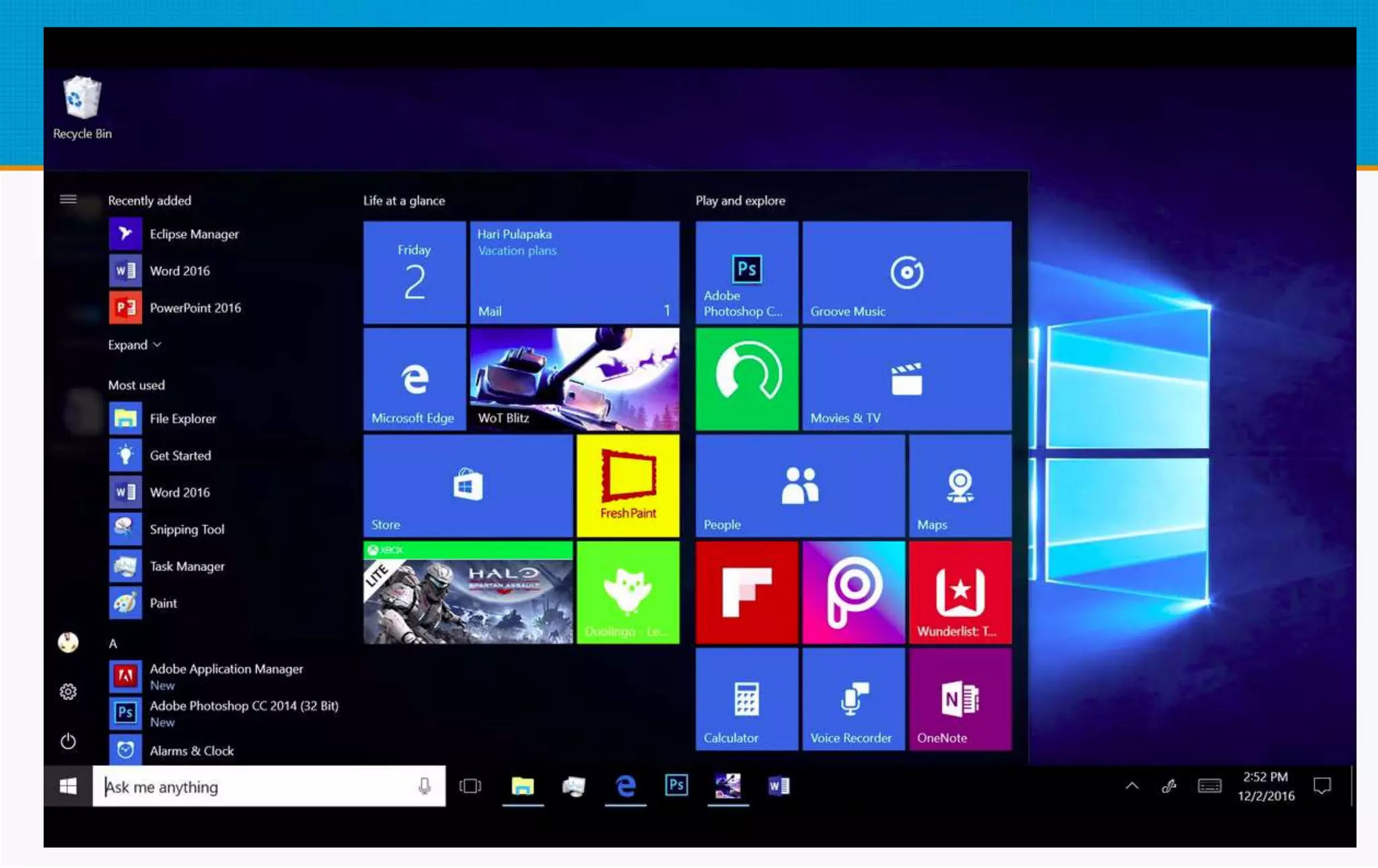
 Status Bar: This is the lower part of the windows. It consists’ of the start button, task bar and time.

 Start Button: it contain everything needed to work with windows, start icon of the windows
 consists of several options in form of sub-menu. Hence, when you click on start button, a sup-
 menu appears as follows:
 (i) Program: it displays the list of software available in the windows environment for the user to utilize.
 (ii) Document: it displays the list of documents that have been opened previously.
 (iii) Setting: it list out all the computer components which their setting can be changed e.g. setting
date and time, changing window screen etc.
 (iv) Find: it is used to find and locate a particular file, folder and e-mail messages.
 (v) Help: it shows the steps involve in performing a particular task. It equally serves as a tutor.
 (vi) Run: it is mainly used to run or execute Ms-command and other application packages.
 (vii) Shut Down: it is used to shut down or re-start the computer. It should be noted that
 the system must be properly shut down before switching off the system.
 Task Bar
 Each time an operation is performed, a button representing that window appears on the task
 bar. To switch from the window to another click on the button for the window you want in the
 task bar.
 Notification Area
 It shows at the extreme end of the status bar. It displays the current time.
 Folder
 A folder is a directory, which stores files and other folders. Or a folder is a directory through
 which users can access files and other folders.

 Windows Operating Devices
 These are electronic devices used in manipulating windows. It could be input device or output
 device.
 Input Device
Reference
www.researchgate.net/publication
www.britannica.com/technology

Windows enviroment

  • 1.
  • 2.
    Windows Environment  TheWindows environment is the onscreen work area provided by Windows, analogous to a physical desktop, and the operating system's core extension points. Learn how to leverage the desktop, taskbar, notification area, control panels, help, and user account control for your app.  Desktop  Taskbar  Notification Area  Control Panels  Help  User Account Control
  • 3.
    Microsoft Windows Operating System Windows is operating system from Microsoft Inc. It is a system program that controls,  coordinates and manipulates overall desktop publishing operations. It serves as an interface  between the hardware and other software on the computer system. It allocates memory  locations to data and other computer programs. It controls other computer resources like files  and programs, input/output devices, computer memories etc during data processing operations.  It also performs the hardware and software diagnosis to detect faults and errors.
  • 4.
    Versions of windows Windows provides a graphical user interface (GUI), and support many peripheral devices. In addition to windows operating system for personal computers, Microsoft also offers operating system for servers and personal computers.  Windows 1.0- 2.0 (1985-1992). Window 1.0 allowed users to point and click to access the windows. Window 2.0 added icons, keyboard shortcuts and improved graphics.  Windows 3.0-3.1 (1990-1994). Support better icons and program manager (1st version of “look and feel” screen of Microsoft windows).  Windows 95 (August 1995). It runs faster and has ability to automatically delete and configure installed hardware (plug and play).
  • 5.
     Windows 98(June 1998). It offers supports for new technology FAT32, AGP, MMX, USB, DVD. It is an active desktop which integrates the web browser (internet Explorer)  Windows ME- Millennium Edition (September 2000). Booting is in Dos option  Windows NT 3.1-4.0 (1993-1996). It supports pre-emptive multi tasking. They are Windows NT and Windows NT SERVER.  Windows Vista (November 2006). It offered an advancement in reliability, security and ease of deployment  Windows 7 (October 2009). Improved performance and start-up-time and window media centre.  Windows 8 (August 2012). It was developed with touch screen use in mind  Windows 10 (2015). Fast start-up, Microsoft edge, Microsoft new browser.
  • 6.
    Major Features ofWindows  Interactive Package: It ensures a flow of communication between the user and the  computer. Hence, it serves as an intermediary between the two parties.  Menu Driven Package: Ms-Windows ensure flexibility in that the user can  perform several functions or task without remembering the commands, simply by  the Click. Of an option of a menu or sub-menu.  Program Manager: Ms-Window serves as a manager to other programs since it controls, co-ordinates and manipulates their processing.  Multi-tasking Package: With windows operations, a user can make use of two or more package while shifting from one package to another e.g. A user can be working in ms-excel, and at the same time involve in PageMaker etc.
  • 7.
    Appearance of WindowScreen  The appearance of window screen depends on how the computer is being set-up. A window screen always contains various items or ICON depending on the window version. Hence, a reliable window screen consists of the following: major icons and other additional icons.  (i) My computer Icon: This is a container for disk drives. My computer icon displays  window with Icons representing object in the computer system. Such as folder, files,  disk-drive.  (ii) Internet Explorer: This is a shortcut for launching the internet explorer program,  which is web browser. A web browser is a software program for navigating, WWW  (World Wide Web)  Network Neighbourhood: Network neighbourhood icon serves as container for  network resources of other, computer it might include items such as; disk drive,  printer and CD-ROMS.  (iv) Network: A network is a collection of several computer connected together with  the aim of sharing the same resources and component e.g. printer.  (v) Recycle Bin: This is a computer object for files that are no longer needed the  computer or, this is a temporary storage location where all files are kept. One can  retrieve such file if deleted by error.
  • 8.
     Status Bar:This is the lower part of the windows. It consists’ of the start button, task bar and time.   Start Button: it contain everything needed to work with windows, start icon of the windows  consists of several options in form of sub-menu. Hence, when you click on start button, a sup-  menu appears as follows:  (i) Program: it displays the list of software available in the windows environment for the user to utilize.  (ii) Document: it displays the list of documents that have been opened previously.  (iii) Setting: it list out all the computer components which their setting can be changed e.g. setting date and time, changing window screen etc.  (iv) Find: it is used to find and locate a particular file, folder and e-mail messages.  (v) Help: it shows the steps involve in performing a particular task. It equally serves as a tutor.  (vi) Run: it is mainly used to run or execute Ms-command and other application packages.  (vii) Shut Down: it is used to shut down or re-start the computer. It should be noted that  the system must be properly shut down before switching off the system.
  • 9.
     Task Bar Each time an operation is performed, a button representing that window appears on the task  bar. To switch from the window to another click on the button for the window you want in the  task bar.  Notification Area  It shows at the extreme end of the status bar. It displays the current time.  Folder  A folder is a directory, which stores files and other folders. Or a folder is a directory through  which users can access files and other folders.   Windows Operating Devices  These are electronic devices used in manipulating windows. It could be input device or output  device.  Input Device
  • 12.