Overview Syncope
Dr. Adenwali Hassan Ahmed:
(Mwn, Bsc-Medical Doctor, Bsc- Public Health Officer,
Msc-Gyn/Obest.
Slide 2 of 27
Introduction of Syncope
• Syncope is also known as fainting. This is a
temporary loss of consciousness with a quick
recovery.
• Syncope is caused by decreased cerebral blood
flow leading to transient loss of consciousness
and postural tone, associated with spontaneous
recovery.
• Most people don’t need follow-up treatment.
However, you need treatment for certain causes,
such as heart issues.
Slide 3 of 27
Overview
• Syncope (pronounced “sin-ko-pea”) is the
medical term for fainting or passing out.
• Fainting is a brief loss of consciousness due to a
drop in blood flow to the brain.
• It happens when you have a sudden, temporary
drop in the amount of blood that flows to your
brain.
• Most of the time, a harmless, short-term cause
makes you faint.
Pass out from weakness, physical or emotional distress due
to a loss of blood supply to the brain
Slide 4 of 27
Cont---
• Syncope can happen if you have:
– A sudden drop in blood pressure.
– A drop in your heart rate.
– Changes in the amount of blood in areas of
your body.
Slide 5 of 27
Cont---
• If you pass out, you’ll likely become conscious
and alert after a few seconds or minutes.
• However, you may feel confused or tired for a
bit.
• You can recover fully in minutes or hours.
Slide 6 of 27
Cont---
• Syncope can be a sign of a more serious
condition. It’s important to get treatment right
away after you have an episode of syncope.
• Most people can prevent problems with syncope
once they get an accurate diagnosis and proper
treatment.
Slide 7 of 27
Types of Syncope
1. Vasovagal syncope (also called
neurocardiogenic syncope). This is the most
common type of syncope. Nearly half of
syncope cases are the vasovagal type.
2. Situational syncope (a type of vasovagal
syncope). Situational syncope happens only
during certain situations that affect the nervous
system
3. Postural or orthostatic syncope (also called
postural hypotension). Upright standing position.
Slide 8 of 27
Cont---
4. Cardiac syncope (Cardiac syncope is a transient
loss of consciousness due to a defect, either
structural or electrical, which prevents the
generation of enough cardiac output to perfuse
the brain adequately.
5. Neurologic syncope (Neurologic syncope can
happen when you have a neurological condition
such as a seizure, stroke or transient ischemic
attack (TIA). Other less common conditions that lead
to neurologic syncope include migraines and normal
pressure hydrocephalus).
Slide 9 of 27
How common is syncope?
• Syncope is a common condition. It affects 3% of
men and 3.5% of women at some point in life.
• Syncope is more common as you get older and
affects up to 6% of people over age 75.
• The condition can occur at any age and happens
in people with and without other medical issues.
Slide 10 of 27
Symptoms of syncope
The most common syncope symptoms include:
• Nausea or vomiting
• Sweaty palms
• Blacking out
• Feeling lightheaded
• Falling for no reason
• Feeling dizzy
• Fainting, especially after eating or exercising
• Feeling unsteady or weak when standing
• Changes in vision, such as seeing spots or having tunnel
vision
• Headaches
Slide 11 of 27
Slide 12 of 27
Causes syncope
• Syncope or passing out, happens when you don’t
have enough blood flowing to your brain.
• There are many causes for this, depending on the
type of syncope.
• Many people have a medical condition they may
or may not know about that affects their nervous
system or heart.
Slide 13 of 27
Cont---
• You may also have a condition that affects blood
flow through your body and causes your blood
pressure to drop when you change positions (for
example, going from lying down to standing).
Slide 14 of 27
TYPES:
1. Vasovagal syncope causes
• Vasovagal syncope happens when you have a
sudden drop in blood pressure, which causes a
drop in blood flow to your brain.
• Occurs when the part of your nervous system
that regulates heart rate and blood pressure
malfunctions in response to a trigger, such as the
sight of blood. Your heart rate slows and the
blood vessels in your legs widen (dilate).
• It often occurs after standing for a while or under
emotional distress.
Slide 15 of 27
Cont---
• Normally, when you stand up, gravity makes blood
settle in the lower part of your body, below your
diaphragm.
• When that happens, your heart and autonomic
nervous system work to keep your blood pressure
stable.
• In vasovagal syncope, your heart rate and blood
pressure inappropriately decrease severely.
• This causes decreased blood flow to your brain and
leads to passing out.
Slide 16 of 27
Slide 17 of 27
2. Situational syncope causes
• Situational syncope happens only during certain
situations that affect your nervous system and lead
to syncope.
 Some of these situations are:
• Dehydration
• Intense emotional stress
• Anxiety
• Fear
• Pain
• Hunger
Slide 18 of 27
Cont---
• Use of alcohol or drugs.
• Hyperventilation (breathing in too much oxygen
and getting rid of too much carbon dioxide too
quickly).
• Coughing forcefully, turning your neck or
wearing a tight collar (carotid sinus
hypersensitivity).
• Urinating (micturition syncope)
Slide 19 of 27
3. Postural syncope causes
• Postural syncope (also called postural
hypotension or orthostatic
hypotension) happens when your blood pressure
drops suddenly due to a quick change in position,
such as standing up after lying down.
• Certain medications and dehydration can lead to
this condition.
Slide 20 of 27
Cont---
• People with this type of syncope usually have
changes in their blood pressure that cause it to
drop by at least 20 millimeters of mercury
(systolic/top number) and at least 10 millimeters
of mercury (diastolic/bottom number) when they
stand.
Slide 21 of 27
4. Cardiac syncope causes
• Cardiac syncope can occur if you have a heart or
blood vessel condition that affects blood flow to
your brain.
• These conditions can include:
– Abnormal heart rhythm (arrhythmia)
– Obstructed blood flow in your heart because of
your heart’s structure (hypertrophic
cardiomyopathy).
Slide 22 of 27
Cont---
– Blockage in your heart’s blood vessels
(myocardial ischemia).
– Valve disease.
– Aortic stenosis (narrowing).
– Blood clot.
– Heart failure
• If you have cardiac syncope, it’s important to see
a cardiologist for proper treatment.
Slide 23 of 27
5. Neurologic syncope causes
o Neurologic syncope can happen when you have a
neurological condition such as a seizure, stroke
or transient ischemic attack (TIA).
o Other less common conditions that lead to
neurologic syncope include Migraines
and normal pressure hydrocephalus.
An abnormal condition in which
cerebrospinal fluid collects in the ventricles of
the brain.
Slide 24 of 27
Consultation
• If you have syncope, you should see a provider who can
refer you to a syncope specialist for a complete evaluation.
• You may then have one or more tests to help
determine the cause of your syncope.
These tests check things like:
– The condition of your heart.
– How fast your heart beats (heart rate).
– The amount of blood in your body (blood volume).
– Blood flow when your body is in different
positions.
Syncope in Emergency
Cont---
Slide 26 of 27
Syncope
• Definition: sudden and transient loss of
consciousness and loss of postural tone
accompanied by a rapid return to baseline
Pathophysiology: dysfunction of both
cerebral hemispheres or the brainstem
(reticular activating system) usually from
hypo-perfusion.
The Reticular Activating System (RAS) is a
neural system involved in the regulation of
sleep–wake cycles, arousal, alertness, attention,
and motor fight-or-flight responses
Slide 27 of 27
Cont---
 Cardiac:
• Rhythm Disturbances: Dysrhythmias,
Pacemaker issues
• Structural: outflow obstruction (aortic stenosis,
hypertrophic obstructive cardiomyopathy
(HOCM), Myocardial infarction (MI))
• Other CV diseases: Dissection,
Cardiomyopathy, PE (Pulmonary Embolism)
Slide 28 of 27
Cont---
• Non- Cardiac:
Reflex (neurally mediated)
– Vasovagal: sensory or emotional reactions
– Orthostatic: postural related, volume
depletion
– Situational: coughing, straining
– Carotid sinus pressure: shaving
– Subclavian steal: arm exercises
Slide 29 of 27
Cont---
 Medications
• Calcium channel blockers (eg; Atenolol). B-blockers
(eg; Amlodipine), Digoxin, Insulin.
• Prolonging meds, Drugs of abuse.
Focal CNS - (A focal neurologic deficit is a
problem with nerve, spinal cord or brain function)
Hypoperfusion-
• Hypoxia, epilepsy, dysfunctional brainstem
Slide 30 of 27
Assessment
• History: syncope character (ask about exertion!),
cardiac risk factors,
• Comorbidities, Medication/drug use, family
history
• Orthostatic symptoms Rule out
seizure/stroke/head injury.
Slide 31 of 27
Cont---
• Physical Exam:
– Cardiac exam (murmurs, rate)
– CNS exam.
Slide 32 of 27
Investigations
• Labs:
– CBC
– Glucose, lytes,
– Blood urea nitrogen (BUN), CK, B-Hcg
This test measures the amount of creatine kinase (CK) in the blood. High levels
of CK can indicate damage or disease of the skeletal muscles
Slide 33 of 27
Cont---
 ECG rates:
o Tachydysrhythmias- Tachydysrhythmias, or
tachycardias, are classified as dysrhythmias
where the heart rate is greater than 100 beats
per minute.
oThere are several different types of
tachydysrhythmias that include: Sinus tachycardia
(ST): regular heart rhythm with a fast heart rate
Sinus tachycardia is a regular cardiac rhythm in which
the heart beats faster than normal
Slide 34 of 27
Cont---
o Bradyarrhythmias- is an abnormally slow
resting heart rate, typically below 60 beats per
minute.
o A too-slow heart rhythm can result from
changes in the heart's electrical system, a heart
defect or other medical conditions.
Slide 35 of 27
Management
• General
– ABCs, monitors, oxygen, IV access
• Cardiogenic Syncope
– Consult cardiology for workup, pacemaker
consideration
• Non-Cardiogenic Syncope
– Benign causes or low-risk syncope: discharge
with general practitioner follow-up
– Consider outpatient cardiac workup
Slide 36 of 27
Medicines for syncope include:
o Midodrine
o Fludrocortisone (Astonin or Florinef)
Midodrine 5mg tablets is used to treat low blood pressure
(hypotension).
It works by stimulating nerve endings in blood vessels,
causing the blood vessels to tighten.
 Fludrocortisone, is a corticosteroid used to treat
adrenogenital syndrome, postural hypotension and adrenal
insufficiency. In adrenal insufficiency, it is generally taken
together with hydrocortisone.
 Fludrocortisone The usual dose is 0.1 mg.
Slide 37 of 27
Cont---
• Midodrine is used to treat orthostatic
hypotension (sudden fall in blood pressure that
occurs when a person assumes a standing
position).
• Midodrine is in a class of medications called
alpha-adrenergic agonists.
– It works by causing blood vessels to tighten, which
increases blood pressure
Slide 38 of 27
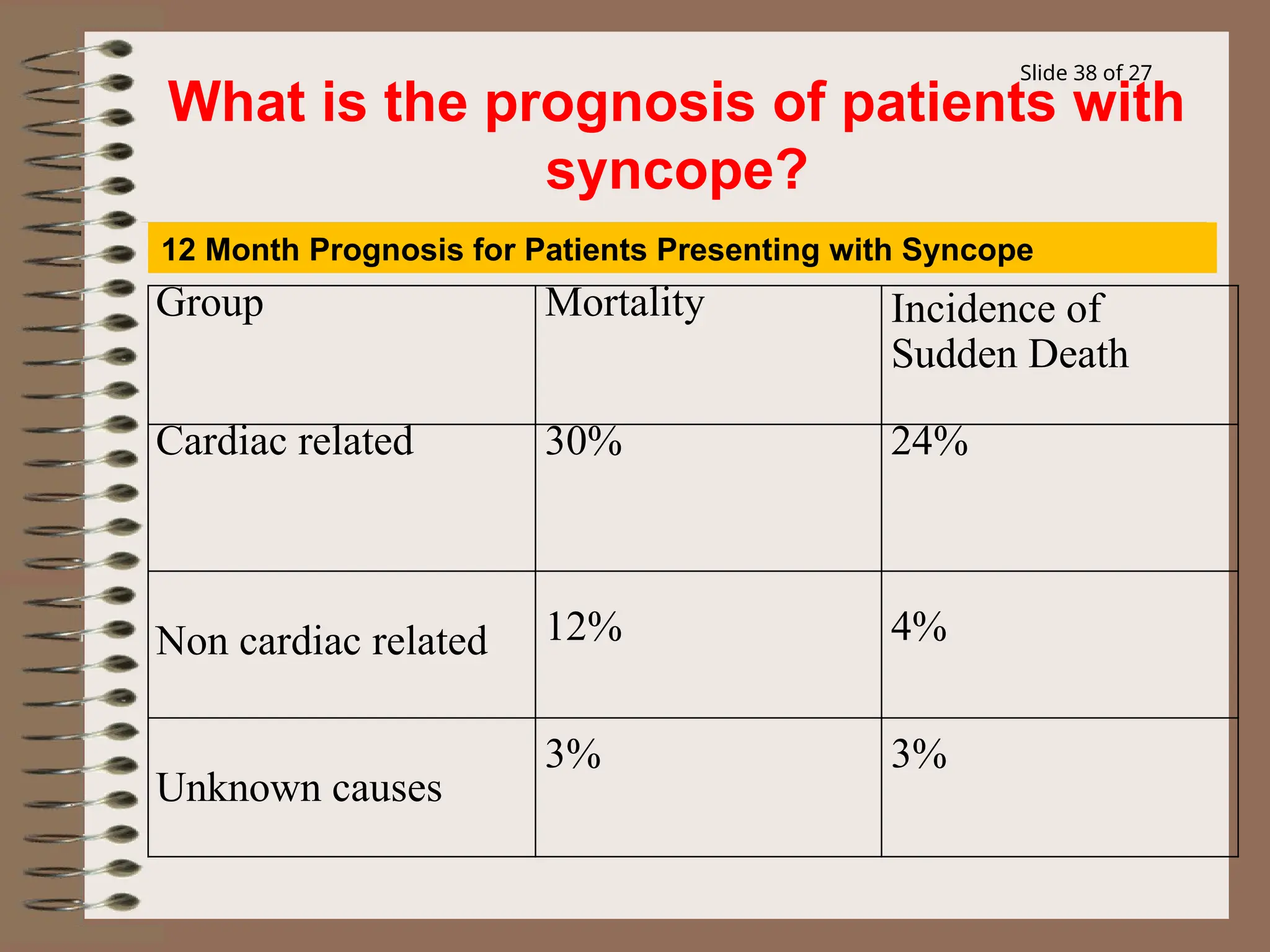
What is the prognosis of patients with
syncope?
12 Month Prognosis for Patients Presenting with Syncope
Group Mortality Incidence of
Sudden Death
Cardiac related 30% 24%
Non cardiac related 12% 4%
Unknown causes
3% 3%
Slide 39 of 27
Summary for Syncope
END
END

Syncope. Medical students Medical students

  • 1.
    Overview Syncope Dr. AdenwaliHassan Ahmed: (Mwn, Bsc-Medical Doctor, Bsc- Public Health Officer, Msc-Gyn/Obest.
  • 2.
    Slide 2 of27 Introduction of Syncope • Syncope is also known as fainting. This is a temporary loss of consciousness with a quick recovery. • Syncope is caused by decreased cerebral blood flow leading to transient loss of consciousness and postural tone, associated with spontaneous recovery. • Most people don’t need follow-up treatment. However, you need treatment for certain causes, such as heart issues.
  • 3.
    Slide 3 of27 Overview • Syncope (pronounced “sin-ko-pea”) is the medical term for fainting or passing out. • Fainting is a brief loss of consciousness due to a drop in blood flow to the brain. • It happens when you have a sudden, temporary drop in the amount of blood that flows to your brain. • Most of the time, a harmless, short-term cause makes you faint. Pass out from weakness, physical or emotional distress due to a loss of blood supply to the brain
  • 4.
    Slide 4 of27 Cont--- • Syncope can happen if you have: – A sudden drop in blood pressure. – A drop in your heart rate. – Changes in the amount of blood in areas of your body.
  • 5.
    Slide 5 of27 Cont--- • If you pass out, you’ll likely become conscious and alert after a few seconds or minutes. • However, you may feel confused or tired for a bit. • You can recover fully in minutes or hours.
  • 6.
    Slide 6 of27 Cont--- • Syncope can be a sign of a more serious condition. It’s important to get treatment right away after you have an episode of syncope. • Most people can prevent problems with syncope once they get an accurate diagnosis and proper treatment.
  • 7.
    Slide 7 of27 Types of Syncope 1. Vasovagal syncope (also called neurocardiogenic syncope). This is the most common type of syncope. Nearly half of syncope cases are the vasovagal type. 2. Situational syncope (a type of vasovagal syncope). Situational syncope happens only during certain situations that affect the nervous system 3. Postural or orthostatic syncope (also called postural hypotension). Upright standing position.
  • 8.
    Slide 8 of27 Cont--- 4. Cardiac syncope (Cardiac syncope is a transient loss of consciousness due to a defect, either structural or electrical, which prevents the generation of enough cardiac output to perfuse the brain adequately. 5. Neurologic syncope (Neurologic syncope can happen when you have a neurological condition such as a seizure, stroke or transient ischemic attack (TIA). Other less common conditions that lead to neurologic syncope include migraines and normal pressure hydrocephalus).
  • 9.
    Slide 9 of27 How common is syncope? • Syncope is a common condition. It affects 3% of men and 3.5% of women at some point in life. • Syncope is more common as you get older and affects up to 6% of people over age 75. • The condition can occur at any age and happens in people with and without other medical issues.
  • 10.
    Slide 10 of27 Symptoms of syncope The most common syncope symptoms include: • Nausea or vomiting • Sweaty palms • Blacking out • Feeling lightheaded • Falling for no reason • Feeling dizzy • Fainting, especially after eating or exercising • Feeling unsteady or weak when standing • Changes in vision, such as seeing spots or having tunnel vision • Headaches
  • 11.
  • 12.
    Slide 12 of27 Causes syncope • Syncope or passing out, happens when you don’t have enough blood flowing to your brain. • There are many causes for this, depending on the type of syncope. • Many people have a medical condition they may or may not know about that affects their nervous system or heart.
  • 13.
    Slide 13 of27 Cont--- • You may also have a condition that affects blood flow through your body and causes your blood pressure to drop when you change positions (for example, going from lying down to standing).
  • 14.
    Slide 14 of27 TYPES: 1. Vasovagal syncope causes • Vasovagal syncope happens when you have a sudden drop in blood pressure, which causes a drop in blood flow to your brain. • Occurs when the part of your nervous system that regulates heart rate and blood pressure malfunctions in response to a trigger, such as the sight of blood. Your heart rate slows and the blood vessels in your legs widen (dilate). • It often occurs after standing for a while or under emotional distress.
  • 15.
    Slide 15 of27 Cont--- • Normally, when you stand up, gravity makes blood settle in the lower part of your body, below your diaphragm. • When that happens, your heart and autonomic nervous system work to keep your blood pressure stable. • In vasovagal syncope, your heart rate and blood pressure inappropriately decrease severely. • This causes decreased blood flow to your brain and leads to passing out.
  • 16.
  • 17.
    Slide 17 of27 2. Situational syncope causes • Situational syncope happens only during certain situations that affect your nervous system and lead to syncope.  Some of these situations are: • Dehydration • Intense emotional stress • Anxiety • Fear • Pain • Hunger
  • 18.
    Slide 18 of27 Cont--- • Use of alcohol or drugs. • Hyperventilation (breathing in too much oxygen and getting rid of too much carbon dioxide too quickly). • Coughing forcefully, turning your neck or wearing a tight collar (carotid sinus hypersensitivity). • Urinating (micturition syncope)
  • 19.
    Slide 19 of27 3. Postural syncope causes • Postural syncope (also called postural hypotension or orthostatic hypotension) happens when your blood pressure drops suddenly due to a quick change in position, such as standing up after lying down. • Certain medications and dehydration can lead to this condition.
  • 20.
    Slide 20 of27 Cont--- • People with this type of syncope usually have changes in their blood pressure that cause it to drop by at least 20 millimeters of mercury (systolic/top number) and at least 10 millimeters of mercury (diastolic/bottom number) when they stand.
  • 21.
    Slide 21 of27 4. Cardiac syncope causes • Cardiac syncope can occur if you have a heart or blood vessel condition that affects blood flow to your brain. • These conditions can include: – Abnormal heart rhythm (arrhythmia) – Obstructed blood flow in your heart because of your heart’s structure (hypertrophic cardiomyopathy).
  • 22.
    Slide 22 of27 Cont--- – Blockage in your heart’s blood vessels (myocardial ischemia). – Valve disease. – Aortic stenosis (narrowing). – Blood clot. – Heart failure • If you have cardiac syncope, it’s important to see a cardiologist for proper treatment.
  • 23.
    Slide 23 of27 5. Neurologic syncope causes o Neurologic syncope can happen when you have a neurological condition such as a seizure, stroke or transient ischemic attack (TIA). o Other less common conditions that lead to neurologic syncope include Migraines and normal pressure hydrocephalus. An abnormal condition in which cerebrospinal fluid collects in the ventricles of the brain.
  • 24.
    Slide 24 of27 Consultation • If you have syncope, you should see a provider who can refer you to a syncope specialist for a complete evaluation. • You may then have one or more tests to help determine the cause of your syncope. These tests check things like: – The condition of your heart. – How fast your heart beats (heart rate). – The amount of blood in your body (blood volume). – Blood flow when your body is in different positions.
  • 25.
  • 26.
    Slide 26 of27 Syncope • Definition: sudden and transient loss of consciousness and loss of postural tone accompanied by a rapid return to baseline Pathophysiology: dysfunction of both cerebral hemispheres or the brainstem (reticular activating system) usually from hypo-perfusion. The Reticular Activating System (RAS) is a neural system involved in the regulation of sleep–wake cycles, arousal, alertness, attention, and motor fight-or-flight responses
  • 27.
    Slide 27 of27 Cont---  Cardiac: • Rhythm Disturbances: Dysrhythmias, Pacemaker issues • Structural: outflow obstruction (aortic stenosis, hypertrophic obstructive cardiomyopathy (HOCM), Myocardial infarction (MI)) • Other CV diseases: Dissection, Cardiomyopathy, PE (Pulmonary Embolism)
  • 28.
    Slide 28 of27 Cont--- • Non- Cardiac: Reflex (neurally mediated) – Vasovagal: sensory or emotional reactions – Orthostatic: postural related, volume depletion – Situational: coughing, straining – Carotid sinus pressure: shaving – Subclavian steal: arm exercises
  • 29.
    Slide 29 of27 Cont---  Medications • Calcium channel blockers (eg; Atenolol). B-blockers (eg; Amlodipine), Digoxin, Insulin. • Prolonging meds, Drugs of abuse. Focal CNS - (A focal neurologic deficit is a problem with nerve, spinal cord or brain function) Hypoperfusion- • Hypoxia, epilepsy, dysfunctional brainstem
  • 30.
    Slide 30 of27 Assessment • History: syncope character (ask about exertion!), cardiac risk factors, • Comorbidities, Medication/drug use, family history • Orthostatic symptoms Rule out seizure/stroke/head injury.
  • 31.
    Slide 31 of27 Cont--- • Physical Exam: – Cardiac exam (murmurs, rate) – CNS exam.
  • 32.
    Slide 32 of27 Investigations • Labs: – CBC – Glucose, lytes, – Blood urea nitrogen (BUN), CK, B-Hcg This test measures the amount of creatine kinase (CK) in the blood. High levels of CK can indicate damage or disease of the skeletal muscles
  • 33.
    Slide 33 of27 Cont---  ECG rates: o Tachydysrhythmias- Tachydysrhythmias, or tachycardias, are classified as dysrhythmias where the heart rate is greater than 100 beats per minute. oThere are several different types of tachydysrhythmias that include: Sinus tachycardia (ST): regular heart rhythm with a fast heart rate Sinus tachycardia is a regular cardiac rhythm in which the heart beats faster than normal
  • 34.
    Slide 34 of27 Cont--- o Bradyarrhythmias- is an abnormally slow resting heart rate, typically below 60 beats per minute. o A too-slow heart rhythm can result from changes in the heart's electrical system, a heart defect or other medical conditions.
  • 35.
    Slide 35 of27 Management • General – ABCs, monitors, oxygen, IV access • Cardiogenic Syncope – Consult cardiology for workup, pacemaker consideration • Non-Cardiogenic Syncope – Benign causes or low-risk syncope: discharge with general practitioner follow-up – Consider outpatient cardiac workup
  • 36.
    Slide 36 of27 Medicines for syncope include: o Midodrine o Fludrocortisone (Astonin or Florinef) Midodrine 5mg tablets is used to treat low blood pressure (hypotension). It works by stimulating nerve endings in blood vessels, causing the blood vessels to tighten.  Fludrocortisone, is a corticosteroid used to treat adrenogenital syndrome, postural hypotension and adrenal insufficiency. In adrenal insufficiency, it is generally taken together with hydrocortisone.  Fludrocortisone The usual dose is 0.1 mg.
  • 37.
    Slide 37 of27 Cont--- • Midodrine is used to treat orthostatic hypotension (sudden fall in blood pressure that occurs when a person assumes a standing position). • Midodrine is in a class of medications called alpha-adrenergic agonists. – It works by causing blood vessels to tighten, which increases blood pressure
  • 38.
    Slide 38 of27 What is the prognosis of patients with syncope? 12 Month Prognosis for Patients Presenting with Syncope Group Mortality Incidence of Sudden Death Cardiac related 30% 24% Non cardiac related 12% 4% Unknown causes 3% 3%
  • 39.
    Slide 39 of27 Summary for Syncope
  • 40.

Editor's Notes

  • #2 Caadiyan, syncope ma aha sabab walaac leh
  • #3 Fainting: miyir beelid
  • #7 Vasovagal syncope: occurs when you faint because your body overreacts to certain triggers, such as the sight of blood or extreme emotional distress. It may also be called neurocardiogenic syncope
  • #8 Vasovagal: involving, or caused by action of the vagus nerve on blood vessel dilation and heart rate
  • #9 Situational syncope happens only during certain situations that affect your nervous system and lead to syncope. Some of these situations are: Dehydration. Intense emotional stress.
  • #10 Blacking out: Madoobaad……. Feeling unsteady: Dareen degenaansho la'aan
  • #12 Syncope is the medical term for fainting or passing out. It is caused by a temporary drop in the amount of blood that flows to the brain. This leads to loss of consciousness and muscle control. The person then falls down or over, which allows blood flow to return to the brain
  • #14 The vagal nerves carry signals between your brain, heart and digestive system. It the longest nerve of the body (comprises both sensory and motor fibers)
  • #19 Orthostatic: pertaining to an upright standing posture
  • #21 Hypertrophic: Abnormal enlargement of a body part or organ
  • #23 An abnormal condition in which cerebrospinal fluid collects in the ventricles of the brain; in infants it can cause abnormally rapid growth of the head and bulging fontanelles and a small face; in adults the symptoms are primarily neurological
  • #24 Syncopedia: is a syncope specialist? A syncope specialist is a physician with a sufficient knowledge of historical clues and physical findings to recognize major causes of T-LOC (including mimics) and syndromes of orthostatic intolerance
  • #27 Dysrhythmias: is an abnormal or irregular heartbeat
  • #28 Neurally mediated reflex syncope (NMRS) refers to a group of related conditions or scenarios in which symptomatic hypotension occurs as a result of neural reflex vasodilation and/or bradycardia. Vasovagal syncope (VS) refers to a particular type of NMRS also known as the common faint.
  • #29 Focal CNS: impairments of nerve, spinal cord, or brain function that affects a specific region of the body, e.g. weakness in the left arm, the right leg, paresis, or plegia.
  • #30 What does QT mean in cardiology? The electrical activity that occurs between the Q and T waves is called the QT interval. This interval shows electrical activity in the heart's lower chambers, called the ventricles. Normally the time between the Q wave and the T wave is about a third of each heartbeat cycle.
  • #32 A common blood test, the blood urea nitrogen (BUN) test reveals important information about how well your kidneys are working. A BUN test measures the amount of urea nitrogen that's in your blood
  • #33 What is the normal heart rate rhythm? A normal resting heart rate should be between 60 to 100 beats per minute,
  • #34 serum electrolyte test, lytes, sodium (Na), potassium (K), chloride (Cl), carbon dioxide (CO2).