Unit – 5
Universal declaration of human rights
and provisions of India.
Constitution and law.
National human rights commission
and state human rights commission.
Universal declaration of human rights
What is the Universal Declaration of Human
Rights and why was it created?
• The Universal Declaration of Human Rights is a historic
document which outlined the rights and freedoms
everyone is entitled to. It was the first international
agreement on the basic principles of human rights. It
laid the foundation for the human rights protections
that we have in the UK today.
• The UDHR was adopted by the newly established
United Nations on 10 December 1948, in response to
the “barbarous acts(Mass kiling) which outraged
(उपद्रव)the conscience(guilt) of mankind” during the
Second World War. Its adoption recognised human
rights to be the foundation for freedom, justice and
peace.
Universal declaration of human rights
What are the main points of the Universal
Declaration of Human Rights?
• The charter addresses four key areas: personal
rights, such as freedom and equality; relationship
rights, such as nationality and having a family;
spiritual and political rights such as the freedom
of religion and voting; and economic, social and
cultural rights, which cover work, wages,
education and social security.
Universal declaration of human rights
Why is the UN Declaration of human rights
important? Or purpose of UN Declaration?
• The power of the Universal Declaration is the
power of ideas to change the world. It inspires
us to continue working to ensure that all
people can gain freedom, equality and
dignity.
Universal declaration of human rights
A summary of the 30 articles of the Universal
Declaration of Human Rights
• Article 1: We are all born free. We all have our own
thoughts and ideas and we should all be treated the
same way.
• Article 2: The rights in the UDHR belong to everyone,
no matter who we are, where we’re from, or whatever
we believe.
• Article 3: We all have the right to life, and to live in
freedom and safety.
• Article 4: No one should be held as a slave, and no one
has the right to treat anyone else as their slave.
• Article 5: No one has the right to inflict torture, or to
subject anyone else to cruel or inhuman treatment.
Universal declaration of human rights
• Article 6: We should all have the same level of legal protection whoever
we are, and wherever in the world we are.
• Article 7: The law is the same for everyone, and must treat us all equally.
• Article 8: We should all have the right to legal support if we are treated
unfairly.
• Article 9: Nobody should be arrested, put in prison, or sent away from
our country unless there is good reason to do so.
• Article 10: Everyone accused of a crime has the right to a fair and public
trial, and those that try us should be independent and not influenced by
others.
• Article 11: Everyone accused of a crime has the right to be considered
innocent until they have fairly been proven to be guilty.
• Article 12: Nobody has the right to enter our home, open our mail, or
intrude on our families without good reason. We also have the right to
be protected if someone tries to unfairly damage our reputation.
Universal declaration of human rights
• Article 13: We all have the right to move freely within our country, and to visit
and leave other countries when we wish.
• Article 14: If we are at risk of harm we have the right to go to another country
to seek protection.
• Article 15: We all have the right to be a citizen of a country and nobody should
prevent us, without good reason, from being a citizen of another country if we
wish.
• Article 16: We should have the right to marry and have a family as soon as
we’re legally old enough. Our ethnicity, nationality and religion should not stop
us from being able to do this. Men and women have the same rights when they
are married and also when they’re separated. We should never be forced to
marry. The government has a responsibility to protect us and our family.
• Article 17: Everyone has the right to own property, and no one has the right to
take this away from us without a fair reason.
• Article 18: Everyone has the freedom to think or believe what they want,
including the right to religious belief. We have the right to change our beliefs or
religion at any time, and the right to publicly or privately practice our chosen
religion, alone or with others.
• Article 19: Everyone has the right to their own opinions, and to be able to
express them freely. We should have the right to share our ideas with who we
want, and in whichever way we choose.
Universal declaration of human rights
• Article 20: We should all have the right to form groups and organise peaceful
meetings. Nobody should be forced to belong to a group if they don’t want to.
• Article 21: We all have the right to take part in our country’s political affairs
either by freely choosing politicians to represent us, or by belonging to the
government ourselves. Governments should be voted for by the public on a
regular basis, and every person’s individual vote should be secret. Every
individual vote should be worth the same.
• Article 22: The society we live in should help every person develop to their best
ability through access to work, involvement in cultural activity, and the right to
social welfare. Every person in society should have the freedom to develop their
personality with the support of the resources available in that country.
• Article 23: We all have the right to employment, to be free to choose our work,
and to be paid a fair salary that allows us to live and support our family.
Everyone who does the same work should have the right to equal pay, without
discrimination. We have the right to come together and form trade union groups
to defend our interests as workers.
• Article 24: Everyone has the right to rest and leisure time. There should be limits
on working hours, and people should be able to take holidays with pay.
Universal declaration of human rights
• Article 25: We all have the right to enough food, clothing, housing and healthcare for
ourselves and our families. We should have access to support if we are out of work, ill,
elderly, disabled, widowed, or can’t earn a living for reasons outside of our control. An
expectant mother and her baby should both receive extra care and support. All children
should have the same rights when they are born.
• Article 26: Everyone has the right to education. Primary schooling should be free. We
should all be able to continue our studies as far as we wish. At school we should be
helped to develop our talents, and be taught an understanding and respect for
everyone’s human rights. We should also be taught to get on with others whatever their
ethnicity, religion, or country they come from. Our parents have the right to choose what
kind of school we go to.
• Article 27: We all have the right to get involved in our community’s arts, music, literature
and sciences, and the benefits they bring. If we are an artist, a musician, a writer or a
scientist, our works should be protected and we should be able to benefit from them.
• Article 28: We all have the right to live in a peaceful and orderly society so that these
rights and freedoms can be protected, and these rights can be enjoyed in all other
countries around the world.
• Article 29: We have duties to the community we live in that should allow us to develop as
fully as possible. The law should guarantee human rights and should allow everyone to
enjoy the same mutual respect.
• Article 30: No government, group or individual should act in a way that would destroy
the rights and freedoms of the Universal Declaration of Human Rights.
Provisions of India
How many provisions are there in Indian
constitution?
• The constitution has a preamble and 470
articles, which are grouped into 25 parts. With
12 schedules and five appendices, it has been
amended 104 times; the latest amendment
became effective on 25 January 2020.
Constitution and law
Law is interpreted by societal or political
institution as a set of rules that are useful in
governing the behaviour of the people of the
land.
A Constitution is the set of fundamental laws
that stipulates(says what must be done) how a
country should be governed.
Constitution is a legal document framed by a
body of people's representatives.
Constitution and law
• Are all laws part of the constitution?
The constitution is the supreme power of the
nation, and governs all laws.
• What constitution means in law?
• A constitution is an aggregate of fundamental
principles or established precedents that
constitute the legal basis of a polity(a form or
process of civil government or constitution.),
organisation or other type of entity and
commonly determine how that entity is to be
governed.
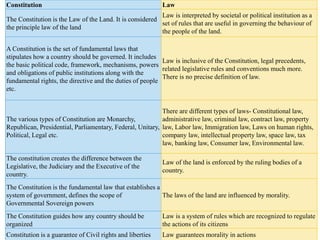
Constitution Law
The Constitution is the Law of the Land. It is considered
the principle law of the land
Law is interpreted by societal or political institution as a
set of rules that are useful in governing the behaviour of
the people of the land.
A Constitution is the set of fundamental laws that
stipulates how a country should be governed. It includes
the basic political code, framework, mechanisms, powers
and obligations of public institutions along with the
fundamental rights, the directive and the duties of people
etc.
Law is inclusive of the Constitution, legal precedents,
related legislative rules and conventions much more.
There is no precise definition of law.
The various types of Constitution are Monarchy,
Republican, Presidential, Parliamentary, Federal, Unitary,
Political, Legal etc.
There are different types of laws- Constitutional law,
administrative law, criminal law, contract law, property
law, Labor law, Immigration law, Laws on human rights,
company law, intellectual property law, space law, tax
law, banking law, Consumer law, Environmental law.
The constitution creates the difference between the
Legislative, the Judiciary and the Executive of the
country.
Law of the land is enforced by the ruling bodies of a
country.
The Constitution is the fundamental law that establishes a
system of government, defines the scope of
Governmental Sovereign powers
The laws of the land are influenced by morality.
The Constitution guides how any country should be
organized
Law is a system of rules which are recognized to regulate
the actions of its citizens
Constitution is a guarantee of Civil rights and liberties Law guarantees morality in actions
National Human Rights Commission
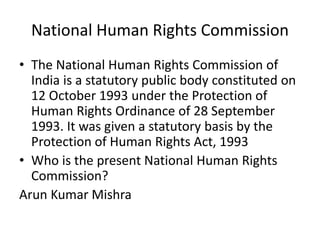
• The National Human Rights Commission of
India is a statutory public body constituted on
12 October 1993 under the Protection of
Human Rights Ordinance of 28 September
1993. It was given a statutory basis by the
Protection of Human Rights Act, 1993
• Who is the present National Human Rights
Commission?
Arun Kumar Mishra
National Human Rights Commission
• What is National Commission of human rights explain?
The NHRC is responsible for the protection and promotion of
human rights, defined by the act as "Rights Relating To Life,
liberty, equality and dignity of the individual guaranteed by
the constitution or embodied in the international covenants
and enforceable by courts in India".
• What are the powers and functions of the National Human
Rights Commission?
NHRC holds the power to investigate grievances (तक्रारी)
related to the violation of human rights either suo
moto(relating to an action taken by a court of its own accord,
without any request by the parties involved.) or after
receiving a petition. It has the power to interfere in any
judicial proceedings involving any allegation of violation of
human rights.
National Human Rights Commission
• How many members are in National Human Rights
Commission?
The Commission consists of a Chairperson, five full-time
Members and seven deemed Members.
• What are the main objective of human Right Commission?
• Its focuses on helping the victims secure their human
rights. It inquires into any case of abatement(less intense)
of violation or negligence(failure to take proper care over
something.) in controlling it by any government officer and
takes other general steps to promote human rights in the
country.
state human rights commission.
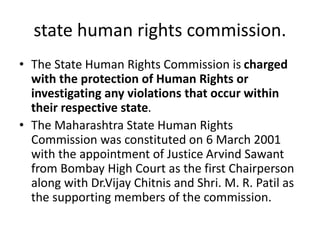
• The State Human Rights Commission is charged
with the protection of Human Rights or
investigating any violations that occur within
their respective state.
• The Maharashtra State Human Rights
Commission was constituted on 6 March 2001
with the appointment of Justice Arvind Sawant
from Bombay High Court as the first Chairperson
along with Dr.Vijay Chitnis and Shri. M. R. Patil as
the supporting members of the commission.
state human rights commission.
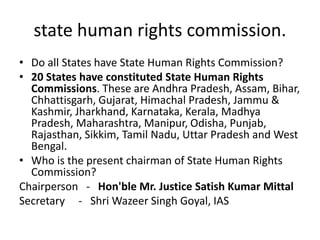
• Do all States have State Human Rights Commission?
• 20 States have constituted State Human Rights
Commissions. These are Andhra Pradesh, Assam, Bihar,
Chhattisgarh, Gujarat, Himachal Pradesh, Jammu &
Kashmir, Jharkhand, Karnataka, Kerala, Madhya
Pradesh, Maharashtra, Manipur, Odisha, Punjab,
Rajasthan, Sikkim, Tamil Nadu, Uttar Pradesh and West
Bengal.
• Who is the present chairman of State Human Rights
Commission?
Chairperson - Hon'ble Mr. Justice Satish Kumar Mittal
Secretary - Shri Wazeer Singh Goyal, IAS
state human rights commission.
• Who appointed state human rights commission?
SHRC is a statutory body constituted under Protection of
Human Rights Act 1993. It consists of a Chairperson and 2
other members. The Chairperson and Members shall be
appointed by the Governor by warrant under his hand
and seal.
• Functions of the States Human Rights Commission
To investigate any breach of human rights or failure to
prevent such violations by a public servant, either on
its own initiative or in response to a petition or a
court order. To intervene in any pending legal
proceedings including allegations of human rights
violations.
state human rights commission.
• What is State Human Rights Commission in India?
The State Human Rights Commission is charged
with the protection of Human Rights or
investigating any violations that occur within their
respective state.
• Is State Human Rights Commission is a
constitutional body?
The National Human Rights Commission (NHRC)
is not a constitutional body.
All da best

Basic human rights - Unit - 5.pptx

  • 1.
    Unit – 5 Universaldeclaration of human rights and provisions of India. Constitution and law. National human rights commission and state human rights commission.
  • 2.
    Universal declaration ofhuman rights What is the Universal Declaration of Human Rights and why was it created? • The Universal Declaration of Human Rights is a historic document which outlined the rights and freedoms everyone is entitled to. It was the first international agreement on the basic principles of human rights. It laid the foundation for the human rights protections that we have in the UK today. • The UDHR was adopted by the newly established United Nations on 10 December 1948, in response to the “barbarous acts(Mass kiling) which outraged (उपद्रव)the conscience(guilt) of mankind” during the Second World War. Its adoption recognised human rights to be the foundation for freedom, justice and peace.
  • 3.
    Universal declaration ofhuman rights What are the main points of the Universal Declaration of Human Rights? • The charter addresses four key areas: personal rights, such as freedom and equality; relationship rights, such as nationality and having a family; spiritual and political rights such as the freedom of religion and voting; and economic, social and cultural rights, which cover work, wages, education and social security.
  • 4.
    Universal declaration ofhuman rights Why is the UN Declaration of human rights important? Or purpose of UN Declaration? • The power of the Universal Declaration is the power of ideas to change the world. It inspires us to continue working to ensure that all people can gain freedom, equality and dignity.
  • 5.
    Universal declaration ofhuman rights A summary of the 30 articles of the Universal Declaration of Human Rights • Article 1: We are all born free. We all have our own thoughts and ideas and we should all be treated the same way. • Article 2: The rights in the UDHR belong to everyone, no matter who we are, where we’re from, or whatever we believe. • Article 3: We all have the right to life, and to live in freedom and safety. • Article 4: No one should be held as a slave, and no one has the right to treat anyone else as their slave. • Article 5: No one has the right to inflict torture, or to subject anyone else to cruel or inhuman treatment.
  • 6.
    Universal declaration ofhuman rights • Article 6: We should all have the same level of legal protection whoever we are, and wherever in the world we are. • Article 7: The law is the same for everyone, and must treat us all equally. • Article 8: We should all have the right to legal support if we are treated unfairly. • Article 9: Nobody should be arrested, put in prison, or sent away from our country unless there is good reason to do so. • Article 10: Everyone accused of a crime has the right to a fair and public trial, and those that try us should be independent and not influenced by others. • Article 11: Everyone accused of a crime has the right to be considered innocent until they have fairly been proven to be guilty. • Article 12: Nobody has the right to enter our home, open our mail, or intrude on our families without good reason. We also have the right to be protected if someone tries to unfairly damage our reputation.
  • 7.
    Universal declaration ofhuman rights • Article 13: We all have the right to move freely within our country, and to visit and leave other countries when we wish. • Article 14: If we are at risk of harm we have the right to go to another country to seek protection. • Article 15: We all have the right to be a citizen of a country and nobody should prevent us, without good reason, from being a citizen of another country if we wish. • Article 16: We should have the right to marry and have a family as soon as we’re legally old enough. Our ethnicity, nationality and religion should not stop us from being able to do this. Men and women have the same rights when they are married and also when they’re separated. We should never be forced to marry. The government has a responsibility to protect us and our family. • Article 17: Everyone has the right to own property, and no one has the right to take this away from us without a fair reason. • Article 18: Everyone has the freedom to think or believe what they want, including the right to religious belief. We have the right to change our beliefs or religion at any time, and the right to publicly or privately practice our chosen religion, alone or with others. • Article 19: Everyone has the right to their own opinions, and to be able to express them freely. We should have the right to share our ideas with who we want, and in whichever way we choose.
  • 8.
    Universal declaration ofhuman rights • Article 20: We should all have the right to form groups and organise peaceful meetings. Nobody should be forced to belong to a group if they don’t want to. • Article 21: We all have the right to take part in our country’s political affairs either by freely choosing politicians to represent us, or by belonging to the government ourselves. Governments should be voted for by the public on a regular basis, and every person’s individual vote should be secret. Every individual vote should be worth the same. • Article 22: The society we live in should help every person develop to their best ability through access to work, involvement in cultural activity, and the right to social welfare. Every person in society should have the freedom to develop their personality with the support of the resources available in that country. • Article 23: We all have the right to employment, to be free to choose our work, and to be paid a fair salary that allows us to live and support our family. Everyone who does the same work should have the right to equal pay, without discrimination. We have the right to come together and form trade union groups to defend our interests as workers. • Article 24: Everyone has the right to rest and leisure time. There should be limits on working hours, and people should be able to take holidays with pay.
  • 9.
    Universal declaration ofhuman rights • Article 25: We all have the right to enough food, clothing, housing and healthcare for ourselves and our families. We should have access to support if we are out of work, ill, elderly, disabled, widowed, or can’t earn a living for reasons outside of our control. An expectant mother and her baby should both receive extra care and support. All children should have the same rights when they are born. • Article 26: Everyone has the right to education. Primary schooling should be free. We should all be able to continue our studies as far as we wish. At school we should be helped to develop our talents, and be taught an understanding and respect for everyone’s human rights. We should also be taught to get on with others whatever their ethnicity, religion, or country they come from. Our parents have the right to choose what kind of school we go to. • Article 27: We all have the right to get involved in our community’s arts, music, literature and sciences, and the benefits they bring. If we are an artist, a musician, a writer or a scientist, our works should be protected and we should be able to benefit from them. • Article 28: We all have the right to live in a peaceful and orderly society so that these rights and freedoms can be protected, and these rights can be enjoyed in all other countries around the world. • Article 29: We have duties to the community we live in that should allow us to develop as fully as possible. The law should guarantee human rights and should allow everyone to enjoy the same mutual respect. • Article 30: No government, group or individual should act in a way that would destroy the rights and freedoms of the Universal Declaration of Human Rights.
  • 10.
    Provisions of India Howmany provisions are there in Indian constitution? • The constitution has a preamble and 470 articles, which are grouped into 25 parts. With 12 schedules and five appendices, it has been amended 104 times; the latest amendment became effective on 25 January 2020.
  • 11.
    Constitution and law Lawis interpreted by societal or political institution as a set of rules that are useful in governing the behaviour of the people of the land. A Constitution is the set of fundamental laws that stipulates(says what must be done) how a country should be governed. Constitution is a legal document framed by a body of people's representatives.
  • 12.
    Constitution and law •Are all laws part of the constitution? The constitution is the supreme power of the nation, and governs all laws. • What constitution means in law? • A constitution is an aggregate of fundamental principles or established precedents that constitute the legal basis of a polity(a form or process of civil government or constitution.), organisation or other type of entity and commonly determine how that entity is to be governed.
  • 13.
    Constitution Law The Constitutionis the Law of the Land. It is considered the principle law of the land Law is interpreted by societal or political institution as a set of rules that are useful in governing the behaviour of the people of the land. A Constitution is the set of fundamental laws that stipulates how a country should be governed. It includes the basic political code, framework, mechanisms, powers and obligations of public institutions along with the fundamental rights, the directive and the duties of people etc. Law is inclusive of the Constitution, legal precedents, related legislative rules and conventions much more. There is no precise definition of law. The various types of Constitution are Monarchy, Republican, Presidential, Parliamentary, Federal, Unitary, Political, Legal etc. There are different types of laws- Constitutional law, administrative law, criminal law, contract law, property law, Labor law, Immigration law, Laws on human rights, company law, intellectual property law, space law, tax law, banking law, Consumer law, Environmental law. The constitution creates the difference between the Legislative, the Judiciary and the Executive of the country. Law of the land is enforced by the ruling bodies of a country. The Constitution is the fundamental law that establishes a system of government, defines the scope of Governmental Sovereign powers The laws of the land are influenced by morality. The Constitution guides how any country should be organized Law is a system of rules which are recognized to regulate the actions of its citizens Constitution is a guarantee of Civil rights and liberties Law guarantees morality in actions
  • 14.
    National Human RightsCommission • The National Human Rights Commission of India is a statutory public body constituted on 12 October 1993 under the Protection of Human Rights Ordinance of 28 September 1993. It was given a statutory basis by the Protection of Human Rights Act, 1993 • Who is the present National Human Rights Commission? Arun Kumar Mishra
  • 15.
    National Human RightsCommission • What is National Commission of human rights explain? The NHRC is responsible for the protection and promotion of human rights, defined by the act as "Rights Relating To Life, liberty, equality and dignity of the individual guaranteed by the constitution or embodied in the international covenants and enforceable by courts in India". • What are the powers and functions of the National Human Rights Commission? NHRC holds the power to investigate grievances (तक्रारी) related to the violation of human rights either suo moto(relating to an action taken by a court of its own accord, without any request by the parties involved.) or after receiving a petition. It has the power to interfere in any judicial proceedings involving any allegation of violation of human rights.
  • 16.
    National Human RightsCommission • How many members are in National Human Rights Commission? The Commission consists of a Chairperson, five full-time Members and seven deemed Members. • What are the main objective of human Right Commission? • Its focuses on helping the victims secure their human rights. It inquires into any case of abatement(less intense) of violation or negligence(failure to take proper care over something.) in controlling it by any government officer and takes other general steps to promote human rights in the country.
  • 17.
    state human rightscommission. • The State Human Rights Commission is charged with the protection of Human Rights or investigating any violations that occur within their respective state. • The Maharashtra State Human Rights Commission was constituted on 6 March 2001 with the appointment of Justice Arvind Sawant from Bombay High Court as the first Chairperson along with Dr.Vijay Chitnis and Shri. M. R. Patil as the supporting members of the commission.
  • 18.
    state human rightscommission. • Do all States have State Human Rights Commission? • 20 States have constituted State Human Rights Commissions. These are Andhra Pradesh, Assam, Bihar, Chhattisgarh, Gujarat, Himachal Pradesh, Jammu & Kashmir, Jharkhand, Karnataka, Kerala, Madhya Pradesh, Maharashtra, Manipur, Odisha, Punjab, Rajasthan, Sikkim, Tamil Nadu, Uttar Pradesh and West Bengal. • Who is the present chairman of State Human Rights Commission? Chairperson - Hon'ble Mr. Justice Satish Kumar Mittal Secretary - Shri Wazeer Singh Goyal, IAS
  • 19.
    state human rightscommission. • Who appointed state human rights commission? SHRC is a statutory body constituted under Protection of Human Rights Act 1993. It consists of a Chairperson and 2 other members. The Chairperson and Members shall be appointed by the Governor by warrant under his hand and seal. • Functions of the States Human Rights Commission To investigate any breach of human rights or failure to prevent such violations by a public servant, either on its own initiative or in response to a petition or a court order. To intervene in any pending legal proceedings including allegations of human rights violations.
  • 20.
    state human rightscommission. • What is State Human Rights Commission in India? The State Human Rights Commission is charged with the protection of Human Rights or investigating any violations that occur within their respective state. • Is State Human Rights Commission is a constitutional body? The National Human Rights Commission (NHRC) is not a constitutional body.
  • 21.