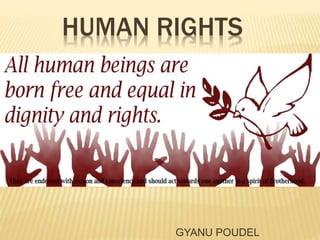
HUMAN RIGHTS
GYANU POUDEL
INTRODUCTION
The basic right or freedom to which all humans
are considered to be entitled ,often held to
include the right to life , liberty , equality and a
fair trail , freedom from slavery , torture &
freedom of thought and expression.
HUMAN RIGHTS
•life, liberty, and
security of person
•justice under the
law
•freedom of speech
and thought
•ability to own
property
•fair working conditions
•enough food, water, and
shelter
•access to quality healthcare
and education
Human rights are the interconnected set of freedoms and rights common to all
people.
The universal declaration of Human Rights , adopted by the United Nations in
1948,
describes these fundamental rights, including:
WHY ARE HUMAN RIGHTS IMPORTANT?
Because human rights are intrinsic to all
people, they should be reflected in how
governments and nations run. One of the major
roles of a government is to protect its people,
and to act as a mediator among different
groups that have their own interests. Citizens
should feel safe and be able to express a
minority viewpoint or position without the threat
of violence.
OBJECTIVE OF HUMAN RIGHTS
a. To promote interdependence among countries in all areas of
cooperation by identifying country’s common strengths and
opportunities which will help reduce poverty and improve the quality
of life for people whilst developing a knowledge-based society within
country and enhancing community and people empowerment;
b. To expand the trade and financial market within country and
increase the bargaining power of Asian countries in lieu of
competition and, in turn, enhances country’s’ economic
competitiveness in the global market;
c. To ultimately transform the continent into community, capable of
interacting with the rest of the world on a more equal footing and
contributing more positively towards mutual peace and prosperity.
THE UNIVERSAL DECLARATION OF HUMAN
RIGHTS (UDHR):
 The Universal Declaration of Human Rights (UDHR)
is a declaration adopted by the United Nations
General Assembly on 10 December, 1948 at Palais
de Chaillot, Paris. This declaration provided
comprehensive protection to all individuals against all
forms of injustice and human rights violations.
 The UDHR defines specific rights, civil, political,
economic, and social as well as cultural. It defines the
rights to life, liberty, and security, fair trial by law,
freedom of thought, expression, conscience,
association and freedom of movement. It emphasizes
right to equal pay for equal work, right to form and
join trade unions, right to health care, education,
adequate rest etc.
 Human rights violations occur when actions by state
(or non-state) actors abuse, ignore, or deny basic
human rights (including civil, political, cultural, social,
and economic rights). Furthermore, violations of
human rights can occur when any state or non-state
actor breaches any part of the UDHR treaty or other
international human rights or humanitarian law.
 In efforts to eliminate violations of human rights,
building awareness and protesting inhumane
treatment has often led to calls for action and
sometimes improved conditions. The UN Security
Council has interceded with peace keeping forces,
and other states and treaties (NATO) have intervened
in situations to protect human rights.
ARTICLE
1. We Are All Born Free & Equal. We are all born free. We
all have our own thoughts and ideas. We should all be
treated in the same way.
2. Don’t Discriminate. These rights belong to everybody,
whatever our differences.
3. The Right to Life. We all have the right to life, and to live
in freedom and safety.
4. No Slavery. Nobody has any right to make us a slave.
We cannot make anyone our slave.
5. No Torture. Nobody has any right to hurt us or to torture
us.
6. You Have Rights No Matter Where You Go. I am a
person just like you!
7. We’re All Equal Before the Law. The law is the same for
everyone. It must treat us all fairly.
8. Your Human Rights Are Protected by Law. We can all ask for
the law to help us when we are not treated fairly.
9. No Unfair Detainment. Nobody has the right to put us in prison
without good reason and keep us there, or to send us away from our
country.
10. The Right to Trial. If we are put on trial this should be in public.
The people who try us should not let anyone tell them what to do.
11. We’re Always Innocent Till Proven Guilty. Nobody should be
blamed for doing something until it is proven. When people say we
did a bad thing we have the right to show it is not true.
12. The Right to Privacy. Nobody should try to harm our good
name. Nobody has the right to come into our home, open our letters,
or bother us or our family without a good reason.
13. Freedom to Move. We all have the right to go where we want in our own
country and to travel as we wish.
14. The Right to Seek a Safe Place to Live. If we are frightened of being badly
treated in our own country, we all have the right to run away to another country to
be safe.
15. Right to a Nationality. We all have the right to belong to a country.
16. Marriage and Family. Every grown-up has the right to marry and have a family
if they want to. Men and women have the same rights when they are married, and
when they are separated.
17. The Right to Your Own Things. Everyone has the right to own things or share
them. Nobody should take our things from us without a good reason.
18. Freedom of Thought. We all have the right to believe in what we want to
believe, to have a religion, or to change it if we want.
19. Freedom of Expression. We all have the right to make up our own minds, to
think what we like, to say what we think, and to share our ideas with other people.
20. The Right to Public Assembly. We all have the right to meet our
friends and to work together in peace to defend our rights. Nobody can
make us join a group if we don’t want to.
21. The Right to Democracy. We all have the right to take part in the
government of our country. Every grown-up should be allowed to choose
their own leaders.
22. Social Security. We all have the right to affordable housing, medicine,
education, and childcare, enough money to live on and medical help if we
are ill or old.
23. Workers’ Rights. Every grown-up has the right to do a job, to a fair
wage for their work, and to join a trade union.
24. The Right to Play. We all have the right to rest from work and to relax.
25. Food and Shelter for All. We all have the right to a good life. Mothers
and children, people who are old, unemployed or disabled, and all people
have the right to be cared for.
26. The Right to Education. Education is a right. Primary school
should be free. We should learn about the United Nations and how
to get on with others. Our parents can choose what we learn.
27. Copyright. Copyright is a special law that protects one’s own
artistic creations and writings; others cannot make copies without
permission. We all have the right to our own way of life and to enjoy
the good things that art, science and learning bring.
28. A Fair and Free World. There must be proper order so we can
all enjoy rights and freedoms in our own country and all over the
world.
29. Responsibility. We have a duty to other people, and we should
protect their rights and freedoms.
30. No One Can Take Away Your Human Rights.

Human rights

  • 1.
  • 2.
    INTRODUCTION The basic rightor freedom to which all humans are considered to be entitled ,often held to include the right to life , liberty , equality and a fair trail , freedom from slavery , torture & freedom of thought and expression.
  • 3.
    HUMAN RIGHTS •life, liberty,and security of person •justice under the law •freedom of speech and thought •ability to own property •fair working conditions •enough food, water, and shelter •access to quality healthcare and education Human rights are the interconnected set of freedoms and rights common to all people. The universal declaration of Human Rights , adopted by the United Nations in 1948, describes these fundamental rights, including:
  • 4.
    WHY ARE HUMANRIGHTS IMPORTANT? Because human rights are intrinsic to all people, they should be reflected in how governments and nations run. One of the major roles of a government is to protect its people, and to act as a mediator among different groups that have their own interests. Citizens should feel safe and be able to express a minority viewpoint or position without the threat of violence.
  • 5.
    OBJECTIVE OF HUMANRIGHTS a. To promote interdependence among countries in all areas of cooperation by identifying country’s common strengths and opportunities which will help reduce poverty and improve the quality of life for people whilst developing a knowledge-based society within country and enhancing community and people empowerment; b. To expand the trade and financial market within country and increase the bargaining power of Asian countries in lieu of competition and, in turn, enhances country’s’ economic competitiveness in the global market; c. To ultimately transform the continent into community, capable of interacting with the rest of the world on a more equal footing and contributing more positively towards mutual peace and prosperity.
  • 6.
    THE UNIVERSAL DECLARATIONOF HUMAN RIGHTS (UDHR):  The Universal Declaration of Human Rights (UDHR) is a declaration adopted by the United Nations General Assembly on 10 December, 1948 at Palais de Chaillot, Paris. This declaration provided comprehensive protection to all individuals against all forms of injustice and human rights violations.  The UDHR defines specific rights, civil, political, economic, and social as well as cultural. It defines the rights to life, liberty, and security, fair trial by law, freedom of thought, expression, conscience, association and freedom of movement. It emphasizes right to equal pay for equal work, right to form and join trade unions, right to health care, education, adequate rest etc.
  • 7.
     Human rightsviolations occur when actions by state (or non-state) actors abuse, ignore, or deny basic human rights (including civil, political, cultural, social, and economic rights). Furthermore, violations of human rights can occur when any state or non-state actor breaches any part of the UDHR treaty or other international human rights or humanitarian law.  In efforts to eliminate violations of human rights, building awareness and protesting inhumane treatment has often led to calls for action and sometimes improved conditions. The UN Security Council has interceded with peace keeping forces, and other states and treaties (NATO) have intervened in situations to protect human rights.
  • 8.
    ARTICLE 1. We AreAll Born Free & Equal. We are all born free. We all have our own thoughts and ideas. We should all be treated in the same way. 2. Don’t Discriminate. These rights belong to everybody, whatever our differences. 3. The Right to Life. We all have the right to life, and to live in freedom and safety. 4. No Slavery. Nobody has any right to make us a slave. We cannot make anyone our slave. 5. No Torture. Nobody has any right to hurt us or to torture us. 6. You Have Rights No Matter Where You Go. I am a person just like you!
  • 9.
    7. We’re AllEqual Before the Law. The law is the same for everyone. It must treat us all fairly. 8. Your Human Rights Are Protected by Law. We can all ask for the law to help us when we are not treated fairly. 9. No Unfair Detainment. Nobody has the right to put us in prison without good reason and keep us there, or to send us away from our country. 10. The Right to Trial. If we are put on trial this should be in public. The people who try us should not let anyone tell them what to do. 11. We’re Always Innocent Till Proven Guilty. Nobody should be blamed for doing something until it is proven. When people say we did a bad thing we have the right to show it is not true. 12. The Right to Privacy. Nobody should try to harm our good name. Nobody has the right to come into our home, open our letters, or bother us or our family without a good reason.
  • 10.
    13. Freedom toMove. We all have the right to go where we want in our own country and to travel as we wish. 14. The Right to Seek a Safe Place to Live. If we are frightened of being badly treated in our own country, we all have the right to run away to another country to be safe. 15. Right to a Nationality. We all have the right to belong to a country. 16. Marriage and Family. Every grown-up has the right to marry and have a family if they want to. Men and women have the same rights when they are married, and when they are separated. 17. The Right to Your Own Things. Everyone has the right to own things or share them. Nobody should take our things from us without a good reason. 18. Freedom of Thought. We all have the right to believe in what we want to believe, to have a religion, or to change it if we want. 19. Freedom of Expression. We all have the right to make up our own minds, to think what we like, to say what we think, and to share our ideas with other people.
  • 11.
    20. The Rightto Public Assembly. We all have the right to meet our friends and to work together in peace to defend our rights. Nobody can make us join a group if we don’t want to. 21. The Right to Democracy. We all have the right to take part in the government of our country. Every grown-up should be allowed to choose their own leaders. 22. Social Security. We all have the right to affordable housing, medicine, education, and childcare, enough money to live on and medical help if we are ill or old. 23. Workers’ Rights. Every grown-up has the right to do a job, to a fair wage for their work, and to join a trade union. 24. The Right to Play. We all have the right to rest from work and to relax. 25. Food and Shelter for All. We all have the right to a good life. Mothers and children, people who are old, unemployed or disabled, and all people have the right to be cared for.
  • 12.
    26. The Rightto Education. Education is a right. Primary school should be free. We should learn about the United Nations and how to get on with others. Our parents can choose what we learn. 27. Copyright. Copyright is a special law that protects one’s own artistic creations and writings; others cannot make copies without permission. We all have the right to our own way of life and to enjoy the good things that art, science and learning bring. 28. A Fair and Free World. There must be proper order so we can all enjoy rights and freedoms in our own country and all over the world. 29. Responsibility. We have a duty to other people, and we should protect their rights and freedoms. 30. No One Can Take Away Your Human Rights.