RIGHT TO EQUALITY
SHREYAN DUTTA
ROLL NO 26
INTRODUCTION
 Right to Equality is listed under Article 14 to Article 18 of the Indian
Constitution.
Right to equality falls under the category of Fundamental Rights.
The word Fundamental suggests that these rights are so important that
the constitution has separately listed them and made special provisions
for their protection.
These Fundamental Rights can only be changed by amending the
constitution.
ARTICLE 14
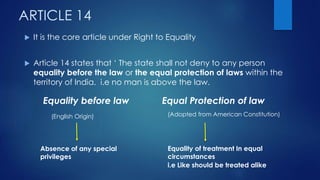
 It is the core article under Right to Equality
 Article 14 states that ‘ The state shall not deny to any person
equality before the law or the equal protection of laws within the
territory of India. i.e no man is above the law.
Equality before law Equal Protection of law
Absence of any special
privileges
Equality of treatment In equal
circumstances
i.e Like should be treated alike
(English Origin) (Adopted from American Constitution)
ARTICLE 14
 Article 14 provides a general principle of equality
whereas the articles 15, 16, 17 and 18 provide for a
particular application.
 Most importantly article 14 provides classification but
prohibits class legislation
 Classification: Different pay scales for trained teachers and
untrained teachers.
 Class legislation: Higher pay scales for men and lower for women.
This affects a particular class of people.
ARTICLE 15
 No discrimination on the grounds of religion, race, caste, sex etc
1. The State shall not discriminate against any citizen on such grounds
2. Prohibits citizens as well as state to make such a discrimination with
regard to access to shops , hotels etc.
3. Empowers the state to make special provisions for protection of
women and children
4. Enables the state to make special provisions for the protection of
interests of backward classes and thus is an exception to article 15
ARTICLE 16 and ARTICLE 17
 Article 16 : It guarantees the equality of opportunity in public
employment for all citizens and says that no citizen shall be
discriminated on basis of race, caste, creed etc in public
employment.
 It doesn’t prevent the state from prescribing necessary
qualifications.
 Article 17 : Abolishes untouchability and forbids its practice in any
form.
ARTICLE 18
 Article 18: Prohibits the state to confer titles on any body whether a
citizen or a non citizen . Military and academic distinctions are
however exempted.
 Academic distinctions include Bharat Ratna, Padma Vibhushan
THANK YOU

Right to equality

  • 1.
    RIGHT TO EQUALITY SHREYANDUTTA ROLL NO 26
  • 2.
    INTRODUCTION  Right toEquality is listed under Article 14 to Article 18 of the Indian Constitution. Right to equality falls under the category of Fundamental Rights. The word Fundamental suggests that these rights are so important that the constitution has separately listed them and made special provisions for their protection. These Fundamental Rights can only be changed by amending the constitution.
  • 3.
    ARTICLE 14  Itis the core article under Right to Equality  Article 14 states that ‘ The state shall not deny to any person equality before the law or the equal protection of laws within the territory of India. i.e no man is above the law. Equality before law Equal Protection of law Absence of any special privileges Equality of treatment In equal circumstances i.e Like should be treated alike (English Origin) (Adopted from American Constitution)
  • 4.
    ARTICLE 14  Article14 provides a general principle of equality whereas the articles 15, 16, 17 and 18 provide for a particular application.  Most importantly article 14 provides classification but prohibits class legislation  Classification: Different pay scales for trained teachers and untrained teachers.  Class legislation: Higher pay scales for men and lower for women. This affects a particular class of people.
  • 5.
    ARTICLE 15  Nodiscrimination on the grounds of religion, race, caste, sex etc 1. The State shall not discriminate against any citizen on such grounds 2. Prohibits citizens as well as state to make such a discrimination with regard to access to shops , hotels etc. 3. Empowers the state to make special provisions for protection of women and children 4. Enables the state to make special provisions for the protection of interests of backward classes and thus is an exception to article 15
  • 6.
    ARTICLE 16 andARTICLE 17  Article 16 : It guarantees the equality of opportunity in public employment for all citizens and says that no citizen shall be discriminated on basis of race, caste, creed etc in public employment.  It doesn’t prevent the state from prescribing necessary qualifications.  Article 17 : Abolishes untouchability and forbids its practice in any form.
  • 7.
    ARTICLE 18  Article18: Prohibits the state to confer titles on any body whether a citizen or a non citizen . Military and academic distinctions are however exempted.  Academic distinctions include Bharat Ratna, Padma Vibhushan
  • 8.