Unit X: Human Rights
By
Munwar –us- Salam
Lecturer, BBS-ION, PUMHSW,
Nawabshah, SBA.
Objectives
At the end of the unit learners will be able
to:
Define human rights
Recognize basic human rights
Appreciate the importance of human rights
Conceptualize a rights based approach to
health
Identify nurses role in client centered health
care approach
DEFINITION
HUMAN RIGHTS are the rights that all
people have by virtue of being human
beings.
HUMAN RIGHTS are derived from the
inherent dignity of the human person and
are defined internationally, nationally and
locally by various law making bodies.
DEFINITION
HUMAN RIGHTS is defined as the supreme,
inherent, and inalienable rights to life, to dignity,
and to self-development. It is concerned with
issues in both areas of civil and political rights and
economic, social and cultural rights founded on
internationally accepted human rights obligations
RIGHTS – moral power
-to hold (rights to life, nationality, own property, rest
and leisure),
-to do (rights to marry, peaceful assembly, run for
public office, education),
-to omit (freedom from torture and cruel, inhuman or
degrading punishment, freedom from arbitrary
arrest, detention or exile)
- to exact something (equal protection of the law,
equal access to public service, equal pay for
equal work)
HUMAN RIGHTS
Rights are things
that protect us
from harm.
Think of a baby that
hasn’t asked to come
into the world..
What are the basic
rights you think any
child should expect?
To be allowed
to live
(the right to life)
To be protected
from harm
To be protected
from disease
To have food
and drink
Basic minimum things such as these that we should all
expect to have, wherever we live, have become known as
Human Rights.
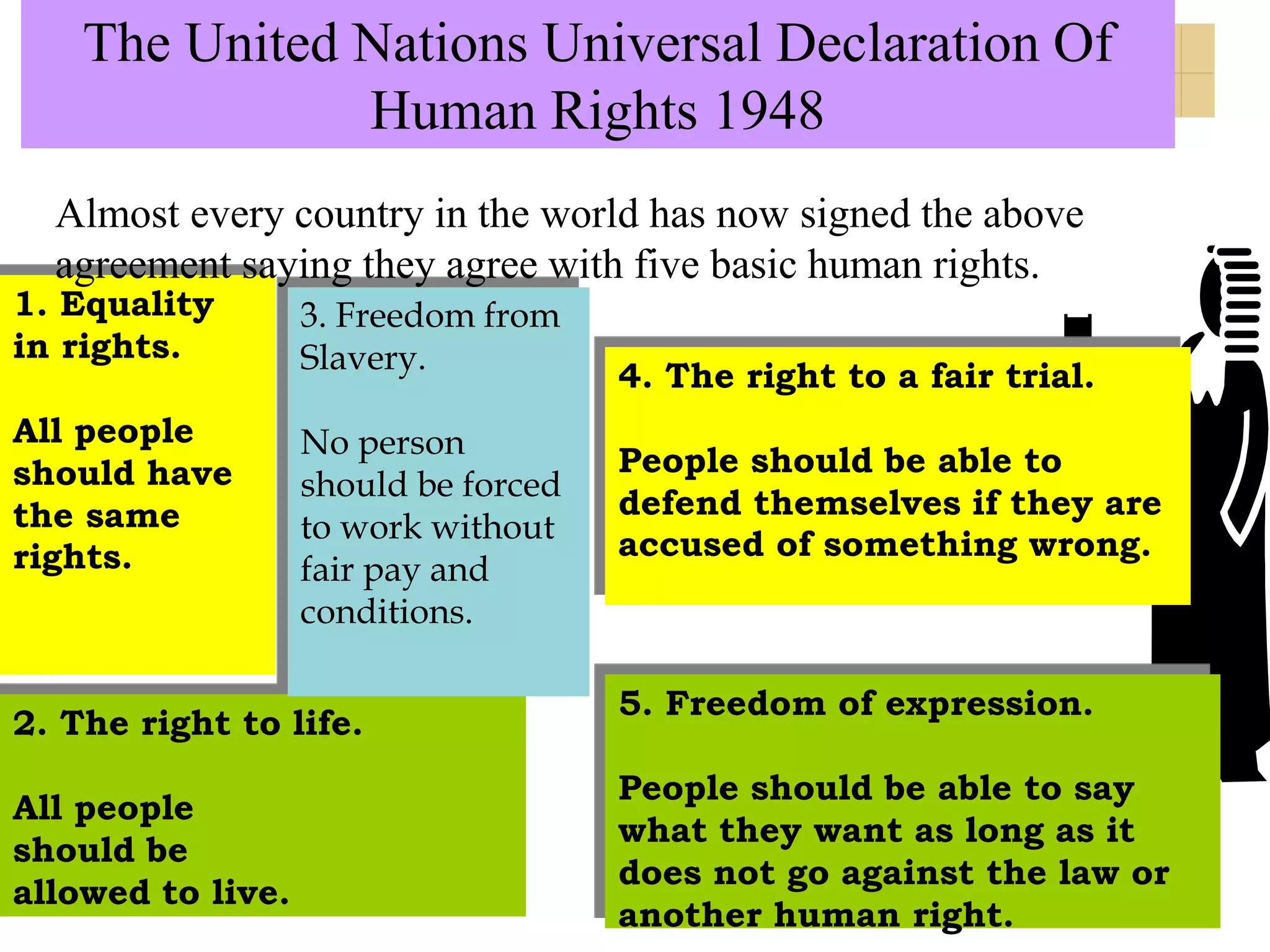
The United Nations Universal Declaration Of
Human Rights 1948
1. Equality
in rights.
All people
should have
the same
rights.
2. The right to life.
All people
should be
allowed to live.
3. Freedom from
Slavery.
No person
should be forced
to work without
fair pay and
conditions.
Almost every country in the world has now signed the above
agreement saying they agree with five basic human rights.
4. The right to a fair trial.
People should be able to
defend themselves if they are
accused of something wrong.
5. Freedom of expression.
People should be able to say
what they want as long as it
does not go against the law or
another human right.
Characteristics of Human Rights
Universal
Internationally guaranteed
Legally protected
Protects individuals and groups
Cannot be taken away
Equal and indivisible
Obliges States and State actors
The Universal Declaration of
Human Rights (1948)
By 1948, the United Nations’ new Human
Rights Commission had captured the world’s
attention. Under the dynamic chairmanship
of Eleanor Roosevelt—President Franklin
Roosevelt’s widow, a human rights champion
in her own right and the United States
delegate to the UN—the Commission set out
to draft the document that became the
Universal Declaration of Human Rights.
The Universal Declaration of
Human Rights (1948)
Roosevelt, credited with its inspiration,
referred to the Declaration as the
international Magna Carta for all
mankind. It was adopted by the United
Nations on December 10, 1948.
The Universal Declaration of
Human Rights (1948)
The Member States of the United Nations
pledged to work together to promote the
thirty Articles of human rights that, for the
first time in history, had been assembled
and codified into a single document. In
consequence, many of these rights, in
various forms, are today part of the
constitutional laws of democratic nations.
UNIVERSAL DECLARATION
OF HUMAN RIGHTS
Article 1. Right to Equality
All human beings are born free and
equal in dignity and rights. They are
endowed with reason and conscience
and should act towards one another in
a spirit of brotherhood.
UNIVERSAL DECLARATION
OF HUMAN RIGHTS
Article 2. Freedom from Discrimination
Everyone is entitled to all the rights and
freedoms set forth in this Declaration,
without distinction of any kind, such as
race, colour, sex, language, religion,
political or other opinion, national or
social origin, property, birth or other
status.
UNIVERSAL DECLARATION
OF HUMAN RIGHTS
Article 3. Right to Life, Liberty, Personal Security
Everyone has the right to life, liberty
and security of person.
Article 4. Freedom from Slavery
No one shall be held in slavery or
servitude; slavery and the slave trade
shall be prohibited in all their forms.
UNIVERSAL DECLARATION
OF HUMAN RIGHTS
Article 5. Freedom from Torture and Degrading Treatment
No one shall be subjected to torture or
to cruel, inhuman or degrading
treatment or punishment.
Article 6. Right to Recognition as a Person before the Law
Everyone has the right to recognition
everywhere as a person before the law.
UNIVERSAL DECLARATION
OF HUMAN RIGHTS
Article 7. Right to Equality before the Law
All are equal before the law and are
entitled without any discrimination to
equal protection of the law. All are
entitled to equal protection against any
discrimination in violation of this
Declaration and against any incitement
to such discrimination.
UNIVERSAL DECLARATION
OF HUMAN RIGHTS
Article 8. Right to Remedy by Competent Tribunal
Everyone has the right to an effective
remedy by the competent national tribunals
for acts violating the fundamental rights
granted him by the constitution or by law.
Article 9. Freedom from Arbitrary Arrest and Exile
No one shall be subjected to arbitrary
arrest, detention or exile.
UNIVERSAL DECLARATION
OF HUMAN RIGHTS
Article 10. Right to Fair Public Hearing
Everyone is entitled in full equality to a
fair and public hearing by an
independent and impartial tribunal, in
the determination of his rights and
obligations and of any criminal charge
against him.
UNIVERSAL DECLARATION
OF HUMAN RIGHTS
Article 11. Right to be Considered
Innocent until Proven Guilty
Everyone charged with a penal offence
has the right to be presumed innocent
until proved guilty according to law in a
public trial at which he has had all the
guarantees necessary for his defence.
UNIVERSAL DECLARATION
OF HUMAN RIGHTS
Article 11. Right to be Considered Innocent until Proven Guilty
No one shall be held guilty of any penal
offence on account of any act or omission
which did not constitute a penal offence,
under national or international law, at the
time when it was committed. Nor shall a
heavier penalty be imposed than the one
that was applicable at the time the penal
offence was committed.
UNIVERSAL DECLARATION
OF HUMAN RIGHTS
Article 12. Freedom from Interference with
Privacy, Family, Home and Correspondence
No one shall be subjected to arbitrary
interference with his privacy, family,
home or correspondence, nor to attacks
upon his honour and reputation.
Everyone has the right to the protection
of the law against such interference or
attacks.
UNIVERSAL DECLARATION
OF HUMAN RIGHTS
Article 13. Right to Free Movement in
and out of the Country
Everyone has the right to freedom of
movement and residence within the
borders of each State.
Everyone has the right to leave any
country, including his own, and to
return to his country.
UNIVERSAL DECLARATION
OF HUMAN RIGHTS
Article 14. Right to Asylum in other Countries from Persecution
Everyone has the right to seek and to enjoy
in other countries asylum from persecution.
This right may not be invoked in the case of
prosecutions genuinely arising from
nonpolitical crimes or from acts contrary to
the purposes and principles of the United
Nations.
UNIVERSAL DECLARATION
OF HUMAN RIGHTS
Article 15. Right to a Nationality and the
Freedom to Change It
Everyone has the right to a nationality.
No one shall be arbitrarily deprived of
his nationality nor denied the right to
change his nationality.
UNIVERSAL DECLARATION
OF HUMAN RIGHTS
Article 16. Right to Marriage and Family
Men and women of full age, without
any limitation due to race, nationality or
religion, have the right to marry and to
found a family. They are entitled to
equal rights as to marriage, during
marriage and at its dissolution.
UNIVERSAL DECLARATION
OF HUMAN RIGHTS
Article 16. Right to Marriage and Family
Marriage shall be entered into only with
the free and full consent of the
intending spouses.
The family is the natural and
fundamental group unit of society and
is entitled to protection by society and
the State.
UNIVERSAL DECLARATION
OF HUMAN RIGHTS
Article 17. Right to Own Property
Everyone has the right to own property
alone as well as in association with
others.
No one shall be arbitrarily deprived of
his property.
UNIVERSAL DECLARATION
OF HUMAN RIGHTS
Article 18. Freedom of Belief and Religion
Everyone has the right to freedom of
thought, conscience and religion; this right
includes freedom to change his religion or
belief, and freedom, either alone or in
community with others and in public or
private, to manifest his religion or belief in
teaching, practice, worship and observance.
UNIVERSAL DECLARATION
OF HUMAN RIGHTS
Article 19. Freedom of Opinion and Information
Everyone has the right to freedom of
opinion and expression; this right
includes freedom to hold opinions
without interference and to seek,
receive and impart information and
ideas through any media and regardless
of frontiers.
UNIVERSAL DECLARATION
OF HUMAN RIGHTS
Article 20. Right of Peaceful Assembly
and Association
Everyone has the right to freedom of
peaceful assembly and association.
No one may be compelled to belong to
an association.
UNIVERSAL DECLARATION
OF HUMAN RIGHTS
Article 21. Right to Participate in
Government and in Free Elections
Everyone has the right to take part in
the government of his country, directly
or through freely chosen
representatives.
Everyone has the right to equal access
to public service in his country.
UNIVERSAL DECLARATION
OF HUMAN RIGHTS
Article 21. Right to Participate in Government and
in Free Elections
The will of the people shall be the basis
of the authority of government; this will
shall be expressed in periodic and
genuine elections which shall be by
universal and equal suffrage and shall
be held by secret vote or by equivalent
free voting procedures.
UNIVERSAL DECLARATION
OF HUMAN RIGHTS
Article 22. Right to Social Security
Everyone, as a member of society, has the
right to social security and is entitled to
realization, through national effort and
international co-operation and in accordance
with the organization and resources of each
State, of the economic, social and cultural
rights indispensable for his dignity and the
free development of his personality.
UNIVERSAL DECLARATION
OF HUMAN RIGHTS
Article 23. Right to Desirable Work and to Join
Trade Unions
Everyone has the right to work, to free
choice of employment, to just and
favourable conditions of work and to
protection against unemployment.
Everyone, without any discrimination,
has the right to equal pay for equal
work.
UNIVERSAL DECLARATION
OF HUMAN RIGHTS
Article 23. Right to Desirable Work and to
Join Trade Unions
Everyone who works has the right to just
and favourable remuneration ensuring for
himself and his family an existence worthy
of human dignity, and supplemented, if
necessary, by other means of social
protection.
UNIVERSAL DECLARATION
OF HUMAN RIGHTS
Article 23. Right to Desirable Work and to Join Trade Unions
Everyone has the right to form and to join
trade unions for the protection of his
interests.
Article 24. Right to Rest and Leisure
Everyone has the right to rest and leisure,
including reasonable limitation of working
hours and periodic holidays with pay.
UNIVERSAL DECLARATION
OF HUMAN RIGHTS
Article 25. Right to Adequate Living
Standard
Everyone has the right to a standard of living
adequate for the health and well-being of himself
and of his family, including food, clothing, housing
and medical care and necessary social services,
and the right to security in the event of
unemployment, sickness, disability, widowhood,
old age or other lack of livelihood in circumstances
beyond his control.
UNIVERSAL DECLARATION
OF HUMAN RIGHTS
Article 25. Right to Adequate Living
Standard
Motherhood and childhood are entitled
to special care and assistance. All
children, whether born in or out of
wedlock, shall enjoy the same social
protection.
UNIVERSAL DECLARATION
OF HUMAN RIGHTS
Article 26. Right to Education
Everyone has the right to education.
Education shall be free, at least in the
elementary and fundamental stages.
Elementary education shall be compulsory.
Technical and professional education shall
be made generally available and higher
education shall be equally accessible to all
on the basis of merit.
UNIVERSAL DECLARATION
OF HUMAN RIGHTS
Article 26. Right to Education
Education shall be directed to the full development
of the human personality and to the strengthening
of respect for human rights and fundamental
freedoms. It shall promote understanding,
tolerance and friendship among all nations, racial
or religious groups, and shall further the activities
of the United Nations for the maintenance of
peace.
UNIVERSAL DECLARATION
OF HUMAN RIGHTS
Article 26. Right to Education
Parents have a prior right to choose the
kind of education that shall be given to
their children.
UNIVERSAL DECLARATION
OF HUMAN RIGHTS
Article 27. Right to Participate in the
Cultural Life of Community
Everyone has the right freely to
participate in the cultural life of the
community, to enjoy the arts and to
share in scientific advancement and its
benefits.
UNIVERSAL DECLARATION
OF HUMAN RIGHTS
Article 27. Right to Participate in the
Cultural Life of Community
Everyone has the right to the protection
of the moral and material interests
resulting from any scientific, literary or
artistic production of which he is the
author.
UNIVERSAL DECLARATION
OF HUMAN RIGHTS
Article 28. Right to a Social Order that
Articulates this Document
Everyone is entitled to a social and
international order in which the rights
and freedoms set forth in this
Declaration can be fully realized.
UNIVERSAL DECLARATION
OF HUMAN RIGHTS
Article 29. Community Duties Essential
to Free and Full Development
Everyone has duties to the community
in which alone the free and full
development of his personality is
possible.
UNIVERSAL DECLARATION
OF HUMAN RIGHTS
Article 29. Community Duties Essential to Free
and Full Development
In the exercise of his rights and freedoms,
everyone shall be subject only to such limitations
as are determined by law solely for the purpose of
securing due recognition and respect for the rights
and freedoms of others and of meeting the just
requirements of morality, public order and the
general welfare in a democratic society.
UNIVERSAL DECLARATION
OF HUMAN RIGHTS
Article 29. Community Duties Essential
to Free and Full Development
These rights and freedoms may in no
case be exercised contrary to the
purposes and principles of the United
Nations.
UNIVERSAL DECLARATION
OF HUMAN RIGHTS
Article 30. Freedom from State or Personal
Interference in the above Rights
Nothing in this Declaration may be
interpreted as implying for any State,
group or person any right to engage in
any activity or to perform any act aimed
at the destruction of any of the rights
and freedoms set forth herein.
Five categories of Human
Rights
Economic Rights
Cultural RightsSocial Rights
Civil Rights Political Rights
Five categories of Human Rights
Civil – the right to be treated as an equal to anyone
else in society
Political – the right to vote, to freedom of speech and
to obtain information
Economic – the right to participate in an economy
that benefits all; and to desirable work
Social – the right to education, health care, food,
clothing, shelter and social security
Cultural – the right to freedom of religion, and to
speak the language, and to practice the culture of
one’s choice
SOME CIVIL RIGHTS
Life
Belief in own religion
Opinion
Free speech
Non-discrimination according to sex
Marry
Race
Cultural background
SOME POLITICAL RIGHTS
Vote in elections
Freely form or join political parties
Live in an independent country
Stand for public office
Freely disagree with views and policies
of political leaders
SOME ECONOMIC RIGHTS
Jobs
Work without exploitation
Fair wage
Safe working conditions
Form trade unions
Have adequate food
Protection against labor malpractices
SOME SOCIAL RIGHTS
Housing
Education
Health services
Recreation facilities
Clean environment
Social security
SOME CULTURAL RIGHTS
Use own language
Develop cultural activities
Ancestral domains
Develop own kind of schooling
Importance of Human Rights
Human rights are important because,
The States affirmed the universal
respect for inalienable rights and
fundamental freedoms of each and
every person, including the principles of
the prohibition against arbitrary
detention, the right to due process and
other civil and political rights as well as
social, cultural and economic rights.
Importance of Human Rights
These fundamental human rights
should be “a common standard of
achievement for all peoples and
nations”,
They are the basic rights that all human
beings should enjoy, respect and
protect.
Importance of Human Rights
International human rights law lays
down obligations which States are
bound to respect. By becoming parties
to international treaties, States assume
obligations and duties under
international law to respect, to protect
and to fulfill human rights.
Importance of Human Rights
The obligation to respect means that States
must refrain from interfering with or curtailing
the enjoyment of human rights.
The obligation to protect requires States to
protect individuals and groups against human
rights abuses.
The obligation to fulfill means that States
must take positive action to facilitate the
enjoyment of basic human rights.
Importance of Human Rights
Through ratification of international human
rights treaties, Governments undertake to put
into place domestic measures and legislation
compatible with their treaty obligations and
duties.
Universal human rights should be applied to
all persons without distinction of any kind: we
are all human beings, so we are all entitled to
enjoy these rights.
Importance of Human Rights
“Human rights are what reason requires
and conscience demands. They are us
and we are them. Human rights are
rights that any person has as a human
being. We are all human beings; we are
all deserving of human rights. One
cannot be true without the other.” - Kofi
Annan, Secretary-general of the United Nations
Rights based approach to health
“The right to health does not mean the right to be
healthy, nor does it mean poor governments must
put in place expensive health services for they
have no resources. But it does require
authorities put in place policies and action
plans which lead to available and accessible
health care for all in the shortest possible
time. To ensure that this happens is the
challenge facing both the human rights
community and public health professionals.”
UN High Commissioner for Human Rights, Mary Robinson
Human Rights
Human rights concern the relation the between state and the
individual;
They lead to state obligations and individual entitlements
All human rights are interdependent and interrelated. Health is
a fundamental human right, indispensable for the exercise of
other human rights
Freedom from discrimination underpins all human rights
Promotion of human rights is a principle purpose of the UN
First expression of the right to
health:
The WHO Constitution (1946)
“The States parties to this Constitution declare, in conformity with the
Charter of the United Nations, that the following principles are basic to the
happiness, harmonious relations and security of all peoples.
Health is a state of complete physical, mental and social well-being
and not merely the absence of disease or infirmity.
The enjoyment of the highest attainable standard of health is one of
the fundamental rights of every human being without distinction of
race, religion, political belief, economic or social condition (...)”
Universal Declaration of Human Rights (1948)
Art.25.1
“Everyone has the right to a standard of
living adequate for the health of himself
and of his family, including food, clothing,
housing and medical care and necessary
social services”
Rights based approach to health
Follow the
principles of:
* Availability
* Accessibility
* Acceptability
* Quality of health
services
Rights-based approach:
Justice as a right, not as charity
A rights-based approach to development describes
situations not simply in terms of human needs, or of
developmental requirements, but in terms of society's
obligations to respond to the inalienable rights of
individuals; empowers people to demand justice as a
right, not as charity; and gives communities a moral
basis from which to claim international assistance when
needed.
Kofi Anan, United Nations Secretary-General
Client – Centered Care
An approach to care planning and
support which empowers individuals to
make the decisions about what they
want to happen in their lives.
These decisions then form the basis for
any plans that are developed and
implemented.
Client Centred Values
Individuality
Independence
Rights
Respect
Choice
Dignity
Privacy
Partnership
How do these values influence aspects of social
work and why?
Nurses role in client centered health care
approach
The individual – someone requiring care or
support.
Families, friends, advocates. Those of
importance to the individual.
Others around the individual – Team
members and colleagues, other professionals.
Assess
• Needs
• Difficulties
• Strengths
Plan
• Day to day
care
• Goals for
the future
Implement
• Practicalities
• Communication
• Management
style/
• organisation
• Induction/
training
Evaluate
• Formal
• Ongoing
Nurses role in client centered health care
approach
Maintaining Person Centred Approached in
complex or sensitive situations. 2.2
For example –
Distressing or
traumatic, eg Hospital
Appointment, Individual
out of regular
environment.
Doing something the
individual perceived to
be threatening or
frightening
.
Likely to have serious
implications or
consequences, eg
discussions about the
future.
Of a personal nature –
During personal care.
Involving complex
communication or
cognitive needs. (Making
an activity meaningful with for
someone with dementia.)

Human rights

  • 1.
    Unit X: HumanRights By Munwar –us- Salam Lecturer, BBS-ION, PUMHSW, Nawabshah, SBA.
  • 2.
    Objectives At the endof the unit learners will be able to: Define human rights Recognize basic human rights Appreciate the importance of human rights Conceptualize a rights based approach to health Identify nurses role in client centered health care approach
  • 3.
    DEFINITION HUMAN RIGHTS arethe rights that all people have by virtue of being human beings. HUMAN RIGHTS are derived from the inherent dignity of the human person and are defined internationally, nationally and locally by various law making bodies.
  • 4.
    DEFINITION HUMAN RIGHTS isdefined as the supreme, inherent, and inalienable rights to life, to dignity, and to self-development. It is concerned with issues in both areas of civil and political rights and economic, social and cultural rights founded on internationally accepted human rights obligations
  • 5.
    RIGHTS – moralpower -to hold (rights to life, nationality, own property, rest and leisure), -to do (rights to marry, peaceful assembly, run for public office, education), -to omit (freedom from torture and cruel, inhuman or degrading punishment, freedom from arbitrary arrest, detention or exile) - to exact something (equal protection of the law, equal access to public service, equal pay for equal work) HUMAN RIGHTS
  • 6.
    Rights are things thatprotect us from harm. Think of a baby that hasn’t asked to come into the world.. What are the basic rights you think any child should expect?
  • 7.
    To be allowed tolive (the right to life) To be protected from harm To be protected from disease To have food and drink Basic minimum things such as these that we should all expect to have, wherever we live, have become known as Human Rights.
  • 8.
    The United NationsUniversal Declaration Of Human Rights 1948 1. Equality in rights. All people should have the same rights. 2. The right to life. All people should be allowed to live. 3. Freedom from Slavery. No person should be forced to work without fair pay and conditions. Almost every country in the world has now signed the above agreement saying they agree with five basic human rights. 4. The right to a fair trial. People should be able to defend themselves if they are accused of something wrong. 5. Freedom of expression. People should be able to say what they want as long as it does not go against the law or another human right.
  • 9.
    Characteristics of HumanRights Universal Internationally guaranteed Legally protected Protects individuals and groups Cannot be taken away Equal and indivisible Obliges States and State actors
  • 10.
    The Universal Declarationof Human Rights (1948) By 1948, the United Nations’ new Human Rights Commission had captured the world’s attention. Under the dynamic chairmanship of Eleanor Roosevelt—President Franklin Roosevelt’s widow, a human rights champion in her own right and the United States delegate to the UN—the Commission set out to draft the document that became the Universal Declaration of Human Rights.
  • 11.
    The Universal Declarationof Human Rights (1948) Roosevelt, credited with its inspiration, referred to the Declaration as the international Magna Carta for all mankind. It was adopted by the United Nations on December 10, 1948.
  • 12.
    The Universal Declarationof Human Rights (1948) The Member States of the United Nations pledged to work together to promote the thirty Articles of human rights that, for the first time in history, had been assembled and codified into a single document. In consequence, many of these rights, in various forms, are today part of the constitutional laws of democratic nations.
  • 13.
    UNIVERSAL DECLARATION OF HUMANRIGHTS Article 1. Right to Equality All human beings are born free and equal in dignity and rights. They are endowed with reason and conscience and should act towards one another in a spirit of brotherhood.
  • 14.
    UNIVERSAL DECLARATION OF HUMANRIGHTS Article 2. Freedom from Discrimination Everyone is entitled to all the rights and freedoms set forth in this Declaration, without distinction of any kind, such as race, colour, sex, language, religion, political or other opinion, national or social origin, property, birth or other status.
  • 15.
    UNIVERSAL DECLARATION OF HUMANRIGHTS Article 3. Right to Life, Liberty, Personal Security Everyone has the right to life, liberty and security of person. Article 4. Freedom from Slavery No one shall be held in slavery or servitude; slavery and the slave trade shall be prohibited in all their forms.
  • 16.
    UNIVERSAL DECLARATION OF HUMANRIGHTS Article 5. Freedom from Torture and Degrading Treatment No one shall be subjected to torture or to cruel, inhuman or degrading treatment or punishment. Article 6. Right to Recognition as a Person before the Law Everyone has the right to recognition everywhere as a person before the law.
  • 17.
    UNIVERSAL DECLARATION OF HUMANRIGHTS Article 7. Right to Equality before the Law All are equal before the law and are entitled without any discrimination to equal protection of the law. All are entitled to equal protection against any discrimination in violation of this Declaration and against any incitement to such discrimination.
  • 18.
    UNIVERSAL DECLARATION OF HUMANRIGHTS Article 8. Right to Remedy by Competent Tribunal Everyone has the right to an effective remedy by the competent national tribunals for acts violating the fundamental rights granted him by the constitution or by law. Article 9. Freedom from Arbitrary Arrest and Exile No one shall be subjected to arbitrary arrest, detention or exile.
  • 19.
    UNIVERSAL DECLARATION OF HUMANRIGHTS Article 10. Right to Fair Public Hearing Everyone is entitled in full equality to a fair and public hearing by an independent and impartial tribunal, in the determination of his rights and obligations and of any criminal charge against him.
  • 20.
    UNIVERSAL DECLARATION OF HUMANRIGHTS Article 11. Right to be Considered Innocent until Proven Guilty Everyone charged with a penal offence has the right to be presumed innocent until proved guilty according to law in a public trial at which he has had all the guarantees necessary for his defence.
  • 21.
    UNIVERSAL DECLARATION OF HUMANRIGHTS Article 11. Right to be Considered Innocent until Proven Guilty No one shall be held guilty of any penal offence on account of any act or omission which did not constitute a penal offence, under national or international law, at the time when it was committed. Nor shall a heavier penalty be imposed than the one that was applicable at the time the penal offence was committed.
  • 22.
    UNIVERSAL DECLARATION OF HUMANRIGHTS Article 12. Freedom from Interference with Privacy, Family, Home and Correspondence No one shall be subjected to arbitrary interference with his privacy, family, home or correspondence, nor to attacks upon his honour and reputation. Everyone has the right to the protection of the law against such interference or attacks.
  • 23.
    UNIVERSAL DECLARATION OF HUMANRIGHTS Article 13. Right to Free Movement in and out of the Country Everyone has the right to freedom of movement and residence within the borders of each State. Everyone has the right to leave any country, including his own, and to return to his country.
  • 24.
    UNIVERSAL DECLARATION OF HUMANRIGHTS Article 14. Right to Asylum in other Countries from Persecution Everyone has the right to seek and to enjoy in other countries asylum from persecution. This right may not be invoked in the case of prosecutions genuinely arising from nonpolitical crimes or from acts contrary to the purposes and principles of the United Nations.
  • 25.
    UNIVERSAL DECLARATION OF HUMANRIGHTS Article 15. Right to a Nationality and the Freedom to Change It Everyone has the right to a nationality. No one shall be arbitrarily deprived of his nationality nor denied the right to change his nationality.
  • 26.
    UNIVERSAL DECLARATION OF HUMANRIGHTS Article 16. Right to Marriage and Family Men and women of full age, without any limitation due to race, nationality or religion, have the right to marry and to found a family. They are entitled to equal rights as to marriage, during marriage and at its dissolution.
  • 27.
    UNIVERSAL DECLARATION OF HUMANRIGHTS Article 16. Right to Marriage and Family Marriage shall be entered into only with the free and full consent of the intending spouses. The family is the natural and fundamental group unit of society and is entitled to protection by society and the State.
  • 28.
    UNIVERSAL DECLARATION OF HUMANRIGHTS Article 17. Right to Own Property Everyone has the right to own property alone as well as in association with others. No one shall be arbitrarily deprived of his property.
  • 29.
    UNIVERSAL DECLARATION OF HUMANRIGHTS Article 18. Freedom of Belief and Religion Everyone has the right to freedom of thought, conscience and religion; this right includes freedom to change his religion or belief, and freedom, either alone or in community with others and in public or private, to manifest his religion or belief in teaching, practice, worship and observance.
  • 30.
    UNIVERSAL DECLARATION OF HUMANRIGHTS Article 19. Freedom of Opinion and Information Everyone has the right to freedom of opinion and expression; this right includes freedom to hold opinions without interference and to seek, receive and impart information and ideas through any media and regardless of frontiers.
  • 31.
    UNIVERSAL DECLARATION OF HUMANRIGHTS Article 20. Right of Peaceful Assembly and Association Everyone has the right to freedom of peaceful assembly and association. No one may be compelled to belong to an association.
  • 32.
    UNIVERSAL DECLARATION OF HUMANRIGHTS Article 21. Right to Participate in Government and in Free Elections Everyone has the right to take part in the government of his country, directly or through freely chosen representatives. Everyone has the right to equal access to public service in his country.
  • 33.
    UNIVERSAL DECLARATION OF HUMANRIGHTS Article 21. Right to Participate in Government and in Free Elections The will of the people shall be the basis of the authority of government; this will shall be expressed in periodic and genuine elections which shall be by universal and equal suffrage and shall be held by secret vote or by equivalent free voting procedures.
  • 34.
    UNIVERSAL DECLARATION OF HUMANRIGHTS Article 22. Right to Social Security Everyone, as a member of society, has the right to social security and is entitled to realization, through national effort and international co-operation and in accordance with the organization and resources of each State, of the economic, social and cultural rights indispensable for his dignity and the free development of his personality.
  • 35.
    UNIVERSAL DECLARATION OF HUMANRIGHTS Article 23. Right to Desirable Work and to Join Trade Unions Everyone has the right to work, to free choice of employment, to just and favourable conditions of work and to protection against unemployment. Everyone, without any discrimination, has the right to equal pay for equal work.
  • 36.
    UNIVERSAL DECLARATION OF HUMANRIGHTS Article 23. Right to Desirable Work and to Join Trade Unions Everyone who works has the right to just and favourable remuneration ensuring for himself and his family an existence worthy of human dignity, and supplemented, if necessary, by other means of social protection.
  • 37.
    UNIVERSAL DECLARATION OF HUMANRIGHTS Article 23. Right to Desirable Work and to Join Trade Unions Everyone has the right to form and to join trade unions for the protection of his interests. Article 24. Right to Rest and Leisure Everyone has the right to rest and leisure, including reasonable limitation of working hours and periodic holidays with pay.
  • 38.
    UNIVERSAL DECLARATION OF HUMANRIGHTS Article 25. Right to Adequate Living Standard Everyone has the right to a standard of living adequate for the health and well-being of himself and of his family, including food, clothing, housing and medical care and necessary social services, and the right to security in the event of unemployment, sickness, disability, widowhood, old age or other lack of livelihood in circumstances beyond his control.
  • 39.
    UNIVERSAL DECLARATION OF HUMANRIGHTS Article 25. Right to Adequate Living Standard Motherhood and childhood are entitled to special care and assistance. All children, whether born in or out of wedlock, shall enjoy the same social protection.
  • 40.
    UNIVERSAL DECLARATION OF HUMANRIGHTS Article 26. Right to Education Everyone has the right to education. Education shall be free, at least in the elementary and fundamental stages. Elementary education shall be compulsory. Technical and professional education shall be made generally available and higher education shall be equally accessible to all on the basis of merit.
  • 41.
    UNIVERSAL DECLARATION OF HUMANRIGHTS Article 26. Right to Education Education shall be directed to the full development of the human personality and to the strengthening of respect for human rights and fundamental freedoms. It shall promote understanding, tolerance and friendship among all nations, racial or religious groups, and shall further the activities of the United Nations for the maintenance of peace.
  • 42.
    UNIVERSAL DECLARATION OF HUMANRIGHTS Article 26. Right to Education Parents have a prior right to choose the kind of education that shall be given to their children.
  • 43.
    UNIVERSAL DECLARATION OF HUMANRIGHTS Article 27. Right to Participate in the Cultural Life of Community Everyone has the right freely to participate in the cultural life of the community, to enjoy the arts and to share in scientific advancement and its benefits.
  • 44.
    UNIVERSAL DECLARATION OF HUMANRIGHTS Article 27. Right to Participate in the Cultural Life of Community Everyone has the right to the protection of the moral and material interests resulting from any scientific, literary or artistic production of which he is the author.
  • 45.
    UNIVERSAL DECLARATION OF HUMANRIGHTS Article 28. Right to a Social Order that Articulates this Document Everyone is entitled to a social and international order in which the rights and freedoms set forth in this Declaration can be fully realized.
  • 46.
    UNIVERSAL DECLARATION OF HUMANRIGHTS Article 29. Community Duties Essential to Free and Full Development Everyone has duties to the community in which alone the free and full development of his personality is possible.
  • 47.
    UNIVERSAL DECLARATION OF HUMANRIGHTS Article 29. Community Duties Essential to Free and Full Development In the exercise of his rights and freedoms, everyone shall be subject only to such limitations as are determined by law solely for the purpose of securing due recognition and respect for the rights and freedoms of others and of meeting the just requirements of morality, public order and the general welfare in a democratic society.
  • 48.
    UNIVERSAL DECLARATION OF HUMANRIGHTS Article 29. Community Duties Essential to Free and Full Development These rights and freedoms may in no case be exercised contrary to the purposes and principles of the United Nations.
  • 49.
    UNIVERSAL DECLARATION OF HUMANRIGHTS Article 30. Freedom from State or Personal Interference in the above Rights Nothing in this Declaration may be interpreted as implying for any State, group or person any right to engage in any activity or to perform any act aimed at the destruction of any of the rights and freedoms set forth herein.
  • 50.
    Five categories ofHuman Rights Economic Rights Cultural RightsSocial Rights Civil Rights Political Rights
  • 51.
    Five categories ofHuman Rights Civil – the right to be treated as an equal to anyone else in society Political – the right to vote, to freedom of speech and to obtain information Economic – the right to participate in an economy that benefits all; and to desirable work Social – the right to education, health care, food, clothing, shelter and social security Cultural – the right to freedom of religion, and to speak the language, and to practice the culture of one’s choice
  • 52.
    SOME CIVIL RIGHTS Life Beliefin own religion Opinion Free speech Non-discrimination according to sex Marry Race Cultural background
  • 53.
    SOME POLITICAL RIGHTS Votein elections Freely form or join political parties Live in an independent country Stand for public office Freely disagree with views and policies of political leaders
  • 54.
    SOME ECONOMIC RIGHTS Jobs Workwithout exploitation Fair wage Safe working conditions Form trade unions Have adequate food Protection against labor malpractices
  • 55.
    SOME SOCIAL RIGHTS Housing Education Healthservices Recreation facilities Clean environment Social security
  • 56.
    SOME CULTURAL RIGHTS Useown language Develop cultural activities Ancestral domains Develop own kind of schooling
  • 57.
    Importance of HumanRights Human rights are important because, The States affirmed the universal respect for inalienable rights and fundamental freedoms of each and every person, including the principles of the prohibition against arbitrary detention, the right to due process and other civil and political rights as well as social, cultural and economic rights.
  • 58.
    Importance of HumanRights These fundamental human rights should be “a common standard of achievement for all peoples and nations”, They are the basic rights that all human beings should enjoy, respect and protect.
  • 59.
    Importance of HumanRights International human rights law lays down obligations which States are bound to respect. By becoming parties to international treaties, States assume obligations and duties under international law to respect, to protect and to fulfill human rights.
  • 60.
    Importance of HumanRights The obligation to respect means that States must refrain from interfering with or curtailing the enjoyment of human rights. The obligation to protect requires States to protect individuals and groups against human rights abuses. The obligation to fulfill means that States must take positive action to facilitate the enjoyment of basic human rights.
  • 61.
    Importance of HumanRights Through ratification of international human rights treaties, Governments undertake to put into place domestic measures and legislation compatible with their treaty obligations and duties. Universal human rights should be applied to all persons without distinction of any kind: we are all human beings, so we are all entitled to enjoy these rights.
  • 62.
    Importance of HumanRights “Human rights are what reason requires and conscience demands. They are us and we are them. Human rights are rights that any person has as a human being. We are all human beings; we are all deserving of human rights. One cannot be true without the other.” - Kofi Annan, Secretary-general of the United Nations
  • 63.
    Rights based approachto health “The right to health does not mean the right to be healthy, nor does it mean poor governments must put in place expensive health services for they have no resources. But it does require authorities put in place policies and action plans which lead to available and accessible health care for all in the shortest possible time. To ensure that this happens is the challenge facing both the human rights community and public health professionals.” UN High Commissioner for Human Rights, Mary Robinson
  • 64.
    Human Rights Human rightsconcern the relation the between state and the individual; They lead to state obligations and individual entitlements All human rights are interdependent and interrelated. Health is a fundamental human right, indispensable for the exercise of other human rights Freedom from discrimination underpins all human rights Promotion of human rights is a principle purpose of the UN
  • 65.
    First expression ofthe right to health: The WHO Constitution (1946) “The States parties to this Constitution declare, in conformity with the Charter of the United Nations, that the following principles are basic to the happiness, harmonious relations and security of all peoples. Health is a state of complete physical, mental and social well-being and not merely the absence of disease or infirmity. The enjoyment of the highest attainable standard of health is one of the fundamental rights of every human being without distinction of race, religion, political belief, economic or social condition (...)”
  • 66.
    Universal Declaration ofHuman Rights (1948) Art.25.1 “Everyone has the right to a standard of living adequate for the health of himself and of his family, including food, clothing, housing and medical care and necessary social services”
  • 68.
    Rights based approachto health Follow the principles of: * Availability * Accessibility * Acceptability * Quality of health services
  • 69.
    Rights-based approach: Justice asa right, not as charity A rights-based approach to development describes situations not simply in terms of human needs, or of developmental requirements, but in terms of society's obligations to respond to the inalienable rights of individuals; empowers people to demand justice as a right, not as charity; and gives communities a moral basis from which to claim international assistance when needed. Kofi Anan, United Nations Secretary-General
  • 70.
    Client – CenteredCare An approach to care planning and support which empowers individuals to make the decisions about what they want to happen in their lives. These decisions then form the basis for any plans that are developed and implemented.
  • 71.
  • 72.
    Nurses role inclient centered health care approach The individual – someone requiring care or support. Families, friends, advocates. Those of importance to the individual. Others around the individual – Team members and colleagues, other professionals.
  • 73.
    Assess • Needs • Difficulties •Strengths Plan • Day to day care • Goals for the future Implement • Practicalities • Communication • Management style/ • organisation • Induction/ training Evaluate • Formal • Ongoing Nurses role in client centered health care approach
  • 74.
    Maintaining Person CentredApproached in complex or sensitive situations. 2.2 For example – Distressing or traumatic, eg Hospital Appointment, Individual out of regular environment. Doing something the individual perceived to be threatening or frightening . Likely to have serious implications or consequences, eg discussions about the future. Of a personal nature – During personal care. Involving complex communication or cognitive needs. (Making an activity meaningful with for someone with dementia.)