Directive Principles ofDirective Principles of
State PolicyState Policy
Presented byPresented by
T.B.BHARATHIT.B.BHARATHI
Teacher in Social SciencesTeacher in Social Sciences
The Hyderabad Public SchoolThe Hyderabad Public School
KadapaKadapa
What are these?
These are the guidelines for the
government laid down in Part IV of
our Constitution.
The inspiration is derived from the
Irish Constitution and also from the
UN Declaration of Human Rights.
Their Nature
• They are non-
justiciable rights
of the people.
• They are
fundamental in
governance of
the country.
• If laws are made
to give effect to
the Directive
Principles, they
shall not be
invalid on the
ground that they
take away your
Fundamental
Rights.
Classification
Economic
Principles
General
Principles
Gandhian
Principles
Directive
Principles
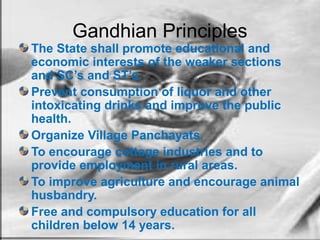
Gandhian Principles
The State shall promote educational and
economic interests of the weaker sections
and SC’s and ST’s.
Prevent consumption of liquor and other
intoxicating drinks and improve the public
health.
Organize Village Panchayats.
To encourage cottage industries and to
provide employment in rural areas.
To improve agriculture and encourage animal
husbandry.
Free and compulsory education for all
children below 14 years.
Social and Economic Principles
• The State should ensure adequate means of
livelihood to its people.
• Fair distribution of Nation’s Wealth.
• Equal pay for men and women.
• Children to be protected against exploitation.
• To ensure right to work, right to education
and right to State assistance in case of
unemployment.
• The State is directed to provide a living wage
to its people.
• The State should ensure participation of
workers in the management of their factories.
General Principles
• According to the 42nd
Amendment Act, the
government should protect and improve
the environment and safe guard the forest
and wild life.
• Preserve and Protect the places and
things of National importance.
Few More
• Maintain just and honorable relations with
the Nations.
• Promote international Peace and Security.
• Foster respect for international law.
• Encourage settlement of disputes
peacefully.
Criticism
• They are vague and repetitive. (Adequate
means of livelihood, living wage etc.)
• They are not enforceable by any court.
They are like empty vessels.
• Article 31-C has made them totally
unclear.
Why to include?
• They highlight the National Objectives.
They tell us about the social and
economic programme of a modern
Welfare State.
• They prescribe that the material source of
the country should be used for the
common good.
• These principles will pull back the
revolutionary and push forward the
reactionary.
To Conclude,
• The Directive Principles have to conform to
and run as subsidiary to the chapter on
Fundamental Rights.
• The Supreme Court says that the general
welfare shall prevail over the individual right.
• Fundamental Rights and Directive Principles
complement each other.
• “Together not individually, they form the core
of the Constitution. They together constitute
its true Conscience.”
Thank You

Directive principles of state policy

  • 1.
    Directive Principles ofDirectivePrinciples of State PolicyState Policy Presented byPresented by T.B.BHARATHIT.B.BHARATHI Teacher in Social SciencesTeacher in Social Sciences The Hyderabad Public SchoolThe Hyderabad Public School KadapaKadapa
  • 2.
    What are these? Theseare the guidelines for the government laid down in Part IV of our Constitution. The inspiration is derived from the Irish Constitution and also from the UN Declaration of Human Rights.
  • 3.
    Their Nature • Theyare non- justiciable rights of the people. • They are fundamental in governance of the country. • If laws are made to give effect to the Directive Principles, they shall not be invalid on the ground that they take away your Fundamental Rights.
  • 4.
  • 5.
    Gandhian Principles The Stateshall promote educational and economic interests of the weaker sections and SC’s and ST’s. Prevent consumption of liquor and other intoxicating drinks and improve the public health. Organize Village Panchayats. To encourage cottage industries and to provide employment in rural areas. To improve agriculture and encourage animal husbandry. Free and compulsory education for all children below 14 years.
  • 6.
    Social and EconomicPrinciples • The State should ensure adequate means of livelihood to its people. • Fair distribution of Nation’s Wealth. • Equal pay for men and women. • Children to be protected against exploitation. • To ensure right to work, right to education and right to State assistance in case of unemployment. • The State is directed to provide a living wage to its people. • The State should ensure participation of workers in the management of their factories.
  • 7.
    General Principles • Accordingto the 42nd Amendment Act, the government should protect and improve the environment and safe guard the forest and wild life. • Preserve and Protect the places and things of National importance.
  • 8.
    Few More • Maintainjust and honorable relations with the Nations. • Promote international Peace and Security. • Foster respect for international law. • Encourage settlement of disputes peacefully.
  • 9.
    Criticism • They arevague and repetitive. (Adequate means of livelihood, living wage etc.) • They are not enforceable by any court. They are like empty vessels. • Article 31-C has made them totally unclear.
  • 10.
    Why to include? •They highlight the National Objectives. They tell us about the social and economic programme of a modern Welfare State. • They prescribe that the material source of the country should be used for the common good. • These principles will pull back the revolutionary and push forward the reactionary.
  • 11.
    To Conclude, • TheDirective Principles have to conform to and run as subsidiary to the chapter on Fundamental Rights. • The Supreme Court says that the general welfare shall prevail over the individual right. • Fundamental Rights and Directive Principles complement each other. • “Together not individually, they form the core of the Constitution. They together constitute its true Conscience.” Thank You