
Subject: Engineering Physics.
Mechanical F.Y. (shift 2)
Vadodara Institute of Engineering.
Kotambi
Credits:
Vadodara Institute of Engineering.
 Kothari Vrajesh 130800119517
 Ojha Anandvardhan 130800119518
 Pandya Kaushal 130800119519
 Pandya Param 130800119520
Under the guidance of:
Professor Anand M Panchal.
Vadodara Institute of Engineering.
Topic:
Contents :
Vadodara Institute of Engineering.
 Introduction..
 Advantages..
 Total Internal Reflection..
 Numerical Aperture..
 Acceptance Angle..
 Types of Fibre..
Introduction
 An optical fiber is essentially a waveguide for light.
 It consists of a core and cladding that surrounds the core.
 The index of refraction of the cladding is less than that of
the core, causing rays of light leaving the core to be
refracted back into the core.
 A light-emitting diode (LED) or laser diode (LD) can be
used for the source.
Vadodara Institute of Engineering.
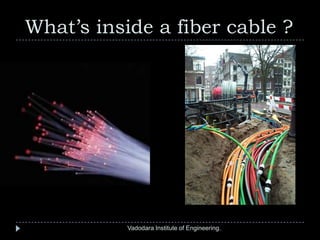
What’s inside a fiber cable ?
Vadodara Institute of Engineering.
Layers surrounding Fiber cables
 Primary coating
 Gives additional mechanical strength
 Protects fiber from stress
 Protection against chemical attacks
 Buffer jacket
 Avoids the formation of microbends
 Bending stress is relieved
 Fiber losses are reduced
Vadodara Institute of Engineering.
Layers surrounding Fiber cables…
 Outer Jacket
 To reduce abrasion and to provide extra protection
against external mechanical strength
 Filler materials
 To avoid moisture absorption by fibers
 Prevents corrosion
Vadodara Institute of Engineering.
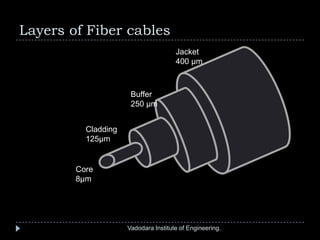
Layers of Fiber cables
Core
8µm
Cladding
125µm
Buffer
250 µm
Jacket
400 µm
Vadodara Institute of Engineering.
Advantages of Optical fibre 
 Less expensive.
 Thinner.
 Higher carrying capacity.
 Less signal degradation Light signals Low power .
Digital signals Non-flammable .
 Lightweight .
 Flexible Medical imaging.
 Mechanical imaging - inspecting mechanical welds in pipes and
engines (in airplanes, rockets, space shuttles, cars)
 Plumbing - to inspect sewer lines
Vadodara Institute of Engineering.
The Basic principle :
Total Internal Reflection.
Vadodara Institute of Engineering.
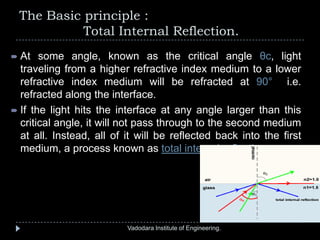
 At some angle, known as the critical angle θc, light
traveling from a higher refractive index medium to a lower
refractive index medium will be refracted at 90° i.e.
refracted along the interface.
 If the light hits the interface at any angle larger than this
critical angle, it will not pass through to the second medium
at all. Instead, all of it will be reflected back into the first
medium, a process known as total internal reflection
Vadodara Institute of Engineering.
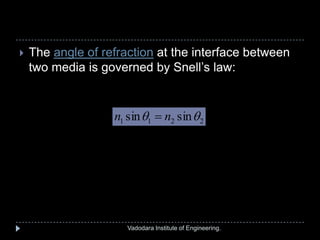
 The angle of refraction at the interface between
two media is governed by Snell’s law:
2211 sinsin  nn 
Numerical Aperture
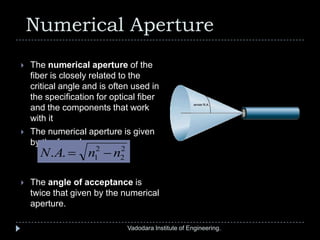
 The numerical aperture of the
fiber is closely related to the
critical angle and is often used in
the specification for optical fiber
and the components that work
with it
 The numerical aperture is given
by the formula:
 The angle of acceptance is
twice that given by the numerical
aperture.
2
2
2
1.. nnAN 
Vadodara Institute of Engineering.
Acceptance Angle..
Vadodara Institute of Engineering.
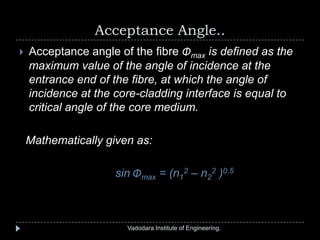
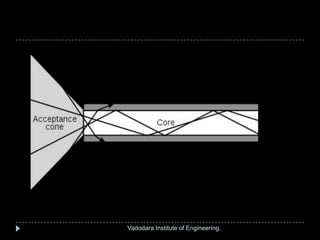
 Acceptance angle of the fibre Φmax is defined as the
maximum value of the angle of incidence at the
entrance end of the fibre, at which the angle of
incidence at the core-cladding interface is equal to
critical angle of the core medium.
Mathematically given as:
sin Φmax = (n1
2 – n2
2 )0.5
Vadodara Institute of Engineering.
Types of Optical Fiber.
Vadodara Institute of Engineering.
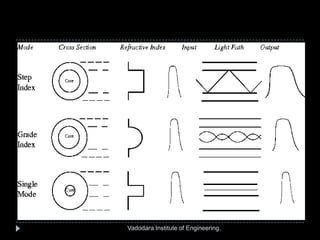
Single mode Step-Index Fibre (SMSI Fibre)
Vadodara Institute of Engineering.
 A single mode step index fibre has a central core
material of uniform refractive index value.
 The diameter of the core is (8 – 10 µm) sufficiently
small so that, there is essentially only one path that
light may take as it propagates down the cable.
Multi mode Step-Index Fibre.
Vadodara Institute of Engineering.
 In comparison to the single-mode fibre, multimode
fibre has a relatively large core of diameter 50 – 25
µm and a high numerical aperture.
 The diameter of the cladding usually lie between
100-250µm.
Multimode Graded Index Fibre.
Vadodara Institute of Engineering.
 In an effort to reduce the pulse dispersion,
multimode graded index fibre was developed.
 A graded index index fibre is characterized by a
central core that has a refractive index which is not
uniform.
Vadodara Institute of Engineering.
Reference :
Vadodara Institute of Engineering.
 Engineering Physics by G. Vijayakumari.
 Engineering Physics by V Rajendran.
 http://en.wikipedia.org/wiki/Optical_fiber
Vadodara Institute of Engineering.

Basic Fiber optics..

  • 1.
    Subject: Engineering Physics. MechanicalF.Y. (shift 2) Vadodara Institute of Engineering. Kotambi
  • 2.
    Credits: Vadodara Institute ofEngineering.  Kothari Vrajesh 130800119517  Ojha Anandvardhan 130800119518  Pandya Kaushal 130800119519  Pandya Param 130800119520 Under the guidance of: Professor Anand M Panchal.
  • 3.
    Vadodara Institute ofEngineering. Topic:
  • 4.
    Contents : Vadodara Instituteof Engineering.  Introduction..  Advantages..  Total Internal Reflection..  Numerical Aperture..  Acceptance Angle..  Types of Fibre..
  • 5.
    Introduction  An opticalfiber is essentially a waveguide for light.  It consists of a core and cladding that surrounds the core.  The index of refraction of the cladding is less than that of the core, causing rays of light leaving the core to be refracted back into the core.  A light-emitting diode (LED) or laser diode (LD) can be used for the source. Vadodara Institute of Engineering.
  • 6.
    What’s inside afiber cable ? Vadodara Institute of Engineering.
  • 7.
    Layers surrounding Fibercables  Primary coating  Gives additional mechanical strength  Protects fiber from stress  Protection against chemical attacks  Buffer jacket  Avoids the formation of microbends  Bending stress is relieved  Fiber losses are reduced Vadodara Institute of Engineering.
  • 8.
    Layers surrounding Fibercables…  Outer Jacket  To reduce abrasion and to provide extra protection against external mechanical strength  Filler materials  To avoid moisture absorption by fibers  Prevents corrosion Vadodara Institute of Engineering.
  • 9.
    Layers of Fibercables Core 8µm Cladding 125µm Buffer 250 µm Jacket 400 µm Vadodara Institute of Engineering.
  • 10.
    Advantages of Opticalfibre   Less expensive.  Thinner.  Higher carrying capacity.  Less signal degradation Light signals Low power . Digital signals Non-flammable .  Lightweight .  Flexible Medical imaging.  Mechanical imaging - inspecting mechanical welds in pipes and engines (in airplanes, rockets, space shuttles, cars)  Plumbing - to inspect sewer lines Vadodara Institute of Engineering.
  • 11.
    The Basic principle: Total Internal Reflection. Vadodara Institute of Engineering.  At some angle, known as the critical angle θc, light traveling from a higher refractive index medium to a lower refractive index medium will be refracted at 90° i.e. refracted along the interface.  If the light hits the interface at any angle larger than this critical angle, it will not pass through to the second medium at all. Instead, all of it will be reflected back into the first medium, a process known as total internal reflection
  • 12.
    Vadodara Institute ofEngineering.  The angle of refraction at the interface between two media is governed by Snell’s law: 2211 sinsin  nn 
  • 13.
    Numerical Aperture  Thenumerical aperture of the fiber is closely related to the critical angle and is often used in the specification for optical fiber and the components that work with it  The numerical aperture is given by the formula:  The angle of acceptance is twice that given by the numerical aperture. 2 2 2 1.. nnAN  Vadodara Institute of Engineering.
  • 14.
    Acceptance Angle.. Vadodara Instituteof Engineering.  Acceptance angle of the fibre Φmax is defined as the maximum value of the angle of incidence at the entrance end of the fibre, at which the angle of incidence at the core-cladding interface is equal to critical angle of the core medium. Mathematically given as: sin Φmax = (n1 2 – n2 2 )0.5
  • 15.
  • 16.
    Types of OpticalFiber. Vadodara Institute of Engineering.
  • 17.
    Single mode Step-IndexFibre (SMSI Fibre) Vadodara Institute of Engineering.  A single mode step index fibre has a central core material of uniform refractive index value.  The diameter of the core is (8 – 10 µm) sufficiently small so that, there is essentially only one path that light may take as it propagates down the cable.
  • 18.
    Multi mode Step-IndexFibre. Vadodara Institute of Engineering.  In comparison to the single-mode fibre, multimode fibre has a relatively large core of diameter 50 – 25 µm and a high numerical aperture.  The diameter of the cladding usually lie between 100-250µm.
  • 19.
    Multimode Graded IndexFibre. Vadodara Institute of Engineering.  In an effort to reduce the pulse dispersion, multimode graded index fibre was developed.  A graded index index fibre is characterized by a central core that has a refractive index which is not uniform.
  • 20.
  • 21.
    Reference : Vadodara Instituteof Engineering.  Engineering Physics by G. Vijayakumari.  Engineering Physics by V Rajendran.  http://en.wikipedia.org/wiki/Optical_fiber
  • 22.