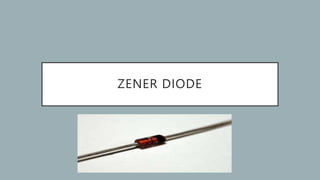
ZENER DIODE
Clarence Melvin Zener was the American physicist who first (1934) described the property concerning the
breakdown of electrical insulators. These findings were later exploited by Bell Labs in the development of
the Zener diode, which was duly named after him.
ZENER DIODE
• A Zener diode is special heavily doped P N diode.
• A Zener diode is a special silicon pn junction device that allows current to flow not
only in the forward direction like a typical silicon or germanium diode, but also in the
reverse direction if the voltage is greater than the breakdown voltage known
as Zener knee voltage or simply Zener voltage
• A Zener diode operating in breakdown acts as a voltage regulator because it
maintains a nearly constant voltage, which is equal to the Zener voltage, across its
terminals over a specified range of reverse-current values.
DIFFERENCE BETWEEN PN DIODE AND ZENER DIODE
V I CHARACTERISTICS OF ZENER DIODE
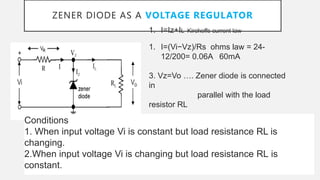
ZENER DIODE AS A VOLTAGE REGULATOR
1. I=Iz+IL Kirchoffs current law
1. I=(Vi−Vz)/Rs ohms law = 24-
12/200= 0.06A 60mA
3. Vz=Vo …. Zener diode is connected
in
parallel with the load
resistor RL
4. IL=Vo/RL=Vz/RL
Conditions
1. When input voltage Vi is constant but load resistance RL is
changing.
2.When input voltage Vi is changing but load resistance RL is
constant.
• Vin = 30V , Rs=400 ohms, Izmin = 1mA, Izmax
= 50mA, Vz=10V and
• Find ILmin Ilmax , Rlmin, Rlmax
VIN = CONSTANT AND RL INCREASES
• If RL IL
• I is constant as Vin is constant
• I=Iz+IL
• Iz e.g 10=8+2
• 10= 9 +1
• If RL IL
• I is constant as Vin is constant
• I=Iz+IL
• Iz e.g 10=6+4
• 10= 4+6
VIN = CONSTANT AND RL DECREASES
CONDITION 1
VIN = INCREASES AND RL CONSTANT
• If Vin then current I
• IL is constant as RL is constant
• I=Iz+IL
• Iz e,g, 10=8+2 12= 10+2
• If Vin then current I
• IL is constant as RL is constant
• I=Iz+IL
• Iz e.g 10 = 8 + 2
VIN = DECREASES AND RL CONSTANT
CONDITION 2
AVALANCHE BREAKDOWN
12
ZENER BREAKDOWN
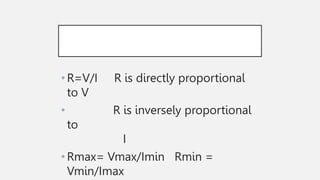
•R=V/I R is directly proportional
to V
• R is inversely proportional
to
I
•Rmax= Vmax/Imin Rmin =
Vmin/Imax

Basic Electronics Engineering Zener diode.pptx

  • 1.
  • 3.
    Clarence Melvin Zenerwas the American physicist who first (1934) described the property concerning the breakdown of electrical insulators. These findings were later exploited by Bell Labs in the development of the Zener diode, which was duly named after him.
  • 4.
    ZENER DIODE • AZener diode is special heavily doped P N diode. • A Zener diode is a special silicon pn junction device that allows current to flow not only in the forward direction like a typical silicon or germanium diode, but also in the reverse direction if the voltage is greater than the breakdown voltage known as Zener knee voltage or simply Zener voltage • A Zener diode operating in breakdown acts as a voltage regulator because it maintains a nearly constant voltage, which is equal to the Zener voltage, across its terminals over a specified range of reverse-current values.
  • 5.
    DIFFERENCE BETWEEN PNDIODE AND ZENER DIODE
  • 7.
    V I CHARACTERISTICSOF ZENER DIODE
  • 8.
    ZENER DIODE ASA VOLTAGE REGULATOR 1. I=Iz+IL Kirchoffs current law 1. I=(Vi−Vz)/Rs ohms law = 24- 12/200= 0.06A 60mA 3. Vz=Vo …. Zener diode is connected in parallel with the load resistor RL 4. IL=Vo/RL=Vz/RL Conditions 1. When input voltage Vi is constant but load resistance RL is changing. 2.When input voltage Vi is changing but load resistance RL is constant.
  • 9.
    • Vin =30V , Rs=400 ohms, Izmin = 1mA, Izmax = 50mA, Vz=10V and • Find ILmin Ilmax , Rlmin, Rlmax
  • 10.
    VIN = CONSTANTAND RL INCREASES • If RL IL • I is constant as Vin is constant • I=Iz+IL • Iz e.g 10=8+2 • 10= 9 +1 • If RL IL • I is constant as Vin is constant • I=Iz+IL • Iz e.g 10=6+4 • 10= 4+6 VIN = CONSTANT AND RL DECREASES CONDITION 1
  • 11.
    VIN = INCREASESAND RL CONSTANT • If Vin then current I • IL is constant as RL is constant • I=Iz+IL • Iz e,g, 10=8+2 12= 10+2 • If Vin then current I • IL is constant as RL is constant • I=Iz+IL • Iz e.g 10 = 8 + 2 VIN = DECREASES AND RL CONSTANT CONDITION 2
  • 12.
  • 13.
  • 14.
    •R=V/I R isdirectly proportional to V • R is inversely proportional to I •Rmax= Vmax/Imin Rmin = Vmin/Imax