Transistors
&
Opamp
15 October 2023 1
Contents
• Transistor (BJT) Structure
• Transistor characteristics and parameters
• DC operating point
• Transistor as an amplifier
• Transistor as a switch
• MOSFET
• Operational Amplifier
15 October 2023 2
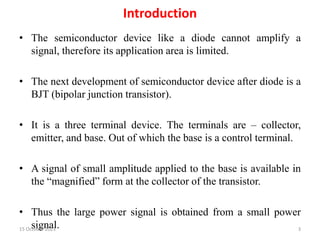
Introduction
• The semiconductor device like a diode cannot amplify a
signal, therefore its application area is limited.
• The next development of semiconductor device after diode is a
BJT (bipolar junction transistor).
• It is a three terminal device. The terminals are – collector,
emitter, and base. Out of which the base is a control terminal.

• A signal of small amplitude applied to the base is available in
the “magnified” form at the collector of the transistor.
• Thus the large power signal is obtained from a small power
signal.
15 October 2023 3
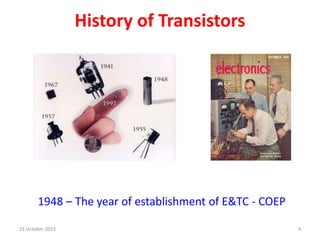
http://www.bellsystemmemorial.com/belllabs_transistor.html
History of Transistors
1948 – The year of establishment of E&TC - COEP
15 October 2023 4
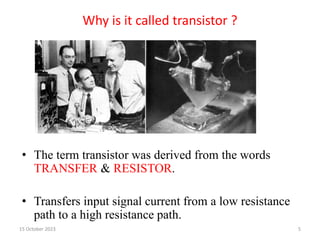
Why is it called transistor ?
• The term transistor was derived from the words
TRANSFER & RESISTOR.
• Transfers input signal current from a low resistance
path to a high resistance path.
15 October 2023 5
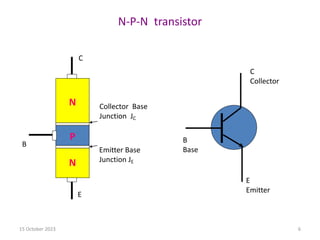
N-P-N transistor
N
N
P
C
E
B
Collector Base
Junction JC
Emitter Base
Junction JE
E
Emitter
B
Base
C
Collector
15 October 2023 6
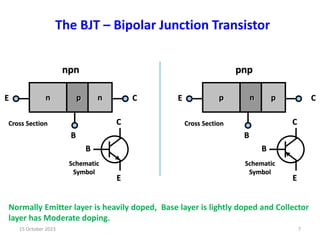
The BJT – Bipolar Junction Transistor
Normally Emitter layer is heavily doped, Base layer is lightly doped and Collector
layer has Moderate doping.
npn pnp
n p n
E
B
C p n p
E
B
C
Cross Section Cross Section
B
C
E
Schematic
Symbol
B
C
E
Schematic
Symbol
15 October 2023 7
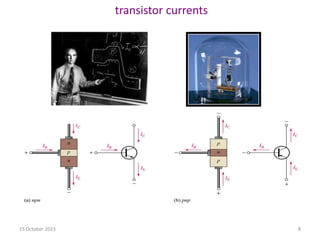
transistor currents
N
P
E
B
Collector Base
Junction JC
Emitter Base
Junction JE
E
Emitter
B
Base
15 October 2023 8
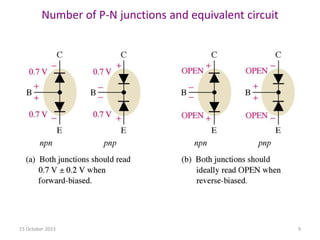
Number of P-N junctions and equivalent circuit
N
P
E
B
P
N
B
C
E
Emitter
C
Collector
B
Base
15 October 2023 9
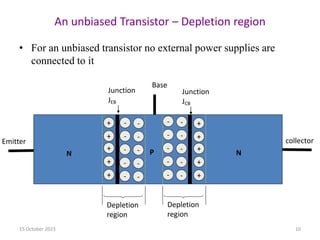
An unbiased Transistor – Depletion region
• For an unbiased transistor no external power supplies are
connected to it
P
Junction
JEB
Emitter collector
N
Base
Junction
JCB
N
Depletion
region
Depletion
region
-
-
-
-
-
+
+
+
+
+
-
-
-
-
-
+
+
+
+
+
-
-
-
-
-
-
-
-
-
-
15 October 2023 10
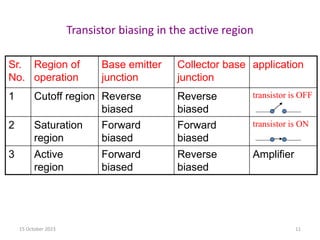
Transistor biasing in the active region
Sr.
No.
Region of
operation
Base emitter
junction
Collector base
junction
application
1 Cutoff region Reverse
biased
Reverse
biased
transistor is OFF
2 Saturation
region
Forward
biased
Forward
biased
transistor is ON
3 Active
region
Forward
biased
Reverse
biased
Amplifier
15 October 2023 11
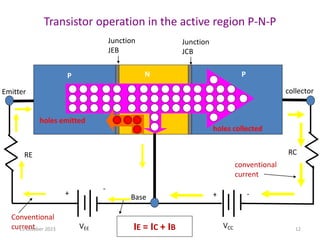
Transistor operation in the active region P-N-P
P
Junction
JEB
Emitter collector
N
Base
Junction
JCB
VEE
RE
+
-
RC
VCC
-
holes emitted
holes collected
Conventional
current
conventional
current
+
P P
N
IE = IC + IB
15 October 2023 12
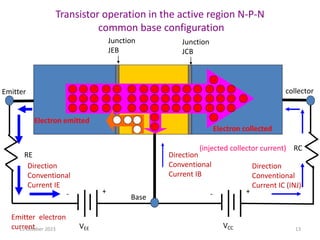
Transistor operation in the active region N-P-N
common base configuration
P
Junction
JEB
Emitter collector
N
Base
Junction
JCB
N
VEE
RE
+
-
RC
VCC
+
-
Electron emitted
Electron collected
Emitter electron
current
Direction
Conventional
Current IC (INJ)
Direction
Conventional
Current IB
Direction
Conventional
Current IE
(injected collector current)
15 October 2023 13
Transistor configuration
• Depending on which terminal is made common to input and
output port there are three possible configurations of the
transistor. They are as follows:
• Common base configuration
• Common emitter configuration
• Common collector configuration
15 October 2023 14
15 October 2023 15
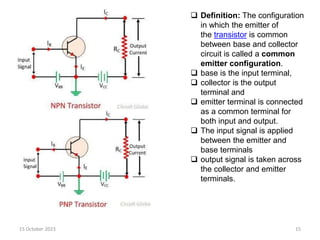
 Definition: The configuration
in which the emitter of
the transistor is common
between base and collector
circuit is called a common
emitter configuration.
 base is the input terminal,
 collector is the output
terminal and
 emitter terminal is connected
as a common terminal for
both input and output.
 The input signal is applied
between the emitter and
base terminals
 output signal is taken across
the collector and emitter
terminals.
15 October 2023 16
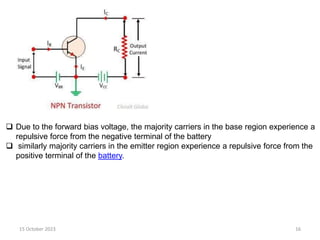
 Due to the forward bias voltage, the majority carriers in the base region experience a
repulsive force from the negative terminal of the battery
 similarly majority carriers in the emitter region experience a repulsive force from the
positive terminal of the battery.
15 October 2023 17
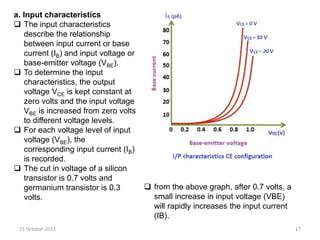
a. Input characteristics
 The input characteristics
describe the relationship
between input current or base
current (IB) and input voltage or
base-emitter voltage (VBE).
 To determine the input
characteristics, the output
voltage VCE is kept constant at
zero volts and the input voltage
VBE is increased from zero volts
to different voltage levels.
 For each voltage level of input
voltage (VBE), the
corresponding input current (IB)
is recorded.
 The cut in voltage of a silicon
transistor is 0.7 volts and
germanium transistor is 0.3
volts.
 from the above graph, after 0.7 volts, a
small increase in input voltage (VBE)
will rapidly increases the input current
(IB).
15 October 2023 18
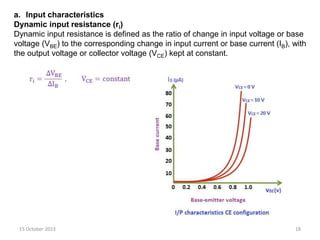
a. Input characteristics
Dynamic input resistance (ri)
Dynamic input resistance is defined as the ratio of change in input voltage or base
voltage (VBE) to the corresponding change in input current or base current (IB), with
the output voltage or collector voltage (VCE) kept at constant.
15 October 2023 19
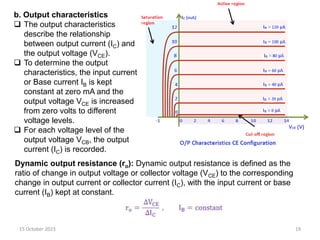
b. Output characteristics
 The output characteristics
describe the relationship
between output current (IC) and
the output voltage (VCE).
 To determine the output
characteristics, the input current
or Base current IB is kept
constant at zero mA and the
output voltage VCE is increased
from zero volts to different
voltage levels.
 For each voltage level of the
output voltage VCB, the output
current (IC) is recorded.
Dynamic output resistance (ro): Dynamic output resistance is defined as the
ratio of change in output voltage or collector voltage (VCE) to the corresponding
change in output current or collector current (IC), with the input current or base
current (IB) kept at constant.
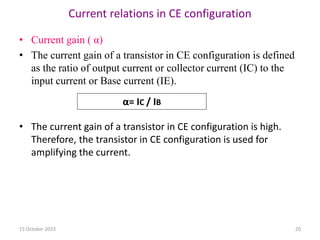
Current relations in CE configuration
• Current gain ( α)
• The current gain of a transistor in CE configuration is defined
as the ratio of output current or collector current (IC) to the
input current or Base current (IE).
• The current gain of a transistor in CE configuration is high.
Therefore, the transistor in CE configuration is used for
amplifying the current.
α= IC / IB
15 October 2023 20
15 October 2023 21
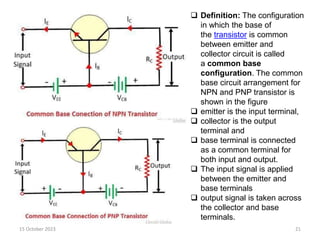
 Definition: The configuration
in which the base of
the transistor is common
between emitter and
collector circuit is called
a common base
configuration. The common
base circuit arrangement for
NPN and PNP transistor is
shown in the figure
 emitter is the input terminal,
 collector is the output
terminal and
 base terminal is connected
as a common terminal for
both input and output.
 The input signal is applied
between the emitter and
base terminals
 output signal is taken across
the collector and base
terminals.
15 October 2023 22
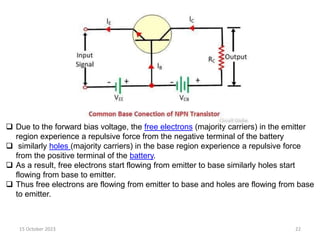
 Due to the forward bias voltage, the free electrons (majority carriers) in the emitter
region experience a repulsive force from the negative terminal of the battery
 similarly holes (majority carriers) in the base region experience a repulsive force
from the positive terminal of the battery.
 As a result, free electrons start flowing from emitter to base similarly holes start
flowing from base to emitter.
 Thus free electrons are flowing from emitter to base and holes are flowing from base
to emitter.
15 October 2023 23
a. Input characteristics
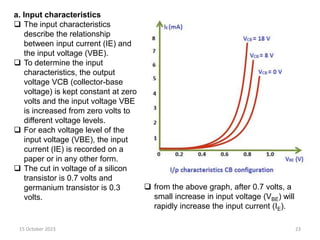
 The input characteristics
describe the relationship
between input current (IE) and
the input voltage (VBE).
 To determine the input
characteristics, the output
voltage VCB (collector-base
voltage) is kept constant at zero
volts and the input voltage VBE
is increased from zero volts to
different voltage levels.
 For each voltage level of the
input voltage (VBE), the input
current (IE) is recorded on a
paper or in any other form.
 The cut in voltage of a silicon
transistor is 0.7 volts and
germanium transistor is 0.3
volts.
 from the above graph, after 0.7 volts, a
small increase in input voltage (VBE) will
rapidly increase the input current (IE).
15 October 2023 24
a. Input characteristics
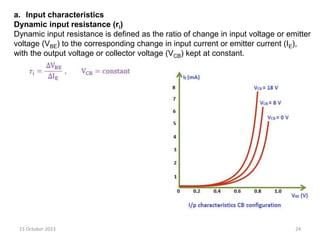
Dynamic input resistance (ri)
Dynamic input resistance is defined as the ratio of change in input voltage or emitter
voltage (VBE) to the corresponding change in input current or emitter current (IE),
with the output voltage or collector voltage (VCB) kept at constant.
15 October 2023 25
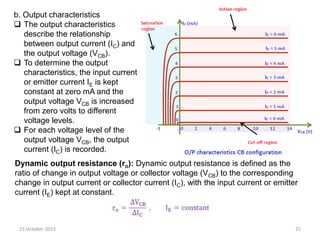
b. Output characteristics
 The output characteristics
describe the relationship
between output current (IC) and
the output voltage (VCB).
 To determine the output
characteristics, the input current
or emitter current IE is kept
constant at zero mA and the
output voltage VCB is increased
from zero volts to different
voltage levels.
 For each voltage level of the
output voltage VCB, the output
current (IC) is recorded.
Dynamic output resistance (ro): Dynamic output resistance is defined as the
ratio of change in output voltage or collector voltage (VCB) to the corresponding
change in output current or collector current (IC), with the input current or emitter
current (IE) kept at constant.
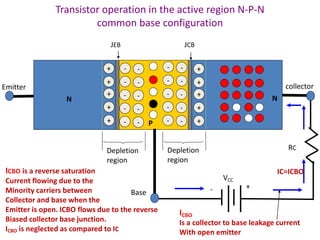
Transistor operation in the active region N-P-N
common base configuration
P
JEB
Emitter collector
N
Base
JCB
N
Depletion
region
Depletion
region
-
-
-
-
-
+
+
+
+
+
-
-
-
-
-
+
+
+
+
+
-
-
-
-
-
-
-
-
-
-
RC
VCC
+
-
IC=ICBO
ICBO
Is a collector to base leakage current
With open emitter
ICBO is a reverse saturation
Current flowing due to the
Minority carriers between
Collector and base when the
Emitter is open. ICBO flows due to the reverse
Biased collector base junction.
ICBO is neglected as compared to IC
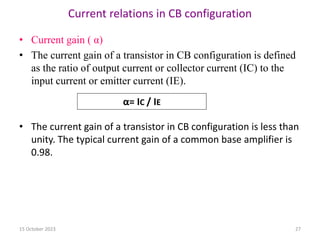
Current relations in CB configuration
• Current gain ( α)
• The current gain of a transistor in CB configuration is defined
as the ratio of output current or collector current (IC) to the
input current or emitter current (IE).
• The current gain of a transistor in CB configuration is less than
unity. The typical current gain of a common base amplifier is
0.98.
α= IC / IE
15 October 2023 27
15 October 2023 28
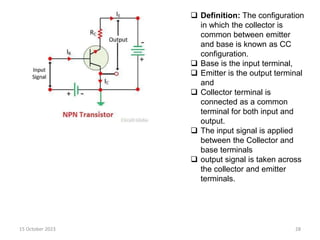
 Definition: The configuration
in which the collector is
common between emitter
and base is known as CC
configuration.
 Base is the input terminal,
 Emitter is the output terminal
and
 Collector terminal is
connected as a common
terminal for both input and
output.
 The input signal is applied
between the Collector and
base terminals
 output signal is taken across
the collector and emitter
terminals.
15 October 2023 29
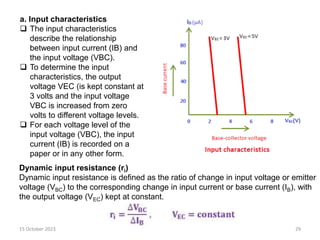
a. Input characteristics
 The input characteristics
describe the relationship
between input current (IB) and
the input voltage (VBC).
 To determine the input
characteristics, the output
voltage VEC (is kept constant at
3 volts and the input voltage
VBC is increased from zero
volts to different voltage levels.
 For each voltage level of the
input voltage (VBC), the input
current (IB) is recorded on a
paper or in any other form.
Dynamic input resistance (ri)
Dynamic input resistance is defined as the ratio of change in input voltage or emitter
voltage (VBC) to the corresponding change in input current or base current (IB), with
the output voltage (VEC) kept at constant.
15 October 2023 30
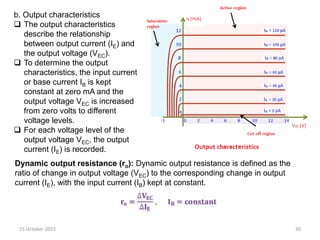
b. Output characteristics
 The output characteristics
describe the relationship
between output current (IE) and
the output voltage (VEC).
 To determine the output
characteristics, the input current
or base current IB is kept
constant at zero mA and the
output voltage VEC is increased
from zero volts to different
voltage levels.
 For each voltage level of the
output voltage VEC, the output
current (IE) is recorded.
Dynamic output resistance (ro): Dynamic output resistance is defined as the
ratio of change in output voltage (VEC) to the corresponding change in output
current (IE), with the input current (IB) kept at constant.
15 October 2023 31
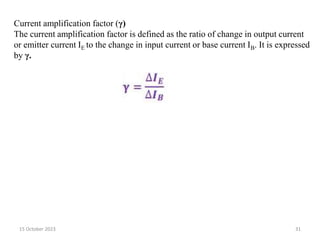
Current amplification factor (γ)
The current amplification factor is defined as the ratio of change in output current
or emitter current IE to the change in input current or base current IB. It is expressed
by γ.
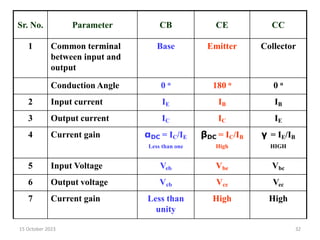
Sr. No. Parameter CB CE CC
1 Common terminal
between input and
output
Base Emitter Collector
Conduction Angle 0 o 180 o 0 o
2 Input current IE IB IB
3 Output current IC IC IE
4 Current gain αDC = IC/IE
Less than one
βDC = IC/IB
High
γ = IE/IB
HIGH
5 Input Voltage Veb Vbe Vbc
6 Output voltage Vcb Vce Vec
7 Current gain Less than
unity
High High
15 October 2023 32
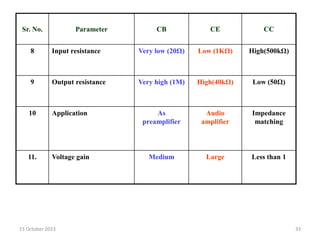
Sr. No. Parameter CB CE CC
8 Input resistance Very low (20Ω) Low (1KΩ) High(500kΩ)
9 Output resistance Very high (1M) High(40kΩ) Low (50Ω)
10 Application As
preamplifier
Audio
amplifier
Impedance
matching
11. Voltage gain Medium Large Less than 1
15 October 2023 33
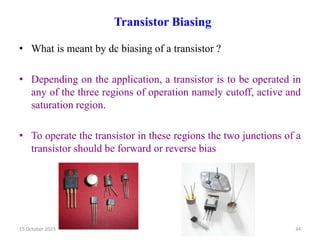
Transistor Biasing
• What is meant by dc biasing of a transistor ?
• Depending on the application, a transistor is to be operated in
any of the three regions of operation namely cutoff, active and
saturation region.
• To operate the transistor in these regions the two junctions of a
transistor should be forward or reverse bias
15 October 2023 34
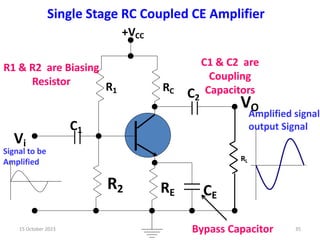
RC
RE CE
R2
R1
+VCC
C1
C2
VO
Vi
Signal to be
Amplified RL
Amplified signal
output Signal
R1 & R2 are Biasing
Resistor
C1 & C2 are
Coupling
Capacitors
Bypass Capacitor
Single Stage RC Coupled CE Amplifier
15 October 2023 35
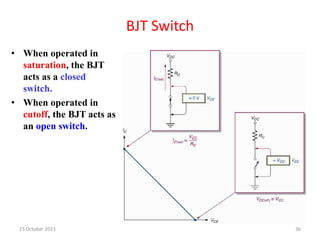
BJT Switch
• When operated in
saturation, the BJT
acts as a closed
switch.
• When operated in
cutoff, the BJT acts as
an open switch.
15 October 2023 36
MOSFET
15 October 2023 37
FIELD-EFFECT TRANSISTORS ( FET)
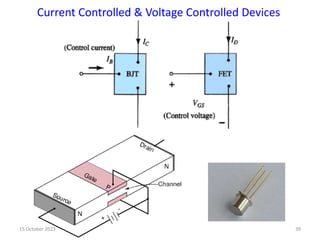
• FETs are the uni polar devices because, unlike BJTs
that use both electron and hole current, they operate
only with one type of charge carrier.
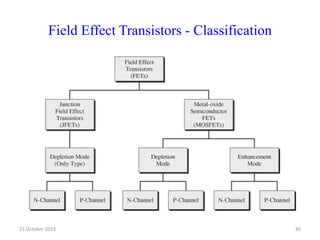
• The two main types of FET’s are -
 Junction Field Fffect Transistor (JFET) and
 Metal Oxide Semiconductor Field Effect Transistor
(MOSFET)
15 October 2023 38
Current Controlled & Voltage Controlled Devices
15 October 2023 39
Field Effect Transistors - Classification
15 October 2023 40
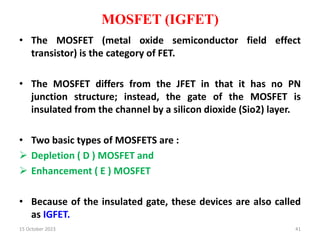
MOSFET (IGFET)
• The MOSFET (metal oxide semiconductor field effect
transistor) is the category of FET.
• The MOSFET differs from the JFET in that it has no PN
junction structure; instead, the gate of the MOSFET is
insulated from the channel by a silicon dioxide (Sio2) layer.
• Two basic types of MOSFETS are :
 Depletion ( D ) MOSFET and
 Enhancement ( E ) MOSFET
• Because of the insulated gate, these devices are also called
as IGFET.
15 October 2023 41
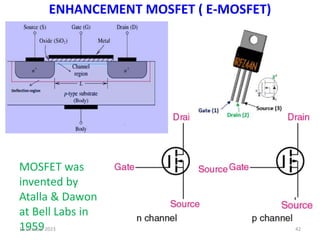
ENHANCEMENT MOSFET ( E-MOSFET)
MOSFET was
invented by
Atalla & Dawon
at Bell Labs in
1959
15 October 2023 42
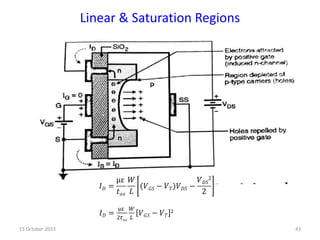
Linear & Saturation Regions
15 October 2023 43
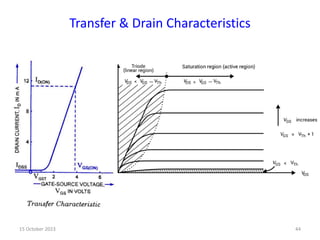
Transfer & Drain Characteristics
15 October 2023 44
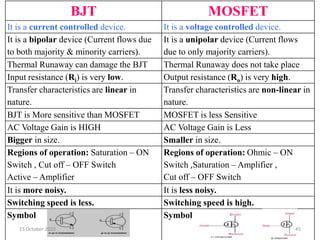
BJT MOSFET
It is a current controlled device. It is a voltage controlled device.
It is a bipolar device (Current flows due
to both majority & minority carriers).
It is a unipolar device (Current flows
due to only majority carriers).
Thermal Runaway can damage the BJT Thermal Runaway does not take place
Input resistance (Ri) is very low. Output resistance (Ro) is very high.
Transfer characteristics are linear in
nature.
Transfer characteristics are non-linear in
nature.
BJT is More sensitive than MOSFET MOSFET is less Sensitive
AC Voltage Gain is HIGH AC Voltage Gain is Less
Bigger in size. Smaller in size.
Regions of operation: Saturation – ON
Switch , Cut off – OFF Switch
Active – Amplifier
Regions of operation: Ohmic – ON
Switch ,Saturation – Amplifier ,
Cut off – OFF Switch
It is more noisy. It is less noisy.
Switching speed is less. Switching speed is high.
Symbol Symbol
15 October 2023 45
Operational
Amplifier
An operational amplifier (often op-amp or opamp) is
a DC coupled high-gain electronic voltage amplifier with
a differential input and usually, a single-ended output
15 October 2023 46
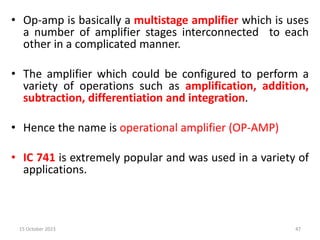
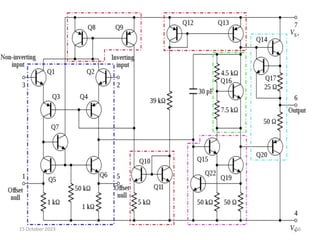
• Op-amp is basically a multistage amplifier which is uses
a number of amplifier stages interconnected to each
other in a complicated manner.
• The amplifier which could be configured to perform a
variety of operations such as amplification, addition,
subtraction, differentiation and integration.
• Hence the name is operational amplifier (OP-AMP)
• IC 741 is extremely popular and was used in a variety of
applications.
15 October 2023 47
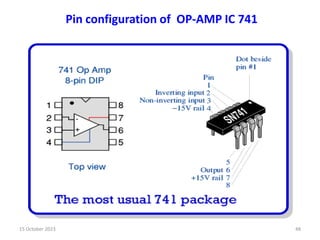
Pin configuration of OP-AMP IC 741
15 October 2023 48
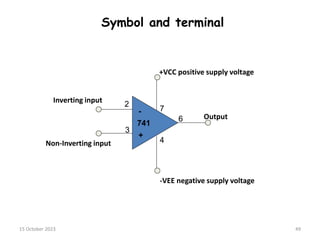
Symbol and terminal
741
2
3
4
7
6
-
+
+VCC positive supply voltage
-VEE negative supply voltage
Output
Inverting input
Non-Inverting input
15 October 2023 49
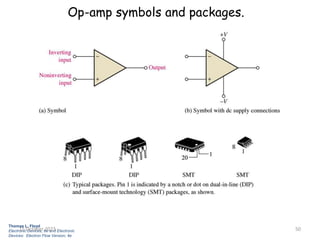
Op-amp symbols and packages.
Thomas L. Floyd
Electronic Devices, 6e and Electronic
Devices: Electron Flow Version, 4e
15 October 2023 50
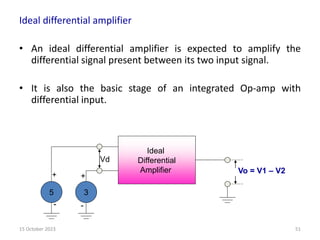
Ideal differential amplifier
• An ideal differential amplifier is expected to amplify the
differential signal present between its two input signal.
• It is also the basic stage of an integrated Op-amp with
differential input.
3
5
Vd
Vo = V1 – V2
+
+
-
-
Ideal
Differential
Amplifier
15 October 2023 51
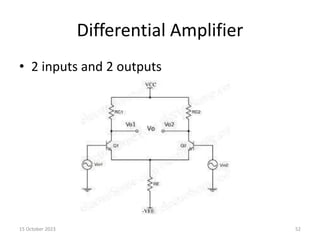
Differential Amplifier
• 2 inputs and 2 outputs
15 October 2023 52
Ideal
Differential
Amplifier (Ad=10)
3
5
Vd
Vo =Ad(V1 – V2)
+
+
-
-
Differential gain -
• Vo = Ad ( V1 – V2 )
Where Ad is called as the differential gain.
• The differential gain can be defined as the gain with which the
differential amplifier amplifies the differential signal.
Vo = Ad Vd as Vd = V1 – V2
Gain Ad = Vo / Vd decibel Vo=10 Vd 2V
Ad (dB) =10 log10 [ Vo / Vd ]
15 October 2023 53
Ideal
Differential
Amplifier
3
5
Vd
Vo = Ac(V1 – V2)
+
+
-
-
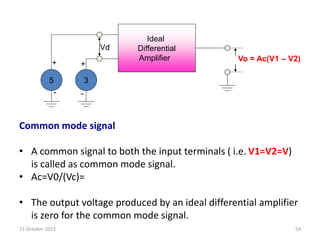
Common mode signal
• A common signal to both the input terminals ( i.e. V1=V2=V)
is called as common mode signal.
• Ac=V0/(Vc)=
• The output voltage produced by an ideal differential amplifier
is zero for the common mode signal.
15 October 2023 54
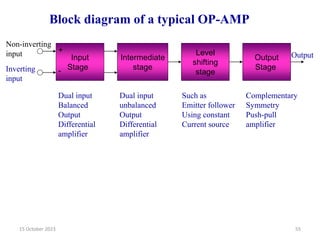
Block diagram of a typical OP-AMP
Input
Stage
Intermediate
stage
Level
shifting
stage
Output
Stage
Non-inverting
input
Inverting
input
+
-
Output
Dual input
Balanced
Output
Differential
amplifier
Dual input
unbalanced
Output
Differential
amplifier
Such as
Emitter follower
Using constant
Current source
Complementary
Symmetry
Push-pull
amplifier
15 October 2023 55
15 October 2023 56
Ideal
Differential
Amplifier
V2
V1
Vd
Vo = A(V1 – V2)
+
+
-
-
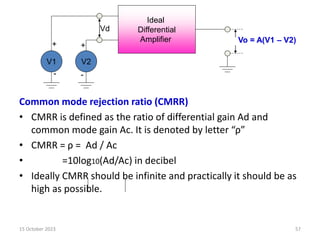
Common mode rejection ratio (CMRR)
• CMRR is defined as the ratio of differential gain Ad and
common mode gain Ac. It is denoted by letter “ρ”
• CMRR = ρ = Ad / Ac
• =10log10(Ad/Ac) in decibel
• Ideally CMRR should be infinite and practically it should be as
high as possible.
15 October 2023 57
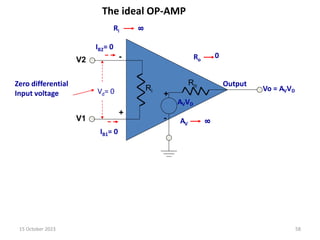
The ideal OP-AMP
-
+
Output
V2
V1
Ro
AVVD
+
-
Ri
Vd= 0
Zero differential
Input voltage
Ri
8
Ro
0
AV
8
IB2= 0
IB1= 0
Vo = AVVD
15 October 2023 58
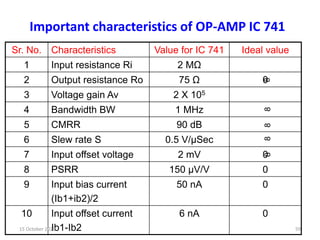
Important characteristics of OP-AMP IC 741
Sr. No. Characteristics Value for IC 741 Ideal value
1 Input resistance Ri 2 MΩ
2 Output resistance Ro 75 Ω 0
3 Voltage gain Av 2 X 10⁵
4 Bandwidth BW 1 MHz
5 CMRR 90 dB
6 Slew rate S 0.5 V/μSec
7 Input offset voltage 2 mV 0
8 PSRR 150 μV/V 0
9 Input bias current
(Ib1+ib2)/2
50 nA 0
10 Input offset current
Ib1-Ib2
6 nA 0
8
8
8
8
8
15 October 2023 59
15 October 2023 60
OP-AMP
-
+
VS
V1
RF
Vo
R1
+
-
V2
Vd
IB2 = 0
+ -
-
+
AV =
8
input
t
t
0
0
VS
VO
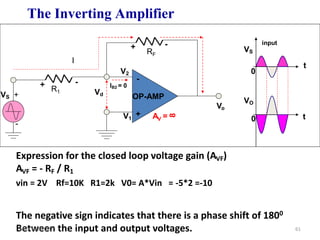
Expression for the closed loop voltage gain (AVF)
AVF = - RF / R1
vin = 2V Rf=10K R1=2k V0= A*Vin = -5*2 =-10
The negative sign indicates that there is a phase shift of 1800
Between the input and output voltages.
I
The Inverting Amplifier
15 October 2023 61
OP-AMP
-
+
VS
V1
RF
Vo
R1
+
-
V2
I2 = 0
+ -
-
+
AV =
8
input
t
t
0
0
VS
VO
I1 = 0
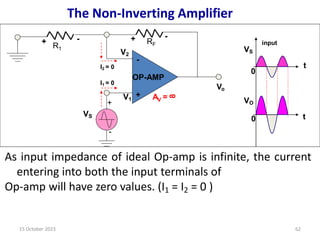
As input impedance of ideal Op-amp is infinite, the current
entering into both the input terminals of
Op-amp will have zero values. (I1 = I2 = 0 )
The Non-Inverting Amplifier
15 October 2023 62
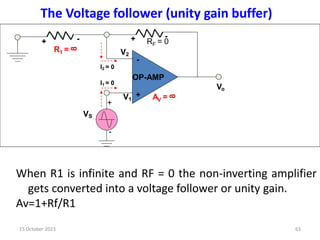
The Voltage follower (unity gain buffer)
OP-AMP
-
+
VS
V1
RF = 0
Vo
+
-
V2
I2 = 0
+ -
-
+
AV =
8
I1 = 0
When R1 is infinite and RF = 0 the non-inverting amplifier
gets converted into a voltage follower or unity gain.
Av=1+Rf/R1
R1 =
8
15 October 2023 63
Conclusion
• Read the Instruction Manuals of equipment i.e. Car,
Washing m/c, Microwave oven, Cell phone, Laptop etc.
• BJT is used rarely.
• MOSFET is matured technology & used everywhere.
• MOSFET ckts have low dissipations, high swing &
integration.
• Device / Ckt / Chip / Application designers are well
respected. Less effect of recession.
• Classrooms may diminish; Hands on has only meaning.
• Knowledge of E&TC is must for every branch.
• Opamp is hot topic forever !
15 October 2023 64
Thank You
madanbmali@gmail.com
Mbmali.scoe@sinhgad.edu
hodetc.scoe@sinhgad.edu
Cell: 9822893167
15 October 2023 65

Unit 2.pptx

  • 1.
  • 2.
    Contents • Transistor (BJT)Structure • Transistor characteristics and parameters • DC operating point • Transistor as an amplifier • Transistor as a switch • MOSFET • Operational Amplifier 15 October 2023 2
  • 3.
    Introduction • The semiconductordevice like a diode cannot amplify a signal, therefore its application area is limited. • The next development of semiconductor device after diode is a BJT (bipolar junction transistor). • It is a three terminal device. The terminals are – collector, emitter, and base. Out of which the base is a control terminal. • A signal of small amplitude applied to the base is available in the “magnified” form at the collector of the transistor. • Thus the large power signal is obtained from a small power signal. 15 October 2023 3
  • 4.
    http://www.bellsystemmemorial.com/belllabs_transistor.html History of Transistors 1948– The year of establishment of E&TC - COEP 15 October 2023 4
  • 5.
    Why is itcalled transistor ? • The term transistor was derived from the words TRANSFER & RESISTOR. • Transfers input signal current from a low resistance path to a high resistance path. 15 October 2023 5
  • 6.
    N-P-N transistor N N P C E B Collector Base JunctionJC Emitter Base Junction JE E Emitter B Base C Collector 15 October 2023 6
  • 7.
    The BJT –Bipolar Junction Transistor Normally Emitter layer is heavily doped, Base layer is lightly doped and Collector layer has Moderate doping. npn pnp n p n E B C p n p E B C Cross Section Cross Section B C E Schematic Symbol B C E Schematic Symbol 15 October 2023 7
  • 8.
    transistor currents N P E B Collector Base JunctionJC Emitter Base Junction JE E Emitter B Base 15 October 2023 8
  • 9.
    Number of P-Njunctions and equivalent circuit N P E B P N B C E Emitter C Collector B Base 15 October 2023 9
  • 10.
    An unbiased Transistor– Depletion region • For an unbiased transistor no external power supplies are connected to it P Junction JEB Emitter collector N Base Junction JCB N Depletion region Depletion region - - - - - + + + + + - - - - - + + + + + - - - - - - - - - - 15 October 2023 10
  • 11.
    Transistor biasing inthe active region Sr. No. Region of operation Base emitter junction Collector base junction application 1 Cutoff region Reverse biased Reverse biased transistor is OFF 2 Saturation region Forward biased Forward biased transistor is ON 3 Active region Forward biased Reverse biased Amplifier 15 October 2023 11
  • 12.
    Transistor operation inthe active region P-N-P P Junction JEB Emitter collector N Base Junction JCB VEE RE + - RC VCC - holes emitted holes collected Conventional current conventional current + P P N IE = IC + IB 15 October 2023 12
  • 13.
    Transistor operation inthe active region N-P-N common base configuration P Junction JEB Emitter collector N Base Junction JCB N VEE RE + - RC VCC + - Electron emitted Electron collected Emitter electron current Direction Conventional Current IC (INJ) Direction Conventional Current IB Direction Conventional Current IE (injected collector current) 15 October 2023 13
  • 14.
    Transistor configuration • Dependingon which terminal is made common to input and output port there are three possible configurations of the transistor. They are as follows: • Common base configuration • Common emitter configuration • Common collector configuration 15 October 2023 14
  • 15.
    15 October 202315  Definition: The configuration in which the emitter of the transistor is common between base and collector circuit is called a common emitter configuration.  base is the input terminal,  collector is the output terminal and  emitter terminal is connected as a common terminal for both input and output.  The input signal is applied between the emitter and base terminals  output signal is taken across the collector and emitter terminals.
  • 16.
    15 October 202316  Due to the forward bias voltage, the majority carriers in the base region experience a repulsive force from the negative terminal of the battery  similarly majority carriers in the emitter region experience a repulsive force from the positive terminal of the battery.
  • 17.
    15 October 202317 a. Input characteristics  The input characteristics describe the relationship between input current or base current (IB) and input voltage or base-emitter voltage (VBE).  To determine the input characteristics, the output voltage VCE is kept constant at zero volts and the input voltage VBE is increased from zero volts to different voltage levels.  For each voltage level of input voltage (VBE), the corresponding input current (IB) is recorded.  The cut in voltage of a silicon transistor is 0.7 volts and germanium transistor is 0.3 volts.  from the above graph, after 0.7 volts, a small increase in input voltage (VBE) will rapidly increases the input current (IB).
  • 18.
    15 October 202318 a. Input characteristics Dynamic input resistance (ri) Dynamic input resistance is defined as the ratio of change in input voltage or base voltage (VBE) to the corresponding change in input current or base current (IB), with the output voltage or collector voltage (VCE) kept at constant.
  • 19.
    15 October 202319 b. Output characteristics  The output characteristics describe the relationship between output current (IC) and the output voltage (VCE).  To determine the output characteristics, the input current or Base current IB is kept constant at zero mA and the output voltage VCE is increased from zero volts to different voltage levels.  For each voltage level of the output voltage VCB, the output current (IC) is recorded. Dynamic output resistance (ro): Dynamic output resistance is defined as the ratio of change in output voltage or collector voltage (VCE) to the corresponding change in output current or collector current (IC), with the input current or base current (IB) kept at constant.
  • 20.
    Current relations inCE configuration • Current gain ( α) • The current gain of a transistor in CE configuration is defined as the ratio of output current or collector current (IC) to the input current or Base current (IE). • The current gain of a transistor in CE configuration is high. Therefore, the transistor in CE configuration is used for amplifying the current. α= IC / IB 15 October 2023 20
  • 21.
    15 October 202321  Definition: The configuration in which the base of the transistor is common between emitter and collector circuit is called a common base configuration. The common base circuit arrangement for NPN and PNP transistor is shown in the figure  emitter is the input terminal,  collector is the output terminal and  base terminal is connected as a common terminal for both input and output.  The input signal is applied between the emitter and base terminals  output signal is taken across the collector and base terminals.
  • 22.
    15 October 202322  Due to the forward bias voltage, the free electrons (majority carriers) in the emitter region experience a repulsive force from the negative terminal of the battery  similarly holes (majority carriers) in the base region experience a repulsive force from the positive terminal of the battery.  As a result, free electrons start flowing from emitter to base similarly holes start flowing from base to emitter.  Thus free electrons are flowing from emitter to base and holes are flowing from base to emitter.
  • 23.
    15 October 202323 a. Input characteristics  The input characteristics describe the relationship between input current (IE) and the input voltage (VBE).  To determine the input characteristics, the output voltage VCB (collector-base voltage) is kept constant at zero volts and the input voltage VBE is increased from zero volts to different voltage levels.  For each voltage level of the input voltage (VBE), the input current (IE) is recorded on a paper or in any other form.  The cut in voltage of a silicon transistor is 0.7 volts and germanium transistor is 0.3 volts.  from the above graph, after 0.7 volts, a small increase in input voltage (VBE) will rapidly increase the input current (IE).
  • 24.
    15 October 202324 a. Input characteristics Dynamic input resistance (ri) Dynamic input resistance is defined as the ratio of change in input voltage or emitter voltage (VBE) to the corresponding change in input current or emitter current (IE), with the output voltage or collector voltage (VCB) kept at constant.
  • 25.
    15 October 202325 b. Output characteristics  The output characteristics describe the relationship between output current (IC) and the output voltage (VCB).  To determine the output characteristics, the input current or emitter current IE is kept constant at zero mA and the output voltage VCB is increased from zero volts to different voltage levels.  For each voltage level of the output voltage VCB, the output current (IC) is recorded. Dynamic output resistance (ro): Dynamic output resistance is defined as the ratio of change in output voltage or collector voltage (VCB) to the corresponding change in output current or collector current (IC), with the input current or emitter current (IE) kept at constant.
  • 26.
    Transistor operation inthe active region N-P-N common base configuration P JEB Emitter collector N Base JCB N Depletion region Depletion region - - - - - + + + + + - - - - - + + + + + - - - - - - - - - - RC VCC + - IC=ICBO ICBO Is a collector to base leakage current With open emitter ICBO is a reverse saturation Current flowing due to the Minority carriers between Collector and base when the Emitter is open. ICBO flows due to the reverse Biased collector base junction. ICBO is neglected as compared to IC
  • 27.
    Current relations inCB configuration • Current gain ( α) • The current gain of a transistor in CB configuration is defined as the ratio of output current or collector current (IC) to the input current or emitter current (IE). • The current gain of a transistor in CB configuration is less than unity. The typical current gain of a common base amplifier is 0.98. α= IC / IE 15 October 2023 27
  • 28.
    15 October 202328  Definition: The configuration in which the collector is common between emitter and base is known as CC configuration.  Base is the input terminal,  Emitter is the output terminal and  Collector terminal is connected as a common terminal for both input and output.  The input signal is applied between the Collector and base terminals  output signal is taken across the collector and emitter terminals.
  • 29.
    15 October 202329 a. Input characteristics  The input characteristics describe the relationship between input current (IB) and the input voltage (VBC).  To determine the input characteristics, the output voltage VEC (is kept constant at 3 volts and the input voltage VBC is increased from zero volts to different voltage levels.  For each voltage level of the input voltage (VBC), the input current (IB) is recorded on a paper or in any other form. Dynamic input resistance (ri) Dynamic input resistance is defined as the ratio of change in input voltage or emitter voltage (VBC) to the corresponding change in input current or base current (IB), with the output voltage (VEC) kept at constant.
  • 30.
    15 October 202330 b. Output characteristics  The output characteristics describe the relationship between output current (IE) and the output voltage (VEC).  To determine the output characteristics, the input current or base current IB is kept constant at zero mA and the output voltage VEC is increased from zero volts to different voltage levels.  For each voltage level of the output voltage VEC, the output current (IE) is recorded. Dynamic output resistance (ro): Dynamic output resistance is defined as the ratio of change in output voltage (VEC) to the corresponding change in output current (IE), with the input current (IB) kept at constant.
  • 31.
    15 October 202331 Current amplification factor (γ) The current amplification factor is defined as the ratio of change in output current or emitter current IE to the change in input current or base current IB. It is expressed by γ.
  • 32.
    Sr. No. ParameterCB CE CC 1 Common terminal between input and output Base Emitter Collector Conduction Angle 0 o 180 o 0 o 2 Input current IE IB IB 3 Output current IC IC IE 4 Current gain αDC = IC/IE Less than one βDC = IC/IB High γ = IE/IB HIGH 5 Input Voltage Veb Vbe Vbc 6 Output voltage Vcb Vce Vec 7 Current gain Less than unity High High 15 October 2023 32
  • 33.
    Sr. No. ParameterCB CE CC 8 Input resistance Very low (20Ω) Low (1KΩ) High(500kΩ) 9 Output resistance Very high (1M) High(40kΩ) Low (50Ω) 10 Application As preamplifier Audio amplifier Impedance matching 11. Voltage gain Medium Large Less than 1 15 October 2023 33
  • 34.
    Transistor Biasing • Whatis meant by dc biasing of a transistor ? • Depending on the application, a transistor is to be operated in any of the three regions of operation namely cutoff, active and saturation region. • To operate the transistor in these regions the two junctions of a transistor should be forward or reverse bias 15 October 2023 34
  • 35.
    RC RE CE R2 R1 +VCC C1 C2 VO Vi Signal tobe Amplified RL Amplified signal output Signal R1 & R2 are Biasing Resistor C1 & C2 are Coupling Capacitors Bypass Capacitor Single Stage RC Coupled CE Amplifier 15 October 2023 35
  • 36.
    BJT Switch • Whenoperated in saturation, the BJT acts as a closed switch. • When operated in cutoff, the BJT acts as an open switch. 15 October 2023 36
  • 37.
  • 38.
    FIELD-EFFECT TRANSISTORS (FET) • FETs are the uni polar devices because, unlike BJTs that use both electron and hole current, they operate only with one type of charge carrier. • The two main types of FET’s are -  Junction Field Fffect Transistor (JFET) and  Metal Oxide Semiconductor Field Effect Transistor (MOSFET) 15 October 2023 38
  • 39.
    Current Controlled &Voltage Controlled Devices 15 October 2023 39
  • 40.
    Field Effect Transistors- Classification 15 October 2023 40
  • 41.
    MOSFET (IGFET) • TheMOSFET (metal oxide semiconductor field effect transistor) is the category of FET. • The MOSFET differs from the JFET in that it has no PN junction structure; instead, the gate of the MOSFET is insulated from the channel by a silicon dioxide (Sio2) layer. • Two basic types of MOSFETS are :  Depletion ( D ) MOSFET and  Enhancement ( E ) MOSFET • Because of the insulated gate, these devices are also called as IGFET. 15 October 2023 41
  • 42.
    ENHANCEMENT MOSFET (E-MOSFET) MOSFET was invented by Atalla & Dawon at Bell Labs in 1959 15 October 2023 42
  • 43.
    Linear & SaturationRegions 15 October 2023 43
  • 44.
    Transfer & DrainCharacteristics 15 October 2023 44
  • 45.
    BJT MOSFET It isa current controlled device. It is a voltage controlled device. It is a bipolar device (Current flows due to both majority & minority carriers). It is a unipolar device (Current flows due to only majority carriers). Thermal Runaway can damage the BJT Thermal Runaway does not take place Input resistance (Ri) is very low. Output resistance (Ro) is very high. Transfer characteristics are linear in nature. Transfer characteristics are non-linear in nature. BJT is More sensitive than MOSFET MOSFET is less Sensitive AC Voltage Gain is HIGH AC Voltage Gain is Less Bigger in size. Smaller in size. Regions of operation: Saturation – ON Switch , Cut off – OFF Switch Active – Amplifier Regions of operation: Ohmic – ON Switch ,Saturation – Amplifier , Cut off – OFF Switch It is more noisy. It is less noisy. Switching speed is less. Switching speed is high. Symbol Symbol 15 October 2023 45
  • 46.
    Operational Amplifier An operational amplifier(often op-amp or opamp) is a DC coupled high-gain electronic voltage amplifier with a differential input and usually, a single-ended output 15 October 2023 46
  • 47.
    • Op-amp isbasically a multistage amplifier which is uses a number of amplifier stages interconnected to each other in a complicated manner. • The amplifier which could be configured to perform a variety of operations such as amplification, addition, subtraction, differentiation and integration. • Hence the name is operational amplifier (OP-AMP) • IC 741 is extremely popular and was used in a variety of applications. 15 October 2023 47
  • 48.
    Pin configuration ofOP-AMP IC 741 15 October 2023 48
  • 49.
    Symbol and terminal 741 2 3 4 7 6 - + +VCCpositive supply voltage -VEE negative supply voltage Output Inverting input Non-Inverting input 15 October 2023 49
  • 50.
    Op-amp symbols andpackages. Thomas L. Floyd Electronic Devices, 6e and Electronic Devices: Electron Flow Version, 4e 15 October 2023 50
  • 51.
    Ideal differential amplifier •An ideal differential amplifier is expected to amplify the differential signal present between its two input signal. • It is also the basic stage of an integrated Op-amp with differential input. 3 5 Vd Vo = V1 – V2 + + - - Ideal Differential Amplifier 15 October 2023 51
  • 52.
    Differential Amplifier • 2inputs and 2 outputs 15 October 2023 52
  • 53.
    Ideal Differential Amplifier (Ad=10) 3 5 Vd Vo =Ad(V1– V2) + + - - Differential gain - • Vo = Ad ( V1 – V2 ) Where Ad is called as the differential gain. • The differential gain can be defined as the gain with which the differential amplifier amplifies the differential signal. Vo = Ad Vd as Vd = V1 – V2 Gain Ad = Vo / Vd decibel Vo=10 Vd 2V Ad (dB) =10 log10 [ Vo / Vd ] 15 October 2023 53
  • 54.
    Ideal Differential Amplifier 3 5 Vd Vo = Ac(V1– V2) + + - - Common mode signal • A common signal to both the input terminals ( i.e. V1=V2=V) is called as common mode signal. • Ac=V0/(Vc)= • The output voltage produced by an ideal differential amplifier is zero for the common mode signal. 15 October 2023 54
  • 55.
    Block diagram ofa typical OP-AMP Input Stage Intermediate stage Level shifting stage Output Stage Non-inverting input Inverting input + - Output Dual input Balanced Output Differential amplifier Dual input unbalanced Output Differential amplifier Such as Emitter follower Using constant Current source Complementary Symmetry Push-pull amplifier 15 October 2023 55
  • 56.
  • 57.
    Ideal Differential Amplifier V2 V1 Vd Vo = A(V1– V2) + + - - Common mode rejection ratio (CMRR) • CMRR is defined as the ratio of differential gain Ad and common mode gain Ac. It is denoted by letter “ρ” • CMRR = ρ = Ad / Ac • =10log10(Ad/Ac) in decibel • Ideally CMRR should be infinite and practically it should be as high as possible. 15 October 2023 57
  • 58.
    The ideal OP-AMP - + Output V2 V1 Ro AVVD + - Ri Vd=0 Zero differential Input voltage Ri 8 Ro 0 AV 8 IB2= 0 IB1= 0 Vo = AVVD 15 October 2023 58
  • 59.
    Important characteristics ofOP-AMP IC 741 Sr. No. Characteristics Value for IC 741 Ideal value 1 Input resistance Ri 2 MΩ 2 Output resistance Ro 75 Ω 0 3 Voltage gain Av 2 X 10⁵ 4 Bandwidth BW 1 MHz 5 CMRR 90 dB 6 Slew rate S 0.5 V/μSec 7 Input offset voltage 2 mV 0 8 PSRR 150 μV/V 0 9 Input bias current (Ib1+ib2)/2 50 nA 0 10 Input offset current Ib1-Ib2 6 nA 0 8 8 8 8 8 15 October 2023 59
  • 60.
  • 61.
    OP-AMP - + VS V1 RF Vo R1 + - V2 Vd IB2 = 0 +- - + AV = 8 input t t 0 0 VS VO Expression for the closed loop voltage gain (AVF) AVF = - RF / R1 vin = 2V Rf=10K R1=2k V0= A*Vin = -5*2 =-10 The negative sign indicates that there is a phase shift of 1800 Between the input and output voltages. I The Inverting Amplifier 15 October 2023 61
  • 62.
    OP-AMP - + VS V1 RF Vo R1 + - V2 I2 = 0 +- - + AV = 8 input t t 0 0 VS VO I1 = 0 As input impedance of ideal Op-amp is infinite, the current entering into both the input terminals of Op-amp will have zero values. (I1 = I2 = 0 ) The Non-Inverting Amplifier 15 October 2023 62
  • 63.
    The Voltage follower(unity gain buffer) OP-AMP - + VS V1 RF = 0 Vo + - V2 I2 = 0 + - - + AV = 8 I1 = 0 When R1 is infinite and RF = 0 the non-inverting amplifier gets converted into a voltage follower or unity gain. Av=1+Rf/R1 R1 = 8 15 October 2023 63
  • 64.
    Conclusion • Read theInstruction Manuals of equipment i.e. Car, Washing m/c, Microwave oven, Cell phone, Laptop etc. • BJT is used rarely. • MOSFET is matured technology & used everywhere. • MOSFET ckts have low dissipations, high swing & integration. • Device / Ckt / Chip / Application designers are well respected. Less effect of recession. • Classrooms may diminish; Hands on has only meaning. • Knowledge of E&TC is must for every branch. • Opamp is hot topic forever ! 15 October 2023 64
  • 65.