BASIC GMP
Presented By:
Md. Mosaruf Hossan
Deputy Production Manager
GMP ?
 Good Manufacturing Practice
 Good Management Practice
 Give more Production
 Get More Profit
 Bnv Product Drcv`‡b
¸bMZ gv‡bi wbðqZv
w`‡e, hv h_vh_ gvb`Û
eRvq †i‡L wbqg
Abymv‡i m½wZc~b©
Product Drcv`‡bi †¶‡Î
wbqwš¿Z ¸bMZgvb
wbwðZ Ki‡e Ges
gv‡K©wUs mv”Q‡›`
†g‡b wb‡e|
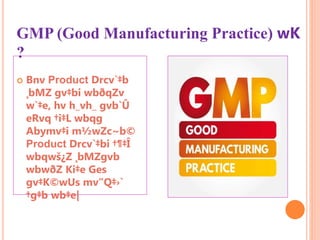
GMP (Good Manufacturing Practice) wK
?
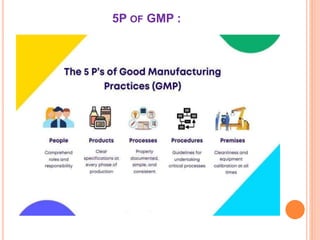
5P OF GMP :
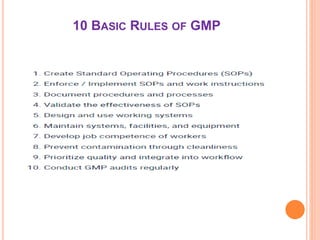
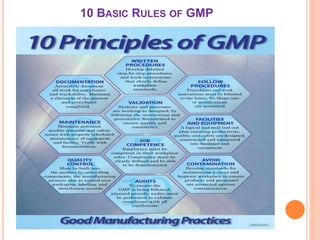
10 BASIC RULES OF GMP
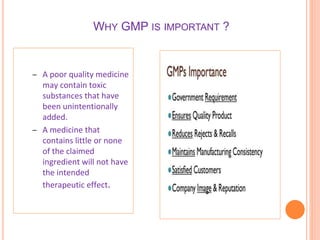
WHY GMP IS IMPORTANT ?
– A poor quality medicine
may contain toxic
substances that have
been unintentionally
added.
– A medicine that
contains little or none
of the claimed
ingredient will not have
the intended
therapeutic effect.
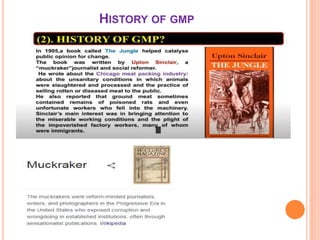
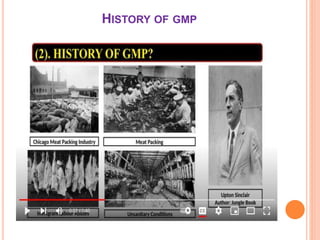
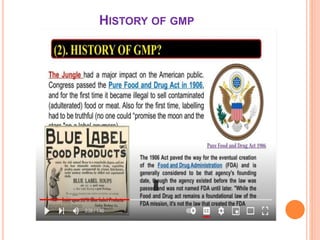
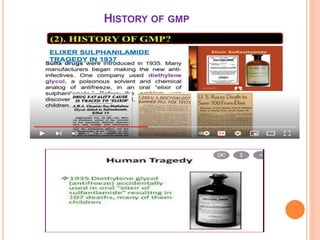
HISTORY OF GMP
HISTORY OF GMP
HISTORY OF GMP
HISTORY OF GMP
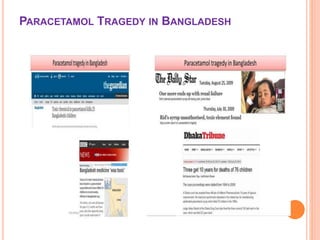
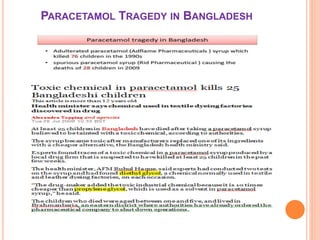
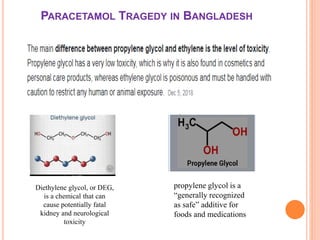
PARACETAMOL TRAGEDY IN BANGLADESH
propylene glycol is a
“generally recognized
as safe” additive for
foods and medications
Diethylene glycol, or DEG,
is a chemical that can
cause potentially fatal
kidney and neurological
toxicity
Some of the Main risks are
– unexpected contamination of products, causing
damage to health or even death.
– incorrect information on products, which could
mean that patients receive the wrong medicine.
– insufficient or too much active ingredient,
resulting in ineffective treatment or adverse
effects.
ROLE OF GMP:
 cÖ‡Z¨K Personnel ‡K Training ‡`qv|
 cÖwZwU area Ges equipments (mvR miÄvg ¸‡jv) cwi¯‹vi ivLv|
 Changeover Gi wbqg ¸‡jv h_vh_ fv‡e †g‡b Pjv|
 SOP (Standard operating procedure) Gi Aby‡gvw`Z Ges
cÖPwjZ Kvh©cÖbvjx †g‡b Pjv|
 Contamination (`~lb) Ges Cross contamination wbqš¿b Kiv|
ROLE OF GMP:
 mwVK BDwbdg© cwiavb Kiv Ges mwVK fv‡e WKz‡g‡›Ukb cyib
Kiv|
 Right Product/Materials, carton, Label, container e¨envi Kiv|
 Aby‡gvw`Z Ges Dchy³ Batch Documentation Abymib Kiv BZ¨vw`|
 House keeping Abymib Kiv
 Mix-up wbqš¿b Kiv|
 Cleaning (wK¬wbs)
 House keeping (N‡ii
hZœ/†MvQv‡bv)
 Changeover/‡PÄIfvi (cwieZ©b)
GMP Gi Ašif~³ wZbwU welq
eb©bv Kiv n‡jv:
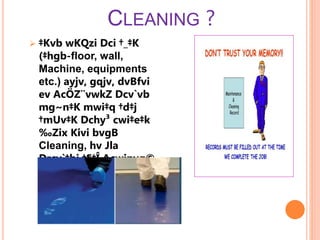
CLEANING ?
 ‡Kvb wKQzi Dci †_‡K
(‡hgb-floor, wall,
Machine, equipments
etc.) ayjv, gqjv, dvBfvi
ev AcÖZ¨vwkZ Dcv`vb
mg~n‡K mwi‡q †d‡j
†mUv‡K Dchy³ cwi‡e‡k
‰Zix Kivi bvgB
Cleaning, hv Jla
Drcv`‡bi †¶‡Î Acwinvq©
Ges GKUv MyiæZ¡c~Y©
Aa¨vq|
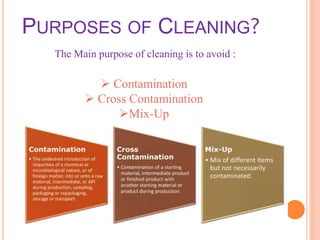
PURPOSES OF CLEANING?
The Main purpose of cleaning is to avoid :
 Contamination
 Cross Contamination
Mix-Up
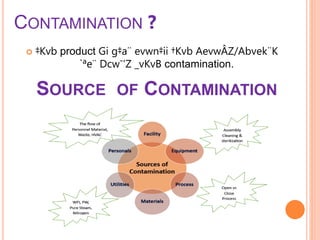
CONTAMINATION ?
 ‡Kvb product Gi g‡a¨ evwn‡ii †Kvb AevwÂZ/Abvek¨K
`ªe¨ Dcw¯’Z _vKvB contamination.
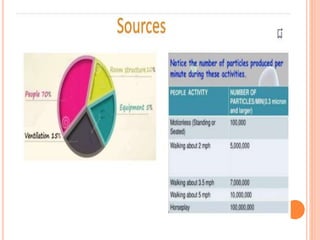
SOURCE OF CONTAMINATION
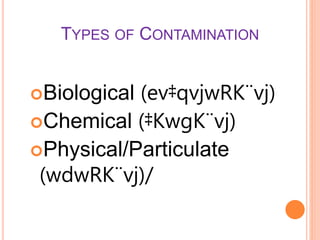
TYPES OF CONTAMINATION
Biological (ev‡qvjwRK¨vj)
Chemical (‡KwgK¨vj)
Physical/Particulate
(wdwRK¨vj)/
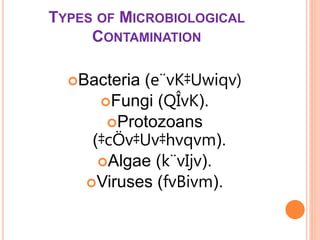
TYPES OF MICROBIOLOGICAL
CONTAMINATION
Bacteria (e¨vK‡Uwiqv)
Fungi (QÎvK).
Protozoans
(‡cÖv‡Uv‡hvqvm).
Algae (k¨vIjv).
Viruses (fvBivm).
TYPES OF CHEMICAL CONTAMINATION
Lubricants (jyweª‡K›Um)
Cleaning agents (wK¬wbs
G‡R›Um)
Toxic Metals (Uw·K †gUvjm)
Product Cross Contamination
(‡cvWv± µkKbUvwg‡bkb)
TYPES OF PARTICULATE CONTAMINATION
 dvBevi
 †gUvj
 Pzj
 Z¡K
 evwn‡ii wewfbœ iK‡gi e¯‘ ev `ªe¨
The People/machine-generated contaminant:
1.The human outer skin is completely shed every 24 hours.
2.Particles of 0.3 microns and greater are liberated at a rate
varying between 100000 to 10 million per minute.
3.A person while walking will liberate thousands of bacteria per
minute, and a single sneeze can produce up to 1 million bacteria.
4.The manufacturing process itself can generate contaminants,
for example, paint from equipment, dust from belt drives, etc.
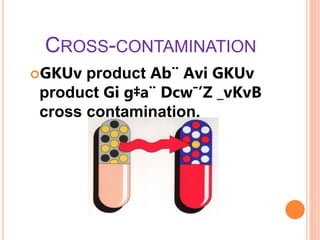
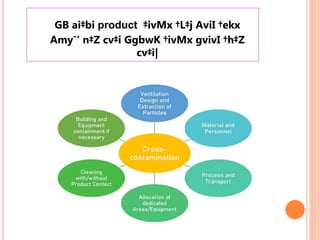
CROSS-CONTAMINATION
GKUv product Ab¨ Avi GKUv
product Gi g‡a¨ Dcw¯’Z _vKvB
cross contamination.
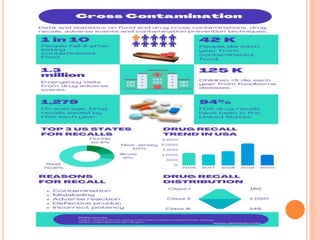
Cross contamination data that can make you nervous!
– According to WHO report on 20th April 2020, 1 in 10 people fall ill
after eating contaminated food worldwide.
– 420,000 people die every year from contaminated food that is a
combined loss of 33 million healthy life years.
– Children under the age of 5 years carry 40% of the foodborne
disease burden. Responsible for 125,000 deaths every year.
– According to the CDC, adverse drug events cause around 1.3
million emergency department visits per year. About 350,000 of
those patients need to be hospitalized.
– On average, FDA has issues 1,279 drug recalls every year.
Many of those due to cross contaminations.
– In 2019, the FDA publicly reprimanded 21 companies for cross-
contamination. 94% of FDA drug recalls have been in the United
States.
GB ai‡bi product ‡ivMx †L‡j AviI †ekx
Amy¯’ n‡Z cv‡i GgbwK †ivMx gvivI †h‡Z
cv‡i|
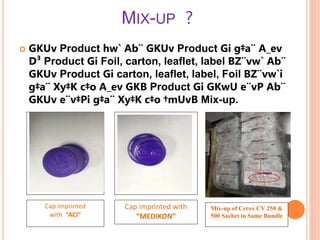
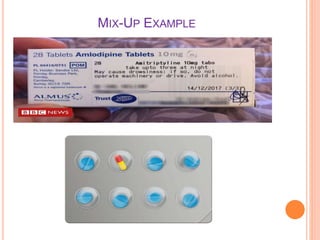
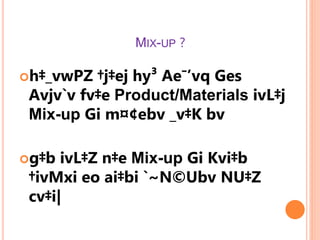
MIX-UP ?
 GKUv Product hw` Ab¨ GKUv Product Gi g‡a¨ A_ev
D³ Product Gi Foil, carton, leaflet, label BZ¨vw` Ab¨
GKUv Product Gi carton, leaflet, label, Foil BZ¨vw`i
g‡a¨ Xy‡K c‡o A_ev GKB Product Gi GKwU e¨vP Ab¨
GKUv e¨v‡Pi g‡a¨ Xy‡K c‡o †mUvB Mix-up.
Cap imprinted
with “ACI”
Cap imprinted with
“MEDIKON”
Mix-up of Cerox CV 250 &
500 Sachet in Same Bundle
MIX-UP EXAMPLE
MIX-UP ?
h‡_vwPZ †j‡ej hy³ Ae¯’vq Ges
Avjv`v fv‡e Product/Materials ivL‡j
Mix-up Gi m¤¢ebv _v‡K bv
g‡b ivL‡Z n‡e Mix-up Gi Kvi‡b
†ivMxi eo ai‡bi `~N©Ubv NU‡Z
cv‡i|
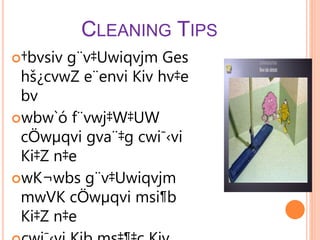
CLEANING TIPS
†bvsiv g¨v‡Uwiqvjm Ges
hš¿cvwZ e¨envi Kiv hv‡e
bv
wbw`ó f¨vwj‡W‡UW
cÖwµqvi gva¨‡g cwi¯‹vi
Ki‡Z n‡e
wK¬wbs g¨v‡Uwiqvjm
mwVK cÖwµqvi msi¶b
Ki‡Z n‡e
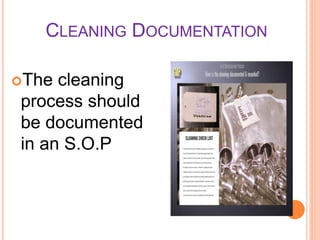
CLEANING DOCUMENTATION
The cleaning
process should
be documented
in an S.O.P
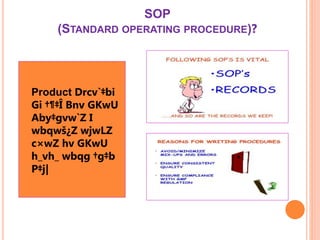
SOP
(STANDARD OPERATING PROCEDURE)?
 Product Drcv`‡bi
Gi †¶‡Î Bnv GKwU
Aby‡gvw`Z I
wbqwš¿Z wjwLZ
c×wZ hv GKwU
h_vh_ wbqg †g‡b
P‡j|
TYPES OF CLEANING PROCEDURES:
ïK‡bv Kvco Ges Dry mops e¨envi
K‡i|
Detergent wgwkªZ cvwb,
A¨vj‡Kvnj Ges cvwb e¨envi K‡i|
f¨vKzqvg Cleaning.
CLEANING AGENTS ?
‰Re : A¨vj‡Kvnj, Gwm‡Uvb,
Kve©b †UUªv‡K¬vivBW BZ¨vw`|
A‰Re : cvwb, Dilute GwmW,
wWUv‡R©›U BZ¨vw` |
CLEANING ?
 Operator Ges Operators helper :
Machine, equipments, machine related wRwbm ¸‡jv BZ¨vw`|
 Cleaner :
Floor, Wall, drum, bucket, Bowls, vessels etc.
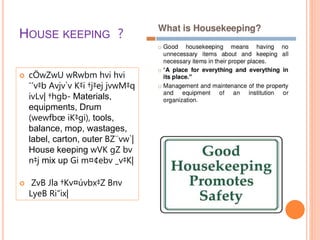
HOUSE KEEPING ?
 cÖwZwU wRwbm hvi hvi
¯’v‡b Avjv`v K‡i †j‡ej jvwM‡q
ivLv| †hgb- Materials,
equipments, Drum
(wewfbœ iK‡gi), tools,
balance, mop, wastages,
label, carton, outer BZ¨vw`|
House keeping wVK gZ bv
n‡j mix up Gi m¤¢ebv _v‡K|
 ZvB Jla †Kv¤úvbx‡Z Bnv
LyeB Ri“ix|
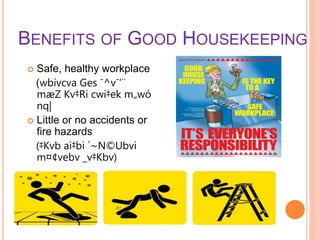
BENEFITS OF GOOD HOUSEKEEPING
 Safe, healthy workplace
(wbivcva Ges ¯^v¯’¨
mæZ Kv‡Ri cwi‡ek m„wó
nq|
 Little or no accidents or
fire hazards
(‡Kvb ai‡bi `~N©Ubvi
m¤¢vebv _v‡Kbv)
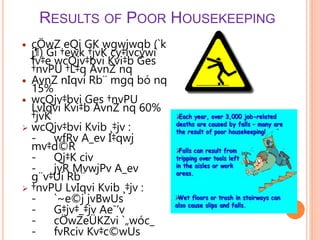
RESULTS OF POOR HOUSEKEEPING
 cÖwZ eQi GK wgwjwqb (`k
j¶) Gi †ewk †jvK cy‡ivcywi
fv‡e wcQjv‡bvi Kvi‡b Ges
†nvPU †L‡q AvnZ nq
 AvnZ nIqvi Rb¨ mgq bó nq
15%
 wcQjv‡bvi Ges †nvPU
LvIqvi Kvi‡b AvnZ nq 60%
†jvK
 wcQjv‡bvi Kvib ¸‡jv :
- wfRv A_ev I‡qwj
mv‡d©R
- Qj‡K civ
- jyR MvwjPv A_ev
g¨v‡Ui Rb¨
 †nvPU LvIqvi Kvib ¸‡jv :
- `~e©j jvBwUs
- G‡jv‡_‡jv Ae¯’v
- cÖwZeÜKZvi `„wóc_
- fvRciv Kv‡c©wUs
CHANGEOVER ?
 bZzb †Kvb Product manufacturing/packing/
compression/ encapsulation/filling/sealing/
coating ïi“ Kivi Av‡M D³ room/machine/
equipment/balance/floor fvjfv‡e cwi¯‹vi K‡i
Ges H i“‡gi Av‡Mi product Gi me wKQz mwi‡q w`‡q
bZzb product Gi hveZxq wRwbm G‡b KvR ïi“ Kivi
cÖ¯‘wZB n‡jv change over.
 Changeover n‡jv Jla †Kv¤úvbx‡Z AwZe ¸i“Z¡c~b© Aa¨vq
hvi cÖ‡qvRbxqZv Acwimxg|
CHANGE OVER?
-Removal of materials & documents of previous
product/batch.
 Cleaning according to SOP. (cwi”QbœZv)
- Fill up of changeover sheet & approval
 Checking of materials of next batch as--Materials
name
 Material code
 Expiry date
 Potency (if required)
CHANGE OVER ?
 Process sheet with batch no. & date
 Documentation
 Temperature & Humidity (if required)
 Recovery
 Operators dressing
 Display of product name, strength and
batch number
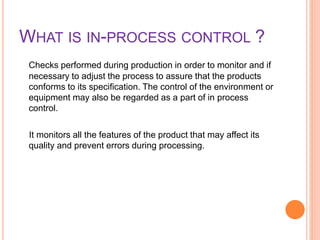
WHAT IS IN-PROCESS CONTROL ?
Checks performed during production in order to monitor and if
necessary to adjust the process to assure that the products
conforms to its specification. The control of the environment or
equipment may also be regarded as a part of in process
control.
It monitors all the features of the product that may affect its
quality and prevent errors during processing.
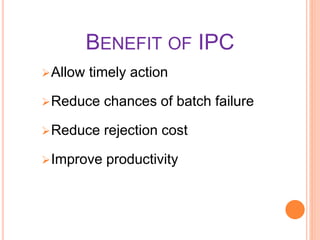
BENEFIT OF IPC
Allow timely action
Reduce chances of batch failure
Reduce rejection cost
Improve productivity
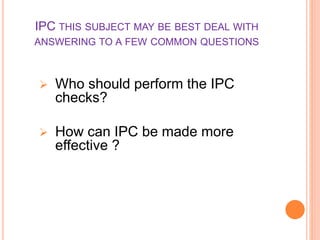
IPC THIS SUBJECT MAY BE BEST DEAL WITH
ANSWERING TO A FEW COMMON QUESTIONS
 Who should perform the IPC
checks?
 How can IPC be made more
effective ?
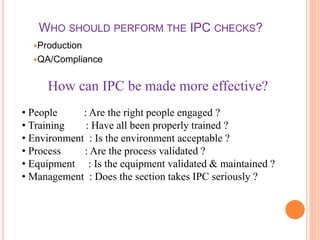
WHO SHOULD PERFORM THE IPC CHECKS?
Production
QA/Compliance
How can IPC be made more effective?
• People : Are the right people engaged ?
• Training : Have all been properly trained ?
• Environment : Is the environment acceptable ?
• Process : Are the process validated ?
• Equipment : Is the equipment validated & maintained ?
• Management : Does the section takes IPC seriously ?
BENEFIT TO FOLLOW GMP
 Quality product cvIqv hv‡e
 Batch failure Kg‡e
 Productivity evo‡e (Drcv`b ¶gZvi DbœwZ
n‡e)
 m‡e©v”Q ¸bMZ gvb AR©b Ki‡e
 Product Gi ¸bMZ gvb GKB _vK‡e
 Rejection Kg‡e d‡j cost Kg‡e
 wbivcËv evo‡e Ges SzwK iwnZ n‡e
 fvj GKUv Ae¯’vb Ẑix n‡e
Product Drcv`‡bi MybMZ gvb i¶v Kivi
`vwqZ¡
Avgv‡`i mevi| Avgv‡`i g‡b ivL‡Z n‡e
†Kv¤úvbx‡Z
Drcvw`Z Product ¸‡jv Avwg wb‡RI
†L‡Z cvwi,
Avgvi cwievi †L‡Z cv‡i Ges Avgvi
AvZ¥xq ¯^RbI
†L‡Z cv‡I A_©vr Avgv‡`i Aem¨B eyS‡Z
n‡e my¯’Zvi
GMP is the magic key that opens the
door of the Quality.
ANY
QUESTION
Basic Concept regarding Good Manufacturing Practice.ppt

Basic Concept regarding Good Manufacturing Practice.ppt

  • 1.
    BASIC GMP Presented By: Md.Mosaruf Hossan Deputy Production Manager
  • 2.
    GMP ?  GoodManufacturing Practice  Good Management Practice  Give more Production  Get More Profit
  • 3.
     Bnv ProductDrcv`‡b ¸bMZ gv‡bi wbðqZv w`‡e, hv h_vh_ gvb`Û eRvq †i‡L wbqg Abymv‡i m½wZc~b© Product Drcv`‡bi †¶‡Î wbqwš¿Z ¸bMZgvb wbwðZ Ki‡e Ges gv‡K©wUs mv”Q‡›` †g‡b wb‡e| GMP (Good Manufacturing Practice) wK ?
  • 4.
  • 5.
  • 6.
  • 7.
    WHY GMP ISIMPORTANT ? – A poor quality medicine may contain toxic substances that have been unintentionally added. – A medicine that contains little or none of the claimed ingredient will not have the intended therapeutic effect.
  • 8.
  • 9.
  • 10.
  • 11.
  • 12.
  • 13.
  • 14.
    PARACETAMOL TRAGEDY INBANGLADESH propylene glycol is a “generally recognized as safe” additive for foods and medications Diethylene glycol, or DEG, is a chemical that can cause potentially fatal kidney and neurological toxicity
  • 15.
    Some of theMain risks are – unexpected contamination of products, causing damage to health or even death. – incorrect information on products, which could mean that patients receive the wrong medicine. – insufficient or too much active ingredient, resulting in ineffective treatment or adverse effects.
  • 16.
    ROLE OF GMP: cÖ‡Z¨K Personnel ‡K Training ‡`qv|  cÖwZwU area Ges equipments (mvR miÄvg ¸‡jv) cwi¯‹vi ivLv|  Changeover Gi wbqg ¸‡jv h_vh_ fv‡e †g‡b Pjv|  SOP (Standard operating procedure) Gi Aby‡gvw`Z Ges cÖPwjZ Kvh©cÖbvjx †g‡b Pjv|  Contamination (`~lb) Ges Cross contamination wbqš¿b Kiv|
  • 17.
    ROLE OF GMP: mwVK BDwbdg© cwiavb Kiv Ges mwVK fv‡e WKz‡g‡›Ukb cyib Kiv|  Right Product/Materials, carton, Label, container e¨envi Kiv|  Aby‡gvw`Z Ges Dchy³ Batch Documentation Abymib Kiv BZ¨vw`|  House keeping Abymib Kiv  Mix-up wbqš¿b Kiv|
  • 18.
     Cleaning (wK¬wbs) House keeping (N‡ii hZœ/†MvQv‡bv)  Changeover/‡PÄIfvi (cwieZ©b) GMP Gi Ašif~³ wZbwU welq eb©bv Kiv n‡jv:
  • 19.
    CLEANING ?  ‡KvbwKQzi Dci †_‡K (‡hgb-floor, wall, Machine, equipments etc.) ayjv, gqjv, dvBfvi ev AcÖZ¨vwkZ Dcv`vb mg~n‡K mwi‡q †d‡j †mUv‡K Dchy³ cwi‡e‡k ‰Zix Kivi bvgB Cleaning, hv Jla Drcv`‡bi †¶‡Î Acwinvq© Ges GKUv MyiæZ¡c~Y© Aa¨vq|
  • 20.
    PURPOSES OF CLEANING? TheMain purpose of cleaning is to avoid :  Contamination  Cross Contamination Mix-Up
  • 21.
    CONTAMINATION ?  ‡Kvbproduct Gi g‡a¨ evwn‡ii †Kvb AevwÂZ/Abvek¨K `ªe¨ Dcw¯’Z _vKvB contamination. SOURCE OF CONTAMINATION
  • 23.
    TYPES OF CONTAMINATION Biological(ev‡qvjwRK¨vj) Chemical (‡KwgK¨vj) Physical/Particulate (wdwRK¨vj)/
  • 24.
    TYPES OF MICROBIOLOGICAL CONTAMINATION Bacteria(e¨vK‡Uwiqv) Fungi (QÎvK). Protozoans (‡cÖv‡Uv‡hvqvm). Algae (k¨vIjv). Viruses (fvBivm).
  • 25.
    TYPES OF CHEMICALCONTAMINATION Lubricants (jyweª‡K›Um) Cleaning agents (wK¬wbs G‡R›Um) Toxic Metals (Uw·K †gUvjm) Product Cross Contamination (‡cvWv± µkKbUvwg‡bkb)
  • 26.
    TYPES OF PARTICULATECONTAMINATION  dvBevi  †gUvj  Pzj  Z¡K  evwn‡ii wewfbœ iK‡gi e¯‘ ev `ªe¨ The People/machine-generated contaminant: 1.The human outer skin is completely shed every 24 hours. 2.Particles of 0.3 microns and greater are liberated at a rate varying between 100000 to 10 million per minute. 3.A person while walking will liberate thousands of bacteria per minute, and a single sneeze can produce up to 1 million bacteria. 4.The manufacturing process itself can generate contaminants, for example, paint from equipment, dust from belt drives, etc.
  • 27.
    CROSS-CONTAMINATION GKUv product Ab¨Avi GKUv product Gi g‡a¨ Dcw¯’Z _vKvB cross contamination.
  • 28.
    Cross contamination datathat can make you nervous! – According to WHO report on 20th April 2020, 1 in 10 people fall ill after eating contaminated food worldwide. – 420,000 people die every year from contaminated food that is a combined loss of 33 million healthy life years. – Children under the age of 5 years carry 40% of the foodborne disease burden. Responsible for 125,000 deaths every year. – According to the CDC, adverse drug events cause around 1.3 million emergency department visits per year. About 350,000 of those patients need to be hospitalized. – On average, FDA has issues 1,279 drug recalls every year. Many of those due to cross contaminations. – In 2019, the FDA publicly reprimanded 21 companies for cross- contamination. 94% of FDA drug recalls have been in the United States.
  • 30.
    GB ai‡bi product‡ivMx †L‡j AviI †ekx Amy¯’ n‡Z cv‡i GgbwK †ivMx gvivI †h‡Z cv‡i|
  • 32.
    MIX-UP ?  GKUvProduct hw` Ab¨ GKUv Product Gi g‡a¨ A_ev D³ Product Gi Foil, carton, leaflet, label BZ¨vw` Ab¨ GKUv Product Gi carton, leaflet, label, Foil BZ¨vw`i g‡a¨ Xy‡K c‡o A_ev GKB Product Gi GKwU e¨vP Ab¨ GKUv e¨v‡Pi g‡a¨ Xy‡K c‡o †mUvB Mix-up. Cap imprinted with “ACI” Cap imprinted with “MEDIKON” Mix-up of Cerox CV 250 & 500 Sachet in Same Bundle
  • 33.
  • 34.
    MIX-UP ? h‡_vwPZ †j‡ejhy³ Ae¯’vq Ges Avjv`v fv‡e Product/Materials ivL‡j Mix-up Gi m¤¢ebv _v‡K bv g‡b ivL‡Z n‡e Mix-up Gi Kvi‡b †ivMxi eo ai‡bi `~N©Ubv NU‡Z cv‡i|
  • 35.
    CLEANING TIPS †bvsiv g¨v‡UwiqvjmGes hš¿cvwZ e¨envi Kiv hv‡e bv wbw`ó f¨vwj‡W‡UW cÖwµqvi gva¨‡g cwi¯‹vi Ki‡Z n‡e wK¬wbs g¨v‡Uwiqvjm mwVK cÖwµqvi msi¶b Ki‡Z n‡e
  • 36.
    CLEANING DOCUMENTATION The cleaning processshould be documented in an S.O.P
  • 37.
    SOP (STANDARD OPERATING PROCEDURE)? Product Drcv`‡bi Gi †¶‡Î Bnv GKwU Aby‡gvw`Z I wbqwš¿Z wjwLZ c×wZ hv GKwU h_vh_ wbqg †g‡b P‡j|
  • 39.
    TYPES OF CLEANINGPROCEDURES: ïK‡bv Kvco Ges Dry mops e¨envi K‡i| Detergent wgwkªZ cvwb, A¨vj‡Kvnj Ges cvwb e¨envi K‡i| f¨vKzqvg Cleaning.
  • 40.
    CLEANING AGENTS ? ‰Re: A¨vj‡Kvnj, Gwm‡Uvb, Kve©b †UUªv‡K¬vivBW BZ¨vw`| A‰Re : cvwb, Dilute GwmW, wWUv‡R©›U BZ¨vw` |
  • 41.
    CLEANING ?  OperatorGes Operators helper : Machine, equipments, machine related wRwbm ¸‡jv BZ¨vw`|  Cleaner : Floor, Wall, drum, bucket, Bowls, vessels etc.
  • 42.
    HOUSE KEEPING ? cÖwZwU wRwbm hvi hvi ¯’v‡b Avjv`v K‡i †j‡ej jvwM‡q ivLv| †hgb- Materials, equipments, Drum (wewfbœ iK‡gi), tools, balance, mop, wastages, label, carton, outer BZ¨vw`| House keeping wVK gZ bv n‡j mix up Gi m¤¢ebv _v‡K|  ZvB Jla †Kv¤úvbx‡Z Bnv LyeB Ri“ix|
  • 43.
    BENEFITS OF GOODHOUSEKEEPING  Safe, healthy workplace (wbivcva Ges ¯^v¯’¨ mæZ Kv‡Ri cwi‡ek m„wó nq|  Little or no accidents or fire hazards (‡Kvb ai‡bi `~N©Ubvi m¤¢vebv _v‡Kbv)
  • 44.
    RESULTS OF POORHOUSEKEEPING  cÖwZ eQi GK wgwjwqb (`k j¶) Gi †ewk †jvK cy‡ivcywi fv‡e wcQjv‡bvi Kvi‡b Ges †nvPU †L‡q AvnZ nq  AvnZ nIqvi Rb¨ mgq bó nq 15%  wcQjv‡bvi Ges †nvPU LvIqvi Kvi‡b AvnZ nq 60% †jvK  wcQjv‡bvi Kvib ¸‡jv : - wfRv A_ev I‡qwj mv‡d©R - Qj‡K civ - jyR MvwjPv A_ev g¨v‡Ui Rb¨  †nvPU LvIqvi Kvib ¸‡jv : - `~e©j jvBwUs - G‡jv‡_‡jv Ae¯’v - cÖwZeÜKZvi `„wóc_ - fvRciv Kv‡c©wUs
  • 45.
    CHANGEOVER ?  bZzb†Kvb Product manufacturing/packing/ compression/ encapsulation/filling/sealing/ coating ïi“ Kivi Av‡M D³ room/machine/ equipment/balance/floor fvjfv‡e cwi¯‹vi K‡i Ges H i“‡gi Av‡Mi product Gi me wKQz mwi‡q w`‡q bZzb product Gi hveZxq wRwbm G‡b KvR ïi“ Kivi cÖ¯‘wZB n‡jv change over.  Changeover n‡jv Jla †Kv¤úvbx‡Z AwZe ¸i“Z¡c~b© Aa¨vq hvi cÖ‡qvRbxqZv Acwimxg|
  • 46.
    CHANGE OVER? -Removal ofmaterials & documents of previous product/batch.  Cleaning according to SOP. (cwi”QbœZv) - Fill up of changeover sheet & approval  Checking of materials of next batch as--Materials name  Material code  Expiry date  Potency (if required)
  • 47.
    CHANGE OVER ? Process sheet with batch no. & date  Documentation  Temperature & Humidity (if required)  Recovery  Operators dressing  Display of product name, strength and batch number
  • 48.
    WHAT IS IN-PROCESSCONTROL ? Checks performed during production in order to monitor and if necessary to adjust the process to assure that the products conforms to its specification. The control of the environment or equipment may also be regarded as a part of in process control. It monitors all the features of the product that may affect its quality and prevent errors during processing.
  • 49.
    BENEFIT OF IPC Allowtimely action Reduce chances of batch failure Reduce rejection cost Improve productivity
  • 50.
    IPC THIS SUBJECTMAY BE BEST DEAL WITH ANSWERING TO A FEW COMMON QUESTIONS  Who should perform the IPC checks?  How can IPC be made more effective ?
  • 51.
    WHO SHOULD PERFORMTHE IPC CHECKS? Production QA/Compliance How can IPC be made more effective? • People : Are the right people engaged ? • Training : Have all been properly trained ? • Environment : Is the environment acceptable ? • Process : Are the process validated ? • Equipment : Is the equipment validated & maintained ? • Management : Does the section takes IPC seriously ?
  • 52.
    BENEFIT TO FOLLOWGMP  Quality product cvIqv hv‡e  Batch failure Kg‡e  Productivity evo‡e (Drcv`b ¶gZvi DbœwZ n‡e)  m‡e©v”Q ¸bMZ gvb AR©b Ki‡e  Product Gi ¸bMZ gvb GKB _vK‡e  Rejection Kg‡e d‡j cost Kg‡e  wbivcËv evo‡e Ges SzwK iwnZ n‡e  fvj GKUv Ae¯’vb Ẑix n‡e
  • 53.
    Product Drcv`‡bi MybMZgvb i¶v Kivi `vwqZ¡ Avgv‡`i mevi| Avgv‡`i g‡b ivL‡Z n‡e †Kv¤úvbx‡Z Drcvw`Z Product ¸‡jv Avwg wb‡RI †L‡Z cvwi, Avgvi cwievi †L‡Z cv‡i Ges Avgvi AvZ¥xq ¯^RbI †L‡Z cv‡I A_©vr Avgv‡`i Aem¨B eyS‡Z n‡e my¯’Zvi
  • 55.
    GMP is themagic key that opens the door of the Quality. ANY QUESTION