FOOD MANUFACTURING
PRACTICES
Food Processing NC II
1:Good Manufacturing
Practices (GMP)
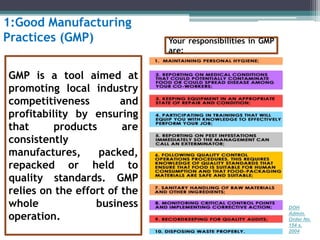
GMP is a tool aimed at
promoting local industry
competitiveness and
profitability by ensuring
that products are
consistently
manufactures, packed,
repacked or held to
quality standards. GMP
relies on the effort of the
whole business
operation.
Your responsibilities in GMP
are:
DOH
Admin.
Order No.
154 s.
2004
2: Occupational Safety and Health
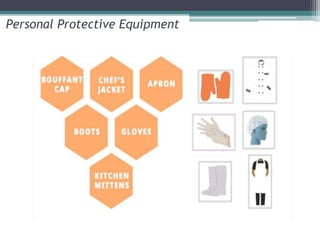
Personal Protective Equipment
Proper Handling of Cutting
Tools
• Identify the right cutting tool for the job.
• Handle cutting tools with care. Knives can
break and cause an accident in the workplace.
• Keep knives sharp. This will require less effort
to cut through food.
• When carrying a knife from one section to
another, hold the knife pointing down at your
side with the sharp edge facing behind
you. Let others know that you are passing by
with a sharp object.
• Always use a chopping board.
• Store knives properly.
Fire Safety
The following are the measures you can take to
ensure fire safety:
Inspect wires, plugs, gas range, and other
equipment on a regular basis.
Extinguish the fire! Pull pin. Aim at the base.
Squeeze handle. Sweep from side to side.
Not all fires are the same. Use the right Class of
fire extinguisher for every type of fire.
▫ Class A - ordinary combustibles such as wood and
paper
▫ Class B - combustible liquids and gases such as
alcohol, LPG, grease
▫ Class C - electrical fire
▫ Class D - combustible metals such as aluminum
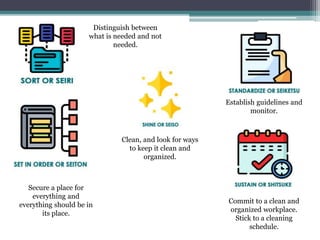
3: 5S of Good Housekeeping
5S of Good Housekeeping is another
management approach for productivity
and quality that focuses on maintaining
orderliness and cleanliness in the
workplace. It is derived from the
Japanese words:
seiri, seiton, seiso,
seiketsu, and shitsuke.
Distinguish between
what is needed and not
needed.
Clean, and look for ways
to keep it clean and
organized.
Secure a place for
everything and
everything should be in
its place.
Establish guidelines and
monitor.
Commit to a clean and
organized workplace.
Stick to a cleaning
schedule.
4: Cleaning and Sanitizing
Equipment, Tools, and Utensils
Keeping things clean in the workplace
prevents food spoilage and the spread of food-
borne diseases. By cleaning and sanitizing
equipment, tools, and utensils, you can ensure
the safety of the food being handled as well as
the safety of those working in the area.
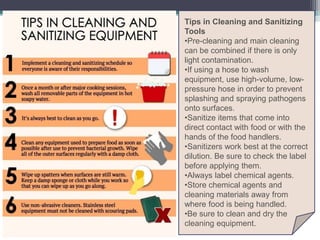
Tips in Cleaning and Sanitizing
Tools
•Pre-cleaning and main cleaning
can be combined if there is only
light contamination.
•If using a hose to wash
equipment, use high-volume, low-
pressure hose in order to prevent
splashing and spraying pathogens
onto surfaces.
•Sanitize items that come into
direct contact with food or with the
hands of the food handlers.
•Sanitizers work best at the correct
dilution. Be sure to check the label
before applying them.
•Always label chemical agents.
•Store chemical agents and
cleaning materials away from
where food is being handled.
•Be sure to clean and dry the
cleaning equipment.
Cleaning
Cleaning means to remove unnecessary and
unpleasant matter like garbage, food waste,
and grease.
Cleaning equipment differs from cleaning tools and
utensils. Equipment is usually bigger and involves
electrical wiring.
It is always best to refer to the manufacturer’s
instructions when cleaning and sanitizing
equipment. However, there are general rules that
must be observed when cleaning equipment:
• Make sure that the power is turned off and power
cords are unplugged.
• Gas equipment should be turned off.
• Proper protective clothing must be worn when
cleaning equipment that deals with chemicals.
• Ventilation should be provided.
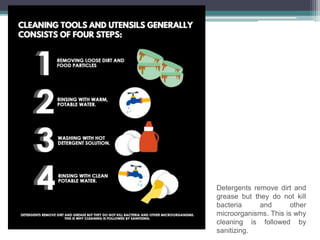
Detergents remove dirt and
grease but they do not kill
bacteria and other
microorganisms. This is why
cleaning is followed by
sanitizing.
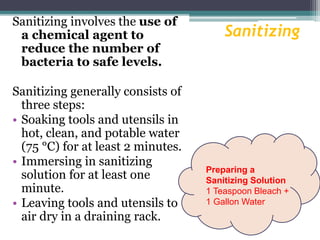
Sanitizing
Sanitizing involves the use of
a chemical agent to
reduce the number of
bacteria to safe levels.
Sanitizing generally consists of
three steps:
• Soaking tools and utensils in
hot, clean, and potable water
(75 °C) for at least 2 minutes.
• Immersing in sanitizing
solution for at least one
minute.
• Leaving tools and utensils to
air dry in a draining rack.
Preparing a
Sanitizing Solution
1 Teaspoon Bleach +
1 Gallon Water
5: Proper Waste Disposal
Solid Waste Segregation
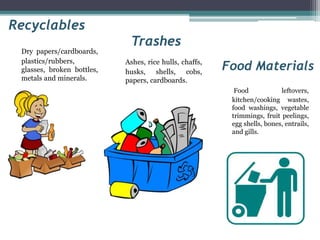
Waste/Refuse should be separated as:
• Recyclables
• Trashes
• Food Materials
Dry papers/cardboards,
plastics/rubbers,
glasses, broken bottles,
metals and minerals.
Recyclables
Trashes
Ashes, rice hulls, chaffs,
husks, shells, cobs,
papers, cardboards.
Food Materials
Food leftovers,
kitchen/cooking wastes,
food washings, vegetable
trimmings, fruit peelings,
egg shells, bones, entrails,
and gills.
Chemical waste is any solid, liquid, gaseous matter
that when improperly managed or disposed of may
pose harmful effects on the environment and to
the surrounding community. Examples:
• Used oil
• Contaminated syringe
• Denatured alcohol
• Industrial cleaners
• Pesticides
• Batteries
• Degreasing solvents
Chemical Waste Management
1. Identify the type of
chemical waste.
2. Select appropriate
container.
3. Label chemical waste.
Include chemical name,
quantity, the date the waste
was generated, place of
origin (what part of the
production line, room
number), assigned
personnel. For mixtures,
include each chemical along
with their weight or
volume.
4. Store in appropriate
cabinets and wait for the
Pollution Control Officer to
collect.
How to
dispose of
chemical
waste?
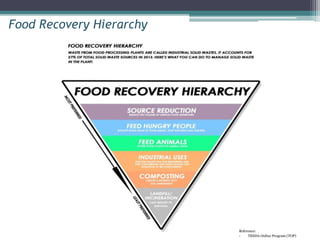
Food Recovery Hierarchy
Reference:
• TESDA Online Program (TOP)
Food Manufacturing Practices

Food Manufacturing Practices

  • 1.
  • 2.
    1:Good Manufacturing Practices (GMP) GMPis a tool aimed at promoting local industry competitiveness and profitability by ensuring that products are consistently manufactures, packed, repacked or held to quality standards. GMP relies on the effort of the whole business operation. Your responsibilities in GMP are: DOH Admin. Order No. 154 s. 2004
  • 3.
  • 4.
  • 5.
    Proper Handling ofCutting Tools • Identify the right cutting tool for the job. • Handle cutting tools with care. Knives can break and cause an accident in the workplace. • Keep knives sharp. This will require less effort to cut through food. • When carrying a knife from one section to another, hold the knife pointing down at your side with the sharp edge facing behind you. Let others know that you are passing by with a sharp object. • Always use a chopping board. • Store knives properly.
  • 6.
    Fire Safety The followingare the measures you can take to ensure fire safety: Inspect wires, plugs, gas range, and other equipment on a regular basis. Extinguish the fire! Pull pin. Aim at the base. Squeeze handle. Sweep from side to side. Not all fires are the same. Use the right Class of fire extinguisher for every type of fire. ▫ Class A - ordinary combustibles such as wood and paper ▫ Class B - combustible liquids and gases such as alcohol, LPG, grease ▫ Class C - electrical fire ▫ Class D - combustible metals such as aluminum
  • 7.
    3: 5S ofGood Housekeeping 5S of Good Housekeeping is another management approach for productivity and quality that focuses on maintaining orderliness and cleanliness in the workplace. It is derived from the Japanese words: seiri, seiton, seiso, seiketsu, and shitsuke.
  • 8.
    Distinguish between what isneeded and not needed. Clean, and look for ways to keep it clean and organized. Secure a place for everything and everything should be in its place. Establish guidelines and monitor. Commit to a clean and organized workplace. Stick to a cleaning schedule.
  • 9.
    4: Cleaning andSanitizing Equipment, Tools, and Utensils Keeping things clean in the workplace prevents food spoilage and the spread of food- borne diseases. By cleaning and sanitizing equipment, tools, and utensils, you can ensure the safety of the food being handled as well as the safety of those working in the area.
  • 10.
    Tips in Cleaningand Sanitizing Tools •Pre-cleaning and main cleaning can be combined if there is only light contamination. •If using a hose to wash equipment, use high-volume, low- pressure hose in order to prevent splashing and spraying pathogens onto surfaces. •Sanitize items that come into direct contact with food or with the hands of the food handlers. •Sanitizers work best at the correct dilution. Be sure to check the label before applying them. •Always label chemical agents. •Store chemical agents and cleaning materials away from where food is being handled. •Be sure to clean and dry the cleaning equipment.
  • 11.
    Cleaning Cleaning means toremove unnecessary and unpleasant matter like garbage, food waste, and grease. Cleaning equipment differs from cleaning tools and utensils. Equipment is usually bigger and involves electrical wiring. It is always best to refer to the manufacturer’s instructions when cleaning and sanitizing equipment. However, there are general rules that must be observed when cleaning equipment: • Make sure that the power is turned off and power cords are unplugged. • Gas equipment should be turned off. • Proper protective clothing must be worn when cleaning equipment that deals with chemicals. • Ventilation should be provided.
  • 12.
    Detergents remove dirtand grease but they do not kill bacteria and other microorganisms. This is why cleaning is followed by sanitizing.
  • 13.
    Sanitizing Sanitizing involves theuse of a chemical agent to reduce the number of bacteria to safe levels. Sanitizing generally consists of three steps: • Soaking tools and utensils in hot, clean, and potable water (75 °C) for at least 2 minutes. • Immersing in sanitizing solution for at least one minute. • Leaving tools and utensils to air dry in a draining rack. Preparing a Sanitizing Solution 1 Teaspoon Bleach + 1 Gallon Water
  • 14.
    5: Proper WasteDisposal Solid Waste Segregation Waste/Refuse should be separated as: • Recyclables • Trashes • Food Materials
  • 15.
    Dry papers/cardboards, plastics/rubbers, glasses, brokenbottles, metals and minerals. Recyclables Trashes Ashes, rice hulls, chaffs, husks, shells, cobs, papers, cardboards. Food Materials Food leftovers, kitchen/cooking wastes, food washings, vegetable trimmings, fruit peelings, egg shells, bones, entrails, and gills.
  • 16.
    Chemical waste isany solid, liquid, gaseous matter that when improperly managed or disposed of may pose harmful effects on the environment and to the surrounding community. Examples: • Used oil • Contaminated syringe • Denatured alcohol • Industrial cleaners • Pesticides • Batteries • Degreasing solvents Chemical Waste Management
  • 17.
    1. Identify thetype of chemical waste. 2. Select appropriate container. 3. Label chemical waste. Include chemical name, quantity, the date the waste was generated, place of origin (what part of the production line, room number), assigned personnel. For mixtures, include each chemical along with their weight or volume. 4. Store in appropriate cabinets and wait for the Pollution Control Officer to collect. How to dispose of chemical waste?
  • 18.
    Food Recovery Hierarchy Reference: •TESDA Online Program (TOP)