Basic Concept of
microbiology


 Microbiology can also divided into different branch like..
1. Virology – study of viruses
2. Bacteriology – Study of Bacteria
3. Mycology – Study of Fungi
4. immunology – Study of immunity
5. Biotechnology
6. Phycology – Study of Algae
7. Genetic – Study of Genes
8. Industrial microbiology
9. Environmental microbiology
10. soil microbiology
11. Food microbiology
All of are describe on the basis of Study…
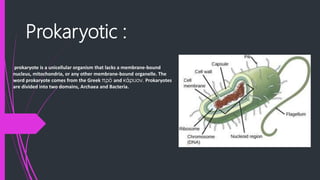
Prokaryotic :
prokaryote is a unicellular organism that lacks a membrane-bound
nucleus, mitochondria, or any other membrane-bound organelle. The
word prokaryote comes from the Greek πρό and κάρυον. Prokaryotes
are divided into two domains, Archaea and Bacteria.
characteristics of prokaryotic

1. Membrane bound cell organelles such as Mitochondria, Golgi apparatus,
Chloroplasts are absent.
2. A membrane bound well defined nucleus is absent.
3. Genetic material is circular DNA and occurs naked in the cell cytoplasm. It is
attached to the cell membrane and called nucleoid.
4. The cell size ranges from 0.1 to 5.0 micrometer in size.
5. The cell wall is a rigid structure which is made up of polysaccharides.
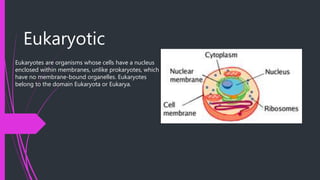
Eukaryotic
Eukaryotes are organisms whose cells have a nucleus
enclosed within membranes, unlike prokaryotes, which
have no membrane-bound organelles. Eukaryotes
belong to the domain Eukaryota or Eukarya.
Characteristics of Eukaryotic
1. Eukaryotic cells have the nucleus enclosed within the nuclear membrane.
2. The cell has mitochondria.
3. Flagella and cilia are the locomotory organs in a eukaryotic cell.
4. A cell wall is the outermost layer of the eukaryotic cells.
5. The cells divide by a process called mitosis.
6. The eukaryotic cells contain a cytoskeletal structure.
7. The nucleus contains a single, linear DNA, which carries all the genetic information
Bacteria
 Bacteria are individual living cells
 Characteristics of Bacteria
 Bacteria are the most successful organisms on the planet. They lived on this
planet for two billion years before the first eukaryotes and, during that time,
evolved into millions of different species
 Size and Shape
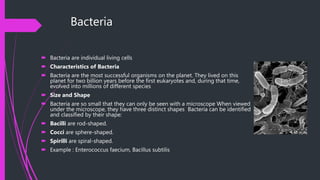
 Bacteria are so small that they can only be seen with a microscope When viewed
under the microscope, they have three distinct shapes Bacteria can be identified
and classified by their shape:
 Bacilli are rod-shaped.
 Cocci are sphere-shaped.
 Spirilli are spiral-shaped.
 Example : Enterococcus faecium, Bacillus subtilis
Virus
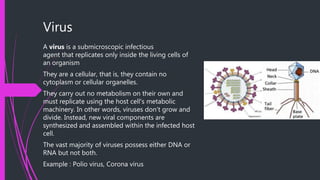
A virus is a submicroscopic infectious
agent that replicates only inside the living cells of
an organism
They are a cellular, that is, they contain no
cytoplasm or cellular organelles.
They carry out no metabolism on their own and
must replicate using the host cell's metabolic
machinery. In other words, viruses don't grow and
divide. Instead, new viral components are
synthesized and assembled within the infected host
cell.
The vast majority of viruses possess either DNA or
RNA but not both.
Example : Polio virus, Corona virus
Fungi
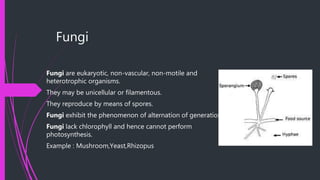
Fungi are eukaryotic, non-vascular, non-motile and
heterotrophic organisms.
They may be unicellular or filamentous.
They reproduce by means of spores.
Fungi exhibit the phenomenon of alternation of generation.
Fungi lack chlorophyll and hence cannot perform
photosynthesis.
Example : Mushroom,Yeast,Rhizopus
Algae
Algae are eukaryotic organisms that have no roots,
stems, or leaves but do have chlorophyll and other
pigments for carrying out photosynthesis. Algae can be
multicellular or unicellular. Unicellular algae occur most
frequently in water, especially in plankton.
Example : Spirogyra,Clodophora
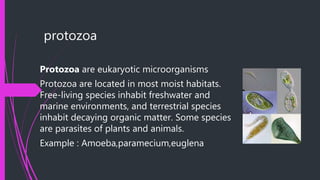
protozoa
Protozoa are eukaryotic microorganisms
Protozoa are located in most moist habitats.
Free-living species inhabit freshwater and
marine environments, and terrestrial species
inhabit decaying organic matter. Some species
are parasites of plants and animals.
Example : Amoeba,paramecium,euglena

Basic concept of microbiology

  • 1.
  • 2.
  • 3.
     Microbiology canalso divided into different branch like.. 1. Virology – study of viruses 2. Bacteriology – Study of Bacteria 3. Mycology – Study of Fungi 4. immunology – Study of immunity 5. Biotechnology 6. Phycology – Study of Algae 7. Genetic – Study of Genes 8. Industrial microbiology 9. Environmental microbiology 10. soil microbiology 11. Food microbiology All of are describe on the basis of Study…
  • 4.
    Prokaryotic : prokaryote isa unicellular organism that lacks a membrane-bound nucleus, mitochondria, or any other membrane-bound organelle. The word prokaryote comes from the Greek πρό and κάρυον. Prokaryotes are divided into two domains, Archaea and Bacteria.
  • 5.
    characteristics of prokaryotic  1.Membrane bound cell organelles such as Mitochondria, Golgi apparatus, Chloroplasts are absent. 2. A membrane bound well defined nucleus is absent. 3. Genetic material is circular DNA and occurs naked in the cell cytoplasm. It is attached to the cell membrane and called nucleoid. 4. The cell size ranges from 0.1 to 5.0 micrometer in size. 5. The cell wall is a rigid structure which is made up of polysaccharides.
  • 6.
    Eukaryotic Eukaryotes are organismswhose cells have a nucleus enclosed within membranes, unlike prokaryotes, which have no membrane-bound organelles. Eukaryotes belong to the domain Eukaryota or Eukarya.
  • 7.
    Characteristics of Eukaryotic 1.Eukaryotic cells have the nucleus enclosed within the nuclear membrane. 2. The cell has mitochondria. 3. Flagella and cilia are the locomotory organs in a eukaryotic cell. 4. A cell wall is the outermost layer of the eukaryotic cells. 5. The cells divide by a process called mitosis. 6. The eukaryotic cells contain a cytoskeletal structure. 7. The nucleus contains a single, linear DNA, which carries all the genetic information
  • 8.
    Bacteria  Bacteria areindividual living cells  Characteristics of Bacteria  Bacteria are the most successful organisms on the planet. They lived on this planet for two billion years before the first eukaryotes and, during that time, evolved into millions of different species  Size and Shape  Bacteria are so small that they can only be seen with a microscope When viewed under the microscope, they have three distinct shapes Bacteria can be identified and classified by their shape:  Bacilli are rod-shaped.  Cocci are sphere-shaped.  Spirilli are spiral-shaped.  Example : Enterococcus faecium, Bacillus subtilis
  • 9.
    Virus A virus isa submicroscopic infectious agent that replicates only inside the living cells of an organism They are a cellular, that is, they contain no cytoplasm or cellular organelles. They carry out no metabolism on their own and must replicate using the host cell's metabolic machinery. In other words, viruses don't grow and divide. Instead, new viral components are synthesized and assembled within the infected host cell. The vast majority of viruses possess either DNA or RNA but not both. Example : Polio virus, Corona virus
  • 10.
    Fungi Fungi are eukaryotic,non-vascular, non-motile and heterotrophic organisms. They may be unicellular or filamentous. They reproduce by means of spores. Fungi exhibit the phenomenon of alternation of generation. Fungi lack chlorophyll and hence cannot perform photosynthesis. Example : Mushroom,Yeast,Rhizopus
  • 11.
    Algae Algae are eukaryoticorganisms that have no roots, stems, or leaves but do have chlorophyll and other pigments for carrying out photosynthesis. Algae can be multicellular or unicellular. Unicellular algae occur most frequently in water, especially in plankton. Example : Spirogyra,Clodophora
  • 12.
    protozoa Protozoa are eukaryoticmicroorganisms Protozoa are located in most moist habitats. Free-living species inhabit freshwater and marine environments, and terrestrial species inhabit decaying organic matter. Some species are parasites of plants and animals. Example : Amoeba,paramecium,euglena