CHAPTER 2 
Overview of Business Processes
INTRODUCTION 
• Questions to be addressed in this chapter include: 
– What are the basic business activities in which an 
organization engages? 
• What decisions must be made to undertake these activities? 
• What information is required to make those decisions? 
– What role does the data processing cycle play in organizing 
business activities and providing information to users? 
– What is the role of the information system and enterprise 
resource planning in modern organizations? 
10/18/2014 2
INFORMATION NEEDS AND BUSINESS 
ACTIVITIES 
• Businesses engage in a variety of activities, including: 
– Acquiring capital 
– Buying buildings and equipment 
– Hiring and training employees 
– Purchasing inventory 
– Doing advertising and marketing 
– Selling goods or services 
– Collecting payment from customers 
– Paying employees 
– Paying taxes 
– Paying vendors 
Each activity 
requires different 
types of decisions! 
10/18/2014 3
INFORMATION NEEDS AND 
BUSINESS ACTIVITIES 
• Businesses engage in a variety of activities, 
including: 
– Acquiring capital 
– Buying buildings and equipment 
– Hiring and training employees 
– Purchasing inventory 
– Doing advertising and marketing 
– Selling goods or services 
– Collecting payment from customers 
– Paying employees 
– Paying taxes 
– Paying vendors 
Each decision 
requires different 
types of information. 
10/18/2014 4
INFORMATION NEEDS AND 
BUSINESS ACTIVITIES 
• Types of information needed for decisions: 
– Some is financial 
– Some is nonfinancial 
– Some comes from internal sources 
– Some comes from external sources 
• An effective AIS needs to be able to integrate 
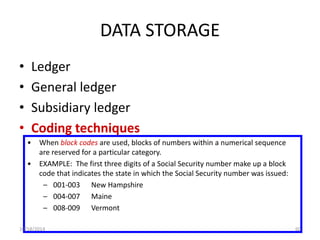
information of different types and from 
different sources. 
10/18/2014 5
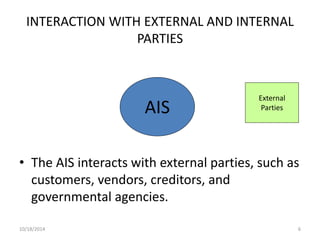
INTERACTION WITH EXTERNAL AND INTERNAL 
PARTIES 
AIS 
External 
Parties 
• The AIS interacts with external parties, such as 
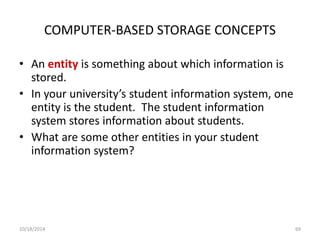
customers, vendors, creditors, and 
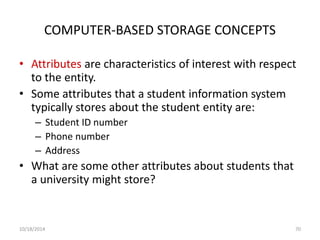
governmental agencies. 
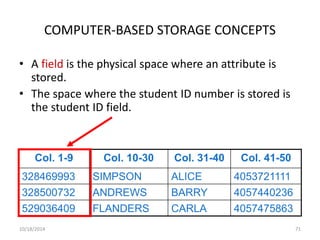
10/18/2014 6
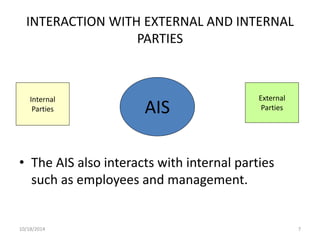
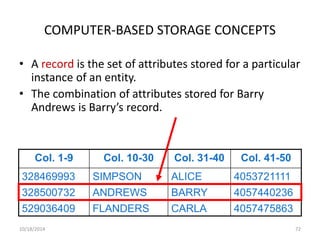
INTERACTION WITH EXTERNAL AND INTERNAL 
PARTIES 
Internal 
Parties 
AIS External 
Parties 
• The AIS also interacts with internal parties 
such as employees and management. 
10/18/2014 7
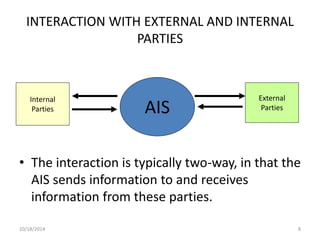
INTERACTION WITH EXTERNAL AND INTERNAL 
PARTIES 
Internal 
Parties 
AIS External 
Parties 
• The interaction is typically two-way, in that the 
AIS sends information to and receives 
information from these parties. 
10/18/2014 8
BUSINESS CYCLES 
• A transaction is: 
– An agreement between two entities to exchange 
goods or services; OR 
– Any other event that can be measured in economic 
terms by an organization. 
• EXAMPLES: 
– Sell goods to customers 
– Depreciate equipment 
10/18/2014 9
BUSINESS CYCLES 
• The transaction cycle is a process: 
– Begins with capturing data about a transaction 
– Ends with an information output, such as financial 
statements 
10/18/2014 10
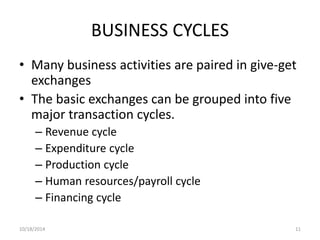
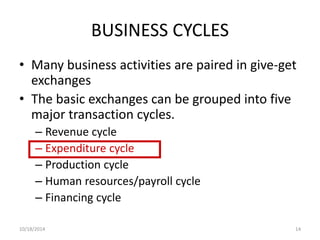
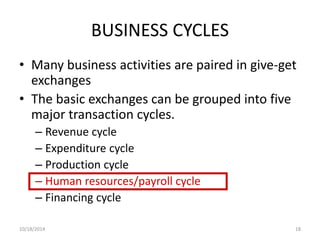
BUSINESS CYCLES 
• Many business activities are paired in give-get 
exchanges 
• The basic exchanges can be grouped into five 
major transaction cycles. 
– Revenue cycle 
– Expenditure cycle 
– Production cycle 
– Human resources/payroll cycle 
– Financing cycle 
10/18/2014 11
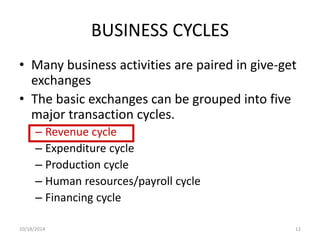
BUSINESS CYCLES 
• Many business activities are paired in give-get 
exchanges 
• The basic exchanges can be grouped into five 
major transaction cycles. 
– Revenue cycle 
– Expenditure cycle 
– Production cycle 
– Human resources/payroll cycle 
– Financing cycle 
10/18/2014 12
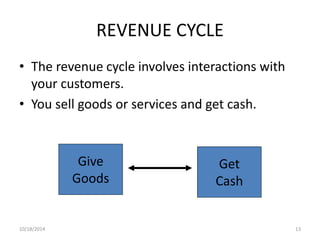
REVENUE CYCLE 
• The revenue cycle involves interactions with 
your customers. 
• You sell goods or services and get cash. 
Give 
Goods 
Get 
Cash 
10/18/2014 13
BUSINESS CYCLES 
• Many business activities are paired in give-get 
exchanges 
• The basic exchanges can be grouped into five 
major transaction cycles. 
– Revenue cycle 
– Expenditure cycle 
– Production cycle 
– Human resources/payroll cycle 
– Financing cycle 
10/18/2014 14
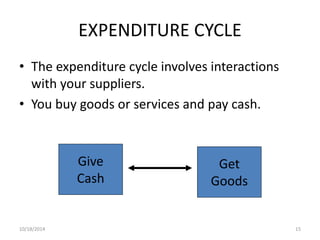
EXPENDITURE CYCLE 
• The expenditure cycle involves interactions 
with your suppliers. 
• You buy goods or services and pay cash. 
Give 
Cash 
Get 
Goods 
10/18/2014 15
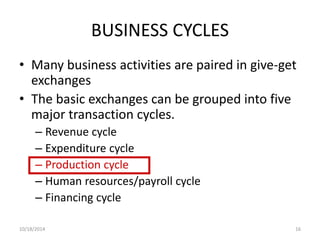
BUSINESS CYCLES 
• Many business activities are paired in give-get 
exchanges 
• The basic exchanges can be grouped into five 
major transaction cycles. 
– Revenue cycle 
– Expenditure cycle 
– Production cycle 
– Human resources/payroll cycle 
– Financing cycle 
10/18/2014 16
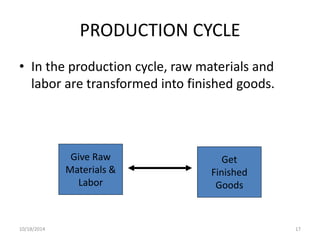
PRODUCTION CYCLE 
• In the production cycle, raw materials and 
labor are transformed into finished goods. 
Give Raw 
Materials & 
Labor 
Get 
Finished 
Goods 
10/18/2014 17
BUSINESS CYCLES 
• Many business activities are paired in give-get 
exchanges 
• The basic exchanges can be grouped into five 
major transaction cycles. 
– Revenue cycle 
– Expenditure cycle 
– Production cycle 
– Human resources/payroll cycle 
– Financing cycle 
10/18/2014 18
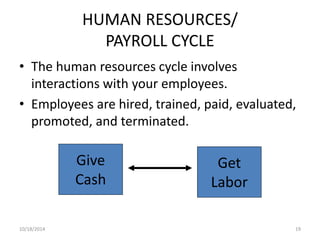
HUMAN RESOURCES/ 
PAYROLL CYCLE 
• The human resources cycle involves 
interactions with your employees. 
• Employees are hired, trained, paid, evaluated, 
promoted, and terminated. 
Give 
Cash 
Get 
Labor 
10/18/2014 19
BUSINESS CYCLES 
• Many business activities are paired in give-get 
exchanges 
• The basic exchanges can be grouped into five 
major transaction cycles. 
– Revenue cycle 
– Expenditure cycle 
– Production cycle 
– Human resources/payroll cycle 
– Financing cycle 
10/18/2014 20
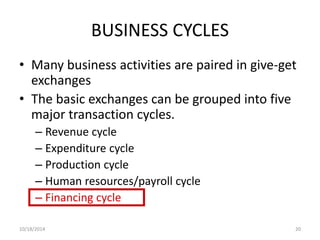
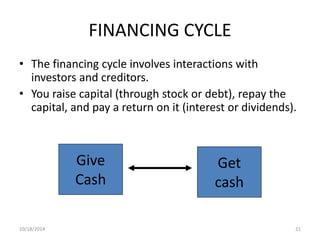
FINANCING CYCLE 
• The financing cycle involves interactions with 
investors and creditors. 
• You raise capital (through stock or debt), repay the 
capital, and pay a return on it (interest or dividends). 
Give 
Cash 
Get 
cash 
10/18/2014 21
BUSINESS CYCLES 
• Thousands of transactions can occur within 
any of these cycles. 
• But there are relatively few types of 
transactions in a cycle. 
10/18/2014 22
BUSINESS CYCLES 
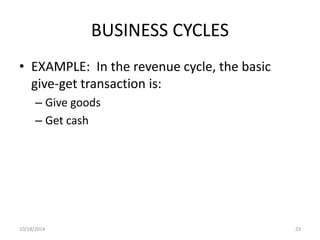
• EXAMPLE: In the revenue cycle, the basic 
give-get transaction is: 
– Give goods 
– Get cash 
10/18/2014 23
BUSINESS CYCLES 
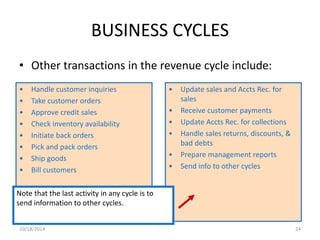
• Other transactions in the revenue cycle include: 
• Handle customer inquiries 
• Take customer orders 
• Approve credit sales 
• Check inventory availability 
• Initiate back orders 
• Pick and pack orders 
• Ship goods 
• Bill customers 
• Update sales and Accts Rec. for 
sales 
• Receive customer payments 
• Update Accts Rec. for collections 
• Handle sales returns, discounts, & 
bad debts 
• Prepare management reports 
• Send info to other cycles 
Note that the last activity in any cycle is to 
send information to other cycles. 
10/18/2014 24
BUSINESS CYCLES 
• Click on the buttons below if you wish to see 
the transactions that occur in the other cycles: 
Expenditure 
Cycle 
Human Res./ 
Payroll Cycle 
Production 
Cycle 
Financing 
Cycle 
10/18/2014 25
BUSINESS CYCLES 
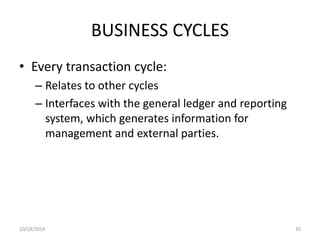
• Every transaction cycle: 
– Relates to other cycles 
– Interfaces with the general ledger and reporting 
system, which generates information for 
management and external parties. 
10/18/2014 30
General Ledger 
and Reporting 
System 
Revenue 
Cycle 
Expenditure 
Cycle 
Production 
Cycle 
Human Res./ 
Payroll Cycle 
Financing 
Cycle 
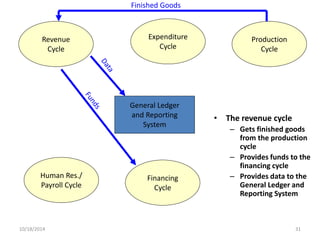
• The revenue cycle 
– Gets finished goods 
from the production 
cycle 
– Provides funds to the 
financing cycle 
– Provides data to the 
General Ledger and 
Reporting System 
Finished Goods 
10/18/2014 31
General Ledger 
and Reporting 
System 
Revenue 
Cycle 
Expenditure 
Cycle 
Production 
Cycle 
Human Res./ 
Payroll Cycle 
Financing 
Cycle 
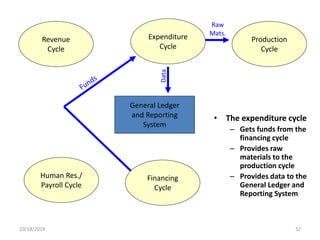
• The expenditure cycle 
– Gets funds from the 
financing cycle 
– Provides raw 
materials to the 
production cycle 
– Provides data to the 
General Ledger and 
Reporting System 
Raw 
Mats. 
Data 
10/18/2014 32
General Ledger 
and Reporting 
System 
Revenue 
Cycle 
Expenditure 
Cycle 
Production 
Cycle 
Human Res./ 
Payroll Cycle 
Financing 
Cycle 
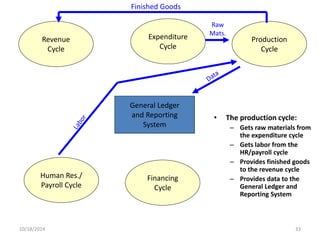
• The production cycle: 
– Gets raw materials from 
the expenditure cycle 
– Gets labor from the 
HR/payroll cycle 
– Provides finished goods 
to the revenue cycle 
– Provides data to the 
General Ledger and 
Reporting System 
Raw 
Mats. 
Finished Goods 
10/18/2014 33
General Ledger 
and Reporting 
System 
Revenue 
Cycle 
Expenditure 
Cycle 
Production 
Cycle 
Human Res./ 
Payroll Cycle 
Financing 
Cycle 
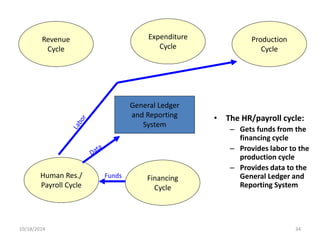
• The HR/payroll cycle: 
– Gets funds from the 
financing cycle 
– Provides labor to the 
production cycle 
– Provides data to the 
General Ledger and 
Reporting System 
Funds 
10/18/2014 34
General Ledger 
and Reporting 
System 
Revenue 
Cycle 
Expenditure 
Cycle 
Production 
Cycle 
Human Res./ 
Payroll Cycle 
Financing 
Cycle 
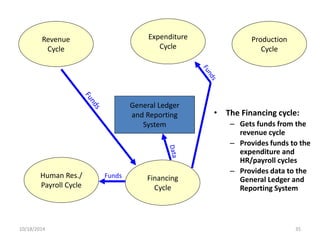
• The Financing cycle: 
– Gets funds from the 
revenue cycle 
– Provides funds to the 
expenditure and 
HR/payroll cycles 
– Provides data to the 
General Ledger and 
Reporting System 
Funds 
10/18/2014 35
General Ledger 
and Reporting 
System 
Revenue 
Cycle 
Expenditure 
Cycle 
Production 
Cycle 
Human Res./ 
Payroll Cycle 
Financing 
Cycle 
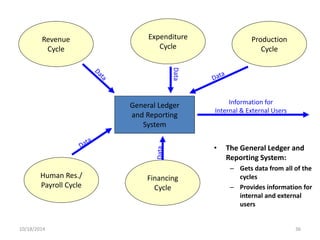
Information for 
Internal & External Users 
• The General Ledger and 
Reporting System: 
– Gets data from all of the 
cycles 
– Provides information for 
internal and external 
users 
Data 
Data 
10/18/2014 36
BUSINESS CYCLES 
• Many accounting software packages 
implement the different transaction cycles as 
separate modules. 
– Not every module is needed in every organization, 
e.g., retail companies don’t have a production 
cycle. 
– Some companies may need extra modules. 
– The implementation of each transaction cycle can 
differ significantly across companies. 
10/18/2014 37
BUSINESS CYCLES 
• However the cycles are implemented, it is 
critical that the AIS be able to: 
– Accommodate the information needs of managers 
– Integrate financial and nonfinancial data. 
10/18/2014 38
TRANSACTION PROCESSING: 
THE DATA PROCESSING CYCLE 
• Accountants play an important role in data 
processing. They answer questions such as: 
– What data should be entered and stored? 
– Who should be able to access the data? 
– How should the data be organized, updated, stored, 
accessed, and retrieved? 
– How can scheduled and unanticipated information needs 
be met. 
• To answer these questions, they must understand 
data processing concepts. 
10/18/2014 39
TRANSACTION PROCESSING: 
THE DATA PROCESSING CYCLE 
• An important function of the AIS is to 
efficiently and effectively process the data 
about a company’s transactions. 
– In manual systems, data is entered into paper 
journals and ledgers. 
– In computer-based systems, the series of 
operations performed on data is referred to as the 
data processing cycle. 
10/18/2014 40
TRANSACTION PROCESSING: 
THE DATA PROCESSING CYCLE 
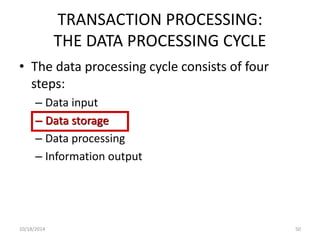
• The data processing cycle consists of four 
steps: 
– Data input 
– Data storage 
– Data processing 
– Information output 
10/18/2014 41
TRANSACTION PROCESSING: 
THE DATA PROCESSING CYCLE 
• The data processing cycle consists of four 
steps: 
– Data input 
– Data storage 
– Data processing 
– Information output 
10/18/2014 42
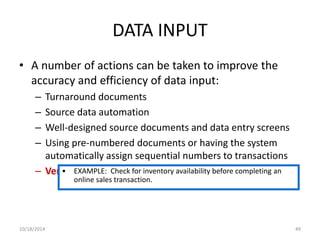
DATA INPUT 
• The first step in data processing is to capture 
the data. 
• Usually triggered by a business activity. 
• Data is captured about: 
– The event that occurred 
– The resources affected by the event 
– The agents who participated 
10/18/2014 43
DATA INPUT 
• A number of actions can be taken to improve 
the accuracy and efficiency of data input: 
– Turnaround documents 
• EXAMPLE: The stub on your telephone bill that you tear off and return with 
your check when you pay the bill. 
• The customer account number is coded on the document, usually in machine-readable 
form, which reduces the probability of human error in applying the 
check to the correct account. 
10/18/2014 44
DATA INPUT 
• A number of actions can be taken to improve 
the accuracy and efficiency of data input: 
– Turnaround documents 
– Source data automation 
• Capture data with minimal human intervention. 
• EXAMPLES: 
– ATMs for banking 
– Point-of-sale (POS) scanners in retail stores 
– Automated gas pumps that accept your credit card 
10/18/2014 45
DATA INPUT 
• A number of actions can be taken to improve 
the accuracy and efficiency of data input: 
– Turnaround documents 
– Source data automation 
– Well-designed source documents and data entry 
screens 
• How do these improve the accuracy and efficiency of data input? 
10/18/2014 46
DATA INPUT 
• A number of actions can be taken to improve 
the accuracy and efficiency of data input: 
– Turnaround documents 
– Source data automation 
– Well-designed source documents and data entry 
screens 
• What does it mean if a document number is missing in the 
– Using pre-sequence? 
numbered documents or having the 
system automatically assign sequential numbers 
to transactions 
10/18/2014 47
DATA INPUT 
• A number of actions can be taken to improve 
the accuracy and efficiency of data input: 
– Turnaround documents 
– Source data automation 
– Well-designed source documents and data entry 
screens 
• What does it mean if there are duplicate document numbers? 
– Using pre-numbered documents or having the 
system automatically assign sequential numbers 
to transactions 
10/18/2014 48
DATA INPUT 
• A number of actions can be taken to improve the 
accuracy and efficiency of data input: 
– Turnaround documents 
– Source data automation 
– Well-designed source documents and data entry screens 
– Using pre-numbered documents or having the system 
automatically assign sequential numbers to transactions 
– Verify • transactions 
EXAMPLE: Check for inventory availability before completing an 
online sales transaction. 
10/18/2014 49
TRANSACTION PROCESSING: 
THE DATA PROCESSING CYCLE 
• The data processing cycle consists of four 
steps: 
– Data input 
– Data storage 
– Data processing 
– Information output 
10/18/2014 50
DATA STORAGE 
• Data needs to be organized for easy and 
efficient access. 
• Let’s start with some vocabulary terms with 
respect to data storage. 
10/18/2014 51
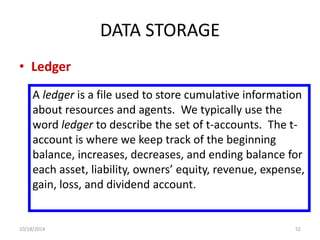
• Ledger 
DATA STORAGE 
A ledger is a file used to store cumulative information 
about resources and agents. We typically use the 
word ledger to describe the set of t-accounts. The t-account 
is where we keep track of the beginning 
balance, increases, decreases, and ending balance for 
each asset, liability, owners’ equity, revenue, expense, 
gain, loss, and dividend account. 
10/18/2014 52
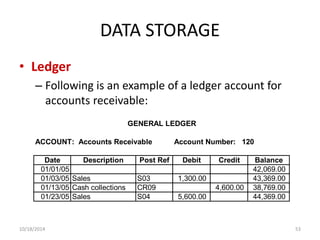
• Ledger 
DATA STORAGE 
– Following is an example of a ledger account for 
accounts receivable: 
GENERAL LEDGER 
ACCOUNT: Accounts Receivable Account Number: 120 
Date Description Post Ref Debit Credit Balance 
01/01/05 42,069.00 
01/03/05 Sales S03 1,300.00 43,369.00 
01/13/05 Cash collections CR09 4,600.00 38,769.00 
01/23/05 Sales S04 5,600.00 44,369.00 
10/18/2014 53
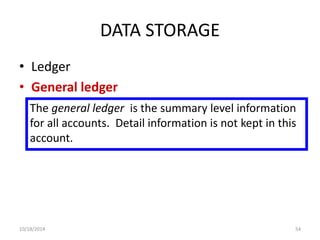
DATA STORAGE 
• Ledger 
• General ledger 
The general ledger is the summary level information 
for all accounts. Detail information is not kept in this 
account. 
10/18/2014 54
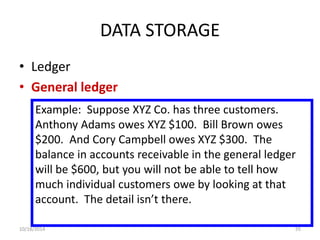
DATA STORAGE 
• Ledger 
• General ledger 
Example: Suppose XYZ Co. has three customers. 
Anthony Adams owes XYZ $100. Bill Brown owes 
$200. And Cory Campbell owes XYZ $300. The 
balance in accounts receivable in the general ledger 
will be $600, but you will not be able to tell how 
much individual customers owe by looking at that 
account. The detail isn’t there. 
10/18/2014 55
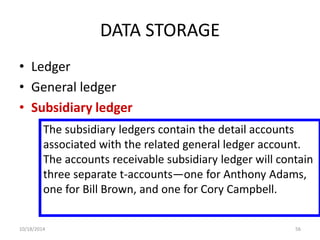
DATA STORAGE 
• Ledger 
• General ledger 
• Subsidiary ledger 
The subsidiary ledgers contain the detail accounts 
associated with the related general ledger account. 
The accounts receivable subsidiary ledger will contain 
three separate t-accounts—one for Anthony Adams, 
one for Bill Brown, and one for Cory Campbell. 
10/18/2014 56
DATA STORAGE 
• Ledger 
• General ledger 
• Subsidiary ledger 
The related general ledger account is often called 
a “control” account. 
The sum of the subsidiary account balances 
should equal the balance in the control account. 
10/18/2014 57
DATA STORAGE 
• Ledger 
• General ledger 
• Subsidiary ledger 
• Coding techniques 
• Coding is a method of systematically assigning numbers or letters to data items to 
help classify and organize them. There are many types of codes including: 
– Sequence codes 
– Block codes 
– Group codes 
10/18/2014 58
DATA STORAGE 
• Ledger 
• General ledger 
• Subsidiary ledger 
• Coding techniques 
• With sequence codes, items (such as checks or invoices) are numbered 
consecutively to ensure no gaps in the sequence. The numbering helps ensure 
that: 
– All items are accounted for 
– There are no duplicated numbers, which would suggest errors or fraud 
10/18/2014 59
DATA STORAGE 
• Ledger 
• General ledger 
• Subsidiary ledger 
• Coding techniques 
• When block codes are used, blocks of numbers within a numerical sequence 
are reserved for a particular category. 
• EXAMPLE: The first three digits of a Social Security number make up a block 
code that indicates the state in which the Social Security number was issued: 
– 001-003 New Hampshire 
– 004-007 Maine 
– 008-009 Vermont 
10/18/2014 60
DATA STORAGE 
• Ledger 
• General ledger 
• Subsidiary ledger 
• Coding techniques 
• When group codes are used, two or more subgroups of digits are used to code 
an item. 
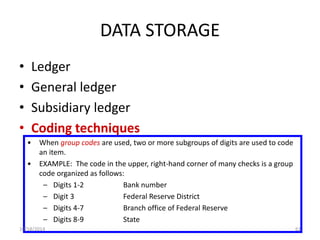
• EXAMPLE: The code in the upper, right-hand corner of many checks is a group 
code organized as follows: 
– Digits 1-2 Bank number 
– Digit 3 Federal Reserve District 
– Digits 4-7 Branch office of Federal Reserve 
– Digits 8-9 State 
10/18/2014 61
DATA STORAGE 
• Ledger 
• General ledger 
• Subsidiary ledger 
• Coding techniques 
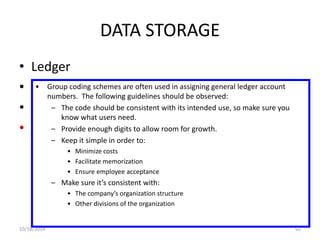
• Group coding schemes are often used in assigning general ledger account 
numbers. The following guidelines should be observed: 
– The code should be consistent with its intended use, so make sure you 
know what users need. 
– Provide enough digits to allow room for growth. 
– Keep it simple in order to: 
• Minimize costs 
• Facilitate memorization 
• Ensure employee acceptance 
– Make sure it’s consistent with: 
• The company’s organization structure 
• Other divisions of the organization 
10/18/2014 62
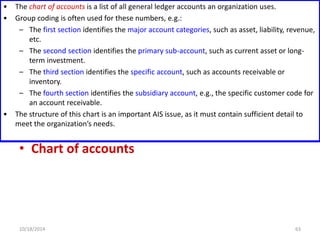
• The chart of accounts is a list of all general ledger accounts an organization uses. 
• Group coding is often used for these numbers, e.g.: 
DATA STORAGE 
– The first section identifies the major account categories, such as asset, liability, revenue, 
etc. 
– The second section identifies the primary sub-account, such as current asset or long-term 
investment. 
• Ledger 
• General ledger 
• Subsidiary ledger 
• Coding techniques 
• Chart of accounts 
– The third section identifies the specific account, such as accounts receivable or 
inventory. 
– The fourth section identifies the subsidiary account, e.g., the specific customer code for 
an account receivable. 
• The structure of this chart is an important AIS issue, as it must contain sufficient detail to 
meet the organization’s needs. 
10/18/2014 63
DATA STORAGE 
• Ledger 
• General ledger 
• Subsidiary ledger 
• Coding techniques 
• Chart of accounts 
10/18/2014 64
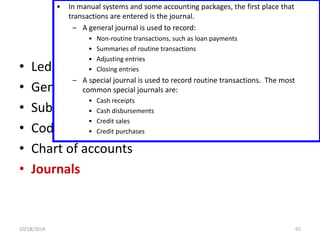
• In manual systems and some accounting packages, the first place that 
transactions are entered is the journal. 
– A general journal is used to record: 
DATA STORAGE 
• Non-routine transactions, such as loan payments 
• Summaries of routine transactions 
• Adjusting entries 
• Closing entries 
• Ledger 
• General ledger 
• Subsidiary ledger 
• Coding techniques 
• Chart of accounts 
• Journals 
– A special journal is used to record routine transactions. The most 
common special journals are: 
• Cash receipts 
• Cash disbursements 
• Credit sales 
• Credit purchases 
10/18/2014 65
DATA STORAGE 
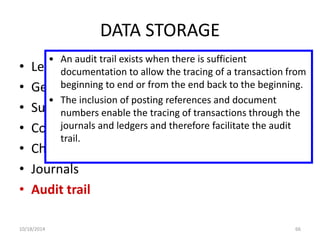
• An audit trail exists when there is sufficient 
• Ledger 
• General ledger 
• Subsidiary ledger 
• Coding techniques 
• Chart of accounts 
• Journals 
• Audit trail 
documentation to allow the tracing of a transaction from 
beginning to end or from the end back to the beginning. 
• The inclusion of posting references and document 
numbers enable the tracing of transactions through the 
journals and ledgers and therefore facilitate the audit 
trail. 
10/18/2014 66
DATA STORAGE 
• Now that we’ve learned some storage 
terminology, let’s return to the data storage 
process. 
• When transaction data is captured on a source 
document, the next step is to record the data 
in a journal. 
• A journal entry is made for each transaction 
showing the accounts and amounts to be 
credited. 
10/18/2014 67
COMPUTER-BASED STORAGE CONCEPTS 
• Now let’s moving on to discussing some computer-based 
storage concepts, including: 
– Entity 
– Attribute 
– Record 
– Data Value 
– Field 
– File 
– Master File 
– Transaction File 
– Database 
10/18/2014 68
COMPUTER-BASED STORAGE CONCEPTS 
• An entity is something about which information is 
stored. 
• In your university’s student information system, one 
entity is the student. The student information 
system stores information about students. 
• What are some other entities in your student 
information system? 
10/18/2014 69
COMPUTER-BASED STORAGE CONCEPTS 
• Attributes are characteristics of interest with respect 
to the entity. 
• Some attributes that a student information system 
typically stores about the student entity are: 
– Student ID number 
– Phone number 
– Address 
• What are some other attributes about students that 
a university might store? 
10/18/2014 70
COMPUTER-BASED STORAGE CONCEPTS 
• A field is the physical space where an attribute is 
stored. 
• The space where the student ID number is stored is 
the student ID field. 
Col. 1-9 Col. 10-30 Col. 31-40 Col. 41-50 
328469993 SIMPSON ALICE 4053721111 
328500732 ANDREWS BARRY 4057440236 
529036409 FLANDERS CARLA 4057475863 
10/18/2014 71
COMPUTER-BASED STORAGE CONCEPTS 
• A record is the set of attributes stored for a particular 
instance of an entity. 
• The combination of attributes stored for Barry 
Andrews is Barry’s record. 
Col. 1-9 Col. 10-30 Col. 31-40 Col. 41-50 
328469993 SIMPSON ALICE 4053721111 
328500732 ANDREWS BARRY 4057440236 
529036409 FLANDERS CARLA 4057475863 
10/18/2014 72
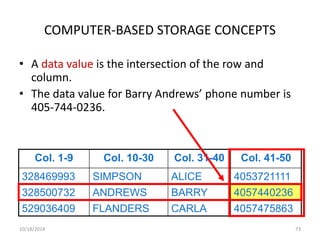
COMPUTER-BASED STORAGE CONCEPTS 
• A data value is the intersection of the row and 
column. 
• The data value for Barry Andrews’ phone number is 
405-744-0236. 
Col. 1-9 Col. 10-30 Col. 31-40 Col. 41-50 
328469993 SIMPSON ALICE 4053721111 
328500732 ANDREWS BARRY 4057440236 
529036409 FLANDERS CARLA 4057475863 
10/18/2014 73
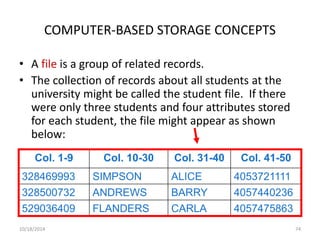
COMPUTER-BASED STORAGE CONCEPTS 
• A file is a group of related records. 
• The collection of records about all students at the 
university might be called the student file. If there 
were only three students and four attributes stored 
for each student, the file might appear as shown 
below: 
Col. 1-9 Col. 10-30 Col. 31-40 Col. 41-50 
328469993 SIMPSON ALICE 4053721111 
328500732 ANDREWS BARRY 4057440236 
529036409 FLANDERS CARLA 4057475863 
10/18/2014 74
COMPUTER-BASED STORAGE CONCEPTS 
• A master file is a file that stores cumulative 
information about an organization’s entities. 
• It is conceptually similar to a ledger in a 
manual AIS in that: 
– The file is permanent 
– The file exists across fiscal periods 
– Changes are made to the file to reflect the effects 
of new transactions. 
10/18/2014 75
COMPUTER-BASED STORAGE CONCEPTS 
• A transaction file is a file that contains records 
of individual transactions (events) that occur 
during a fiscal period. 
• It is conceptually similar to a journal in a 
manual AIS in that: 
– The files are temporary 
– The files are usually maintained for one fiscal 
period 
10/18/2014 76
COMPUTER-BASED STORAGE CONCEPTS 
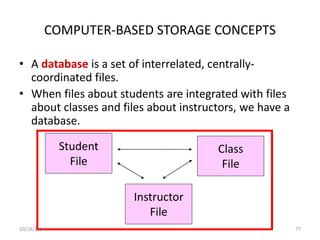
• A database is a set of interrelated, centrally-coordinated 
files. 
• When files about students are integrated with files 
about classes and files about instructors, we have a 
database. 
Student 
File 
Class 
File 
Instructor 
File 
10/18/2014 77
TRANSACTION PROCESSING: 
THE DATA PROCESSING CYCLE 
• The data processing cycle consists of four 
steps: 
– Data input 
– Data storage 
– Data processing 
– Information output 
10/18/2014 78
DATA PROCESSING 
• Once data about a business activity has been 
collected and entered into a system, it must 
be processed. 
10/18/2014 79
DATA PROCESSING 
• There are four different types of file 
processing: 
– Updating data to record the occurrence of an 
event, the resources affected by the event, and 
the agents who participated, e.g., recording a sale 
to a customer. 
– Changing data, e.g., a customer address 
– Adding data, e.g., a new customer. 
– Deleting data, e.g., removing an old customer that 
has not purchased anything in 5 years. 
10/18/2014 80
TRANSACTION PROCESSING: 
THE DATA PROCESSING CYCLE 
• The data processing cycle consists of four 
steps: 
– Data input 
– Data storage 
– Data processing 
– Information output 
10/18/2014 81
INFORMATION OUTPUT 
• The final step in the information process is 
information output. 
• This output can be in the form of: 
– Documents 
• Documents are records of transactions or other 
company data. 
• EXAMPLE: Employee paychecks or purchase 
orders for merchandise 
• Documents generated at the end of the 
transaction processing activities are known as 
operational documents (as opposed to source 
documents). 
• They can be printed or stored as electronic 
images. 
10/18/2014 82
INFORMATION OUTPUT 
• The final step in the information process is 
information output. 
• This output can be in the form of: 
– Documents 
– Reports 
• Reports are used by employees to control 
operational activities and by managers to make 
decisions and design strategies. 
• They may be produced: 
– On a regular basis 
– On an exception basis 
– On demand 
• Organizations should periodically reassess 
whether each report is needed. 
10/18/2014 83
INFORMATION OUTPUT 
• The final step in the information process is 
information output. 
• This output can be in the form of: 
– Documents 
– Reports 
– Queries 
• Queries are user requests for specific pieces of 
information. 
• They may be requested: 
– Periodically 
– One time 
• They can be displayed: 
– On the monitor, called soft copy 
– On the screen, called hard copy 
10/18/2014 84
INFORMATION OUTPUT 
• Output can serve a variety of purposes: 
– Financial statements can be provided to both 
external and internal parties. 
– Some outputs are specifically for internal use: 
• For planning purposes 
• Examples of outputs for planning purposes 
include: 
– Budgets 
• Budgets are an entity’s formal expression of goals in 
financial terms 
– Sales forecasts 
10/18/2014 85
INFORMATION OUTPUT 
• Output can serve a variety of purposes: 
– Financial statements can be provided to both 
external and internal parties. 
– Some outputs are specifically for internal use: 
• For planning purposes 
• For management of day-to-day operations 
• Example: delivery schedules 
10/18/2014 86
INFORMATION OUTPUT 
• Performance reports are outputs that are used 
for control purposes. 
• Output can serve a variety of purposes: 
• These reports compare an organization’s 
standard or expected performance with its 
actual outcomes. 
– Financial statements can be provided to both 
external and internal parties. 
– Some outputs are specifically for internal use: 
• Management by exception is an approach to 
utilizing performance reports that focuses on 
investigating and acting on only those variances 
that are significant. 
• For planning purposes 
• For management of day-to-day operations 
• For control purposes 
10/18/2014 87
INFORMATION OUTPUT 
• Output can serve a variety of purposes: 
– Financial statements can be provided to both 
external and internal parties. 
– Some outputs are specifically for internal use: 
• For planning purposes 
• For management of day-to-day operations 
• For control purposes 
• For evaluation purposes 
• These outputs might include: 
– Surveys of customer satisfaction 
– Reports on employee error rates 
10/18/2014 88
INFORMATION OUTPUT 
• The saying goes, “Not many people sit around and 
have a roast goose fall in their lap.” 
• In other words, if you want a roast goose, you have 
to aim. 
• With financial results, you’re also unlikely to 
achieve when you don’t aim. 
• Just be careful where you aim! 
10/18/2014 89
• The traditional AIS captured financial data. 
– Non-financial data was captured in other, sometimes-redundant 
systems 
• Enterprise resource planning (ERP) systems are 
designed to integrate all aspects of a company’s 
operations (including both financial and non-financial 
information) with the traditional functions 
of an AIS. 
ROLE OF THE AIS 
10/18/2014 90
SUMMARY 
• We’ve learned about the basic business activities in which 
an organization engages, the decisions that need to be 
made, and the information required to make those 
decisions. 
• We’ve reviewed the data processing cycle and its role in 
organizing business activities and providing information to 
users. 
• Finally, we’ve touched on the role of the information 
systems in modern organizations and introduced the 
notion of enterprise resource planning systems. 
10/18/2014 91

Overview of Business Process

  • 1.
    CHAPTER 2 Overviewof Business Processes
  • 2.
    INTRODUCTION • Questionsto be addressed in this chapter include: – What are the basic business activities in which an organization engages? • What decisions must be made to undertake these activities? • What information is required to make those decisions? – What role does the data processing cycle play in organizing business activities and providing information to users? – What is the role of the information system and enterprise resource planning in modern organizations? 10/18/2014 2
  • 3.
    INFORMATION NEEDS ANDBUSINESS ACTIVITIES • Businesses engage in a variety of activities, including: – Acquiring capital – Buying buildings and equipment – Hiring and training employees – Purchasing inventory – Doing advertising and marketing – Selling goods or services – Collecting payment from customers – Paying employees – Paying taxes – Paying vendors Each activity requires different types of decisions! 10/18/2014 3
  • 4.
    INFORMATION NEEDS AND BUSINESS ACTIVITIES • Businesses engage in a variety of activities, including: – Acquiring capital – Buying buildings and equipment – Hiring and training employees – Purchasing inventory – Doing advertising and marketing – Selling goods or services – Collecting payment from customers – Paying employees – Paying taxes – Paying vendors Each decision requires different types of information. 10/18/2014 4
  • 5.
    INFORMATION NEEDS AND BUSINESS ACTIVITIES • Types of information needed for decisions: – Some is financial – Some is nonfinancial – Some comes from internal sources – Some comes from external sources • An effective AIS needs to be able to integrate information of different types and from different sources. 10/18/2014 5
  • 6.
    INTERACTION WITH EXTERNALAND INTERNAL PARTIES AIS External Parties • The AIS interacts with external parties, such as customers, vendors, creditors, and governmental agencies. 10/18/2014 6
  • 7.
    INTERACTION WITH EXTERNALAND INTERNAL PARTIES Internal Parties AIS External Parties • The AIS also interacts with internal parties such as employees and management. 10/18/2014 7
  • 8.
    INTERACTION WITH EXTERNALAND INTERNAL PARTIES Internal Parties AIS External Parties • The interaction is typically two-way, in that the AIS sends information to and receives information from these parties. 10/18/2014 8
  • 9.
    BUSINESS CYCLES •A transaction is: – An agreement between two entities to exchange goods or services; OR – Any other event that can be measured in economic terms by an organization. • EXAMPLES: – Sell goods to customers – Depreciate equipment 10/18/2014 9
  • 10.
    BUSINESS CYCLES •The transaction cycle is a process: – Begins with capturing data about a transaction – Ends with an information output, such as financial statements 10/18/2014 10
  • 11.
    BUSINESS CYCLES •Many business activities are paired in give-get exchanges • The basic exchanges can be grouped into five major transaction cycles. – Revenue cycle – Expenditure cycle – Production cycle – Human resources/payroll cycle – Financing cycle 10/18/2014 11
  • 12.
    BUSINESS CYCLES •Many business activities are paired in give-get exchanges • The basic exchanges can be grouped into five major transaction cycles. – Revenue cycle – Expenditure cycle – Production cycle – Human resources/payroll cycle – Financing cycle 10/18/2014 12
  • 13.
    REVENUE CYCLE •The revenue cycle involves interactions with your customers. • You sell goods or services and get cash. Give Goods Get Cash 10/18/2014 13
  • 14.
    BUSINESS CYCLES •Many business activities are paired in give-get exchanges • The basic exchanges can be grouped into five major transaction cycles. – Revenue cycle – Expenditure cycle – Production cycle – Human resources/payroll cycle – Financing cycle 10/18/2014 14
  • 15.
    EXPENDITURE CYCLE •The expenditure cycle involves interactions with your suppliers. • You buy goods or services and pay cash. Give Cash Get Goods 10/18/2014 15
  • 16.
    BUSINESS CYCLES •Many business activities are paired in give-get exchanges • The basic exchanges can be grouped into five major transaction cycles. – Revenue cycle – Expenditure cycle – Production cycle – Human resources/payroll cycle – Financing cycle 10/18/2014 16
  • 17.
    PRODUCTION CYCLE •In the production cycle, raw materials and labor are transformed into finished goods. Give Raw Materials & Labor Get Finished Goods 10/18/2014 17
  • 18.
    BUSINESS CYCLES •Many business activities are paired in give-get exchanges • The basic exchanges can be grouped into five major transaction cycles. – Revenue cycle – Expenditure cycle – Production cycle – Human resources/payroll cycle – Financing cycle 10/18/2014 18
  • 19.
    HUMAN RESOURCES/ PAYROLLCYCLE • The human resources cycle involves interactions with your employees. • Employees are hired, trained, paid, evaluated, promoted, and terminated. Give Cash Get Labor 10/18/2014 19
  • 20.
    BUSINESS CYCLES •Many business activities are paired in give-get exchanges • The basic exchanges can be grouped into five major transaction cycles. – Revenue cycle – Expenditure cycle – Production cycle – Human resources/payroll cycle – Financing cycle 10/18/2014 20
  • 21.
    FINANCING CYCLE •The financing cycle involves interactions with investors and creditors. • You raise capital (through stock or debt), repay the capital, and pay a return on it (interest or dividends). Give Cash Get cash 10/18/2014 21
  • 22.
    BUSINESS CYCLES •Thousands of transactions can occur within any of these cycles. • But there are relatively few types of transactions in a cycle. 10/18/2014 22
  • 23.
    BUSINESS CYCLES •EXAMPLE: In the revenue cycle, the basic give-get transaction is: – Give goods – Get cash 10/18/2014 23
  • 24.
    BUSINESS CYCLES •Other transactions in the revenue cycle include: • Handle customer inquiries • Take customer orders • Approve credit sales • Check inventory availability • Initiate back orders • Pick and pack orders • Ship goods • Bill customers • Update sales and Accts Rec. for sales • Receive customer payments • Update Accts Rec. for collections • Handle sales returns, discounts, & bad debts • Prepare management reports • Send info to other cycles Note that the last activity in any cycle is to send information to other cycles. 10/18/2014 24
  • 25.
    BUSINESS CYCLES •Click on the buttons below if you wish to see the transactions that occur in the other cycles: Expenditure Cycle Human Res./ Payroll Cycle Production Cycle Financing Cycle 10/18/2014 25
  • 26.
    BUSINESS CYCLES •Every transaction cycle: – Relates to other cycles – Interfaces with the general ledger and reporting system, which generates information for management and external parties. 10/18/2014 30
  • 27.
    General Ledger andReporting System Revenue Cycle Expenditure Cycle Production Cycle Human Res./ Payroll Cycle Financing Cycle • The revenue cycle – Gets finished goods from the production cycle – Provides funds to the financing cycle – Provides data to the General Ledger and Reporting System Finished Goods 10/18/2014 31
  • 28.
    General Ledger andReporting System Revenue Cycle Expenditure Cycle Production Cycle Human Res./ Payroll Cycle Financing Cycle • The expenditure cycle – Gets funds from the financing cycle – Provides raw materials to the production cycle – Provides data to the General Ledger and Reporting System Raw Mats. Data 10/18/2014 32
  • 29.
    General Ledger andReporting System Revenue Cycle Expenditure Cycle Production Cycle Human Res./ Payroll Cycle Financing Cycle • The production cycle: – Gets raw materials from the expenditure cycle – Gets labor from the HR/payroll cycle – Provides finished goods to the revenue cycle – Provides data to the General Ledger and Reporting System Raw Mats. Finished Goods 10/18/2014 33
  • 30.
    General Ledger andReporting System Revenue Cycle Expenditure Cycle Production Cycle Human Res./ Payroll Cycle Financing Cycle • The HR/payroll cycle: – Gets funds from the financing cycle – Provides labor to the production cycle – Provides data to the General Ledger and Reporting System Funds 10/18/2014 34
  • 31.
    General Ledger andReporting System Revenue Cycle Expenditure Cycle Production Cycle Human Res./ Payroll Cycle Financing Cycle • The Financing cycle: – Gets funds from the revenue cycle – Provides funds to the expenditure and HR/payroll cycles – Provides data to the General Ledger and Reporting System Funds 10/18/2014 35
  • 32.
    General Ledger andReporting System Revenue Cycle Expenditure Cycle Production Cycle Human Res./ Payroll Cycle Financing Cycle Information for Internal & External Users • The General Ledger and Reporting System: – Gets data from all of the cycles – Provides information for internal and external users Data Data 10/18/2014 36
  • 33.
    BUSINESS CYCLES •Many accounting software packages implement the different transaction cycles as separate modules. – Not every module is needed in every organization, e.g., retail companies don’t have a production cycle. – Some companies may need extra modules. – The implementation of each transaction cycle can differ significantly across companies. 10/18/2014 37
  • 34.
    BUSINESS CYCLES •However the cycles are implemented, it is critical that the AIS be able to: – Accommodate the information needs of managers – Integrate financial and nonfinancial data. 10/18/2014 38
  • 35.
    TRANSACTION PROCESSING: THEDATA PROCESSING CYCLE • Accountants play an important role in data processing. They answer questions such as: – What data should be entered and stored? – Who should be able to access the data? – How should the data be organized, updated, stored, accessed, and retrieved? – How can scheduled and unanticipated information needs be met. • To answer these questions, they must understand data processing concepts. 10/18/2014 39
  • 36.
    TRANSACTION PROCESSING: THEDATA PROCESSING CYCLE • An important function of the AIS is to efficiently and effectively process the data about a company’s transactions. – In manual systems, data is entered into paper journals and ledgers. – In computer-based systems, the series of operations performed on data is referred to as the data processing cycle. 10/18/2014 40
  • 37.
    TRANSACTION PROCESSING: THEDATA PROCESSING CYCLE • The data processing cycle consists of four steps: – Data input – Data storage – Data processing – Information output 10/18/2014 41
  • 38.
    TRANSACTION PROCESSING: THEDATA PROCESSING CYCLE • The data processing cycle consists of four steps: – Data input – Data storage – Data processing – Information output 10/18/2014 42
  • 39.
    DATA INPUT •The first step in data processing is to capture the data. • Usually triggered by a business activity. • Data is captured about: – The event that occurred – The resources affected by the event – The agents who participated 10/18/2014 43
  • 40.
    DATA INPUT •A number of actions can be taken to improve the accuracy and efficiency of data input: – Turnaround documents • EXAMPLE: The stub on your telephone bill that you tear off and return with your check when you pay the bill. • The customer account number is coded on the document, usually in machine-readable form, which reduces the probability of human error in applying the check to the correct account. 10/18/2014 44
  • 41.
    DATA INPUT •A number of actions can be taken to improve the accuracy and efficiency of data input: – Turnaround documents – Source data automation • Capture data with minimal human intervention. • EXAMPLES: – ATMs for banking – Point-of-sale (POS) scanners in retail stores – Automated gas pumps that accept your credit card 10/18/2014 45
  • 42.
    DATA INPUT •A number of actions can be taken to improve the accuracy and efficiency of data input: – Turnaround documents – Source data automation – Well-designed source documents and data entry screens • How do these improve the accuracy and efficiency of data input? 10/18/2014 46
  • 43.
    DATA INPUT •A number of actions can be taken to improve the accuracy and efficiency of data input: – Turnaround documents – Source data automation – Well-designed source documents and data entry screens • What does it mean if a document number is missing in the – Using pre-sequence? numbered documents or having the system automatically assign sequential numbers to transactions 10/18/2014 47
  • 44.
    DATA INPUT •A number of actions can be taken to improve the accuracy and efficiency of data input: – Turnaround documents – Source data automation – Well-designed source documents and data entry screens • What does it mean if there are duplicate document numbers? – Using pre-numbered documents or having the system automatically assign sequential numbers to transactions 10/18/2014 48
  • 45.
    DATA INPUT •A number of actions can be taken to improve the accuracy and efficiency of data input: – Turnaround documents – Source data automation – Well-designed source documents and data entry screens – Using pre-numbered documents or having the system automatically assign sequential numbers to transactions – Verify • transactions EXAMPLE: Check for inventory availability before completing an online sales transaction. 10/18/2014 49
  • 46.
    TRANSACTION PROCESSING: THEDATA PROCESSING CYCLE • The data processing cycle consists of four steps: – Data input – Data storage – Data processing – Information output 10/18/2014 50
  • 47.
    DATA STORAGE •Data needs to be organized for easy and efficient access. • Let’s start with some vocabulary terms with respect to data storage. 10/18/2014 51
  • 48.
    • Ledger DATASTORAGE A ledger is a file used to store cumulative information about resources and agents. We typically use the word ledger to describe the set of t-accounts. The t-account is where we keep track of the beginning balance, increases, decreases, and ending balance for each asset, liability, owners’ equity, revenue, expense, gain, loss, and dividend account. 10/18/2014 52
  • 49.
    • Ledger DATASTORAGE – Following is an example of a ledger account for accounts receivable: GENERAL LEDGER ACCOUNT: Accounts Receivable Account Number: 120 Date Description Post Ref Debit Credit Balance 01/01/05 42,069.00 01/03/05 Sales S03 1,300.00 43,369.00 01/13/05 Cash collections CR09 4,600.00 38,769.00 01/23/05 Sales S04 5,600.00 44,369.00 10/18/2014 53
  • 50.
    DATA STORAGE •Ledger • General ledger The general ledger is the summary level information for all accounts. Detail information is not kept in this account. 10/18/2014 54
  • 51.
    DATA STORAGE •Ledger • General ledger Example: Suppose XYZ Co. has three customers. Anthony Adams owes XYZ $100. Bill Brown owes $200. And Cory Campbell owes XYZ $300. The balance in accounts receivable in the general ledger will be $600, but you will not be able to tell how much individual customers owe by looking at that account. The detail isn’t there. 10/18/2014 55
  • 52.
    DATA STORAGE •Ledger • General ledger • Subsidiary ledger The subsidiary ledgers contain the detail accounts associated with the related general ledger account. The accounts receivable subsidiary ledger will contain three separate t-accounts—one for Anthony Adams, one for Bill Brown, and one for Cory Campbell. 10/18/2014 56
  • 53.
    DATA STORAGE •Ledger • General ledger • Subsidiary ledger The related general ledger account is often called a “control” account. The sum of the subsidiary account balances should equal the balance in the control account. 10/18/2014 57
  • 54.
    DATA STORAGE •Ledger • General ledger • Subsidiary ledger • Coding techniques • Coding is a method of systematically assigning numbers or letters to data items to help classify and organize them. There are many types of codes including: – Sequence codes – Block codes – Group codes 10/18/2014 58
  • 55.
    DATA STORAGE •Ledger • General ledger • Subsidiary ledger • Coding techniques • With sequence codes, items (such as checks or invoices) are numbered consecutively to ensure no gaps in the sequence. The numbering helps ensure that: – All items are accounted for – There are no duplicated numbers, which would suggest errors or fraud 10/18/2014 59
  • 56.
    DATA STORAGE •Ledger • General ledger • Subsidiary ledger • Coding techniques • When block codes are used, blocks of numbers within a numerical sequence are reserved for a particular category. • EXAMPLE: The first three digits of a Social Security number make up a block code that indicates the state in which the Social Security number was issued: – 001-003 New Hampshire – 004-007 Maine – 008-009 Vermont 10/18/2014 60
  • 57.
    DATA STORAGE •Ledger • General ledger • Subsidiary ledger • Coding techniques • When group codes are used, two or more subgroups of digits are used to code an item. • EXAMPLE: The code in the upper, right-hand corner of many checks is a group code organized as follows: – Digits 1-2 Bank number – Digit 3 Federal Reserve District – Digits 4-7 Branch office of Federal Reserve – Digits 8-9 State 10/18/2014 61
  • 58.
    DATA STORAGE •Ledger • General ledger • Subsidiary ledger • Coding techniques • Group coding schemes are often used in assigning general ledger account numbers. The following guidelines should be observed: – The code should be consistent with its intended use, so make sure you know what users need. – Provide enough digits to allow room for growth. – Keep it simple in order to: • Minimize costs • Facilitate memorization • Ensure employee acceptance – Make sure it’s consistent with: • The company’s organization structure • Other divisions of the organization 10/18/2014 62
  • 59.
    • The chartof accounts is a list of all general ledger accounts an organization uses. • Group coding is often used for these numbers, e.g.: DATA STORAGE – The first section identifies the major account categories, such as asset, liability, revenue, etc. – The second section identifies the primary sub-account, such as current asset or long-term investment. • Ledger • General ledger • Subsidiary ledger • Coding techniques • Chart of accounts – The third section identifies the specific account, such as accounts receivable or inventory. – The fourth section identifies the subsidiary account, e.g., the specific customer code for an account receivable. • The structure of this chart is an important AIS issue, as it must contain sufficient detail to meet the organization’s needs. 10/18/2014 63
  • 60.
    DATA STORAGE •Ledger • General ledger • Subsidiary ledger • Coding techniques • Chart of accounts 10/18/2014 64
  • 61.
    • In manualsystems and some accounting packages, the first place that transactions are entered is the journal. – A general journal is used to record: DATA STORAGE • Non-routine transactions, such as loan payments • Summaries of routine transactions • Adjusting entries • Closing entries • Ledger • General ledger • Subsidiary ledger • Coding techniques • Chart of accounts • Journals – A special journal is used to record routine transactions. The most common special journals are: • Cash receipts • Cash disbursements • Credit sales • Credit purchases 10/18/2014 65
  • 62.
    DATA STORAGE •An audit trail exists when there is sufficient • Ledger • General ledger • Subsidiary ledger • Coding techniques • Chart of accounts • Journals • Audit trail documentation to allow the tracing of a transaction from beginning to end or from the end back to the beginning. • The inclusion of posting references and document numbers enable the tracing of transactions through the journals and ledgers and therefore facilitate the audit trail. 10/18/2014 66
  • 63.
    DATA STORAGE •Now that we’ve learned some storage terminology, let’s return to the data storage process. • When transaction data is captured on a source document, the next step is to record the data in a journal. • A journal entry is made for each transaction showing the accounts and amounts to be credited. 10/18/2014 67
  • 64.
    COMPUTER-BASED STORAGE CONCEPTS • Now let’s moving on to discussing some computer-based storage concepts, including: – Entity – Attribute – Record – Data Value – Field – File – Master File – Transaction File – Database 10/18/2014 68
  • 65.
    COMPUTER-BASED STORAGE CONCEPTS • An entity is something about which information is stored. • In your university’s student information system, one entity is the student. The student information system stores information about students. • What are some other entities in your student information system? 10/18/2014 69
  • 66.
    COMPUTER-BASED STORAGE CONCEPTS • Attributes are characteristics of interest with respect to the entity. • Some attributes that a student information system typically stores about the student entity are: – Student ID number – Phone number – Address • What are some other attributes about students that a university might store? 10/18/2014 70
  • 67.
    COMPUTER-BASED STORAGE CONCEPTS • A field is the physical space where an attribute is stored. • The space where the student ID number is stored is the student ID field. Col. 1-9 Col. 10-30 Col. 31-40 Col. 41-50 328469993 SIMPSON ALICE 4053721111 328500732 ANDREWS BARRY 4057440236 529036409 FLANDERS CARLA 4057475863 10/18/2014 71
  • 68.
    COMPUTER-BASED STORAGE CONCEPTS • A record is the set of attributes stored for a particular instance of an entity. • The combination of attributes stored for Barry Andrews is Barry’s record. Col. 1-9 Col. 10-30 Col. 31-40 Col. 41-50 328469993 SIMPSON ALICE 4053721111 328500732 ANDREWS BARRY 4057440236 529036409 FLANDERS CARLA 4057475863 10/18/2014 72
  • 69.
    COMPUTER-BASED STORAGE CONCEPTS • A data value is the intersection of the row and column. • The data value for Barry Andrews’ phone number is 405-744-0236. Col. 1-9 Col. 10-30 Col. 31-40 Col. 41-50 328469993 SIMPSON ALICE 4053721111 328500732 ANDREWS BARRY 4057440236 529036409 FLANDERS CARLA 4057475863 10/18/2014 73
  • 70.
    COMPUTER-BASED STORAGE CONCEPTS • A file is a group of related records. • The collection of records about all students at the university might be called the student file. If there were only three students and four attributes stored for each student, the file might appear as shown below: Col. 1-9 Col. 10-30 Col. 31-40 Col. 41-50 328469993 SIMPSON ALICE 4053721111 328500732 ANDREWS BARRY 4057440236 529036409 FLANDERS CARLA 4057475863 10/18/2014 74
  • 71.
    COMPUTER-BASED STORAGE CONCEPTS • A master file is a file that stores cumulative information about an organization’s entities. • It is conceptually similar to a ledger in a manual AIS in that: – The file is permanent – The file exists across fiscal periods – Changes are made to the file to reflect the effects of new transactions. 10/18/2014 75
  • 72.
    COMPUTER-BASED STORAGE CONCEPTS • A transaction file is a file that contains records of individual transactions (events) that occur during a fiscal period. • It is conceptually similar to a journal in a manual AIS in that: – The files are temporary – The files are usually maintained for one fiscal period 10/18/2014 76
  • 73.
    COMPUTER-BASED STORAGE CONCEPTS • A database is a set of interrelated, centrally-coordinated files. • When files about students are integrated with files about classes and files about instructors, we have a database. Student File Class File Instructor File 10/18/2014 77
  • 74.
    TRANSACTION PROCESSING: THEDATA PROCESSING CYCLE • The data processing cycle consists of four steps: – Data input – Data storage – Data processing – Information output 10/18/2014 78
  • 75.
    DATA PROCESSING •Once data about a business activity has been collected and entered into a system, it must be processed. 10/18/2014 79
  • 76.
    DATA PROCESSING •There are four different types of file processing: – Updating data to record the occurrence of an event, the resources affected by the event, and the agents who participated, e.g., recording a sale to a customer. – Changing data, e.g., a customer address – Adding data, e.g., a new customer. – Deleting data, e.g., removing an old customer that has not purchased anything in 5 years. 10/18/2014 80
  • 77.
    TRANSACTION PROCESSING: THEDATA PROCESSING CYCLE • The data processing cycle consists of four steps: – Data input – Data storage – Data processing – Information output 10/18/2014 81
  • 78.
    INFORMATION OUTPUT •The final step in the information process is information output. • This output can be in the form of: – Documents • Documents are records of transactions or other company data. • EXAMPLE: Employee paychecks or purchase orders for merchandise • Documents generated at the end of the transaction processing activities are known as operational documents (as opposed to source documents). • They can be printed or stored as electronic images. 10/18/2014 82
  • 79.
    INFORMATION OUTPUT •The final step in the information process is information output. • This output can be in the form of: – Documents – Reports • Reports are used by employees to control operational activities and by managers to make decisions and design strategies. • They may be produced: – On a regular basis – On an exception basis – On demand • Organizations should periodically reassess whether each report is needed. 10/18/2014 83
  • 80.
    INFORMATION OUTPUT •The final step in the information process is information output. • This output can be in the form of: – Documents – Reports – Queries • Queries are user requests for specific pieces of information. • They may be requested: – Periodically – One time • They can be displayed: – On the monitor, called soft copy – On the screen, called hard copy 10/18/2014 84
  • 81.
    INFORMATION OUTPUT •Output can serve a variety of purposes: – Financial statements can be provided to both external and internal parties. – Some outputs are specifically for internal use: • For planning purposes • Examples of outputs for planning purposes include: – Budgets • Budgets are an entity’s formal expression of goals in financial terms – Sales forecasts 10/18/2014 85
  • 82.
    INFORMATION OUTPUT •Output can serve a variety of purposes: – Financial statements can be provided to both external and internal parties. – Some outputs are specifically for internal use: • For planning purposes • For management of day-to-day operations • Example: delivery schedules 10/18/2014 86
  • 83.
    INFORMATION OUTPUT •Performance reports are outputs that are used for control purposes. • Output can serve a variety of purposes: • These reports compare an organization’s standard or expected performance with its actual outcomes. – Financial statements can be provided to both external and internal parties. – Some outputs are specifically for internal use: • Management by exception is an approach to utilizing performance reports that focuses on investigating and acting on only those variances that are significant. • For planning purposes • For management of day-to-day operations • For control purposes 10/18/2014 87
  • 84.
    INFORMATION OUTPUT •Output can serve a variety of purposes: – Financial statements can be provided to both external and internal parties. – Some outputs are specifically for internal use: • For planning purposes • For management of day-to-day operations • For control purposes • For evaluation purposes • These outputs might include: – Surveys of customer satisfaction – Reports on employee error rates 10/18/2014 88
  • 85.
    INFORMATION OUTPUT •The saying goes, “Not many people sit around and have a roast goose fall in their lap.” • In other words, if you want a roast goose, you have to aim. • With financial results, you’re also unlikely to achieve when you don’t aim. • Just be careful where you aim! 10/18/2014 89
  • 86.
    • The traditionalAIS captured financial data. – Non-financial data was captured in other, sometimes-redundant systems • Enterprise resource planning (ERP) systems are designed to integrate all aspects of a company’s operations (including both financial and non-financial information) with the traditional functions of an AIS. ROLE OF THE AIS 10/18/2014 90
  • 87.
    SUMMARY • We’velearned about the basic business activities in which an organization engages, the decisions that need to be made, and the information required to make those decisions. • We’ve reviewed the data processing cycle and its role in organizing business activities and providing information to users. • Finally, we’ve touched on the role of the information systems in modern organizations and introduced the notion of enterprise resource planning systems. 10/18/2014 91