



Balances
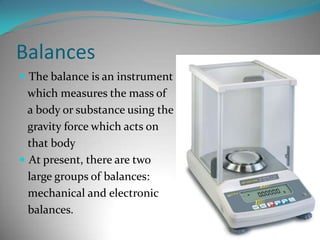
 The balance is an instrument

which measures the mass of
a body or substance using the
gravity force which acts on
that body
 At present, there are two
large groups of balances:
mechanical and electronic
balances.
Spring balance
Sliding weight balance.
Analytical balance.
Mechanical Balances
1.0 Spring balance

 Its function is based on a mechanical

property of springs as the force exercised
on a spring

2.0 Sliding weight
balance.

3.0 Analytical balance

 This type of balance is equipped with two

known weights which can be moved on
setting scales
Operation Verification
 Verify that the balance is leveled.
 Test the zero mechanism.
 Verify and adjust the sensitivity.
a) Lock the balance.

b) Place a standard weight (equivalent to the optical scale range) on the plate.
c) Position the micro setting to one (1).
d) Release the balance.
e) Adjust to the zero position.
Maintenance of the mechanical balance
Daily

Annually

Verify the level.
2. Verify the zero setting.
3. Verify the sensitivity
adjustment.
4. Clean the weighing plate.

1.

1.

Calibrate the balance and
document the process.
2. Disassemble and clean the
internal components.
Electronic balances
 The weighing plate.
 A measuring device
 Electronic controlling parts and display
The weighing plate.
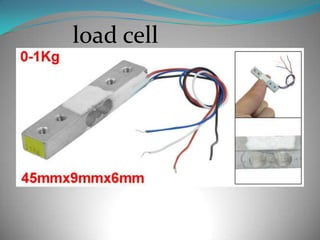
load cell
Theory of operation
 Electronic balances are mostly used two different

technologies.
 Load cell / Strain gauge and electromagnetic force
restoration.
 Load cell principle is used for all scales with higher
limits and less accuracy like patient and baby
scales, while high quality analytical balances are used
electromagnetic force restoration principle.
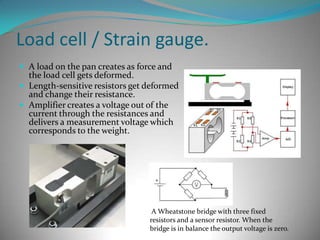
Load cell / Strain gauge.
 A load on the pan creates as force and

the load cell gets deformed.
 Length-sensitive resistors get deformed
and change their resistance.
 Amplifier creates a voltage out of the
current through the resistances and
delivers a measurement voltage which
corresponds to the weight.

A Wheatstone bridge with three fixed
resistors and a sensor resistor. When the
bridge is in balance the output voltage is zero.
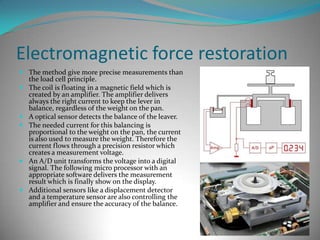
Electromagnetic force restoration
 The method give more precise measurements than
the load cell principle.
 The coil is floating in a magnetic field which is
created by an amplifier. The amplifier delivers
always the right current to keep the lever in
balance, regardless of the weight on the pan.
 A optical sensor detects the balance of the leaver.
 The needed current for this balancing is
proportional to the weight on the pan, the current
is also used to measure the weight. Therefore the
current flows through a precision resistor which
creates a measurement voltage.
 An A/D unit transforms the voltage into a digital
signal. The following micro processor with an
appropriate software delivers the measurement
result which is finally show on the display.
 Additional sensors like a displacement detector
and a temperature sensor are also controlling the
amplifier and ensure the accuracy of the balance.
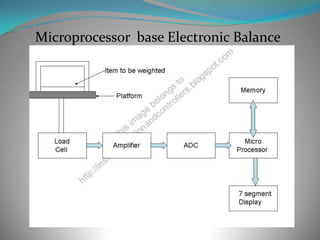
Microprocessor base Electronic Balance
Power Supply
1.
2.
3.
4.

5.
6.

The input socket with the plug
from the external power supply.
The glass fuse.
A capacitor. Works together
with the following coil as a
filter for the DC input voltage.
Looks like a transformer, but is
just a coil for filtering out any
AC components of the
DC voltage.
Three stabilizers for three
different DC output voltages.
Capacitors for stabilizing the
output voltages.
Maintenance Check list
 Clean the weighing plate, Remove any contaminations.
 Check door open and closed is smooth.
 Clean the weighing chamber, externally and internally.
 Check the “Zero point display ” is stable.
 Verify that the adjustment mechanisms on the front door of the

weighing chamber works adequately
 clean, pre-weighed container for weighing (glass container or weighing
paper if possible). Note that plastic can become electromagnetically
charged and is not recommended for weighing powdered or granulated
chemicals.
 Any spill must be cleaned immediately to avoid corrosion or
contamination. Use 70% ethanol to disinfect the pan of the balance.
Basic fault Identification
 The weight reading is

incorrect.
 The balance’s reader is
unstable.
 Functional Error
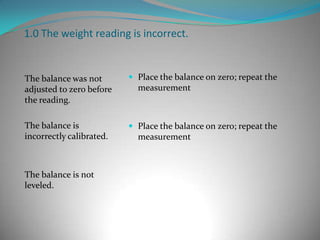
1.0 The weight reading is incorrect.

The balance was not
adjusted to zero before
the reading.

 Place the balance on zero; repeat the

The balance is
incorrectly calibrated.

 Place the balance on zero; repeat the

The balance is not
leveled.

measurement

measurement
2.0 The balance’s reader is unstable.

The balance’s reader is
unstable.

 Place the balance on a stable surface

The front door of the
balance is open.

 Close the front door to measure
Functional Error
Readings not
reproducible (hysteresis).

 The measurement cell is dirty.

Non-linear readings

 Non-linear readings

 The measurement cell is badly assembled.

 Mechanical system is in bad condition.

The screen indicates an
overload or negative
condition without a load
being applied.

 Measuring cell damaged by overload.
 Measuring cell is inadequately assembled.
Balances

Balances

  • 1.
    Balances  The balanceis an instrument which measures the mass of a body or substance using the gravity force which acts on that body  At present, there are two large groups of balances: mechanical and electronic balances.
  • 2.
  • 3.
  • 4.
  • 5.
    Mechanical Balances 1.0 Springbalance  Its function is based on a mechanical property of springs as the force exercised on a spring 2.0 Sliding weight balance. 3.0 Analytical balance  This type of balance is equipped with two known weights which can be moved on setting scales
  • 6.
    Operation Verification  Verifythat the balance is leveled.  Test the zero mechanism.  Verify and adjust the sensitivity. a) Lock the balance. b) Place a standard weight (equivalent to the optical scale range) on the plate. c) Position the micro setting to one (1). d) Release the balance. e) Adjust to the zero position.
  • 7.
    Maintenance of themechanical balance Daily Annually Verify the level. 2. Verify the zero setting. 3. Verify the sensitivity adjustment. 4. Clean the weighing plate. 1. 1. Calibrate the balance and document the process. 2. Disassemble and clean the internal components.
  • 8.
    Electronic balances  Theweighing plate.  A measuring device  Electronic controlling parts and display
  • 9.
  • 10.
  • 11.
    Theory of operation Electronic balances are mostly used two different technologies.  Load cell / Strain gauge and electromagnetic force restoration.  Load cell principle is used for all scales with higher limits and less accuracy like patient and baby scales, while high quality analytical balances are used electromagnetic force restoration principle.
  • 12.
    Load cell /Strain gauge.  A load on the pan creates as force and the load cell gets deformed.  Length-sensitive resistors get deformed and change their resistance.  Amplifier creates a voltage out of the current through the resistances and delivers a measurement voltage which corresponds to the weight. A Wheatstone bridge with three fixed resistors and a sensor resistor. When the bridge is in balance the output voltage is zero.
  • 13.
    Electromagnetic force restoration The method give more precise measurements than the load cell principle.  The coil is floating in a magnetic field which is created by an amplifier. The amplifier delivers always the right current to keep the lever in balance, regardless of the weight on the pan.  A optical sensor detects the balance of the leaver.  The needed current for this balancing is proportional to the weight on the pan, the current is also used to measure the weight. Therefore the current flows through a precision resistor which creates a measurement voltage.  An A/D unit transforms the voltage into a digital signal. The following micro processor with an appropriate software delivers the measurement result which is finally show on the display.  Additional sensors like a displacement detector and a temperature sensor are also controlling the amplifier and ensure the accuracy of the balance.
  • 14.
  • 15.
    Power Supply 1. 2. 3. 4. 5. 6. The inputsocket with the plug from the external power supply. The glass fuse. A capacitor. Works together with the following coil as a filter for the DC input voltage. Looks like a transformer, but is just a coil for filtering out any AC components of the DC voltage. Three stabilizers for three different DC output voltages. Capacitors for stabilizing the output voltages.
  • 17.
    Maintenance Check list Clean the weighing plate, Remove any contaminations.  Check door open and closed is smooth.  Clean the weighing chamber, externally and internally.  Check the “Zero point display ” is stable.  Verify that the adjustment mechanisms on the front door of the weighing chamber works adequately  clean, pre-weighed container for weighing (glass container or weighing paper if possible). Note that plastic can become electromagnetically charged and is not recommended for weighing powdered or granulated chemicals.  Any spill must be cleaned immediately to avoid corrosion or contamination. Use 70% ethanol to disinfect the pan of the balance.
  • 18.
    Basic fault Identification The weight reading is incorrect.  The balance’s reader is unstable.  Functional Error
  • 19.
    1.0 The weightreading is incorrect. The balance was not adjusted to zero before the reading.  Place the balance on zero; repeat the The balance is incorrectly calibrated.  Place the balance on zero; repeat the The balance is not leveled. measurement measurement
  • 20.
    2.0 The balance’sreader is unstable. The balance’s reader is unstable.  Place the balance on a stable surface The front door of the balance is open.  Close the front door to measure
  • 21.
    Functional Error Readings not reproducible(hysteresis).  The measurement cell is dirty. Non-linear readings  Non-linear readings  The measurement cell is badly assembled.  Mechanical system is in bad condition. The screen indicates an overload or negative condition without a load being applied.  Measuring cell damaged by overload.  Measuring cell is inadequately assembled.