4th Annual 
Practical Funds Transfer Pricing and Balance Sheet Management Forum 
17th September 2014, London, UK 
NSFR LIQUIDITY FRAMEWORK: 
Theoretical Implementation 
Requirements 
IMPLEMENTATION REQUIREMENTS TO ADAPT 
TO NEW NSFR LIQUIDITY PARAMETERS 
WORKSHOP 
Rodrigo Zepeda 
Independent Consultant
Section 1: 
An Overview of the NSFR Liquidity Framework 
Section 2: 
Building NSFR into FTP Logic 
Section 3: 
Integrating NSFR into FTP and Liquidity Management Systems 
Section 4: 
FTP and NSFR: Strategic Considerations 
1
An Overview of the NSFR 
Liquidity Framework 
SECTION 1 
3
Basel III, the LCR, and the NSFR 
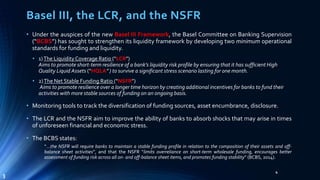
• Under the auspices of the new Basel III Framework, the Basel Committee on Banking Supervision 
(“BCBS”) has sought to strengthen its liquidity framework by developing two minimum operational 
standards for funding and liquidity. 
• 1) The Liquidity Coverage Ratio (“LCR”) 
Aims to promote short-term resilience of a bank’s liquidity risk profile by ensuring that it has sufficient High 
Quality Liquid Assets (“HQLA” ) to survive a significant stress scenario lasting for one month. 
• 2) The Net Stable Funding Ratio (“NSFR”) 
Aims to promote resilience over a longer time horizon by creating additional incentives for banks to fund their 
activities with more stable sources of funding on an ongoing basis. 
• Monitoring tools to track the diversification of funding sources, asset encumbrance, disclosure. 
• The LCR and the NSFR aim to improve the ability of banks to absorb shocks that may arise in times 
of unforeseen financial and economic stress. 
• The BCBS states: 
“…the NSFR will require banks to maintain a stable funding profile in relation to the composition of their assets and off-balance 
sheet activities”, and that the NSFR “limits overreliance on short-term wholesale funding, encourages better 
assessment of funding risk across all on- and off-balance sheet items, and promotes funding stability” (BCBS, 2014). 
4 
3
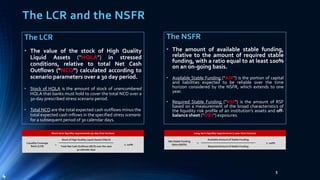
The LCR and the NSFR 
The LCR 
• The value of the stock of High Quality 
Liquid Assets (“HQLA”) in stressed 
conditions, relative to total Net Cash 
Outflows (“NCO”) calculated according to 
scenario parameters over a 30 day period. 
• Stock of HQLA is the amount of stock of unencumbered 
HQLA that banks must hold to cover the total NCO over a 
30-day prescribed stress scenario period. 
• Total NCO are the total expected cash outflows minus the 
total expected cash inflows in the specified stress scenario 
for a subsequent period of 30 calendar days. 
The NSFR 
• The amount of available stable funding, 
relative to the amount of required stable 
funding, with a ratio equal to at least 100% 
on an on-going basis. 
• Available Stable Funding (“ASF”) is the portion of capital 
and liabilities expected to be reliable over the time 
horizon considered by the NSFR, which extends to one 
year. 
• Required Stable Funding (“RSF”) is the amount of RSF 
based on a measurement of the broad characteristics of 
the liquidity risk profile of an institution’s assets and off-balance 
sheet (“OBS”) exposures. 
5 
Short-term liquidity requirements (30 day time horizon) 
Liquidity Coverage 
Ratio (LCR) 
= 
Stock of High Quality Liquid Assets (HQLA) 
≥ 100% 
Total Net Cash Outflows (NCO) over the next 
30 calendar days 
Long-term liquidity requirements (1 year time horizon) 
Net Stable Funding 
Ratio (NSFR) 
= 
Available Amount of Stable Funding 
≥ 100% 
Required Amount of Stable Funding 
4
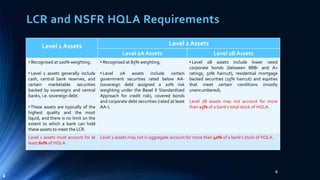
LCR and NSFR HQLA Requirements 
6 
Level 1 Assets Level 2 Assets 
Level 2A Assets Level 2B Assets 
• Recognised at 100%weighting. 
• Level 1 assets generally include 
cash, central bank reserves, and 
certain marketable securities 
backed by sovereigns and central 
banks, i.e. sovereign debt. 
•These assets are typically of the 
highest quality and the most 
liquid, and there is no limit on the 
extent to which a bank can hold 
these assets to meet the LCR. 
• Recognised at 85%weighting. 
• Level 2A assets include certain 
government securities rated below AA- 
(sovereign debt assigned a 20% risk 
weighting under the Basel II Standardised 
Approach for credit risk), covered bonds 
and corporate debt securities (rated at least 
AA-). 
• Level 2B assets include lower rated 
corporate bonds (between BBB- and A+ 
ratings, 50% haircut), residential mortgage 
backed securities (25% haircut) and equities 
that meet certain conditions (mostly 
unencumbered). 
Level 2B assets may not account for more 
than 15%of a bank’s total stock of HQLA. 
Level 1 assets must account for at 
least 60% of HQLA. 
Level 2 assets may not in aggregate account for more than 40% of a bank’s stock of HQLA. 
2
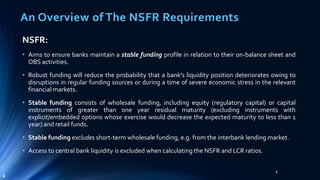
An Overview of The NSFR Requirements 
NSFR: 
• Aims to ensure banks maintain a stable funding profile in relation to their on-balance sheet and 
OBS activities. 
• Robust funding will reduce the probability that a bank’s liquidity position deteriorates owing to 
disruptions in regular funding sources or during a time of severe economic stress in the relevant 
financialmarkets. 
• Stable funding consists of wholesale funding, including equity (regulatory capital) or capital 
instruments of greater than one year residual maturity (excluding instruments with 
explicit/embedded options whose exercise would decrease the expected maturity to less than 1 
year) and retail funds. 
• Stable funding excludes short-term wholesale funding, e.g. from the interbank lending market. 
• Access to central bank liquidity is excluded when calculating the NSFR and LCR ratios. 
7 
2
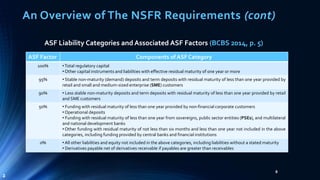
An Overview of The NSFR Requirements (cont) 
8 
ASF Liability Categories and Associated ASF Factors (BCBS 2014, p. 5) 
ASF Factor Components of ASF Category 
100% •Total regulatory capital 
•Other capital instruments and liabilities with effective residual maturity of one year or more 
95% • Stable non-maturity (demand) deposits and term deposits with residual maturity of less than one year provided by 
retail and small and medium-sized enterprise (SME) customers 
90% • Less stable non-maturity deposits and term deposits with residual maturity of less than one year provided by retail 
and SME customers 
50% • Funding with residual maturity of less than one year provided by non-financial corporate customers 
•Operational deposits 
• Funding with residual maturity of less than one year from sovereigns, public sector entities (PSEs), and multilateral 
and national development banks 
•Other funding with residual maturity of not less than six months and less than one year not included in the above 
categories, including funding provided by central banks and financial institutions 
0% •All other liabilities and equity not included in the above categories, including liabilities without a stated maturity 
• Derivatives payable net of derivatives receivable if payables are greater than receivables 
2
An Overview of The NSFR Requirements (cont) 
9 
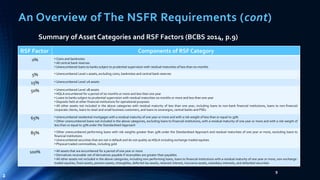
Summary of Asset Categories and RSF Factors (BCBS 2014, p.9) 
RSF Factor Components of RSF Category 
0% • Coins and banknotes 
• All central bank reserves 
• Unencumbered loans to banks subject to prudential supervision with residual maturities of less than six months 
5% • Unencumbered Level 1 assets, excluding coins, banknotes and central bank reserves 
15% • Unencumbered Level 2A assets 
50% • Unencumbered Level 2B assets 
• HQLA encumbered for a period of six months or more and less than one year 
• Loans to banks subject to prudential supervision with residual maturities six months or more and less than one year 
• Deposits held at other financial institutions for operational purposes 
• All other assets not included in the above categories with residual maturity of less than one year, including loans to non-bank financial institutions, loans to non-financial 
corporate clients, loans to retail and small business customers, and loans to sovereigns, central banks and PSEs 
65% • Unencumbered residential mortgages with a residual maturity of one year or more and with a risk weight of less than or equal to 35% 
• Other unencumbered loans not included in the above categories, excluding loans to financial institutions, with a residual maturity of one year or more and with a risk weight of 
less than or equal to 35%under the Standardised Approach 
85% • Other unencumbered performing loans with risk weights greater than 35% under the Standardised Approach and residual maturities of one year or more, excluding loans to 
financial institutions 
• Unencumbered securities that are not in default and do not quality as HQLA including exchange-traded equities 
• Physical traded commodities, including gold 
100% • All assets that are encumbered for a period of one year or more 
• Derivatives receivable net of derivatives payable if receivables are greater than payables 
• All other assets not included in the above categories, including non-performing loans, loans to financial institutions with a residual maturity of one year or more, non-exchange-traded 
equities, fixed assets, pension assets, intangibles, deferred tax assets, retained interest, insurance assets, subsidiary interests, and defaulted securities 
2
An Overview of The NSFR Requirements (cont) 
10 
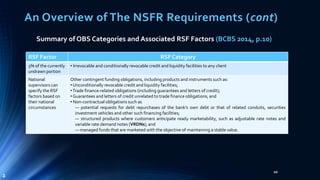
Summary of OBS Categories and Associated RSF Factors (BCBS 2014, p.10) 
RSF Factor RSF Category 
5% of the currently 
undrawn portion 
• Irrevocable and conditionally revocable credit and liquidity facilities to any client 
National 
supervisors can 
specify the RSF 
factors based on 
their national 
circumstances 
Other contingent funding obligations, including products and instruments such as: 
•Unconditionally revocable credit and liquidity facilities; 
•Trade finance-related obligations (including guarantees and letters of credit); 
• Guarantees and letters of credit unrelated to trade finance obligations; and 
• Non-contractual obligations such as 
— potential requests for debt repurchases of the bank’s own debt or that of related conduits, securities 
investment vehicles and other such financing facilities; 
— structured products where customers anticipate ready marketability, such as adjustable rate notes and 
variable rate demand notes (VRDNs); and 
— managed funds that are marketed with the objective of maintaining a stable value. 
2
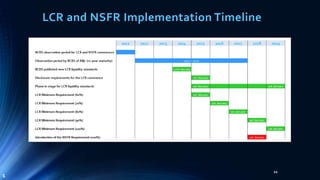
LCR and NSFR Implementation Timeline 
11 
1
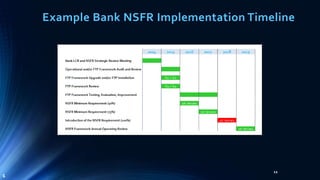
Example Bank NSFR Implementation Timeline 
12 
1
Building NSFR into FTP Logic 
SECTION 2 
13
FTP Logic 
• Funds Transfer Pricing (“FTP”): is a process by which a bank uses an internal 
system to measure and allocate the profitability of outgoing, incoming, or 
invested funds, with a view to measuring the comparative performance of 
different operating business units of a bank. 
• In essence FTP measures the contribution each source of funding makes to the overall 
profitability of the bank or financial institution (“BFI”). 
Moody’s Analytics (2011): 
• FTP is a critical component of risk transfer, profitability measurement, capital allocation, and specifying business 
unit incentives, via allocation of net interest income (“NII”) to products, product lines, or business units. 
• A well-designed FTP system uses a central funding center (i.e. Treasury) to buy funds from liability gatherers at 
an economic funds transfer credit, and sells funds to asset gatherers at an economic funds transfer price; FTP 
rates allow the bank to allocate contribution margin so the line of business (“LOB”) profit and loss (“P&L”) can 
be aggregated to equal the bank’s net interest margin (“NIM”). 
• Theoretical and technical underpinnings of a successful FTP implementation are significant, major hurdle is 
securing buy-in from the banks’ LOB. 
14 
4
Pre- and Post-Crisis Approaches to FTP Systems 
• Pre-Crisis approaches to FTP systems involved bank FTP infrastructures that either did not charge for 
funding liquidity risk or were overly simplistic and lacked responsiveness – deriving from prevailing 
assumption of ‘on tap’ liquidity in wholesalemarkets. 
• Post-Crisis approaches now acknowledge the need for pricing liquidity risk, justified from both the crisis 
experience and empirically proved through bank modelling (IMF, 2013). 
• According to Matz (2011, p.437): “Including liquidity costs and benefits in prices is unquestionably the 
biggest single improvement risk managers can make.” 
• Features of allocating liquidity costs and benefits in a LiquidityTransfer Pricing (“LTP”) system: 
• Reduces deposit disintermediation and lowers reliance on volatile funding; 
• Receives compensation for OBS commitments that reflect risks taken; 
• Reduces foregone interest lost from holdings of excess buffer assets; 
• Increases income; 
• Makes it possible to evaluate performance of buffer portfolio without comparison to arbitrary benchmarks; 
• Improves liquidity risk management fromtrading activities; and 
• Complies with regulatory guidance (Matz 2011, p.438-443). 
15 
4
The Features of a LTP System (FSI 2011, p.4) 
• Attributes the liquidity costs, benefits and risks from business units to a centrally managed pool, charging for 
fund users (i.e. assets/loans) for cost of liquidity, and crediting fund providers (i.e. liabilities/deposits) for 
liquidity benefits. 
• Costs of providing liquidity cushion are recouped through charges for contingent commitments (e.g. lines of 
credit, collateral postings, liquidity facilities) based on predicted use of liquidity. 
16 
3
LTP System Guiding Principles 
Principles for Sound Liquidity Risk Management and Supervision (BCBS, 2008) (“Liquidity Principles”): 
• Principle 1: A bank is responsible for the sound management of liquidity risk. 
• Principle 2: A bank should clearly articulate a liquidity risk tolerance that is appropriate for its business strategy 
and its role in the financial system. 
• Principle 4: A bank should incorporate liquidity costs, benefits and risks in the internal pricing, performance 
measurement and new product approval process for all significant business activities (both on- and off-balance 
sheet), thereby aligning the risk-taking incentives of individual business lines with the liquidity risk exposures 
their activities create for the bank as a whole. 
• Principle 5: A bank should have a sound process for identifying, measuring, monitoring and controlling liquidity 
risk. This process should include a robust framework for comprehensively projecting cash flows arising from 
assets, liabilities and off-balance sheet items over an appropriate set of time horizons. 
• Principle 6: A bank should actively monitor and control liquidity risk exposures and funding needs within and 
across legal entities, business lines and currencies, taking into account legal, regulatory and operational 
limitations to the transferability of liquidity. 
17 
3
Building NSFR into FTP Logic 
• Static or Dynamic Basel III framework? 
• Update an old FTP system or devise and implement a new FTP system? 
• Separate or Integrated Basel III and FTP systems and steering mechanisms? 
• Compliance of external and internal requirements on an aggregate level 
(Kratky, 2012)? 
• Compliance of external and internal requirements on a product level (Kratky, 
2012)? 
• Immediate (anticipating Basel III funding costs) or Phased-In higher FTP costs 
(Kratky, 2012)? 
• Management of Basel III ratios in isolation or managed simultaneously? 
18 
4
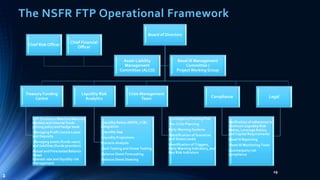
The NSFR FTP Operational Framework 
19 
Board of Directors 
Treasury Funding 
Centre 
Liquidity Risk 
Analytics 
FTP (Pooled or Matched Maturity 
Models) and internal funds 
pricing policy and hedge book 
Managing Profit Centre Loans 
and Deposits 
Managing assets (funds users) 
and liabilities (funds providers) 
Actual and Forecasted Balance 
Sheet 
Interest rate and liquidity risk 
management 
Crisis Management 
Team 
Liquidity Ratios (NSFR, LCR) 
Integration 
Liquidity Gap 
Liquidity Projections 
Scenario Analysis 
Back Testing and Stress Testing 
Balance Sheet Forecasting 
Balance Sheet Steering 
Contingency Funding Plan 
Pre-Crisis Planning 
Early Warning Systems 
Identification of Scenarios 
and Stress Levels 
Identification of Triggers, 
Early Warning Indicators, and 
Key Risk Indicators 
Chief Risk Officer 
Chief Financial 
Officer 
Asset-Liability 
Management 
Committee (ALCO) 
Basel III Management 
Committee / 
Project Working Group 
Compliance Legal 
Verification of adherence to 
minimum Liquidity Risk 
Ratios, Leverage Ratios, 
and Capital Requirements 
Basel III Reporting 
Basel III Monitoring Tools 
Counterparty risk 
compliance 
2
Integrating NSFR into FTP and 
Liquidity Management Systems 
SECTION 3 
20
The Foundations of a Robust NSFR LTP-FTP Framework 
• Liquidity Principle 1: “A bank should establish a robust liquidity risk management framework that ensures it 
maintains sufficient liquidity, including a cushion of unencumbered, high quality liquid assets, to withstand 
a range of stress events, including those involving the loss or impairment of both unsecured and secured 
funding sources. Supervisors should assess the adequacy of both a bank’s liquidity risk management 
framework and its liquidity position and should take prompt action if a bank is deficient in either area in 
order to protect depositors and to limit potential damage to the financial system” (BCBS 2008, p.3). 
• Liquidity Principle 7:“A bank should establish a funding strategy that provides effective diversification in the 
sources and tenor of funding. It should maintain an ongoing presence in its chosen funding markets and 
strong relationships with funds providers to promote effective diversification of funding sources. A bank 
should regularly gauge its capacity to raise funds quickly from each source. It should identify the main 
factors that affect its ability to raise funds and monitor those factors closely to ensure that estimates of 
fund raising capacity remain valid” (BCBS 2008, pp.3-4). 
• Liquidity Principle 12: “A bank should maintain a cushion of unencumbered, high quality liquid assets to be 
held as insurance against a range of liquidity stress scenarios, including those that involve the loss or 
impairment of unsecured and typically available secured funding sources. There should be no legal, 
regulatory or operational impediment to using these assets to obtain funding” (BCBS 2008, p.4). 
21 
2
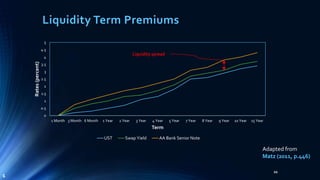
Liquidity Term Premiums 
5 
4.5 
4 
3.5 
3 
2.5 
2 
1.5 
1 
0.5 
0 
1 Month 3 Month 6 Month 1 Year 2 Year 3 Year 4 Year 5 Year 7 Year 8 Year 9 Year 10 Year 15 Year 
Rates (percent) 
Term 
UST Swap Yield AA Bank Senior Note 
Adapted from 
Matz (2011, p.446) 
22 
Liquidity spread 
1
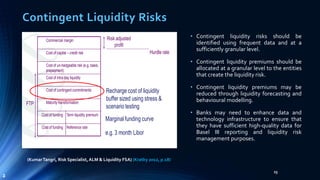
Contingent Liquidity Risks 
• Contingent liquidity risks should be 
identified using frequent data and at a 
sufficiently granular level. 
• Contingent liquidity premiums should be 
allocated at a granular level to the entities 
that create the liquidity risk. 
• Contingent liquidity premiums may be 
reduced through liquidity forecasting and 
behavioural modelling. 
• Banks may need to enhance data and 
technology infrastructure to ensure that 
they have sufficient high-quality data for 
Basel III reporting and liquidity risk 
management purposes. 
23 
2 
Funds Transfer Pricing 
FTP 
Risk adjusted 
profit 
Recharge cost of liquidity 
buffer sized using stress & 
scenario testing 
Commercial margin 
Cost of capital – credit risk 
Cost of un-hedgeable risk (e.g. basis, 
prepayment) 
Cost of intra day liquidity 
Cost of contingent commitments 
Maturity transformation 
Cost of funding Term liquidity premium 
Cost of funding Reference rate 
Marginal funding curve 
e.g. 3 month Libor 
Hurdle rate 
(Kumar Tangri, Risk Specialist, ALM & Liquidity FSA) (Kratky 2012, p.18)
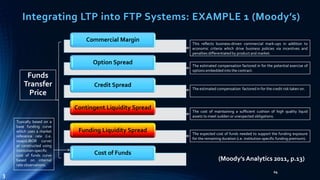
Integrating LTP into FTP Systems: EXAMPLE 1 (Moody’s) 
This reflects business-driven commercial mark-ups in addition to 
economic criteria which drive business policies via incentives and 
penalties differentiated by product and market. 
The estimated compensation factored in for the potential exercise of 
options embedded into the contract. 
The estimated compensation factored in for the credit risk taken on. 
The cost of maintaining a sufficient cushion of high quality liquid 
assets to meet sudden or unexpected obligations. 
24 
Commercial Margin 
Option Spread 
Credit Spread 
Contingent Liquidity Spread 
Funding Liquidity Spread 
Cost of Funds 
(Moody’s Analytics 2011, p.13) 
Funds 
Transfer 
Price 
Typically based on a 
base funding curve 
which uses a market 
reference rate (i.e. 
swap/LIBOR curve) 
or constructed using 
institution-specific 
cost of funds curve 
based on internal 
rate observations. 
The expected cost of funds needed to support the funding exposure 
for the remaining duration (i.e. institution-specific funding premium). 
3
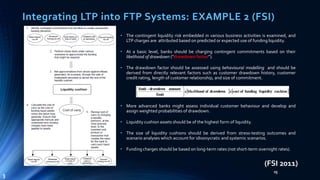
Integrating LTP into FTP Systems: EXAMPLE 2 (FSI) 
• The contingent liquidity risk embedded in various business activities is examined, and 
LTP charges are attributed based on predicted or expected use of funding liquidity. 
• At a basic level, banks should be charging contingent commitments based on their 
likelihood of drawdown  cost of funding liquidity cushion 
(FSI 2011) 
25 
likelihood of drawdown (“drawdown factor”). 
• The drawdown factor should be assessed using behavioural modelling and should be 
derived from directly relevant factors such as customer drawdown history, customer 
credit rating, length of customer relationship, and size of commitment. 
limit - drawdown amount 
limit 
 
x x  
 
 
 
• More advanced banks might assess individual customer behaviour and develop and 
assign weighted probabilities of drawdown. 
• Liquidity cushion assets should be of the highest form of liquidity. 
• The size of liquidity cushions should be derived from stress-testing outcomes and 
scenario analyses which account for idiosnycratic and systemic scenarios. 
• Funding charges should be based on long-termrates (not short-termovernight rates). 
3
Integrating LTP into FTP Systems: EXAMPLE 3 (Matz) 
• DIRECT current mismatch costs : 
• Mismatch (term structure) costs; 
• Mismatch component of liquidity risk is fairly stable; 
• Debits and credits should equal after adjustment (e.g. liquidity life of 
indeterminate maturity deposits, rollover life of retail time deposits). 
• INDIRECT future contingent costs: 
• Standby liquidity costs; 
• Contingency component of liquidity risk is very volatile; 
• Charges and credits need to be 100% assigned to products and business 
activities, and full amount of cost (but no more) is allocated as income 
to contingent liquidity risk hedges. 
• The cost of liquidity contingency risk is the hedge cost: 
• Holding unencumbered high-quality marketable assets: Cost is the 
forgone income, the opportunity cost, resulting from the choice to hold 
lower-yielding assets. 
• Holding stable long-term liabilities: Cost is the difference between the 
actual cost of funding and the lowest possible cost. 
26 
Mismatch term or structural risk is 
charged for consuming liquidity 
risk, and the offsetting credit is 
applied to existing liabilities. 
Unfunded 
Funded 
Revolving Loan 
Contingent risk is charged on 
unfunded portion of loan, and 
offsetting credit is split between 
unpledged buffer assets hedge and 
long-termliabilities hedge. 
Unpledged Liquid 
Assets Held 
Long Term 
Liabilities* 
Core Deposits 
Long Term Liabilities 
Contingent 
Charges & 
Credits 
Mismatch 
(Structural) 
Charges & 
Credits 
Liquidity Charges 
* Only amounts required to cover contingent risk 
(Matz 2011, p.464) 
[Sourced from Joanne Trefrey, Bank of Monntreal] 
(Matz 2011) 
4
NSFR Balance Sheet Calculation 
• Discuss Basel III Monitoring Reporting Template (Version 2.6.1) (Bank of 
Luxembourg) – separate Microsoft Excel sheet. 
27 
3
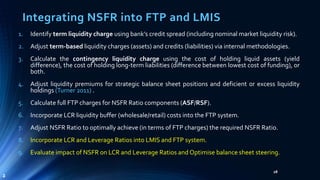
Integrating NSFR into FTP and LMIS 
1. Identify term liquidity charge using bank’s credit spread (including nominal market liquidity risk). 
2. Adjust term-based liquidity charges (assets) and credits (liabilities) via internal methodologies. 
3. Calculate the contingency liquidity charge using the cost of holding liquid assets (yield 
difference), the cost of holding long-term liabilities (difference between lowest cost of funding), or 
both. 
4. Adjust liquidity premiums for strategic balance sheet positions and deficient or excess liquidity 
holdings (Turner 2011) . 
5. Calculate full FTP charges for NSFR Ratio components (ASF/RSF). 
6. Incorporate LCR liquidity buffer (wholesale/retail) costs into the FTP system. 
7. Adjust NSFR Ratio to optimally achieve (in terms of FTP charges) the required NSFR Ratio. 
8. Incorporate LCR and Leverage Ratios into LMIS and FTP system. 
9. Evaluate impact of NSFR on LCR and Leverage Ratios and Optimise balance sheet steering. 
28 
2
FTP and NSFR: Strategic 
Considerations 
SECTION 4 
29
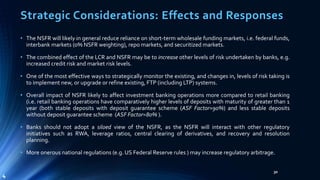
Strategic Considerations: Effects and Responses 
• The NSFR will likely in general reduce reliance on short-term wholesale funding markets, i.e. federal funds, 
interbank markets (o% NSFR weighting), repo markets, and securitized markets. 
• The combined effect of the LCR and NSFR may be to increase other levels of risk undertaken by banks, e.g. 
increased credit risk and market risk levels. 
• One of the most effective ways to strategically monitor the existing, and changes in, levels of risk taking is 
to implement new, or upgrade or refine existing, FTP (including LTP) systems. 
• Overall impact of NSFR likely to affect investment banking operations more compared to retail banking 
(i.e. retail banking operations have comparatively higher levels of deposits with maturity of greater than 1 
year (both stable deposits with deposit guarantee scheme (ASF Factor=90%) and less stable deposits 
without deposit guarantee scheme (ASF Factor=80%). 
• Banks should not adopt a siloed view of the NSFR, as the NSFR will interact with other regulatory 
initiatives such as RWA, leverage ratios, central clearing of derivatives, and recovery and resolution 
planning. 
• More onerous national regulations (e.g. US Federal Reserve rules ) may increase regulatory arbitrage. 
30 
4
Strategic Considerations: Increasing the NSFR 
“The changes may go beyond simply changing the composition 
of existing balance sheets; banks may also need to exit some 
businesses or adopt new business models” (King 2013, p.4153) 
31 
King (2013): 
• The study estimated the NSFR for banks in 15 countries and the 
impact on Net Interest Margins (“NIMs”). 
• The analysis showed suggested that banks in France, Germany, 
Switzerland, and the UK might experience greatest declines in 
NIMs in meeting NSFR, owing to their universal banking model with 
highly diversified funding and a high concentration of trading assets. 
• Average decline for them was -156 basis points (“bp”) compared to 
-27 bp for 6 other banks (Canada; Mexico; Netherlands; Spain; 
Italy;Australia) below NSFR ratio. 
• Banks must either increase ASF, reduce RSF, or both by: (1) 
extending maturity of wholesale funding (2) Increase the share of 
corporate loans to retail loans and shorten maturity; (3) sell 
investments and increase cash holdings; and (4) increase holding 
of high-quality liquid bonds. 
[Study was based on a sample of (commercial, investment, savings, cooperative, and 
mortgage) banks in 15 countries (Australia; Canada; Chile; France; Germany; Hong Kong; 
Italy; Japan; Korea; Mexico; Netherlands; Spain; Switzerland; UK; USA) using income 
statement and balance sheet data as of year-end 2009] 
Strategies to increase the NSFR (King 2013, p.4147) 
3
Strategic Perspectives 
32 
IMF (2014): 
• High number of banks meeting minimum 100% NSFR 
threshold (86% out of total of 2,079 banks) at end- 
2012 (excluding France, Germany, Portugal, Slovenia). 
• Sensitivity tests used showed NSFR is sensitive to 
changes in the weights assigned to loans and 
deposits, and less to securities and OBS categories, 
i.e. changes in loan and deposit weights will have a 
substantial impact on how banks meet/do not meet 
100% NSFR threshold. 
• Socio-economic and political context needs to be 
taken into account, e.g. high NSFR ratios may reflect 
a lack of confidence in the system or potential balance 
of payment problems indicated by high government 
securities holdings and deposits. 
[Study was based on an empirical analysis of end-2012 financial data for 
2,079 banks covering 128 countries] 
PwC (2014): 
• Secured financing transactions unduly penalised as 
transacted with non-banks (50%weighting). 
• Disruptive impact on derivatives (50% weighting with 
central clearing house), repos, and trade finance 
agreements (50%weighting). 
• Three potential options for dealing with NSFR: 
1. reduce volume of NSFR-unfriendly transactions (likely 
to erode market credibility; 
2. reduce asset-liability mismatch by reducing tenor of 
assets (likely to lead to loss of clients seeking 
alternative maturities elsewhere); 
3. extend maturities of liabilities (most viable option). 
[Findings are partly based on the views of bankers attending a PwC-hosted 
round table on the latest developments in NSFR] 
3
Strategic Perspectives (cont) 
33 
(Fielder and Mahlnecht, 2013) 
• Improving one Basel III ratio such as the LCR in isolation is pointless if another ratio such as the NSFR is negatively effected, or the 
resulting transaction needs to be “healed” (e.g. through strategically unwanted balance sheet expansion). 
Optimisation: 
• Reduce indirect costs of loans, for instance by streamlining lending processes, increasing automation, reducing local branch networks, 
and by improving collateral management (e.g. cross-collateralisation) and securitizing parts of balance sheets held. 
• Banks that dispose of excess liquidity/HQLA can use assets to make profits by servicing other banks in need of LCR/NSFR 
improvements. 
• NSFR numerator can be improved by term repo on illiquid ineligible securities (RSF 100%) which cheapens funding costs whilst 
satisfying NSFR. 
• Banks can borrow HQLA eligible assets and collateralize themwith non-eligible assets (“asset/asset-swaps”). 
Structured Implementation: 
• Considering: (1) which business types have to be reduced or abandoned; (2) which new opportunities arise; (3) 
analysis of interdependencies; (4) adapting existing strategy planning processes; (5) deciding on business model 
changes; (6) planning deposit and asset structures and use of FTP and limits; (7) can the LCR and NSFR be actively 
steered to facilitate new business plans. 
3
Strategic Perspectives (cont) 
34 
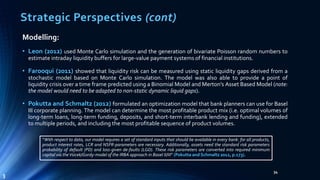
Modelling: 
• Leon (2012) used Monte Carlo simulation and the generation of bivariate Poisson random numbers to 
estimate intraday liquidity buffers for large-value payment systems of financial institutions. 
• Farooqui (2011) showed that liquidity risk can be measured using static liquidity gaps derived from a 
stochastic model based on Monte Carlo simulation. The model was also able to provide a point of 
liquidity crisis over a time frame predicted using a Binomial Model and Merton’s Asset Based Model (note: 
the model would need to be adapted to non-static dynamic liquid gaps). 
• Pokutta and Schmaltz (2012) formulated an optimization model that bank planners can use for Basel 
III corporate planning. The model can determine the most profitable product mix (i.e. optimal volumes of 
long-term loans, long-term funding, deposits, and short-term interbank lending and funding), extended 
to multiple periods, and including the most profitable sequence of product volumes. 
“With respect to data, our model requires a set of standard inputs that should be available in every bank: for all products, 
product interest rates, LCR and NSFR-parameters are necessary. Additionally, assets need the standard risk parameters 
probability of default (PD) and loss-given de-faults (LGD). These risk parameters are converted into required minimum 
capital via theVsicek/Gordy-model of the IRBA approach in Basel II/III” (Pokutta and Schmaltz 2012, p.173). 
3
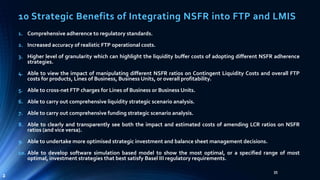
10 Strategic Benefits of Integrating NSFR into FTP and LMIS 
35 
1. Comprehensive adherence to regulatory standards. 
2. Increased accuracy of realistic FTP operational costs. 
3. Higher level of granularity which can highlight the liquidity buffer costs of adopting different NSFR adherence 
strategies. 
4. Able to view the impact of manipulating different NSFR ratios on Contingent Liquidity Costs and overall FTP 
costs for products, Lines of Business, Business Units, or overall profitability. 
5. Able to cross-net FTP charges for Lines of Business or Business Units. 
6. Able to carry out comprehensive liquidity strategic scenario analysis. 
7. Able to carry out comprehensive funding strategic scenario analysis. 
8. Able to clearly and transparently see both the impact and estimated costs of amending LCR ratios on NSFR 
ratios (and vice versa). 
9. Able to undertake more optimised strategic investment and balance sheet management decisions. 
10. Able to develop software simulation based model to show the most optimal, or a specified range of most 
optimal, investment strategies that best satisfy Basel III regulatory requirements. 
2
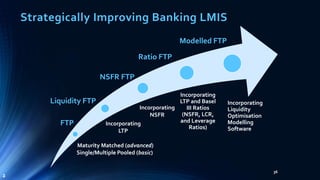
Strategically Improving Banking LMIS 
36 
Incorporating 
LTP 
Maturity Matched (advanced) 
Single/Multiple Pooled (basic) 
Incorporating 
LTP and Basel 
III Ratios 
(NSFR, LCR, 
and Leverage 
Ratios) 
Incorporating 
Liquidity 
Optimisation 
Modelling 
Software 
Ratio FTP 
NSFR FTP 
Liquidity FTP 
FTP 
Modelled FTP 
Incorporating 
NSFR 
2
37
38 
References: (1) 
• Accenture (2011). Basel III and Its Consequences: Confronting a New Regulatory Environment. Accenture Management Consulting, by Michael Auer, 
(Executive Principal, Accenture Risk Management, Munich), Georg von Pfoestl (Manager, Accenture Risk Management, Vienna), and Jacek 
Kochanowicz (Manager, Accenture Risk Management, Frankfurt). 
• AxiomEPM (2012). Extracting More Value from FundsTransfer Pricing. (April).White Paper. 
• BCBS (2010). Results of the comprehensive quantitative impact study. (December). Basel Committee on Banking Supervision, Bank for International 
Settlements. 
• BCBS (2013). Basel III: The Liquidity Coverage Ratio and liquidity risk monitoring tools. (January). Basel Committee on Banking Supervision, Bank for 
International Settlements. 
• BCBS (2014). Basel III: The Net Stable Funding Ratio. (January). Basel Committee on Banking Supervision, Bank for International Settlements. 
• Becker, L. (2014). Repo desks up in arms about NSFR. (7 April), Riskmagazine. 
• CEBS (2010). Results of the comprehensive quantitative impact study. (16 December). Committee of European Banking Supervisors. 
• Devasabai, K. (2014). Hedge funds face higher prime broker charges under Basel III. (18 June). Risk Magazine. 
• Farooqui, S. (2011). Development of Simulation based Model to quantify the degree of Bank’s Liquidity Risk. 2011 ERM Symposium (14-16 March), 
Swissôtel Chicago, Chicago, IL.
39 
References: (2) 
• Felder, R. and Mahlknecht, M. (2013). Basel III: Solving the Liquidity Business Challenge. (April). Capco Journal 37: Cass-Capco Institute Paper Series 
on Risk, pp.76-94. 
• FSI (2011). Liquidity transfer pricing: a guide to better practice (Occasional Paper No 10). (December). Financial Stability institute, Bank for 
International Settlements, by JoelGrant (Australian Prudential Regulation Authority). 
• IMF (2013). Changes in Bank Funding Patterns and Financial Stability Risks, In Global Financial Stability Report: Transition Challenges to Stability, 
pp.105-148. (October), International Monetary Fund. 
• IMF (2014). The Net Stable Funding Ratio: Impact and Issues for Consideration. IMF Working Paper, (WP/14/106) by Jeanne Gobat, Mamoru Yanase, 
and Joseph Maloney (ThisWorking Paper should not be reported as representing the views of the IMF). 
• King,M.R. (2013). The Basel III Net Stable Funding Ratio and bank net interest margins. Journal of Banking & Finance, 37, pp.4144-4156. 
• Kratky, A. (2012). Incorporating Liquidity Risk into Funds Transfer Pricing: Progress and Challenges. Commerzbank (Group Treasury – Liquidity 
Analytics), presentation for the Professional Risk Managers’ International Association. 
• Leon, C. (2012). Estimating the intraday liquidity risk of financial institutions: a Monte Carlo simulation approach. (27 September 2012), Journal of 
FinancialMarket Infrastructures. 
• Linklaters (2011). Basel III and project finance. (July), Briefing by MatthewWorth and Edward Chan, as published in Project Finance International, 29 
June 2011, Issue 460.
40 
References: (3) 
• Matz, L. (2011). Liquidity RiskMeasurement andManagement. Xlibris Corporation. 
• McKinsey (2010). Basel III and European banking: Its impact, how banks might respond, and the challenges of implementation. (November), 
McKinsey Working Papers on Risk, Number 26, McKinsey & Company, by Philipp Härle, Erik Lüders, Theo Pepanides, Sonja Pfetsch, Thomas 
Poppensieker, andUwe Stegemann. 
• Moody’s Analytics (2011). Implementing High Value Funds Transfer Pricing Systems. (September)ModelingMethodology by Robert J.Wyle, CFA and 
YaakovTsaig, Ph.D. 
• Moody’s Analytics (2013). Liquidity Risk Management is a Game Changer. (December) Research /Whitepaper by Cayetano Gea-Carrasco (Stress 
Testing, Balance Sheet Management, and Liquidity Practice Leader) and David Little (Managing Director, Head of the US Enterprise Risk Solutions and 
SalesTeam). 
• Oracle Financial Services (2011).Oracle Financial Services Liquidity Risk Management. Oracle Data Sheet. 
• Pokutta, S. and Schmaltz, C. (2012). Optimal Bank Planning Under Basel III Regulations. Capco Journal of Financial Transformation, Journal 34, 
pp.165-174. 
• PwC (2014). Stretched to the limit: Dealing with the implications of the NSFR (Basel III breakfast briefing series). PricewaterhouseCoopers LLP. 
• SSG (2009). Risk Management Lessons fromthe Global Banking Crisis of 2008. (21October). Senior SupervisorsGroup. 
• Taylor, S. (2011). Unlocking Liquidity Premiums. (April) Novantas Review, pp.1-4. 
• Watt,M. (2012). Basel III blamed for aircraft financing drought. (9 May), Riskmagazine.
Presentation Information 
DECLARATION OFCONFLICTING INTERESTS 
The author declares that to the best of his knowledge he has no potential conflicts of interest with respect to the research or 
authorship of this presentation. 
ABOUTTHE PRESENTER 
Rodrigo Zepeda is an independent consultant who specialises in derivatives and financial services law, regulation, and 
compliance. He holds a LLM Masters degree in International and Comparative Business Law, has been an Associate of the 
Chartered Institute for Securities and Investment since 2004, and has passed the New York Bar Examination. He has also 
published widely in leading industry journals such as the Capco Institute’s Journal of Financial Transformation, the Journal of 
International Banking Law and Regulation, as well as e-books on derivatives law. Noted publications include “Optimizing Risk 
Allocation for CCPs under the European Market Infrastructure Regulation”; “The ISDA Master Agreement 2012: A Missed 
Opportunity”; “The ISDA Master Agreement: The Derivatives Risk Management Tool of the 21st Century?”; and “To EU, or not to 
EU: that is the AIFMD question”. 
41 
CONTACT DETAILS 
Email: rodrigo@zepeda.co.uk 
LinkedIn: http://www.linkedin.com/in/rodrigozepeda 
Mobile: UK + (0)7592457373
4th Annual 
Practical Funds Transfer Pricing and Balance Sheet Management Forum 
17th September 2014, London, UK 
NSFR LIQUIDITY FRAMEWORK: 
Theoretical Implementation 
Requirements 
IMPLEMENTATION REQUIREMENTS TO ADAPT 
TO NEW NSFR LIQUIDITY PARAMETERS 
WORKSHOP 
Rodrigo Zepeda 
Independent Consultant

Basel III NSFR Liquidity Framework: Theoretical Implementation Requirements

  • 1.
    4th Annual PracticalFunds Transfer Pricing and Balance Sheet Management Forum 17th September 2014, London, UK NSFR LIQUIDITY FRAMEWORK: Theoretical Implementation Requirements IMPLEMENTATION REQUIREMENTS TO ADAPT TO NEW NSFR LIQUIDITY PARAMETERS WORKSHOP Rodrigo Zepeda Independent Consultant
  • 2.
    Section 1: AnOverview of the NSFR Liquidity Framework Section 2: Building NSFR into FTP Logic Section 3: Integrating NSFR into FTP and Liquidity Management Systems Section 4: FTP and NSFR: Strategic Considerations 1
  • 3.
    An Overview ofthe NSFR Liquidity Framework SECTION 1 3
  • 4.
    Basel III, theLCR, and the NSFR • Under the auspices of the new Basel III Framework, the Basel Committee on Banking Supervision (“BCBS”) has sought to strengthen its liquidity framework by developing two minimum operational standards for funding and liquidity. • 1) The Liquidity Coverage Ratio (“LCR”) Aims to promote short-term resilience of a bank’s liquidity risk profile by ensuring that it has sufficient High Quality Liquid Assets (“HQLA” ) to survive a significant stress scenario lasting for one month. • 2) The Net Stable Funding Ratio (“NSFR”) Aims to promote resilience over a longer time horizon by creating additional incentives for banks to fund their activities with more stable sources of funding on an ongoing basis. • Monitoring tools to track the diversification of funding sources, asset encumbrance, disclosure. • The LCR and the NSFR aim to improve the ability of banks to absorb shocks that may arise in times of unforeseen financial and economic stress. • The BCBS states: “…the NSFR will require banks to maintain a stable funding profile in relation to the composition of their assets and off-balance sheet activities”, and that the NSFR “limits overreliance on short-term wholesale funding, encourages better assessment of funding risk across all on- and off-balance sheet items, and promotes funding stability” (BCBS, 2014). 4 3
  • 5.
    The LCR andthe NSFR The LCR • The value of the stock of High Quality Liquid Assets (“HQLA”) in stressed conditions, relative to total Net Cash Outflows (“NCO”) calculated according to scenario parameters over a 30 day period. • Stock of HQLA is the amount of stock of unencumbered HQLA that banks must hold to cover the total NCO over a 30-day prescribed stress scenario period. • Total NCO are the total expected cash outflows minus the total expected cash inflows in the specified stress scenario for a subsequent period of 30 calendar days. The NSFR • The amount of available stable funding, relative to the amount of required stable funding, with a ratio equal to at least 100% on an on-going basis. • Available Stable Funding (“ASF”) is the portion of capital and liabilities expected to be reliable over the time horizon considered by the NSFR, which extends to one year. • Required Stable Funding (“RSF”) is the amount of RSF based on a measurement of the broad characteristics of the liquidity risk profile of an institution’s assets and off-balance sheet (“OBS”) exposures. 5 Short-term liquidity requirements (30 day time horizon) Liquidity Coverage Ratio (LCR) = Stock of High Quality Liquid Assets (HQLA) ≥ 100% Total Net Cash Outflows (NCO) over the next 30 calendar days Long-term liquidity requirements (1 year time horizon) Net Stable Funding Ratio (NSFR) = Available Amount of Stable Funding ≥ 100% Required Amount of Stable Funding 4
  • 6.
    LCR and NSFRHQLA Requirements 6 Level 1 Assets Level 2 Assets Level 2A Assets Level 2B Assets • Recognised at 100%weighting. • Level 1 assets generally include cash, central bank reserves, and certain marketable securities backed by sovereigns and central banks, i.e. sovereign debt. •These assets are typically of the highest quality and the most liquid, and there is no limit on the extent to which a bank can hold these assets to meet the LCR. • Recognised at 85%weighting. • Level 2A assets include certain government securities rated below AA- (sovereign debt assigned a 20% risk weighting under the Basel II Standardised Approach for credit risk), covered bonds and corporate debt securities (rated at least AA-). • Level 2B assets include lower rated corporate bonds (between BBB- and A+ ratings, 50% haircut), residential mortgage backed securities (25% haircut) and equities that meet certain conditions (mostly unencumbered). Level 2B assets may not account for more than 15%of a bank’s total stock of HQLA. Level 1 assets must account for at least 60% of HQLA. Level 2 assets may not in aggregate account for more than 40% of a bank’s stock of HQLA. 2
  • 7.
    An Overview ofThe NSFR Requirements NSFR: • Aims to ensure banks maintain a stable funding profile in relation to their on-balance sheet and OBS activities. • Robust funding will reduce the probability that a bank’s liquidity position deteriorates owing to disruptions in regular funding sources or during a time of severe economic stress in the relevant financialmarkets. • Stable funding consists of wholesale funding, including equity (regulatory capital) or capital instruments of greater than one year residual maturity (excluding instruments with explicit/embedded options whose exercise would decrease the expected maturity to less than 1 year) and retail funds. • Stable funding excludes short-term wholesale funding, e.g. from the interbank lending market. • Access to central bank liquidity is excluded when calculating the NSFR and LCR ratios. 7 2
  • 8.
    An Overview ofThe NSFR Requirements (cont) 8 ASF Liability Categories and Associated ASF Factors (BCBS 2014, p. 5) ASF Factor Components of ASF Category 100% •Total regulatory capital •Other capital instruments and liabilities with effective residual maturity of one year or more 95% • Stable non-maturity (demand) deposits and term deposits with residual maturity of less than one year provided by retail and small and medium-sized enterprise (SME) customers 90% • Less stable non-maturity deposits and term deposits with residual maturity of less than one year provided by retail and SME customers 50% • Funding with residual maturity of less than one year provided by non-financial corporate customers •Operational deposits • Funding with residual maturity of less than one year from sovereigns, public sector entities (PSEs), and multilateral and national development banks •Other funding with residual maturity of not less than six months and less than one year not included in the above categories, including funding provided by central banks and financial institutions 0% •All other liabilities and equity not included in the above categories, including liabilities without a stated maturity • Derivatives payable net of derivatives receivable if payables are greater than receivables 2
  • 9.
    An Overview ofThe NSFR Requirements (cont) 9 Summary of Asset Categories and RSF Factors (BCBS 2014, p.9) RSF Factor Components of RSF Category 0% • Coins and banknotes • All central bank reserves • Unencumbered loans to banks subject to prudential supervision with residual maturities of less than six months 5% • Unencumbered Level 1 assets, excluding coins, banknotes and central bank reserves 15% • Unencumbered Level 2A assets 50% • Unencumbered Level 2B assets • HQLA encumbered for a period of six months or more and less than one year • Loans to banks subject to prudential supervision with residual maturities six months or more and less than one year • Deposits held at other financial institutions for operational purposes • All other assets not included in the above categories with residual maturity of less than one year, including loans to non-bank financial institutions, loans to non-financial corporate clients, loans to retail and small business customers, and loans to sovereigns, central banks and PSEs 65% • Unencumbered residential mortgages with a residual maturity of one year or more and with a risk weight of less than or equal to 35% • Other unencumbered loans not included in the above categories, excluding loans to financial institutions, with a residual maturity of one year or more and with a risk weight of less than or equal to 35%under the Standardised Approach 85% • Other unencumbered performing loans with risk weights greater than 35% under the Standardised Approach and residual maturities of one year or more, excluding loans to financial institutions • Unencumbered securities that are not in default and do not quality as HQLA including exchange-traded equities • Physical traded commodities, including gold 100% • All assets that are encumbered for a period of one year or more • Derivatives receivable net of derivatives payable if receivables are greater than payables • All other assets not included in the above categories, including non-performing loans, loans to financial institutions with a residual maturity of one year or more, non-exchange-traded equities, fixed assets, pension assets, intangibles, deferred tax assets, retained interest, insurance assets, subsidiary interests, and defaulted securities 2
  • 10.
    An Overview ofThe NSFR Requirements (cont) 10 Summary of OBS Categories and Associated RSF Factors (BCBS 2014, p.10) RSF Factor RSF Category 5% of the currently undrawn portion • Irrevocable and conditionally revocable credit and liquidity facilities to any client National supervisors can specify the RSF factors based on their national circumstances Other contingent funding obligations, including products and instruments such as: •Unconditionally revocable credit and liquidity facilities; •Trade finance-related obligations (including guarantees and letters of credit); • Guarantees and letters of credit unrelated to trade finance obligations; and • Non-contractual obligations such as — potential requests for debt repurchases of the bank’s own debt or that of related conduits, securities investment vehicles and other such financing facilities; — structured products where customers anticipate ready marketability, such as adjustable rate notes and variable rate demand notes (VRDNs); and — managed funds that are marketed with the objective of maintaining a stable value. 2
  • 11.
    LCR and NSFRImplementation Timeline 11 1
  • 12.
    Example Bank NSFRImplementation Timeline 12 1
  • 13.
    Building NSFR intoFTP Logic SECTION 2 13
  • 14.
    FTP Logic •Funds Transfer Pricing (“FTP”): is a process by which a bank uses an internal system to measure and allocate the profitability of outgoing, incoming, or invested funds, with a view to measuring the comparative performance of different operating business units of a bank. • In essence FTP measures the contribution each source of funding makes to the overall profitability of the bank or financial institution (“BFI”). Moody’s Analytics (2011): • FTP is a critical component of risk transfer, profitability measurement, capital allocation, and specifying business unit incentives, via allocation of net interest income (“NII”) to products, product lines, or business units. • A well-designed FTP system uses a central funding center (i.e. Treasury) to buy funds from liability gatherers at an economic funds transfer credit, and sells funds to asset gatherers at an economic funds transfer price; FTP rates allow the bank to allocate contribution margin so the line of business (“LOB”) profit and loss (“P&L”) can be aggregated to equal the bank’s net interest margin (“NIM”). • Theoretical and technical underpinnings of a successful FTP implementation are significant, major hurdle is securing buy-in from the banks’ LOB. 14 4
  • 15.
    Pre- and Post-CrisisApproaches to FTP Systems • Pre-Crisis approaches to FTP systems involved bank FTP infrastructures that either did not charge for funding liquidity risk or were overly simplistic and lacked responsiveness – deriving from prevailing assumption of ‘on tap’ liquidity in wholesalemarkets. • Post-Crisis approaches now acknowledge the need for pricing liquidity risk, justified from both the crisis experience and empirically proved through bank modelling (IMF, 2013). • According to Matz (2011, p.437): “Including liquidity costs and benefits in prices is unquestionably the biggest single improvement risk managers can make.” • Features of allocating liquidity costs and benefits in a LiquidityTransfer Pricing (“LTP”) system: • Reduces deposit disintermediation and lowers reliance on volatile funding; • Receives compensation for OBS commitments that reflect risks taken; • Reduces foregone interest lost from holdings of excess buffer assets; • Increases income; • Makes it possible to evaluate performance of buffer portfolio without comparison to arbitrary benchmarks; • Improves liquidity risk management fromtrading activities; and • Complies with regulatory guidance (Matz 2011, p.438-443). 15 4
  • 16.
    The Features ofa LTP System (FSI 2011, p.4) • Attributes the liquidity costs, benefits and risks from business units to a centrally managed pool, charging for fund users (i.e. assets/loans) for cost of liquidity, and crediting fund providers (i.e. liabilities/deposits) for liquidity benefits. • Costs of providing liquidity cushion are recouped through charges for contingent commitments (e.g. lines of credit, collateral postings, liquidity facilities) based on predicted use of liquidity. 16 3
  • 17.
    LTP System GuidingPrinciples Principles for Sound Liquidity Risk Management and Supervision (BCBS, 2008) (“Liquidity Principles”): • Principle 1: A bank is responsible for the sound management of liquidity risk. • Principle 2: A bank should clearly articulate a liquidity risk tolerance that is appropriate for its business strategy and its role in the financial system. • Principle 4: A bank should incorporate liquidity costs, benefits and risks in the internal pricing, performance measurement and new product approval process for all significant business activities (both on- and off-balance sheet), thereby aligning the risk-taking incentives of individual business lines with the liquidity risk exposures their activities create for the bank as a whole. • Principle 5: A bank should have a sound process for identifying, measuring, monitoring and controlling liquidity risk. This process should include a robust framework for comprehensively projecting cash flows arising from assets, liabilities and off-balance sheet items over an appropriate set of time horizons. • Principle 6: A bank should actively monitor and control liquidity risk exposures and funding needs within and across legal entities, business lines and currencies, taking into account legal, regulatory and operational limitations to the transferability of liquidity. 17 3
  • 18.
    Building NSFR intoFTP Logic • Static or Dynamic Basel III framework? • Update an old FTP system or devise and implement a new FTP system? • Separate or Integrated Basel III and FTP systems and steering mechanisms? • Compliance of external and internal requirements on an aggregate level (Kratky, 2012)? • Compliance of external and internal requirements on a product level (Kratky, 2012)? • Immediate (anticipating Basel III funding costs) or Phased-In higher FTP costs (Kratky, 2012)? • Management of Basel III ratios in isolation or managed simultaneously? 18 4
  • 19.
    The NSFR FTPOperational Framework 19 Board of Directors Treasury Funding Centre Liquidity Risk Analytics FTP (Pooled or Matched Maturity Models) and internal funds pricing policy and hedge book Managing Profit Centre Loans and Deposits Managing assets (funds users) and liabilities (funds providers) Actual and Forecasted Balance Sheet Interest rate and liquidity risk management Crisis Management Team Liquidity Ratios (NSFR, LCR) Integration Liquidity Gap Liquidity Projections Scenario Analysis Back Testing and Stress Testing Balance Sheet Forecasting Balance Sheet Steering Contingency Funding Plan Pre-Crisis Planning Early Warning Systems Identification of Scenarios and Stress Levels Identification of Triggers, Early Warning Indicators, and Key Risk Indicators Chief Risk Officer Chief Financial Officer Asset-Liability Management Committee (ALCO) Basel III Management Committee / Project Working Group Compliance Legal Verification of adherence to minimum Liquidity Risk Ratios, Leverage Ratios, and Capital Requirements Basel III Reporting Basel III Monitoring Tools Counterparty risk compliance 2
  • 20.
    Integrating NSFR intoFTP and Liquidity Management Systems SECTION 3 20
  • 21.
    The Foundations ofa Robust NSFR LTP-FTP Framework • Liquidity Principle 1: “A bank should establish a robust liquidity risk management framework that ensures it maintains sufficient liquidity, including a cushion of unencumbered, high quality liquid assets, to withstand a range of stress events, including those involving the loss or impairment of both unsecured and secured funding sources. Supervisors should assess the adequacy of both a bank’s liquidity risk management framework and its liquidity position and should take prompt action if a bank is deficient in either area in order to protect depositors and to limit potential damage to the financial system” (BCBS 2008, p.3). • Liquidity Principle 7:“A bank should establish a funding strategy that provides effective diversification in the sources and tenor of funding. It should maintain an ongoing presence in its chosen funding markets and strong relationships with funds providers to promote effective diversification of funding sources. A bank should regularly gauge its capacity to raise funds quickly from each source. It should identify the main factors that affect its ability to raise funds and monitor those factors closely to ensure that estimates of fund raising capacity remain valid” (BCBS 2008, pp.3-4). • Liquidity Principle 12: “A bank should maintain a cushion of unencumbered, high quality liquid assets to be held as insurance against a range of liquidity stress scenarios, including those that involve the loss or impairment of unsecured and typically available secured funding sources. There should be no legal, regulatory or operational impediment to using these assets to obtain funding” (BCBS 2008, p.4). 21 2
  • 22.
    Liquidity Term Premiums 5 4.5 4 3.5 3 2.5 2 1.5 1 0.5 0 1 Month 3 Month 6 Month 1 Year 2 Year 3 Year 4 Year 5 Year 7 Year 8 Year 9 Year 10 Year 15 Year Rates (percent) Term UST Swap Yield AA Bank Senior Note Adapted from Matz (2011, p.446) 22 Liquidity spread 1
  • 23.
    Contingent Liquidity Risks • Contingent liquidity risks should be identified using frequent data and at a sufficiently granular level. • Contingent liquidity premiums should be allocated at a granular level to the entities that create the liquidity risk. • Contingent liquidity premiums may be reduced through liquidity forecasting and behavioural modelling. • Banks may need to enhance data and technology infrastructure to ensure that they have sufficient high-quality data for Basel III reporting and liquidity risk management purposes. 23 2 Funds Transfer Pricing FTP Risk adjusted profit Recharge cost of liquidity buffer sized using stress & scenario testing Commercial margin Cost of capital – credit risk Cost of un-hedgeable risk (e.g. basis, prepayment) Cost of intra day liquidity Cost of contingent commitments Maturity transformation Cost of funding Term liquidity premium Cost of funding Reference rate Marginal funding curve e.g. 3 month Libor Hurdle rate (Kumar Tangri, Risk Specialist, ALM & Liquidity FSA) (Kratky 2012, p.18)
  • 24.
    Integrating LTP intoFTP Systems: EXAMPLE 1 (Moody’s) This reflects business-driven commercial mark-ups in addition to economic criteria which drive business policies via incentives and penalties differentiated by product and market. The estimated compensation factored in for the potential exercise of options embedded into the contract. The estimated compensation factored in for the credit risk taken on. The cost of maintaining a sufficient cushion of high quality liquid assets to meet sudden or unexpected obligations. 24 Commercial Margin Option Spread Credit Spread Contingent Liquidity Spread Funding Liquidity Spread Cost of Funds (Moody’s Analytics 2011, p.13) Funds Transfer Price Typically based on a base funding curve which uses a market reference rate (i.e. swap/LIBOR curve) or constructed using institution-specific cost of funds curve based on internal rate observations. The expected cost of funds needed to support the funding exposure for the remaining duration (i.e. institution-specific funding premium). 3
  • 25.
    Integrating LTP intoFTP Systems: EXAMPLE 2 (FSI) • The contingent liquidity risk embedded in various business activities is examined, and LTP charges are attributed based on predicted or expected use of funding liquidity. • At a basic level, banks should be charging contingent commitments based on their likelihood of drawdown  cost of funding liquidity cushion (FSI 2011) 25 likelihood of drawdown (“drawdown factor”). • The drawdown factor should be assessed using behavioural modelling and should be derived from directly relevant factors such as customer drawdown history, customer credit rating, length of customer relationship, and size of commitment. limit - drawdown amount limit  x x     • More advanced banks might assess individual customer behaviour and develop and assign weighted probabilities of drawdown. • Liquidity cushion assets should be of the highest form of liquidity. • The size of liquidity cushions should be derived from stress-testing outcomes and scenario analyses which account for idiosnycratic and systemic scenarios. • Funding charges should be based on long-termrates (not short-termovernight rates). 3
  • 26.
    Integrating LTP intoFTP Systems: EXAMPLE 3 (Matz) • DIRECT current mismatch costs : • Mismatch (term structure) costs; • Mismatch component of liquidity risk is fairly stable; • Debits and credits should equal after adjustment (e.g. liquidity life of indeterminate maturity deposits, rollover life of retail time deposits). • INDIRECT future contingent costs: • Standby liquidity costs; • Contingency component of liquidity risk is very volatile; • Charges and credits need to be 100% assigned to products and business activities, and full amount of cost (but no more) is allocated as income to contingent liquidity risk hedges. • The cost of liquidity contingency risk is the hedge cost: • Holding unencumbered high-quality marketable assets: Cost is the forgone income, the opportunity cost, resulting from the choice to hold lower-yielding assets. • Holding stable long-term liabilities: Cost is the difference between the actual cost of funding and the lowest possible cost. 26 Mismatch term or structural risk is charged for consuming liquidity risk, and the offsetting credit is applied to existing liabilities. Unfunded Funded Revolving Loan Contingent risk is charged on unfunded portion of loan, and offsetting credit is split between unpledged buffer assets hedge and long-termliabilities hedge. Unpledged Liquid Assets Held Long Term Liabilities* Core Deposits Long Term Liabilities Contingent Charges & Credits Mismatch (Structural) Charges & Credits Liquidity Charges * Only amounts required to cover contingent risk (Matz 2011, p.464) [Sourced from Joanne Trefrey, Bank of Monntreal] (Matz 2011) 4
  • 27.
    NSFR Balance SheetCalculation • Discuss Basel III Monitoring Reporting Template (Version 2.6.1) (Bank of Luxembourg) – separate Microsoft Excel sheet. 27 3
  • 28.
    Integrating NSFR intoFTP and LMIS 1. Identify term liquidity charge using bank’s credit spread (including nominal market liquidity risk). 2. Adjust term-based liquidity charges (assets) and credits (liabilities) via internal methodologies. 3. Calculate the contingency liquidity charge using the cost of holding liquid assets (yield difference), the cost of holding long-term liabilities (difference between lowest cost of funding), or both. 4. Adjust liquidity premiums for strategic balance sheet positions and deficient or excess liquidity holdings (Turner 2011) . 5. Calculate full FTP charges for NSFR Ratio components (ASF/RSF). 6. Incorporate LCR liquidity buffer (wholesale/retail) costs into the FTP system. 7. Adjust NSFR Ratio to optimally achieve (in terms of FTP charges) the required NSFR Ratio. 8. Incorporate LCR and Leverage Ratios into LMIS and FTP system. 9. Evaluate impact of NSFR on LCR and Leverage Ratios and Optimise balance sheet steering. 28 2
  • 29.
    FTP and NSFR:Strategic Considerations SECTION 4 29
  • 30.
    Strategic Considerations: Effectsand Responses • The NSFR will likely in general reduce reliance on short-term wholesale funding markets, i.e. federal funds, interbank markets (o% NSFR weighting), repo markets, and securitized markets. • The combined effect of the LCR and NSFR may be to increase other levels of risk undertaken by banks, e.g. increased credit risk and market risk levels. • One of the most effective ways to strategically monitor the existing, and changes in, levels of risk taking is to implement new, or upgrade or refine existing, FTP (including LTP) systems. • Overall impact of NSFR likely to affect investment banking operations more compared to retail banking (i.e. retail banking operations have comparatively higher levels of deposits with maturity of greater than 1 year (both stable deposits with deposit guarantee scheme (ASF Factor=90%) and less stable deposits without deposit guarantee scheme (ASF Factor=80%). • Banks should not adopt a siloed view of the NSFR, as the NSFR will interact with other regulatory initiatives such as RWA, leverage ratios, central clearing of derivatives, and recovery and resolution planning. • More onerous national regulations (e.g. US Federal Reserve rules ) may increase regulatory arbitrage. 30 4
  • 31.
    Strategic Considerations: Increasingthe NSFR “The changes may go beyond simply changing the composition of existing balance sheets; banks may also need to exit some businesses or adopt new business models” (King 2013, p.4153) 31 King (2013): • The study estimated the NSFR for banks in 15 countries and the impact on Net Interest Margins (“NIMs”). • The analysis showed suggested that banks in France, Germany, Switzerland, and the UK might experience greatest declines in NIMs in meeting NSFR, owing to their universal banking model with highly diversified funding and a high concentration of trading assets. • Average decline for them was -156 basis points (“bp”) compared to -27 bp for 6 other banks (Canada; Mexico; Netherlands; Spain; Italy;Australia) below NSFR ratio. • Banks must either increase ASF, reduce RSF, or both by: (1) extending maturity of wholesale funding (2) Increase the share of corporate loans to retail loans and shorten maturity; (3) sell investments and increase cash holdings; and (4) increase holding of high-quality liquid bonds. [Study was based on a sample of (commercial, investment, savings, cooperative, and mortgage) banks in 15 countries (Australia; Canada; Chile; France; Germany; Hong Kong; Italy; Japan; Korea; Mexico; Netherlands; Spain; Switzerland; UK; USA) using income statement and balance sheet data as of year-end 2009] Strategies to increase the NSFR (King 2013, p.4147) 3
  • 32.
    Strategic Perspectives 32 IMF (2014): • High number of banks meeting minimum 100% NSFR threshold (86% out of total of 2,079 banks) at end- 2012 (excluding France, Germany, Portugal, Slovenia). • Sensitivity tests used showed NSFR is sensitive to changes in the weights assigned to loans and deposits, and less to securities and OBS categories, i.e. changes in loan and deposit weights will have a substantial impact on how banks meet/do not meet 100% NSFR threshold. • Socio-economic and political context needs to be taken into account, e.g. high NSFR ratios may reflect a lack of confidence in the system or potential balance of payment problems indicated by high government securities holdings and deposits. [Study was based on an empirical analysis of end-2012 financial data for 2,079 banks covering 128 countries] PwC (2014): • Secured financing transactions unduly penalised as transacted with non-banks (50%weighting). • Disruptive impact on derivatives (50% weighting with central clearing house), repos, and trade finance agreements (50%weighting). • Three potential options for dealing with NSFR: 1. reduce volume of NSFR-unfriendly transactions (likely to erode market credibility; 2. reduce asset-liability mismatch by reducing tenor of assets (likely to lead to loss of clients seeking alternative maturities elsewhere); 3. extend maturities of liabilities (most viable option). [Findings are partly based on the views of bankers attending a PwC-hosted round table on the latest developments in NSFR] 3
  • 33.
    Strategic Perspectives (cont) 33 (Fielder and Mahlnecht, 2013) • Improving one Basel III ratio such as the LCR in isolation is pointless if another ratio such as the NSFR is negatively effected, or the resulting transaction needs to be “healed” (e.g. through strategically unwanted balance sheet expansion). Optimisation: • Reduce indirect costs of loans, for instance by streamlining lending processes, increasing automation, reducing local branch networks, and by improving collateral management (e.g. cross-collateralisation) and securitizing parts of balance sheets held. • Banks that dispose of excess liquidity/HQLA can use assets to make profits by servicing other banks in need of LCR/NSFR improvements. • NSFR numerator can be improved by term repo on illiquid ineligible securities (RSF 100%) which cheapens funding costs whilst satisfying NSFR. • Banks can borrow HQLA eligible assets and collateralize themwith non-eligible assets (“asset/asset-swaps”). Structured Implementation: • Considering: (1) which business types have to be reduced or abandoned; (2) which new opportunities arise; (3) analysis of interdependencies; (4) adapting existing strategy planning processes; (5) deciding on business model changes; (6) planning deposit and asset structures and use of FTP and limits; (7) can the LCR and NSFR be actively steered to facilitate new business plans. 3
  • 34.
    Strategic Perspectives (cont) 34 Modelling: • Leon (2012) used Monte Carlo simulation and the generation of bivariate Poisson random numbers to estimate intraday liquidity buffers for large-value payment systems of financial institutions. • Farooqui (2011) showed that liquidity risk can be measured using static liquidity gaps derived from a stochastic model based on Monte Carlo simulation. The model was also able to provide a point of liquidity crisis over a time frame predicted using a Binomial Model and Merton’s Asset Based Model (note: the model would need to be adapted to non-static dynamic liquid gaps). • Pokutta and Schmaltz (2012) formulated an optimization model that bank planners can use for Basel III corporate planning. The model can determine the most profitable product mix (i.e. optimal volumes of long-term loans, long-term funding, deposits, and short-term interbank lending and funding), extended to multiple periods, and including the most profitable sequence of product volumes. “With respect to data, our model requires a set of standard inputs that should be available in every bank: for all products, product interest rates, LCR and NSFR-parameters are necessary. Additionally, assets need the standard risk parameters probability of default (PD) and loss-given de-faults (LGD). These risk parameters are converted into required minimum capital via theVsicek/Gordy-model of the IRBA approach in Basel II/III” (Pokutta and Schmaltz 2012, p.173). 3
  • 35.
    10 Strategic Benefitsof Integrating NSFR into FTP and LMIS 35 1. Comprehensive adherence to regulatory standards. 2. Increased accuracy of realistic FTP operational costs. 3. Higher level of granularity which can highlight the liquidity buffer costs of adopting different NSFR adherence strategies. 4. Able to view the impact of manipulating different NSFR ratios on Contingent Liquidity Costs and overall FTP costs for products, Lines of Business, Business Units, or overall profitability. 5. Able to cross-net FTP charges for Lines of Business or Business Units. 6. Able to carry out comprehensive liquidity strategic scenario analysis. 7. Able to carry out comprehensive funding strategic scenario analysis. 8. Able to clearly and transparently see both the impact and estimated costs of amending LCR ratios on NSFR ratios (and vice versa). 9. Able to undertake more optimised strategic investment and balance sheet management decisions. 10. Able to develop software simulation based model to show the most optimal, or a specified range of most optimal, investment strategies that best satisfy Basel III regulatory requirements. 2
  • 36.
    Strategically Improving BankingLMIS 36 Incorporating LTP Maturity Matched (advanced) Single/Multiple Pooled (basic) Incorporating LTP and Basel III Ratios (NSFR, LCR, and Leverage Ratios) Incorporating Liquidity Optimisation Modelling Software Ratio FTP NSFR FTP Liquidity FTP FTP Modelled FTP Incorporating NSFR 2
  • 37.
  • 38.
    38 References: (1) • Accenture (2011). Basel III and Its Consequences: Confronting a New Regulatory Environment. Accenture Management Consulting, by Michael Auer, (Executive Principal, Accenture Risk Management, Munich), Georg von Pfoestl (Manager, Accenture Risk Management, Vienna), and Jacek Kochanowicz (Manager, Accenture Risk Management, Frankfurt). • AxiomEPM (2012). Extracting More Value from FundsTransfer Pricing. (April).White Paper. • BCBS (2010). Results of the comprehensive quantitative impact study. (December). Basel Committee on Banking Supervision, Bank for International Settlements. • BCBS (2013). Basel III: The Liquidity Coverage Ratio and liquidity risk monitoring tools. (January). Basel Committee on Banking Supervision, Bank for International Settlements. • BCBS (2014). Basel III: The Net Stable Funding Ratio. (January). Basel Committee on Banking Supervision, Bank for International Settlements. • Becker, L. (2014). Repo desks up in arms about NSFR. (7 April), Riskmagazine. • CEBS (2010). Results of the comprehensive quantitative impact study. (16 December). Committee of European Banking Supervisors. • Devasabai, K. (2014). Hedge funds face higher prime broker charges under Basel III. (18 June). Risk Magazine. • Farooqui, S. (2011). Development of Simulation based Model to quantify the degree of Bank’s Liquidity Risk. 2011 ERM Symposium (14-16 March), Swissôtel Chicago, Chicago, IL.
  • 39.
    39 References: (2) • Felder, R. and Mahlknecht, M. (2013). Basel III: Solving the Liquidity Business Challenge. (April). Capco Journal 37: Cass-Capco Institute Paper Series on Risk, pp.76-94. • FSI (2011). Liquidity transfer pricing: a guide to better practice (Occasional Paper No 10). (December). Financial Stability institute, Bank for International Settlements, by JoelGrant (Australian Prudential Regulation Authority). • IMF (2013). Changes in Bank Funding Patterns and Financial Stability Risks, In Global Financial Stability Report: Transition Challenges to Stability, pp.105-148. (October), International Monetary Fund. • IMF (2014). The Net Stable Funding Ratio: Impact and Issues for Consideration. IMF Working Paper, (WP/14/106) by Jeanne Gobat, Mamoru Yanase, and Joseph Maloney (ThisWorking Paper should not be reported as representing the views of the IMF). • King,M.R. (2013). The Basel III Net Stable Funding Ratio and bank net interest margins. Journal of Banking & Finance, 37, pp.4144-4156. • Kratky, A. (2012). Incorporating Liquidity Risk into Funds Transfer Pricing: Progress and Challenges. Commerzbank (Group Treasury – Liquidity Analytics), presentation for the Professional Risk Managers’ International Association. • Leon, C. (2012). Estimating the intraday liquidity risk of financial institutions: a Monte Carlo simulation approach. (27 September 2012), Journal of FinancialMarket Infrastructures. • Linklaters (2011). Basel III and project finance. (July), Briefing by MatthewWorth and Edward Chan, as published in Project Finance International, 29 June 2011, Issue 460.
  • 40.
    40 References: (3) • Matz, L. (2011). Liquidity RiskMeasurement andManagement. Xlibris Corporation. • McKinsey (2010). Basel III and European banking: Its impact, how banks might respond, and the challenges of implementation. (November), McKinsey Working Papers on Risk, Number 26, McKinsey & Company, by Philipp Härle, Erik Lüders, Theo Pepanides, Sonja Pfetsch, Thomas Poppensieker, andUwe Stegemann. • Moody’s Analytics (2011). Implementing High Value Funds Transfer Pricing Systems. (September)ModelingMethodology by Robert J.Wyle, CFA and YaakovTsaig, Ph.D. • Moody’s Analytics (2013). Liquidity Risk Management is a Game Changer. (December) Research /Whitepaper by Cayetano Gea-Carrasco (Stress Testing, Balance Sheet Management, and Liquidity Practice Leader) and David Little (Managing Director, Head of the US Enterprise Risk Solutions and SalesTeam). • Oracle Financial Services (2011).Oracle Financial Services Liquidity Risk Management. Oracle Data Sheet. • Pokutta, S. and Schmaltz, C. (2012). Optimal Bank Planning Under Basel III Regulations. Capco Journal of Financial Transformation, Journal 34, pp.165-174. • PwC (2014). Stretched to the limit: Dealing with the implications of the NSFR (Basel III breakfast briefing series). PricewaterhouseCoopers LLP. • SSG (2009). Risk Management Lessons fromthe Global Banking Crisis of 2008. (21October). Senior SupervisorsGroup. • Taylor, S. (2011). Unlocking Liquidity Premiums. (April) Novantas Review, pp.1-4. • Watt,M. (2012). Basel III blamed for aircraft financing drought. (9 May), Riskmagazine.
  • 41.
    Presentation Information DECLARATIONOFCONFLICTING INTERESTS The author declares that to the best of his knowledge he has no potential conflicts of interest with respect to the research or authorship of this presentation. ABOUTTHE PRESENTER Rodrigo Zepeda is an independent consultant who specialises in derivatives and financial services law, regulation, and compliance. He holds a LLM Masters degree in International and Comparative Business Law, has been an Associate of the Chartered Institute for Securities and Investment since 2004, and has passed the New York Bar Examination. He has also published widely in leading industry journals such as the Capco Institute’s Journal of Financial Transformation, the Journal of International Banking Law and Regulation, as well as e-books on derivatives law. Noted publications include “Optimizing Risk Allocation for CCPs under the European Market Infrastructure Regulation”; “The ISDA Master Agreement 2012: A Missed Opportunity”; “The ISDA Master Agreement: The Derivatives Risk Management Tool of the 21st Century?”; and “To EU, or not to EU: that is the AIFMD question”. 41 CONTACT DETAILS Email: rodrigo@zepeda.co.uk LinkedIn: http://www.linkedin.com/in/rodrigozepeda Mobile: UK + (0)7592457373
  • 42.
    4th Annual PracticalFunds Transfer Pricing and Balance Sheet Management Forum 17th September 2014, London, UK NSFR LIQUIDITY FRAMEWORK: Theoretical Implementation Requirements IMPLEMENTATION REQUIREMENTS TO ADAPT TO NEW NSFR LIQUIDITY PARAMETERS WORKSHOP Rodrigo Zepeda Independent Consultant

Editor's Notes

  • #6 LCR: banks are expected to meet the LCR 100% requirement on an ongoing basis and hold a stock of unencumbered HQLA to address the potential onset of a liquidity stress scenario. Total expected cash outflows: (Outstanding balances of various categories/types of liabilities and OBS commitments) x (Rates at which they are expected to run off or be drawn down). Total expected cash inflows: (Outstanding balances of various categories of contractual receivables) x (Rates at which they are expected to flow in). Subject to an aggregate cap of 75% of total expected cash outflows, thereby ensuring a minimum level of HQLA holdings at all times.
  • #7 HQLA: assets should be liquid in markets during a time of stress and (in most cases) be eligible for use in central bank operations (some may be subject to haircuts), i.e. easily and immediately converted into cash at little or no loss of value. The liquidity of an asset will depend on the underlying stress scenario, the volume to be monetised and the envisaged timeframe.
  • #8  Seeks to directly address liquidity mismatches by incentivising banks to use stable funding sources for their long-term assets, as opposed to overreliance on short-term funding sources in the interbank markets which dried up during the recent financial crisis. Seeks to prevent the excessive use of special purpose entities or structured investment vehicles to circumvent the Basel III requirements, as OBS commitments (which typically require liquidity facilities) need to be funded through specific liquidity requirements. The amounts of ASF and RSF specified in the NSFR are calibrated to reflect the presumed degree of stability of liabilities and liquidity of assets, reflected across two dimensions, namely: (1) funding tenor (NSFR is calibrated so longer-term liabilities assumed to be more stable than short-term liabilities); and (2) funding type and counterparty (NSFR is calibrated under the assumption that short-term (<1 year maturity) deposits provided by retail and small and medium-sized enterprise (“SME”) customers are behaviourally more stable than wholesale funding of the same maturity from other counterparties). The final calibration of the NSFR risk weightings and rules is yet to be determined, but will be finalised by the BCBS in 2015.
  • #9 ASF: each part of the ASF is assigned an ASF Factor which represents the proportion of the component’s value that is to be included in the calculation of the ASF, i.e. the proportion that is expected to stay in the bank during a stress period.
  • #10 RSF: this is calculated as the weighted sum of the assets held and funded by the bank including OBS exposures (weights are RSF Factors). RSF Factor represents the part of the asset that could not be monetized (e.g. via collateralisation) during a liquidity stress scenario and therefore is required to be covered by a stable source of funding.
  • #19 Compliance of external and internal requirements on an aggregate level – less complex, but steering is less efficient where the Basel III ratios are breached. Compliance of external and internal requirements on a product level (i.e. assets, loans, deposits, facilities) – external requirements have a significant influence but steering mechanism is synchronised. Phased-In FTP funding costs represent a “proportional migration” to the new Basel III regulatory regime.
  • #23 “The spread between the swap curve and the bank’s marginal cost of funds is the bank’s credit spread… Purchasers of the bank’s obligations have credit risk that ultimately arises from the possibility, no matter how small, of a bank default. But for the bank that issues the origination, there is no credit risk. Instead, the credit spread required by the buyers is the firm-specific portion of the bank’s marginal cost of funds. As such, it is a perfectly acceptable proxy for the current, market cost of mismatch liquidity” (Matz 2011, pp.445-446).
  • #25 Moody’s advocate the application of an economic approach to the calculation of transfer prices. This identifies the inherent risks in financial instruments as well as allocating appropriate premia to each component, and combines economic and commercial criteria to bridge the gap between market value-based risk management and commercial product pricing.
  • #27 LTP systems should at a minimum have dual methodologies, one for normal/mismatch liquidity and one for crisis/contingent liquidity (i.e. the insurance cost of holding standby liquidity). Mismatch liquidity costs arise from liquidity held for normal operating environments plus some amount of prudential liquidity cushion. Contingent costs are costs incurred for holding “standby liquidity” – maintaining capacity to quickly increase liquidity if necessary. Contingency scenarios include: (1) liquidity in the ordinary course of business; (2) liquidity for a bank-specific crisis; and (3) liquidity for cyclical, market, and other systemic disruptions.
  • #29 Adjustments may include adjustments to reflect differences between liquidity lives and rate risk lives.
  • #31 US Basel III Rules: US rules are stricter as they use the peak cumulative net outflow over a 30-day stress period as compared to the European cumulative net outflow on the 30th day. US rules are stricter because they have a more conservative understanding of HQLA, which excludes covered bonds and private-label mortgage-backed securities. US rules are stricter because they have shortened timelines (LCR due at 80% (2015) and 100% (2017). US rules have a much wider application, as they apply to all banks with greater than US$250 billion in assets (or greater than US$10 billion in OBS foreign exposures). Top 10 US Banks (by total assets held) impacted by rules are: (1) JPMorgan Chase & Co; (2) Bank of America; (3)Citigroup; (4)Wells Fargo & Company; (5)Goldman Sachs; (6) Metlife, Inc; (7) Morgan Stanley; (8)US Bancorp; (9)HSBC North America Holdings Inc:; and (10) Bank of New York Mellon Corporation.
  • #32 It is noted that the cost of maturity extension will depend on the shape of the yield curve, if the yield curve is steeper the cost of maturity extension will rise, if it is flatter the cost of maturity extension will decrease. Four countries with most problematic NSFRs demonstrate different balance sheet structuring, with a clear problem in the low ASF values, complicated by high RSF ratios. In practice this is evidenced by low shares of deposits (Germany and France); high reliance on wholesale debt (Switzerland and the UK); high reliance on interbank loans (Switzerland); and high trading liabilities offset by large trading assets. According to King (2013, p.4154): “The NSFR penalizes their diversification of funding, rewarding equity and deposits the most and giving no weight to interbank borrowing or other short-term sources.” Banks can increase ASF by extending maturity of wholesale funding beyond 1 year (which increases interest expense), likely less costly than an equity issue and more feasible than increasing competition for more deposits. The most cost-effective strategies to meet the NSFR are to increase holdings of higher-rated securities and to extend the maturity of wholesale funding. These changes reduce NIMs by 70-88 bp on average, or around 40% of their year-end values.
  • #33 IMF (2014, p.29): “Banks will also have to invest considerable resources in upgrading their liquidity risk management systems and aligning them to the new LCR and NSFR reporting requirements.” IMF (2014, p.35): “The NSFR would also push banks to upgrade their financial management system across their balance sheets and groups, helping improve more timely risk identification.” IMG (2014, p.34): “The NSFR further does a relative good job in producing consistent and robust measures of banks’ funding risk across countries, compared to other standards currently in use.” ______________________________________________________________________________________________________________________________________________________________________________________________
  • #34 (Fielder and Mahlknecht 2013): a bank should perform an integrated analysis centrally and ideally link the results of FTP analyses to similar analyses (which are either in place to analyse the impact of other impending regulations, such as IFRS 9, or as part of structured strategy planning processes).
  • #35  Pokutta and Schmaltz (2012): Model covers four Basel III ratios (Minimum Capital Ratio; Leverage Ratio; Liquidity Coverage Ratio; and Net Stable Funding Ratio) – the model shows the interaction between the ratios and how they impact banks’ business strategy.