UNDERSTANDING RISK MANAGEMENT
FRAMEWORK IN NBFCS
- Aanchal Kaur Nagpal
COVERAGE
• Why risk management in NBFCs?
• Types of Risks faced by an NBFC
• Risk Management Framework in NBFCs
WHY RISK MANAGEMENT?
 An NBFC is prone to inherent risks while operating
in the financial sector
 Spill over effects of NBFCs – systemic risk
 NBFC sector has, over the years, evolved
considerably in terms of size, operations,
technological sophistication and entry into newer
areas of financial services and products
 No. as well as size of NBFCs has increased
 After the IL&FS, DHFL and Reliance Capital crisis,
need for strong and effective risk management
frameworks has emerged more than ever.
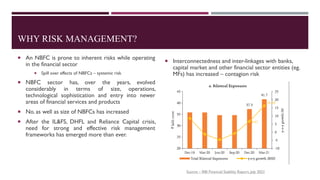
 Interconnectedness and inter-linkages with banks,
capital market and other financial sector entities (eg.
MFs) has increased – contagion risk
Source – RBI Financial Stability Report, July 2021
SYSTEMIC RISKS AND INTERCONNECTEDNESS
 Risk arises from inter-connectivity
o Banks lend to NBFCs
o Mutual funds invest in NBFC securities
o NBFCs securitise assets which end up on the balance
sheets of banks and mutual funds
o Some degree of insurance company exposure on
NBFCs too
 Financial interconnectedness is the relationship and
among financial entities
 is the network of credit exposures, trading links and
other relationships and dependencies between financial
agents.
 Interconnectedness matters because it serves as a
conduit for contagion.
 The impact of the failure of a large interconnected
entity can spread rapidly and extensively across the
financial system, to the point where it can cause
worldwide financial instability.
SYSTEMIC RISKS AND INTERCONNECTEDNESS
 The total outstanding bilateral exposures among
constituents of the financial system have been rising
out of the sharp contraction in Q1:2020-21
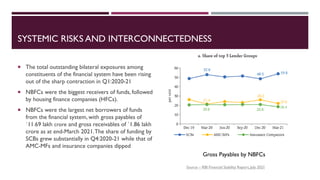
 NBFCs were the biggest receivers of funds, followed
by housing finance companies (HFCs).
 NBFCs were the largest net borrowers of funds
from the financial system, with gross payables of
`11.69 lakh crore and gross receivables of `1.86 lakh
crore as at end-March 2021.The share of funding by
SCBs grew substantially in Q4:2020-21 while that of
AMC-MFs and insurance companies dipped
Gross Payables by NBFCs
Source – RBI Financial Stability Report, July 2021
SYSTEMIC RISKS AND INTERCONNECTEDNESS
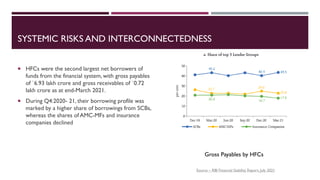
 HFCs were the second largest net borrowers of
funds from the financial system, with gross payables
of `6.93 lakh crore and gross receivables of `0.72
lakh crore as at end-March 2021.
 During Q4:2020- 21, their borrowing profile was
marked by a higher share of borrowings from SCBs,
whereas the shares of AMC-MFs and insurance
companies declined
Gross Payables by HFCs
Source – RBI Financial Stability Report, July 2021
SHADOW BANKING
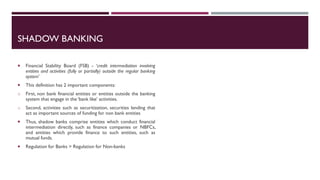
 Financial Stability Board (FSB) - ‘credit intermediation involving
entities and activities (fully or partially) outside the regular banking
system’
 This definition has 2 important components:
o First, non bank financial entities or entities outside the banking
system that engage in the ‘bank like’ activities.
o Second, activities such as securitization, securities lending that
act as important sources of funding for non bank entities
 Thus, shadow banks comprise entities which conduct financial
intermediation directly, such as finance companies or NBFCs,
and entities which provide finance to such entities, such as
mutual funds.
 Regulation for Banks > Regulation for Non-banks
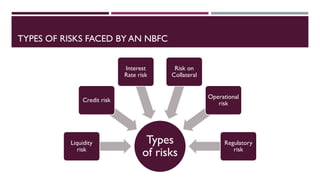
TYPES OF RISKS FACED BY AN NBFC
Types
of risks
Liquidity
risk
Credit risk
Interest
Rate risk
Risk on
Collateral
Operational
risk
Regulatory
risk
TYPES OF RISKS
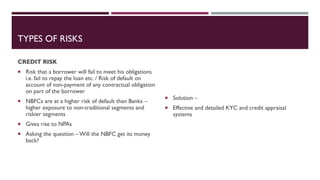
CREDIT RISK
 Risk that a borrower will fail to meet his obligations
i.e. fail to repay the loan etc. / Risk of default on
account of non-payment of any contractual obligation
on part of the borrower
 NBFCs are at a higher risk of default than Banks –
higher exposure to non-traditional segments and
riskier segments
 Gives rise to NPAs
 Asking the question – Will the NBFC get its money
back?
 Solution –
 Effective and detailed KYC and credit appraisal
systems
INTEREST RATE RISK
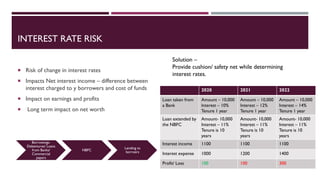
 Risk of change in interest rates
 Impacts Net interest income – difference between
interest charged to y borrowers and cost of funds
 Impact on earnings and profits
 Long term impact on net worth
Borrowings-
Debentures/ Loans
from Banks/
Commercial
papers
NBFC
Lending to
borroers
Solution –
Provide cushion/ safety net while determining
interest rates.
2020 2021 2022
Loan taken from
a Bank
Amount – 10,000
Interest – 10%
Tenure 1 year
Amount – 10,000
Interest – 12%
Tenure 1 year
Amount – 10,000
Interest – 14%
Tenure 1 year
Loan extended by
the NBFC
Amount- 10,000
Interest – 11%
Tenure is 10
years
Amount- 10,000
Interest – 11%
Tenure is 10
years
Amount- 10,000
Interest – 11%
Tenure is 10
years
Interest income 1100 1100 1100
Interest expense 1000 1200 1400
Profit/ Loss 100 100 300
LIQUIDITY RISK
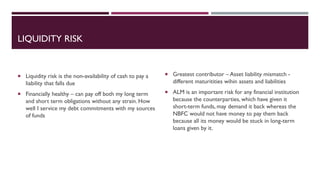
 Liquidity risk is the non-availability of cash to pay a
liability that falls due
 Financially healthy – can pay off both my long term
and short term obligations without any strain. How
well I service my debt commitments with my sources
of funds
 Greatest contributor – Asset liability mismatch -
different maturitities wihin assets and liabilities
 ALM is an important risk for any financial institution
because the counterparties, which have given it
short-term funds, may demand it back whereas the
NBFC would not have money to pay them back
because all its money would be stuck in long-term
loans given by it.
RISK ON COLLATERAL
 In case of secured lending
 Risk that the collateral will not fetch the expected
value
 Secured assets should be able to retain its value
over the tenure of the loan
 Solution - Checking the liquidity/ saleability of the
collateral
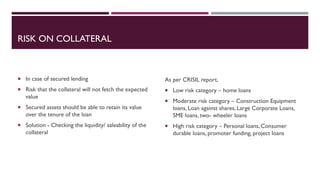
As per CRISIL report,
 Low risk category – home loans
 Moderate risk category – Construction Equipment
loans, Loan against shares, Large Corporate Loans,
SME loans, two- wheeler loans
 High risk category – Personal loans, Consumer
durable loans, promoter funding, project loans
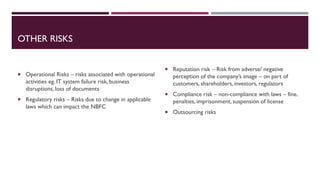
OTHER RISKS
 Operational Risks – risks associated with operational
activities eg. IT system failure risk, business
disruptions, loss of documents
 Regulatory risks – Risks due to change in applicable
laws which can impact the NBFC
 Reputation risk – Risk from adverse/ negative
perception of the company’s image – on part of
customers, shareholders, investors, regulators
 Compliance risk – non-compliance with laws – fine,
penalties, imprisonment, suspension of license
 Outsourcing risks
RISK MANAGEMENT PROVISIONS
 Liquidity risk management framework
 Risk Management Framework
 Fraud risk management framework
 Outsourcing Framework
 Risk- Based Internal Audit
 Scalar Based Approach – also considers risks as one
of the parameters
 CRAR
LIQUIDITY RISK MANAGEMENT FRAMEWORK
 Was introduced to strengthen and raise the standard
of the Asset Liability Management (ALM) framework
applicable to NBFCs
 Was introduced on 24th May, 2019
 Divided into two parts
 Liquidity risk management
 Liquidity risk coverage (new requirement)
 Constituents of Liquidity Risk Management –
 Liquidity Risk Management Policy, Strategies and
Practices
 Management Information System (MIS)
 Internal Controls
 Liquidity Risk Measurement – Stock Approach
 Maturity profiling
 Liquidity Risk Monitoring Tools
 Managing Interest Rate Risk
 Currency Risk
LRM
Liquidity risk management policy, strategies and practices:
 Formulating a risk management framework
 Governance –
 Board – shall be overall responsible for LRM, laying down
policies etc.
 Risk management committee – report to the Board,
Committee to be constituted with CEO/ MD and heads of
various risk verticals.
 ALM Committee – must be headed by CEO/ MD or
Executive Director and may have the Chiefs of Investment,
Credit, Resource Management or Planning, Funds
Management / Treasury (forex and domestic), International
Banking and Economic Research as members,
 Scope to include taking decisions on maturity profile mix, sale of
assets as source of funding, responsibility for managing liquidity
risk, overseeing liquidity positions of all branches
 ALM Support Group – new requirement
 Consisted of operating staff of the organization
 responsible for analysing, monitoring and reporting the
liquidity risk profile to the ALCO
LRM
 Liquidity risk tolerance- sound process for
identifying, measuring, monitoring and controlling
liquidity risk. It should clearly articulate a liquidity
risk tolerance that is appropriate for its business
strategy and its role in the financial system
 Maturity profiling and tolerance limits -
LIQUIDITY COVERAGE RATIO
 Basel III: International framework for liquidity risk
measurement, standards and monitoring
 The objective of the LCR is to promote the short-term
resilience of the liquidity risk profile of banks
 Applicability- Non-deposit taking NBFCs with asset size
of Rs.5,000 crore and above, Deposit taking NBFCs
irrespective of their asset size
 NBFCs have an adequate stock of unencumbered
high-quality liquid assets (HQLA) that can be
converted easily and immediately in private markets
into cash to meet their liquidity needs for a 30 calendar
day liquidity stress scenario.
 Improve ability to absorb shocks, reducing spillover
effect
 Financial entities even though have adequate capital are
not able to meet their short tem needs since they do
not manage their liquidity well
 Definition of LCR - Stock of high-quality liquid assets
Total/ Net cash outflows over the next 30 calendar days
RISK BASED INTERNAL AUDIT
 Audit function is of special importance to all entities for risk
mitigation of risk.
 RBI on 3rd February 202 issued a circular prescribing the
requirement for RBIA Framework - to be implemented by 31st
March 2022.
 However,RBI on 11th June, 2021 has issued a circular stating
“On a review, it has been decided that the provisions of the aforesaid
circular (circular dated 3rd February, 2021) shall be applicable to all
deposit taking HFCs, irrespective of their size and non-deposit taking
HFCs with asset size of ₹5,000 crore and above.
 Audit methodology that links an organisation's overall risk
management framework and provides an assurance to the
Board of Directors and the Senior Management on the quality
and effectiveness of the organisation’s internal controls, risk
management and governance related systems and processes.
 NBFC’s internal controls, risk management, and governance
related systems and processes are adequate to deal with risk
faced by it
 RBIA function should consider risk matrix while setting up
action plan
 RBIA should undertake an independent risk assessment for the
purpose of formulating a risk-based audit plan which considers
the inherent business risks emanating from an activity / location
and the effectiveness of the control systems for monitoring
such inherent risks
CAPITAL TO RISK WEIGHTED ASSETS RATIO (CRAR)/ CAPITAL
ADEQUACY RATIO
 Ratio of an NBFC’s capital to its risk
 How effectively can my capital absorb losses
 Risk weights are given to each of my assets
 CAR=RiskWeighted Assets/Tier 1 Capital +
Tier 2 Capital
 CRAR should be 15%
GUIDELINES ON MANAGING RISKS AND CODE OF CONDUCT IN
OUTSOURCING OF FINANCIAL SERVICES BY NBFCS
 NBFCs have been outsourcing various activities and are
hence exposed to various risks
 failure of a service provider in providing a specified
service, a breach in security / confidentiality, or non-
compliance with legal and regulatory requirements by
either the service provider or the outsourcing NBFC
can lead to financial losses or loss of reputation for the
NBFC
 Strategic risk, Reputation Risk, Compliance Risk,
Operational Risk, Legal Risk, Exit Strategy Risk, Counter
party Risk, Country Risk, Contractual Risk,Access Risk,
Concentration and Systemic Risk
 Financial services – customer onboarding, recovery etc.
(food, canteen, accounting etc, not included)
 Outsourcing Policy - criteria for selection of such
activities as well as service providers, delegation of
authority depending on risks and materiality and
systems to monitor and review the operations of these
activities
 Role of Board and Senior Management - Approving a
framework to evaluate the risks and materiality, Laying
down appropriate approval authorities for outsourcing
depending on risks and materiality
 Evaluation of Service provider – proper due diligence
 Detailed outsourcing agreement
 Business Continuity and Management of Disaster
Recovery Plan- in case of sudden termination
Thank you! 

Understanding-Risk-Management-Framework-in-NBFCs.pdf

  • 1.
    UNDERSTANDING RISK MANAGEMENT FRAMEWORKIN NBFCS - Aanchal Kaur Nagpal
  • 2.
    COVERAGE • Why riskmanagement in NBFCs? • Types of Risks faced by an NBFC • Risk Management Framework in NBFCs
  • 3.
    WHY RISK MANAGEMENT? An NBFC is prone to inherent risks while operating in the financial sector  Spill over effects of NBFCs – systemic risk  NBFC sector has, over the years, evolved considerably in terms of size, operations, technological sophistication and entry into newer areas of financial services and products  No. as well as size of NBFCs has increased  After the IL&FS, DHFL and Reliance Capital crisis, need for strong and effective risk management frameworks has emerged more than ever.  Interconnectedness and inter-linkages with banks, capital market and other financial sector entities (eg. MFs) has increased – contagion risk Source – RBI Financial Stability Report, July 2021
  • 4.
    SYSTEMIC RISKS ANDINTERCONNECTEDNESS  Risk arises from inter-connectivity o Banks lend to NBFCs o Mutual funds invest in NBFC securities o NBFCs securitise assets which end up on the balance sheets of banks and mutual funds o Some degree of insurance company exposure on NBFCs too  Financial interconnectedness is the relationship and among financial entities  is the network of credit exposures, trading links and other relationships and dependencies between financial agents.  Interconnectedness matters because it serves as a conduit for contagion.  The impact of the failure of a large interconnected entity can spread rapidly and extensively across the financial system, to the point where it can cause worldwide financial instability.
  • 5.
    SYSTEMIC RISKS ANDINTERCONNECTEDNESS  The total outstanding bilateral exposures among constituents of the financial system have been rising out of the sharp contraction in Q1:2020-21  NBFCs were the biggest receivers of funds, followed by housing finance companies (HFCs).  NBFCs were the largest net borrowers of funds from the financial system, with gross payables of `11.69 lakh crore and gross receivables of `1.86 lakh crore as at end-March 2021.The share of funding by SCBs grew substantially in Q4:2020-21 while that of AMC-MFs and insurance companies dipped Gross Payables by NBFCs Source – RBI Financial Stability Report, July 2021
  • 6.
    SYSTEMIC RISKS ANDINTERCONNECTEDNESS  HFCs were the second largest net borrowers of funds from the financial system, with gross payables of `6.93 lakh crore and gross receivables of `0.72 lakh crore as at end-March 2021.  During Q4:2020- 21, their borrowing profile was marked by a higher share of borrowings from SCBs, whereas the shares of AMC-MFs and insurance companies declined Gross Payables by HFCs Source – RBI Financial Stability Report, July 2021
  • 7.
    SHADOW BANKING  FinancialStability Board (FSB) - ‘credit intermediation involving entities and activities (fully or partially) outside the regular banking system’  This definition has 2 important components: o First, non bank financial entities or entities outside the banking system that engage in the ‘bank like’ activities. o Second, activities such as securitization, securities lending that act as important sources of funding for non bank entities  Thus, shadow banks comprise entities which conduct financial intermediation directly, such as finance companies or NBFCs, and entities which provide finance to such entities, such as mutual funds.  Regulation for Banks > Regulation for Non-banks
  • 8.
    TYPES OF RISKSFACED BY AN NBFC Types of risks Liquidity risk Credit risk Interest Rate risk Risk on Collateral Operational risk Regulatory risk
  • 9.
    TYPES OF RISKS CREDITRISK  Risk that a borrower will fail to meet his obligations i.e. fail to repay the loan etc. / Risk of default on account of non-payment of any contractual obligation on part of the borrower  NBFCs are at a higher risk of default than Banks – higher exposure to non-traditional segments and riskier segments  Gives rise to NPAs  Asking the question – Will the NBFC get its money back?  Solution –  Effective and detailed KYC and credit appraisal systems
  • 10.
    INTEREST RATE RISK Risk of change in interest rates  Impacts Net interest income – difference between interest charged to y borrowers and cost of funds  Impact on earnings and profits  Long term impact on net worth Borrowings- Debentures/ Loans from Banks/ Commercial papers NBFC Lending to borroers Solution – Provide cushion/ safety net while determining interest rates. 2020 2021 2022 Loan taken from a Bank Amount – 10,000 Interest – 10% Tenure 1 year Amount – 10,000 Interest – 12% Tenure 1 year Amount – 10,000 Interest – 14% Tenure 1 year Loan extended by the NBFC Amount- 10,000 Interest – 11% Tenure is 10 years Amount- 10,000 Interest – 11% Tenure is 10 years Amount- 10,000 Interest – 11% Tenure is 10 years Interest income 1100 1100 1100 Interest expense 1000 1200 1400 Profit/ Loss 100 100 300
  • 11.
    LIQUIDITY RISK  Liquidityrisk is the non-availability of cash to pay a liability that falls due  Financially healthy – can pay off both my long term and short term obligations without any strain. How well I service my debt commitments with my sources of funds  Greatest contributor – Asset liability mismatch - different maturitities wihin assets and liabilities  ALM is an important risk for any financial institution because the counterparties, which have given it short-term funds, may demand it back whereas the NBFC would not have money to pay them back because all its money would be stuck in long-term loans given by it.
  • 12.
    RISK ON COLLATERAL In case of secured lending  Risk that the collateral will not fetch the expected value  Secured assets should be able to retain its value over the tenure of the loan  Solution - Checking the liquidity/ saleability of the collateral As per CRISIL report,  Low risk category – home loans  Moderate risk category – Construction Equipment loans, Loan against shares, Large Corporate Loans, SME loans, two- wheeler loans  High risk category – Personal loans, Consumer durable loans, promoter funding, project loans
  • 13.
    OTHER RISKS  OperationalRisks – risks associated with operational activities eg. IT system failure risk, business disruptions, loss of documents  Regulatory risks – Risks due to change in applicable laws which can impact the NBFC  Reputation risk – Risk from adverse/ negative perception of the company’s image – on part of customers, shareholders, investors, regulators  Compliance risk – non-compliance with laws – fine, penalties, imprisonment, suspension of license  Outsourcing risks
  • 14.
    RISK MANAGEMENT PROVISIONS Liquidity risk management framework  Risk Management Framework  Fraud risk management framework  Outsourcing Framework  Risk- Based Internal Audit  Scalar Based Approach – also considers risks as one of the parameters  CRAR
  • 15.
    LIQUIDITY RISK MANAGEMENTFRAMEWORK  Was introduced to strengthen and raise the standard of the Asset Liability Management (ALM) framework applicable to NBFCs  Was introduced on 24th May, 2019  Divided into two parts  Liquidity risk management  Liquidity risk coverage (new requirement)  Constituents of Liquidity Risk Management –  Liquidity Risk Management Policy, Strategies and Practices  Management Information System (MIS)  Internal Controls  Liquidity Risk Measurement – Stock Approach  Maturity profiling  Liquidity Risk Monitoring Tools  Managing Interest Rate Risk  Currency Risk
  • 16.
    LRM Liquidity risk managementpolicy, strategies and practices:  Formulating a risk management framework  Governance –  Board – shall be overall responsible for LRM, laying down policies etc.  Risk management committee – report to the Board, Committee to be constituted with CEO/ MD and heads of various risk verticals.  ALM Committee – must be headed by CEO/ MD or Executive Director and may have the Chiefs of Investment, Credit, Resource Management or Planning, Funds Management / Treasury (forex and domestic), International Banking and Economic Research as members,  Scope to include taking decisions on maturity profile mix, sale of assets as source of funding, responsibility for managing liquidity risk, overseeing liquidity positions of all branches  ALM Support Group – new requirement  Consisted of operating staff of the organization  responsible for analysing, monitoring and reporting the liquidity risk profile to the ALCO
  • 17.
    LRM  Liquidity risktolerance- sound process for identifying, measuring, monitoring and controlling liquidity risk. It should clearly articulate a liquidity risk tolerance that is appropriate for its business strategy and its role in the financial system  Maturity profiling and tolerance limits -
  • 18.
    LIQUIDITY COVERAGE RATIO Basel III: International framework for liquidity risk measurement, standards and monitoring  The objective of the LCR is to promote the short-term resilience of the liquidity risk profile of banks  Applicability- Non-deposit taking NBFCs with asset size of Rs.5,000 crore and above, Deposit taking NBFCs irrespective of their asset size  NBFCs have an adequate stock of unencumbered high-quality liquid assets (HQLA) that can be converted easily and immediately in private markets into cash to meet their liquidity needs for a 30 calendar day liquidity stress scenario.  Improve ability to absorb shocks, reducing spillover effect  Financial entities even though have adequate capital are not able to meet their short tem needs since they do not manage their liquidity well  Definition of LCR - Stock of high-quality liquid assets Total/ Net cash outflows over the next 30 calendar days
  • 19.
    RISK BASED INTERNALAUDIT  Audit function is of special importance to all entities for risk mitigation of risk.  RBI on 3rd February 202 issued a circular prescribing the requirement for RBIA Framework - to be implemented by 31st March 2022.  However,RBI on 11th June, 2021 has issued a circular stating “On a review, it has been decided that the provisions of the aforesaid circular (circular dated 3rd February, 2021) shall be applicable to all deposit taking HFCs, irrespective of their size and non-deposit taking HFCs with asset size of ₹5,000 crore and above.  Audit methodology that links an organisation's overall risk management framework and provides an assurance to the Board of Directors and the Senior Management on the quality and effectiveness of the organisation’s internal controls, risk management and governance related systems and processes.  NBFC’s internal controls, risk management, and governance related systems and processes are adequate to deal with risk faced by it  RBIA function should consider risk matrix while setting up action plan  RBIA should undertake an independent risk assessment for the purpose of formulating a risk-based audit plan which considers the inherent business risks emanating from an activity / location and the effectiveness of the control systems for monitoring such inherent risks
  • 20.
    CAPITAL TO RISKWEIGHTED ASSETS RATIO (CRAR)/ CAPITAL ADEQUACY RATIO  Ratio of an NBFC’s capital to its risk  How effectively can my capital absorb losses  Risk weights are given to each of my assets  CAR=RiskWeighted Assets/Tier 1 Capital + Tier 2 Capital  CRAR should be 15%
  • 21.
    GUIDELINES ON MANAGINGRISKS AND CODE OF CONDUCT IN OUTSOURCING OF FINANCIAL SERVICES BY NBFCS  NBFCs have been outsourcing various activities and are hence exposed to various risks  failure of a service provider in providing a specified service, a breach in security / confidentiality, or non- compliance with legal and regulatory requirements by either the service provider or the outsourcing NBFC can lead to financial losses or loss of reputation for the NBFC  Strategic risk, Reputation Risk, Compliance Risk, Operational Risk, Legal Risk, Exit Strategy Risk, Counter party Risk, Country Risk, Contractual Risk,Access Risk, Concentration and Systemic Risk  Financial services – customer onboarding, recovery etc. (food, canteen, accounting etc, not included)  Outsourcing Policy - criteria for selection of such activities as well as service providers, delegation of authority depending on risks and materiality and systems to monitor and review the operations of these activities  Role of Board and Senior Management - Approving a framework to evaluate the risks and materiality, Laying down appropriate approval authorities for outsourcing depending on risks and materiality  Evaluation of Service provider – proper due diligence  Detailed outsourcing agreement  Business Continuity and Management of Disaster Recovery Plan- in case of sudden termination
  • 22.