Applying COSO’s Enterprise Risk Management — Integrated Framework September 29, 2004
Today’s organizations are concerned about: Risk Management Governance Control Assurance (and Consulting)
ERM Defined: “…  a process, effected by an entity's board of directors, management and other personnel, applied in strategy setting and across the enterprise, designed to identify potential events that may affect the entity, and manage risks to be within its risk appetite, to provide reasonable assurance regarding the achievement of entity objectives.” Source:  COSO Enterprise Risk Management – Integrated Framework .  2004. COSO.
Why ERM Is Important  Underlying principles: Every entity, whether for-profit  or not, exists to realize value for  its stakeholders. Value is created,  preserved, or eroded  by management decisions in all activities, from setting strategy to operating  the enterprise day-to-day.
Why ERM Is Important  ERM supports value creation by enabling management to:   Deal effectively with potential future events that create uncertainty. Respond in a manner that reduces the likelihood of downside outcomes and increases the upside.
Enterprise Risk Management  —  Integrated Framework  This COSO ERM framework defines essential components, suggests a common language, and provides clear direction and guidance for enterprise risk management.
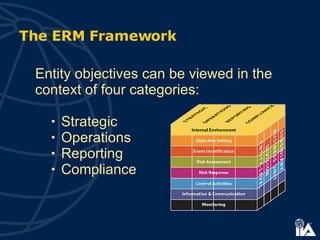
The ERM Framework Entity objectives can be viewed in the context of four categories: Strategic  Operations Reporting Compliance
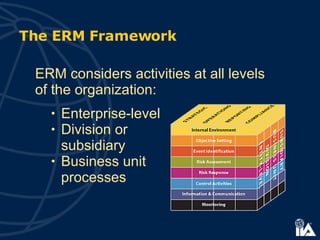
The ERM Framework ERM considers activities at all levels of the organization: Enterprise-level Division or subsidiary Business unit processes
Enterprise risk management requires an entity to take a  portfolio view  of risk.   The ERM Framework
Management considers how  individual risks interrelate. Management develops a portfolio view from two perspectives: - Business unit level - Entity level The ERM Framework
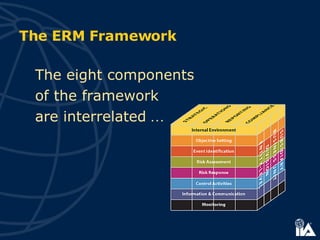
The ERM Framework The eight components of the framework are interrelated  …
Internal Environment Establishes a philosophy regarding risk management. It recognizes that unexpected as well as expected events may occur. Establishes the entity’s risk culture. Considers all other aspects of how the organization’s actions may affect its risk culture.
Objective Setting Is applied when management considers risks strategy in the setting of objectives. Forms the risk appetite of the entity — a high-level view of how much risk management and the board are willing to accept. Risk tolerance, the acceptable level of variation around objectives, is aligned with risk appetite.
Event Identification Differentiates risks and opportunities. Events that may have a negative impact represent risks. Events that may have a positive impact represent natural offsets (opportunities), which management channels back to strategy setting.
Event Identification Involves identifying those incidents, occurring internally or externally, that could affect strategy and achievement of objectives. Addresses how internal and external factors combine and interact to influence the risk profile.
Risk Assessment Allows an entity to understand the extent to which potential events might impact objectives. Assesses risks from two perspectives: - Likelihood -  Impact Is used to assess risks and is normally also used to measure the related objectives.
Risk Assessment Employs a combination of both qualitative and quantitative risk assessment methodologies. Relates time horizons to objective horizons. Assesses risk on both an inherent and a residual basis.
Risk Response Identifies and evaluates possible responses to risk. Evaluates options in relation to entity’s risk appetite, cost vs. benefit of potential risk responses, and degree to which a response will reduce impact and/or likelihood. Selects and executes response based on evaluation of the portfolio of risks and responses.
Control Activities Policies and procedures that help ensure that the risk responses, as well as other entity directives, are carried out. Occur throughout the organization, at all levels and in all functions. Include application and general information technology controls.
Management  identifies, captures, and communicates pertinent information in a form and timeframe that enables people to carry out their responsibilities.  Communication occurs in a broader sense, flowing down, across, and up  the organization.   Information & Communication
Monitoring Effectiveness of the other ERM components is monitored through:   Ongoing monitoring activities. Separate evaluations. A combination of the two.
Internal Control A strong system of internal control is essential to effective enterprise risk management.
Expands and elaborates on elements  of internal control as set out in COSO’s “control framework.” Includes objective setting as a separate component. Objectives are a “prerequisite” for internal control. Expands the control framework’s  “ Financial Reporting” and “Risk Assessment.” Relationship to  Internal Control — Integrated Framework
ERM Roles & Responsibilities Management  The board of directors    Risk officer s Internal auditors
Internal Auditors Play an important role in monitoring ERM, but do NOT have primary responsibility for its implementation  or maintenance. Assist management and the board or audit committee in the process by: - Monitoring  - Evaluating - Examining  - Reporting  - Recommending improvements
Visit the guidance section of  The IIA’s Web site for The IIA’s  position paper, “Role of Internal Auditing’s in Enterprise Risk Management.” Internal Auditors
2010.A1  –  The internal audit activity’s plan of engagements should be based on a risk assessment, undertaken at least annually. 2120.A1  –  Based on the results of the risk assessment, the internal audit activity should evaluate the adequacy and effectiveness of controls encompassing the organization’s governance, operations, and information systems. 2210.A1  –  When planning the engagement, the internal auditor should identify and assess risks relevant to the activity under review.  The engagement objectives should reflect the results of the risk assessment. Standards
Organizational design of business Establishing an ERM organization Performing risk assessments Determining overall risk appetite Identifying risk responses Communication of risk results Monitoring Oversight & periodic review  by management Key Implementation Factors
Organizational Design Strategies of the business Key business objectives Related objectives that cascade  down the organization from key business objectives Assignment of responsibilities to organizational elements and leaders (linkage)
Example: Linkage Mission  –  To provide high-quality accessible and affordable community-based health care Strategic Objective  –  To be the first  or second largest, full-service health  care provider in mid-size metropolitan markets Related Objective  –  To initiate  dialogue with leadership of 10 top under-performing hospitals and negotiate agreements with two this year
Establish ERM Determine a risk philosophy Survey risk culture Consider organizational integrity  and ethical values Decide roles and responsibilities
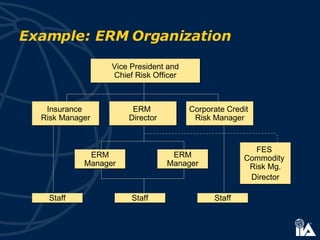
Example: ERM Organization ERM  Director Vice President and Chief Risk Officer Corporate Credit  Risk Manager Insurance  Risk Manager ERM Manager ERM Manager Staff Staff Staff FES  Commodity  Risk Mg. Director
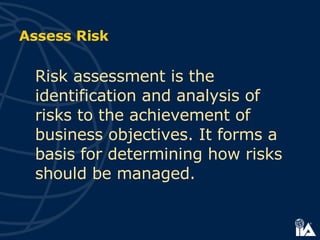
Risk assessment is the identification and analysis of risks to the achievement of business objectives. It forms a basis for determining how risks should be managed. Assess Risk
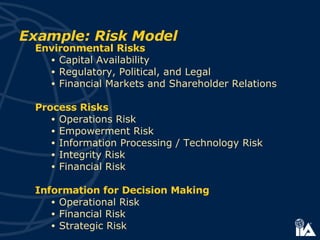
Example: Risk Model Environmental Risks Capital Availability Regulatory, Political, and Legal Financial Markets and Shareholder Relations Process Risks Operations Risk Empowerment Risk Information Processing / Technology Risk Integrity Risk Financial Risk Information for Decision Making Operational Risk Financial Risk Strategic Risk
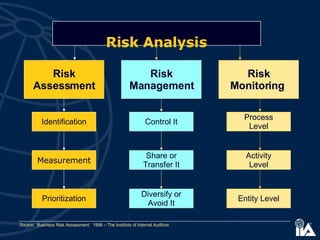
Risk Analysis Source:  Business Risk Assessment.  1998 – The Institute of Internal Auditors Control It Share or Transfer It Diversify or Avoid It Risk Management Process Level Activity Level Entity Level Risk Monitoring   Identification Measurement Prioritization Risk Assessment
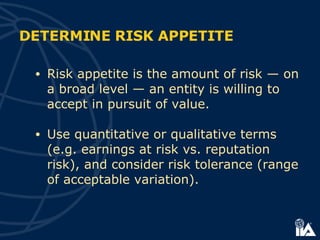
DETERMINE RISK APPETITE Risk appetite is the amount of risk — on a broad level — an entity is willing to accept in pursuit of value. Use quantitative or qualitative terms (e.g. earnings at risk vs. reputation risk), and consider risk tolerance (range of acceptable variation).
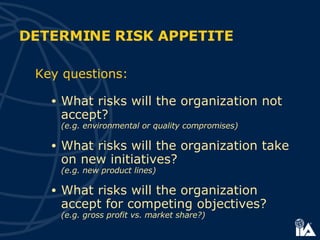
Key questions: What risks will the organization not accept?  (e.g. environmental or quality compromises) What risks will the organization take on new initiatives?  (e.g. new product lines) What risks will the organization accept for competing objectives?   (e.g. gross profit vs. market share?) DETERMINE RISK APPETITE
Quantification of risk exposure Options available: -  Accept = monitor -  Avoid = eliminate  (get out of situation) -  Reduce = institute controls -  Share = partner with someone  (e.g. insurance) Residual risk  (unmitigated risk – e.g. shrinkage) IDENTIFY RISK RESPONSES
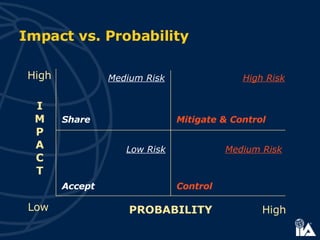
Impact vs. Probability Control Share Mitigate & Control Accept High Risk Medium Risk Medium Risk Low Risk Low High High I M P A C T PROBABILITY
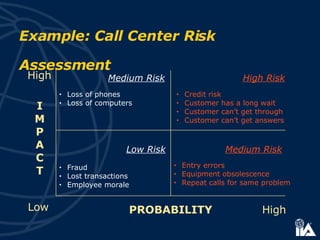
Example: Call Center Risk Assessment Low High High I M P A C T PROBABILITY High Risk Medium Risk Medium Risk Low Risk Loss of phones Loss of computers Credit risk Customer has a long wait Customer can’t get through Customer can’t get answers Entry errors  Equipment obsolescence Repeat calls for same problem Fraud Lost transactions Employee morale
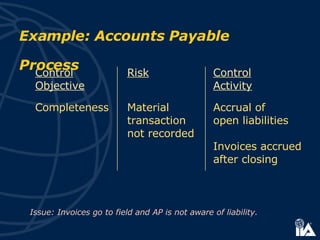
Example: Accounts Payable Process Control   Risk Control   Objective Activity Completeness Material Accrual of  transaction open liabilities  not recorded  Invoices accrued  after closing  Issue: Invoices go to field and AP is not aware of liability.
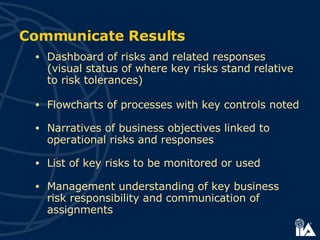
Dashboard of risks and related responses  (visual status of where key risks stand relative to risk tolerances)  Flowcharts of processes with key controls noted Narratives of business objectives linked to operational risks and responses List of key risks to be monitored or used Management understanding of key business risk responsibility and communication of assignments Communicate Results
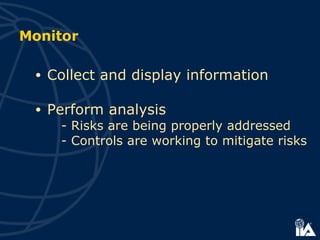
Monitor Collect and display information Perform analysis - Risks are being properly addressed - Controls are working to mitigate risks
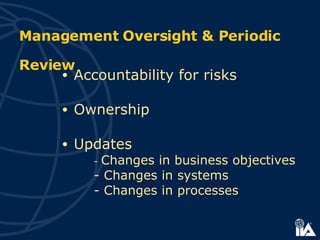
Accountability for risks Ownership Updates -  Changes in business objectives - Changes in systems - Changes in processes Management Oversight & Periodic Review
Internal auditors can add value by: Reviewing critical control systems and risk management processes. Performing an effectiveness review of management's risk assessments and the internal controls. Providing advice in the design and improvement of control systems and risk mitigation strategies.
Implementing a risk-based approach to planning and executing the internal audit process.  Ensuring that internal auditing’s resources are directed at those areas most important to the organization. Challenging the basis of management’s risk assessments and evaluating the adequacy and effectiveness of risk treatment strategies.   Internal auditors can add value by:
Facilitating ERM workshops. Defining risk tolerances where none have been identified, based on internal auditing's experience, judgment, and consultation with management.  Internal auditors can add value by:
For more information On COSO’s Enterprise Risk Management —  Integrated Framework , visit www.coso.org or www.theiia.org
This presentation  was produced  by  Applying COSO’s Enterprise Risk Management — Integrated Framework

Coso Erm(2)

  • 1.
    Applying COSO’s EnterpriseRisk Management — Integrated Framework September 29, 2004
  • 2.
    Today’s organizations areconcerned about: Risk Management Governance Control Assurance (and Consulting)
  • 3.
    ERM Defined: “… a process, effected by an entity's board of directors, management and other personnel, applied in strategy setting and across the enterprise, designed to identify potential events that may affect the entity, and manage risks to be within its risk appetite, to provide reasonable assurance regarding the achievement of entity objectives.” Source: COSO Enterprise Risk Management – Integrated Framework . 2004. COSO.
  • 4.
    Why ERM IsImportant Underlying principles: Every entity, whether for-profit or not, exists to realize value for its stakeholders. Value is created, preserved, or eroded by management decisions in all activities, from setting strategy to operating the enterprise day-to-day.
  • 5.
    Why ERM IsImportant ERM supports value creation by enabling management to:   Deal effectively with potential future events that create uncertainty. Respond in a manner that reduces the likelihood of downside outcomes and increases the upside.
  • 6.
    Enterprise Risk Management — Integrated Framework This COSO ERM framework defines essential components, suggests a common language, and provides clear direction and guidance for enterprise risk management.
  • 7.
    The ERM FrameworkEntity objectives can be viewed in the context of four categories: Strategic Operations Reporting Compliance
  • 8.
    The ERM FrameworkERM considers activities at all levels of the organization: Enterprise-level Division or subsidiary Business unit processes
  • 9.
    Enterprise risk managementrequires an entity to take a portfolio view of risk. The ERM Framework
  • 10.
    Management considers how individual risks interrelate. Management develops a portfolio view from two perspectives: - Business unit level - Entity level The ERM Framework
  • 11.
    The ERM FrameworkThe eight components of the framework are interrelated …
  • 12.
    Internal Environment Establishesa philosophy regarding risk management. It recognizes that unexpected as well as expected events may occur. Establishes the entity’s risk culture. Considers all other aspects of how the organization’s actions may affect its risk culture.
  • 13.
    Objective Setting Isapplied when management considers risks strategy in the setting of objectives. Forms the risk appetite of the entity — a high-level view of how much risk management and the board are willing to accept. Risk tolerance, the acceptable level of variation around objectives, is aligned with risk appetite.
  • 14.
    Event Identification Differentiatesrisks and opportunities. Events that may have a negative impact represent risks. Events that may have a positive impact represent natural offsets (opportunities), which management channels back to strategy setting.
  • 15.
    Event Identification Involvesidentifying those incidents, occurring internally or externally, that could affect strategy and achievement of objectives. Addresses how internal and external factors combine and interact to influence the risk profile.
  • 16.
    Risk Assessment Allowsan entity to understand the extent to which potential events might impact objectives. Assesses risks from two perspectives: - Likelihood - Impact Is used to assess risks and is normally also used to measure the related objectives.
  • 17.
    Risk Assessment Employsa combination of both qualitative and quantitative risk assessment methodologies. Relates time horizons to objective horizons. Assesses risk on both an inherent and a residual basis.
  • 18.
    Risk Response Identifiesand evaluates possible responses to risk. Evaluates options in relation to entity’s risk appetite, cost vs. benefit of potential risk responses, and degree to which a response will reduce impact and/or likelihood. Selects and executes response based on evaluation of the portfolio of risks and responses.
  • 19.
    Control Activities Policiesand procedures that help ensure that the risk responses, as well as other entity directives, are carried out. Occur throughout the organization, at all levels and in all functions. Include application and general information technology controls.
  • 20.
    Management identifies,captures, and communicates pertinent information in a form and timeframe that enables people to carry out their responsibilities. Communication occurs in a broader sense, flowing down, across, and up the organization. Information & Communication
  • 21.
    Monitoring Effectiveness ofthe other ERM components is monitored through: Ongoing monitoring activities. Separate evaluations. A combination of the two.
  • 22.
    Internal Control Astrong system of internal control is essential to effective enterprise risk management.
  • 23.
    Expands and elaborateson elements of internal control as set out in COSO’s “control framework.” Includes objective setting as a separate component. Objectives are a “prerequisite” for internal control. Expands the control framework’s “ Financial Reporting” and “Risk Assessment.” Relationship to Internal Control — Integrated Framework
  • 24.
    ERM Roles &Responsibilities Management The board of directors Risk officer s Internal auditors
  • 25.
    Internal Auditors Playan important role in monitoring ERM, but do NOT have primary responsibility for its implementation or maintenance. Assist management and the board or audit committee in the process by: - Monitoring - Evaluating - Examining - Reporting - Recommending improvements
  • 26.
    Visit the guidancesection of The IIA’s Web site for The IIA’s position paper, “Role of Internal Auditing’s in Enterprise Risk Management.” Internal Auditors
  • 27.
    2010.A1 – The internal audit activity’s plan of engagements should be based on a risk assessment, undertaken at least annually. 2120.A1 – Based on the results of the risk assessment, the internal audit activity should evaluate the adequacy and effectiveness of controls encompassing the organization’s governance, operations, and information systems. 2210.A1 – When planning the engagement, the internal auditor should identify and assess risks relevant to the activity under review. The engagement objectives should reflect the results of the risk assessment. Standards
  • 28.
    Organizational design ofbusiness Establishing an ERM organization Performing risk assessments Determining overall risk appetite Identifying risk responses Communication of risk results Monitoring Oversight & periodic review by management Key Implementation Factors
  • 29.
    Organizational Design Strategiesof the business Key business objectives Related objectives that cascade down the organization from key business objectives Assignment of responsibilities to organizational elements and leaders (linkage)
  • 30.
    Example: Linkage Mission – To provide high-quality accessible and affordable community-based health care Strategic Objective – To be the first or second largest, full-service health care provider in mid-size metropolitan markets Related Objective – To initiate dialogue with leadership of 10 top under-performing hospitals and negotiate agreements with two this year
  • 31.
    Establish ERM Determinea risk philosophy Survey risk culture Consider organizational integrity and ethical values Decide roles and responsibilities
  • 32.
    Example: ERM OrganizationERM Director Vice President and Chief Risk Officer Corporate Credit Risk Manager Insurance Risk Manager ERM Manager ERM Manager Staff Staff Staff FES Commodity Risk Mg. Director
  • 33.
    Risk assessment isthe identification and analysis of risks to the achievement of business objectives. It forms a basis for determining how risks should be managed. Assess Risk
  • 34.
    Example: Risk ModelEnvironmental Risks Capital Availability Regulatory, Political, and Legal Financial Markets and Shareholder Relations Process Risks Operations Risk Empowerment Risk Information Processing / Technology Risk Integrity Risk Financial Risk Information for Decision Making Operational Risk Financial Risk Strategic Risk
  • 35.
    Risk Analysis Source: Business Risk Assessment. 1998 – The Institute of Internal Auditors Control It Share or Transfer It Diversify or Avoid It Risk Management Process Level Activity Level Entity Level Risk Monitoring Identification Measurement Prioritization Risk Assessment
  • 36.
    DETERMINE RISK APPETITERisk appetite is the amount of risk — on a broad level — an entity is willing to accept in pursuit of value. Use quantitative or qualitative terms (e.g. earnings at risk vs. reputation risk), and consider risk tolerance (range of acceptable variation).
  • 37.
    Key questions: Whatrisks will the organization not accept? (e.g. environmental or quality compromises) What risks will the organization take on new initiatives? (e.g. new product lines) What risks will the organization accept for competing objectives? (e.g. gross profit vs. market share?) DETERMINE RISK APPETITE
  • 38.
    Quantification of riskexposure Options available: - Accept = monitor - Avoid = eliminate (get out of situation) - Reduce = institute controls - Share = partner with someone (e.g. insurance) Residual risk (unmitigated risk – e.g. shrinkage) IDENTIFY RISK RESPONSES
  • 39.
    Impact vs. ProbabilityControl Share Mitigate & Control Accept High Risk Medium Risk Medium Risk Low Risk Low High High I M P A C T PROBABILITY
  • 40.
    Example: Call CenterRisk Assessment Low High High I M P A C T PROBABILITY High Risk Medium Risk Medium Risk Low Risk Loss of phones Loss of computers Credit risk Customer has a long wait Customer can’t get through Customer can’t get answers Entry errors Equipment obsolescence Repeat calls for same problem Fraud Lost transactions Employee morale
  • 41.
    Example: Accounts PayableProcess Control Risk Control Objective Activity Completeness Material Accrual of transaction open liabilities not recorded Invoices accrued after closing Issue: Invoices go to field and AP is not aware of liability.
  • 42.
    Dashboard of risksand related responses (visual status of where key risks stand relative to risk tolerances) Flowcharts of processes with key controls noted Narratives of business objectives linked to operational risks and responses List of key risks to be monitored or used Management understanding of key business risk responsibility and communication of assignments Communicate Results
  • 43.
    Monitor Collect anddisplay information Perform analysis - Risks are being properly addressed - Controls are working to mitigate risks
  • 44.
    Accountability for risksOwnership Updates - Changes in business objectives - Changes in systems - Changes in processes Management Oversight & Periodic Review
  • 45.
    Internal auditors canadd value by: Reviewing critical control systems and risk management processes. Performing an effectiveness review of management's risk assessments and the internal controls. Providing advice in the design and improvement of control systems and risk mitigation strategies.
  • 46.
    Implementing a risk-basedapproach to planning and executing the internal audit process. Ensuring that internal auditing’s resources are directed at those areas most important to the organization. Challenging the basis of management’s risk assessments and evaluating the adequacy and effectiveness of risk treatment strategies. Internal auditors can add value by:
  • 47.
    Facilitating ERM workshops.Defining risk tolerances where none have been identified, based on internal auditing's experience, judgment, and consultation with management. Internal auditors can add value by:
  • 48.
    For more informationOn COSO’s Enterprise Risk Management — Integrated Framework , visit www.coso.org or www.theiia.org
  • 49.
    This presentation was produced by Applying COSO’s Enterprise Risk Management — Integrated Framework