Barium Swallow
&
Barium Meal:
Presented By:
M. Zare Mehrjardi, M.D. 1, 2
Part 1
Barium Swallow
Bontrager. pp. 443-445; 458-460; 469-473
Outlines
• Anatomy of the Pharynx & Esophagus
• Examinations of the Pharynx & Esophagus
• Contrast Media
• Patient Preparation
• Procedure Preparation
• Positioning of:
 Neck soft tissue: AP & Lateral
 Esophagus:AP, PA , Left Lateral, RAO, LAO
• Film Critique
• Some Significant Pathologies
Anatomy of the Pharynx & Esophagus
• Naso-------pharynx,
Oro--------pharynx,
Laryngo--pharynx,
Esophagus
• Soft palate, Uvula
• Buccal cavity
• Epiglottis
• Piriform fossa (recess)
Anatomy of the Pharynx & Esophagus
• Naso------pharynx,
Oro--------pharynx,
Laryngo--pharynx,
Esophagus
• Soft palate, Uvula
• Adenoids
• Vocal folds
• Epiglottis
Anatomy of the Pharynx & Esophagus
• Mucosa,
Submucosa,
Muscular layers
• Zigzag (Z) line
• Diaphragmatic hiatus
• Abdominal part of
esophagus
Examinations of the Pharynx
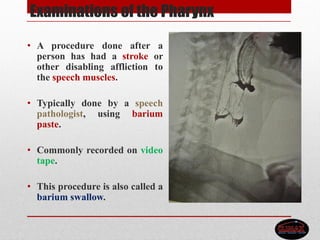
• A procedure done after a
person has had a stroke or
other disabling affliction to
the speech muscles.
• Typically done by a speech
pathologist, using barium
paste.
• Commonly recorded on video
tape.
• This procedure is also called a
barium swallow.
Examinations of the Esophagus
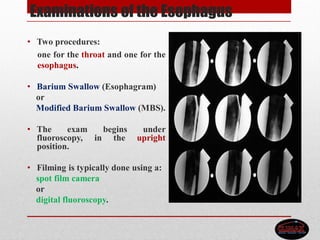
• Two procedures:
one for the throat and one for the
esophagus.
• Barium Swallow (Esophagram)
or
Modified Barium Swallow (MBS).
• The exam begins under
fluoroscopy, in the upright
position.
• Filming is typically done using a:
spot film camera
or
digital fluoroscopy.
Examinations of the Esophagus
• Can use double or single contrast.
• Barium should flow to sufficiently coat esophagus.
• Can be done upright or recumbent.
• Exam will usually be started with fluoroscopy.
Contrast Media
• Like the other examinations of the alimentary track, barium
sulfate is used unless there are contraindications to barium.
• Both thin and thick barium are used.
• Thin barium is useful to outline the esophagus quickly. When
administered in the upright position is empties into the stomach in
seconds. It is also used to diagnose reflux when using the water
test, shallow LPO, compression, or the toe-touch maneuver.
• Thick barium (barium paste) is mixed with one part water to 3-4
parts barium powder. Commercial products are often packaged
in a tube.
• Thick barium coats and adheres to the mucosa. It may be mixed
with cotton balls, marshmallows, or other foods.
Patient Preparation
No patient preparation is needed for an esophagram,
unless it is to be followed by an UGI.
Procedure Preparation
• Evaluate the Order.
• Greet the patient.
• Take History.
(If the patient is female, then a menstrual history must be obtained.
Irradiation of an early pregnancy is one of the most hazardous
situations in diagnostic radiography.)
• Remove jewelry, check attire, snaps, pins, NG tubes, etc.
• Explain the exam in layman’s terms.
• Questions?
• Set technique before positioning.
Examinations of the Pharynx & Esophagus
• Esophagrams begin under fluoroscopy, in the upright position.
• The patient holds a cup of barium, with a straw, in the right hand.
• The radiologist instructs the patient to drink, and films in the AP, RPO,
and LPO positions.
• The patient is often put into an RAO before the table is lowered to
horizontal. The examination continues in the recumbent position.
• Overhead films are taken per the radiologist’s routine.
• The trick to overhead filming is to fill the esophagus, from the pharynx to
the cardiac orifice of the stomach, and make the exposure before the
esophagus empties. To do this the patient is instructed to take three large
bolus swallows. On the fourth, breathing is suspended and the exposure
is made at the moment the patient swallows. A shallow trendelenburg
position will help keep the esophagus full.
Positioning - Neck soft tissue
• Positioned the same as an AP & Lateral C-spine:
½ the mAs.
• Expose during Inspiration.
• Done to assess the patency of the airway:
Masses;
Foreign bodies;
Enlarged adenoids (kids);
Epiglottitis (kids);
Trachea
Nasopharynx
Esophagus
Adnoids
Oropharynx
Positioning - Neck soft tissue
Hyoid Bone
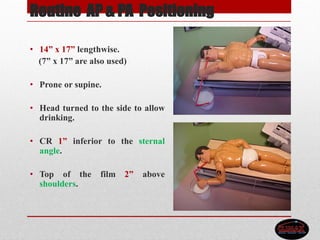
Routine AP & PA Positioning
• 14” x 17” lengthwise.
(7” x 17” are also used)
• Prone or supine.
• Head turned to the side to allow
drinking.
• CR 1” inferior to the sternal
angle.
• Top of the film 2” above
shoulders.
Critique Criteria (AP & PA)
• Entire esophagus should
be filled with barium, in
an unrotated frontal
projection.
• When there is inadequate filling of the
esophagus, under-penetration, and/or
insufficient density, the esophagus is
difficult to visualize against the
mediastinum.
• Good filling, contrast, and density,
demonstrating a condition called
presbyesophagus.
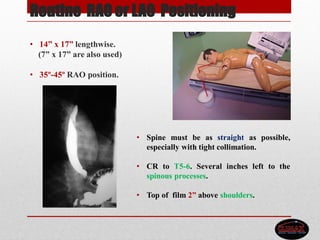
Routine RAO or LAO Positioning
• 14” x 17” lengthwise.
(7” x 17” are also used)
• 35º-45º RAO position.
• Spine must be as straight as possible,
especially with tight collimation.
• CR to T5-6. Several inches left to the
spinous processes.
• Top of film 2” above shoulders.
Critique Criteria (RAO)
• Like the RAO stomach, which is
the single best projection, the RAO
is also best for the esophagus.
• The heart provides a homogeneous
background to contrast it against.
• The distal esophagus, traversing
the esophageal hiatus, is laid out in
profile.
• The RAO should demonstrate the
entire barium filled esophagus.
• The abdominal portion is more
important than the pharyngeal
portion, which may be evaluated by
direct inspection.
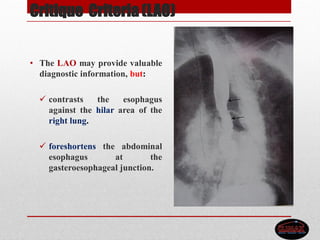
Critique Criteria (LAO)
• The LAO may provide valuable
diagnostic information, but:
 contrasts the esophagus
against the hilar area of the
right lung.
 foreshortens the abdominal
esophagus at the
gasteroesophageal junction.
Routine Right Lateral Positioning
• 14” x 17” lengthwise.
(7” x 17” are also used)
• Right lateral.
• C-spine “coextensive” to T-spine.
• CR to T5-6 in the midcoronal plane.
• Top of film 2” above shoulders.
• The arms may be raised and
superimposed (like a lateral chest
position), or the left shoulder may be
rotated posteriorly for a “swimmers
lateral”.
Critique Criteria (Right Lateral)
• Entire barium filled esophagus
projected posterior to heart,
and anterior to the T-spine.
Soft tissue
of arm
Humerus
SIGNIFICANT PATHOLOGIES
OF THE ESOPHAGUS
AND THEIR
RADIOGRAPHIC APPEARANCES
• TE Fistula
• Foreign Body
• Diverticulum
• Esophageal Cancer
• Presbyesophagus
• Esophageal Varices
• Esophageal Benign
Strictures
• Achalasia
Tracheoesophageal (TE) Fistula
• A congenital or ulcerative
opening (fistula tract) between
the esophagus and trachea.
• Radiographic examinations of
fistulas are fistulagrams, or
sinograms (sinus tract).
• Barium in the bronchial tree
may result from a TE fistula, or
aspiration of barium.
Foreign Body
• Radiolucent FBs, such as
chicken or fish bones, may
require a swallow of barium to
be demonstrated.
• Rotary blades from an electric
razor. One stuck in the
proximal esophagus, and one in
the pyloric canal.
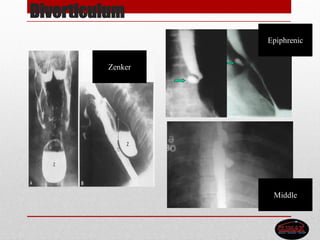
Diverticulum
Epiphrenic
Middle
Zenker
Esophageal Cancer
• Colon used to replace the esophagus after
it was removed in a cancer operation.
• Note the haustrations.
• Narrowing of the lumen of
esophagus with destruction
of mucosa and irregular
outline with sharp shoulder
edges and dilated upper
part of the esophagus.
Presbyesophagus
• An old esophagus.
• Presby, meaning old, is used to
describe the dilatation and
scalloping of the esophagus that
occurs with age.
Esophageal Varices
• Use Valsalva Maneuver:
 Have pt. first deeply inspire.
 Swallow contrast.
 Bear down.
 Recumbent position.
• multiple submucosal filling
defects.
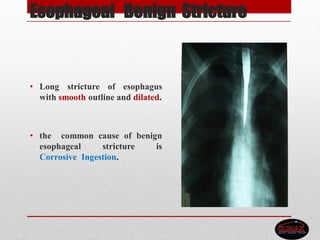
Esophageal Benign Stricture
• Long stricture of esophagus
with smooth outline and dilated.
• the common cause of benign
esophageal stricture is
Corrosive Ingestion.
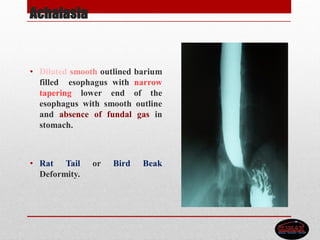
Achalasia
• Dilated smooth outlined barium
filled esophagus with narrow
tapering lower end of the
esophagus with smooth outline
and absence of fundal gas in
stomach.
• Rat Tail or Bird Beak
Deformity.
Part 2
Barium Meal
Bontrager. Chapter 14.
Outlines
• Position of the Stomach
• Anatomy of the Stomach & Duodenum
• Radiographic Anatomy
• Examinations of the Upper GI
• Contrast Media
• Patient Preparation
• Procedure Preparation
• Positioning of:
 AP, PA, RAO, LPO, Rt. lateral
• Film Critique
• Some Significant Pathologies
Position of the Stomach
• Consider the body habitus of the patient:
 The stomach is high and transverse with the hypersthenic patient.
 It is low and vertical with the hyposthenic patient.
• The orthosthenic or average patient has the duodenum bulb near the
L2 region (1 to 2 inches above the inferior costal margin).
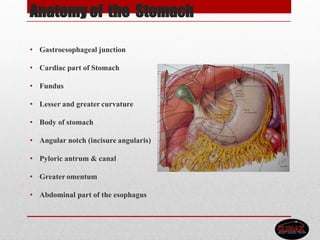
Anatomy of the Stomach
• Gastroesophageal junction
• Cardiac part of Stomach
• Fundus
• Lesser and greater curvature
• Body of stomach
• Angular notch (incisure angularis)
• Pyloric antrum & canal
• Greater omentum
• Abdominal part of the esophagus
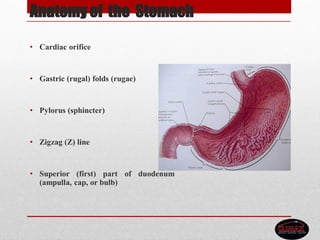
Anatomy of the Stomach
• Cardiac orifice
• Gastric (rugal) folds (rugae)
• Pylorus (sphincter)
• Zigzag (Z) line
• Superior (first) part of duodenum
(ampulla, cap, or bulb)
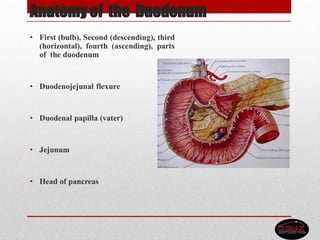
Anatomy of the Duodenum
• First (bulb), Second (descending), third
(horizontal), fourth (ascending), parts
of the duodenum
• Duodenojejunal flexure
• Duodenal papilla (vater)
• Jejunum
• Head of pancreas
Anatomy of the Duodenum
• First (bulb), Second (descending), third
(horizontal), fourth (ascending), parts
of the duodenum
• Duodenojejunal flexure
• Duodenal papilla (vater)
• Jejunum
• Head of pancreas
Barium in
esophagus
Gas and barium
in fundus of S.
Greater
curvature of s.
Left
hemidiaphragm
Duodenal bulb
(or cap)
body of s.
2nd or descending
part of d.
Pyloric orifice
(surrounded by sphincter)
Rugae (rugal
folds)
Lesser
curvature of s.
3rd or horizontal
part of d.
4th or ascending part of d.
Jejunum
Pyloric canal
&
Antrum
Incisure angularis
Radiographic Anatomy of the Upper Gastrointestinal Tract (RAO)
Cardiac zone (extends into fundus)
Distal esophagus
Gastroesophageal junction (at cardiac orifice)
Area of detail
Left
hemidiaphragm
Peristalic
contraction from
distal to abdominal
part of esophagus
Radiographic Anatomy of the Upper Gastrointestinal Tract (RAO)
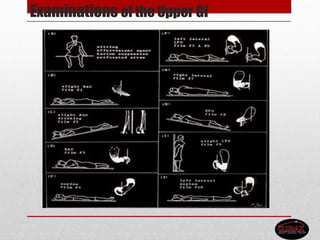
Examinations of the Upper GI
• The purpose of is to study radiographically the form and
function of the distal esophagus, stomach, and duodenum.
• The more common pathologic indications for an upper GI
study include the following:
 Bezoar
 Diverticula
 Emesis
 Gastric carcinoma
 Gastritis
 Hiatal hernia
 Ulcers
Examinations of the Upper GI
• High kV of 100-125 is required to penetrate adequately and increase
visibility of barium-filled structures.
• A kV below 100 will not provide visibility of the mucosa of the esophagus,
stomach, or duodenum.
• Short exposure times are needed to control peristaltic motion.
• With double contrast, reduction of the kV to the 90-100 range is common
to provide higher-contrast images without overpenetrating the anatomy.
• Iodinated water-soluble contrast studies often require a kV range of 80-
90 kV.
• Take exposures at the end of full expiration.
Examinations of the Upper GI
• In the early years of radiology only barium contrast was used. A
concentration of barium entirely attenuates the beam. Filling
defects appear as lucent shadows in the midst of the barium, or as
irregular shapes on the edge of an organ.
• Calcium citrate or magnesium citrate crystals produce CO2 gas,
and a translucent, double contrast effect.
Contrast Media
• Radiopaque contrast media is typically barium, a soft,
metallic, alkaline element: atomic no. 56.
• Processed into barium sulfate (BaSO4). Salts of barium are
chemically pure or they’re poisonous.
• Insoluble in water. Colloidal suspension (shake vigorously).
• In the GI tract barium is inert. Reactions are extremely
rare.
• Barium suspensions are tasteless, but rather unpalatable.
Flavorings are added to commercial preparations, or may
be added when used.
Contrast Media
• Added water changes viscosity and opacity.
• Thin barium moves through the tract more quickly.
• Thick barium adheres to the mucosa.
• Mixtures are defined by department protocols.
• Water is absorbed by the colon. If a patient is dehydrated,
water is absorbed and barium becomes impacted. In
addition to drinking water, laxatives, such as castor oil may
be given after the exam.
Contrast Media
• Barium is contraindicated when there is a chance of leakage
(post-surgical, or perforations), and obstruction.
• Water soluble, iodine preparations are absorbed by the body,
and used in such cases.
• Gastroview, Gastrografin, and Oral Hypaque are brand
names. All are bitter tasting.
• Iodine sensitivity is a possibility.
• Water soluble contrast is also used to dilute barium
preparations (loosing opacity).
Patient Preparation
• The goal is for the patient to arrive in the radiology department
with a completely empty stomach.
• For an examination scheduled during the morning hours, the
patient should be NPO from midnight until the time of the
examination.
• Pt. should follow a low residue diet for 2 days prior to exam.
• Food and fluids should be withheld for at least 8 hours prior to
the exam.
• The patient also is instructed not to smoke cigarettes or chew gum
during the NPO period. These activities tend to increase gastric
secretions and salivation, which prevents proper coating of
barium to the gastric mucosa.
Procedure Preparation
• Evaluate the Order.
• Greet the patient.
• Take History:
Abdominal, epigastric, or chest pain (RO/MI); acid reflux; dyspepsia
(indigestion); eructation; anemia; GI bleeding; abdominal mass; N/V;
hematemesis; etc.
• Remove jewelry, check attire, snaps, pins, NG tubes, etc.
• Explain the exam in layman’s terms.
• Questions?
• Set technique before positioning.
• AP scout generally obtained prior to exam
Film Critique Reminder
• In addition to criteria specific to each projection, all
films are evaluated for:
1. Patient ID
2. Rt/Lt, special marker
3. Contrast & density
4. Motion
5. Artifacts
Positioning - Routine AP
• 14” x 17” lengthwise.
• Midsagital plane straight, no
rotation.
• CR between xyphoid tip and
inferior costal margin.
 1” higher for hypersthenic.
 2” lower for asthenic.
• Favor left side if needed.
• Suspend breathing on expiration.
Critique Criteria (AP)
• In the supine position the
fundus is inferior to the
pylorus.
• Barium fills the fundus, and if
double contrast, air fills the
body and duodenum.
• On a 14” x 17” film, the entire
stomach, duodenum, and the
proximal jejunum (whatever
may fill) should be included.
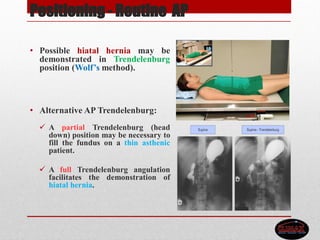
Positioning - Routine AP
• Possible hiatal hernia may be
demonstrated in Trendelenburg
position (Wolf’s method).
• Alternative AP Trendelenburg:
 A partial Trendelenburg (head
down) position may be necessary to
fill the fundus on a thin asthenic
patient.
 A full Trendelenburg angulation
facilitates the demonstration of
hiatal hernia.
Positioning - Routine PA
• 14” x 17” lengthwise.
• In PA position landmarks are less
accessible.
• In addition to 1-2” above lower
margin of lateral ribs (Bontrager), 6”
above the iliac crest is often used to
localize the level of the pylorus and
duodenal bulb (center).
• Higher for hypersthenic, lower for
asthenic.
• Favor left side if needed.
• Double check Lt marker (it’s a tricky
one).
Critique Criteria (PA)
• In the prone position the
fundus is superior to the
pylorus.
• Barium fills the Pylorus,
duodenum, and if double
contrast, air fills the fundus.
• On a 14” x 17” film, the entire
stomach, duodenum, and the
proximal jejunum (whatever
may fill) should be included.
Positioning - Routine PA
• Pathology Demonstrated:
1. Polyps;
2. Diverticula;
3. Bezoars;
4. Signs of gastritis;
in the body and pylorus of the stomach.
• Alternate PA axial:
 The position of the high transverse stomach
on a hypersthenic-type patient causes almost
an end-on view, with much overlapping of the
pyloric region of the stomach and the
duodenal bulb with a PA projection.
 A 35°-45° cephalic angle of the central ray
separates these areas for better visualization.
 The greater and lesser curvatures of the
stomach also are better visualized in profile.
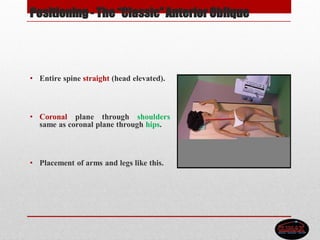
Positioning - The “Classic”Anterior Oblique
• Entire spine straight (head elevated).
• Coronal plane through shoulders
same as coronal plane through hips.
• Placement of arms and legs like this.
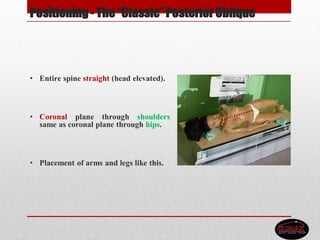
Positioning - The “Classic”Posterior Oblique
• Entire spine straight (head elevated).
• Coronal plane through shoulders
same as coronal plane through hips.
• Placement of arms and legs like this.
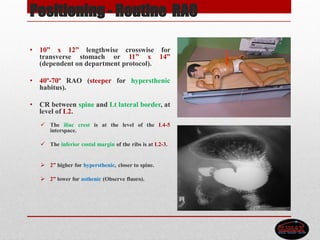
Positioning - Routine RAO
• 10” x 12” lengthwise crosswise for
transverse stomach or 11” x 14”
(dependent on department protocol).
• 40º-70º RAO (steeper for hypersthenic
habitus).
• CR between spine and Lt lateral border, at
level of L2.
 The iliac crest is at the level of the L4-5
interspace.
 The inferior costal margin of the ribs is at L2-3.
 2” higher for hypersthenic, closer to spine.
 2” lower for asthenic (Observe fluoro).
Critique Criteria (RAO)
• Of the stomach projections
the RAO is the film of choice.
• In addition to the profile of
stomach anatomy, the
duodenal bulb and the sweep
of the duodenum must be
included.
• Like the PA, air rises to the
fundus, and barium settles in
the pylorus.
Positioning - Routine RAO
• Pathology Demonstrated:
This is the ideal position for
demonstrating polyps and ulcers
of the pylorus, duodenal bulb, and
C-loop of the duodenum
Positioning - Routine LPO
• 10” x 12” lengthwise crosswise for
transverse stomach or 11” x 14”
(dependent on department
protocol).
• 30º-60º LPO (steeper for
hypersthenic habitus).
• CR same as AP (between xiphoid tip
and inferior costal margin).
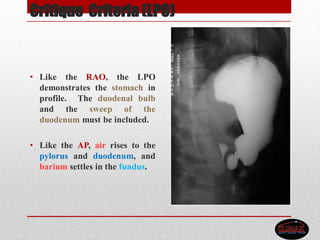
Critique Criteria (LPO)
• Like the RAO, the LPO
demonstrates the stomach in
profile. The duodenal bulb
and the sweep of the
duodenum must be included.
• Like the AP, air rises to the
pylorus and duodenum, and
barium settles in the fundus.
Positioning - Routine LPO
• Pathology Demonstrated:
When a double-contrast technique
is used, the air-filled pylorus and
duodenal bulb may better
demonstrate signs of gastritis and
ulcers.
Positioning - Routine Rt Lateral
• 10” x 12” lengthwise crosswise for
transverse stomach or 11” x 14”
(dependent on department protocol).
• True right lateral position, mid-
coronal plane to long axis of table.
• CR to level of inferior costal margin,
between anterior bodies of L spine
and rectus abdominis.
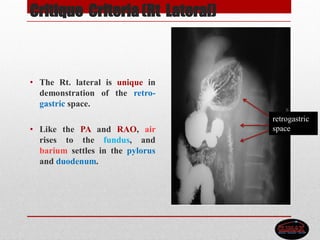
Critique Criteria (Rt Lateral)
• The Rt. lateral is unique in
demonstration of the retro-
gastric space.
• Like the PA and RAO, air
rises to the fundus, and
barium settles in the pylorus
and duodenum.
retrogastric
space
Positioning - Routine Rt Lateral
• Pathology Demonstrated:
 Pathologic processes of the
retrogastric space are shown.
 Diverticula, tumors, gastric
ulcers, and trauma to the
stomach may be demonstrated
along the posterior margin of
the stomach.
SIGNIFICANT PATHOLOGIES
OF THE UPPER GI
AND THEIR
RADIOGRAPHIC APPEARANCES
• Bezoar
 Phytobezoar
 Trichobezoar
• Diverticula
• Gastric carcinoma
• Hiatal hernia
(sliding hiatal hernia)
• Gastritis
• Ulcer
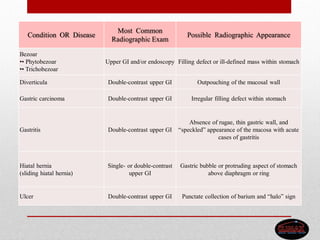
Condition OR Disease
Most Common
Radiographic Exam
Possible Radiographic Appearance
Bezoar
•• Phytobezoar
•• Trichobezoar
Upper GI and/or endoscopy Filling defect or ill-defined mass within stomach
Diverticula Double-contrast upper GI Outpouching of the mucosal wall
Gastric carcinoma Double-contrast upper GI Irregular filling defect within stomach
Gastritis Double-contrast upper GI
Absence of rugae, thin gastric wall, and
“speckled” appearance of the mucosa with acute
cases of gastritis
Hiatal hernia
(sliding hiatal hernia)
Single- or double-contrast
upper GI
Gastric bubble or protruding aspect of stomach
above diaphragm or ring
Ulcer Double-contrast upper GI Punctate collection of barium and “halo” sign
Bezoar
• A mass defined as a filling
defect within the stomach.
• The bezoar retains a light
coating of barium even after the
stomach has emptied most of
the barium.
Diverticula
• Gastric diverticula generally
range 1-2 centimeters but may be
as small as a few millimeters to 8
centimeters in diameter.
• Nearly 70%-90% of gastric
diverticula arise in the posterior
aspect of the fundus.
• The lateral position may be the
only projection that demonstrates
gastric diverticula.
• Most gastric diverticula are
asymptomatic and are discovered
accidentally.
Gastric Cancer
• Radiographic signs include:
 A large irregular filling
defect within the stomach.
 Marked or nodular edges of
the stomach lining.
 Rigidity of the stomach.
 Associated ulceration of the
mucosa.
Gastritis
• Fine coating of barium
demonstrates subtle changes to
the mucosal lining.
• Specific radiographic
appearances may include, but
are not restricted to:
 Absence of rugae.
 A thin gastric wall.
 “Speckled” appearance of the
mucosa.
Sliding Hiatal Hernia
• A condition in which a portion
of the stomach herniates
through the diaphragmatic
opening.
• The herniation may be slight,
but in severe cases, most of the
stomach is found within the
thoracic cavity above the
diaphragm.
• May occur in both pediatric and
adult patients.
Ulcer
• Punctate collection of barium and
“halo” sign.
• Perforating ulcer:
 Radiographic signs include
the presence of free air under
the diaphragm, as seen with
an erect abdomen radiograph.
 If untreated, this ulcer may
lead to peritonitis and
eventual death.
Recommended
Citation
Cite as:
Zare Mehrjardi M. Barium swallow and barium meal: techniques and
interpretation. 2013. doi: 10.13140/RG.2.2.10543.33449/1.
E-mail: zare@sbmu.ac.ir
© 2013 Climax RC
All Rights Reserved

Presentation on flouroscopy (barium).pdf

  • 1.
    Barium Swallow & Barium Meal: PresentedBy: M. Zare Mehrjardi, M.D. 1, 2
  • 2.
    Part 1 Barium Swallow Bontrager.pp. 443-445; 458-460; 469-473
  • 3.
    Outlines • Anatomy ofthe Pharynx & Esophagus • Examinations of the Pharynx & Esophagus • Contrast Media • Patient Preparation • Procedure Preparation • Positioning of:  Neck soft tissue: AP & Lateral  Esophagus:AP, PA , Left Lateral, RAO, LAO • Film Critique • Some Significant Pathologies
  • 4.
    Anatomy of thePharynx & Esophagus • Naso-------pharynx, Oro--------pharynx, Laryngo--pharynx, Esophagus • Soft palate, Uvula • Buccal cavity • Epiglottis • Piriform fossa (recess)
  • 5.
    Anatomy of thePharynx & Esophagus • Naso------pharynx, Oro--------pharynx, Laryngo--pharynx, Esophagus • Soft palate, Uvula • Adenoids • Vocal folds • Epiglottis
  • 6.
    Anatomy of thePharynx & Esophagus • Mucosa, Submucosa, Muscular layers • Zigzag (Z) line • Diaphragmatic hiatus • Abdominal part of esophagus
  • 7.
    Examinations of thePharynx • A procedure done after a person has had a stroke or other disabling affliction to the speech muscles. • Typically done by a speech pathologist, using barium paste. • Commonly recorded on video tape. • This procedure is also called a barium swallow.
  • 8.
    Examinations of theEsophagus • Two procedures: one for the throat and one for the esophagus. • Barium Swallow (Esophagram) or Modified Barium Swallow (MBS). • The exam begins under fluoroscopy, in the upright position. • Filming is typically done using a: spot film camera or digital fluoroscopy.
  • 9.
    Examinations of theEsophagus • Can use double or single contrast. • Barium should flow to sufficiently coat esophagus. • Can be done upright or recumbent. • Exam will usually be started with fluoroscopy.
  • 10.
    Contrast Media • Likethe other examinations of the alimentary track, barium sulfate is used unless there are contraindications to barium. • Both thin and thick barium are used. • Thin barium is useful to outline the esophagus quickly. When administered in the upright position is empties into the stomach in seconds. It is also used to diagnose reflux when using the water test, shallow LPO, compression, or the toe-touch maneuver. • Thick barium (barium paste) is mixed with one part water to 3-4 parts barium powder. Commercial products are often packaged in a tube. • Thick barium coats and adheres to the mucosa. It may be mixed with cotton balls, marshmallows, or other foods.
  • 11.
    Patient Preparation No patientpreparation is needed for an esophagram, unless it is to be followed by an UGI.
  • 12.
    Procedure Preparation • Evaluatethe Order. • Greet the patient. • Take History. (If the patient is female, then a menstrual history must be obtained. Irradiation of an early pregnancy is one of the most hazardous situations in diagnostic radiography.) • Remove jewelry, check attire, snaps, pins, NG tubes, etc. • Explain the exam in layman’s terms. • Questions? • Set technique before positioning.
  • 13.
    Examinations of thePharynx & Esophagus • Esophagrams begin under fluoroscopy, in the upright position. • The patient holds a cup of barium, with a straw, in the right hand. • The radiologist instructs the patient to drink, and films in the AP, RPO, and LPO positions. • The patient is often put into an RAO before the table is lowered to horizontal. The examination continues in the recumbent position. • Overhead films are taken per the radiologist’s routine. • The trick to overhead filming is to fill the esophagus, from the pharynx to the cardiac orifice of the stomach, and make the exposure before the esophagus empties. To do this the patient is instructed to take three large bolus swallows. On the fourth, breathing is suspended and the exposure is made at the moment the patient swallows. A shallow trendelenburg position will help keep the esophagus full.
  • 14.
    Positioning - Necksoft tissue • Positioned the same as an AP & Lateral C-spine: ½ the mAs. • Expose during Inspiration. • Done to assess the patency of the airway: Masses; Foreign bodies; Enlarged adenoids (kids); Epiglottitis (kids);
  • 15.
  • 16.
    Routine AP &PA Positioning • 14” x 17” lengthwise. (7” x 17” are also used) • Prone or supine. • Head turned to the side to allow drinking. • CR 1” inferior to the sternal angle. • Top of the film 2” above shoulders.
  • 17.
    Critique Criteria (AP& PA) • Entire esophagus should be filled with barium, in an unrotated frontal projection. • When there is inadequate filling of the esophagus, under-penetration, and/or insufficient density, the esophagus is difficult to visualize against the mediastinum. • Good filling, contrast, and density, demonstrating a condition called presbyesophagus.
  • 18.
    Routine RAO orLAO Positioning • 14” x 17” lengthwise. (7” x 17” are also used) • 35º-45º RAO position. • Spine must be as straight as possible, especially with tight collimation. • CR to T5-6. Several inches left to the spinous processes. • Top of film 2” above shoulders.
  • 19.
    Critique Criteria (RAO) •Like the RAO stomach, which is the single best projection, the RAO is also best for the esophagus. • The heart provides a homogeneous background to contrast it against. • The distal esophagus, traversing the esophageal hiatus, is laid out in profile. • The RAO should demonstrate the entire barium filled esophagus. • The abdominal portion is more important than the pharyngeal portion, which may be evaluated by direct inspection.
  • 20.
    Critique Criteria (LAO) •The LAO may provide valuable diagnostic information, but:  contrasts the esophagus against the hilar area of the right lung.  foreshortens the abdominal esophagus at the gasteroesophageal junction.
  • 21.
    Routine Right LateralPositioning • 14” x 17” lengthwise. (7” x 17” are also used) • Right lateral. • C-spine “coextensive” to T-spine. • CR to T5-6 in the midcoronal plane. • Top of film 2” above shoulders. • The arms may be raised and superimposed (like a lateral chest position), or the left shoulder may be rotated posteriorly for a “swimmers lateral”.
  • 22.
    Critique Criteria (RightLateral) • Entire barium filled esophagus projected posterior to heart, and anterior to the T-spine. Soft tissue of arm Humerus
  • 23.
    SIGNIFICANT PATHOLOGIES OF THEESOPHAGUS AND THEIR RADIOGRAPHIC APPEARANCES • TE Fistula • Foreign Body • Diverticulum • Esophageal Cancer • Presbyesophagus • Esophageal Varices • Esophageal Benign Strictures • Achalasia
  • 24.
    Tracheoesophageal (TE) Fistula •A congenital or ulcerative opening (fistula tract) between the esophagus and trachea. • Radiographic examinations of fistulas are fistulagrams, or sinograms (sinus tract). • Barium in the bronchial tree may result from a TE fistula, or aspiration of barium.
  • 25.
    Foreign Body • RadiolucentFBs, such as chicken or fish bones, may require a swallow of barium to be demonstrated. • Rotary blades from an electric razor. One stuck in the proximal esophagus, and one in the pyloric canal.
  • 26.
  • 27.
    Esophageal Cancer • Colonused to replace the esophagus after it was removed in a cancer operation. • Note the haustrations. • Narrowing of the lumen of esophagus with destruction of mucosa and irregular outline with sharp shoulder edges and dilated upper part of the esophagus.
  • 28.
    Presbyesophagus • An oldesophagus. • Presby, meaning old, is used to describe the dilatation and scalloping of the esophagus that occurs with age.
  • 29.
    Esophageal Varices • UseValsalva Maneuver:  Have pt. first deeply inspire.  Swallow contrast.  Bear down.  Recumbent position. • multiple submucosal filling defects.
  • 30.
    Esophageal Benign Stricture •Long stricture of esophagus with smooth outline and dilated. • the common cause of benign esophageal stricture is Corrosive Ingestion.
  • 31.
    Achalasia • Dilated smoothoutlined barium filled esophagus with narrow tapering lower end of the esophagus with smooth outline and absence of fundal gas in stomach. • Rat Tail or Bird Beak Deformity.
  • 32.
  • 33.
    Outlines • Position ofthe Stomach • Anatomy of the Stomach & Duodenum • Radiographic Anatomy • Examinations of the Upper GI • Contrast Media • Patient Preparation • Procedure Preparation • Positioning of:  AP, PA, RAO, LPO, Rt. lateral • Film Critique • Some Significant Pathologies
  • 34.
    Position of theStomach • Consider the body habitus of the patient:  The stomach is high and transverse with the hypersthenic patient.  It is low and vertical with the hyposthenic patient. • The orthosthenic or average patient has the duodenum bulb near the L2 region (1 to 2 inches above the inferior costal margin).
  • 35.
    Anatomy of theStomach • Gastroesophageal junction • Cardiac part of Stomach • Fundus • Lesser and greater curvature • Body of stomach • Angular notch (incisure angularis) • Pyloric antrum & canal • Greater omentum • Abdominal part of the esophagus
  • 36.
    Anatomy of theStomach • Cardiac orifice • Gastric (rugal) folds (rugae) • Pylorus (sphincter) • Zigzag (Z) line • Superior (first) part of duodenum (ampulla, cap, or bulb)
  • 37.
    Anatomy of theDuodenum • First (bulb), Second (descending), third (horizontal), fourth (ascending), parts of the duodenum • Duodenojejunal flexure • Duodenal papilla (vater) • Jejunum • Head of pancreas
  • 38.
    Anatomy of theDuodenum • First (bulb), Second (descending), third (horizontal), fourth (ascending), parts of the duodenum • Duodenojejunal flexure • Duodenal papilla (vater) • Jejunum • Head of pancreas
  • 39.
    Barium in esophagus Gas andbarium in fundus of S. Greater curvature of s. Left hemidiaphragm Duodenal bulb (or cap) body of s. 2nd or descending part of d. Pyloric orifice (surrounded by sphincter) Rugae (rugal folds) Lesser curvature of s. 3rd or horizontal part of d. 4th or ascending part of d. Jejunum Pyloric canal & Antrum Incisure angularis Radiographic Anatomy of the Upper Gastrointestinal Tract (RAO)
  • 40.
    Cardiac zone (extendsinto fundus) Distal esophagus Gastroesophageal junction (at cardiac orifice) Area of detail Left hemidiaphragm Peristalic contraction from distal to abdominal part of esophagus Radiographic Anatomy of the Upper Gastrointestinal Tract (RAO)
  • 41.
    Examinations of theUpper GI • The purpose of is to study radiographically the form and function of the distal esophagus, stomach, and duodenum. • The more common pathologic indications for an upper GI study include the following:  Bezoar  Diverticula  Emesis  Gastric carcinoma  Gastritis  Hiatal hernia  Ulcers
  • 42.
    Examinations of theUpper GI • High kV of 100-125 is required to penetrate adequately and increase visibility of barium-filled structures. • A kV below 100 will not provide visibility of the mucosa of the esophagus, stomach, or duodenum. • Short exposure times are needed to control peristaltic motion. • With double contrast, reduction of the kV to the 90-100 range is common to provide higher-contrast images without overpenetrating the anatomy. • Iodinated water-soluble contrast studies often require a kV range of 80- 90 kV. • Take exposures at the end of full expiration.
  • 43.
  • 44.
    Examinations of theUpper GI • In the early years of radiology only barium contrast was used. A concentration of barium entirely attenuates the beam. Filling defects appear as lucent shadows in the midst of the barium, or as irregular shapes on the edge of an organ. • Calcium citrate or magnesium citrate crystals produce CO2 gas, and a translucent, double contrast effect.
  • 45.
    Contrast Media • Radiopaquecontrast media is typically barium, a soft, metallic, alkaline element: atomic no. 56. • Processed into barium sulfate (BaSO4). Salts of barium are chemically pure or they’re poisonous. • Insoluble in water. Colloidal suspension (shake vigorously). • In the GI tract barium is inert. Reactions are extremely rare. • Barium suspensions are tasteless, but rather unpalatable. Flavorings are added to commercial preparations, or may be added when used.
  • 46.
    Contrast Media • Addedwater changes viscosity and opacity. • Thin barium moves through the tract more quickly. • Thick barium adheres to the mucosa. • Mixtures are defined by department protocols. • Water is absorbed by the colon. If a patient is dehydrated, water is absorbed and barium becomes impacted. In addition to drinking water, laxatives, such as castor oil may be given after the exam.
  • 47.
    Contrast Media • Bariumis contraindicated when there is a chance of leakage (post-surgical, or perforations), and obstruction. • Water soluble, iodine preparations are absorbed by the body, and used in such cases. • Gastroview, Gastrografin, and Oral Hypaque are brand names. All are bitter tasting. • Iodine sensitivity is a possibility. • Water soluble contrast is also used to dilute barium preparations (loosing opacity).
  • 48.
    Patient Preparation • Thegoal is for the patient to arrive in the radiology department with a completely empty stomach. • For an examination scheduled during the morning hours, the patient should be NPO from midnight until the time of the examination. • Pt. should follow a low residue diet for 2 days prior to exam. • Food and fluids should be withheld for at least 8 hours prior to the exam. • The patient also is instructed not to smoke cigarettes or chew gum during the NPO period. These activities tend to increase gastric secretions and salivation, which prevents proper coating of barium to the gastric mucosa.
  • 49.
    Procedure Preparation • Evaluatethe Order. • Greet the patient. • Take History: Abdominal, epigastric, or chest pain (RO/MI); acid reflux; dyspepsia (indigestion); eructation; anemia; GI bleeding; abdominal mass; N/V; hematemesis; etc. • Remove jewelry, check attire, snaps, pins, NG tubes, etc. • Explain the exam in layman’s terms. • Questions? • Set technique before positioning. • AP scout generally obtained prior to exam
  • 50.
    Film Critique Reminder •In addition to criteria specific to each projection, all films are evaluated for: 1. Patient ID 2. Rt/Lt, special marker 3. Contrast & density 4. Motion 5. Artifacts
  • 51.
    Positioning - RoutineAP • 14” x 17” lengthwise. • Midsagital plane straight, no rotation. • CR between xyphoid tip and inferior costal margin.  1” higher for hypersthenic.  2” lower for asthenic. • Favor left side if needed. • Suspend breathing on expiration.
  • 52.
    Critique Criteria (AP) •In the supine position the fundus is inferior to the pylorus. • Barium fills the fundus, and if double contrast, air fills the body and duodenum. • On a 14” x 17” film, the entire stomach, duodenum, and the proximal jejunum (whatever may fill) should be included.
  • 53.
    Positioning - RoutineAP • Possible hiatal hernia may be demonstrated in Trendelenburg position (Wolf’s method). • Alternative AP Trendelenburg:  A partial Trendelenburg (head down) position may be necessary to fill the fundus on a thin asthenic patient.  A full Trendelenburg angulation facilitates the demonstration of hiatal hernia.
  • 54.
    Positioning - RoutinePA • 14” x 17” lengthwise. • In PA position landmarks are less accessible. • In addition to 1-2” above lower margin of lateral ribs (Bontrager), 6” above the iliac crest is often used to localize the level of the pylorus and duodenal bulb (center). • Higher for hypersthenic, lower for asthenic. • Favor left side if needed. • Double check Lt marker (it’s a tricky one).
  • 55.
    Critique Criteria (PA) •In the prone position the fundus is superior to the pylorus. • Barium fills the Pylorus, duodenum, and if double contrast, air fills the fundus. • On a 14” x 17” film, the entire stomach, duodenum, and the proximal jejunum (whatever may fill) should be included.
  • 56.
    Positioning - RoutinePA • Pathology Demonstrated: 1. Polyps; 2. Diverticula; 3. Bezoars; 4. Signs of gastritis; in the body and pylorus of the stomach. • Alternate PA axial:  The position of the high transverse stomach on a hypersthenic-type patient causes almost an end-on view, with much overlapping of the pyloric region of the stomach and the duodenal bulb with a PA projection.  A 35°-45° cephalic angle of the central ray separates these areas for better visualization.  The greater and lesser curvatures of the stomach also are better visualized in profile.
  • 57.
    Positioning - The“Classic”Anterior Oblique • Entire spine straight (head elevated). • Coronal plane through shoulders same as coronal plane through hips. • Placement of arms and legs like this.
  • 58.
    Positioning - The“Classic”Posterior Oblique • Entire spine straight (head elevated). • Coronal plane through shoulders same as coronal plane through hips. • Placement of arms and legs like this.
  • 59.
    Positioning - RoutineRAO • 10” x 12” lengthwise crosswise for transverse stomach or 11” x 14” (dependent on department protocol). • 40º-70º RAO (steeper for hypersthenic habitus). • CR between spine and Lt lateral border, at level of L2.  The iliac crest is at the level of the L4-5 interspace.  The inferior costal margin of the ribs is at L2-3.  2” higher for hypersthenic, closer to spine.  2” lower for asthenic (Observe fluoro).
  • 60.
    Critique Criteria (RAO) •Of the stomach projections the RAO is the film of choice. • In addition to the profile of stomach anatomy, the duodenal bulb and the sweep of the duodenum must be included. • Like the PA, air rises to the fundus, and barium settles in the pylorus.
  • 61.
    Positioning - RoutineRAO • Pathology Demonstrated: This is the ideal position for demonstrating polyps and ulcers of the pylorus, duodenal bulb, and C-loop of the duodenum
  • 62.
    Positioning - RoutineLPO • 10” x 12” lengthwise crosswise for transverse stomach or 11” x 14” (dependent on department protocol). • 30º-60º LPO (steeper for hypersthenic habitus). • CR same as AP (between xiphoid tip and inferior costal margin).
  • 63.
    Critique Criteria (LPO) •Like the RAO, the LPO demonstrates the stomach in profile. The duodenal bulb and the sweep of the duodenum must be included. • Like the AP, air rises to the pylorus and duodenum, and barium settles in the fundus.
  • 64.
    Positioning - RoutineLPO • Pathology Demonstrated: When a double-contrast technique is used, the air-filled pylorus and duodenal bulb may better demonstrate signs of gastritis and ulcers.
  • 65.
    Positioning - RoutineRt Lateral • 10” x 12” lengthwise crosswise for transverse stomach or 11” x 14” (dependent on department protocol). • True right lateral position, mid- coronal plane to long axis of table. • CR to level of inferior costal margin, between anterior bodies of L spine and rectus abdominis.
  • 66.
    Critique Criteria (RtLateral) • The Rt. lateral is unique in demonstration of the retro- gastric space. • Like the PA and RAO, air rises to the fundus, and barium settles in the pylorus and duodenum. retrogastric space
  • 67.
    Positioning - RoutineRt Lateral • Pathology Demonstrated:  Pathologic processes of the retrogastric space are shown.  Diverticula, tumors, gastric ulcers, and trauma to the stomach may be demonstrated along the posterior margin of the stomach.
  • 68.
    SIGNIFICANT PATHOLOGIES OF THEUPPER GI AND THEIR RADIOGRAPHIC APPEARANCES • Bezoar  Phytobezoar  Trichobezoar • Diverticula • Gastric carcinoma • Hiatal hernia (sliding hiatal hernia) • Gastritis • Ulcer
  • 69.
    Condition OR Disease MostCommon Radiographic Exam Possible Radiographic Appearance Bezoar •• Phytobezoar •• Trichobezoar Upper GI and/or endoscopy Filling defect or ill-defined mass within stomach Diverticula Double-contrast upper GI Outpouching of the mucosal wall Gastric carcinoma Double-contrast upper GI Irregular filling defect within stomach Gastritis Double-contrast upper GI Absence of rugae, thin gastric wall, and “speckled” appearance of the mucosa with acute cases of gastritis Hiatal hernia (sliding hiatal hernia) Single- or double-contrast upper GI Gastric bubble or protruding aspect of stomach above diaphragm or ring Ulcer Double-contrast upper GI Punctate collection of barium and “halo” sign
  • 70.
    Bezoar • A massdefined as a filling defect within the stomach. • The bezoar retains a light coating of barium even after the stomach has emptied most of the barium.
  • 71.
    Diverticula • Gastric diverticulagenerally range 1-2 centimeters but may be as small as a few millimeters to 8 centimeters in diameter. • Nearly 70%-90% of gastric diverticula arise in the posterior aspect of the fundus. • The lateral position may be the only projection that demonstrates gastric diverticula. • Most gastric diverticula are asymptomatic and are discovered accidentally.
  • 72.
    Gastric Cancer • Radiographicsigns include:  A large irregular filling defect within the stomach.  Marked or nodular edges of the stomach lining.  Rigidity of the stomach.  Associated ulceration of the mucosa.
  • 73.
    Gastritis • Fine coatingof barium demonstrates subtle changes to the mucosal lining. • Specific radiographic appearances may include, but are not restricted to:  Absence of rugae.  A thin gastric wall.  “Speckled” appearance of the mucosa.
  • 74.
    Sliding Hiatal Hernia •A condition in which a portion of the stomach herniates through the diaphragmatic opening. • The herniation may be slight, but in severe cases, most of the stomach is found within the thoracic cavity above the diaphragm. • May occur in both pediatric and adult patients.
  • 75.
    Ulcer • Punctate collectionof barium and “halo” sign. • Perforating ulcer:  Radiographic signs include the presence of free air under the diaphragm, as seen with an erect abdomen radiograph.  If untreated, this ulcer may lead to peritonitis and eventual death.
  • 76.
    Recommended Citation Cite as: Zare MehrjardiM. Barium swallow and barium meal: techniques and interpretation. 2013. doi: 10.13140/RG.2.2.10543.33449/1.
  • 77.
    E-mail: zare@sbmu.ac.ir © 2013Climax RC All Rights Reserved