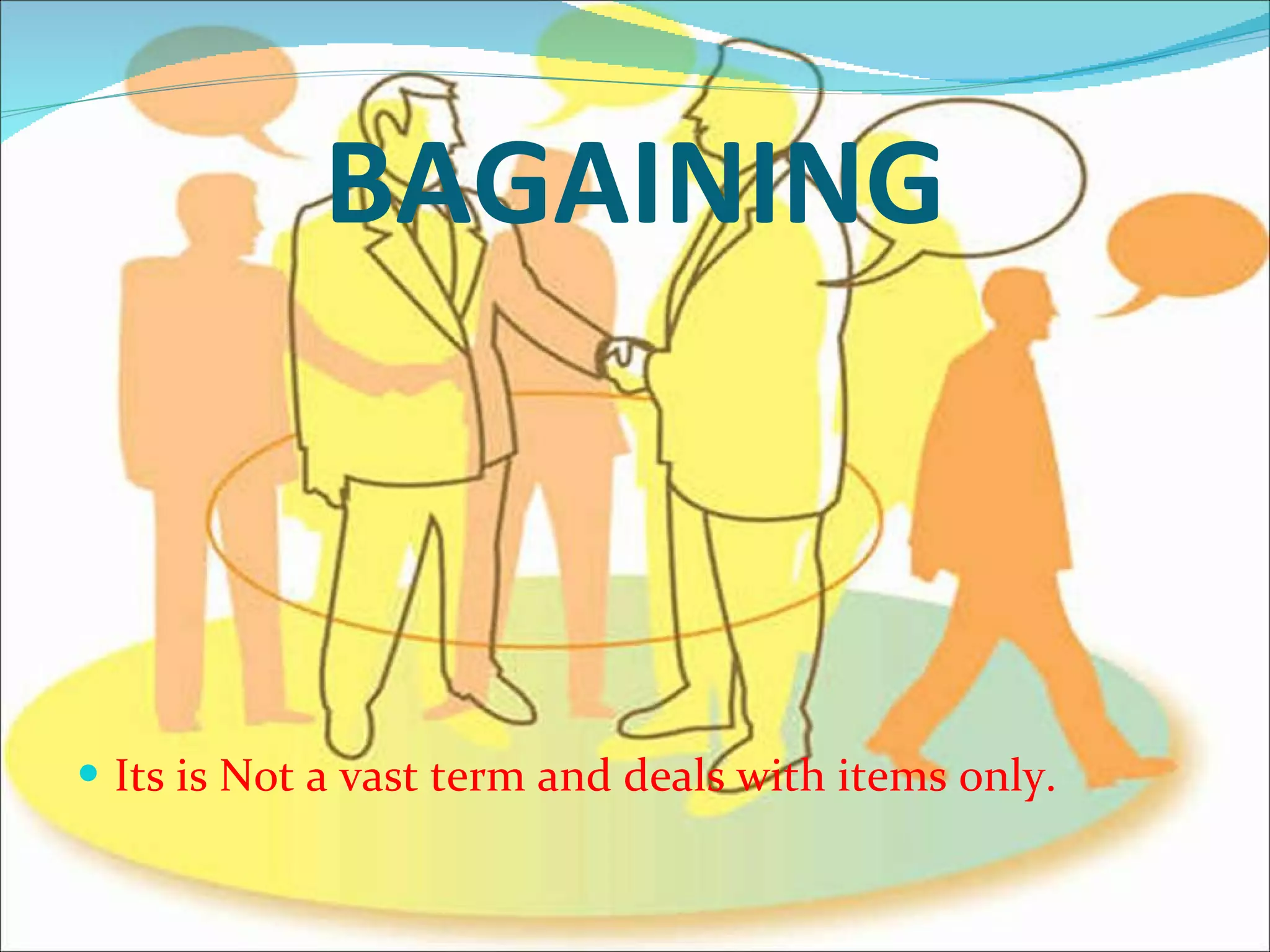
BAGAINING Its is Not a vast term and deals with items only.
Integrative and Distributive Bargaining Strategies Integrative strategies (win-win attitude) Distributive strategies (win-lose attitude)
Integrative Bargaining occurs when the two sides look not just for their own outcomes, but for favorable outcomes for  both  sides. It is sometimes called  Win-Win  bargaining or  Non-Zero-Sum  bargaining
Requirements For Integrative Bargaining Strategies An adversarial approach  a problem-solving orientation  an ability to "bluff" effectively  an ability to ignore the other side’s interests and priorities
A distributive bargaining strategy is based on attempt to divide up a fixed pie or amount of resources, resulting in a win-lose situation.
Process of distributive bargaining strategy In distributive bargaining, the focus is on achieving immediate goals, with little or no regard for building future relationships. Little time or energy or energy is expanded in resolving the conflict in a distributive negotiation, resulting in the generation of few if any creative solution. One or two fixed solutions are presented and a decision or choice is expected almost immediately.
    BARGAINING   Distributive Vs Integrative Distributive 1. One issue (or one at a time) 2. “Win-Lose” 3. Maximize share of “fixed pie” 4. One-time relationship 5. Keep interests hidden 6. One expressed position for each issue 7. Keep information hidden Integrative Several issues “ Win-Win” “ Expand the pie” by creating and claiming value Continuing long-term relationship Share interests with other party Create many options per issue to maximize mutual gains Share information, explain “why” of issue
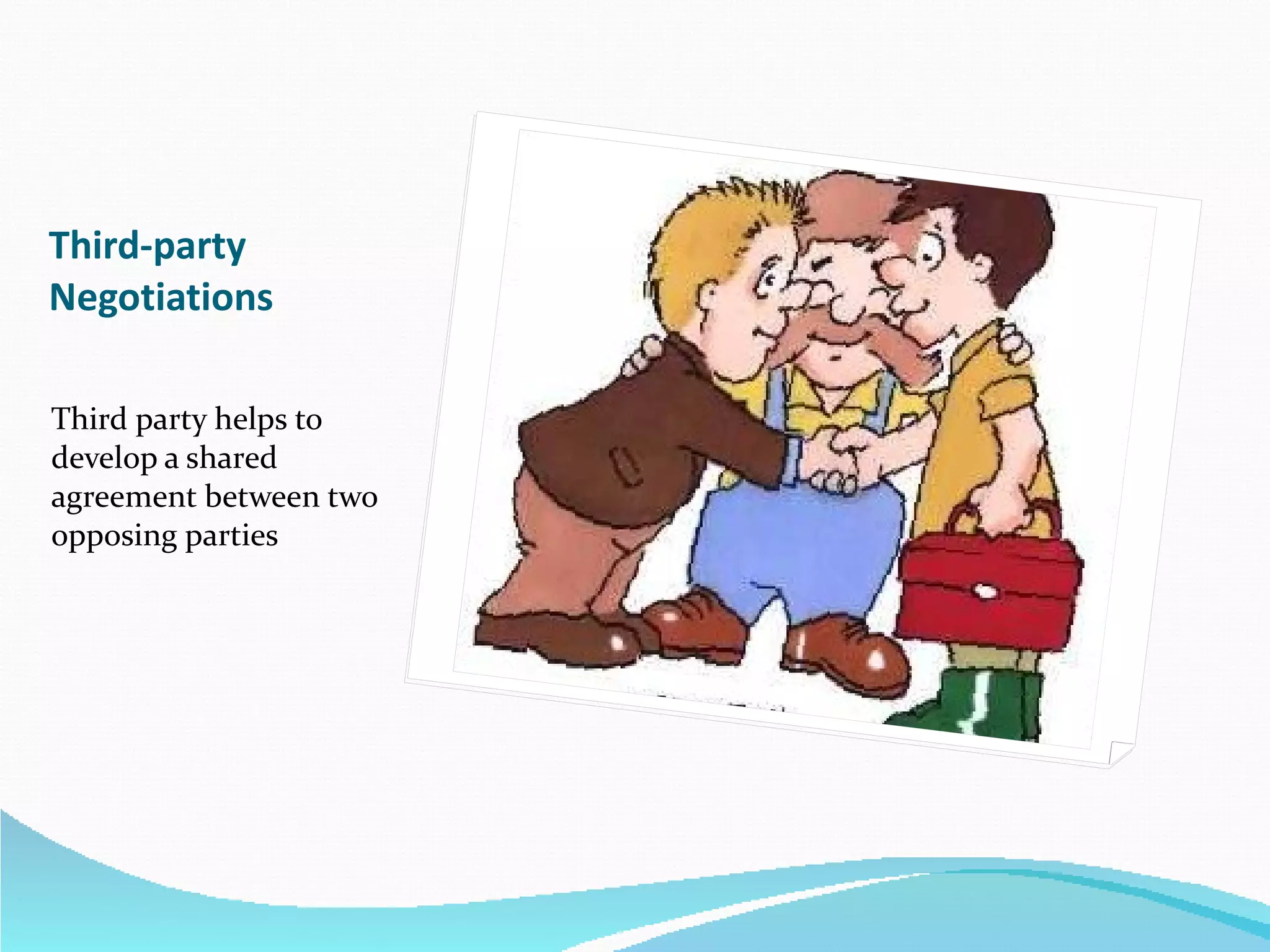
Third-party Negotiations Third party helps to develop a shared agreement between two opposing parties
A third party offers each party a chance to “VENT” in a nonthreatening environment.  Chance to disclose your feelings about the situation.
You  and the other party can both benefit from the experience and expertise of third party.  Third party help the negotiating parties to organize their thoughts and develop options that may be acceptable to both parties.
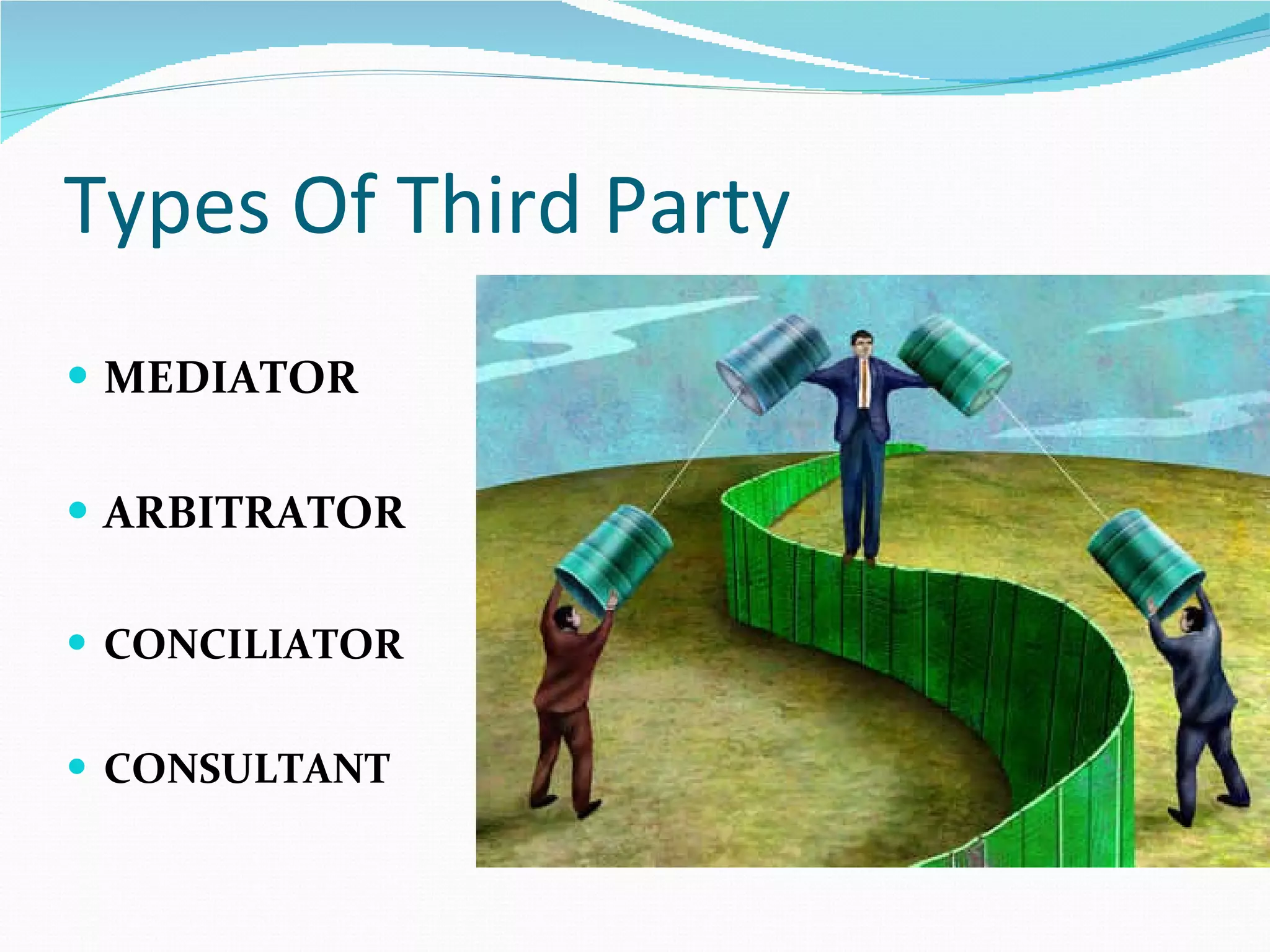
Types Of Third Party MEDIATOR ARBITRATOR CONCILIATOR CONSULTANT
A  MEDIATOR  is a natural party who has no stake in the outcome of agreement. An  ARBITRATOR  is a natural third party who has the legal power to bind both parties in an agreement determined by arbitrator.
A  CONCILIATOR  is a trusted third party whose role is insure to that a steady flow of accurate information exist between the negotiating parties. A  CONSULTANT   is a natural third party who teaches and advises the negotiating parties on skills and techniques of negotiation.

Bargaining + 3rd party

  • 1.
    BAGAINING Its isNot a vast term and deals with items only.
  • 2.
    Integrative and DistributiveBargaining Strategies Integrative strategies (win-win attitude) Distributive strategies (win-lose attitude)
  • 3.
    Integrative Bargaining occurswhen the two sides look not just for their own outcomes, but for favorable outcomes for both sides. It is sometimes called Win-Win bargaining or Non-Zero-Sum bargaining
  • 4.
    Requirements For IntegrativeBargaining Strategies An adversarial approach a problem-solving orientation an ability to "bluff" effectively an ability to ignore the other side’s interests and priorities
  • 5.
    A distributive bargainingstrategy is based on attempt to divide up a fixed pie or amount of resources, resulting in a win-lose situation.
  • 6.
    Process of distributivebargaining strategy In distributive bargaining, the focus is on achieving immediate goals, with little or no regard for building future relationships. Little time or energy or energy is expanded in resolving the conflict in a distributive negotiation, resulting in the generation of few if any creative solution. One or two fixed solutions are presented and a decision or choice is expected almost immediately.
  • 7.
    BARGAINING Distributive Vs Integrative Distributive 1. One issue (or one at a time) 2. “Win-Lose” 3. Maximize share of “fixed pie” 4. One-time relationship 5. Keep interests hidden 6. One expressed position for each issue 7. Keep information hidden Integrative Several issues “ Win-Win” “ Expand the pie” by creating and claiming value Continuing long-term relationship Share interests with other party Create many options per issue to maximize mutual gains Share information, explain “why” of issue
  • 8.
    Third-party Negotiations Thirdparty helps to develop a shared agreement between two opposing parties
  • 9.
    A third partyoffers each party a chance to “VENT” in a nonthreatening environment. Chance to disclose your feelings about the situation.
  • 10.
    You andthe other party can both benefit from the experience and expertise of third party. Third party help the negotiating parties to organize their thoughts and develop options that may be acceptable to both parties.
  • 11.
    Types Of ThirdParty MEDIATOR ARBITRATOR CONCILIATOR CONSULTANT
  • 12.
    A MEDIATOR is a natural party who has no stake in the outcome of agreement. An ARBITRATOR is a natural third party who has the legal power to bind both parties in an agreement determined by arbitrator.
  • 13.
    A CONCILIATOR is a trusted third party whose role is insure to that a steady flow of accurate information exist between the negotiating parties. A CONSULTANT is a natural third party who teaches and advises the negotiating parties on skills and techniques of negotiation.