Human Resource Management
JOB EVALUATION
CONCEPT AND METHODS
Submitted To: Submitted By:
Dr. Manjoo Saraswat Deeksha, Sonali ,
Dept. Registrar, RNBGU Rajshree, Vikas ,
Ankit
(MBA 2015-17)
Presented By
Group-1st
INDEX
• Meaning & Definition
• Objectives
• Various Methods
• Merits & Demerits of Methods
• Examples of Methods
• Conclusion
A job-evaluation program involves answering several
questions:
The major ones are:
• Which jobs are to be evaluated?
• Who should evaluate the jobs?
• What training do the evaluation need?
• How much time is involved?
• What should be the criteria for evaluation?
Meaning of Job evaluation
Job of evaluation : Systematic way of
determining the value or worth of a job in
relation to other jobs in an organization.
An assessment of the relative worth of various
jobs on the basis of a consistent set of job and
personal factoers , such as qualification and
skills required .
Definition
According to Kimball and Kimball,
“ Job evaluation represent an effort to
determine the relative value of every job
in a plant and to determine what the fair
basic wage for such a job should be.”
Objective of Job Evaluation
• The objective of job evaluation is to determine which
job should get more pay than others.
• Gather information and data relating to job
description , job specification and employee
specification of various jobs in the organizations.
• To determine the hierarchy/ rank based jobs in the
organization.
• To determine duties , responsibilities and
demands of the job with that of other jobs.
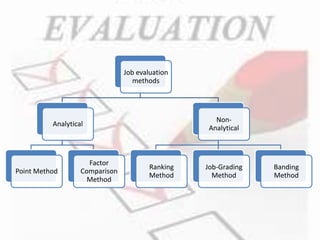
Job evaluation
methods
Analytical
Point Method
Factor
Comparison
Method
Non-
Analytical
Ranking
Method
Job-Grading
Method
Banding
Method
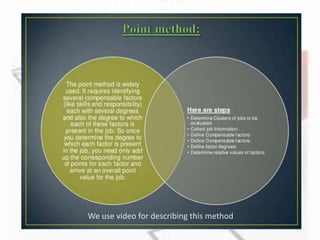
We use video for describing this method
2. Factor comparison method
• Under this method ,instead of ranking complete jobs,
each job is ranked according to to a series of factors .
These factors include mental effort, physical effort ,
physical effort , skill needed , responsibilty working
conditions etc.
• Pay will be assigned in this method by comparing the
weights of factors required for each job
• Wages are assigned to the job in comparison
to the ranking on each factor .
1. Ranking method
• Simplest Method
• Inexpensive Method
• In this method Each Entity Is Compared
to every other entity in terms of value of
the organization
Non-Analytical Method
Definition
Ranking, This method is one of the simplest to
administered. Jobs are compared to each other
based on the overall worth of the job to the
organization. The worth of job is usually based on
certain judgment of Skills, Efforts, Responsibilities
and working conditions.
Merits of Ranking method
• simple to use
• Required little time
• Minimal administration required
Demerits of Ranking Method
• Possibility of Biasedness
• Ranking by different evaluators are not comparable
• Some times criteria for ranking is not understood
• Very difficult to use if there is large number of jobs,
People or Teams to evaluate
2. Grading or Classification Method
EXAMPLE:
Let's say that Beth wants to develop a class for administrative workers. Within this
class she may have three different grades, or levels, based upon the nature of the
work and the level of responsibility. She calls them A-1, A-2 and A-3:
• A-1 performs clerical work under close supervision. The job typically requires a
high school diploma and a general knowledge of office procedures, equipment,
etiquette and the ability to follow instructions. There are no supervisory
responsibilities.
• A-2 performs clerical work with no supervision and may be assigned simple special
projects. The job typically requires an associate level or vocational degree and
requires the same knowledge as an A-1 as well as intermediate knowledge of word
processing and spreadsheets.
• A-3 may perform the duties of A-1 and A-2 but independent of any supervision. A-
3 personnel may also engage in special projects without supervision, provide
personal administrative assistance to management level personnel and may have
supervisory responsibilities over A-1 and A-2 personnel.
• Beth may place the executive assistant to the company's president in the A-3
grade, while a mail clerk would be placed in grade A-1. Of course, Beth may
develop classes and grades of other types of job categories such as research,
management and marketing. A good model that Beth can follow is the federal
government's GS classification system.
3. Banding Method
• A banding procedure takes place when jobs
are grouped together by common
characteristics.
• The Decision Band method (DBM) of job
evaluation bases itself on the premise that the
value of a job to an organization depends on
the level of responsibility,
Advantages:
• Quick and easy procedure
• Has initial face validity to employees
• Allows for organizational flexibility
• Minimal administration required
Disadvantages:
Subtle, but important, differences between groups ignored
Subtle, but important, differences within groups ignored
May invite inequity perceptions
Conclusion
 Aims to determine a job’s relative worth.
Formal comparison of jobs to determine
the worth of one job relative to another.
Identifying compensable factors.
THANKS

Job evaluation

  • 1.
    Human Resource Management JOBEVALUATION CONCEPT AND METHODS Submitted To: Submitted By: Dr. Manjoo Saraswat Deeksha, Sonali , Dept. Registrar, RNBGU Rajshree, Vikas , Ankit (MBA 2015-17) Presented By Group-1st
  • 2.
    INDEX • Meaning &Definition • Objectives • Various Methods • Merits & Demerits of Methods • Examples of Methods • Conclusion
  • 3.
    A job-evaluation programinvolves answering several questions: The major ones are: • Which jobs are to be evaluated? • Who should evaluate the jobs? • What training do the evaluation need? • How much time is involved? • What should be the criteria for evaluation?
  • 4.
    Meaning of Jobevaluation Job of evaluation : Systematic way of determining the value or worth of a job in relation to other jobs in an organization. An assessment of the relative worth of various jobs on the basis of a consistent set of job and personal factoers , such as qualification and skills required .
  • 5.
    Definition According to Kimballand Kimball, “ Job evaluation represent an effort to determine the relative value of every job in a plant and to determine what the fair basic wage for such a job should be.”
  • 6.
    Objective of JobEvaluation • The objective of job evaluation is to determine which job should get more pay than others. • Gather information and data relating to job description , job specification and employee specification of various jobs in the organizations. • To determine the hierarchy/ rank based jobs in the organization. • To determine duties , responsibilities and demands of the job with that of other jobs.
  • 7.
  • 8.
    We use videofor describing this method
  • 11.
    2. Factor comparisonmethod • Under this method ,instead of ranking complete jobs, each job is ranked according to to a series of factors . These factors include mental effort, physical effort , physical effort , skill needed , responsibilty working conditions etc. • Pay will be assigned in this method by comparing the weights of factors required for each job • Wages are assigned to the job in comparison to the ranking on each factor .
  • 12.
    1. Ranking method •Simplest Method • Inexpensive Method • In this method Each Entity Is Compared to every other entity in terms of value of the organization Non-Analytical Method
  • 13.
    Definition Ranking, This methodis one of the simplest to administered. Jobs are compared to each other based on the overall worth of the job to the organization. The worth of job is usually based on certain judgment of Skills, Efforts, Responsibilities and working conditions.
  • 15.
    Merits of Rankingmethod • simple to use • Required little time • Minimal administration required Demerits of Ranking Method • Possibility of Biasedness • Ranking by different evaluators are not comparable • Some times criteria for ranking is not understood • Very difficult to use if there is large number of jobs, People or Teams to evaluate
  • 16.
    2. Grading orClassification Method
  • 18.
    EXAMPLE: Let's say thatBeth wants to develop a class for administrative workers. Within this class she may have three different grades, or levels, based upon the nature of the work and the level of responsibility. She calls them A-1, A-2 and A-3: • A-1 performs clerical work under close supervision. The job typically requires a high school diploma and a general knowledge of office procedures, equipment, etiquette and the ability to follow instructions. There are no supervisory responsibilities. • A-2 performs clerical work with no supervision and may be assigned simple special projects. The job typically requires an associate level or vocational degree and requires the same knowledge as an A-1 as well as intermediate knowledge of word processing and spreadsheets. • A-3 may perform the duties of A-1 and A-2 but independent of any supervision. A- 3 personnel may also engage in special projects without supervision, provide personal administrative assistance to management level personnel and may have supervisory responsibilities over A-1 and A-2 personnel. • Beth may place the executive assistant to the company's president in the A-3 grade, while a mail clerk would be placed in grade A-1. Of course, Beth may develop classes and grades of other types of job categories such as research, management and marketing. A good model that Beth can follow is the federal government's GS classification system.
  • 20.
    3. Banding Method •A banding procedure takes place when jobs are grouped together by common characteristics. • The Decision Band method (DBM) of job evaluation bases itself on the premise that the value of a job to an organization depends on the level of responsibility,
  • 21.
    Advantages: • Quick andeasy procedure • Has initial face validity to employees • Allows for organizational flexibility • Minimal administration required Disadvantages: Subtle, but important, differences between groups ignored Subtle, but important, differences within groups ignored May invite inequity perceptions
  • 22.
    Conclusion  Aims todetermine a job’s relative worth. Formal comparison of jobs to determine the worth of one job relative to another. Identifying compensable factors.
  • 23.