Introduction
NAME :- Suman Twari
Class :- 11th ‘c’
Roll no :- 43
SUBJECT :- Accountancy
Teacher Name :- Mrs. Rajni mam
Accountancy
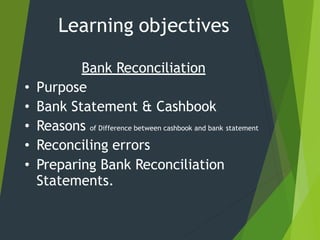
Bank Reconciliation
• Purpose
• Bank Statement & Cashbook
• Reasons of Difference between cashbook and bank statement
• Reconciling errors
• Preparing Bank Reconciliation
Statements.
Learning objectives
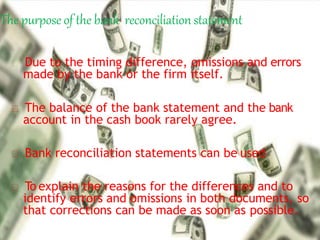
The purpose of the bank reconciliation statement
Due to the timing difference, omissions and errors
made by the bank or the firm itself.
The balance of the bank statement and the bank
account in the cash book rarely agree.
Bank reconciliation statements can be used
To explain the reasons for the differences and to
identify errors and omissions in both documents, so
that corrections can be made as soon as possible.
6-3
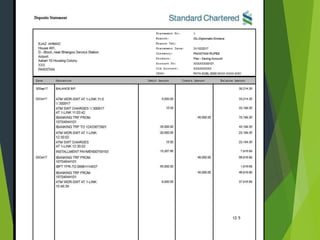
Bank Statement
Bank Statement – A statement listing different types of activity that have taken
place during the month.
 Debit:decreases the account —
 Credit: increases the account +
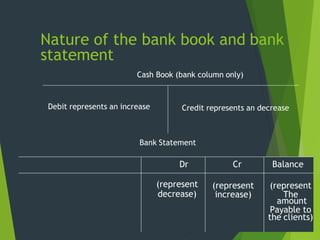
Nature of the bank book and bank
statement
Cash Book (bank column only)
Debit represents an increase Credit represents an decrease
Bank Statement
Dr Cr Balance
(represent
decrease)
(represent
increase)
(represent
The
amount
Payable to
the clients)
12–5
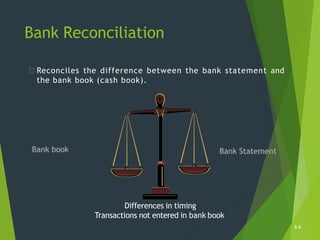
Bank Reconciliation
6-6
Reconciles the difference between the bank statement and
the bank book (cash book).
Differences in timing
Transactions not entered in bank book
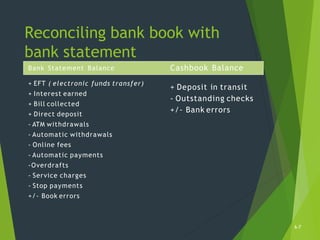
Reconciling bank book with
bank statement
6-7
+ EFT ( electronic funds transfer)
+ Interest earned
+ Bill collected
+ Direct deposit
- ATM withdrawals
- Automatic withdrawals
- Online fees
- Automatic payments
-Overdrafts
- Service charges
- Stop payments
+/- Book errors
Bank Statement Balance Cashbook Balance
+ Deposit in transit
- Outstanding checks
+/- Bank errors
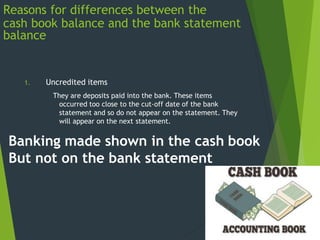
Reasons for differences between the
cash book balance and the bank statement
balance
1. Uncredited items
They are deposits paid into the bank. These items
occurred too close to the cut-off date of the bank
statement and so do not appear on the statement. They
will appear on the next statement.
Banking made shown in the cash book
But not on the bank statement
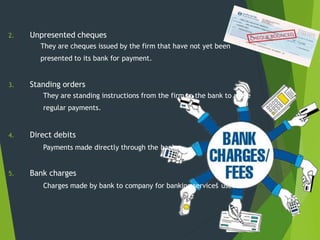
2. Unpresented cheques
They are cheques issued by the firm that have not yet been
presented to its bank for payment.
3. Standing orders
They are standing instructions from the firm to the bank to make
regular payments.
4. Direct debits
Payments made directly through the bank.
5. Bank charges
Charges made by bank to company for banking services used.
6. Dishonoured cheques
7.
8.
They are cheques deposited but subsequently returned by the
bank due to the failure of the drawer to pay.
Credit transfers / direct credits
They are money received from customers directly through the
banking system.
Interest allowed by the bank
They are interest received for deposits or fixed deposits.
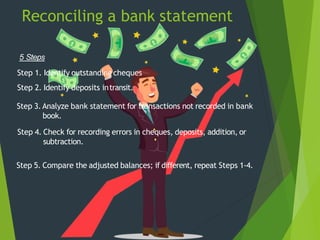
Reconciling a bank statement
5 Steps
Step 1. Identify outstanding cheques
Step 2. Identify deposits intransit.
Step 3. Analyze bank statement for transactions not recorded in bank
book.
Step 4. Check for recording errors in cheques, deposits, addition, or
subtraction.
Step 5. Compare the adjusted balances; if different, repeat Steps 1-4.
Bank Reconciliation - Step 1
Deposits in Transit:
Late period deposits
not yet reflected on
bank statement
Trace deposits on bank statement to books.
Identify deposits in transit. Add to bank
balance.
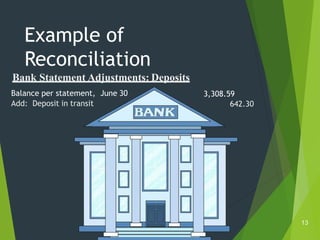
Example of
Reconciliation
3,308.59
642.30
Bank Statement Adjustments: Deposits
Balance per statement, June 30
Add: Deposit in transit
13
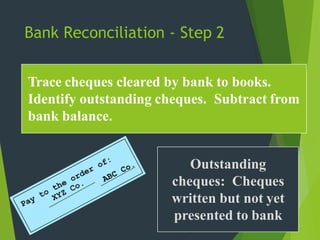
Bank Reconciliation - Step 2
Outstanding
cheques: Cheques
written but not yet
presented to bank
Trace cheques cleared by bank to books.
Identify outstanding cheques. Subtract from
bank balance.
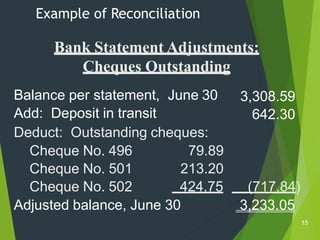
Example of Reconciliation
Bank Statement Adjustments:
Cheques Outstanding
3,308.59
642.30
Balance per statement, June 30
Add: Deposit in transit
Deduct: Outstanding cheques:
Cheque No. 496
Cheque No. 501
Cheque No. 502
79.89
213.20
424.75 (717.84)
Adjusted balance, June 30 3,233.05
15
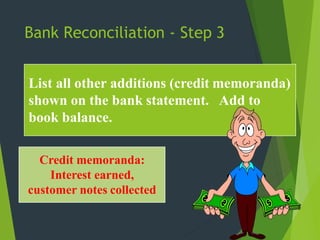
Bank Reconciliation - Step 3
Credit memoranda:
Interest earned,
customer notes collected
List all other additions (credit memoranda)
shown on the bank statement. Add to
book balance.
Example of Reconciliation
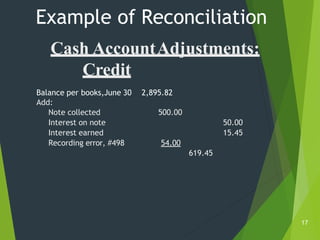
Balance per books,June 30 2,895.82
Add:
Note collected 500.00
Interest on note 50.00
Interest earned 15.45
Recording error, #498 54.00
619.45
Cash AccountAdjustments:
Credit
17
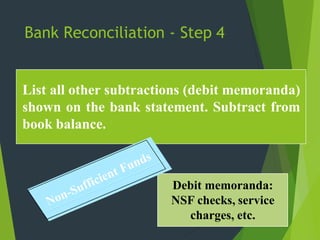
List all other subtractions (debit memoranda)
shown on the bank statement. Subtract from
book balance.
Bank Reconciliation - Step 4
Debit memoranda:
NSF checks, service
charges, etc.
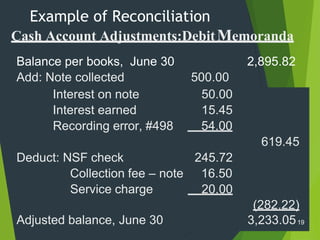
Example of Reconciliation
Cash Account Adjustments:DebitMemoranda
Balance per books, June 30 2,895.82
Add: Note collected 500.00
Interest on note 50.00
Interest earned 15.45
Recording error, #498 54.00
619.45
Deduct: NSF check 245.72
Collection fee – note 16.50
Service charge 20.00
(282.22)
Adjusted balance, June 30 3,233.0519
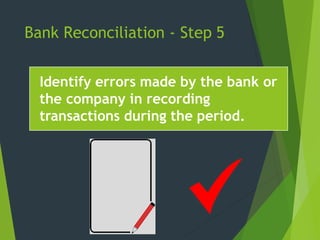
Bank Reconciliation - Step 5
Identify errors made by the bank or
the company in recording
transactions during the period.
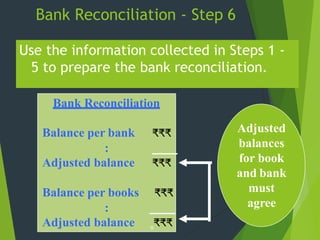
Bank Reconciliation - Step 6
Use the information collected in Steps 1 -
5 to prepare the bank reconciliation.
Bank Reconciliation
Balance per bank ₹₹₹
:
Adjusted balance ₹₹₹
Balance per books ₹₹₹
:
Adjusted balance ₹₹₹
Adjusted
balances
for book
and bank
must
agree
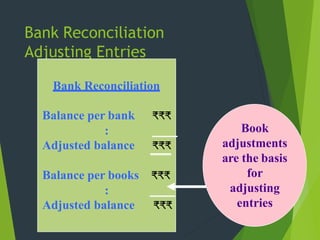
Bank Reconciliation
Adjusting Entries
Bank Reconciliation
Balance per bank ₹₹₹
:
Adjusted balance ₹₹₹
Balance per books ₹₹₹
:
Adjusted balance ₹₹₹
Book
adjustments
are the basis
for
adjusting
entries
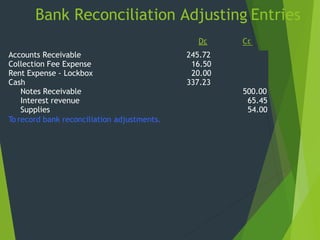
Bank Reconciliation Adjusting Entries
Dr
. Cr
.
Accounts Receivable 245.72
Collection Fee Expense 16.50
Rent Expense - Lockbox 20.00
Cash 337.23
Notes Receivable 500.00
Interest revenue 65.45
Supplies 54.00
To record bank reconciliation adjustments.
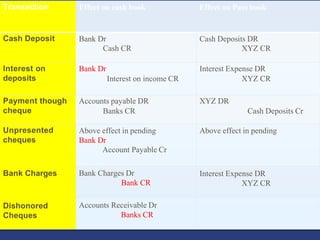
Transaction Effect on cash book Effect on Pass book
Cash Deposit Bank Dr Cash Deposits DR
Cash CR XYZ CR
Interest on Bank Dr Interest Expense DR
deposits Interest on income CR XYZ CR
Payment though Accounts payable DR XYZ DR
cheque Banks CR Cash Deposits Cr
Unpresented
cheques
Above effect in pending
Bank Dr
Above effect in pending
Bank Charges
Dishonored
Cheques
Account Payable Cr
Bank Charges Dr
Bank CR
Accounts Receivable Dr
Banks CR
Interest Expense DR
XYZ CR
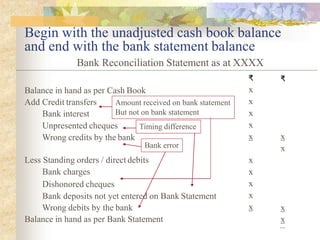
Begin with the unadjusted cash book balance
and end with the bank statement balance
Bank Reconciliation Statement as at XXXX
₹
Balance in hand as per Cash Book
Add Credit transfers
Bank interest
Unpresented cheques
Wrong credits by the bank
₹
x
x
x
x
x x
x
Less Standing orders / direct debits
Bank charges
Dishonored cheques
x
x
x
x
x
Bank deposits not yet entered on Bank Statement
Wrong debits by the bank
Balance in hand as per Bank Statement
x
x
Amount received on bank statement
But not on bank statement
Timing difference
Bank error
By - Suman Tiwari
Thank you

Brs presentation ppt file

  • 1.
    Introduction NAME :- SumanTwari Class :- 11th ‘c’ Roll no :- 43 SUBJECT :- Accountancy Teacher Name :- Mrs. Rajni mam Accountancy
  • 2.
    Bank Reconciliation • Purpose •Bank Statement & Cashbook • Reasons of Difference between cashbook and bank statement • Reconciling errors • Preparing Bank Reconciliation Statements. Learning objectives
  • 3.
    The purpose ofthe bank reconciliation statement Due to the timing difference, omissions and errors made by the bank or the firm itself. The balance of the bank statement and the bank account in the cash book rarely agree. Bank reconciliation statements can be used To explain the reasons for the differences and to identify errors and omissions in both documents, so that corrections can be made as soon as possible.
  • 4.
    6-3 Bank Statement Bank Statement– A statement listing different types of activity that have taken place during the month.  Debit:decreases the account —  Credit: increases the account +
  • 5.
    Nature of thebank book and bank statement Cash Book (bank column only) Debit represents an increase Credit represents an decrease Bank Statement Dr Cr Balance (represent decrease) (represent increase) (represent The amount Payable to the clients)
  • 6.
  • 7.
    Bank Reconciliation 6-6 Reconciles thedifference between the bank statement and the bank book (cash book). Differences in timing Transactions not entered in bank book
  • 8.
    Reconciling bank bookwith bank statement 6-7 + EFT ( electronic funds transfer) + Interest earned + Bill collected + Direct deposit - ATM withdrawals - Automatic withdrawals - Online fees - Automatic payments -Overdrafts - Service charges - Stop payments +/- Book errors Bank Statement Balance Cashbook Balance + Deposit in transit - Outstanding checks +/- Bank errors
  • 9.
    Reasons for differencesbetween the cash book balance and the bank statement balance 1. Uncredited items They are deposits paid into the bank. These items occurred too close to the cut-off date of the bank statement and so do not appear on the statement. They will appear on the next statement. Banking made shown in the cash book But not on the bank statement
  • 10.
    2. Unpresented cheques Theyare cheques issued by the firm that have not yet been presented to its bank for payment. 3. Standing orders They are standing instructions from the firm to the bank to make regular payments. 4. Direct debits Payments made directly through the bank. 5. Bank charges Charges made by bank to company for banking services used.
  • 11.
    6. Dishonoured cheques 7. 8. Theyare cheques deposited but subsequently returned by the bank due to the failure of the drawer to pay. Credit transfers / direct credits They are money received from customers directly through the banking system. Interest allowed by the bank They are interest received for deposits or fixed deposits.
  • 12.
    Reconciling a bankstatement 5 Steps Step 1. Identify outstanding cheques Step 2. Identify deposits intransit. Step 3. Analyze bank statement for transactions not recorded in bank book. Step 4. Check for recording errors in cheques, deposits, addition, or subtraction. Step 5. Compare the adjusted balances; if different, repeat Steps 1-4.
  • 13.
    Bank Reconciliation -Step 1 Deposits in Transit: Late period deposits not yet reflected on bank statement Trace deposits on bank statement to books. Identify deposits in transit. Add to bank balance.
  • 14.
    Example of Reconciliation 3,308.59 642.30 Bank StatementAdjustments: Deposits Balance per statement, June 30 Add: Deposit in transit 13
  • 15.
    Bank Reconciliation -Step 2 Outstanding cheques: Cheques written but not yet presented to bank Trace cheques cleared by bank to books. Identify outstanding cheques. Subtract from bank balance.
  • 16.
    Example of Reconciliation BankStatement Adjustments: Cheques Outstanding 3,308.59 642.30 Balance per statement, June 30 Add: Deposit in transit Deduct: Outstanding cheques: Cheque No. 496 Cheque No. 501 Cheque No. 502 79.89 213.20 424.75 (717.84) Adjusted balance, June 30 3,233.05 15
  • 17.
    Bank Reconciliation -Step 3 Credit memoranda: Interest earned, customer notes collected List all other additions (credit memoranda) shown on the bank statement. Add to book balance.
  • 18.
    Example of Reconciliation Balanceper books,June 30 2,895.82 Add: Note collected 500.00 Interest on note 50.00 Interest earned 15.45 Recording error, #498 54.00 619.45 Cash AccountAdjustments: Credit 17
  • 19.
    List all othersubtractions (debit memoranda) shown on the bank statement. Subtract from book balance. Bank Reconciliation - Step 4 Debit memoranda: NSF checks, service charges, etc.
  • 20.
    Example of Reconciliation CashAccount Adjustments:DebitMemoranda Balance per books, June 30 2,895.82 Add: Note collected 500.00 Interest on note 50.00 Interest earned 15.45 Recording error, #498 54.00 619.45 Deduct: NSF check 245.72 Collection fee – note 16.50 Service charge 20.00 (282.22) Adjusted balance, June 30 3,233.0519
  • 21.
    Bank Reconciliation -Step 5 Identify errors made by the bank or the company in recording transactions during the period.
  • 22.
    Bank Reconciliation -Step 6 Use the information collected in Steps 1 - 5 to prepare the bank reconciliation. Bank Reconciliation Balance per bank ₹₹₹ : Adjusted balance ₹₹₹ Balance per books ₹₹₹ : Adjusted balance ₹₹₹ Adjusted balances for book and bank must agree
  • 23.
    Bank Reconciliation Adjusting Entries BankReconciliation Balance per bank ₹₹₹ : Adjusted balance ₹₹₹ Balance per books ₹₹₹ : Adjusted balance ₹₹₹ Book adjustments are the basis for adjusting entries
  • 24.
    Bank Reconciliation AdjustingEntries Dr . Cr . Accounts Receivable 245.72 Collection Fee Expense 16.50 Rent Expense - Lockbox 20.00 Cash 337.23 Notes Receivable 500.00 Interest revenue 65.45 Supplies 54.00 To record bank reconciliation adjustments.
  • 25.
    Transaction Effect oncash book Effect on Pass book Cash Deposit Bank Dr Cash Deposits DR Cash CR XYZ CR Interest on Bank Dr Interest Expense DR deposits Interest on income CR XYZ CR Payment though Accounts payable DR XYZ DR cheque Banks CR Cash Deposits Cr Unpresented cheques Above effect in pending Bank Dr Above effect in pending Bank Charges Dishonored Cheques Account Payable Cr Bank Charges Dr Bank CR Accounts Receivable Dr Banks CR Interest Expense DR XYZ CR
  • 26.
    Begin with theunadjusted cash book balance and end with the bank statement balance Bank Reconciliation Statement as at XXXX ₹ Balance in hand as per Cash Book Add Credit transfers Bank interest Unpresented cheques Wrong credits by the bank ₹ x x x x x x x Less Standing orders / direct debits Bank charges Dishonored cheques x x x x x Bank deposits not yet entered on Bank Statement Wrong debits by the bank Balance in hand as per Bank Statement x x Amount received on bank statement But not on bank statement Timing difference Bank error
  • 27.
    By - SumanTiwari Thank you