BANK RECONCILIATION STATEMENT
A bank reconciliation statement is a statement
prepared to reconcile the bank balances as per cash
book and pass book. This statement explains the reasons
for the disagreement of balances between these two
books, on any given date.
Causes for differences
The bank balance as per cash book may differ from
the bank balance as per bank statement as on a particular
date due to a variety of reasons as under:
I. Transactions entered in pass book but not in cash
book as on the date of bank reconciliation statement:
i. Cash or cheque is directly deposited in bank by debtors or
others and credited by bank but the depositor has no
intimation of the same.
ii. Bank has credited the pass book for interest on investment,
for dividends on shares etc. collected by it but the depositor
has no intimation of the same.
iii.Bank has debited the pass book for direct payments on
insurance premiums, interest on loans from others
electricity bills etc., but the depositor has no intimation of
the same.
iv. Bank debits the pass book for interest on overdraft or bank
loan, for bank charges, commission, service charges,
collection charges etc. Similarly, bank credits pass book for
interest on bank balance on fixed deposits etc.
v.Cheque or bills discounted previously are dishonored and or
debited in pass book.
vi. Bank has credited pass book for cheques deposited and
collected; and pass book has debits for payment of cheques
issued; but both have remained unrecorded in cash book.
vii. There may be erroneous debits in pass book for bank
charges, interest and for cheques drawn by others. Similarly,
there may be erroneous credits in pass book for interest on
deposits etc. and for cheques etc., deposited by others.
• I. Transactions entered in cash book but not in pass book as
on the date of bank reconciliation statement:
• Cheque are issued but are not presented to bank for
payment.
• Cheques and bills are deposited in bank but not collected
and credited in pass book.
• Cheques or cash are debited in cash book but actually not
sent to bank.
• Cheque are deposited but returned dishonoured by bank but
they are not adjusted in cash book yet. Similarly, cheque
are issued but the bank returns them dishonoured.
• Cash book is credited for issue of cheques but they are
actually not issued or money not drawn.
• Dividend, interest, deposits etc. debited in cash book more
than once in error. Similarly, bank charges or withdrawals
Preparation of bank reconciliation statement
1. Balances shown by the cash book and the pass book on a specified
date are to be noted. Debit balance in the cash book and credit balance
in the pass book indicate that the business has favourable balance in
the bank. Similarly, credit balance in the cash book and debit balance
in the pass book indicate that the business has infavourable balance in
the bank. It means bank has given ‘overdraft’ to the business.
2. All the debits and credits shown in the cash book must be compared
with the entries in the pass book to identify any items omitted.
Similarly, all the debits and credits in the pass book should be
compared with the entries in the cash book to ascertain the items
which were not recorded.
Needs for Bank Reconciliation Statement
1. Accuracy
The accuracy of both pass book and cash book can be
maintained through the preparation of bank reconciliation statement.
2.Correctness
This statement ensures that the transactions are correct in
both the books.
3.Detection of Errors
The cheques that are not presented or cheques dishonoured
will be detected through this statement.
4.Rectification of Errors
The identification and rectification of errors in cash book and
pass book is possible.
5.Prevention of Fraudulent Transactions
The intentional errors i.e., frauds are prevented by preparing bank
Any items recorded in both the books but the amounts being
different should be carefully noted to adjust the difference in
the amounts. It is preferable to make a list of all the
differences.
3.The balance shown by the cash book or pass book can be
taken as the ‘Starting balance’ each difference should be either
added to or subtracted from the starting balance depending on
the nature of the difference.
4.When all the differences are adjusted, the balance must be
the balance as per the other book. If cash book balance was the
starting balance, the final balance must be the balance as per
the pass book and vice versa.
Preparation of a bank reconciliation statement
I. If we take cash book balance or overdraft as per
pass book as the starting point:
Bank Reconciliation Statement as on ….
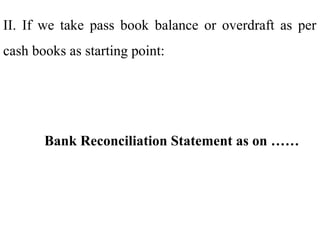
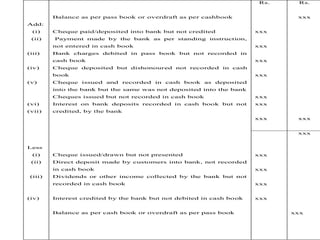
II. If we take pass book balance or overdraft as per
cash books as starting point:
Bank Reconciliation Statement as on ……
Add:
(i)
(ii)
(iii)
(iv)
(v)
(vi)
(vii)
Less
(i)
(ii)
(iii)
(iv)
Balance as per pass book or overdraft as per cashbook
Cheque paid/deposited into bank but not credited
Payment made by the bank as per standing instruction,
not entered in cash book
Bank charges debited in pass book but not recorded in
cash book
Cheque deposited but dishonoured not recorded in cash
book
Cheque issued and recorded in cash book as deposited
into the bank but the same was not deposited into the bank
Cheques issued but not recorded in cash book
Interest on bank deposits recorded in cash book but not
credited, by the bank
Cheque issued/drawn but not presented
Direct deposit made by customers into bank, not recorded
in cash book
Dividends or other income collected by the bank but not
recorded in cash book
Interest credited by the bank but not debited in cash book
Balance as per cash book or overdraft as per pass book
Rs.
xxx
xxx
xxx
xxx
xxx
xxx
xxx
Rs.
xxx
xxx
xxx
xxx
xxx
xxx
xxx
xxx
Rs. Rs.
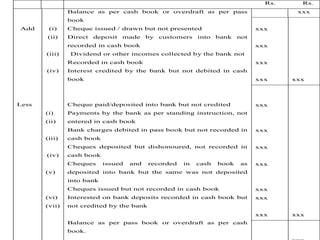
Add
Less
(i)
(ii)
(iii)
(iv)
(i)
(ii)
(iii)
(iv)
(v)
(vi)
(vii)
Balance as per cash book or overdraft as per pass
book
Cheque issued / drawn but not presented
Direct deposit made by customers into bank not
recorded in cash book
Dividend or other incomes collected by the bank not
Recorded in cash book
Interest credited by the bank but not debited in cash
book
Cheque paid/deposited into bank but not credited
Payments by the bank as per standing instruction, not
entered in cash book
Bank charges debited in pass book but not recorded in
cash book
Cheques deposited but dishonoured, not recorded in
cash book
Cheques issued and recorded in cash book as
deposited into bank but the same was not deposited
into bank
Cheques issued but not recorded in cash book
Interested on bank deposits recorded in cash book but
not credited by the bank
Balance as per pass book or overdraft as per cash
book.
xxx
xxx
xxx
xxx
xxx xxx
xxx
xxx
xxx
xxx
xxx
xxx
xxx xxx

Bank Reconciliation Statement for Commerce

  • 1.
    BANK RECONCILIATION STATEMENT Abank reconciliation statement is a statement prepared to reconcile the bank balances as per cash book and pass book. This statement explains the reasons for the disagreement of balances between these two books, on any given date. Causes for differences The bank balance as per cash book may differ from the bank balance as per bank statement as on a particular date due to a variety of reasons as under:
  • 2.
    I. Transactions enteredin pass book but not in cash book as on the date of bank reconciliation statement: i. Cash or cheque is directly deposited in bank by debtors or others and credited by bank but the depositor has no intimation of the same. ii. Bank has credited the pass book for interest on investment, for dividends on shares etc. collected by it but the depositor has no intimation of the same. iii.Bank has debited the pass book for direct payments on insurance premiums, interest on loans from others electricity bills etc., but the depositor has no intimation of the same.
  • 3.
    iv. Bank debitsthe pass book for interest on overdraft or bank loan, for bank charges, commission, service charges, collection charges etc. Similarly, bank credits pass book for interest on bank balance on fixed deposits etc. v.Cheque or bills discounted previously are dishonored and or debited in pass book. vi. Bank has credited pass book for cheques deposited and collected; and pass book has debits for payment of cheques issued; but both have remained unrecorded in cash book. vii. There may be erroneous debits in pass book for bank charges, interest and for cheques drawn by others. Similarly, there may be erroneous credits in pass book for interest on deposits etc. and for cheques etc., deposited by others.
  • 4.
    • I. Transactionsentered in cash book but not in pass book as on the date of bank reconciliation statement: • Cheque are issued but are not presented to bank for payment. • Cheques and bills are deposited in bank but not collected and credited in pass book. • Cheques or cash are debited in cash book but actually not sent to bank. • Cheque are deposited but returned dishonoured by bank but they are not adjusted in cash book yet. Similarly, cheque are issued but the bank returns them dishonoured. • Cash book is credited for issue of cheques but they are actually not issued or money not drawn. • Dividend, interest, deposits etc. debited in cash book more than once in error. Similarly, bank charges or withdrawals
  • 5.
    Preparation of bankreconciliation statement 1. Balances shown by the cash book and the pass book on a specified date are to be noted. Debit balance in the cash book and credit balance in the pass book indicate that the business has favourable balance in the bank. Similarly, credit balance in the cash book and debit balance in the pass book indicate that the business has infavourable balance in the bank. It means bank has given ‘overdraft’ to the business. 2. All the debits and credits shown in the cash book must be compared with the entries in the pass book to identify any items omitted. Similarly, all the debits and credits in the pass book should be compared with the entries in the cash book to ascertain the items which were not recorded.
  • 6.
    Needs for BankReconciliation Statement 1. Accuracy The accuracy of both pass book and cash book can be maintained through the preparation of bank reconciliation statement. 2.Correctness This statement ensures that the transactions are correct in both the books. 3.Detection of Errors The cheques that are not presented or cheques dishonoured will be detected through this statement. 4.Rectification of Errors The identification and rectification of errors in cash book and pass book is possible. 5.Prevention of Fraudulent Transactions The intentional errors i.e., frauds are prevented by preparing bank
  • 7.
    Any items recordedin both the books but the amounts being different should be carefully noted to adjust the difference in the amounts. It is preferable to make a list of all the differences. 3.The balance shown by the cash book or pass book can be taken as the ‘Starting balance’ each difference should be either added to or subtracted from the starting balance depending on the nature of the difference. 4.When all the differences are adjusted, the balance must be the balance as per the other book. If cash book balance was the starting balance, the final balance must be the balance as per the pass book and vice versa.
  • 8.
    Preparation of abank reconciliation statement I. If we take cash book balance or overdraft as per pass book as the starting point: Bank Reconciliation Statement as on ….
  • 9.
    II. If wetake pass book balance or overdraft as per cash books as starting point: Bank Reconciliation Statement as on ……
  • 10.
    Add: (i) (ii) (iii) (iv) (v) (vi) (vii) Less (i) (ii) (iii) (iv) Balance as perpass book or overdraft as per cashbook Cheque paid/deposited into bank but not credited Payment made by the bank as per standing instruction, not entered in cash book Bank charges debited in pass book but not recorded in cash book Cheque deposited but dishonoured not recorded in cash book Cheque issued and recorded in cash book as deposited into the bank but the same was not deposited into the bank Cheques issued but not recorded in cash book Interest on bank deposits recorded in cash book but not credited, by the bank Cheque issued/drawn but not presented Direct deposit made by customers into bank, not recorded in cash book Dividends or other income collected by the bank but not recorded in cash book Interest credited by the bank but not debited in cash book Balance as per cash book or overdraft as per pass book Rs. xxx xxx xxx xxx xxx xxx xxx Rs. xxx xxx xxx xxx xxx xxx xxx xxx
  • 11.
    Rs. Rs. Add Less (i) (ii) (iii) (iv) (i) (ii) (iii) (iv) (v) (vi) (vii) Balance asper cash book or overdraft as per pass book Cheque issued / drawn but not presented Direct deposit made by customers into bank not recorded in cash book Dividend or other incomes collected by the bank not Recorded in cash book Interest credited by the bank but not debited in cash book Cheque paid/deposited into bank but not credited Payments by the bank as per standing instruction, not entered in cash book Bank charges debited in pass book but not recorded in cash book Cheques deposited but dishonoured, not recorded in cash book Cheques issued and recorded in cash book as deposited into bank but the same was not deposited into bank Cheques issued but not recorded in cash book Interested on bank deposits recorded in cash book but not credited by the bank Balance as per pass book or overdraft as per cash book. xxx xxx xxx xxx xxx xxx xxx xxx xxx xxx xxx xxx xxx xxx