STRUCTURE OF NATIONAL
ADMINISTRATION
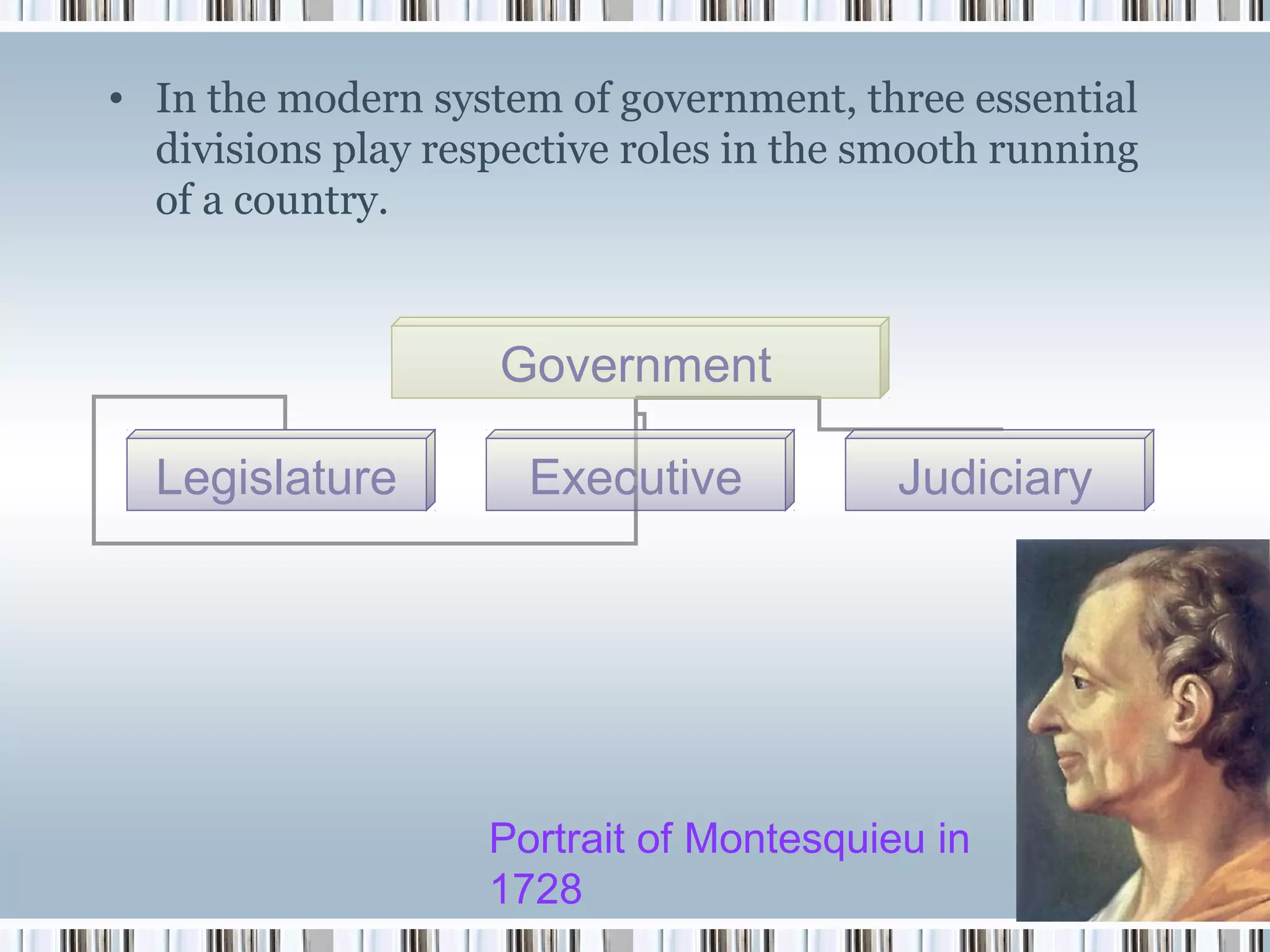
• In the modern system of government, three essential
divisions play respective roles in the smooth running
of a country.

Government
Legislature

Executive

Judiciary

Portrait of Montesquieu in
1728
THE LEGISLATURE
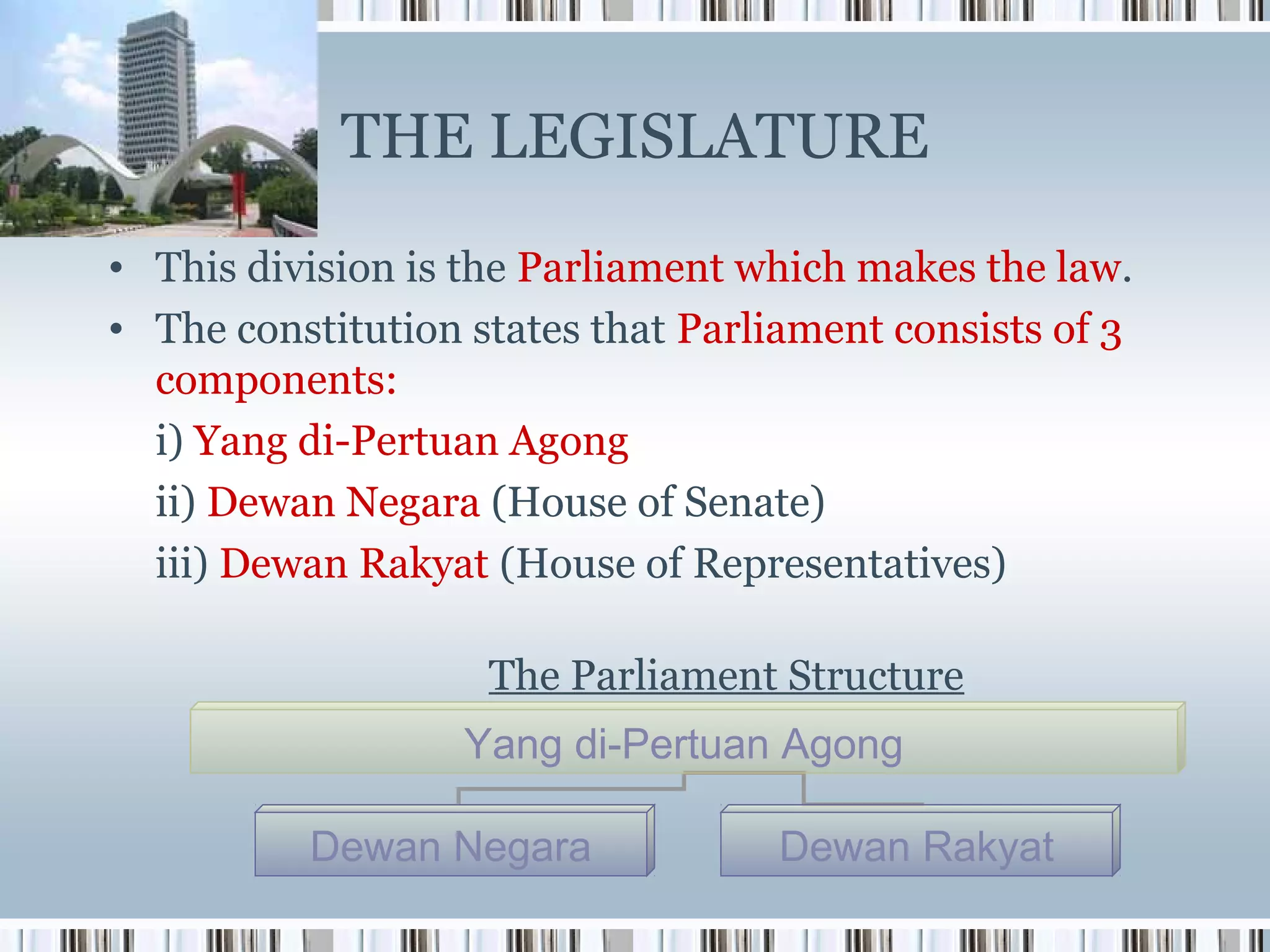
• This division is the Parliament which makes the law.
• The constitution states that Parliament consists of 3
components:
i) Yang di-Pertuan Agong
ii) Dewan Negara (House of Senate)
iii) Dewan Rakyat (House of Representatives)
The Parliament Structure
Yang di-Pertuan Agong
Dewan Negara

Dewan Rakyat
• The role of Parliament:
i. To legislate, amend and annual bill of
law
ii. To enact laws concerning defense,
safety, finance, education, welfare etc
iii.To introduce new taxes
iv. To approve the national budget for a
certain year
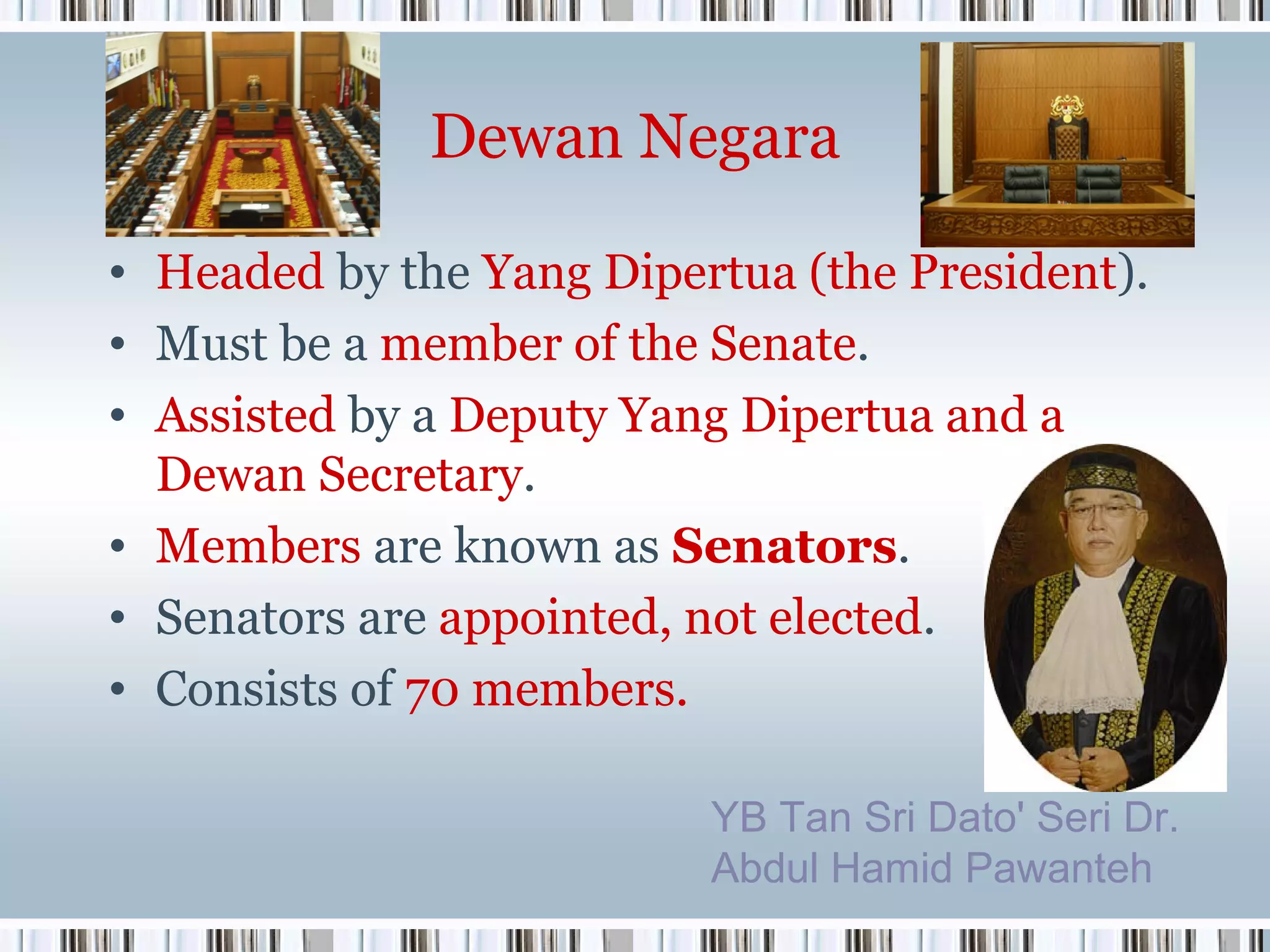
Yang di-Pertuan Agong
• Is the head of:
i) Legislative
ii) Executive
iii) Judiciary
• Empower to put into law, bills that have been
passed by Dewan Rakyat dan Dewan Negara.
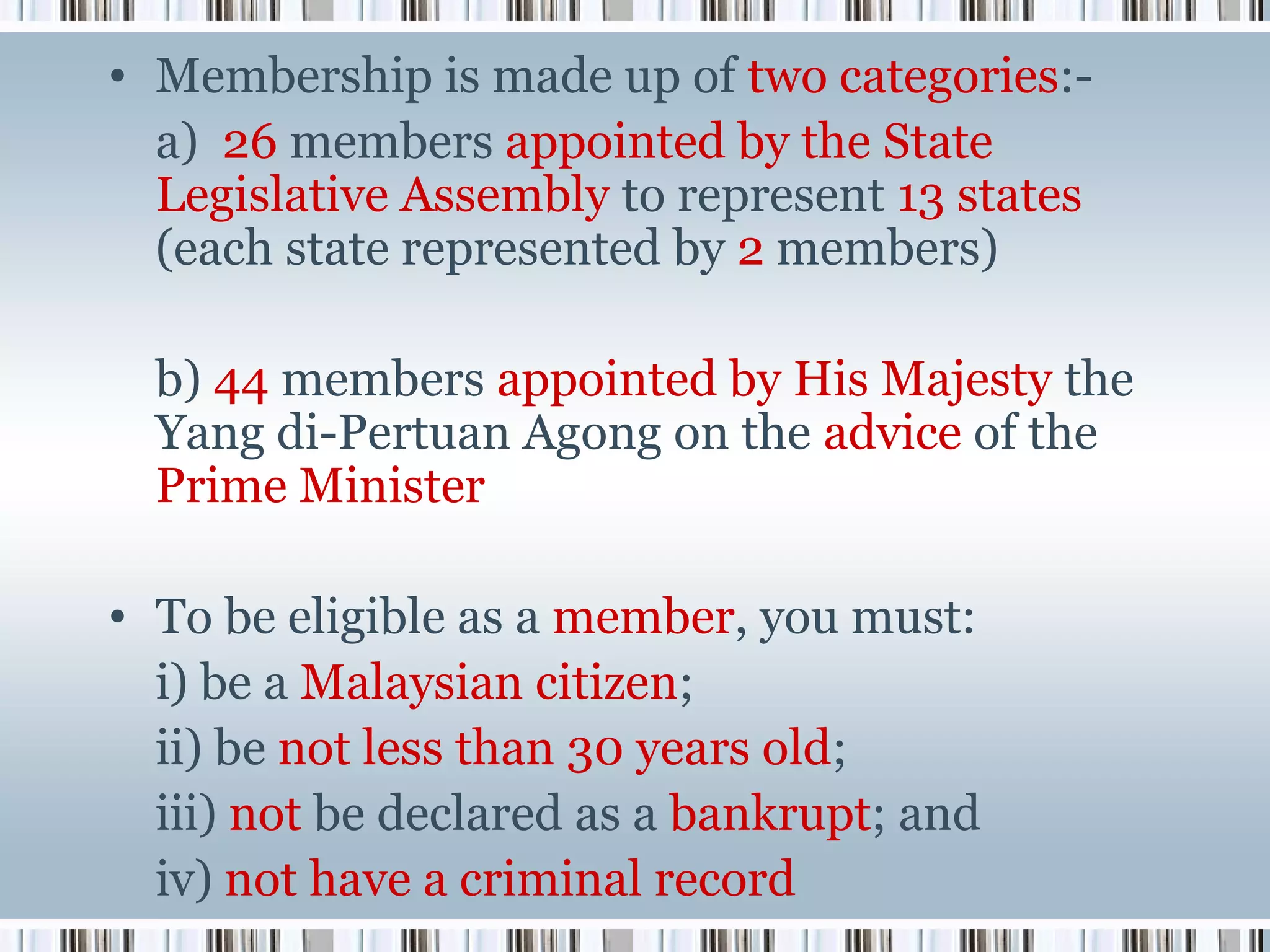
Dewan Negara
• Headed by the Yang Dipertua (the President).
• Must be a member of the Senate.
• Assisted by a Deputy Yang Dipertua and a
Dewan Secretary.
• Members are known as Senators.
• Senators are appointed, not elected.
• Consists of 70 members.
YB Tan Sri Dato' Seri Dr.
Abdul Hamid Pawanteh
• Membership is made up of two categories:a) 26 members appointed by the State
Legislative Assembly to represent 13 states
(each state represented by 2 members)
b) 44 members appointed by His Majesty the
Yang di-Pertuan Agong on the advice of the
Prime Minister
• To be eligible as a member, you must:
i) be a Malaysian citizen;
ii) be not less than 30 years old;
iii) not be declared as a bankrupt; and
iv) not have a criminal record
• The tenure of office is a three-year term for a
maximum of 2 terms.
• The life of the Senate is not affected by the dissolution
of Parliament.
• Senators are drawn from the ranks of distinguished
individuals.
• The role of Dewan Negara:
i) to discuss and pass bills that have been passed by
the Dewan Rakyat;
ii) does not possess the power to reject the bills
presented to it;
iii) only empowers to delay passing a bill for a period
of one month if it does not agree with them.
Dewan Rakyat
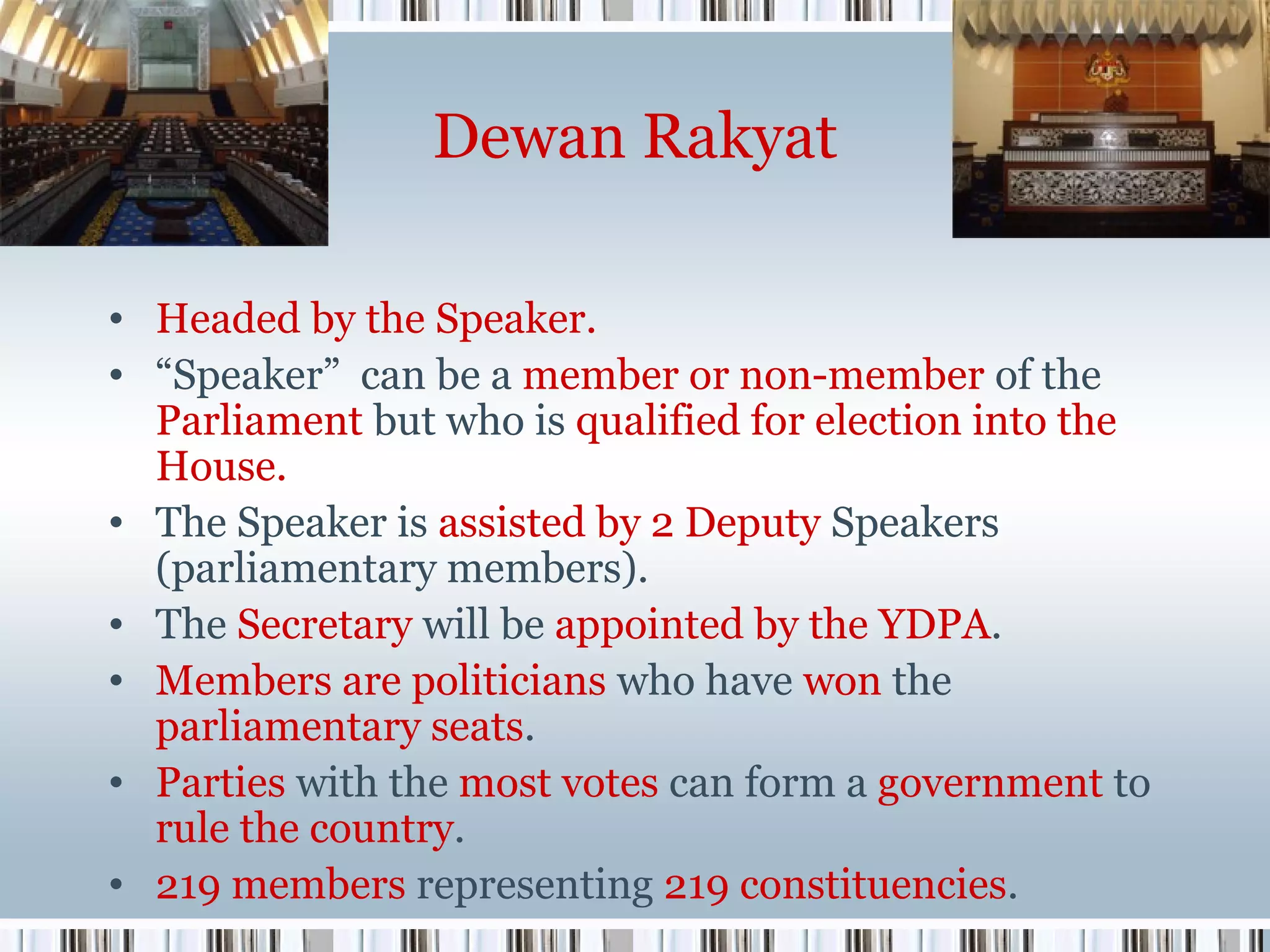
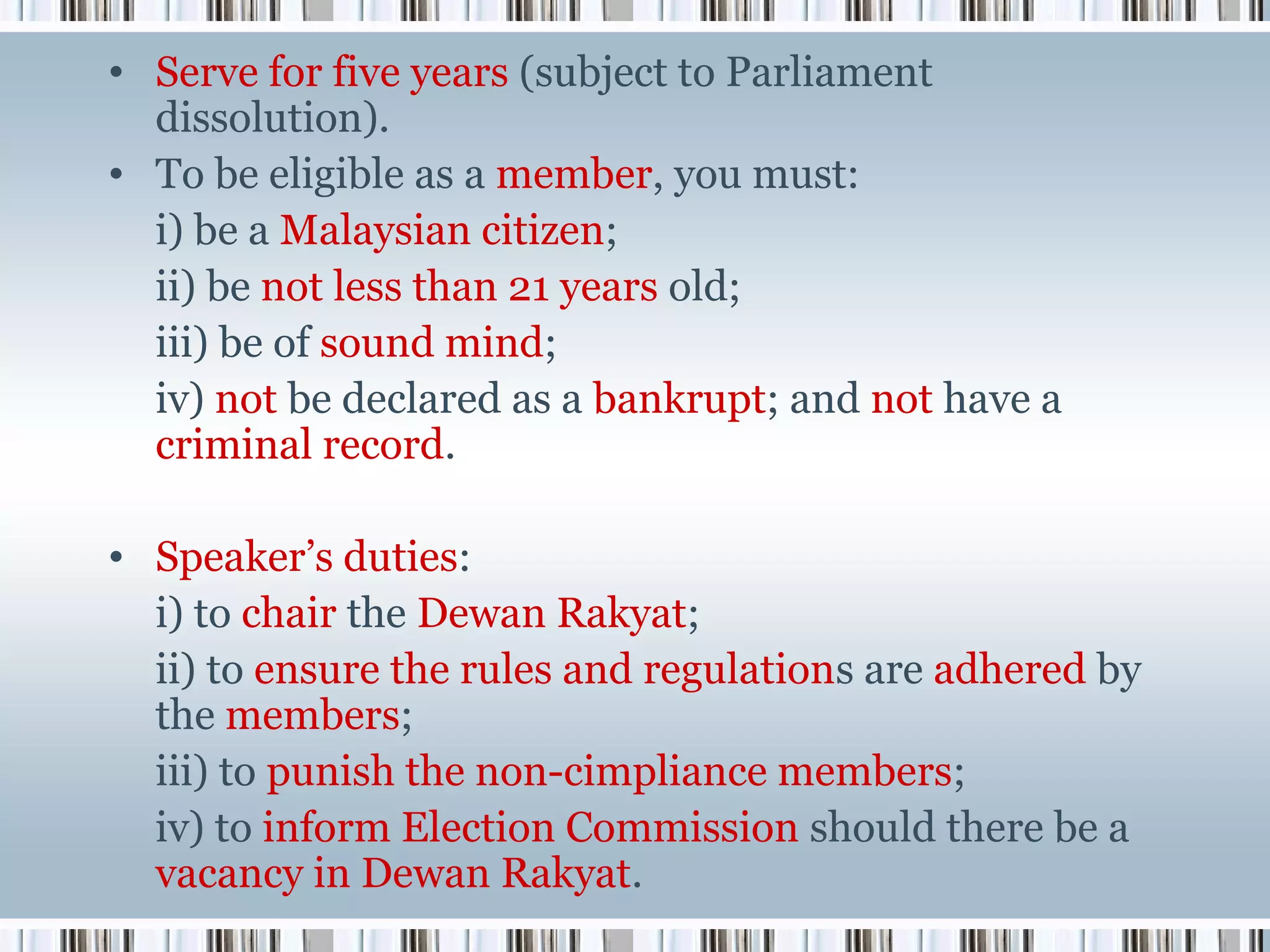
• Headed by the Speaker.
• “Speaker” can be a member or non-member of the
Parliament but who is qualified for election into the
House.
• The Speaker is assisted by 2 Deputy Speakers
(parliamentary members).
• The Secretary will be appointed by the YDPA.
• Members are politicians who have won the
parliamentary seats.
• Parties with the most votes can form a government to
rule the country.
• 219 members representing 219 constituencies.
• Serve for five years (subject to Parliament
dissolution).
• To be eligible as a member, you must:
i) be a Malaysian citizen;
ii) be not less than 21 years old;
iii) be of sound mind;
iv) not be declared as a bankrupt; and not have a
criminal record.
• Speaker’s duties:
i) to chair the Dewan Rakyat;
ii) to ensure the rules and regulations are adhered by
the members;
iii) to punish the non-cimpliance members;
iv) to inform Election Commission should there be a
vacancy in Dewan Rakyat.
• Discretionary power of the Speaker:
i) to allow or reject questions from members;
ii) to determine whether the questions should be
answered by Minister;
iii) to postpone an assembly;
iv) to ask member to leave or stop member from
attending the assembly.
• The role of Dewan Rakyat:
- to enact and discuss matters related with the
interest of the people and the country.

YB Datuk Pandikar Amin Mulia
THE EXECUTIVE (GOVERNING
BODY)
• Constitutes the Cabinet, led by Prime
Minister.
• Cabinets comprises the Ministers
elected.
• Each minister leads a ministry unit.
THE JUDICIARY
• Responsible for the process of justice.
• Has wider power:
- can interpret the Constitution and the law,
in the event of vagueness or dispute
• Judges are appointed by the YDPA on the
advice of the Prime Minister.
The High Court
• The highest court is the Federal Court.
• Has the power to decide on appeals about
decision of the Appeals Court, High Court or a
Judge.
• Divided into High Court of Malaya and the
High Court of Sabah and Sarawak.
• Empower to hear cases which carry death
penalty and civil case
The Lower Courts
• Consist of Session Courts and Magistrate Courts
• Session courts are the highest courts of the lower
courts
• Under the jurisdiction of a Session Court Judge
• Hear all kinds of civil and criminal cases, except
those carry death penalty
• Magistrate Courts presided by magistrates (of
Class One or Class Two)
• Empower to hear all minor criminal cases, not
exceeding ten years of jail
Special Lower Courts
• COURT FOR CHILDREN

- to hear cases, except murder of young persons (-18)
- decisions can be appealed in the High Court
• INDUSTRIAL COURT

- has power to hear cases involving disputes between
employer and employee
- appeal can be made to the High Court
• MILITARY COURTS

- to hear cases involving members of the armed
forces.
• THE SYARIAH COURTS
- Hearing cases concerning the administration of
Islamic Law.
- THREE types of syariah court:
• Syariah Lower Court
• Syariah High Court
• Syariah Appeal Court
•
-

SMALL CLAIM COURT
Introduced in 1989.
Hear civil cases of claim not exceeded RM3000.
Defense attorney is not needed.

12. structure of national_administration

  • 1.
  • 2.
    • In themodern system of government, three essential divisions play respective roles in the smooth running of a country. Government Legislature Executive Judiciary Portrait of Montesquieu in 1728
  • 3.
    THE LEGISLATURE • Thisdivision is the Parliament which makes the law. • The constitution states that Parliament consists of 3 components: i) Yang di-Pertuan Agong ii) Dewan Negara (House of Senate) iii) Dewan Rakyat (House of Representatives) The Parliament Structure Yang di-Pertuan Agong Dewan Negara Dewan Rakyat
  • 4.
    • The roleof Parliament: i. To legislate, amend and annual bill of law ii. To enact laws concerning defense, safety, finance, education, welfare etc iii.To introduce new taxes iv. To approve the national budget for a certain year
  • 5.
    Yang di-Pertuan Agong •Is the head of: i) Legislative ii) Executive iii) Judiciary • Empower to put into law, bills that have been passed by Dewan Rakyat dan Dewan Negara.
  • 6.
    Dewan Negara • Headedby the Yang Dipertua (the President). • Must be a member of the Senate. • Assisted by a Deputy Yang Dipertua and a Dewan Secretary. • Members are known as Senators. • Senators are appointed, not elected. • Consists of 70 members. YB Tan Sri Dato' Seri Dr. Abdul Hamid Pawanteh
  • 7.
    • Membership ismade up of two categories:a) 26 members appointed by the State Legislative Assembly to represent 13 states (each state represented by 2 members) b) 44 members appointed by His Majesty the Yang di-Pertuan Agong on the advice of the Prime Minister • To be eligible as a member, you must: i) be a Malaysian citizen; ii) be not less than 30 years old; iii) not be declared as a bankrupt; and iv) not have a criminal record
  • 8.
    • The tenureof office is a three-year term for a maximum of 2 terms. • The life of the Senate is not affected by the dissolution of Parliament. • Senators are drawn from the ranks of distinguished individuals. • The role of Dewan Negara: i) to discuss and pass bills that have been passed by the Dewan Rakyat; ii) does not possess the power to reject the bills presented to it; iii) only empowers to delay passing a bill for a period of one month if it does not agree with them.
  • 9.
    Dewan Rakyat • Headedby the Speaker. • “Speaker” can be a member or non-member of the Parliament but who is qualified for election into the House. • The Speaker is assisted by 2 Deputy Speakers (parliamentary members). • The Secretary will be appointed by the YDPA. • Members are politicians who have won the parliamentary seats. • Parties with the most votes can form a government to rule the country. • 219 members representing 219 constituencies.
  • 10.
    • Serve forfive years (subject to Parliament dissolution). • To be eligible as a member, you must: i) be a Malaysian citizen; ii) be not less than 21 years old; iii) be of sound mind; iv) not be declared as a bankrupt; and not have a criminal record. • Speaker’s duties: i) to chair the Dewan Rakyat; ii) to ensure the rules and regulations are adhered by the members; iii) to punish the non-cimpliance members; iv) to inform Election Commission should there be a vacancy in Dewan Rakyat.
  • 11.
    • Discretionary powerof the Speaker: i) to allow or reject questions from members; ii) to determine whether the questions should be answered by Minister; iii) to postpone an assembly; iv) to ask member to leave or stop member from attending the assembly. • The role of Dewan Rakyat: - to enact and discuss matters related with the interest of the people and the country. YB Datuk Pandikar Amin Mulia
  • 12.
    THE EXECUTIVE (GOVERNING BODY) •Constitutes the Cabinet, led by Prime Minister. • Cabinets comprises the Ministers elected. • Each minister leads a ministry unit.
  • 13.
    THE JUDICIARY • Responsiblefor the process of justice. • Has wider power: - can interpret the Constitution and the law, in the event of vagueness or dispute • Judges are appointed by the YDPA on the advice of the Prime Minister.
  • 14.
    The High Court •The highest court is the Federal Court. • Has the power to decide on appeals about decision of the Appeals Court, High Court or a Judge. • Divided into High Court of Malaya and the High Court of Sabah and Sarawak. • Empower to hear cases which carry death penalty and civil case
  • 15.
    The Lower Courts •Consist of Session Courts and Magistrate Courts • Session courts are the highest courts of the lower courts • Under the jurisdiction of a Session Court Judge • Hear all kinds of civil and criminal cases, except those carry death penalty • Magistrate Courts presided by magistrates (of Class One or Class Two) • Empower to hear all minor criminal cases, not exceeding ten years of jail
  • 16.
    Special Lower Courts •COURT FOR CHILDREN - to hear cases, except murder of young persons (-18) - decisions can be appealed in the High Court • INDUSTRIAL COURT - has power to hear cases involving disputes between employer and employee - appeal can be made to the High Court • MILITARY COURTS - to hear cases involving members of the armed forces.
  • 17.
    • THE SYARIAHCOURTS - Hearing cases concerning the administration of Islamic Law. - THREE types of syariah court: • Syariah Lower Court • Syariah High Court • Syariah Appeal Court • - SMALL CLAIM COURT Introduced in 1989. Hear civil cases of claim not exceeded RM3000. Defense attorney is not needed.

Editor's Notes