Bamboo in construction
Lionel Jayanetti
What is bamboo?
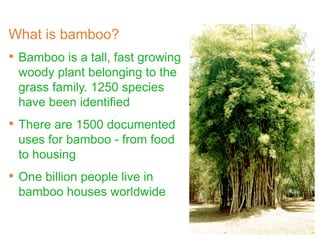
• Bamboo is a tall, fast growing
woody plant belonging to the
grass family. 1250 species
have been identified
• There are 1500 documented
uses for bamboo - from food
to housing
• One billion people live in
bamboo houses worldwide
Why build with bamboo?
• Bamboo grows quickly and easily
• Bamboo is a well-established
cultural feature in many regions
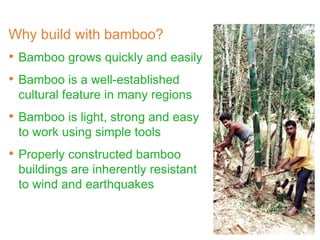
• Bamboo is light, strong and easy
to work using simple tools
• Properly constructed bamboo
buildings are inherently resistant
to wind and earthquakes
Bamboo and the environment
• Bamboo is adaptable to most
climatic conditions and soil types
• Bamboo is an effective carbon sink
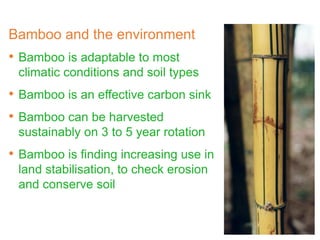
• Bamboo can be harvested
sustainably on 3 to 5 year rotation
• Bamboo is finding increasing use in
land stabilisation, to check erosion
and conserve soil
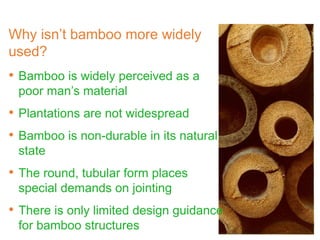
Why isn’t bamboo more widely
used?
• Bamboo is widely perceived as a
poor man’s material
• Plantations are not widespread
• Bamboo is non-durable in its natural
state
• The round, tubular form places
special demands on jointing
• There is only limited design guidance
for bamboo structures
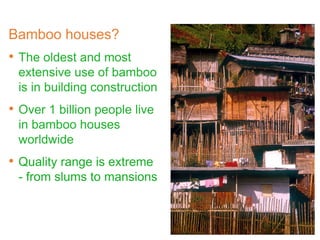
Bamboo houses?
• The oldest and most
extensive use of bamboo
is in building construction
• Over 1 billion people live
in bamboo houses
worldwide
• Quality range is extreme
- from slums to mansions
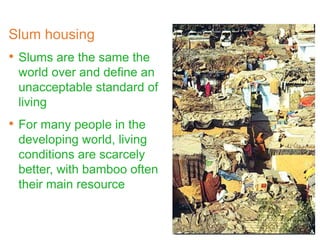
Slum housing
• Slums are the same the
world over and define an
unacceptable standard of
living
• For many people in the
developing world, living
conditions are scarcely
better, with bamboo often
their main resource
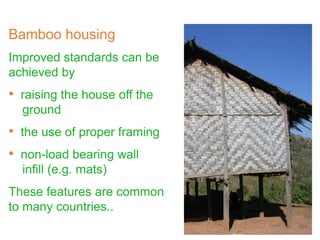
Bamboo housing
Improved standards can be
achieved by
• raising the house off the
ground
• the use of proper framing
• non-load bearing wall
infill (e.g. mats)
These features are common
to many countries..
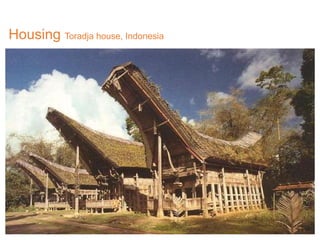
Housing Toradja house, Indonesia
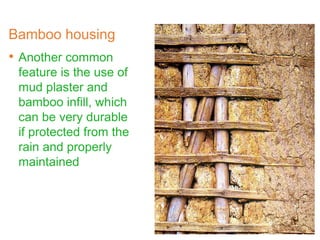
Bamboo housing
• Another common
feature is the use of
mud plaster and
bamboo infill, which
can be very durable
if protected from the
rain and properly
maintained
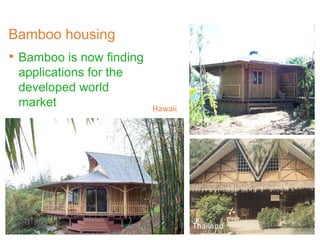
Bamboo housing
• Bamboo is now finding
applications for the
developed world
market Hawaii
Thailand
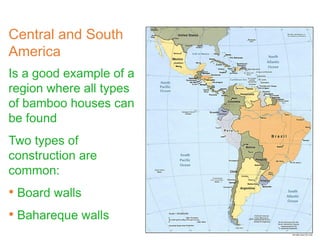
Central and South
America
Is a good example of a
region where all types
of bamboo houses can
be found
Two types of
construction are
common:
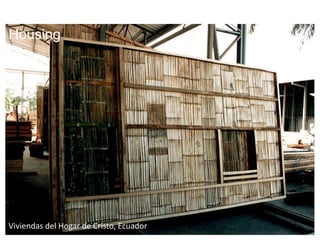
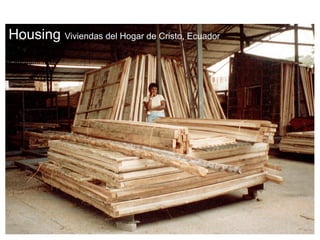
• Board walls
• Bahareque walls
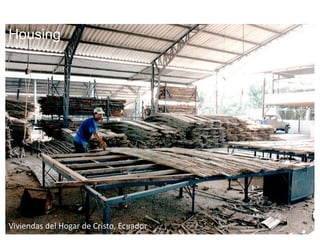
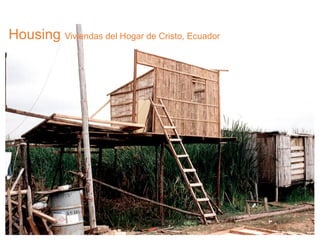
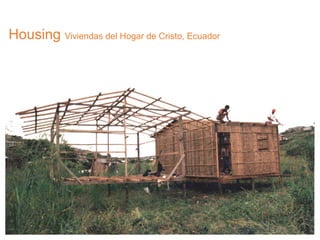
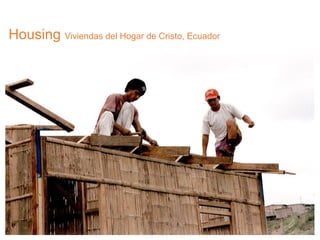
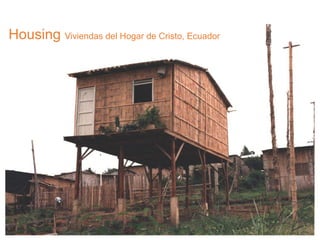
Housing
Viviendas del Hogar de Cristo, Ecuador
Housing
Viviendas del Hogar de Cristo, Ecuador
Housing Viviendas del Hogar de Cristo, Ecuador
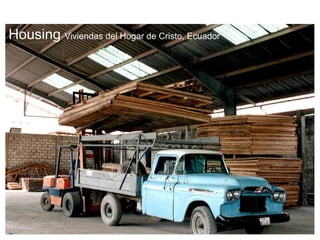
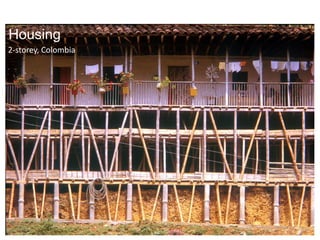
Housing
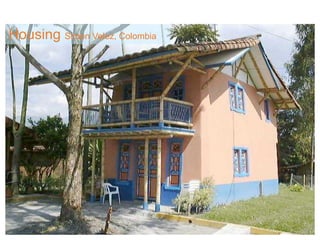
2-storey, Colombia
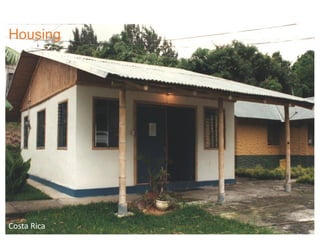
Housing
Costa Rica
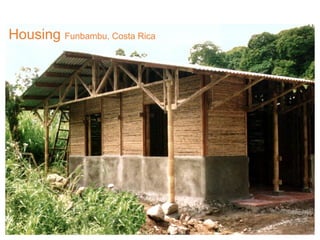
Housing Funbambu, Costa Rica
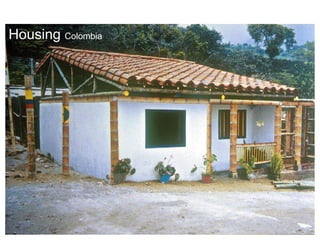
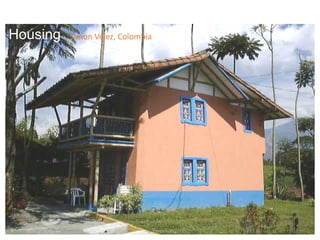
Housing ColombiaHousing Colombia
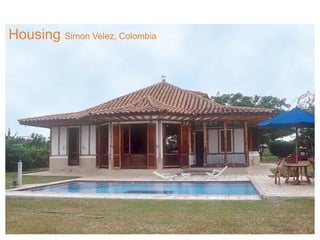
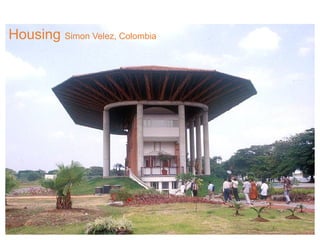
Housing Simon Velez, Colombia
Housing
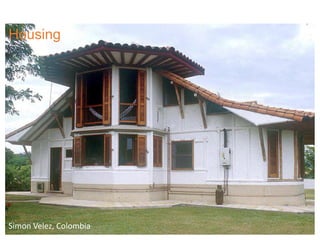
Simon Velez, Colombia
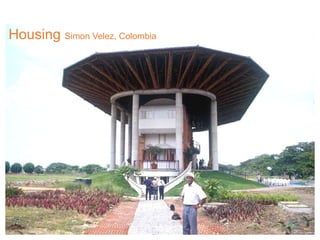
Housing
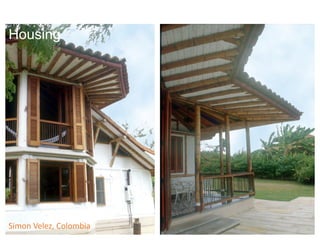
Simon Velez, Colombia
Housing Simon Velez, Colombia
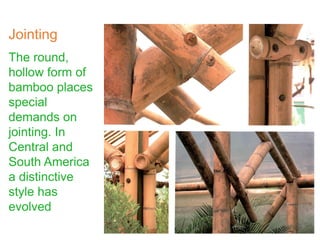
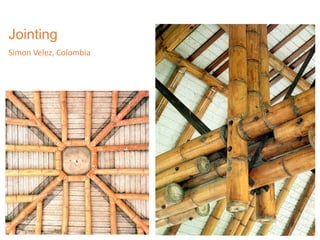
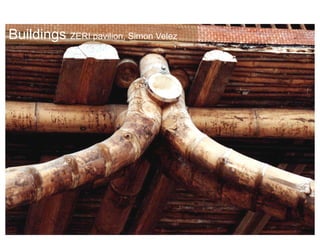
Jointing
The round,
hollow form of
bamboo places
special
demands on
jointing. In
Central and
South America
a distinctive
style has
evolved
Jointing
Simon Velez, Colombia
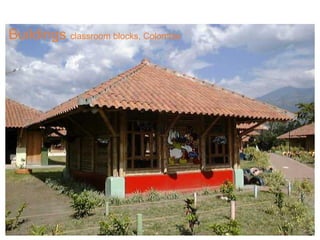
Buildings classroom blocks, Colombia
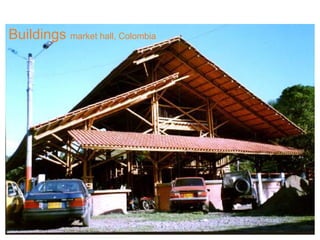
Buildings market hall, Colombia
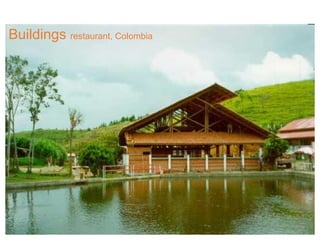
Buildings restaurant, Colombia
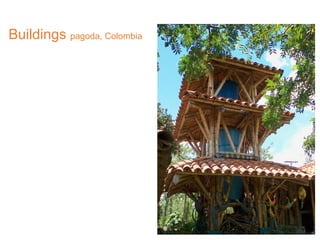
Buildings pagoda, Colombia
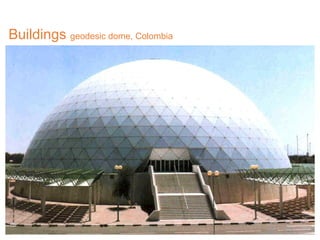
Buildings geodesic dome, Colombia
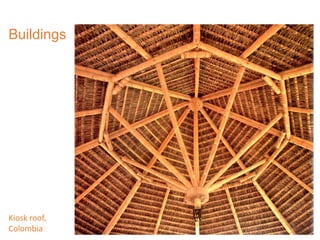
Buildings
Kiosk roof,
Colombia
Buildings filling station, Simon Velez
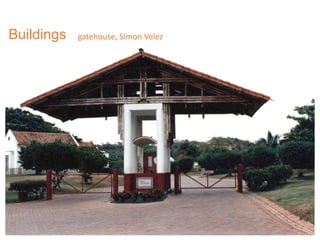
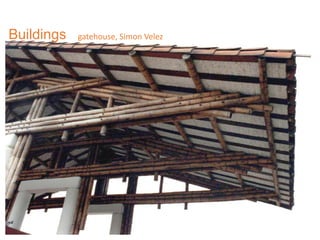
Buildings gatehouse, Simon Velez
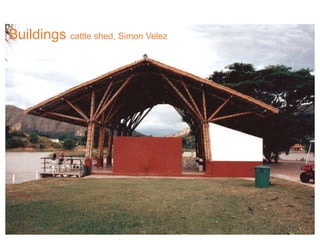
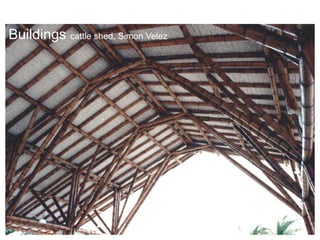
Buildings cattle shed, Simon Velez
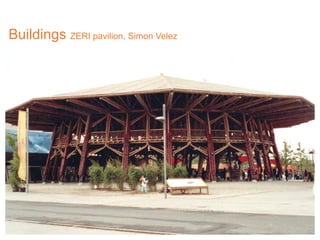
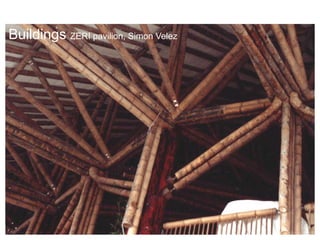
Buildings ZERI pavilion, Simon Velez
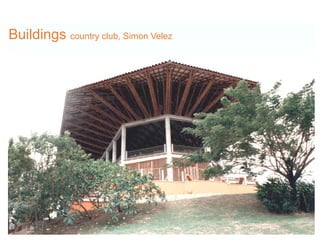
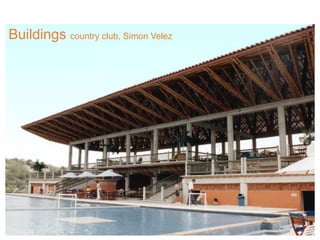
Buildings country club, Simon Velez
Buildings
country club, Simon Velez
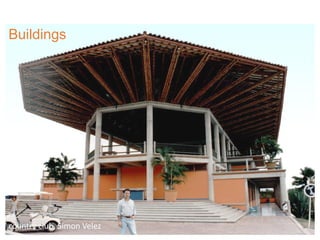
Buildings country club, Simon Velez
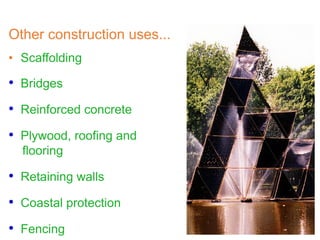
• Scaffolding
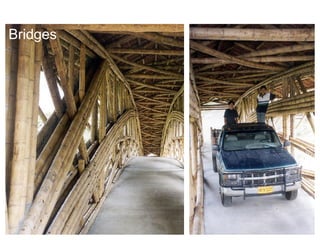
• Bridges
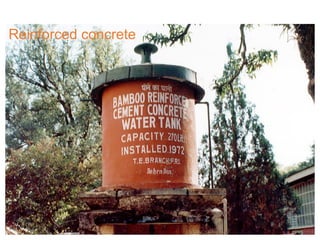
• Reinforced concrete
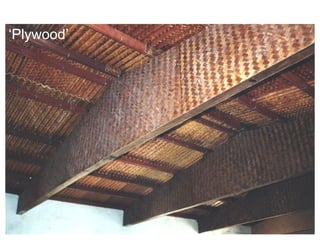
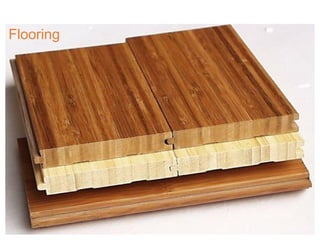
• Plywood, roofing and
flooring
• Retaining walls
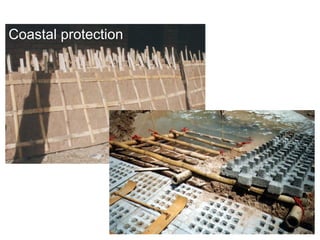
• Coastal protection
• Fencing
Other construction uses...
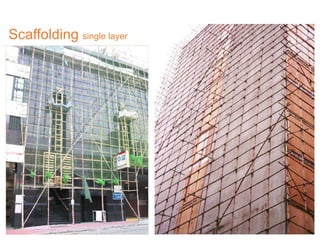
Scaffolding single layer
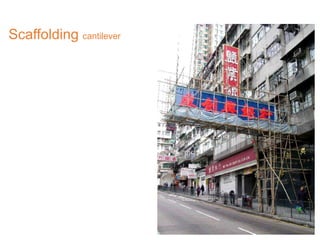
Scaffolding cantilever
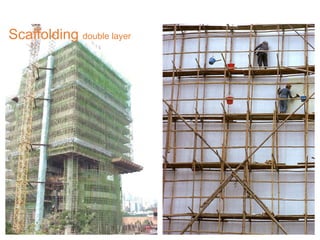
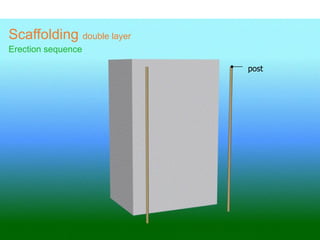
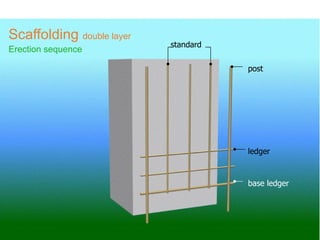
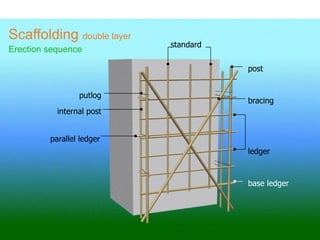
Scaffolding double layer
Erection sequence
post
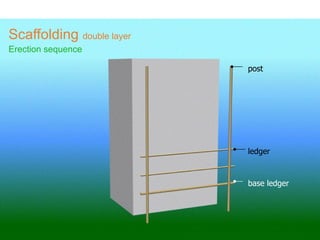
Scaffolding double layer
Erection sequence
base ledger
ledger
post
Scaffolding double layer
Erection sequence
base ledger
ledger
post
standard
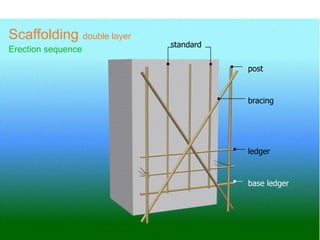
Scaffolding double layer
Erection sequence
base ledger
ledger
post
bracing
standard
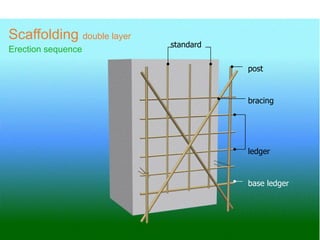
Scaffolding double layer
Erection sequence
base ledger
ledger
post
bracing
standard
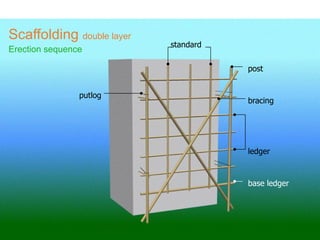
Scaffolding double layer
Erection sequence
post
bracing
putlog
standard
base ledger
ledger
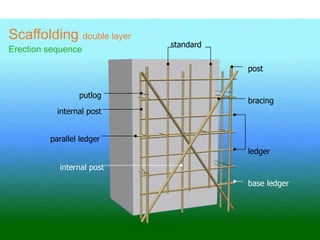
Scaffolding double layer
Erection sequence
internal post
post
bracing
putlog
standard
base ledger
ledger
Scaffolding double layer
Erection sequence
parallel ledger
post
bracing
putlog
standard
base ledger
ledger
internal post
Scaffolding double layer
Erection sequence
internal post
post
bracing
putlog
standard
base ledger
ledger
internal post
parallel ledger
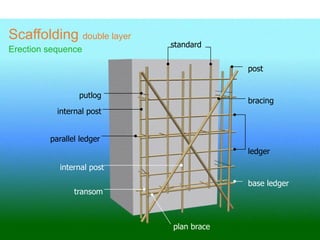
Scaffolding double layer
Erection sequence
plan brace
transom
post
bracing
putlog
standard
base ledger
ledger
internal post
parallel ledger
internal post
Scaffolding double layer
Erection sequence
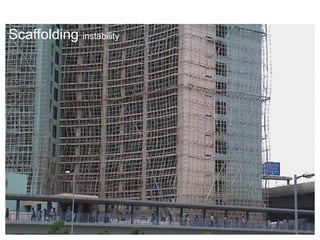
Scaffolding instability
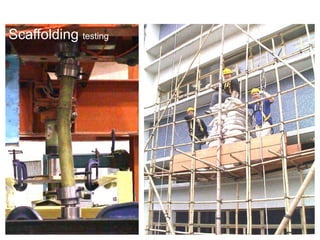
Scaffolding testing
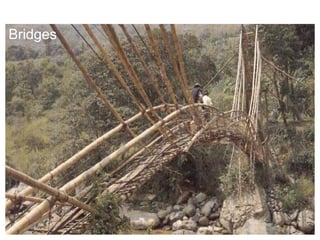
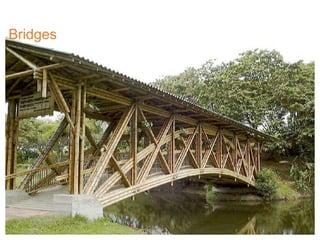
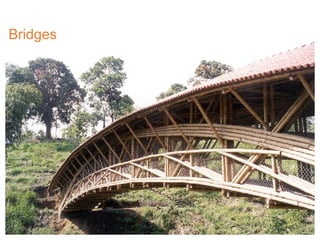
Bridges
Bridges
Bridges
Bridges
Reinforced concrete
‘Plywood’
Flooring
Flooring
Coastal protection
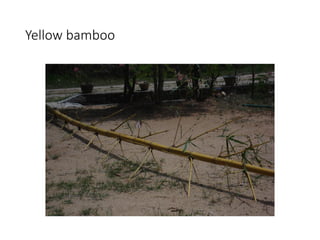
Yellow bamboo
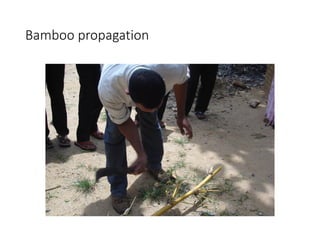
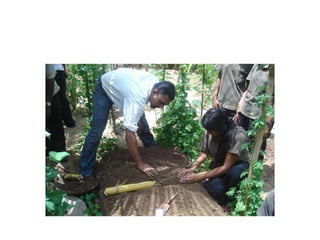
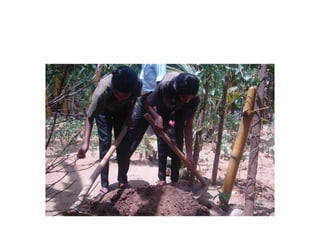
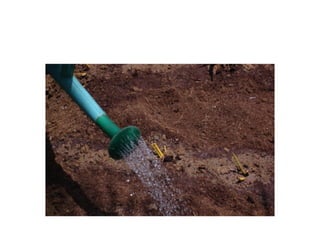
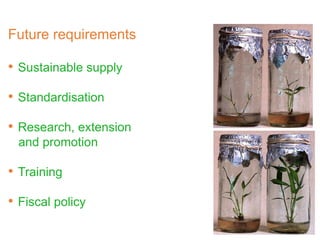
Bamboo propagation
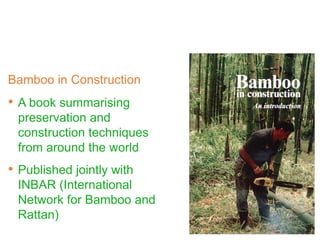
Bamboo in Construction
Lionel Jayanetti
Paul Follett
• A book summarising
preservation and
construction techniques
from around the world
• Published jointly with
INBAR (International
Network for Bamboo and
Rattan)
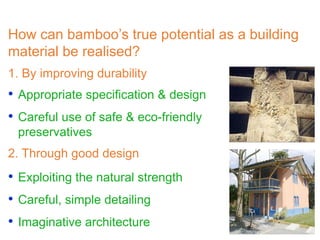
How can bamboo’s true potential as a building
material be realised?
• Exploiting the natural strength
• Careful, simple detailing
• Imaginative architecture
1. By improving durability
• Appropriate specification & design
• Careful use of safe & eco-friendly
preservatives
2. Through good design
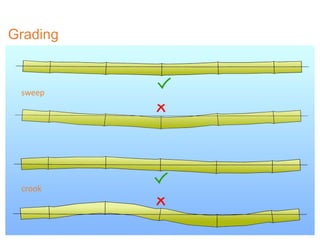
Grading
crook
sweep
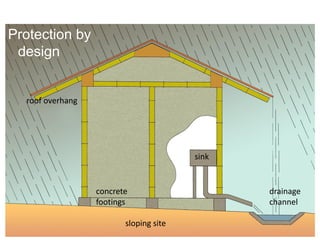
Protection by
design
concrete
footings
roof overhang
sink
drainage
channel
sloping site
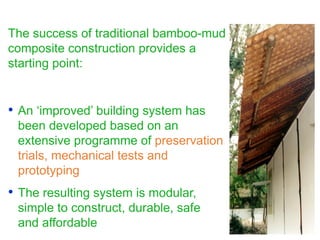
The success of traditional bamboo-mud
composite construction provides a
starting point:
• An ‘improved’ building system has
been developed based on an
extensive programme of preservation
trials, mechanical tests and
prototyping
• The resulting system is modular,
simple to construct, durable, safe
and affordable
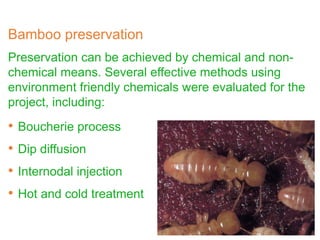
Preservation can be achieved by chemical and non-
chemical means. Several effective methods using
environment friendly chemicals were evaluated for the
project, including:
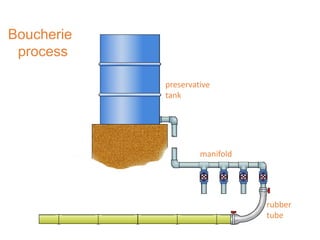
• Boucherie process
• Dip diffusion
• Internodal injection
• Hot and cold treatment
Bamboo preservation
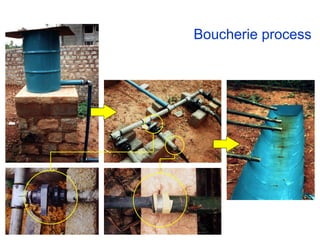
Boucherie
process
rubber
tube
preservative
tank
manifold
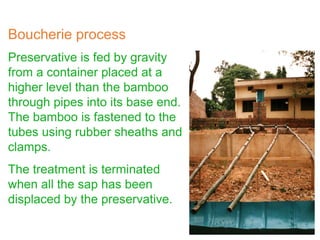
Preservative is fed by gravity
from a container placed at a
higher level than the bamboo
through pipes into its base end.
The bamboo is fastened to the
tubes using rubber sheaths and
clamps.
The treatment is terminated
when all the sap has been
displaced by the preservative.
Boucherie process
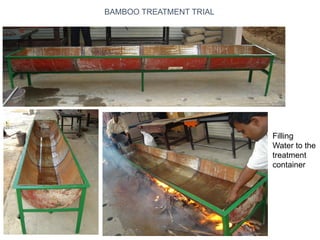
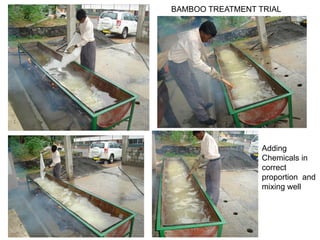
BAMBOO TREATMENT TRIAL
Filling
Water to the
treatment
container
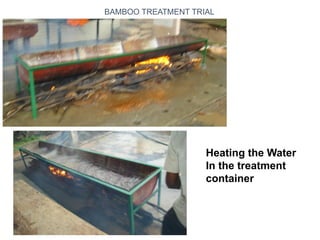
BAMBOO TREATMENT TRIAL
Heating the Water
In the treatment
container
BAMBOO TREATMENT TRIAL
Adding
Chemicals in
correct
proportion and
mixing well
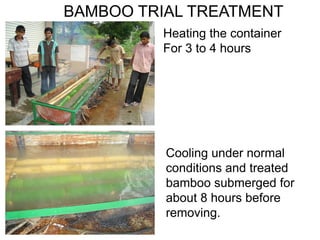
Heating the container
For 3 to 4 hours
BAMBOO TRIAL TREATMENT
Cooling under normal
conditions and treated
bamboo submerged for
about 8 hours before
removing.
Boucherie process
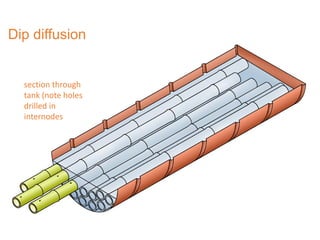
Dip diffusion
section through
tank (note holes
drilled in
internodes
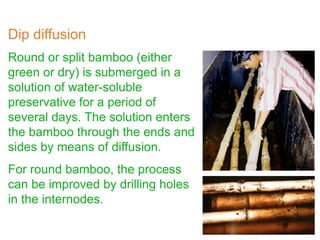
Round or split bamboo (either
green or dry) is submerged in a
solution of water-soluble
preservative for a period of
several days. The solution enters
the bamboo through the ends and
sides by means of diffusion.
For round bamboo, the process
can be improved by drilling holes
in the internodes.
Dip diffusion
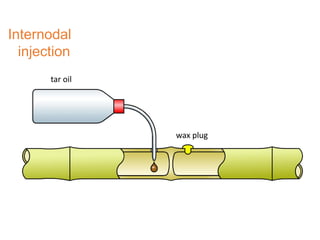
Internodal
injection
tar oil
wax plug
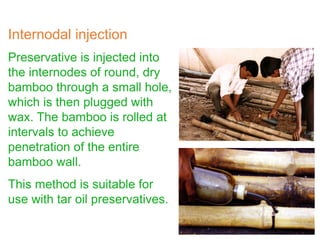
Preservative is injected into
the internodes of round, dry
bamboo through a small hole,
which is then plugged with
wax. The bamboo is rolled at
intervals to achieve
penetration of the entire
bamboo wall.
This method is suitable for
use with tar oil preservatives.
Internodal injection
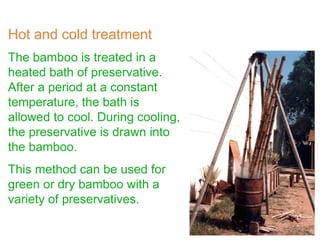
Hot and cold
method
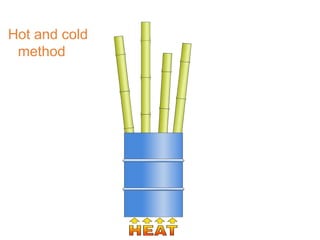
The bamboo is treated in a
heated bath of preservative.
After a period at a constant
temperature, the bath is
allowed to cool. During cooling,
the preservative is drawn into
the bamboo.
This method can be used for
green or dry bamboo with a
variety of preservatives.
Hot and cold treatment
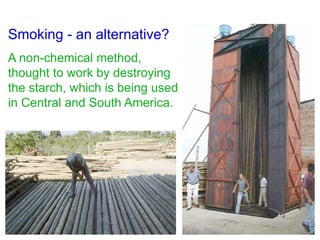
Smoking - an alternative?
A non-chemical method,
thought to work by destroying
the starch, which is being used
in Central and South America.
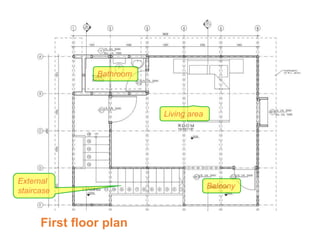
Bamboo 2-storey house
Basic specification
· Plinth area 6m x 4.8m (28.8m2) based on 1.2m
module
· Total covered area 57.6m2 over two storeys
· Maximum use of bamboo
· Bamboo species B. bambos and D. strictus
· 3.6m first floor span
· Covered external staircase
· Bathroom on each floor
· Architect’s brief - innovative and striking, but
simple and replicable
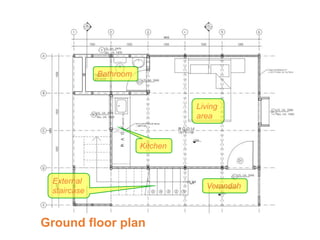
External
staircase
Living
area
Verandah
Kitchen
Bathroom
Ground floor plan
External
staircase
Living area
Balcony
Bathroom
First floor plan
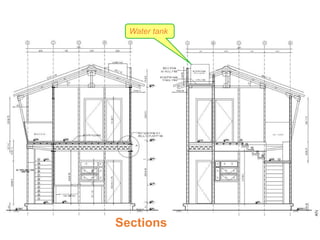
Sections
Water tank
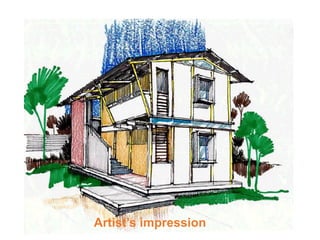
Artist’s impression
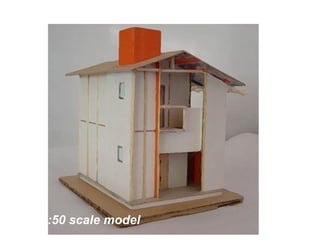
1:50 scale model
1:50 scale model
Concrete blockwork up to floor level
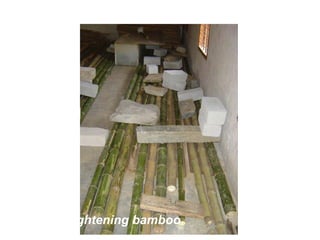
Straightening bamboo
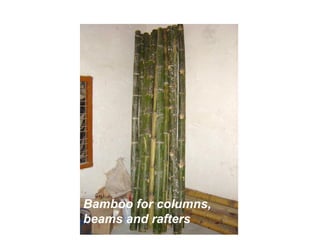
Bamboo for columns,
beams and rafters
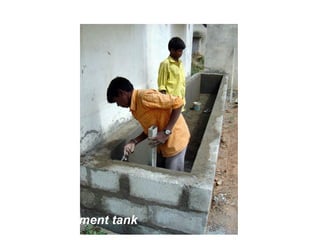
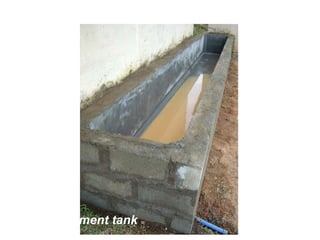
Treatment tank
Treatment tank
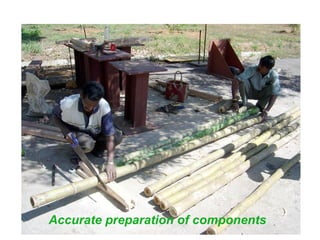
Accurate preparation of components
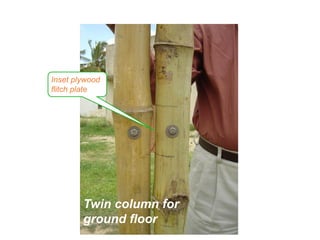
Twin column for
ground floor
Inset plywood
flitch plate
Twin column for
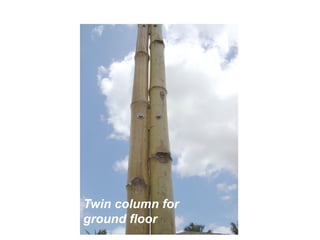
ground floor
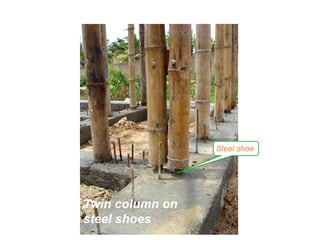
Twin column on
steel shoes
Steel shoe
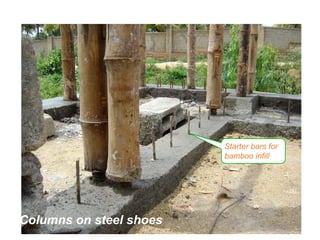
Columns on steel shoes
Starter bars for
bamboo infill
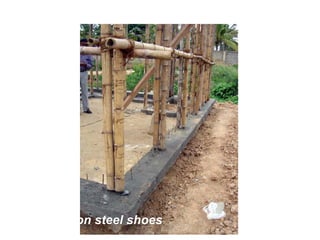
Columns on steel shoes
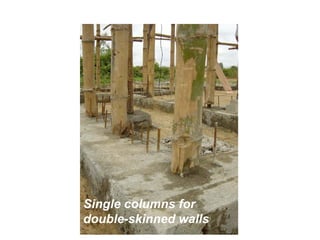
Single columns for
double-skinned walls
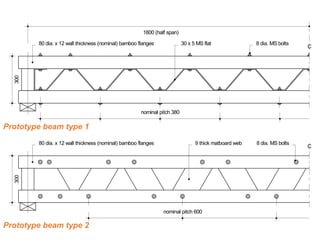
nominal pitch 380
C
300
80 dia. x 12 wall thickness (nominal) bamboo flanges 8 dia. MS bolts30 x 5 MS flat
1800 (half span)
Prototype beam type 1
Prototype beam type 2
C
nominal pitch 600
300
80 dia. x 12 wall thickness (nominal) bamboo flanges 8 dia. MS bolts9 thick matboard web
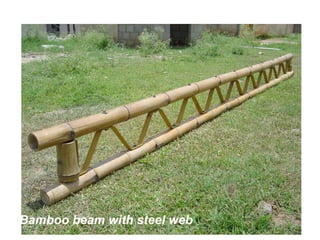
Bamboo beam with steel web
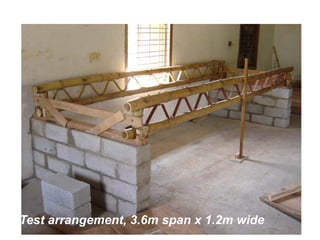
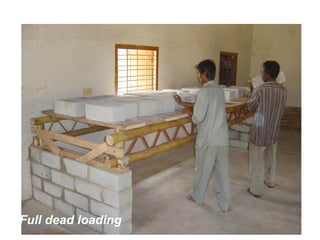
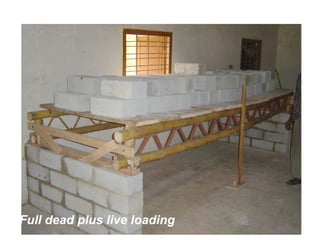
Test arrangement, 3.6m span x 1.2m wide
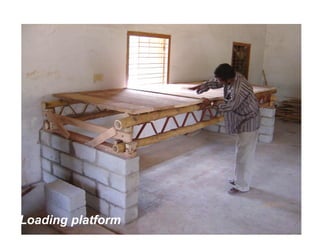
Loading platform
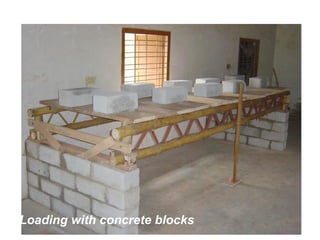
Loading with concrete blocks
Full dead loading
Full dead plus live loading
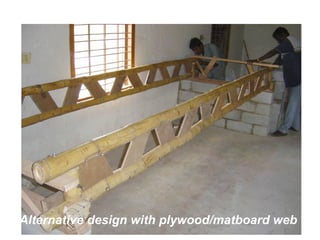
Alternative design with plywood/matboard web
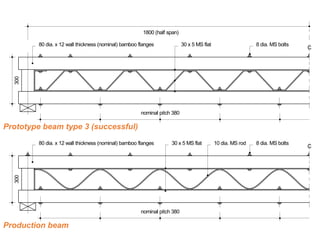
nominal pitch 380
C
300
80 dia. x 12 wall thickness (nominal) bamboo flanges 8 dia. MS bolts30 x 5 MS flat
1800 (half span)
Prototype beam type 3 (successful)
Production beam
nominal pitch 380
C
300
80 dia. x 12 wall thickness (nominal) bamboo flanges 8 dia. MS bolts30 x 5 MS flat
nominal pitch 380
C
300
80 dia. x 12 wall thickness (nominal) bamboo flanges 8 dia. MS bolts30 x 5 MS flat 10 dia. MS rod
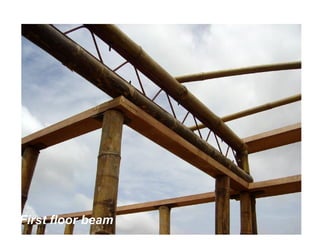
First floor beam
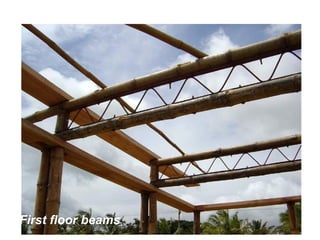
First floor beams
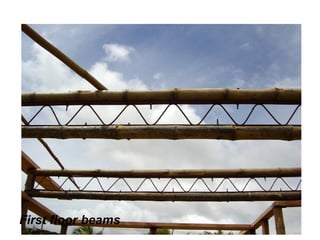
First floor beams
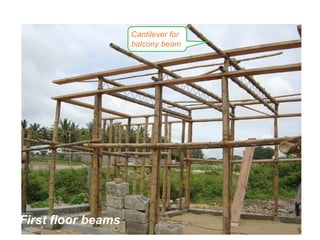
Cantilever for
balcony beam
First floor beams
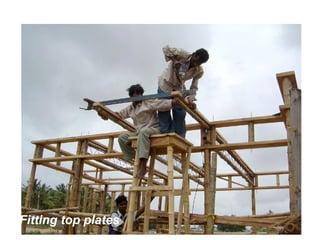
Fitting top plates
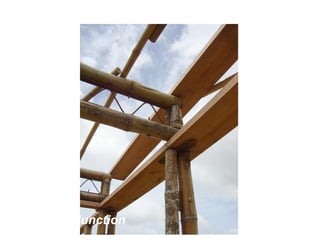
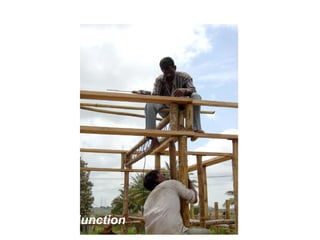
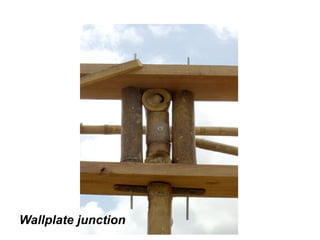
Wallplate junction
Wallplate junction
Wallplate junction
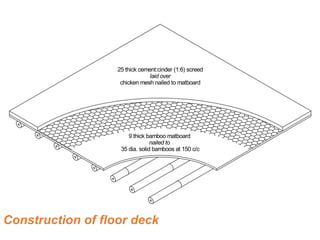
9 thick bamboo matboard
nailed to
35 dia. solid bamboos at 150 c/c
25 thick cement:cinder (1:6) screed
laid over
chicken mesh nailed to matboard
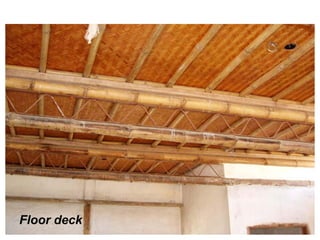
Construction of floor deck
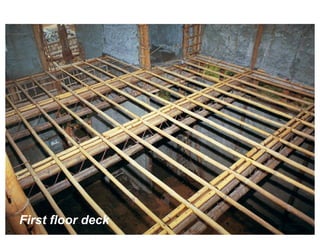
First floor deck
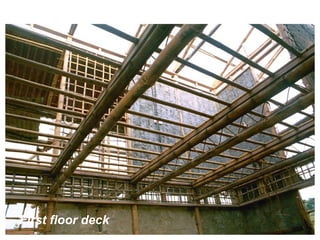
First floor deck
First floor deck
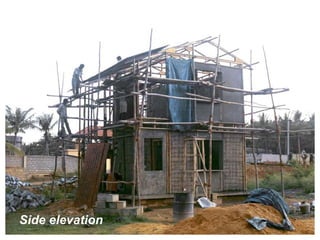
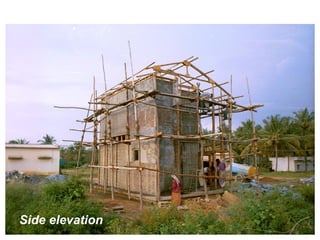
Side elevation
Bathroom
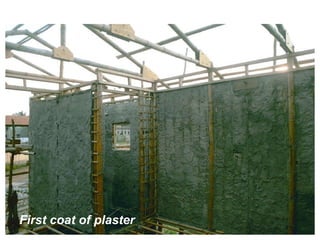
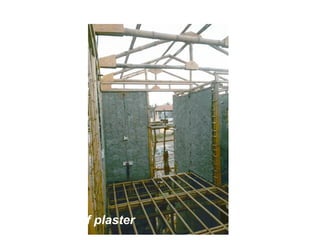
First coat of plaster
Side elevation
First coat of plaster
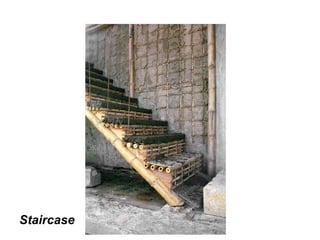
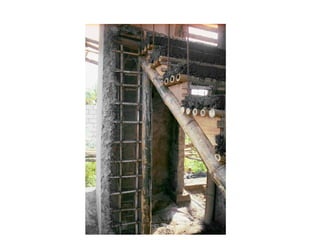
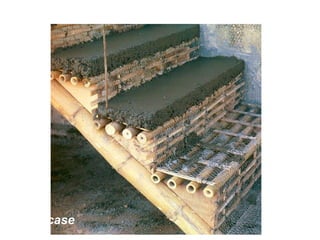
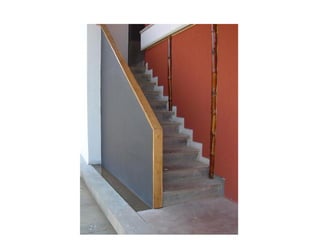
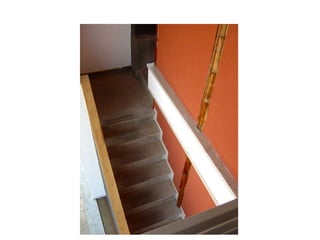
Staircase
Staircase
Staircase
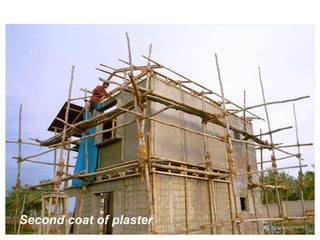
Second coat of plaster
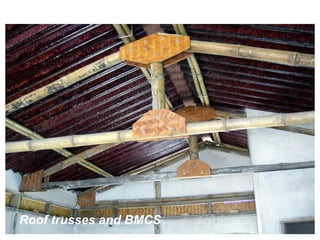
Roof trusses and BMCS
Floor deck
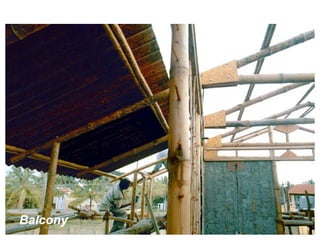
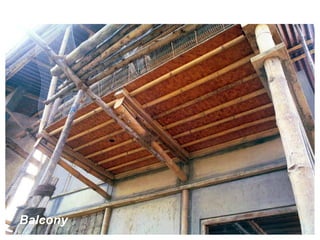
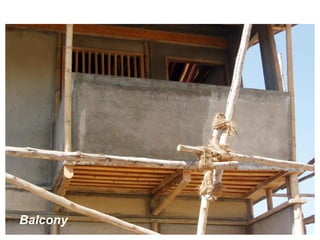
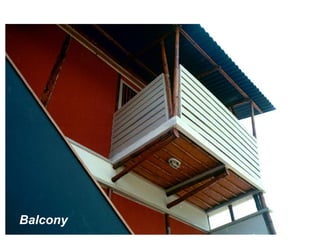
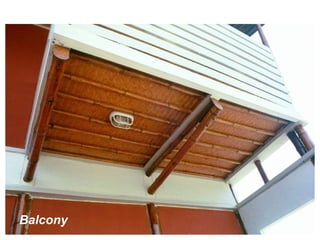
Balcony
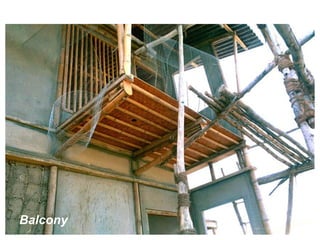
Balcony
Balcony
Balcony
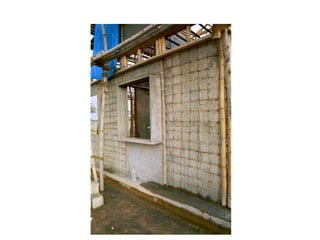
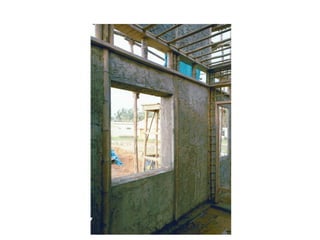
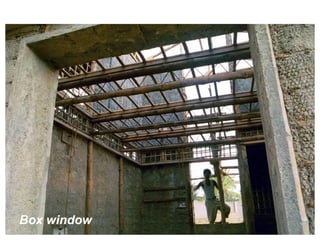
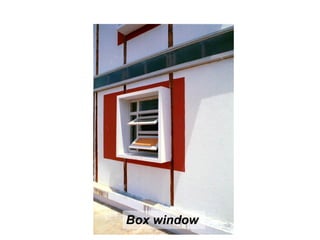
Box window
Box window
Box window
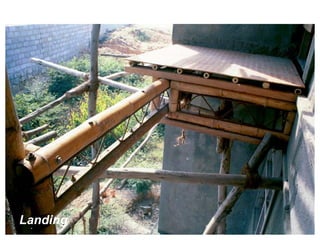
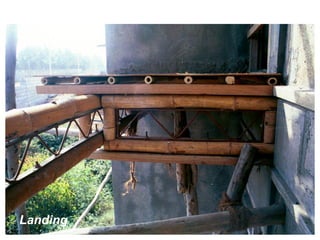
Landing
Landing
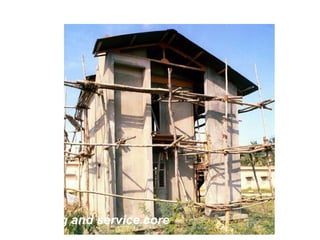
Landing and service core
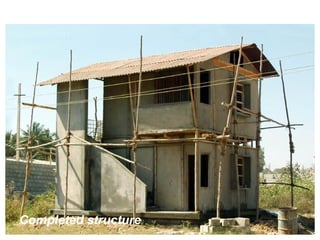
Completed structure
Second fitting
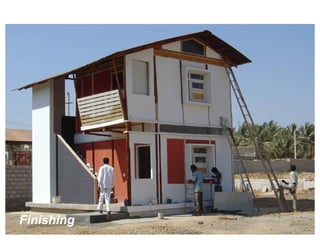
Finishing
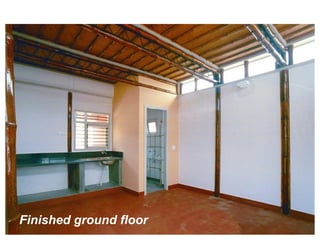
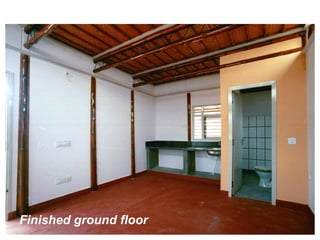
Finished ground floor
Kitchen/bathroom
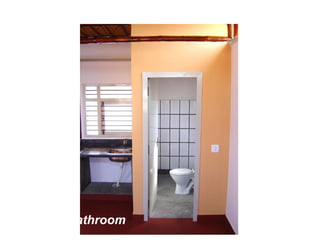
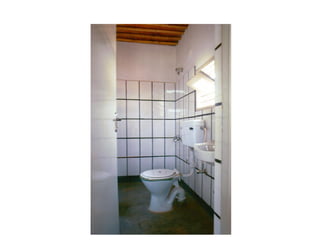
Bathroom
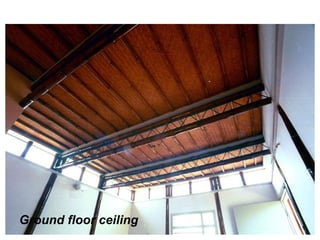
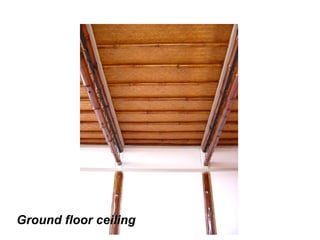
Ground floor ceiling
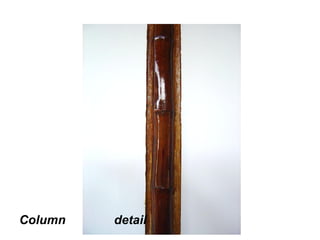
Column detail
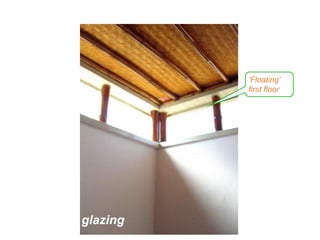
High level glazing
‘Floating’
first floor
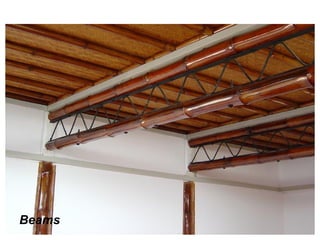
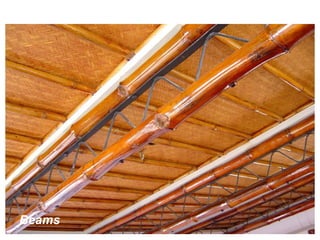
Beams
Beams
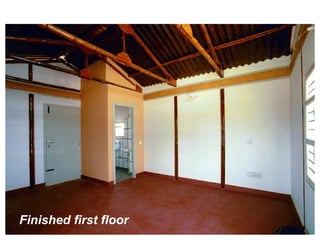
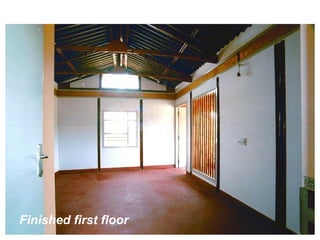
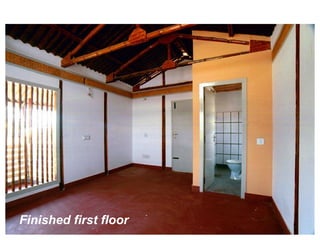
Finished first floor
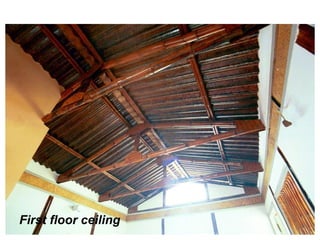
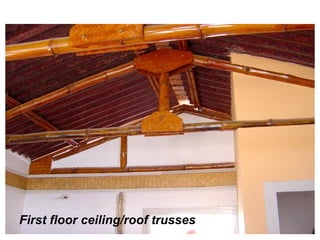
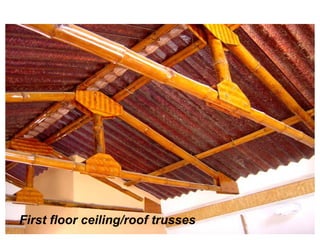
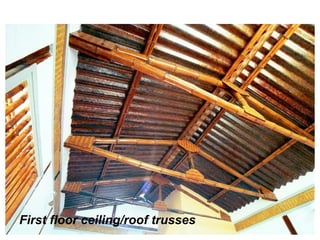
First floor ceiling
First floor ceiling/roof trusses
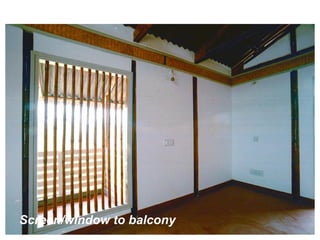
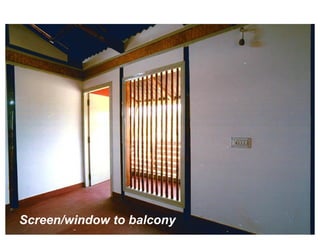
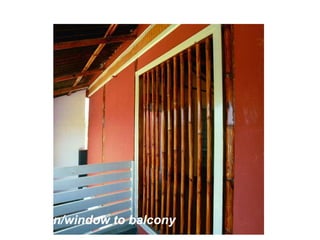
Screen/window to balcony
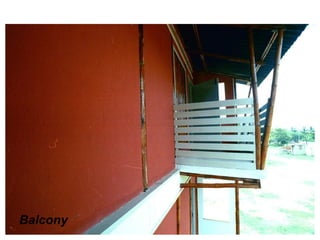
Balcony
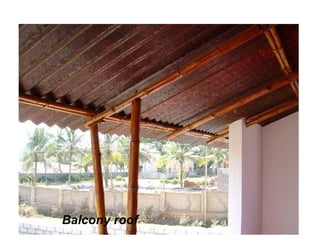
Balcony roof
Balcony
Balcony
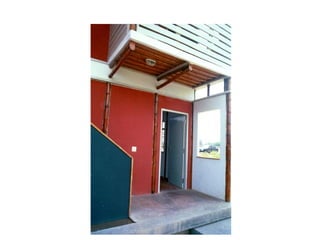
Verandah
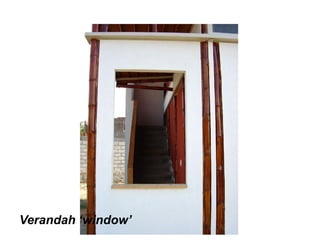
Verandah ‘window’
Staircase
Staircase
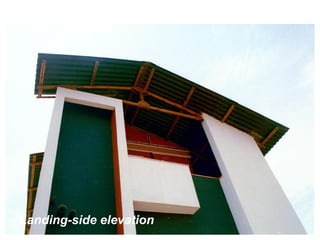
Landing-side elevation
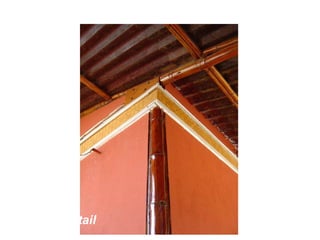
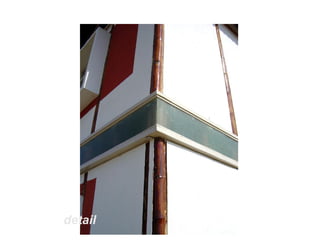
Corner detail
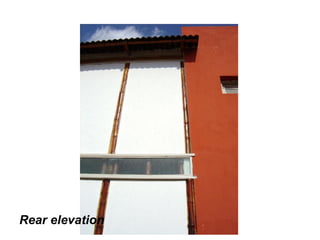
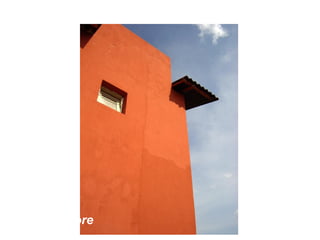
Rear elevation
Service core
Corner detail
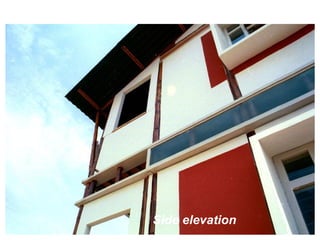
Side elevation
Box window
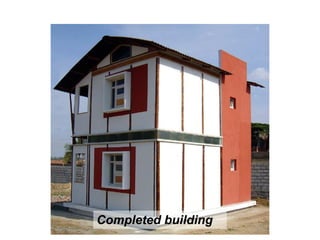
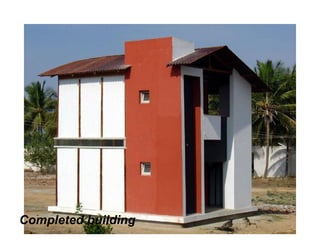
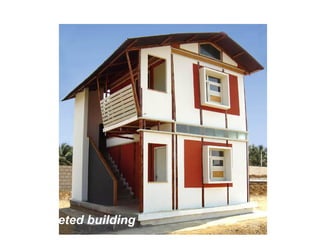
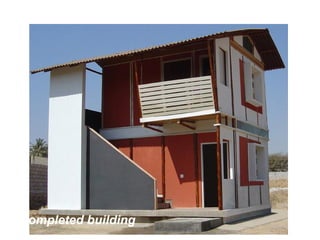
Completed building
Completed building
Completed building
Completed building
Bamboo testing
Performance of walls, roofs and joints
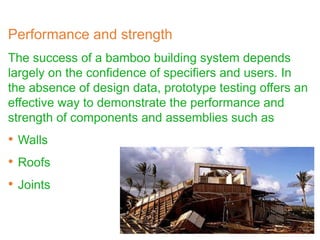
Performance and strength
The success of a bamboo building system depends
largely on the confidence of specifiers and users. In
the absence of design data, prototype testing offers an
effective way to demonstrate the performance and
strength of components and assemblies such as
• Walls
• Roofs
• Joints
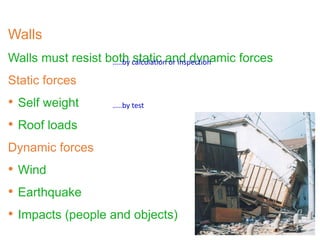
Walls
Walls must resist both static and dynamic forces
Static forces
• Self weight
• Roof loads
Dynamic forces
• Wind
• Earthquake
• Impacts (people and objects)
…..by calculation or inspection
…..by test
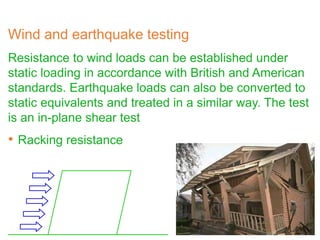
Wind and earthquake testing
Resistance to wind loads can be established under
static loading in accordance with British and American
standards. Earthquake loads can also be converted to
static equivalents and treated in a similar way. The test
is an in-plane shear test
• Racking resistance
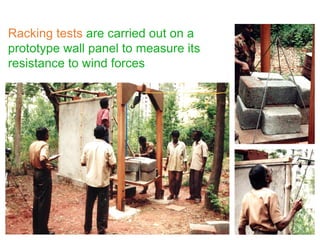
Racking tests are carried out on a
prototype wall panel to measure its
resistance to wind forces
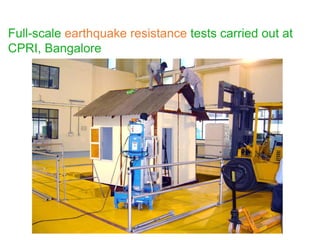
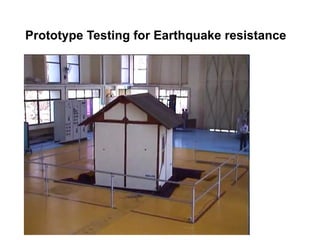
Full-scale earthquake resistance tests carried out at
CPRI, Bangalore
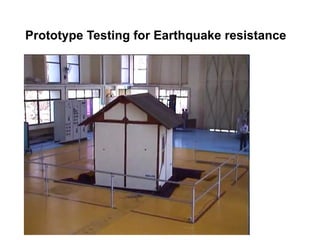
Prototype Testing for Earthquake resistance
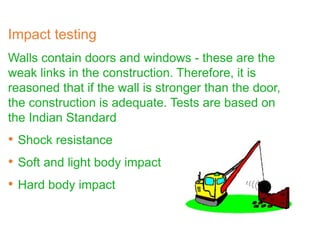
Impact testing
Walls contain doors and windows - these are the
weak links in the construction. Therefore, it is
reasoned that if the wall is stronger than the door,
the construction is adequate. Tests are based on
the Indian Standard
• Shock resistance
• Soft and light body impact
• Hard body impact
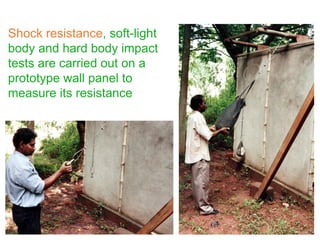
Shock resistance, soft-light
body and hard body impact
tests are carried out on a
prototype wall panel to
measure its resistance
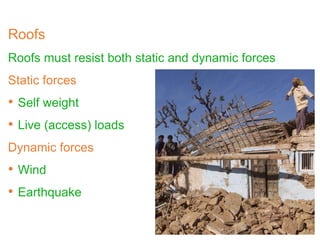
Roofs
Roofs must resist both static and dynamic forces
Static forces
• Self weight
• Live (access) loads
Dynamic forces
• Wind
• Earthquake
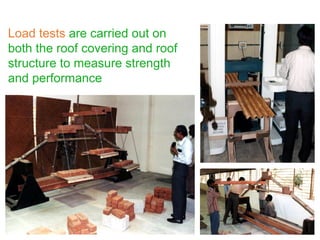
Load tests are carried out on
both the roof covering and roof
structure to measure strength
and performance
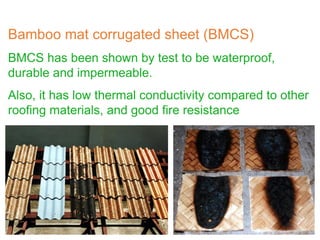
Bamboo mat corrugated sheet (BMCS)
BMCS has been shown by test to be waterproof,
durable and impermeable.
Also, it has low thermal conductivity compared to other
roofing materials, and good fire resistance
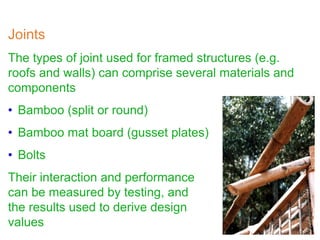
Joints
The types of joint used for framed structures (e.g.
roofs and walls) can comprise several materials and
components
• Bamboo (split or round)
• Bamboo mat board (gusset plates)
• Bolts
Their interaction and performance
can be measured by testing, and
the results used to derive design
values
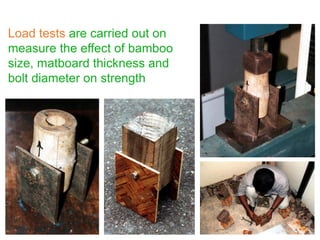
Load tests are carried out on
measure the effect of bamboo
size, matboard thickness and
bolt diameter on strength
Bamboo building system
Foundations, floor, walls and roof
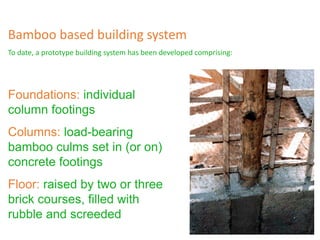
Foundations: individual
column footings
Columns: load-bearing
bamboo culms set in (or on)
concrete footings
Floor: raised by two or three
brick courses, filled with
rubble and screeded
Bamboo based building system
To date, a prototype building system has been developed comprising:
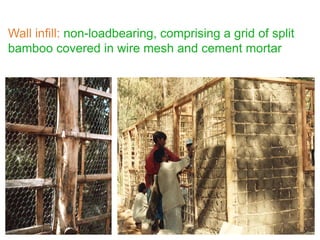
Wall infill: non-loadbearing, comprising a grid of split
bamboo covered in wire mesh and cement mortar
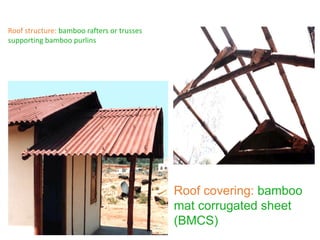
Roof covering: bamboo
mat corrugated sheet
(BMCS)
Roof structure: bamboo rafters or trusses
supporting bamboo purlins
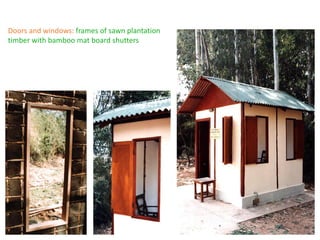
Doors and windows: frames of sawn plantation
timber with bamboo mat board shutters
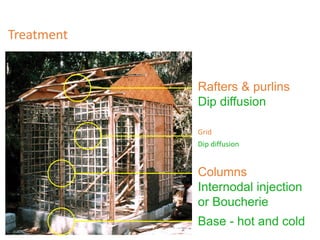
Treatment
Columns
Internodal injection
or Boucherie
Base - hot and cold
Rafters & purlins
Dip diffusion
Grid
Dip diffusion
Bamboo mat corrugated sheet
(BMCS)
Sustainable roofing material
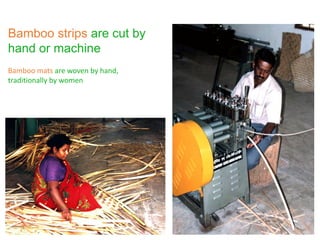
Bamboo strips are cut by
hand or machine
Bamboo mats are woven by hand,
traditionally by women
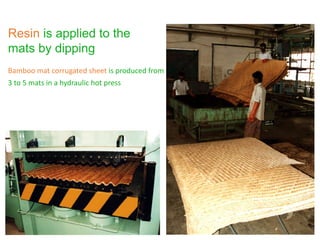
Resin is applied to the
mats by dipping
Bamboo mat corrugated sheet is produced from
3 to 5 mats in a hydraulic hot press
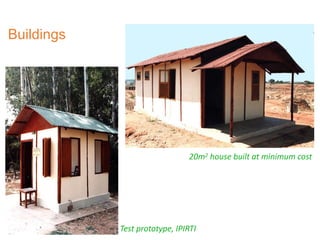
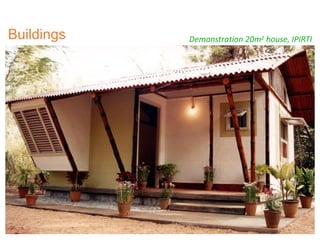
Buildings
Test prototype, IPIRTI
20m2 house built at minimum cost
Demonstration 20m2 house, IPIRTIBuildings
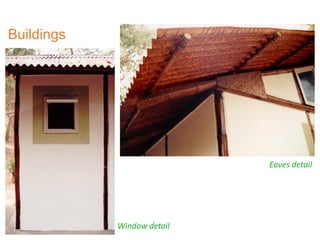
Eaves detail
Window detail
Buildings
Buildings
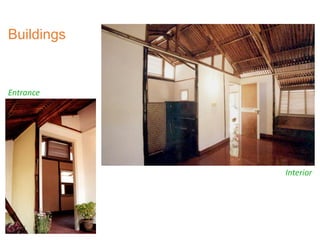
Entrance
Interior
Buildings
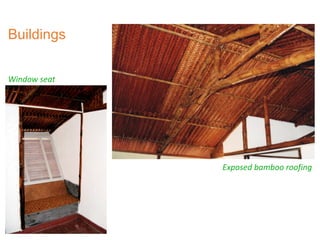
Window seat
Exposed bamboo roofing
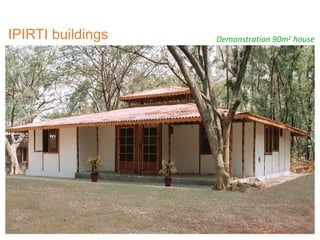
Demonstration 90m2 houseIPIRTI buildings
IPIRTI buildings
Column layout
Placing infill grid
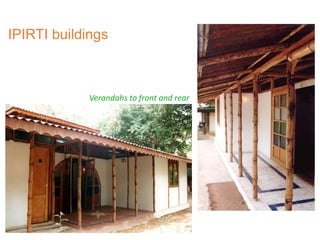
Verandahs to front and rear
IPIRTI buildings
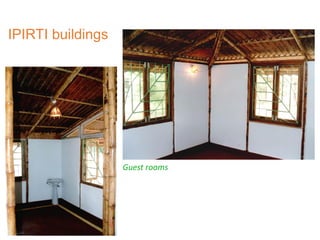
Guest rooms
IPIRTI buildings
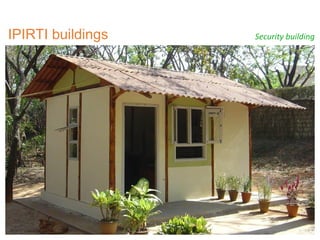
Security buildingIPIRTI buildings
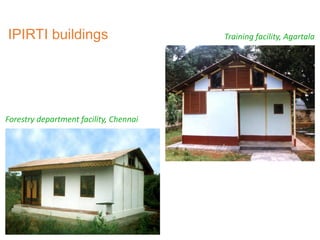
Training facility, AgartalaIPIRTI buildings
Forestry department facility, Chennai
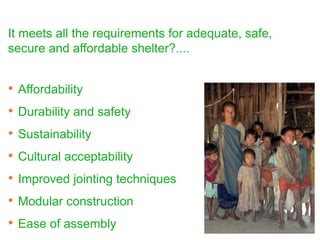
• Affordability
• Durability and safety
• Sustainability
• Cultural acceptability
• Improved jointing techniques
• Modular construction
• Ease of assembly
It meets all the requirements for adequate, safe,
secure and affordable shelter?....
• Foundations are minimised
• Wall panels are non-loadbearing and can be reduced
in thickness
• Basic components (bamboo, wire, bolts, chicken
mesh, cement) are inexpensive
Durability and safety
• All bamboo components are treated with safe
preservatives to give extended life
• The structure is engineered to resist wind and
earthquake forces and other imposed loads
Affordability
• Bamboo is available in commercial quantities using
the established supply system
• It is a renewable resource with a short rotation period
and can be grown on degraded land
• The bamboo is treated using environmentally friendly
preservatives
• The use of high energy embodied materials (cement,
steel) is minimised
Cultural acceptability
• The system offers traditional materials in a modern
engineering context
• The result is homely, with the feel of permanence
Sustainability
• Nailing (and therefore splitting) is eliminated
• Wiring, bolting and strapping provides positive
connections
Modular construction
• Suited to either prefabrication or fabrication in-situ
• All components are designed to be prefabricated (e.g.
infill grids, roof trusses), or prepared on site
Ease of assembly
• Only basic carpentry and masonry tools and skills
are required to undertake the construction
Improved jointing techniques
Some thoughts on the future...
Future potential
Bamboo is well placed to address four major global
challenges:
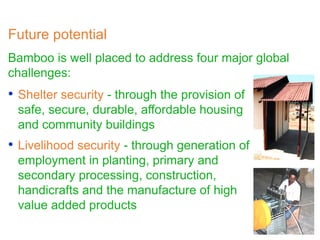
• Shelter security - through the provision of
safe, secure, durable, affordable housing
and community buildings
• Livelihood security - through generation of
employment in planting, primary and
secondary processing, construction,
handicrafts and the manufacture of high
value added products
• Ecological security - conservation of natural forests,
carbon sinking, substitute for high energy materials
• Sustainable food security - agro forestry, maintaining
fertility, erosion control, bamboo shoots
Future potential
Future requirements
• Sustainable supply
• Standardisation
• Research, extension
and promotion
• Training
• Fiscal policy
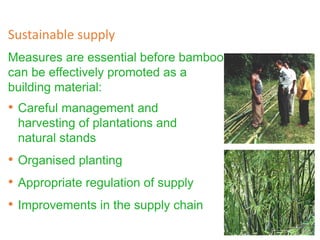
Measures are essential before bamboo
can be effectively promoted as a
building material:
Sustainable supply
• Careful management and
harvesting of plantations and
natural stands
• Organised planting
• Appropriate regulation of supply
• Improvements in the supply chain
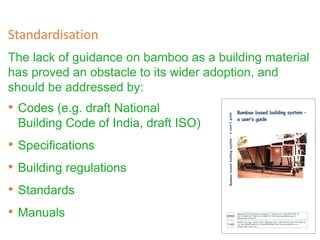
The lack of guidance on bamboo as a building material
has proved an obstacle to its wider adoption, and
should be addressed by:
Standardisation
• Codes (e.g. draft National
Building Code of India, draft ISO)
• Specifications
• Building regulations
• Standards
• Manuals
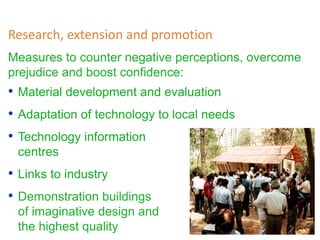
Measures to counter negative perceptions, overcome
prejudice and boost confidence:
Research, extension and promotion
• Material development and evaluation
• Adaptation of technology to local needs
• Technology information
centres
• Links to industry
• Demonstration buildings
of imaginative design and
the highest quality
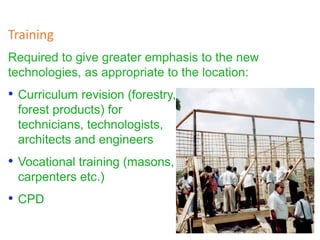
Required to give greater emphasis to the new
technologies, as appropriate to the location:
Training
• Curriculum revision (forestry,
forest products) for
technicians, technologists,
architects and engineers
• Vocational training (masons,
carpenters etc.)
• CPD
Financial interventions to encourage,
establish and support bamboo
development:
Fiscal policy
• Industry incentives
• Review of housing loan policy
• Housing cooperatives (micro
credit)
• Self-help groups
• Financing arrangements
Prototype Testing for Earthquake resistance
Thank you!
Website
www.trada.co.uk/internaional

Lional Jayanetti_Bamboo in Construction