GRADE 10
SCIENCE
EMILY M. MANOGUID
Subject Teacher
• How are you feeling today?
• Are you ready to explore our
lesson ?
• Emulate the emoji that tells on
how are you feeling today
ACTIVITY1:
EleNames
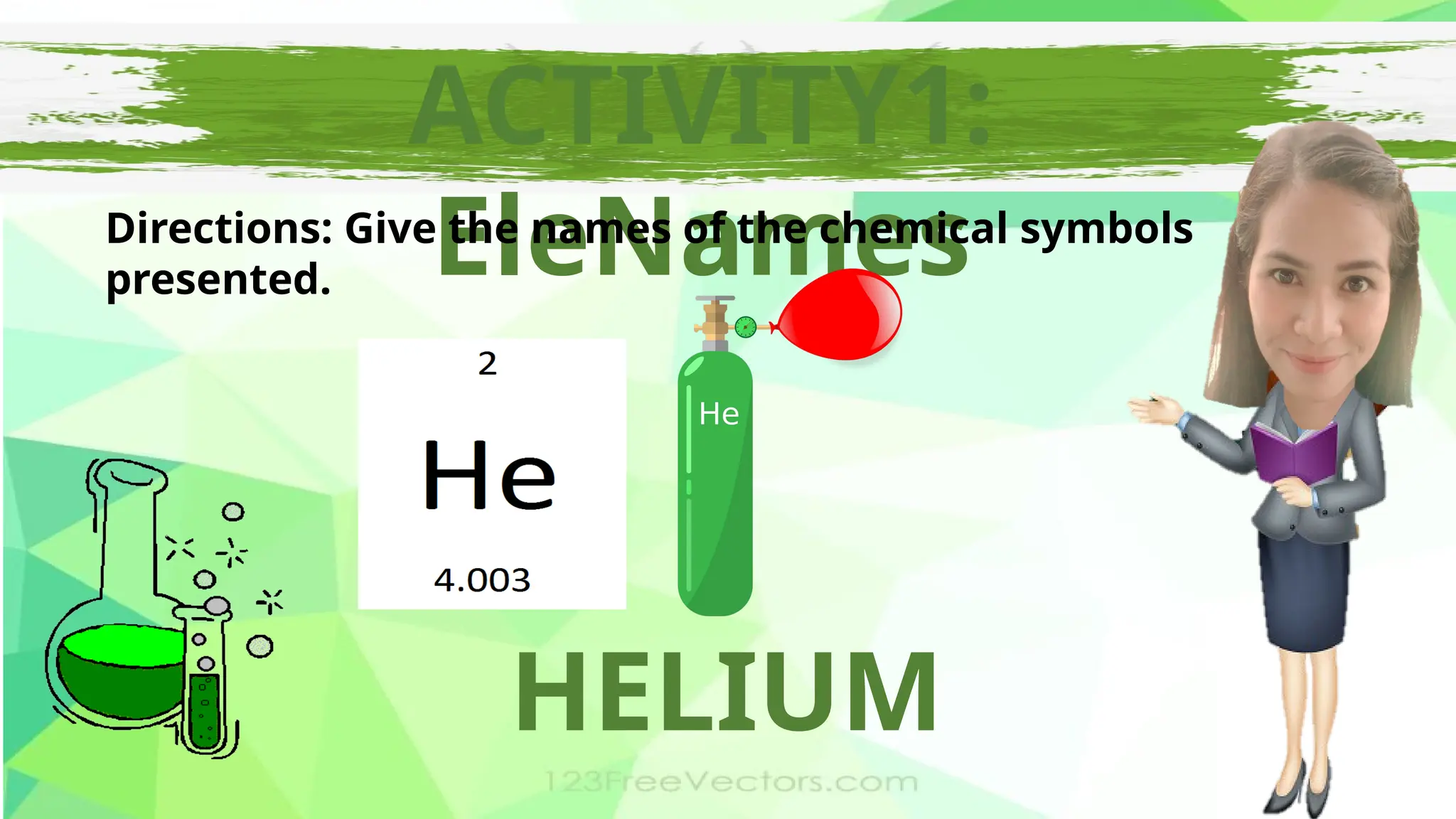
Directions: Give the names of the chemical symbols
presented.
CA_B_N
ACTIVITY1:
EleNames
CARBON
ACTIVITY1:
EleNames
Directions: Give the names of the chemical symbols
presented.
H_L_UM
ACTIVITY1:
EleNames
Directions: Give the names of the chemical symbols
presented.
HELIUM
ACTIVITY1:
EleNames
Directions: Give the names of the chemical symbols
presented.
M_N_ANE_E
ACTIVITY1:
EleNames
Directions: Give the names of the chemical symbols
presented.
MANGANESE
ACTIVITY1:
EleNames
Directions: Give the names of the chemical symbols
presented.
I_D_NE
ACTIVITY1:
EleNames
Directions: Give the names of the chemical symbols
presented.
IODINE
ACTIVITY1:
EleNames
Directions: Give the names of the chemical symbols
presented.
I_D_NE
ACTIVITY1:
EleNames
Directions: Give the names of the chemical symbols
presented.
CA_B_N
ACTIVITY1:
EleNames
CARBON
ACTIVITY1:
EleNames
Directions: Give the names of the chemical symbols
presented.
A_UMI_U_
ACTIVITY1:
EleNames
Directions: Give the names of the chemical symbols
presented.
ALUMINUM
ACTIVITY1:
EleNames
Directions: Give the names of the chemical symbols
presented.
R_ENI_M
ACTIVITY1:
EleNames
Directions: Give the names of the chemical symbols
presented.
RHENIUM
ACTIVITY1:
EleNames
Directions: Give the names of the chemical symbols
presented.
A_T_N_UM
ACTIVITY1:
EleNames
Directions: Give the names of the chemical symbols
presented.
ACTINIUM
ACTIVITY1:
EleNames
Directions: Give the names of the chemical symbols
presented.
T_T_N_UM
ACTIVITY1:
EleNames
Directions: Give the names of the chemical symbols
presented.
TITANIUM
ACTIVITY1:
EleNames
Directions: Give the names of the chemical symbols
presented.
O_YG_N
ACTIVITY1:
EleNames
Directions: Give the names of the chemical symbols
presented.
OXYGEN
ACTIVITY1:
EleNames
Directions: Give the names of the chemical symbols
presented.
N_T_OG_N
ACTIVITY1:
EleNames
Directions: Give the names of the chemical symbols
presented.
NITROGEN
ACTIVITY1:
EleNames
1. What word is formed by combining all
chemical symbols?
2. What are the indicators in chemical
reactions?
ACTIVITY1:
EleNames
Chemical Reaction
- is the process where a material is
transformed into a new one, possessing
a new composition.
LESSON OBJECTIVE:
General Objective:
 Apply the principles of conservation of
mass to chemical reactions. (S10MT-IVe-g-
23)
Specific Objective:
 Define chemical equation
 Balance a chemical equation; and
 Apply Law of Conservation of mass in
balancing chemical equations.
Activity 2: 4 PICS 1 WORD
B_LAN_IN_
Activity 2: 4 PICS 1 WORD
BALANCING
Activity 2: 4 PICS 1 WORD
C_EM_C_L
Activity 2: 4 PICS 1 WORD
CHEMICAL
Activity 2: 4 PICS 1 WORD
EQ_A_IO_
Activity 2: 4 PICS 1 WORD
EQUATION
BALANCING
CHEMICAL
EQUATIONS
BALANCING
CHEMICAL
EQUATIONS
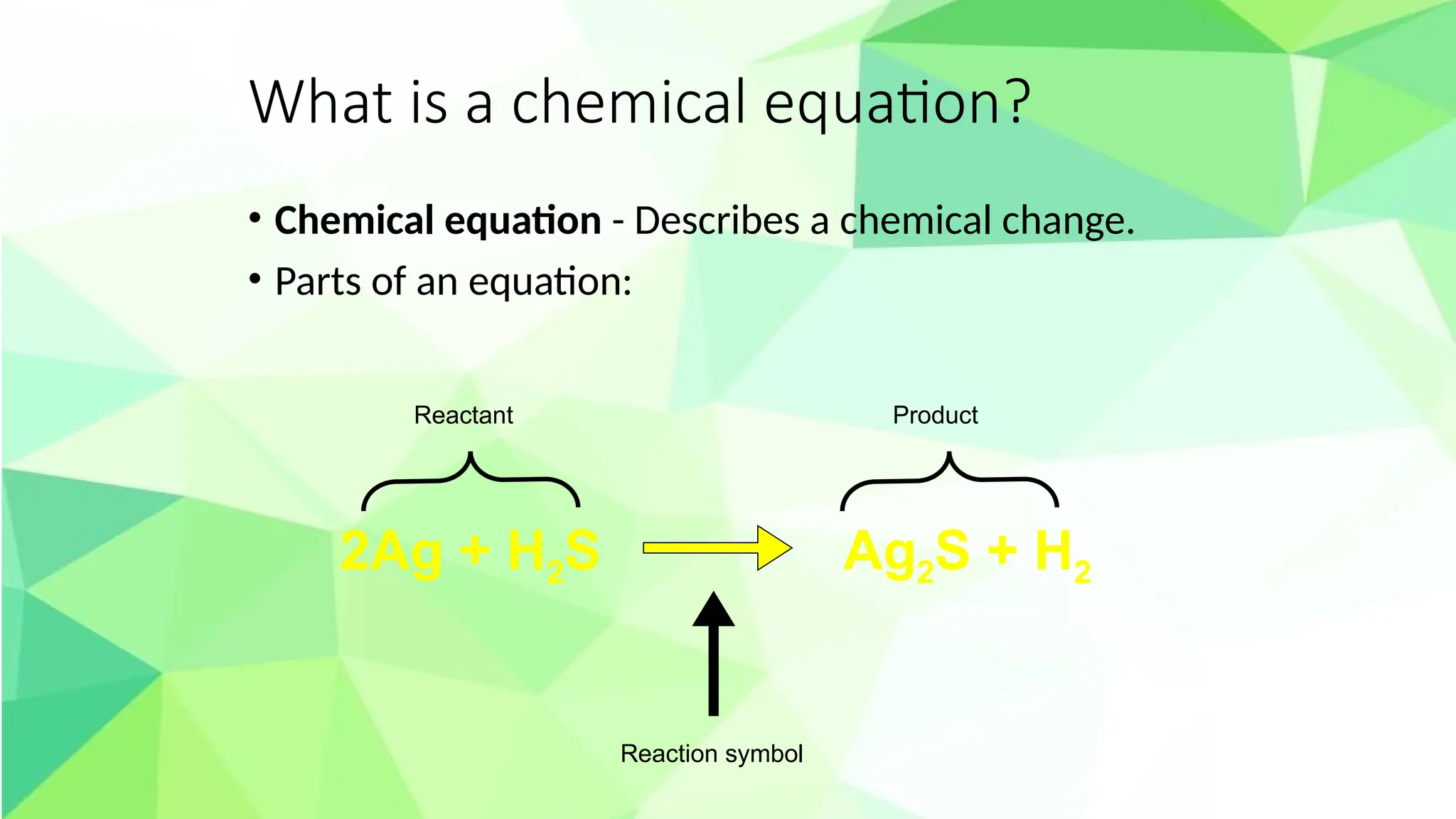
What is a chemical equation?
• Chemical equation - Describes a chemical change.
• Parts of an equation:
2Ag + H2S Ag2S + H2
Reactant Product
Reaction symbol
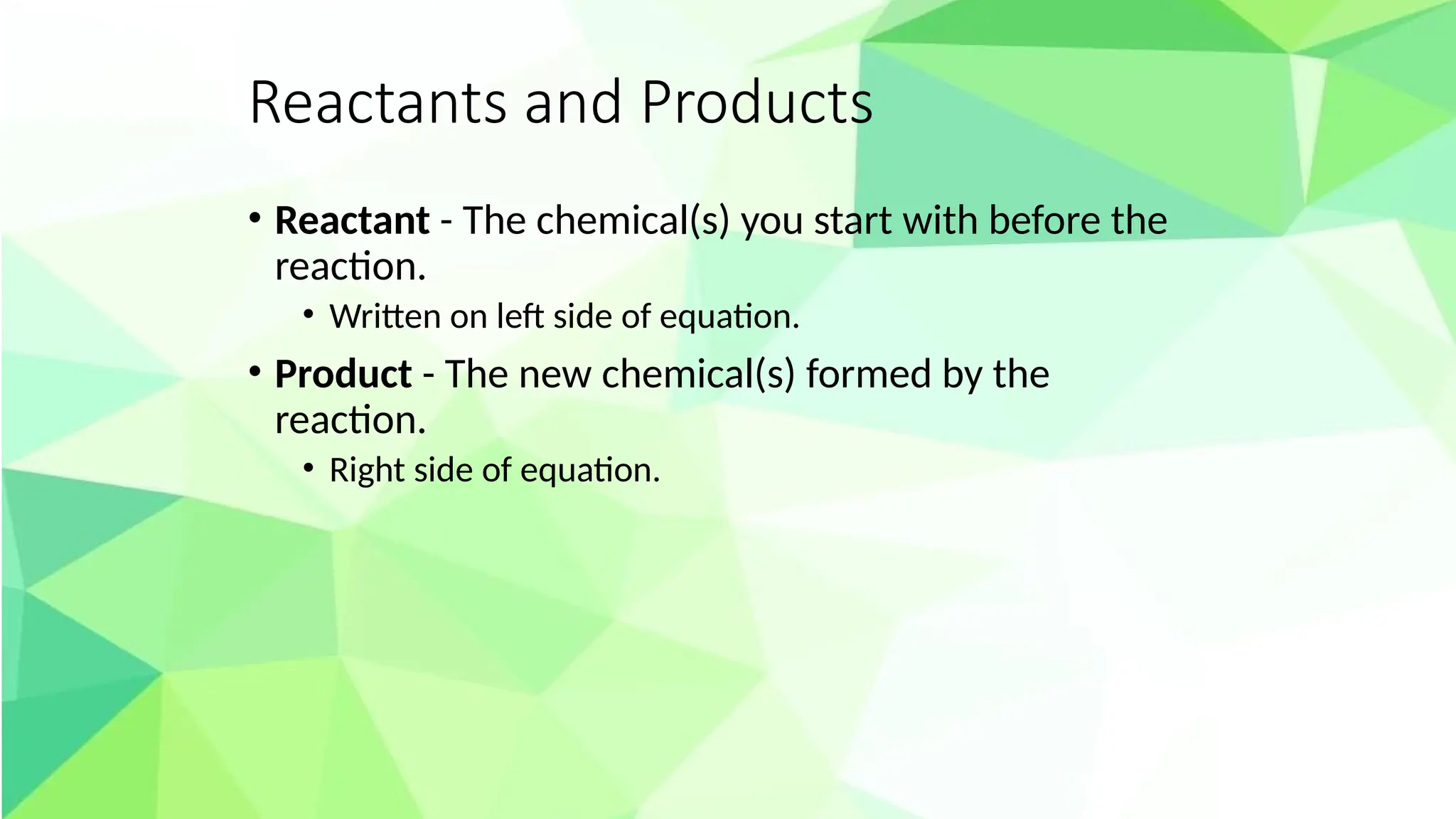
Reactants and Products
• Reactant - The chemical(s) you start with before the
reaction.
• Written on left side of equation.
• Product - The new chemical(s) formed by the
reaction.
• Right side of equation.
Subscripts and Coefficients
• Subscript - shows how many atoms of an element are
in a molecule.
• EX: H2
O
• 2 atoms of hydrogen (H)
• 1 atom of oxygen (O)
• Coefficient - shows how many molecules there are of
a particular chemical.
• EX: 3 H2
O
• Means there are 3 water molecules.
A Chemical Reaction
• 2H2
+ O2
 2H2
O
Law of Conservation of Mass
• In a chem. rxn, matter is neither created nor
destroyed.
• In other words, the number and type of atoms going INTO
a rxn must be the same as the number and type of atoms
coming OUT.
• If an equation obeys the Law of Conservation, it is
balanced.
An Unbalanced Equation
• CH4 + O2  CO2 + H2O
Reactant Side Product Side
1 carbon atom
4 hydrogen atoms
2 oxygen atoms
1 carbon atom
2 hydrogen atoms
3 oxygen atoms
A Balanced Equation
CH4
+ 2O2
 CO2
+ 2H2
O
Reactant Side Product Side
1 carbon atom
4 hydrogen atoms
4 oxygen atoms
1 carbon atom
4 hydrogen atoms
4 oxygen atoms
Rules of the Game
1. Matter cannot be created or destroyed.
2. Subscripts cannot be added, removed, or changed.
3. You can only change coefficients.
4. Coefficients can only go in front of chem.
formulas...NEVER in the middle of a formula.
A few extra tips:
Try balancing big formulas first; save free elements for last.
If the same polyatomic ion appears on both sides of the
equation, it’s usually okay to treat it as one unit.
There is no one particular way to balance equations. Some
equations are harder to balance than others and might require
some creativity to solve.
Balancing Equations
 Balance the following equation by adjusting
coefficients.
reactants products
N
H
N2
+ H2
 NH3
2
2
1
3
2
2
6
3
6
Balancing Equations
• Balance the following equation by adjusting
coefficients.
KClO3
 KCl + O2
reactants products
K
Cl
O
1
1
1
1
3 2
3
2
2
2
6 6
2
2
2
• Balance the following equation:
Activity: Balancing Equation
1.___ Mg + ___ Cl2  ___ MgCl2
2.___ Na + ___ Cl2  ___ NaCl
 What is the importance of
knowing how to balance
chemical equation?
 What are the different steps in
balancing equation?
 Why is balancing equation
important?
Activity: Balance the following equations
1.NO2→ O2+ N2
2. Pb(s) + FeSO4(aq) → PbSO4(s) + Fe
3. CaCO3→ CaO+ CO2
4. MgI2+ Mn(SO3)2→ MgSO3+ MnI4
5. AgNO3+ Cu→ Cu(NO3)2 + Ag
Through a poster present a chemical reaction involved in
biological and industrial processes affecting life and the
environment
Example: Photosynthesis
Use 1/8 size illustration board for the said activity
Thank you!
See you in the next
Lesson. . .

BALANCING CHEMICAL EQUATION SCIENCE GRADE 10