BALANCING
CHEMICAL
EQUATIONS
JORGE M. BICALDO JR.
SCIENCE 10 TEACHER
WHAT ARE THE DIFFERENT TYPES OF CHEMICAL
REACTION/S?
MOVING UP (OF MOLECULES)
The color of your toga hat will represent the color of CHO.
RED- Carbon
YELLOW- Oxygen
BLUE- Hydrogen
I will show you an example of chemical reaction. All you have to
do is recreate the given reaction in front of the class using the
color coded elements. First team to get 2 points wins this game.
OBJECTIVES
Apply the principles of conservation of mass
to chemical reactions (S10MT-IVe-g23)
a. Identify the rules in balancing equations
b. Balance chemical equation/s
CHEMICAL JORGE-ONS!
• Balanced chemical equations have the same number and type of each atom on both sides
of the equation.
• Coefficient: A number placed in front of a formula to balance a chemical equation
• Subscript a small-sized number on the bottom right of the symbol.
• Law of Conservation of Mass states that mass is conserved in a chemical reaction. The
total mass of the reactants is equal to the total mass of the products. No new atoms are
created or destroyed, there was only grouping or regrouping (rearrangement) of atoms.
BALANCING CHEMICAL EQUATION
Balancing chemical equations involves the addition of stoichiometric coefficients to
the reactants and products.
The ultimate goal for balancing chemical equations is to make both sides of the
reaction, the reactants and the products, equal in the number of atoms per element
A balanced chemical equation is one that conforms to the law of conservation of
matter.
Law of Conservation of Mass states that mass is conserved in a chemical reaction
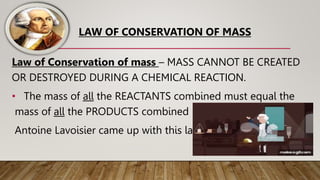
LAW OF CONSERVATION OF MASS
Law of Conservation of mass – MASS CANNOT BE CREATED
OR DESTROYED DURING A CHEMICAL REACTION.
• The mass of all the REACTANTS combined must equal the
mass of all the PRODUCTS combined
Antoine Lavoisier came up with this law
RULES IN BALANCING EQUATION
1. Write the formulas for the reactants (on the left) and
products (on the right) with an arrow in between. If there
are two or more reactants or products use the plus (+) sign
to separate their formulas. Write the chemical formulas in a
skeleton equation.
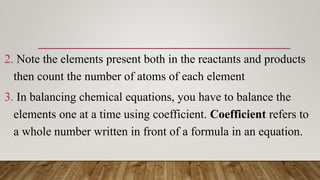
2. Note the elements present both in the reactants and products
then count the number of atoms of each element
3. In balancing chemical equations, you have to balance the
elements one at a time using coefficient. Coefficient refers to
a whole number written in front of a formula in an equation.
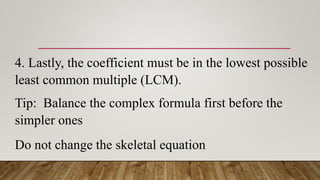
4. Lastly, the coefficient must be in the lowest possible
least common multiple (LCM).
Tip: Balance the complex formula first before the
simpler ones
Do not change the skeletal equation
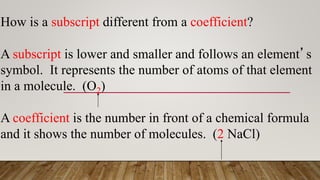
How is a subscript different from a coefficient?
A subscript is lower and smaller and follows an element’s
symbol. It represents the number of atoms of that element
in a molecule. (O2)
A coefficient is the number in front of a chemical formula
and it shows the number of molecules. (2 NaCl)
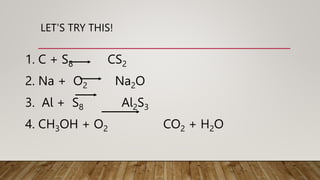
LET’S TRY THIS!
1. C + S8 CS2
2. Na + O2 Na2O
3. Al + S8 Al2S3
4. CH3OH + O2 CO2 + H2O
PHET SIMULATIONS
HTTPS://PHET.COLORADO.EDU/EN/ABOUT
https://phet.colorado.edu/sims/html/balancing-chemical-equations/latest/balancing-chemical-
equations_en.html?fbclid=IwAR3XyXF8WlXc-fWQUH5f5X9aDRJgE7BIVNBJns-6xDcxaWS5EWcNH7ukcvg
WHY DO WE NEED BALANCE IN LIFE?
YOU NEED BALANCE WHEN YOU ARE DANCING IN
YOUR MAPEH CLASS
YOU NEED BALANCE WHEN WRITING STRUCTURED
POEMS FOR ENGLISH AND FILIPINO
EVEN BALANCED IS VERY IMPORTANT
WHAT’S THE BEST METHOD IN BALANCING
EQUATIONS?
WHAT ARE THE RULES IN BALANCING
EQUATIONS?
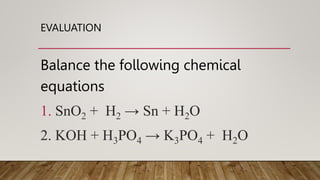
EVALUATION
Balance the following chemical
equations
1. SnO2 + H2 → Sn + H2O
2. KOH + H3PO4 → K3PO4 + H2O
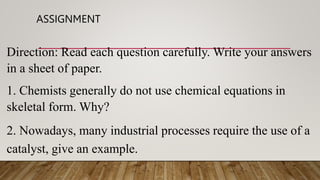
ASSIGNMENT
Direction: Read each question carefully. Write your answers
in a sheet of paper.
1. Chemists generally do not use chemical equations in
skeletal form. Why?
2. Nowadays, many industrial processes require the use of a
catalyst, give an example.
“I HOPE WE STRIKE A BALANCE BETWEEN THE THINGS
THAT ARE WITHIN OUR POWER TO CONTROL AND THE
THINGS THAT ARE OUT OF OUR CONTROL.”
-RM(BTS)

Balancing CHEMICAL EQUATIONS.pptx

  • 1.
  • 2.
    WHAT ARE THEDIFFERENT TYPES OF CHEMICAL REACTION/S?
  • 4.
    MOVING UP (OFMOLECULES) The color of your toga hat will represent the color of CHO. RED- Carbon YELLOW- Oxygen BLUE- Hydrogen I will show you an example of chemical reaction. All you have to do is recreate the given reaction in front of the class using the color coded elements. First team to get 2 points wins this game.
  • 5.
    OBJECTIVES Apply the principlesof conservation of mass to chemical reactions (S10MT-IVe-g23) a. Identify the rules in balancing equations b. Balance chemical equation/s
  • 6.
    CHEMICAL JORGE-ONS! • Balancedchemical equations have the same number and type of each atom on both sides of the equation. • Coefficient: A number placed in front of a formula to balance a chemical equation • Subscript a small-sized number on the bottom right of the symbol. • Law of Conservation of Mass states that mass is conserved in a chemical reaction. The total mass of the reactants is equal to the total mass of the products. No new atoms are created or destroyed, there was only grouping or regrouping (rearrangement) of atoms.
  • 7.
    BALANCING CHEMICAL EQUATION Balancingchemical equations involves the addition of stoichiometric coefficients to the reactants and products. The ultimate goal for balancing chemical equations is to make both sides of the reaction, the reactants and the products, equal in the number of atoms per element A balanced chemical equation is one that conforms to the law of conservation of matter. Law of Conservation of Mass states that mass is conserved in a chemical reaction
  • 8.
    LAW OF CONSERVATIONOF MASS Law of Conservation of mass – MASS CANNOT BE CREATED OR DESTROYED DURING A CHEMICAL REACTION. • The mass of all the REACTANTS combined must equal the mass of all the PRODUCTS combined Antoine Lavoisier came up with this law
  • 9.
    RULES IN BALANCINGEQUATION 1. Write the formulas for the reactants (on the left) and products (on the right) with an arrow in between. If there are two or more reactants or products use the plus (+) sign to separate their formulas. Write the chemical formulas in a skeleton equation.
  • 10.
    2. Note theelements present both in the reactants and products then count the number of atoms of each element 3. In balancing chemical equations, you have to balance the elements one at a time using coefficient. Coefficient refers to a whole number written in front of a formula in an equation.
  • 11.
    4. Lastly, thecoefficient must be in the lowest possible least common multiple (LCM). Tip: Balance the complex formula first before the simpler ones Do not change the skeletal equation
  • 12.
    How is asubscript different from a coefficient? A subscript is lower and smaller and follows an element’s symbol. It represents the number of atoms of that element in a molecule. (O2) A coefficient is the number in front of a chemical formula and it shows the number of molecules. (2 NaCl)
  • 13.
    LET’S TRY THIS! 1.C + S8 CS2 2. Na + O2 Na2O 3. Al + S8 Al2S3 4. CH3OH + O2 CO2 + H2O
  • 14.
  • 15.
    WHY DO WENEED BALANCE IN LIFE?
  • 16.
    YOU NEED BALANCEWHEN YOU ARE DANCING IN YOUR MAPEH CLASS
  • 17.
    YOU NEED BALANCEWHEN WRITING STRUCTURED POEMS FOR ENGLISH AND FILIPINO
  • 18.
    EVEN BALANCED ISVERY IMPORTANT
  • 19.
    WHAT’S THE BESTMETHOD IN BALANCING EQUATIONS? WHAT ARE THE RULES IN BALANCING EQUATIONS?
  • 20.
    EVALUATION Balance the followingchemical equations 1. SnO2 + H2 → Sn + H2O 2. KOH + H3PO4 → K3PO4 + H2O
  • 21.
    ASSIGNMENT Direction: Read eachquestion carefully. Write your answers in a sheet of paper. 1. Chemists generally do not use chemical equations in skeletal form. Why? 2. Nowadays, many industrial processes require the use of a catalyst, give an example.
  • 22.
    “I HOPE WESTRIKE A BALANCE BETWEEN THE THINGS THAT ARE WITHIN OUR POWER TO CONTROL AND THE THINGS THAT ARE OUT OF OUR CONTROL.” -RM(BTS)