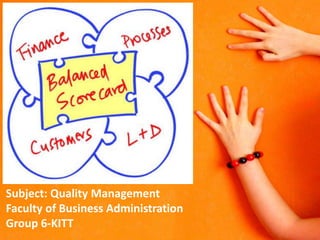
Subject: Quality Management
Faculty of Business Administration
Group 6-KITT
CONTENT
I.

Introduction

II. Purpose and Benefit
III. Philosophy

IV. The principle of application
V. The way for Applying

VI. Applicant for BSC in Vietnam
I. INTRODUCTION

 Who?
Robert S. Kaplan
David Norton

 When & Where?
Starting from 1990,
now is over the world.
I. INTRODUCTION
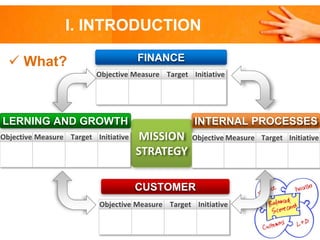
 What?

FINANCE
Objective Measure Target Initiative

LERNING AND GROWTH
Objective Measure Target Initiative

INTERNAL PROCESSES

MISSION
STRATEGY

Objective Measure Target Initiative

CUSTOMER
Objective Measure Target Initiative
I. INTRODUCTION
 Why?
“3 in 1” :
• One of the measuring performance system
• One of the communication tools (or communication)
• One of the managing method of The Effective Strategy
within the organization.

 How?
Individual: interpret and implement The Effective Strategy
in order to improving the performance and measuring the
working productivity.
Organization: improve treatment regimes poisoning,
allocate logically human resources.
II. PURPOSE AND BENEFITS
 Purpose
Building a scorecard system : Perspective, Objective,
Indicator, Target, Initiative of each person and each
department
=> carry out, measure and manage the implementation
of organizational strategy
II. PURPOSE AND BENEFITS
 Benefit
• Setting goals, targets appropriate with the general strategy of
the organization through the scorecard system
• Construction and adjustment actions of the organization by
the measurement results by Scorecard
• Expressing clearly, briefly strategy to all levels
information, promote a spirit of co-ordinates

=> share

• Overcoming the limitations of traditional methods: long cycles,
not specified the problem, allocate resources disproportionately,
only the short-term results
II. PURPOSE AND BENEFITS
 Benefit
• Solve four major hurdles in the strategy's implementation:
vision barriers, human barriers, resource barriers and
management barriers

• Accurately assess the results of each level => preferential
treatment policies, additional human resources
• Creating a scientific basis for the planning and development
of intangible: strategy training, development of business
knowledge, Optimize Value management elements of internal
processes
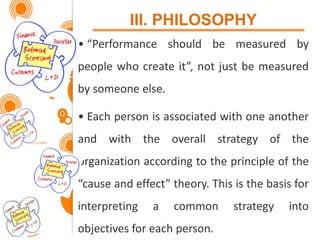
III. PHILOSOPHY
• “Performance should be measured by
people who create it”, not just be measured

by someone else.
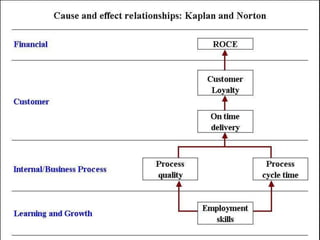
• Each person is associated with one another

and with the overall strategy of the
organization according to the principle of the
“cause and effect” theory. This is the basis for
interpreting

a

common

objectives for each person.

strategy

into
III. PHILOSOPHY
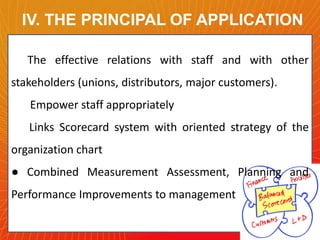
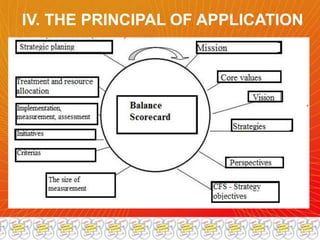
IV. THE PRINCIPAL OF APPLICATION
The effective relations with staff and with other
stakeholders (unions, distributors, major customers).
Empower staff appropriately
Links Scorecard system with oriented strategy of the
organization chart
● Combined Measurement Assessment, Planning and

Performance Improvements to management
IV. THE PRINCIPAL OF APPLICATION
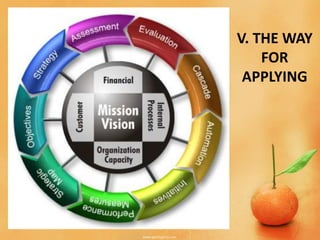
V. THE WAY
FOR
APPLYING
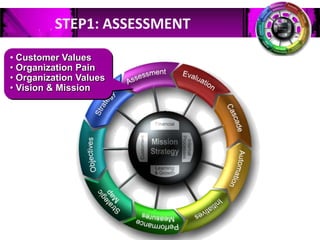
STEP1: ASSESSMENT
• Customer Values
• Organization Pain
• Organization Values
• Vision & Mission
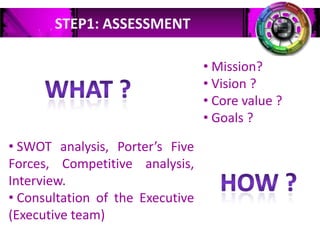
STEP1: ASSESSMENT
• Mission?
• Vision ?
• Core value ?
• Goals ?
• SWOT analysis, Porter’s Five
Forces, Competitive analysis,
Interview.
• Consultation of the Executive
(Executive team)
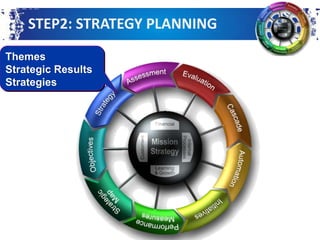
STEP2: STRATEGY PLANNING
Themes
Strategic Results
Strategies
STEP2: STRATEGY PLANNING

Platform strategies to implement mission and vision
of the company

• 3 to 5 medium-term strategies (2-4 years)
• Should be different from competitors. Ex: Effective
quality training, customer service, maintain a good
relationship with the Supplier,...
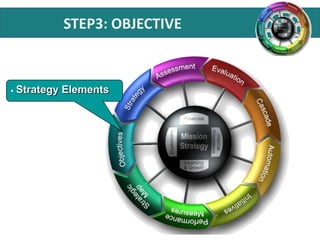
STEP3: OBJECTIVE

•

Strategy Elements
STEP3: OBJECTIVE
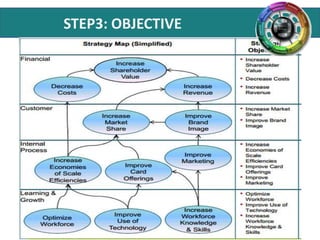
The objectives of the company to
implement the proposed
strategies
Each objective is reviewed base on
4 perspectives:
• Finance
• Customer
• Internal process
• Learn & Growth
STEP3: OBJECTIVE
STEP4: STARTEGY MAP

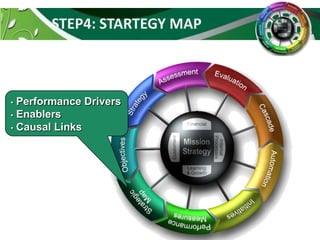
Performance Drivers
• Enablers
• Causal Links
•
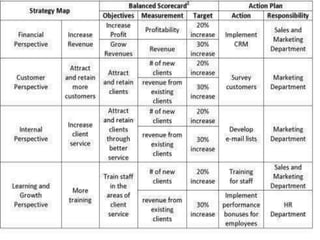
STEP4: STARTEGY MAP

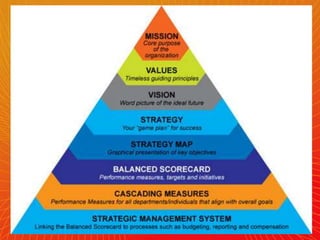
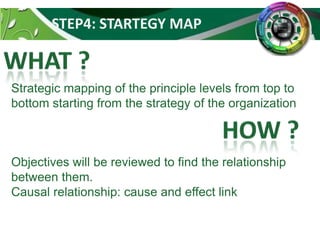
Strategic mapping of the principle levels from top to
bottom starting from the strategy of the organization

Objectives will be reviewed to find the relationship
between them.
Causal relationship: cause and effect link
STEP5: PERFORMANCE MEASURES

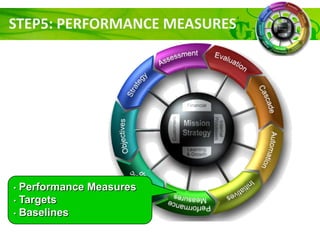
Performance Measures
• Targets
• Baselines
•
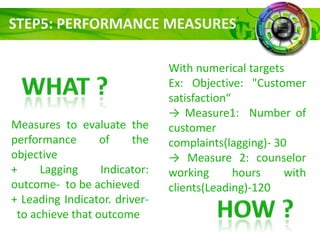
STEP5: PERFORMANCE MEASURES

Measures to evaluate the
performance
of
the
objective
+
Lagging
Indicator:
outcome- to be achieved
+ Leading Indicator. driverto achieve that outcome

With numerical targets
Ex: Objective: "Customer
satisfaction“
→ Measure1: Number of
customer
complaints(lagging)- 30
→ Measure 2: counselor
working
hours
with
clients(Leading)-120
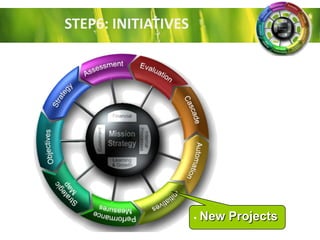
STEP6: INITIATIVES

•

New Projects
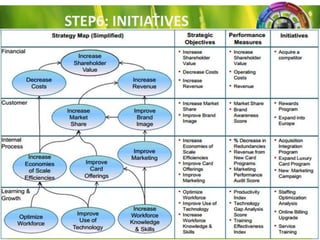
STEP6: INITIATIVES

- Defining initiatives to complete each objective
and measure
STEP7: AUTOMATION

Software
• Performance Reporting
• Knowledge Sharing
•
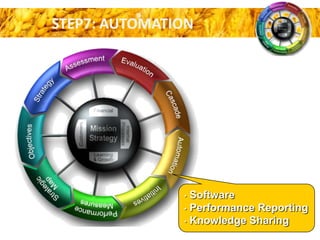
STEP7: AUTOMATION

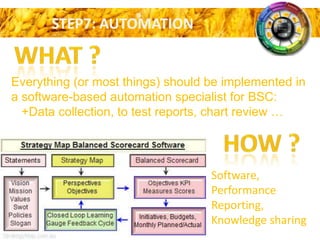
Everything (or most things) should be implemented in
a software-based automation specialist for BSC:
+Data collection, to test reports, chart review …

Software,
Performance
Reporting,
Knowledge sharing
CASCADE
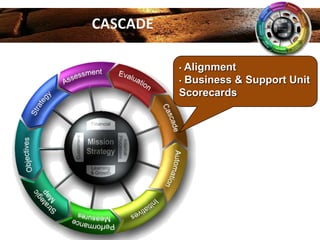
Alignment
• Business & Support Unit
Scorecards
•
CASCADE

Transferring content in the BSC Organization down to every
employee in the enterprise to construct:
+ BSC Department level--> BSC Unit Level--> BSC Personal
Level

Building a BSC at each level which suit, consistent with the
strategy map of that level
EVALUATION
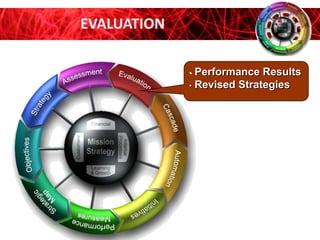
Performance Results
• Revised Strategies
•
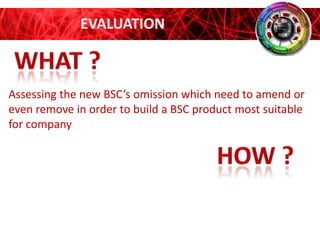
EVALUATION

Assessing the new BSC’s omission which need to amend or
even remove in order to build a BSC product most suitable
for company
•

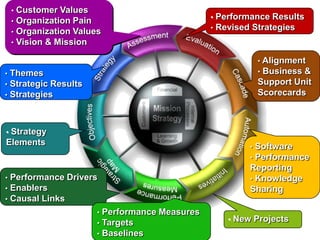
Customer Values
• Organization Pain
• Organization Values
• Vision & Mission

•

Performance Results
• Revised Strategies

• Alignment
•

Business &
Support Unit
Scorecards

•

Themes
• Strategic Results
• Strategies

•

Strategy
Elements

•

Software
• Performance
Reporting
• Knowledge
Sharing

•

Performance Drivers
• Enablers
• Causal Links
•

Performance Measures
• Targets
• Baselines

•

New Projects
V. APPLICATION OF BSC IN VIETNAM
V. APPLICATION OF BSC IN
VIETNAM
INTRODUCTION
Vision
“For a more beautiful and healthier life”

Mission
“DHG Pharma always provides high quality products and
services to satisfy the aspiration for a more beautiful and
healthier life.”
V. APPLICATION OF BSC IN
VIETNAM
INTRODUCTION
Importance milestones:
-1996: The first year that DHG Pharma’s products was elected
as “Vietnam High Quality Goods”, the factories complied with
the GMP standard, being the leader of Vietnam
pharmaceutical industry until now.
- 2004: Equitization
- 2006: “DHG” being listed on HOSE
V. APPLICATION OF BSC IN VIETNAM

THE APPLICATION OF BSC
IN DHG PHARMA
THE APPLICATION OF BSC
Economic situation:
The financial crisis in 2008

• Input materials for pharmaceutical production,
largely due to imports
• Exchange rate fluctuation
THE APPLICATION OF BSC

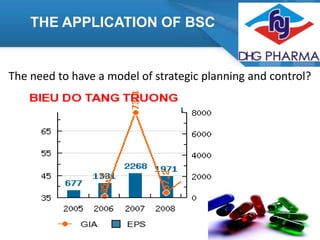
The need to have a model of strategic planning and control?
THE APPLICATION OF BSC
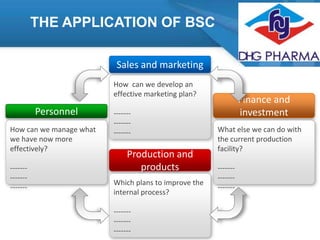
Sales and marketing
How can we develop an
effective marketing plan?

Personnel
How can we manage what
we have now more
effectively?
-------------------

-------------------

Production and
products
Which plans to improve the
internal process?
-------------------

Finance and
investment
What else we can do with
the current production
facility?
-------------------
THE APPLICATION OF BSC

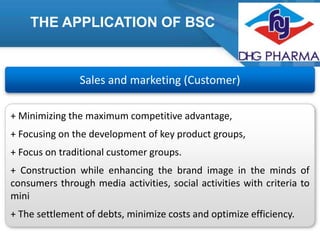
Sales and marketing (Customer)
+ Minimizing the maximum competitive advantage,
+ Focusing on the development of key product groups,
+ Focus on traditional customer groups.
+ Construction while enhancing the brand image in the minds of
consumers through media activities, social activities with criteria to
mini
+ The settlement of debts, minimize costs and optimize efficiency.
THE APPLICATION OF BSC

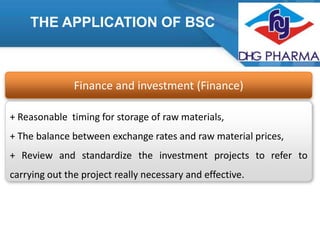
Finance and investment (Finance)
+ Reasonable timing for storage of raw materials,
+ The balance between exchange rates and raw material prices,
+ Review and standardize the investment projects to refer to
carrying out the project really necessary and effective.
THE APPLICATION OF BSC

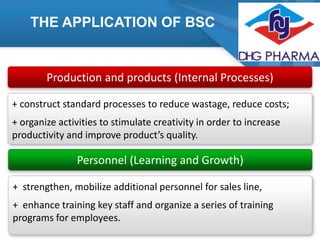
Production and products (Internal Processes)
+ construct standard processes to reduce wastage, reduce costs;

+ organize activities to stimulate creativity in order to increase
productivity and improve product’s quality.

Personnel (Learning and Growth)
+ strengthen, mobilize additional personnel for sales line,
+ enhance training key staff and organize a series of training
programs for employees.
THE APPLICATION OF BSC
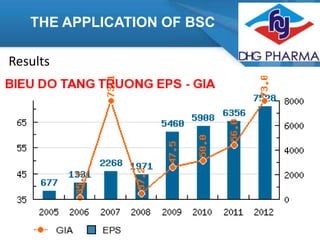
Results
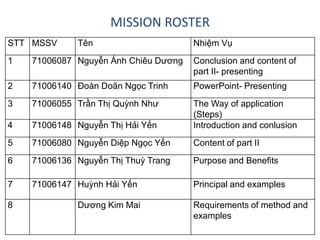
MISSION ROSTER
STT MSSV

Tên

Nhiệm Vụ

1

71006087 Nguyễn Ánh Chiêu Dương

Conclusion and content of
part II- presenting

2

71006140 Đoàn Doãn Ngọc Trinh

PowerPoint- Presenting

3

71006055 Trần Thị Quỳnh Như

4

71006148 Nguyễn Thị Hải Yến

The Way of application
(Steps)
Introduction and conlusion

5

71006080 Nguyễn Diệp Ngọc Yến

Content of part II

6

71006136 Nguyễn Thị Thuỳ Trang

Purpose and Benefits

7

71006147 Huỳnh Hải Yến

Principal and examples

8

Dương Kim Mai

Requirements of method and
examples

Balanced score card

  • 1.
    Subject: Quality Management Facultyof Business Administration Group 6-KITT
  • 2.
    CONTENT I. Introduction II. Purpose andBenefit III. Philosophy IV. The principle of application V. The way for Applying VI. Applicant for BSC in Vietnam
  • 3.
    I. INTRODUCTION  Who? RobertS. Kaplan David Norton  When & Where? Starting from 1990, now is over the world.
  • 4.
    I. INTRODUCTION  What? FINANCE ObjectiveMeasure Target Initiative LERNING AND GROWTH Objective Measure Target Initiative INTERNAL PROCESSES MISSION STRATEGY Objective Measure Target Initiative CUSTOMER Objective Measure Target Initiative
  • 5.
    I. INTRODUCTION  Why? “3in 1” : • One of the measuring performance system • One of the communication tools (or communication) • One of the managing method of The Effective Strategy within the organization.  How? Individual: interpret and implement The Effective Strategy in order to improving the performance and measuring the working productivity. Organization: improve treatment regimes poisoning, allocate logically human resources.
  • 6.
    II. PURPOSE ANDBENEFITS  Purpose Building a scorecard system : Perspective, Objective, Indicator, Target, Initiative of each person and each department => carry out, measure and manage the implementation of organizational strategy
  • 7.
    II. PURPOSE ANDBENEFITS  Benefit • Setting goals, targets appropriate with the general strategy of the organization through the scorecard system • Construction and adjustment actions of the organization by the measurement results by Scorecard • Expressing clearly, briefly strategy to all levels information, promote a spirit of co-ordinates => share • Overcoming the limitations of traditional methods: long cycles, not specified the problem, allocate resources disproportionately, only the short-term results
  • 8.
    II. PURPOSE ANDBENEFITS  Benefit • Solve four major hurdles in the strategy's implementation: vision barriers, human barriers, resource barriers and management barriers • Accurately assess the results of each level => preferential treatment policies, additional human resources • Creating a scientific basis for the planning and development of intangible: strategy training, development of business knowledge, Optimize Value management elements of internal processes
  • 9.
    III. PHILOSOPHY • “Performanceshould be measured by people who create it”, not just be measured by someone else. • Each person is associated with one another and with the overall strategy of the organization according to the principle of the “cause and effect” theory. This is the basis for interpreting a common objectives for each person. strategy into
  • 10.
  • 11.
    IV. THE PRINCIPALOF APPLICATION The effective relations with staff and with other stakeholders (unions, distributors, major customers). Empower staff appropriately Links Scorecard system with oriented strategy of the organization chart ● Combined Measurement Assessment, Planning and Performance Improvements to management
  • 13.
    IV. THE PRINCIPALOF APPLICATION
  • 14.
  • 15.
    STEP1: ASSESSMENT • CustomerValues • Organization Pain • Organization Values • Vision & Mission
  • 16.
    STEP1: ASSESSMENT • Mission? •Vision ? • Core value ? • Goals ? • SWOT analysis, Porter’s Five Forces, Competitive analysis, Interview. • Consultation of the Executive (Executive team)
  • 17.
  • 18.
    STEP2: STRATEGY PLANNING Platformstrategies to implement mission and vision of the company • 3 to 5 medium-term strategies (2-4 years) • Should be different from competitors. Ex: Effective quality training, customer service, maintain a good relationship with the Supplier,...
  • 19.
  • 20.
    STEP3: OBJECTIVE The objectivesof the company to implement the proposed strategies Each objective is reviewed base on 4 perspectives: • Finance • Customer • Internal process • Learn & Growth
  • 21.
  • 22.
    STEP4: STARTEGY MAP PerformanceDrivers • Enablers • Causal Links •
  • 23.
    STEP4: STARTEGY MAP Strategicmapping of the principle levels from top to bottom starting from the strategy of the organization Objectives will be reviewed to find the relationship between them. Causal relationship: cause and effect link
  • 24.
    STEP5: PERFORMANCE MEASURES PerformanceMeasures • Targets • Baselines •
  • 25.
    STEP5: PERFORMANCE MEASURES Measuresto evaluate the performance of the objective + Lagging Indicator: outcome- to be achieved + Leading Indicator. driverto achieve that outcome With numerical targets Ex: Objective: "Customer satisfaction“ → Measure1: Number of customer complaints(lagging)- 30 → Measure 2: counselor working hours with clients(Leading)-120
  • 26.
  • 27.
    STEP6: INITIATIVES - Defininginitiatives to complete each objective and measure
  • 28.
    STEP7: AUTOMATION Software • PerformanceReporting • Knowledge Sharing •
  • 29.
    STEP7: AUTOMATION Everything (ormost things) should be implemented in a software-based automation specialist for BSC: +Data collection, to test reports, chart review … Software, Performance Reporting, Knowledge sharing
  • 30.
    CASCADE Alignment • Business &Support Unit Scorecards •
  • 31.
    CASCADE Transferring content inthe BSC Organization down to every employee in the enterprise to construct: + BSC Department level--> BSC Unit Level--> BSC Personal Level Building a BSC at each level which suit, consistent with the strategy map of that level
  • 32.
  • 33.
    EVALUATION Assessing the newBSC’s omission which need to amend or even remove in order to build a BSC product most suitable for company
  • 34.
    • Customer Values • OrganizationPain • Organization Values • Vision & Mission • Performance Results • Revised Strategies • Alignment • Business & Support Unit Scorecards • Themes • Strategic Results • Strategies • Strategy Elements • Software • Performance Reporting • Knowledge Sharing • Performance Drivers • Enablers • Causal Links • Performance Measures • Targets • Baselines • New Projects
  • 36.
    V. APPLICATION OFBSC IN VIETNAM
  • 37.
    V. APPLICATION OFBSC IN VIETNAM INTRODUCTION Vision “For a more beautiful and healthier life” Mission “DHG Pharma always provides high quality products and services to satisfy the aspiration for a more beautiful and healthier life.”
  • 38.
    V. APPLICATION OFBSC IN VIETNAM INTRODUCTION Importance milestones: -1996: The first year that DHG Pharma’s products was elected as “Vietnam High Quality Goods”, the factories complied with the GMP standard, being the leader of Vietnam pharmaceutical industry until now. - 2004: Equitization - 2006: “DHG” being listed on HOSE
  • 39.
    V. APPLICATION OFBSC IN VIETNAM THE APPLICATION OF BSC IN DHG PHARMA
  • 40.
    THE APPLICATION OFBSC Economic situation: The financial crisis in 2008 • Input materials for pharmaceutical production, largely due to imports • Exchange rate fluctuation
  • 41.
    THE APPLICATION OFBSC The need to have a model of strategic planning and control?
  • 42.
    THE APPLICATION OFBSC Sales and marketing How can we develop an effective marketing plan? Personnel How can we manage what we have now more effectively? ------------------- ------------------- Production and products Which plans to improve the internal process? ------------------- Finance and investment What else we can do with the current production facility? -------------------
  • 43.
    THE APPLICATION OFBSC Sales and marketing (Customer) + Minimizing the maximum competitive advantage, + Focusing on the development of key product groups, + Focus on traditional customer groups. + Construction while enhancing the brand image in the minds of consumers through media activities, social activities with criteria to mini + The settlement of debts, minimize costs and optimize efficiency.
  • 44.
    THE APPLICATION OFBSC Finance and investment (Finance) + Reasonable timing for storage of raw materials, + The balance between exchange rates and raw material prices, + Review and standardize the investment projects to refer to carrying out the project really necessary and effective.
  • 45.
    THE APPLICATION OFBSC Production and products (Internal Processes) + construct standard processes to reduce wastage, reduce costs; + organize activities to stimulate creativity in order to increase productivity and improve product’s quality. Personnel (Learning and Growth) + strengthen, mobilize additional personnel for sales line, + enhance training key staff and organize a series of training programs for employees.
  • 46.
    THE APPLICATION OFBSC Results
  • 48.
    MISSION ROSTER STT MSSV Tên NhiệmVụ 1 71006087 Nguyễn Ánh Chiêu Dương Conclusion and content of part II- presenting 2 71006140 Đoàn Doãn Ngọc Trinh PowerPoint- Presenting 3 71006055 Trần Thị Quỳnh Như 4 71006148 Nguyễn Thị Hải Yến The Way of application (Steps) Introduction and conlusion 5 71006080 Nguyễn Diệp Ngọc Yến Content of part II 6 71006136 Nguyễn Thị Thuỳ Trang Purpose and Benefits 7 71006147 Huỳnh Hải Yến Principal and examples 8 Dương Kim Mai Requirements of method and examples