
Work Load Analysis 
Liliana Hartono 
Agus Rudianto
productivity 
• definition 
• attribute
definition of productivity 
the quality, state, or fact of being able to generate, create, 
enhance, or bring forth goods and services – dictionary.com 
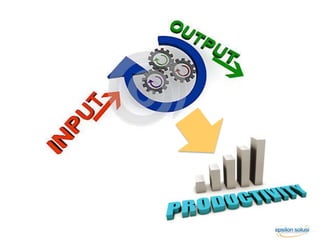
a measure of the efficiency of person, machine, factory, 
system in converting inputs into useful output – business 
dictionary 
Get everything’s done faster, better and more with 
resourceful inputs – free interpretation from all business 
owner after reading Larry Bossidy’s book
more about productivity 
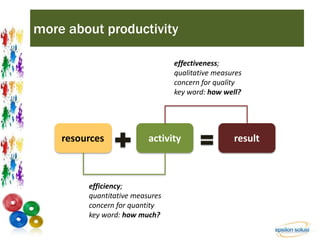
resources activity result 
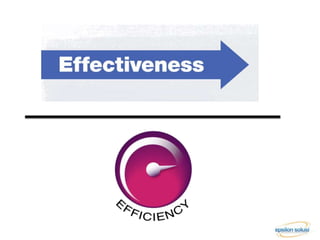
efficiency; 
quantitative measures 
concern for quantity 
key word: how much? 
effectiveness; 
qualitative measures 
concern for quality 
key word: how well?
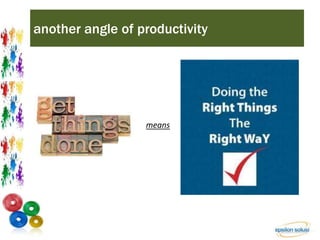
another angle of productivity 
means
eventually… 
Productivity in business means effective process 
using efficient resources to get the desired result. 
Operationally productive means having 
productive process (come from effective and 
efficient process) driven by productive people 
(come from effective and efficient people).
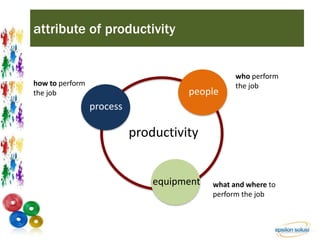
attribute of productivity 
people 
productivity 
process 
equipment 
who perform 
how to perform the job 
the job 
what and where to 
perform the job
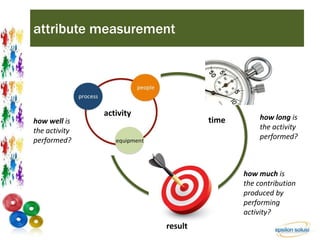
attribute measurement 
time 
result 
activity 
how well is 
the activity 
performed? 
how long is 
the activity 
performed? 
how much is 
the contribution 
produced by 
performing 
activity?
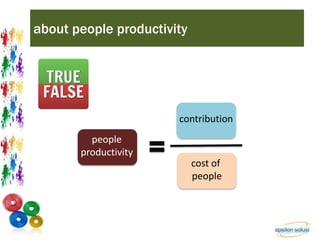
about people productivity 
people 
productivity 
contribution 
cost of 
people
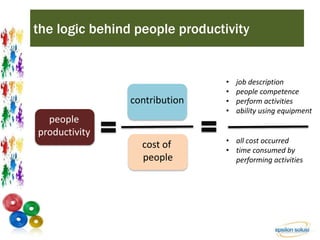
the logic behind people productivity 
people 
productivity 
contribution 
cost of 
people 
• job description 
• people competence 
• perform activities 
• ability using equipment 
• all cost occurred 
• time consumed by 
performing activities
another implication 
using first equation most of the time make you go to cost 
efficiency rather then cost effectiveness. 
you intent to reduce the input rather than optimize the 
process and maximize the result 
using the expanded equation gives you more space to 
elaborate before you determine which portion to be 
improved or reduce.
exercise 1 
we are Pizza restaurant focus on home delivery. 
some data: 
• average revenue from each store IDR 100,000,000/month 
• selling product : pizza, salad, soft drink 
• term of payment : COD and Credit Card 
• salary for staff : IDR 2,400,000 
• salary for supervisor : IDR 5,000,000 
• salary for manager : IDR 8,000,000 
we are now planning to open new store. 
help us to determine number of people and which position 
for our store
work load analysis 
• models 
• tools
what is work load analysis? 
work load; 
1. the amount of work assigned to or expected from a 
worker in a specified time period 
2. the amount of work that a machine produces or can 
produce in a specified time period. 
work load analysis; 
a tool used to predict and plan future work and skill 
requirements based on historical performance to set the 
baseline for specific job.
what kind of job to be analyzed? 
Any job that has : 
• clear target measurement 
• clear process 
• clear activities 
• clear the owner 
can be analyzed the work load
work load analysis method 
There are 2 basic methodology for work load analysis 
• time based method 
• activity based method 
time base method commonly used for any job required 
for time precision. 
activity based method commonly used for any job 
required quality of the result.
time based method 
measurement required: 
• on time 
• lead time 
the implication will be: 
• reducing time consumed 
• additional resources
activity based method 
measurement required: 
• quality of the result 
• quantity of the result 
the implication will be: 
• improvement of the resources capabilities 
• improvement of the process
exercise 2 
customer care department 
you have 2 customer care staff, 1 supervisor in your customer care 
department. 
average number of complaint received is 100 complaint/day 
customer care working hours is 8 hours/day. 
the response target for customer complaint is 24 hours after receiving 
information. 
If you want to analyze customer care department work load, 
• what data you will need more using time based or activity based 
method? 
• what is your potential recommendation based on data above?
work load analysis tools 
• lead time analysis 
• job weight analysis 
• full time equivalent (FTE) analysis
lead time analysis 
lead time analysis is one of the time based methodology 
work load analysis. 
it is a tool to measure time consumed of each activity 
and set the effective time for the specific activity 
application: 
• response time 
• production time 
• delivery time 
one of the favorite tool is CPM (critical path method)
CPM 
CPM is an algorithm for scheduling a set of project activities. 
CPM is using a step-by-step technique for process planning 
that defines critical and non-critical tasks with the goal of 
preventing time-frame problems and process bottlenecks. 
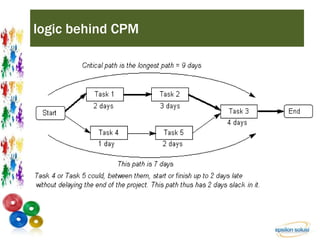
• define the duration of each activity. 
• identify all the paths. 
• calculate the duration of each path. 
• identify the longest path.
logic behind CPM
job weight analysis 
objective: 
• to measure job load compare to individual work load 
• to measure resources need to perform the job 
• to determine man power ratio to activities based on 
work load standard
Job weight – definitions 
• work load is any impact derived from any activities of 
work 
• job load is any impact derived from performing job 
description 
• individual work load is accumulation impact derived from 
performing job, additional task and other activities 
• structured activities is any activity that can be measured 
• unstructured activities is any activity that hard to be 
measured 
• standard of working time is standard working hours 
applied in Indonesia ( 5 days, 8 hours/day (+ 1 hour rest)
job weight – how to do 
• Define the primary task, additional task (if any) and other 
activities (allowance) 
• Describe primary task, additional task and allowance in detail 
activities that can be observed and measured 
• Defined measurement number (N) for every activities above 
• Measure the job load: 
total primary task – allowance 
8 hours – allowance 
• Measure the individual work load 
total primary task + additional + others – allowance 
8 hours – allowance 
• Compare the job load and individual work load to get standard 
ideal job work load
full time equivalent 
• Definition & Objective of 
WLA - FTE 
• FTE Concept Understanding: 
• FTE Project Implementation
definition 
• Work Load Analysis 
Workload analysis is a methodology to determine the time, effort, and 
resources necessary to carry out the department’s operations 
• Manpower Planning 
Estimating or projecting the number of personnel with different skill 
required over time or for a project, and detailing how and when they 
will be acquired. 
• FTE (Full Time Equivalent) 
The total number of person needed to do all transactions of one 
process in certain period. 
The linkage amongst Work Load Analysis, Manpower Planning and FTE 
is having the same object which is dealing with the number of 
Personnel
objectives 
For supporting company to *operate effectively and efficiently, we need 
to know the productivity level of our Personnel through specific 
**observation & measurement, so that we have a firm foundation in 
setting the appropriate quantity of Personnel needed in our business. 
• Shortages & surpluses can be identified 
• Manpower can be utilized properly 
• Reduce labor cost and over staffing can be avoided 
• The demand for employees can be forecasted 
• Training becomes effective * 
• To have a norm/basis to determine the number of Personnel based on 
Workload. 
• To highlight and analyze productivity issues/problems occured in Work 
Unit. 
• To recommend some improvements (corrective action and 
standardization) to achieve efficient & effective business operations **
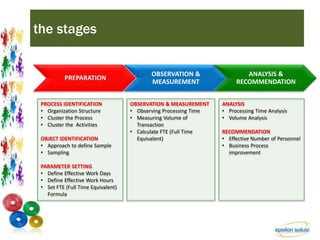
the stages 
PROCESS IDENTIFICATION 
• Organization Structure 
• Cluster the Process 
• Cluster the Activities 
OBJECT IDENTIFICATION 
• Approach to define Sample 
• Sampling 
PARAMETER SETTING 
• Define Effective Work Days 
• Define Effective Work Hours 
• Set FTE (Full Time Equivalent) 
Formula 
OBSERVATION & MEASUREMENT 
• Observing Processing Time 
• Measuring Volume of 
Transaction 
• Calculate FTE (Full Time 
Equivalent) 
ANALYSIS 
• Processing Time Analysis 
• Volume Analysis 
RECOMMENDATION 
• Effective Number of Personnel 
• Business Process 
improvement 
PREPARATION 
OBSERVATION & 
MEASUREMENT 
ANALYSIS & 
RECOMMENDATION
Work load analysis

Work load analysis

  • 1.
    Work Load Analysis Liliana Hartono Agus Rudianto
  • 2.
  • 3.
    definition of productivity the quality, state, or fact of being able to generate, create, enhance, or bring forth goods and services – dictionary.com a measure of the efficiency of person, machine, factory, system in converting inputs into useful output – business dictionary Get everything’s done faster, better and more with resourceful inputs – free interpretation from all business owner after reading Larry Bossidy’s book
  • 6.
    more about productivity resources activity result efficiency; quantitative measures concern for quantity key word: how much? effectiveness; qualitative measures concern for quality key word: how well?
  • 7.
    another angle ofproductivity means
  • 8.
    eventually… Productivity inbusiness means effective process using efficient resources to get the desired result. Operationally productive means having productive process (come from effective and efficient process) driven by productive people (come from effective and efficient people).
  • 9.
    attribute of productivity people productivity process equipment who perform how to perform the job the job what and where to perform the job
  • 10.
    attribute measurement time result activity how well is the activity performed? how long is the activity performed? how much is the contribution produced by performing activity?
  • 11.
    about people productivity people productivity contribution cost of people
  • 12.
    the logic behindpeople productivity people productivity contribution cost of people • job description • people competence • perform activities • ability using equipment • all cost occurred • time consumed by performing activities
  • 13.
    another implication usingfirst equation most of the time make you go to cost efficiency rather then cost effectiveness. you intent to reduce the input rather than optimize the process and maximize the result using the expanded equation gives you more space to elaborate before you determine which portion to be improved or reduce.
  • 14.
    exercise 1 weare Pizza restaurant focus on home delivery. some data: • average revenue from each store IDR 100,000,000/month • selling product : pizza, salad, soft drink • term of payment : COD and Credit Card • salary for staff : IDR 2,400,000 • salary for supervisor : IDR 5,000,000 • salary for manager : IDR 8,000,000 we are now planning to open new store. help us to determine number of people and which position for our store
  • 15.
    work load analysis • models • tools
  • 17.
    what is workload analysis? work load; 1. the amount of work assigned to or expected from a worker in a specified time period 2. the amount of work that a machine produces or can produce in a specified time period. work load analysis; a tool used to predict and plan future work and skill requirements based on historical performance to set the baseline for specific job.
  • 18.
    what kind ofjob to be analyzed? Any job that has : • clear target measurement • clear process • clear activities • clear the owner can be analyzed the work load
  • 19.
    work load analysismethod There are 2 basic methodology for work load analysis • time based method • activity based method time base method commonly used for any job required for time precision. activity based method commonly used for any job required quality of the result.
  • 20.
    time based method measurement required: • on time • lead time the implication will be: • reducing time consumed • additional resources
  • 21.
    activity based method measurement required: • quality of the result • quantity of the result the implication will be: • improvement of the resources capabilities • improvement of the process
  • 22.
    exercise 2 customercare department you have 2 customer care staff, 1 supervisor in your customer care department. average number of complaint received is 100 complaint/day customer care working hours is 8 hours/day. the response target for customer complaint is 24 hours after receiving information. If you want to analyze customer care department work load, • what data you will need more using time based or activity based method? • what is your potential recommendation based on data above?
  • 23.
    work load analysistools • lead time analysis • job weight analysis • full time equivalent (FTE) analysis
  • 24.
    lead time analysis lead time analysis is one of the time based methodology work load analysis. it is a tool to measure time consumed of each activity and set the effective time for the specific activity application: • response time • production time • delivery time one of the favorite tool is CPM (critical path method)
  • 25.
    CPM CPM isan algorithm for scheduling a set of project activities. CPM is using a step-by-step technique for process planning that defines critical and non-critical tasks with the goal of preventing time-frame problems and process bottlenecks. • define the duration of each activity. • identify all the paths. • calculate the duration of each path. • identify the longest path.
  • 26.
  • 27.
    job weight analysis objective: • to measure job load compare to individual work load • to measure resources need to perform the job • to determine man power ratio to activities based on work load standard
  • 28.
    Job weight –definitions • work load is any impact derived from any activities of work • job load is any impact derived from performing job description • individual work load is accumulation impact derived from performing job, additional task and other activities • structured activities is any activity that can be measured • unstructured activities is any activity that hard to be measured • standard of working time is standard working hours applied in Indonesia ( 5 days, 8 hours/day (+ 1 hour rest)
  • 29.
    job weight –how to do • Define the primary task, additional task (if any) and other activities (allowance) • Describe primary task, additional task and allowance in detail activities that can be observed and measured • Defined measurement number (N) for every activities above • Measure the job load: total primary task – allowance 8 hours – allowance • Measure the individual work load total primary task + additional + others – allowance 8 hours – allowance • Compare the job load and individual work load to get standard ideal job work load
  • 30.
    full time equivalent • Definition & Objective of WLA - FTE • FTE Concept Understanding: • FTE Project Implementation
  • 31.
    definition • WorkLoad Analysis Workload analysis is a methodology to determine the time, effort, and resources necessary to carry out the department’s operations • Manpower Planning Estimating or projecting the number of personnel with different skill required over time or for a project, and detailing how and when they will be acquired. • FTE (Full Time Equivalent) The total number of person needed to do all transactions of one process in certain period. The linkage amongst Work Load Analysis, Manpower Planning and FTE is having the same object which is dealing with the number of Personnel
  • 32.
    objectives For supportingcompany to *operate effectively and efficiently, we need to know the productivity level of our Personnel through specific **observation & measurement, so that we have a firm foundation in setting the appropriate quantity of Personnel needed in our business. • Shortages & surpluses can be identified • Manpower can be utilized properly • Reduce labor cost and over staffing can be avoided • The demand for employees can be forecasted • Training becomes effective * • To have a norm/basis to determine the number of Personnel based on Workload. • To highlight and analyze productivity issues/problems occured in Work Unit. • To recommend some improvements (corrective action and standardization) to achieve efficient & effective business operations **
  • 33.
    the stages PROCESSIDENTIFICATION • Organization Structure • Cluster the Process • Cluster the Activities OBJECT IDENTIFICATION • Approach to define Sample • Sampling PARAMETER SETTING • Define Effective Work Days • Define Effective Work Hours • Set FTE (Full Time Equivalent) Formula OBSERVATION & MEASUREMENT • Observing Processing Time • Measuring Volume of Transaction • Calculate FTE (Full Time Equivalent) ANALYSIS • Processing Time Analysis • Volume Analysis RECOMMENDATION • Effective Number of Personnel • Business Process improvement PREPARATION OBSERVATION & MEASUREMENT ANALYSIS & RECOMMENDATION