Total diet ration balancing
software for dairy cows
Presenters:
Frida N. Thuita
Julius C. Kosgei
SNV-3R Forage Seminar
Azure Hotel, Nairobi
28th August 2019
What can Rumen8 do?
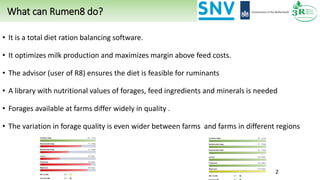
• It is a total diet ration balancing software.
• It optimizes milk production and maximizes margin above feed costs.
• The advisor (user of R8) ensures the diet is feasible for ruminants
• A library with nutritional values of forages, feed ingredients and minerals is needed
• Forages available at farms differ widely in quality .
• The variation in forage quality is even wider between farms and farms in different regions
2
Feed library
• The importance of ‘Kenyanization’
• Different forage species are used on Kenyan farms
• Most tropical forages have - high Neutral Detergent Fibre content
- low digestibility
- low protein content
• Within Kenya - Different Agro Ecological Zones
• Effect of agronomical practices on the nutrient content of forages
• Agro – Industrial by-products which are unique in countries with tropical climate
3
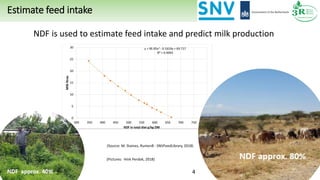
Feed intake based on NDF
DMI driver, e.g. NDF 1.3% of LW
NDF is used to estimate feed intake and predict milk production
Estimate feed intake
(Source: M. Staines, Rumen8 - SNVFeedLibrary, 2018)
4
(Pictures: Hink Perdok, 2018)
Approach
• Developing of feed library for tropical forages
• Pilot on 30 dairy farms (Medium and Large-Scale)
• Monthly farm visits and meetings with each farmer
• Farm walk: farmer and advisors observe cows, feeds, forage, terrain, farm records etc.
• Starting point are the feeds the farmer had available.
• Through coaching gradual changes in the rations and feeding practices were introduced
• Key farm data are important in ration development and balancing
5
Key farm data
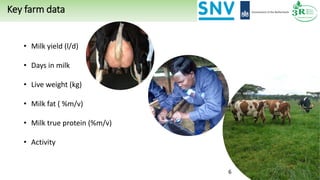
• Milk yield (l/d)
• Days in milk
• Live weight (kg)
• Milk fat ( %m/v)
• Milk true protein (%m/v)
• Activity
6
Role of forages in dairy cow rations
• Forage is the main ingredient in ruminant diets
• Agronomic management practices of forage crops influence quality, yield per hectare, increased
feed intake and milk yield
• Feed intake (DMI) is influenced by the DM content and nutrient content in the forage crops
• Continuously improving the forage quality results in increased feed intake and reduced feed cost
per liter of milk
• Single forages are imbalanced feeds, combination of forages or other feed ingredients can
balance the ration
• When producing forage crops monitor production of DM, ME and CP per hectare
7
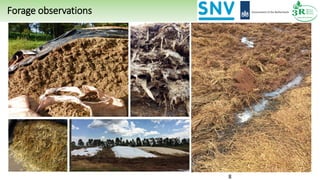
Forage observations
8
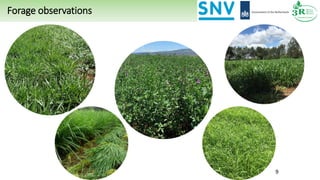
Forage observations
9
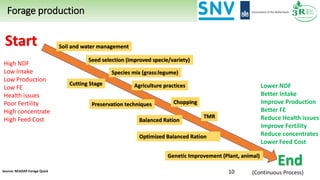
Forage production
Start
End
High NDF
Low Intake
Low Production
Low FE
Health issues
Poor Fertility
High concentrate
High Feed Cost
Lower NDF
Better Intake
Improve Production
Better FE
Reduce Health issues
Improve Fertility
Reduce concentrates
Lower Feed Cost
Soil and water management
Preservation techniques
Agriculture practicesCutting Stage
TMR
Chopping
Balanced Ration
Seed selection (improved specie/variety)
Optimized Balanced Ration
Genetic Improvement (Plant, animal)
(Continuous Process)
Species mix (grass:legume)
Source: NEADAP Forage Quick 10
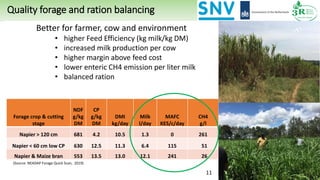
Forage crop & cutting
stage
NDF
g/kg
DM
CP
g/kg
DM
DMI
kg/day
Milk
l/day
MAFC
KES/c/day
CH4
g/l
Napier > 120 cm 681 4.2 10.5 1.3 0 261
Napier < 60 cm low CP 630 12.5 11.3 6.4 115 51
Napier & Maize bran 553 13.5 13.0 12.1 241 26
Better for farmer, cow and environment
• higher Feed Efficiency (kg milk/kg DM)
• increased milk production per cow
• higher margin above feed cost
• lower enteric CH4 emission per liter milk
• balanced ration
Quality forage and ration balancing
(Source: NEADAP Forage Quick Scan, 2019)
11
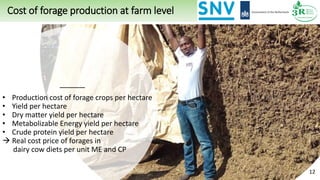
• Production cost of forage crops per hectare
• Yield per hectare
• Dry matter yield per hectare
• Metabolizable Energy yield per hectare
• Crude protein yield per hectare
→ Real cost price of forages in
dairy cow diets per unit ME and CP
Cost of forage production at farm level
12
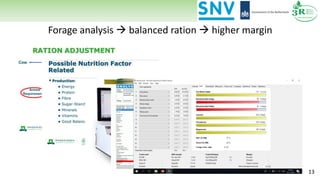
Forage analysis → balanced ration → higher margin
13
Rumen 8 as a tool in feed advisory
• Rumen8 is free available online. https://www.rumen8.com.au/download/index.html
• SNV Tropical Feed library free available online. https://cowsoko.com/rumen8
• Training in the use of Rumen8 is needed
• Universities can use Rumen8 for training of dairy cow nutrition in their curriculum
• Feed manufacturers: to formulate feeds that correct deficiencies of forages
• Analysis of all dietary ingredients and especially forages will increase accuracy of prediction with
Rumen8
• Shows the benefit of quality forages with a potential to increase DMI to intensify milk production
14
Total diet ration balancing software for dairy cows

Total diet ration balancing software for dairy cows

  • 1.
    Total diet rationbalancing software for dairy cows Presenters: Frida N. Thuita Julius C. Kosgei SNV-3R Forage Seminar Azure Hotel, Nairobi 28th August 2019
  • 2.
    What can Rumen8do? • It is a total diet ration balancing software. • It optimizes milk production and maximizes margin above feed costs. • The advisor (user of R8) ensures the diet is feasible for ruminants • A library with nutritional values of forages, feed ingredients and minerals is needed • Forages available at farms differ widely in quality . • The variation in forage quality is even wider between farms and farms in different regions 2
  • 3.
    Feed library • Theimportance of ‘Kenyanization’ • Different forage species are used on Kenyan farms • Most tropical forages have - high Neutral Detergent Fibre content - low digestibility - low protein content • Within Kenya - Different Agro Ecological Zones • Effect of agronomical practices on the nutrient content of forages • Agro – Industrial by-products which are unique in countries with tropical climate 3
  • 4.
    Feed intake basedon NDF DMI driver, e.g. NDF 1.3% of LW NDF is used to estimate feed intake and predict milk production Estimate feed intake (Source: M. Staines, Rumen8 - SNVFeedLibrary, 2018) 4 (Pictures: Hink Perdok, 2018)
  • 5.
    Approach • Developing offeed library for tropical forages • Pilot on 30 dairy farms (Medium and Large-Scale) • Monthly farm visits and meetings with each farmer • Farm walk: farmer and advisors observe cows, feeds, forage, terrain, farm records etc. • Starting point are the feeds the farmer had available. • Through coaching gradual changes in the rations and feeding practices were introduced • Key farm data are important in ration development and balancing 5
  • 6.
    Key farm data •Milk yield (l/d) • Days in milk • Live weight (kg) • Milk fat ( %m/v) • Milk true protein (%m/v) • Activity 6
  • 7.
    Role of foragesin dairy cow rations • Forage is the main ingredient in ruminant diets • Agronomic management practices of forage crops influence quality, yield per hectare, increased feed intake and milk yield • Feed intake (DMI) is influenced by the DM content and nutrient content in the forage crops • Continuously improving the forage quality results in increased feed intake and reduced feed cost per liter of milk • Single forages are imbalanced feeds, combination of forages or other feed ingredients can balance the ration • When producing forage crops monitor production of DM, ME and CP per hectare 7
  • 8.
  • 9.
  • 10.
    Forage production Start End High NDF LowIntake Low Production Low FE Health issues Poor Fertility High concentrate High Feed Cost Lower NDF Better Intake Improve Production Better FE Reduce Health issues Improve Fertility Reduce concentrates Lower Feed Cost Soil and water management Preservation techniques Agriculture practicesCutting Stage TMR Chopping Balanced Ration Seed selection (improved specie/variety) Optimized Balanced Ration Genetic Improvement (Plant, animal) (Continuous Process) Species mix (grass:legume) Source: NEADAP Forage Quick 10
  • 11.
    Forage crop &cutting stage NDF g/kg DM CP g/kg DM DMI kg/day Milk l/day MAFC KES/c/day CH4 g/l Napier > 120 cm 681 4.2 10.5 1.3 0 261 Napier < 60 cm low CP 630 12.5 11.3 6.4 115 51 Napier & Maize bran 553 13.5 13.0 12.1 241 26 Better for farmer, cow and environment • higher Feed Efficiency (kg milk/kg DM) • increased milk production per cow • higher margin above feed cost • lower enteric CH4 emission per liter milk • balanced ration Quality forage and ration balancing (Source: NEADAP Forage Quick Scan, 2019) 11
  • 12.
    • Production costof forage crops per hectare • Yield per hectare • Dry matter yield per hectare • Metabolizable Energy yield per hectare • Crude protein yield per hectare → Real cost price of forages in dairy cow diets per unit ME and CP Cost of forage production at farm level 12
  • 13.
    Forage analysis →balanced ration → higher margin 13
  • 14.
    Rumen 8 asa tool in feed advisory • Rumen8 is free available online. https://www.rumen8.com.au/download/index.html • SNV Tropical Feed library free available online. https://cowsoko.com/rumen8 • Training in the use of Rumen8 is needed • Universities can use Rumen8 for training of dairy cow nutrition in their curriculum • Feed manufacturers: to formulate feeds that correct deficiencies of forages • Analysis of all dietary ingredients and especially forages will increase accuracy of prediction with Rumen8 • Shows the benefit of quality forages with a potential to increase DMI to intensify milk production 14