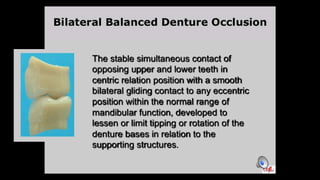
Balanced Occlusion
Prof. Gunjan Srivastava
Professor
Department of Prosthodontics
Institute of Dental Sciences
Siksha’O’Anusandhan
Bhubaneswar
Balanced Occlusion
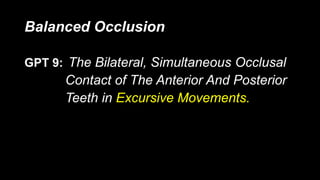
GPT 9: The Bilateral, Simultaneous Occlusal
Contact of The Anterior And Posterior
Teeth in Excursive Movements.
THEORIES
&
CONCEPTS
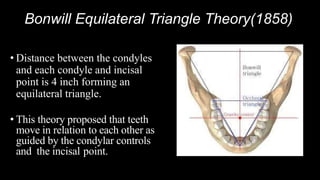
Bonwill Equilateral Triangle Theory(1858)
• Distance between the condyles
and each condyle and incisal
point is 4 inch forming an
equilateral triangle.
• This theory proposed that teeth
move in relation to each other as
guided by the condylar controls
and the incisal point.
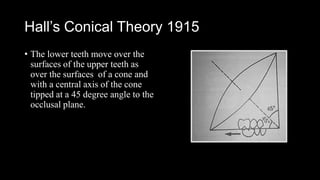
Hall’s Conical Theory 1915
• The lower teeth move over the
surfaces of the upper teeth as
over the surfaces of a cone and
with a central axis of the cone
tipped at a 45 degree angle to the
occlusal plane.
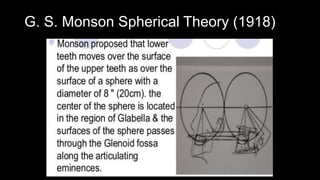
G. S. Monson Spherical Theory (1918)
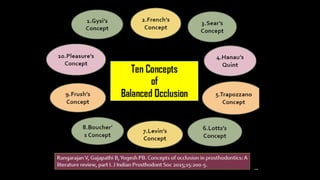
CONCEPTS
1. Gysi
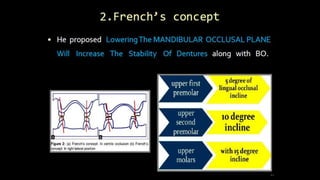
2. French
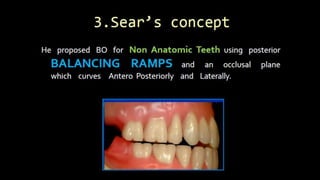
3. Sear
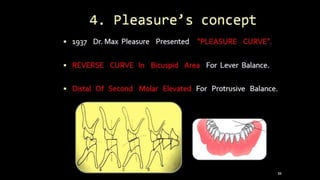
4. Pleasure
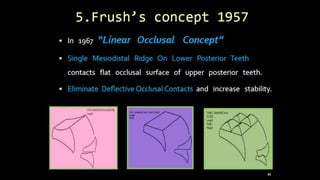
5. Frush
6. Hanau
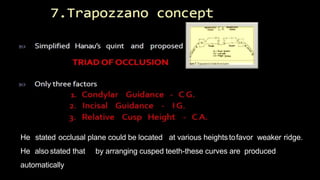
7. Trapozanno
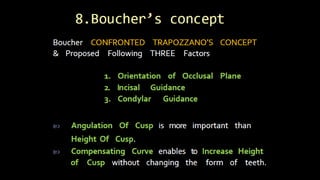
8. Boucher
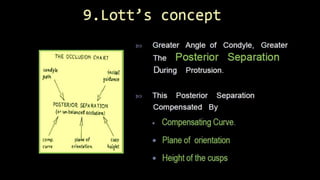
9. Lott
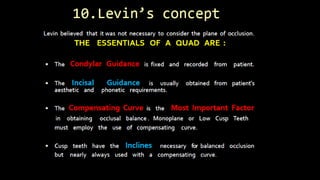
10. Levin
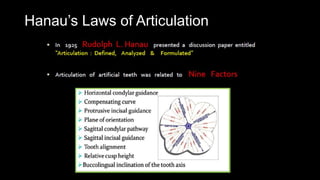
Hanau’s Laws of Articulation
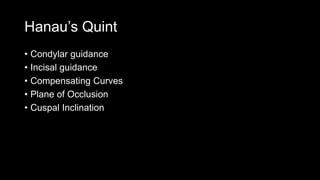
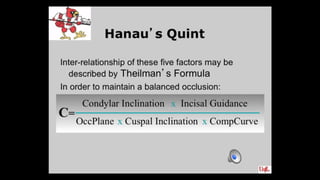
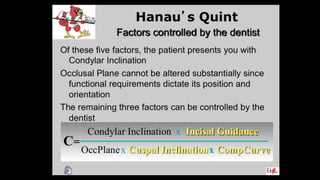
Hanau’s Quint
• Condylar guidance
• Incisal guidance
• Compensating Curves
• Plane of Occlusion
• Cuspal Inclination
He stated occlusal plane could be located at various heightstofavor weaker ridge.
He also stated that by arranging cusped teeth-these curves are produced
automatically
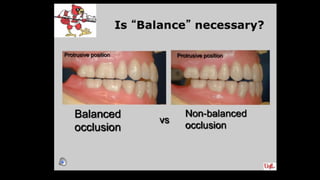
Balanced
Versus
OTHER OCCLUSIONS
Occlusion for complete denture
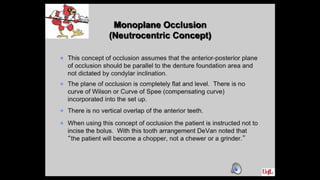
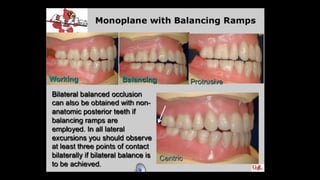
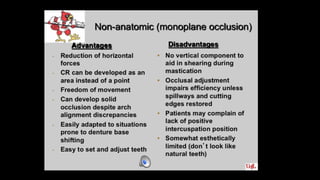
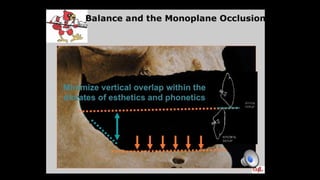
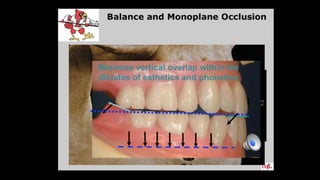
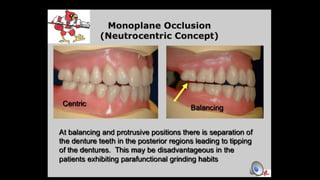
• Monoplane occlusion
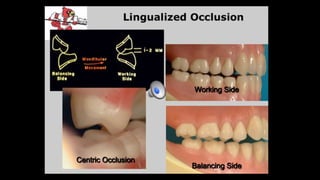
• Lingualized occlusion
• Balanced occlusion
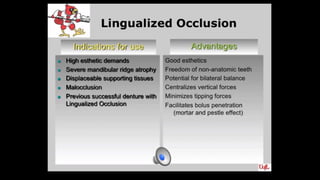
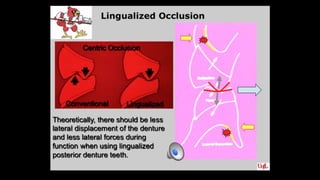
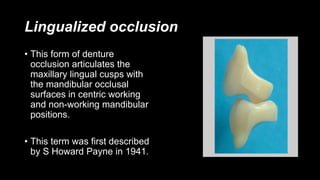
Lingualized occlusion
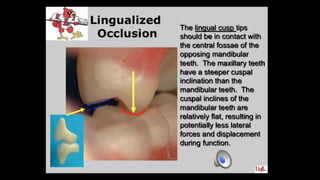
• This form of denture
occlusion articulates the
maxillary lingual cusps with
the mandibular occlusal
surfaces in centric working
and non-working mandibular
positions.
• This term was first described
by S Howard Payne in 1941.
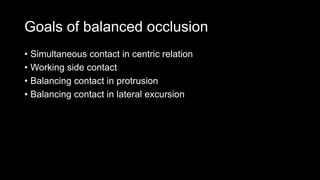
Goals of balanced occlusion
• Simultaneous contact in centric relation
• Working side contact
• Balancing contact in protrusion
• Balancing contact in lateral excursion
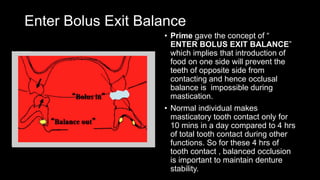
Enter Bolus Exit Balance
• Prime gave the concept of “
ENTER BOLUS EXIT BALANCE”
which implies that introduction of
food on one side will prevent the
teeth of opposite side from
contacting and hence occlusal
balance is impossible during
mastication.
• Normal individual makes
masticatory tooth contact only for
10 mins in a day compared to 4 hrs
of total tooth contact during other
functions. So for these 4 hrs of
tooth contact , balanced occlusion
is important to maintain denture
stability.
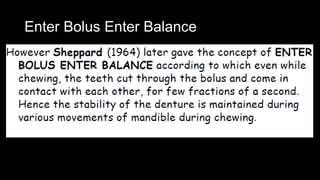
Enter Bolus Enter Balance
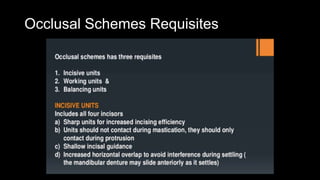
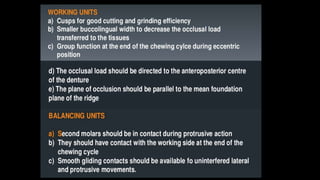
Occlusal Schemes Requisites
Types of Balanced Occlusion
• Unilateral Balanced Occlusion
• Bilateral Balanced Occlusion
• Protrusive balanced Occlusion
• Lateral Balanced Occlusion
• Unilateral Balanced Occlusion This is a type of occlusion
seen on occlusal surfaces of teeth on one side when they
occlude simultaneously with a smooth , uninterrupted glide.
• This is not followed during complete denture preparation. It is
more pertained to fixed partial dentures
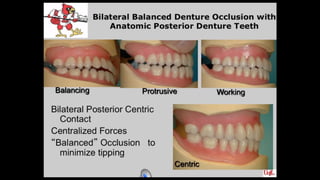
• Bilateral Balanced Occlusion This is a type of occlusion that
is seen when a simultaneous contact occurs on both sides in
centric and eccentric positions.
• Bilateral balanced occlusion helps to distribute the occlusal load
evenly across the arch and therefore helps to improve stability
of the denture during centric, eccentric or parafunctional
movements.
• Protrusive balanced Occlusion This type of balanced
occlusion is present when mandible moves in a forward
direction and the occlusal contacts are smooth and
simultaneous anteriorly and posteriorly.
• There should be atleast three points of contact in the occlusal
plane. Two located posteriorly and one anteriorly.
• Absent in natural dentition.
• Posterior contact during protrusion to maintain balance
• Lateral Balanced Occlusion In lateral balance there will be a
minimal simultaneous three point contact present during lateral
movement of mandible.
• This is absent in natural dentition.
• Teeth should be arranged such that there is simultaneous tooth
contact in balancing side and working side.
• Selective grindingis defined as the, “intentional alterationof the
occlusal surfacesoftheteethto change theirform” —GPT
• Rationale
• Eliminate occlusal interferences
• Achievebalanced occlusion
• Contactsin harmony with TMJand neuromuscular system
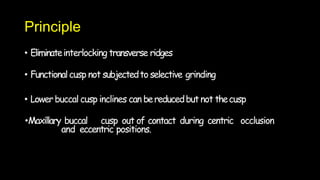
Principle
• Eliminateinterlocking transverse ridges
• Functionalcusp not subjectedto selective grinding
• Lowerbuccal cusp inclines can bereducedbutnot thecusp
•Maxillary buccal cusp out of contact during centric occlusion
and eccentric positions.
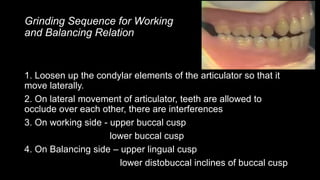
Grinding Sequence for Working
and Balancing Relation
1. Loosen up the condylar elements of the articulator so that it
move laterally.
2. On lateral movement of articulator, teeth are allowed to
occlude over each other, there are interferences
3. On working side - upper buccal cusp
lower buccal cusp
4. On Balancing side – upper lingual cusp
lower distobuccal inclines of buccal cusp
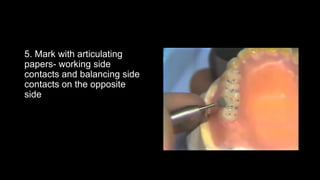
5. Mark with articulating
papers- working side
contacts and balancing side
contacts on the opposite
side
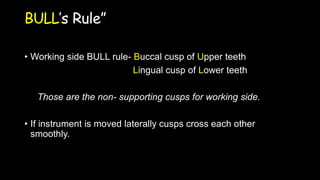
BULL’s Rule”
• Working side BULL rule- Buccal cusp of Upper teeth
Lingual cusp of Lower teeth
Those are the non- supporting cusps for working side.
• If instrument is moved laterally cusps cross each other
smoothly.
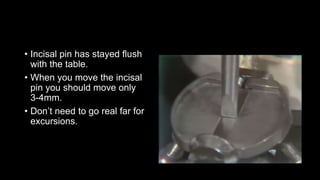
• Incisal pin has stayed flush
with the table.
• When you move the incisal
pin you should move only
3-4mm.
• Don’t need to go real far for
excursions.
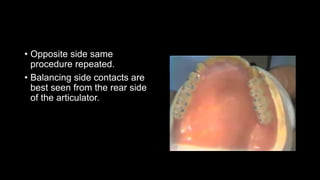
• Opposite side same
procedure repeated.
• Balancing side contacts are
best seen from the rear side
of the articulator.
Thankyou so much for
your patient listening!!!

Balanced occlusion

  • 1.
    Balanced Occlusion Prof. GunjanSrivastava Professor Department of Prosthodontics Institute of Dental Sciences Siksha’O’Anusandhan Bhubaneswar
  • 4.
    Balanced Occlusion GPT 9:The Bilateral, Simultaneous Occlusal Contact of The Anterior And Posterior Teeth in Excursive Movements.
  • 8.
  • 9.
    Bonwill Equilateral TriangleTheory(1858) • Distance between the condyles and each condyle and incisal point is 4 inch forming an equilateral triangle. • This theory proposed that teeth move in relation to each other as guided by the condylar controls and the incisal point.
  • 10.
    Hall’s Conical Theory1915 • The lower teeth move over the surfaces of the upper teeth as over the surfaces of a cone and with a central axis of the cone tipped at a 45 degree angle to the occlusal plane.
  • 11.
    G. S. MonsonSpherical Theory (1918)
  • 12.
    CONCEPTS 1. Gysi 2. French 3.Sear 4. Pleasure 5. Frush 6. Hanau 7. Trapozanno 8. Boucher 9. Lott 10. Levin
  • 19.
    Hanau’s Laws ofArticulation
  • 20.
    Hanau’s Quint • Condylarguidance • Incisal guidance • Compensating Curves • Plane of Occlusion • Cuspal Inclination
  • 23.
    He stated occlusalplane could be located at various heightstofavor weaker ridge. He also stated that by arranging cusped teeth-these curves are produced automatically
  • 27.
  • 28.
    Occlusion for completedenture • Monoplane occlusion • Lingualized occlusion • Balanced occlusion
  • 35.
    Lingualized occlusion • Thisform of denture occlusion articulates the maxillary lingual cusps with the mandibular occlusal surfaces in centric working and non-working mandibular positions. • This term was first described by S Howard Payne in 1941.
  • 41.
    Goals of balancedocclusion • Simultaneous contact in centric relation • Working side contact • Balancing contact in protrusion • Balancing contact in lateral excursion
  • 44.
    Enter Bolus ExitBalance • Prime gave the concept of “ ENTER BOLUS EXIT BALANCE” which implies that introduction of food on one side will prevent the teeth of opposite side from contacting and hence occlusal balance is impossible during mastication. • Normal individual makes masticatory tooth contact only for 10 mins in a day compared to 4 hrs of total tooth contact during other functions. So for these 4 hrs of tooth contact , balanced occlusion is important to maintain denture stability.
  • 45.
  • 46.
  • 48.
    Types of BalancedOcclusion • Unilateral Balanced Occlusion • Bilateral Balanced Occlusion • Protrusive balanced Occlusion • Lateral Balanced Occlusion
  • 49.
    • Unilateral BalancedOcclusion This is a type of occlusion seen on occlusal surfaces of teeth on one side when they occlude simultaneously with a smooth , uninterrupted glide. • This is not followed during complete denture preparation. It is more pertained to fixed partial dentures
  • 50.
    • Bilateral BalancedOcclusion This is a type of occlusion that is seen when a simultaneous contact occurs on both sides in centric and eccentric positions. • Bilateral balanced occlusion helps to distribute the occlusal load evenly across the arch and therefore helps to improve stability of the denture during centric, eccentric or parafunctional movements.
  • 51.
    • Protrusive balancedOcclusion This type of balanced occlusion is present when mandible moves in a forward direction and the occlusal contacts are smooth and simultaneous anteriorly and posteriorly. • There should be atleast three points of contact in the occlusal plane. Two located posteriorly and one anteriorly. • Absent in natural dentition. • Posterior contact during protrusion to maintain balance
  • 52.
    • Lateral BalancedOcclusion In lateral balance there will be a minimal simultaneous three point contact present during lateral movement of mandible. • This is absent in natural dentition. • Teeth should be arranged such that there is simultaneous tooth contact in balancing side and working side.
  • 53.
    • Selective grindingisdefined as the, “intentional alterationof the occlusal surfacesoftheteethto change theirform” —GPT • Rationale • Eliminate occlusal interferences • Achievebalanced occlusion • Contactsin harmony with TMJand neuromuscular system
  • 54.
    Principle • Eliminateinterlocking transverseridges • Functionalcusp not subjectedto selective grinding • Lowerbuccal cusp inclines can bereducedbutnot thecusp •Maxillary buccal cusp out of contact during centric occlusion and eccentric positions.
  • 55.
    Grinding Sequence forWorking and Balancing Relation 1. Loosen up the condylar elements of the articulator so that it move laterally. 2. On lateral movement of articulator, teeth are allowed to occlude over each other, there are interferences 3. On working side - upper buccal cusp lower buccal cusp 4. On Balancing side – upper lingual cusp lower distobuccal inclines of buccal cusp
  • 56.
    5. Mark witharticulating papers- working side contacts and balancing side contacts on the opposite side
  • 57.
    BULL’s Rule” • Workingside BULL rule- Buccal cusp of Upper teeth Lingual cusp of Lower teeth Those are the non- supporting cusps for working side. • If instrument is moved laterally cusps cross each other smoothly.
  • 58.
    • Incisal pinhas stayed flush with the table. • When you move the incisal pin you should move only 3-4mm. • Don’t need to go real far for excursions.
  • 59.
    • Opposite sidesame procedure repeated. • Balancing side contacts are best seen from the rear side of the articulator.
  • 60.
    Thankyou so muchfor your patient listening!!!