





MADE BY
ASTHA MEHROTRA
So where is this concept
coming from?

 PLANNING
 ORGANISING
 LEADING
 CONTROLING:- Establishing standards of
performance; measuring performance and taking
corrective action
MANAGERIAL
FUNCTIONS

Not on how managers should engage
in this control function
But
What actually should they control
Our focus?

 Traditional function:-
Financial aspect:-
 Managers measure costs and profit because they are
easy to measure and important for the success of the
organisation
 But the problem to focus only on one measure is that
it fails to depict the reality
So, how to control?
EXAMPLE-
If costs are the yardstick by
which management may
measure success then
management may decide to
layoff people in order to save
costs

On surface this appears to
be a good decision as
costs are lower which will
probably help department
achieve it’s goals
but is there a long term
impact???

So, what should we do
instead??
Answer was given by –
Robert Kaplan and David
Norton in 1992


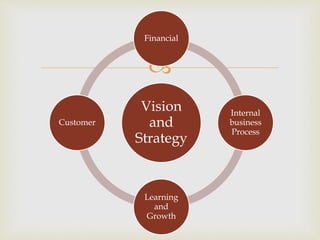
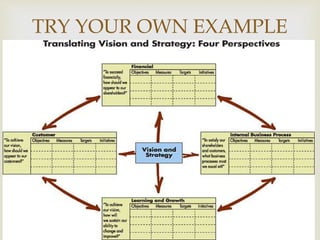
Vision
and
Strategy
Financial
Internal
business
Process
Learning
and
Growth
Customer

EXAMPLE

4 ORIGINAL BUSINESS
PERSPECTIVES
The balance scorecard model suggests
that view the organization from 4
perspectives.
Then develop metrics, collect data and
analyse it relative to each of these
perspectives

SO, LETS GET TO KNOW
A LITTLE BY VISUALS

video

 Was first published in 1992 by Kaplan and Norton, a
book followed in 1996.
 Traditional performance measurement that only
focus on external accounting data are obsolete.
 The approach is to provide ‘balance’ to the financial
perspective.
BALANCED SCORECARD
CONCEPT

 Improve organisational performance by measuring
what matters
 Increase focus on strategy and results
 Align organisational strategy with workers on a day
to day basis
 Focus on drivers key to future performance
 Improve communication of the organization’s Vision
and Strategy
 Prioritize Projects/ Initiatives.
WHY USE A BALANCED
SCORECARD?

 Lack of a well defined strategy
The balanced scorecard relies on well defined strategy
and understanding of linkages between strategic
objections and metrics. Without this foundation
implementation could fail.
 Too much focus on lagging measures
Focusing only on lagging measures may cause a lack of
priority or opportunity for the leading measures.
 Use of Generic Metrics
Don’t just copy metrics from another firm. Identify
measures that apply to your strategy and competitive
position.
SCORECARD POTENTIAL
PITFALLS & CRITICISM

 Help align key performance measures with strategy at all
levels of the organisation
 The methodology facilitates communication and
understanding of business goals and strategies at all
levels of an organisation
 Transforms an organisation’s mission statement and
strategic plan from a passive document into the
“marching orders” for the organisation on a daily basis.
 It enables executives to truly execute their strategies by
identifying what should be done and measured
 Strategic initiatives that follow “best practices”
methodologies that cascade through the entire
organisation.
BALANCED SCORECARD
BENEFIT RE-CAP

TRY YOUR OWN EXAMPLE
Balance scorecard

Balance scorecard

  • 1.
  • 2.
    So where isthis concept coming from?
  • 3.
      PLANNING  ORGANISING LEADING  CONTROLING:- Establishing standards of performance; measuring performance and taking corrective action MANAGERIAL FUNCTIONS
  • 4.
     Not on howmanagers should engage in this control function But What actually should they control Our focus?
  • 5.
      Traditional function:- Financialaspect:-  Managers measure costs and profit because they are easy to measure and important for the success of the organisation  But the problem to focus only on one measure is that it fails to depict the reality So, how to control?
  • 6.
    EXAMPLE- If costs arethe yardstick by which management may measure success then management may decide to layoff people in order to save costs
  • 7.
     On surface thisappears to be a good decision as costs are lower which will probably help department achieve it’s goals but is there a long term impact???
  • 8.
     So, what shouldwe do instead?? Answer was given by – Robert Kaplan and David Norton in 1992
  • 9.
  • 10.
  • 11.
  • 12.
     4 ORIGINAL BUSINESS PERSPECTIVES Thebalance scorecard model suggests that view the organization from 4 perspectives. Then develop metrics, collect data and analyse it relative to each of these perspectives
  • 13.
     SO, LETS GETTO KNOW A LITTLE BY VISUALS
  • 14.
  • 15.
      Was firstpublished in 1992 by Kaplan and Norton, a book followed in 1996.  Traditional performance measurement that only focus on external accounting data are obsolete.  The approach is to provide ‘balance’ to the financial perspective. BALANCED SCORECARD CONCEPT
  • 16.
      Improve organisationalperformance by measuring what matters  Increase focus on strategy and results  Align organisational strategy with workers on a day to day basis  Focus on drivers key to future performance  Improve communication of the organization’s Vision and Strategy  Prioritize Projects/ Initiatives. WHY USE A BALANCED SCORECARD?
  • 17.
      Lack ofa well defined strategy The balanced scorecard relies on well defined strategy and understanding of linkages between strategic objections and metrics. Without this foundation implementation could fail.  Too much focus on lagging measures Focusing only on lagging measures may cause a lack of priority or opportunity for the leading measures.  Use of Generic Metrics Don’t just copy metrics from another firm. Identify measures that apply to your strategy and competitive position. SCORECARD POTENTIAL PITFALLS & CRITICISM
  • 18.
      Help alignkey performance measures with strategy at all levels of the organisation  The methodology facilitates communication and understanding of business goals and strategies at all levels of an organisation  Transforms an organisation’s mission statement and strategic plan from a passive document into the “marching orders” for the organisation on a daily basis.  It enables executives to truly execute their strategies by identifying what should be done and measured  Strategic initiatives that follow “best practices” methodologies that cascade through the entire organisation. BALANCED SCORECARD BENEFIT RE-CAP
  • 19.