‘A Splendid mark of Royalty of Nawabs and Awadh Architecture’
Imaam means the Muslim worshiper and Bara
means Big.
An Imambara is simply a hall where Shia Muslims
come together for various ceremonies, especially
related to the Remembrance of Muharram.
RELIEF MEASURE- Construction of Bara Imambada was started in
1784, a year of a devastating famine, and one of Asaf-ud-Daula’s
objectives in embarking on this grandiose project was to provide
employment for people in the region for almost a decade while
the famine lasted. It is said that ordinary people used to work in
the day building up the edifice, while noblemen and other elite
worked at night to break down anything that was raised that day.
It was a project that preceded a Keynesian like intervention for
employment generation. Construction of the Imambada was
completed in 1791. Estimated cost of building the Imambada
ranges between half a million rupees to a million rupees. Even
after completion, the Nawab used to spend between four and five
hundred thousand rupees on its decoration annual.
It was designed by the Architect Hafiz Kifayat Ulla..
HISTORY
 The complex includes the large Asafi mosque, the
bhoolbhullaiya (the labyrinth), and baoli, a step well.
 Two imposing gateways lead to the main hall.
ASFI MOSQUE BAOLI BHOOL-BHULAIYA
 Entrance Gateways
 Bada Imambada
 Bhul Bhulaiya
 Baoli
 Mosque
40 Steps of stairs leads from road
to the floor of First gateway.
Opening arches are following by
three arches ( Triple Arched
Arch) at the equal distance . This
distance create a space between
front and back faces of gateways,
that space is called courtyard.
 Three arched opening
 Rectangular plan
 Circular garden in the centre of
back of Gateway.
 Enclosed by arcaded cloisters.
FIRST GATEWAY FRONT
BACK
Three arche opening
 Triple arched arche
 A row of mehraabs
and jharokhas
 Row of cupolas from
starting to ending
point
 Chattries on each
corner
 Leads to the main
court with the
Imambada placed
on the South end of
the quadrangle.
FRONT
BACK
SECOND GATEWAY
 In Islaam Architecture we never can see or enter the
main building in very direct or literal manner. First we
have to enter from several gateways to reach the main
building and the gateways are made similar to the
building. Equal distance gap can see between Gateways
and Gateway from building.
 The Main building is considered as God and Gateways
are considered as different levels to reach the god. The
theory says It is not easy to reach the god . We need
dedication and concentration. In the path many
objects meets to confuse us but we should go forward
towards our aim.
‘A Shrine for the Purpose of Azadari’
A row of double arched
doorways , framed with
rectangular frames. Only
center doorway is open for
public rest are closed with
grilled windows.
FRONT VIEW OF
IMAMBADA COURTYARD
A giant flight of flat stairs leads
towards the floor of courtyard.
A octagonal dual floor dome is
dominating element on the
front side.
One step upward from arches ,
there are a row of Jalidaar
windows
 Reflects the maturation of
ornamented Mughal design.
 No European elements or the
use of iron.
 Neither a mosque, nor a
mausoleum, but a huge
building having interesting
elements.
 Construction of halls and use
of vaults show a strong Islamic
influence.
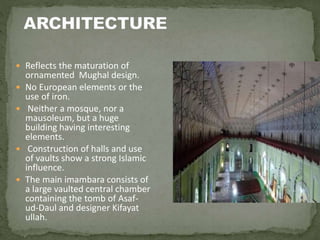
 The main imambara consists of
a large vaulted central chamber
containing the tomb of Asaf-
ud-Daul and designer Kifayat
ullah.
 Area 15x60 Feet
 Height 15 Meter
 Weight 2000 Ton
 No use of Iron or wooden frame in roof construction
 Hollow Ceiling to make it light weight
 Twin Brick wall
 A row of hanging chandeliers in the middle and the big mirrors
are put on both side to create the reflection
Chandelier hanging from
ceiling with a ling iron rod
A row of mirrors to create the
reflection from the light of
Chandelier
Grave of Nawab and Architect
under the Canopy
The hall has balconies on all
four sides right under the
ceiling
large amount of sunlight
enters from Vertical arched
doorways
 Bada Imambada---- a great hall built at the end of a spectacular
courtyard.
 Approached through two magnificent triple-arched gateways.
 The hall is Asia's largest without any external support of wood, iron,
or stone beams.
 16 feet thick roof.
 Weighs nearly 20,000 tons.
 An ingenious method was employed for building the roof.
 Building covered with vaults of very simple forms.
 Construction material---- rubble or coarse concrete of bricks and
mud.
 Allowed to stand a year or two to set and dry.
 The centring is then removed.
 The vault is a more durable form of
roof than the most scientific
Gothic vaulting.
 3 halls under the same roof.
 Central hall---- the Asian Hall.
 2 adjoining halls.
 The China Hall is square at ground
level, becomes octagonal at mid-
height, and 16 sided at the top.
 The India Hall has been fashioned
like a watermelon.
CHAINA HALL
INDIAN HALL
•Round from the floor
and octagonal at the top
•A big floral motif in
the center.
•Chairs are attached on
ventilation. It is said
that these chairs were
for queens or begums.
•Each side has a cusped
arch .
•Entrance arch is bigger
than other arches.
 Present in the main
imambara building.
 8 surrounding chambers
built to different roof
heights,
 Permit the space above
these to be reconstructed
as a labyrinth
“bhoolbhullaiya”.
 with passages
interconnecting through
489 identical doorways.
 Came about
unintentionally to support
the weight of the building.
MOSQUE
 Within the Imambada
courtyard
 Built on a two-storied
plinth it consists of two
tall minarets in the
courtyard
 Bulbous dome
 The top of the domes are
ornamented with lotus
petals and have a final
 flanked by a grand flight
of steps leading to its
paved floor.
 A baoli consists of two parts:-
 vertical shaft from which water is
drawn,
 surrounding inclined
subterranean passageways,
chambers and steps which
provide access to the well.
 Cool, quiet retreats during
summers.
 Chambers in some baolis are
seven or eight levels below the
ground level.
 “Shahi Baoli”----eastern
side of the Asafi
Imambara complex.
 Deep circular well at the
eastern end.
 Approached through a
flight of steps and a door
facing west.
 Rectangular plan.
 Material---- Lakhauri
brick and lime mortar.
BAOLI
 five- storied baoli (step well)
 Called the Shahi-Hammam (royal bath),
 baoli is connected with the river Gomti.
 Only first two stories above water, the rest being perennially under
water.
 Used as a hiding place
 Used as summer palaces due to natural coolness
 Entrance---- high portal haying an unornamented arch (Mehrab).
 Series of stairs descending down to the water reservoir.
 On either flanks are rows of three storeyed Mehrabs.
 Water flows in to the baoli through a large ‘Shah – Jahani’ Mahrab.
 Multi--chambered summer place in the interior.
.
LINE- The structure is made in Horizontal
line where as the Domes and Mehraabs
are made vertically.
COLOR / CONTRAST- The structure is
built
with lakhauri bricks and covered with
lime plaster which provides it brown
and yellow shade. It create an amazing
contrast with sky
SHAPES- Use of Geometrical shapes like
Triangle, Rectangle, Circles and semi
circles
TEXTURE- Walls are covered with lime
plaster so the texture is rough.
PATTERN- Symmetrical geometric
pattern on the sides of wall and arches.
EMPHASIS- In the ceiling of Indian Hall
a big floral motif is the center of
attraction in whole ceiling.
BALANCE- Symmetrical Balance –
Similar windows in design and number
on the both side of arch.
Rhythm- Floral Patterns are made in
rhythmic form. We get an eye
movement to visualize these pattern.
 Muharram, the first month of Islamic calendar marks the martyrdom
of grandson of Holy prophet and his companions at Karbala. The tragic
martyrdom of Imam Hussain, the grandson of Prophet Muhammed
nearly 1300 years ago is observed with solemnity with Muslims
mourning. Draped in black clothes, the mourners assembled at Bada
Imambada before the procession. The procession traces its history to
the period of third nawab of Awadh Mohammad Ali Shah (1837-42) is
managed by Hussainabad and Allied Trust headed by the District
Magistrate (DM) of Lucknow.
TAZIA- A representations of the
tombs of Hasan and Hussain (the
grandsons of Mohammed), carried in
processions for various Islamic
festivities.
 The highlight of the procession is a zari, prepared with bamboo stick
and wax. The procession also included camels, elephants and members
of Royal Family of Awadh. As per the tradition the procession includes
34 items as Alam Hazrat Abbas, Taboot with shamiyana, Zarihey
Aqdas-Mom and Zarihey Aqdas-Abraqi, Zuljunah (duldul) with chatri
and pankha. A matami band playing sad tunes also followed the
precession.
A Procession of
Muharram at
Imambada
CUPOLAS- Small domes placed on the
top of the roof or on the top of the dome
JHAROKHAS- A jharokha (or jharoka)
is a type of overhanging enclosed
balcony used
JALIDAAR WINDOW- Jalidaar windows have
geometrical cuts so the sun light travell trough
the geometrical shapes
PIllARS- Pillars are in cylindrical
form top and bottoms are
decorated with organic forms.
CHATTRI- simple
structure of one dome
raised by four pillars on
the top of minarets or
on the top corners
MINARETS-A
cylindrical tower .
Generally a tall spire with
a conical or onion-shaped
crown, usually either
free-standing or taller
than associated support
structure
DOME- A dome is
an architectural
element that
resembles the hollow
upper half of a
sphere.
CUSPED ARCHES- Cusp in architecture, the
intersections of lobed or scalloped forms,
VAULTS- a roof in the form of an arch or a
series of arches, typical of churches and
other large, formal buildings
ARABESQUE- Stylized
plant forms represent the
sense of rhythm.
MEHRAAB-
Unornamented arches.
BADA IMAMBADA, Lucknow

BADA IMAMBADA, Lucknow

  • 2.
    ‘A Splendid markof Royalty of Nawabs and Awadh Architecture’
  • 3.
    Imaam means theMuslim worshiper and Bara means Big. An Imambara is simply a hall where Shia Muslims come together for various ceremonies, especially related to the Remembrance of Muharram.
  • 4.
    RELIEF MEASURE- Constructionof Bara Imambada was started in 1784, a year of a devastating famine, and one of Asaf-ud-Daula’s objectives in embarking on this grandiose project was to provide employment for people in the region for almost a decade while the famine lasted. It is said that ordinary people used to work in the day building up the edifice, while noblemen and other elite worked at night to break down anything that was raised that day. It was a project that preceded a Keynesian like intervention for employment generation. Construction of the Imambada was completed in 1791. Estimated cost of building the Imambada ranges between half a million rupees to a million rupees. Even after completion, the Nawab used to spend between four and five hundred thousand rupees on its decoration annual. It was designed by the Architect Hafiz Kifayat Ulla.. HISTORY
  • 5.
     The complexincludes the large Asafi mosque, the bhoolbhullaiya (the labyrinth), and baoli, a step well.  Two imposing gateways lead to the main hall. ASFI MOSQUE BAOLI BHOOL-BHULAIYA
  • 6.
     Entrance Gateways Bada Imambada  Bhul Bhulaiya  Baoli  Mosque
  • 9.
    40 Steps ofstairs leads from road to the floor of First gateway. Opening arches are following by three arches ( Triple Arched Arch) at the equal distance . This distance create a space between front and back faces of gateways, that space is called courtyard.  Three arched opening  Rectangular plan  Circular garden in the centre of back of Gateway.  Enclosed by arcaded cloisters. FIRST GATEWAY FRONT BACK
  • 10.
    Three arche opening Triple arched arche  A row of mehraabs and jharokhas  Row of cupolas from starting to ending point  Chattries on each corner  Leads to the main court with the Imambada placed on the South end of the quadrangle. FRONT BACK SECOND GATEWAY
  • 11.
     In IslaamArchitecture we never can see or enter the main building in very direct or literal manner. First we have to enter from several gateways to reach the main building and the gateways are made similar to the building. Equal distance gap can see between Gateways and Gateway from building.  The Main building is considered as God and Gateways are considered as different levels to reach the god. The theory says It is not easy to reach the god . We need dedication and concentration. In the path many objects meets to confuse us but we should go forward towards our aim.
  • 12.
    ‘A Shrine forthe Purpose of Azadari’
  • 14.
    A row ofdouble arched doorways , framed with rectangular frames. Only center doorway is open for public rest are closed with grilled windows. FRONT VIEW OF IMAMBADA COURTYARD A giant flight of flat stairs leads towards the floor of courtyard. A octagonal dual floor dome is dominating element on the front side. One step upward from arches , there are a row of Jalidaar windows
  • 15.
     Reflects thematuration of ornamented Mughal design.  No European elements or the use of iron.  Neither a mosque, nor a mausoleum, but a huge building having interesting elements.  Construction of halls and use of vaults show a strong Islamic influence.  The main imambara consists of a large vaulted central chamber containing the tomb of Asaf- ud-Daul and designer Kifayat ullah.
  • 16.
     Area 15x60Feet  Height 15 Meter  Weight 2000 Ton  No use of Iron or wooden frame in roof construction  Hollow Ceiling to make it light weight  Twin Brick wall  A row of hanging chandeliers in the middle and the big mirrors are put on both side to create the reflection
  • 17.
    Chandelier hanging from ceilingwith a ling iron rod A row of mirrors to create the reflection from the light of Chandelier Grave of Nawab and Architect under the Canopy The hall has balconies on all four sides right under the ceiling large amount of sunlight enters from Vertical arched doorways
  • 18.
     Bada Imambada----a great hall built at the end of a spectacular courtyard.  Approached through two magnificent triple-arched gateways.  The hall is Asia's largest without any external support of wood, iron, or stone beams.  16 feet thick roof.  Weighs nearly 20,000 tons.  An ingenious method was employed for building the roof.  Building covered with vaults of very simple forms.  Construction material---- rubble or coarse concrete of bricks and mud.  Allowed to stand a year or two to set and dry.  The centring is then removed.
  • 19.
     The vaultis a more durable form of roof than the most scientific Gothic vaulting.  3 halls under the same roof.  Central hall---- the Asian Hall.  2 adjoining halls.  The China Hall is square at ground level, becomes octagonal at mid- height, and 16 sided at the top.  The India Hall has been fashioned like a watermelon. CHAINA HALL
  • 20.
    INDIAN HALL •Round fromthe floor and octagonal at the top •A big floral motif in the center. •Chairs are attached on ventilation. It is said that these chairs were for queens or begums. •Each side has a cusped arch . •Entrance arch is bigger than other arches.
  • 21.
     Present inthe main imambara building.  8 surrounding chambers built to different roof heights,  Permit the space above these to be reconstructed as a labyrinth “bhoolbhullaiya”.  with passages interconnecting through 489 identical doorways.  Came about unintentionally to support the weight of the building.
  • 22.
    MOSQUE  Within theImambada courtyard  Built on a two-storied plinth it consists of two tall minarets in the courtyard  Bulbous dome  The top of the domes are ornamented with lotus petals and have a final  flanked by a grand flight of steps leading to its paved floor.
  • 23.
     A baoliconsists of two parts:-  vertical shaft from which water is drawn,  surrounding inclined subterranean passageways, chambers and steps which provide access to the well.  Cool, quiet retreats during summers.  Chambers in some baolis are seven or eight levels below the ground level.
  • 24.
     “Shahi Baoli”----eastern sideof the Asafi Imambara complex.  Deep circular well at the eastern end.  Approached through a flight of steps and a door facing west.  Rectangular plan.  Material---- Lakhauri brick and lime mortar.
  • 25.
    BAOLI  five- storiedbaoli (step well)  Called the Shahi-Hammam (royal bath),  baoli is connected with the river Gomti.  Only first two stories above water, the rest being perennially under water.  Used as a hiding place  Used as summer palaces due to natural coolness  Entrance---- high portal haying an unornamented arch (Mehrab).  Series of stairs descending down to the water reservoir.  On either flanks are rows of three storeyed Mehrabs.  Water flows in to the baoli through a large ‘Shah – Jahani’ Mahrab.  Multi--chambered summer place in the interior.
  • 26.
    . LINE- The structureis made in Horizontal line where as the Domes and Mehraabs are made vertically. COLOR / CONTRAST- The structure is built with lakhauri bricks and covered with lime plaster which provides it brown and yellow shade. It create an amazing contrast with sky
  • 27.
    SHAPES- Use ofGeometrical shapes like Triangle, Rectangle, Circles and semi circles TEXTURE- Walls are covered with lime plaster so the texture is rough.
  • 28.
    PATTERN- Symmetrical geometric patternon the sides of wall and arches. EMPHASIS- In the ceiling of Indian Hall a big floral motif is the center of attraction in whole ceiling.
  • 29.
    BALANCE- Symmetrical Balance– Similar windows in design and number on the both side of arch. Rhythm- Floral Patterns are made in rhythmic form. We get an eye movement to visualize these pattern.
  • 30.
     Muharram, thefirst month of Islamic calendar marks the martyrdom of grandson of Holy prophet and his companions at Karbala. The tragic martyrdom of Imam Hussain, the grandson of Prophet Muhammed nearly 1300 years ago is observed with solemnity with Muslims mourning. Draped in black clothes, the mourners assembled at Bada Imambada before the procession. The procession traces its history to the period of third nawab of Awadh Mohammad Ali Shah (1837-42) is managed by Hussainabad and Allied Trust headed by the District Magistrate (DM) of Lucknow. TAZIA- A representations of the tombs of Hasan and Hussain (the grandsons of Mohammed), carried in processions for various Islamic festivities.
  • 31.
     The highlightof the procession is a zari, prepared with bamboo stick and wax. The procession also included camels, elephants and members of Royal Family of Awadh. As per the tradition the procession includes 34 items as Alam Hazrat Abbas, Taboot with shamiyana, Zarihey Aqdas-Mom and Zarihey Aqdas-Abraqi, Zuljunah (duldul) with chatri and pankha. A matami band playing sad tunes also followed the precession. A Procession of Muharram at Imambada
  • 32.
    CUPOLAS- Small domesplaced on the top of the roof or on the top of the dome JHAROKHAS- A jharokha (or jharoka) is a type of overhanging enclosed balcony used
  • 33.
    JALIDAAR WINDOW- Jalidaarwindows have geometrical cuts so the sun light travell trough the geometrical shapes PIllARS- Pillars are in cylindrical form top and bottoms are decorated with organic forms.
  • 34.
    CHATTRI- simple structure ofone dome raised by four pillars on the top of minarets or on the top corners MINARETS-A cylindrical tower . Generally a tall spire with a conical or onion-shaped crown, usually either free-standing or taller than associated support structure DOME- A dome is an architectural element that resembles the hollow upper half of a sphere.
  • 35.
    CUSPED ARCHES- Cuspin architecture, the intersections of lobed or scalloped forms, VAULTS- a roof in the form of an arch or a series of arches, typical of churches and other large, formal buildings
  • 36.
    ARABESQUE- Stylized plant formsrepresent the sense of rhythm. MEHRAAB- Unornamented arches.