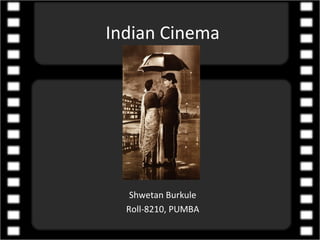
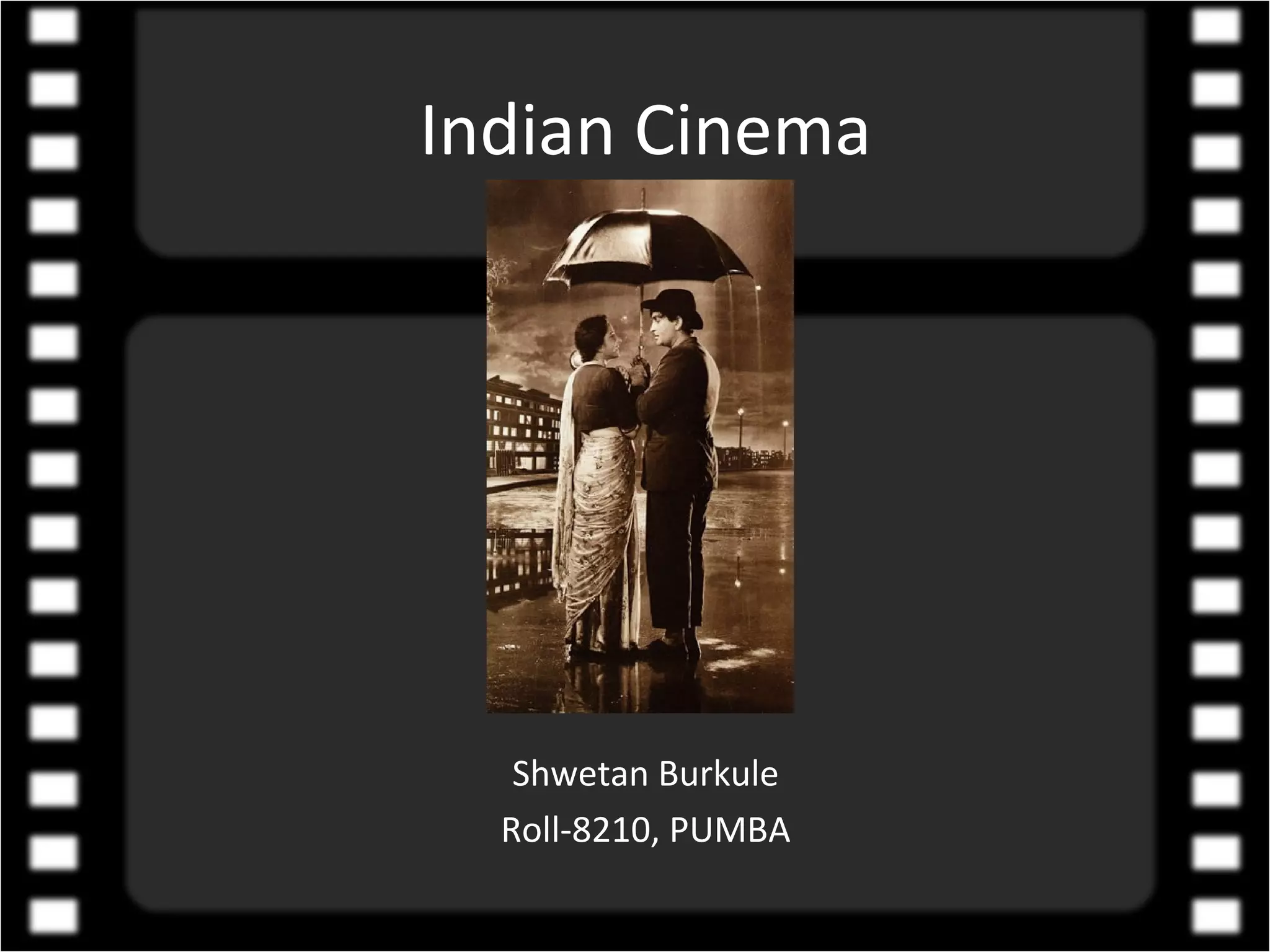
Indian Cinema


   Shwetan Burkule
  Roll-8210, PUMBA
Early Indian Film History
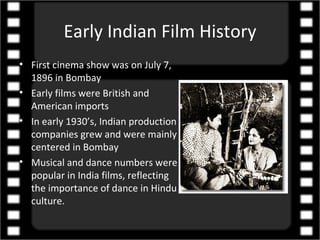
• First cinema show was on July 7,
  1896 in Bombay
• Early films were British and
  American imports
• In early 1930’s, Indian production
  companies grew and were mainly
  centered in Bombay
• Musical and dance numbers were
  popular in India films, reflecting
  the importance of dance in Hindu
  culture.
Early India Film History
• Dhundiraj Govind
  (Dadasaheb) Phalke (1870–
  1944) is known as the father
  of Indian Cinema. His films
  depicted Hindu Gods and
  promoted Indian
  independence from Britain.
• Swadeshi (indigenous)
  movement sought
  independence through
  boycott of British goods.
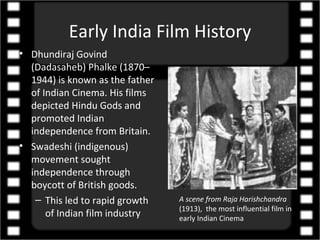
   – This led to rapid growth    A scene from Raja Harishchandra
                                 (1913), the most influential film in
      of Indian film industry    early Indian Cinema
Indian Film After Independence
• India gained independence
  from Britain in 1947.
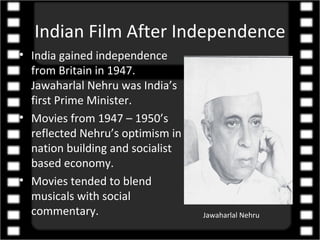
  Jawaharlal Nehru was India’s
  first Prime Minister.
• Movies from 1947 – 1950’s
  reflected Nehru’s optimism in
  nation building and socialist
  based economy.
• Movies tended to blend
  musicals with social
  commentary.                     Jawaharlal Nehru
Indian Film Industry
             Today

• India is a large heterogeneous country of many languages. Because
  of this, film production is fragmented into regional industries:
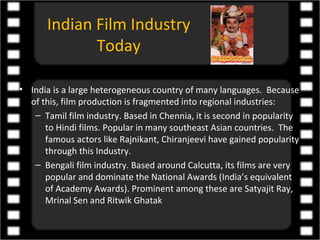
   – Tamil film industry. Based in Chennia, it is second in popularity
      to Hindi films. Popular in many southeast Asian countries. The
      famous actors like Rajnikant, Chiranjeevi have gained popularity
      through this Industry.
   – Bengali film industry. Based around Calcutta, its films are very
      popular and dominate the National Awards (India’s equivalent
      of Academy Awards). Prominent among these are Satyajit Ray,
      Mrinal Sen and Ritwik Ghatak
Contd.

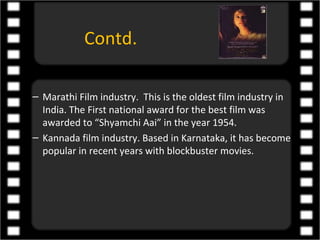
– Marathi Film industry. This is the oldest film industry in
  India. The First national award for the best film was
  awarded to “Shyamchi Aai” in the year 1954.
– Kannada film industry. Based in Karnataka, it has become
  popular in recent years with blockbuster movies.
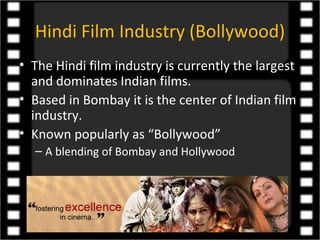
Hindi Film Industry (Bollywood)
• The Hindi film industry is currently the largest
  and dominates Indian films.
• Based in Bombay it is the center of Indian film
  industry.
• Known popularly as “Bollywood”
  – A blending of Bombay and Hollywood
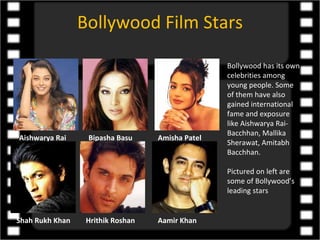
Bollywood Film Stars

                                                  Bollywood has its own
                                                  celebrities among
                                                  young people. Some
                                                  of them have also
                                                  gained international
                                                  fame and exposure
                                                  like Aishwarya Rai-
                                                  Bacchhan, Mallika
Aishwarya Rai     Bipasha Basu     Amisha Patel
                                                  Sherawat, Amitabh
                                                  Bacchhan.

                                                  Pictured on left are
                                                  some of Bollywood’s
                                                  leading stars


Shah Rukh Khan    Hrithik Roshan   Aamir Khan
The Kannada film industry
                (Sandalwood)
• The Kannada film industry, based in Karnataka, is sometimes called
  'Sandalwood', as Karnataka is known for its abundant sandalwood
  forests;
• The first big success in Kannada cinema adapted a Gubbi Company
  stage play written by G. V. Iyer to introduce the mythological
  adventure movie into that language."[17]. Kannada films has
  become very popular after the recent hits like Jogi (2005) &
  Mungaru Male (2007).
The Malayalam film industry

• The Malayalam film industry is based in Kerala.
• Malayalam movies are known for their artistic nature and they
  frequently figure in the national film awards. It is also currently
  known for being the most conservative out of the different film
  industries in India, despite the fact that it went through a liberal
  phase in the 80's.
• Notable personalities include the filmmakers Adoor
  Gopalakrishnan, Bharathan, K. G. George, G. Aravindan,
  Padmarajan, Shaji N.Karun and John Abraham
The Marathi film industry
•   Marathi Film Industry, one of the oldest film industries in India, originated
    in Nasik, and developed in Kolhapur and Pune.
•   Dadasaheb Phalke, recognized as the father of Indian cinema, was a
    pioneer of movies in Marathi. He produced the first Indian silent movie,
    and later some Marathi talkies. In his honor, a much coveted "Dadasaheb
    Phalke Award" is given annually for exceptional contribution to Indian
    cinema.
•   As an offshoot of Prabhat, V. Shantaram founded "Rajkamal Studios" in
    Pune, and produced some excellent Marathi movies in the late 1950s and
    early '60s.
•   Shwaas earned an official Indian entry for an Oscar award in 2004), "Pak
    Pak Pakaak" (won Swarovski Trophy in AFFF, Singapore, in 2005),"Sane
    Guruji", "Uttarayan", "Aga Bai, Arecchaa“ etc are the other prominent
    films.
•   Modern Marathi actors include Dilip Prabhavalkar, Bharat Jadhav, Sonali
    Kulkarni, Sadashiv Amrapurkar, Ashwini Bhave, Amruta Subhash, Atul
    Kulkarni and Sanjay Narvekar.
The Tamil film industry(Kollywood)
• The Tamil film industry (Kollywood) is based in the
  Kodambakkam area of Chennai.
• Several technicians have crossed industries to encapture
  National fame such as Bharathiraja, Selvaraghavan,
  Maniratnam, A. R. Rahman, Shankar, Ravi K. Chandran and
  Jeeva.
• several Bollywood actresses made their débuts in Kollywood,
  with Aishwarya Rai appearing in Iruvar, Priyanka Chopra in
  Thamizhan, Lara Dutta in Arasatchi and Sushmita Sen in
  Ratchagan.
• The Tamil film industry accounts for approximately 1% of the
  gross domestic product of the state of Tamil Nadu.
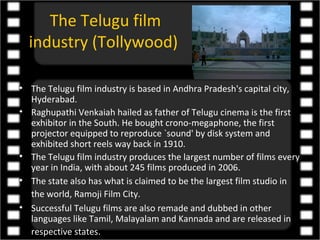
The Telugu film
  industry (Tollywood)

• The Telugu film industry is based in Andhra Pradesh's capital city,
  Hyderabad.
• Raghupathi Venkaiah hailed as father of Telugu cinema is the first
  exhibitor in the South. He bought crono-megaphone, the first
  projector equipped to reproduce `sound' by disk system and
  exhibited short reels way back in 1910.
• The Telugu film industry produces the largest number of films every
  year in India, with about 245 films produced in 2006.
• The state also has what is claimed to be the largest film studio in
  the world, Ramoji Film City.
• Successful Telugu films are also remade and dubbed in other
  languages like Tamil, Malayalam and Kannada and are released in
  respective states.
Globalization of Indian cinema
• Today, Indian cinema is becoming increasingly
  westernised. This trend is most strongly apparent in
  Bollywood.
• Bollywood also produced box-office hits like the films
  Dilwale Dulhaniya Le Jayenge and Kal Ho Naa Ho,
  both of which dealt with the overseas Indian's
  experiences.
• Indian cinema is also influencing the English and
  American musical; Baz Luhrmann's Moulin Rouge!
  (2001) incorporates a Bollywood-style dance
  sequence.
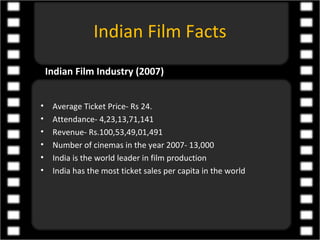
Indian Film Facts
    Indian Film Industry (2007)


•    Average Ticket Price- Rs 24.
•    Attendance- 4,23,13,71,141
•    Revenue- Rs.100,53,49,01,491
•    Number of cinemas in the year 2007- 13,000
•    India is the world leader in film production
•    India has the most ticket sales per capita in the world
Awards
• the Indian government has sponsored the
  National Film Awards (which first began in
  1954), awarded by the government run
  Directorate of Film Festivals (DFF).
• The Filmfare Awards ceremony is one of the
  oldest and most prominent film events given
  for Hindi films in India [12] and is sometimes
  referred to as the "Bollywood Oscars.
Central Board of Film Certification
• For a film to be released publicly it must
  receive approval from the board
• It’s guidelines state:
  – The Cinematograph Act lays down that a film has
    to be certified keeping the interests of
    sovereignty, integrity and security of India,
    friendly relations with foreign states ,public order,
    morality etc. in mind.
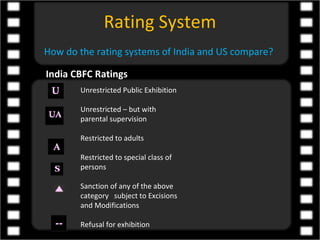
Rating System
How do the rating systems of India and US compare?

India CBFC Ratings
       Unrestricted Public Exhibition

       Unrestricted – but with
       parental supervision

       Restricted to adults

       Restricted to special class of
       persons

       Sanction of any of the above
       category subject to Excisions
       and Modifications

       Refusal for exhibition
References
• Rajadhayaksha, A. (Ed.) (2001). Encyclopedia of India cinema.
• Culturopedia.com. Cinema in India.
  http://cinema.culturopedia.com/cinemaintro.html

  http://www.sscnet.ucla.edu/southasia/Culture/Cinema/cinema.html
  http://en.wikipedia.org/wiki/Cinema_of_India
  http://www.cbfcindia.tn.nic.in/

Indian cinema

  • 1.
    Indian Cinema Shwetan Burkule Roll-8210, PUMBA
  • 2.
    Early Indian FilmHistory • First cinema show was on July 7, 1896 in Bombay • Early films were British and American imports • In early 1930’s, Indian production companies grew and were mainly centered in Bombay • Musical and dance numbers were popular in India films, reflecting the importance of dance in Hindu culture.
  • 3.
    Early India FilmHistory • Dhundiraj Govind (Dadasaheb) Phalke (1870– 1944) is known as the father of Indian Cinema. His films depicted Hindu Gods and promoted Indian independence from Britain. • Swadeshi (indigenous) movement sought independence through boycott of British goods. – This led to rapid growth A scene from Raja Harishchandra (1913), the most influential film in of Indian film industry early Indian Cinema
  • 4.
    Indian Film AfterIndependence • India gained independence from Britain in 1947. Jawaharlal Nehru was India’s first Prime Minister. • Movies from 1947 – 1950’s reflected Nehru’s optimism in nation building and socialist based economy. • Movies tended to blend musicals with social commentary. Jawaharlal Nehru
  • 5.
    Indian Film Industry Today • India is a large heterogeneous country of many languages. Because of this, film production is fragmented into regional industries: – Tamil film industry. Based in Chennia, it is second in popularity to Hindi films. Popular in many southeast Asian countries. The famous actors like Rajnikant, Chiranjeevi have gained popularity through this Industry. – Bengali film industry. Based around Calcutta, its films are very popular and dominate the National Awards (India’s equivalent of Academy Awards). Prominent among these are Satyajit Ray, Mrinal Sen and Ritwik Ghatak
  • 6.
    Contd. – Marathi Filmindustry. This is the oldest film industry in India. The First national award for the best film was awarded to “Shyamchi Aai” in the year 1954. – Kannada film industry. Based in Karnataka, it has become popular in recent years with blockbuster movies.
  • 7.
    Hindi Film Industry(Bollywood) • The Hindi film industry is currently the largest and dominates Indian films. • Based in Bombay it is the center of Indian film industry. • Known popularly as “Bollywood” – A blending of Bombay and Hollywood
  • 8.
    Bollywood Film Stars Bollywood has its own celebrities among young people. Some of them have also gained international fame and exposure like Aishwarya Rai- Bacchhan, Mallika Aishwarya Rai Bipasha Basu Amisha Patel Sherawat, Amitabh Bacchhan. Pictured on left are some of Bollywood’s leading stars Shah Rukh Khan Hrithik Roshan Aamir Khan
  • 9.
    The Kannada filmindustry (Sandalwood) • The Kannada film industry, based in Karnataka, is sometimes called 'Sandalwood', as Karnataka is known for its abundant sandalwood forests; • The first big success in Kannada cinema adapted a Gubbi Company stage play written by G. V. Iyer to introduce the mythological adventure movie into that language."[17]. Kannada films has become very popular after the recent hits like Jogi (2005) & Mungaru Male (2007).
  • 10.
    The Malayalam filmindustry • The Malayalam film industry is based in Kerala. • Malayalam movies are known for their artistic nature and they frequently figure in the national film awards. It is also currently known for being the most conservative out of the different film industries in India, despite the fact that it went through a liberal phase in the 80's. • Notable personalities include the filmmakers Adoor Gopalakrishnan, Bharathan, K. G. George, G. Aravindan, Padmarajan, Shaji N.Karun and John Abraham
  • 11.
    The Marathi filmindustry • Marathi Film Industry, one of the oldest film industries in India, originated in Nasik, and developed in Kolhapur and Pune. • Dadasaheb Phalke, recognized as the father of Indian cinema, was a pioneer of movies in Marathi. He produced the first Indian silent movie, and later some Marathi talkies. In his honor, a much coveted "Dadasaheb Phalke Award" is given annually for exceptional contribution to Indian cinema. • As an offshoot of Prabhat, V. Shantaram founded "Rajkamal Studios" in Pune, and produced some excellent Marathi movies in the late 1950s and early '60s. • Shwaas earned an official Indian entry for an Oscar award in 2004), "Pak Pak Pakaak" (won Swarovski Trophy in AFFF, Singapore, in 2005),"Sane Guruji", "Uttarayan", "Aga Bai, Arecchaa“ etc are the other prominent films. • Modern Marathi actors include Dilip Prabhavalkar, Bharat Jadhav, Sonali Kulkarni, Sadashiv Amrapurkar, Ashwini Bhave, Amruta Subhash, Atul Kulkarni and Sanjay Narvekar.
  • 12.
    The Tamil filmindustry(Kollywood) • The Tamil film industry (Kollywood) is based in the Kodambakkam area of Chennai. • Several technicians have crossed industries to encapture National fame such as Bharathiraja, Selvaraghavan, Maniratnam, A. R. Rahman, Shankar, Ravi K. Chandran and Jeeva. • several Bollywood actresses made their débuts in Kollywood, with Aishwarya Rai appearing in Iruvar, Priyanka Chopra in Thamizhan, Lara Dutta in Arasatchi and Sushmita Sen in Ratchagan. • The Tamil film industry accounts for approximately 1% of the gross domestic product of the state of Tamil Nadu.
  • 13.
    The Telugu film industry (Tollywood) • The Telugu film industry is based in Andhra Pradesh's capital city, Hyderabad. • Raghupathi Venkaiah hailed as father of Telugu cinema is the first exhibitor in the South. He bought crono-megaphone, the first projector equipped to reproduce `sound' by disk system and exhibited short reels way back in 1910. • The Telugu film industry produces the largest number of films every year in India, with about 245 films produced in 2006. • The state also has what is claimed to be the largest film studio in the world, Ramoji Film City. • Successful Telugu films are also remade and dubbed in other languages like Tamil, Malayalam and Kannada and are released in respective states.
  • 14.
    Globalization of Indiancinema • Today, Indian cinema is becoming increasingly westernised. This trend is most strongly apparent in Bollywood. • Bollywood also produced box-office hits like the films Dilwale Dulhaniya Le Jayenge and Kal Ho Naa Ho, both of which dealt with the overseas Indian's experiences. • Indian cinema is also influencing the English and American musical; Baz Luhrmann's Moulin Rouge! (2001) incorporates a Bollywood-style dance sequence.
  • 15.
    Indian Film Facts Indian Film Industry (2007) • Average Ticket Price- Rs 24. • Attendance- 4,23,13,71,141 • Revenue- Rs.100,53,49,01,491 • Number of cinemas in the year 2007- 13,000 • India is the world leader in film production • India has the most ticket sales per capita in the world
  • 16.
    Awards • the Indiangovernment has sponsored the National Film Awards (which first began in 1954), awarded by the government run Directorate of Film Festivals (DFF). • The Filmfare Awards ceremony is one of the oldest and most prominent film events given for Hindi films in India [12] and is sometimes referred to as the "Bollywood Oscars.
  • 17.
    Central Board ofFilm Certification • For a film to be released publicly it must receive approval from the board • It’s guidelines state: – The Cinematograph Act lays down that a film has to be certified keeping the interests of sovereignty, integrity and security of India, friendly relations with foreign states ,public order, morality etc. in mind.
  • 18.
    Rating System How dothe rating systems of India and US compare? India CBFC Ratings Unrestricted Public Exhibition Unrestricted – but with parental supervision Restricted to adults Restricted to special class of persons Sanction of any of the above category subject to Excisions and Modifications Refusal for exhibition
  • 19.
    References • Rajadhayaksha, A.(Ed.) (2001). Encyclopedia of India cinema. • Culturopedia.com. Cinema in India. http://cinema.culturopedia.com/cinemaintro.html http://www.sscnet.ucla.edu/southasia/Culture/Cinema/cinema.html http://en.wikipedia.org/wiki/Cinema_of_India http://www.cbfcindia.tn.nic.in/