HISTORY OF ARCHITECTURE
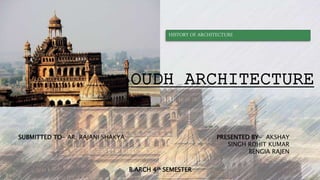
OUDH ARCHITECTURE
PRESENTED BY- AKSHAY
SINGH ROHIT KUMAR
BENGIA RAJEN
SUBMITTED TO- AR. RAJANI SHAKYA
B.ARCH 4th SEMESTER
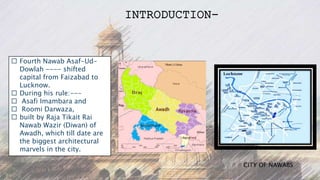
 Fourth Nawab Asaf-Ud-
Dowlah ---- shifted
capital from Faizabad to
Lucknow.
 During his rule:---
 Asafi Imambara and
 Roomi Darwaza,
 built by Raja Tikait Rai
Nawab Wazir (Diwan) of
Awadh, which till date are
the biggest architectural
marvels in the city.
CITY OF NAWABS
INTRODUCTION-
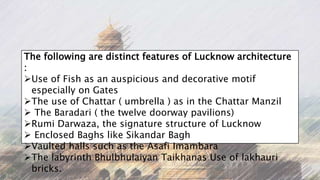
The following are distinct features of Lucknow architecture
:
Use of Fish as an auspicious and decorative motif
especially on Gates
The use of Chattar ( umbrella ) as in the Chattar Manzil
 The Baradari ( the twelve doorway pavilions)
Rumi Darwaza, the signature structure of Lucknow
 Enclosed Baghs like Sikandar Bagh
Vaulted halls such as the Asafi Imambara
The labyrinth Bhulbhulaiyan Taikhanas Use of lakhauri
bricks.
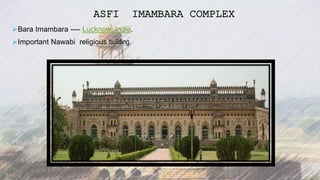
ASFI IMAMBARA COMPLEX
Bara Imambara ---- Lucknow, India.
Important Nawabi religious building.
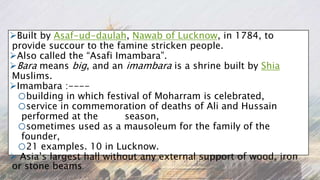
Built by Asaf-ud-daulah, Nawab of Lucknow, in 1784, to
provide succour to the famine stricken people.
Also called the “Asafi Imambara”.
Bara means big, and an imambara is a shrine built by Shia
Muslims.
Imambara :----
obuilding in which festival of Moharram is celebrated,
oservice in commemoration of deaths of Ali and Hussain
performed at the season,
osometimes used as a mausoleum for the family of the
founder,
o21 examples. 10 in Lucknow.
 Asia’s largest hall without any external support of wood, iron
or stone beams.
BUILDING COMPOSITION
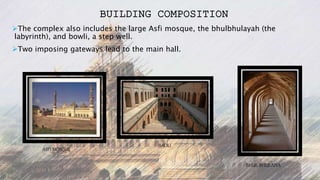
The complex also includes the large Asfi mosque, the bhulbhulayah (the
labyrinth), and bowli, a step well.
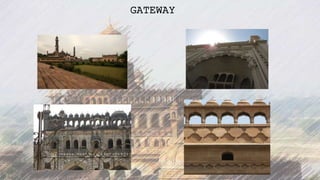
Two imposing gateways lead to the main hall.
ASFI MOSQUE
BAOLI
BHUL-BHULAIYA
ASFI IMAMBARA COMPLEX
Entrance Gateways
Bada Imambada
Bhul Bhulaiya
Baoli
Mosque
Rumi Darwaza
ENTRANCE GATEWAYS
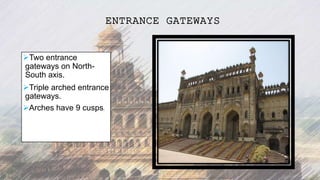
Two entrance
gateways on North-
South axis.
Triple arched entrance
gateways.
Arches have 9 cusps.
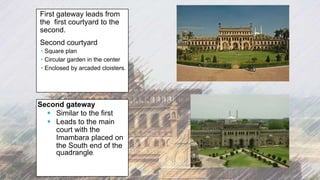
First gateway leads from
the first courtyard to the
second.
Second courtyard
 Square plan
 Circular garden in the center
 Enclosed by arcaded cloisters.
Second gateway
 Similar to the first
 Leads to the main
court with the
Imambara placed on
the South end of the
quadrangle.
GATEWAY
BADA IMAMBADA
SITE PLAN- ASAFI
COMPLEX
ARCHITECTURE
Reflects the maturation of ornamented Mughal design.
No European elements or the use of iron.
 Neither a mosque, nor a mausoleum, but a huge building having
interesting elements.
 Construction of halls and use of vaults show a strong Islamic
influence.
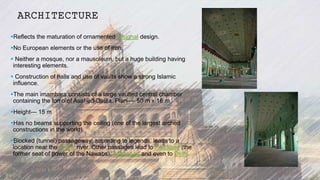
The main imambara consists of a large vaulted central chamber
containing the tomb of Asaf-ud-Daula. Plan---- 50 m x 16 m
Height--- 15 m
Has no beams supporting the ceiling (one of the largest arched
constructions in the world).
Blocked (tunnel) passageway, according to legends, leads to a
location near the Gomti river. Other passages lead to Faizabad (the
former seat of power of the Nawabs), Allahabad and even to Delhi.
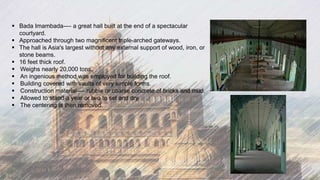
 Bada Imambada---- a great hall built at the end of a spectacular
courtyard.
 Approached through two magnificent triple-arched gateways.
 The hall is Asia's largest without any external support of wood, iron, or
stone beams.
 16 feet thick roof.
 Weighs nearly 20,000 tons.
 An ingenious method was employed for building the roof.
 Building covered with vaults of very simple forms.
 Construction material---- rubble or coarse concrete of bricks and mud.
 Allowed to stand a year or two to set and dry.
 The centering is then removed.
The vault is a more durable form of roof than the most scientific Gothic
vaulting.
3 halls under the same roof.
Central hall---- the Persian Hall.
2 adjoining halls.
The China Hall is square at ground level, becomes octagonal at mid-
height, and 16 sided at the top.
The India Hall has been fashioned like a watermelon.
Persian architect---- Kifayatullah (also lies buried in the main hall of the
Imambara).
Marvelous Acoustics. Even the slightest whisper can be heard at the
other corner of the hall.
On the top terrace, approached through a narrow flight of steps----
“bhulbhulaiya”.
The terrace gives a grand view of old Lucknow with numerous
mosques and minarets on the horizon.
BHULBHULAIYAH
Present in the main imambara building.
8 surrounding chambers built to different
roof heights,
 permit the space above
these to be reconstructed
as a labyrinth----
“bhulbhulayah”,
 with passages
interconnecting through
489 identical doorways.
Came about unintentionally to support the
weight of the building.
ASFI MOSQUE
MOSQUE
 within the Imambada courtyard
 elegant structure
 flanked by a grand flight of steps
leading to its paved floor.
 Located in the west of the
main courtyard.
 Due to quibla orientation
(towards Mecca) its axiality
strikes a discord with that of
the Bara Imambara.
 Just as enormous as the Bara
Imambara itself.
BAOLIS
A baoli consists of two parts:--
--
 vertical shaft from which
water is drawn,
 surrounding inclined
subterranean
passageways, chambers
and steps which provide
access to the well.
Cool, quiet retreats during
summers.
Chambers in some baolis are
seven or eight levels below the
ground level.
SHAHI BAOLI (STEP WELL)
BAOLI
 five- storied baoli (step well)
 Called the Shahi-Hammam (royal
bath),
 baoli is connected with the river
Gomti.
 Only first two stories above water,
the rest being perennially under
water.
 Used as a hiding place.
 Used as summer palaces due to
natural coolness
“Shahi Baoli”----eastern side of the Asafi
Imambara complex.
Deep circular well at the eastern end.
Approached through a flight of steps and a
door facing west.
Rectangular plan.
Material---- Lakhauri brick and lime mortar.
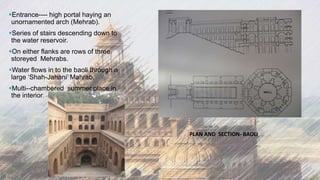
Entrance---- high portal haying an
unornamented arch (Mehrab).
Series of stairs descending down to
the water reservoir.
On either flanks are rows of three
storeyed Mehrabs.
Water flows in to the baoli through a
large ‘Shah-Jahani’ Mahrab.
Multi--chambered summer place in
the interior.
PLAN AND SECTION- BAOLI
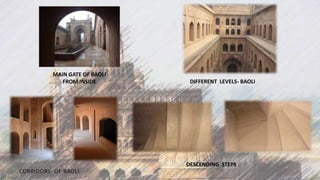
MAIN GATE OF BAOLI
FROM INSIDE DIFFERENT LEVELS- BAOLI
CORRIDORS OF BAOLI
DESCENDING STEPS
ROOMI DARWAZA
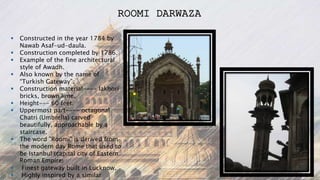
 Constructed in the year 1784 by
Nawab Asaf-ud-daula.
 Construction completed by 1786.
 Example of the fine architectural
style of Awadh.
 Also known by the name of
“Turkish Gateway”.
 Construction material---- lakhori
bricks, brown lime.
 Height--- 60 feet.
 Uppermost part---- octagonal
Chatri (Umbrella) carved
beautifully, approachable by a
staircase.
 The word "Roomi" is derived from
the modern day Rome that used to
be Istanbul (capital city of Eastern
Roman Empire).
 Finest gateway built in Lucknow.
 Highly inspired by a similar
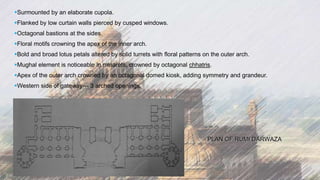
Surmounted by an elaborate cupola.
Flanked by low curtain walls pierced by cusped windows.
Octagonal bastions at the sides.
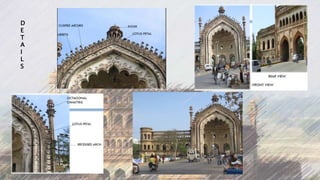
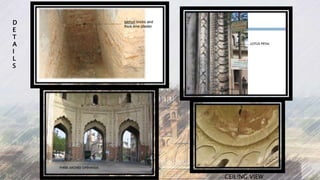
Floral motifs crowning the apex of the inner arch.
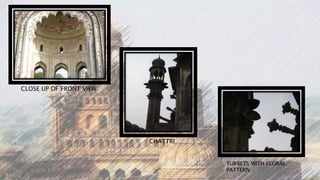
Bold and broad lotus petals altered by solid turrets with floral patterns on the outer arch.
Mughal element is noticeable in minarets, crowned by octagonal chhatris.
Apex of the outer arch crowned by an octagonal domed kiosk, adding symmetry and grandeur.
Western side of gateway--- 3 arched openings.
PLAN OF RUMI DARWAZA
D
E
T
A
I
L
S
CEILING VIEW
D
E
T
A
I
L
S
CLOSE UP OF FRONT VIEW
TURRETS WITH FLORAL
PATTERN
CHATTRI
the end

Awadh architecture

  • 1.
    HISTORY OF ARCHITECTURE OUDHARCHITECTURE PRESENTED BY- AKSHAY SINGH ROHIT KUMAR BENGIA RAJEN SUBMITTED TO- AR. RAJANI SHAKYA B.ARCH 4th SEMESTER
  • 2.
     Fourth NawabAsaf-Ud- Dowlah ---- shifted capital from Faizabad to Lucknow.  During his rule:---  Asafi Imambara and  Roomi Darwaza,  built by Raja Tikait Rai Nawab Wazir (Diwan) of Awadh, which till date are the biggest architectural marvels in the city. CITY OF NAWABS INTRODUCTION-
  • 3.
    The following aredistinct features of Lucknow architecture : Use of Fish as an auspicious and decorative motif especially on Gates The use of Chattar ( umbrella ) as in the Chattar Manzil  The Baradari ( the twelve doorway pavilions) Rumi Darwaza, the signature structure of Lucknow  Enclosed Baghs like Sikandar Bagh Vaulted halls such as the Asafi Imambara The labyrinth Bhulbhulaiyan Taikhanas Use of lakhauri bricks.
  • 4.
    ASFI IMAMBARA COMPLEX BaraImambara ---- Lucknow, India. Important Nawabi religious building.
  • 5.
    Built by Asaf-ud-daulah,Nawab of Lucknow, in 1784, to provide succour to the famine stricken people. Also called the “Asafi Imambara”. Bara means big, and an imambara is a shrine built by Shia Muslims. Imambara :---- obuilding in which festival of Moharram is celebrated, oservice in commemoration of deaths of Ali and Hussain performed at the season, osometimes used as a mausoleum for the family of the founder, o21 examples. 10 in Lucknow.  Asia’s largest hall without any external support of wood, iron or stone beams.
  • 6.
    BUILDING COMPOSITION The complexalso includes the large Asfi mosque, the bhulbhulayah (the labyrinth), and bowli, a step well. Two imposing gateways lead to the main hall. ASFI MOSQUE BAOLI BHUL-BHULAIYA
  • 7.
    ASFI IMAMBARA COMPLEX EntranceGateways Bada Imambada Bhul Bhulaiya Baoli Mosque Rumi Darwaza
  • 8.
    ENTRANCE GATEWAYS Two entrance gatewayson North- South axis. Triple arched entrance gateways. Arches have 9 cusps.
  • 9.
    First gateway leadsfrom the first courtyard to the second. Second courtyard  Square plan  Circular garden in the center  Enclosed by arcaded cloisters. Second gateway  Similar to the first  Leads to the main court with the Imambara placed on the South end of the quadrangle.
  • 10.
  • 11.
  • 12.
    ARCHITECTURE Reflects the maturationof ornamented Mughal design. No European elements or the use of iron.  Neither a mosque, nor a mausoleum, but a huge building having interesting elements.  Construction of halls and use of vaults show a strong Islamic influence. The main imambara consists of a large vaulted central chamber containing the tomb of Asaf-ud-Daula. Plan---- 50 m x 16 m Height--- 15 m Has no beams supporting the ceiling (one of the largest arched constructions in the world). Blocked (tunnel) passageway, according to legends, leads to a location near the Gomti river. Other passages lead to Faizabad (the former seat of power of the Nawabs), Allahabad and even to Delhi.
  • 13.
     Bada Imambada----a great hall built at the end of a spectacular courtyard.  Approached through two magnificent triple-arched gateways.  The hall is Asia's largest without any external support of wood, iron, or stone beams.  16 feet thick roof.  Weighs nearly 20,000 tons.  An ingenious method was employed for building the roof.  Building covered with vaults of very simple forms.  Construction material---- rubble or coarse concrete of bricks and mud.  Allowed to stand a year or two to set and dry.  The centering is then removed.
  • 14.
    The vault isa more durable form of roof than the most scientific Gothic vaulting. 3 halls under the same roof. Central hall---- the Persian Hall. 2 adjoining halls. The China Hall is square at ground level, becomes octagonal at mid- height, and 16 sided at the top. The India Hall has been fashioned like a watermelon. Persian architect---- Kifayatullah (also lies buried in the main hall of the Imambara). Marvelous Acoustics. Even the slightest whisper can be heard at the other corner of the hall. On the top terrace, approached through a narrow flight of steps---- “bhulbhulaiya”. The terrace gives a grand view of old Lucknow with numerous mosques and minarets on the horizon.
  • 15.
    BHULBHULAIYAH Present in themain imambara building. 8 surrounding chambers built to different roof heights,  permit the space above these to be reconstructed as a labyrinth---- “bhulbhulayah”,  with passages interconnecting through 489 identical doorways. Came about unintentionally to support the weight of the building.
  • 16.
    ASFI MOSQUE MOSQUE  withinthe Imambada courtyard  elegant structure  flanked by a grand flight of steps leading to its paved floor.  Located in the west of the main courtyard.  Due to quibla orientation (towards Mecca) its axiality strikes a discord with that of the Bara Imambara.  Just as enormous as the Bara Imambara itself.
  • 17.
    BAOLIS A baoli consistsof two parts:-- --  vertical shaft from which water is drawn,  surrounding inclined subterranean passageways, chambers and steps which provide access to the well. Cool, quiet retreats during summers. Chambers in some baolis are seven or eight levels below the ground level.
  • 18.
    SHAHI BAOLI (STEPWELL) BAOLI  five- storied baoli (step well)  Called the Shahi-Hammam (royal bath),  baoli is connected with the river Gomti.  Only first two stories above water, the rest being perennially under water.  Used as a hiding place.  Used as summer palaces due to natural coolness “Shahi Baoli”----eastern side of the Asafi Imambara complex. Deep circular well at the eastern end. Approached through a flight of steps and a door facing west. Rectangular plan. Material---- Lakhauri brick and lime mortar.
  • 19.
    Entrance---- high portalhaying an unornamented arch (Mehrab). Series of stairs descending down to the water reservoir. On either flanks are rows of three storeyed Mehrabs. Water flows in to the baoli through a large ‘Shah-Jahani’ Mahrab. Multi--chambered summer place in the interior. PLAN AND SECTION- BAOLI
  • 20.
    MAIN GATE OFBAOLI FROM INSIDE DIFFERENT LEVELS- BAOLI CORRIDORS OF BAOLI DESCENDING STEPS
  • 21.
    ROOMI DARWAZA  Constructedin the year 1784 by Nawab Asaf-ud-daula.  Construction completed by 1786.  Example of the fine architectural style of Awadh.  Also known by the name of “Turkish Gateway”.  Construction material---- lakhori bricks, brown lime.  Height--- 60 feet.  Uppermost part---- octagonal Chatri (Umbrella) carved beautifully, approachable by a staircase.  The word "Roomi" is derived from the modern day Rome that used to be Istanbul (capital city of Eastern Roman Empire).  Finest gateway built in Lucknow.  Highly inspired by a similar
  • 22.
    Surmounted by anelaborate cupola. Flanked by low curtain walls pierced by cusped windows. Octagonal bastions at the sides. Floral motifs crowning the apex of the inner arch. Bold and broad lotus petals altered by solid turrets with floral patterns on the outer arch. Mughal element is noticeable in minarets, crowned by octagonal chhatris. Apex of the outer arch crowned by an octagonal domed kiosk, adding symmetry and grandeur. Western side of gateway--- 3 arched openings. PLAN OF RUMI DARWAZA
  • 23.
  • 24.
  • 25.
    CLOSE UP OFFRONT VIEW TURRETS WITH FLORAL PATTERN CHATTRI
  • 26.