BACTERIAL VAGINOSIS
DR LAHARI
WHAT IS BACTERIAL VAGINOSIS
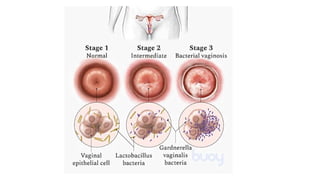
• Polymicrobial vaginal infection involving a reduction in the
amount of lactobacilli bacteria and an overgrowth of
anerobic bacteria
• But in the absence of a demonstrable inflammatory response
INTRODUCTION
• Bacterial vaginosis is the most common cause of abnormal vaginal
odour and discharge in women of reproductive age group
• It is caused by a change in the type of bacteria found in the vagina.
• Normally, bacteria belonging mostly to the Lactobacillus family live
harmlessly in the vagina and produce chemicals that keep the vagina
mildly acidic.
• In bacterial vaginosis, Lactobacillus bacteria are replaced by other
types of bacteria that normally are present in smaller concentrations
in the vagina.
HISTORICAL ASPECTS
• Gardner and Dukes first described the syndrome as "Haemophilus vaginalis
vaginitis" in 1955.
• They concluded that it was a sexually transmitted disease (STD) as the
isolated aetiological agent, H. vaginalis (now renamed Gardnerella
vaginalis)
• How ever Leopold had previously described a gram negative, non-motile
rod isolated from women with symptoms characteristic of BV and it is now
known that Gardenella.vaginalis
• Further research showed wide range of other microorganisms causing BV –
Mycoplasma hominis,Mobiluncus spp,Prevotella spp
SYNONYMS
• Haemophilus vaginalis vaginitis
• Gardnerella vaginalis vaginitis
• Vaginal bacteriosis
• Leukorrhea
• Anerobic vaginosis
PREDISPOSING FACTORS
1)Increase vaginal Ph
Semen
After menstruation when estradiol levels increase
2)Decrease lactobacilli
Multiple sex partners
Vaginal douching
3) Cigarette smoking
4)Use of IUCDS
• Women never had vaginal intercourse can also develop bacterial vaginosis
ETIOlOGY
It is polymicrobial
• G.vaginalis (coccobacilli,surface pathogen)
• Mycoplasma hominis
• Anaerobic bacteria (Bacteroids,Mobiluncus,Prevotella) &
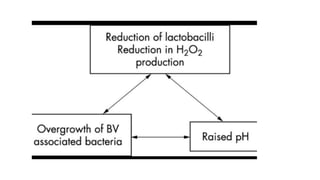
There is synergistic relationship between the acquired organisms and replace
lactobacilli
Their metabolism produces volatile amines & organic acids other than lactic acids
leading to smell and increase pH
• Mobiluncus — produce trimethylamine giving the smell of rotting fish
• Mobiluncus and Bacteriods — produce succinate(ketoacid) – raises vaginal
Ph
• Absence of lactic acid & the production of succinate blunt the chemotactic
response of polymorphnuclear leukocytes & reduce their killing ability
• This explains absence of cellular inflammatory response
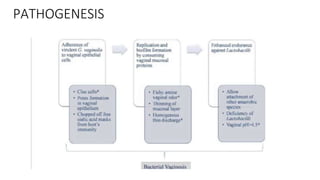
PATHOGENESIS
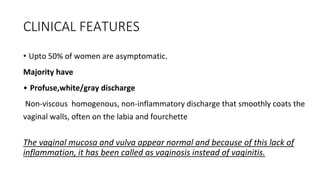
CLINICAL FEATURES
• Upto 50% of women are asymptomatic.
Majority have
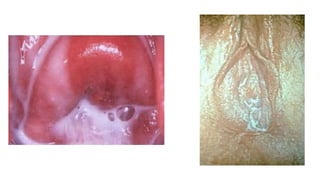
• Profuse,white/gray discharge
Non-viscous homogenous, non-inflammatory discharge that smoothly coats the
vaginal walls, often on the labia and fourchette
The vaginal mucosa and vulva appear normal and because of this lack of
inflammation, it has been called as vaginosis instead of vaginitis.
• Unpleasant “fishy” vaginal odour
The majority of women with BV note a foul odour in the genital area following intercourse
It is because when alkalinization of the secretions by semen occurs, leading to
volatilization of polyamines.
Other symptoms(rare)
• pruritus,
• pain during coitus, and
• lower abdominal pain
• Burning sensation
DIAGNOSIS
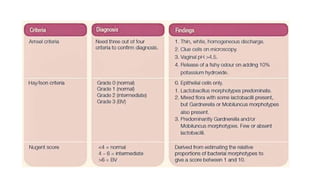
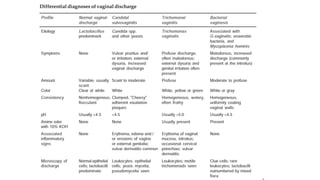
• The method of choice for diagnosing BV by — Amsel's clinical criteria
• Amsel criteria now often accepted as the "gold standard"
AMSEL CRITERIA
Diagnosis requires three or more of the following clinical/diagnostic
features
• Homogeneous,grayish white,thin,adherent vaginal discharge
• Elevated vaginal pH >4.5
• Positive amine test (Whiff test)
• 20% "clue cells" (vaginal epithelial cells adhered to by infective
microbes) on microscopic examination of direct KOH mount
Vaginal discharge:
• The discharge should be thin, homogenous and uniformly
adherent to the vaginal walls.
pH test
• Specimen collected from the lateral or posterior fornix is touched
directly on the paper Ph indicator strips(3.8-6.0)
• Alternatively, the pH paper can be placed on vaginal fluid pooling in
the speculum after the removal from the vagina
• It has the greatest sensitivity of all four clinical signs,but the lowest
specificity
Amine test(sniff test):
Addition of 10% KOH to a sample of vaginal discharge
produces fishy odour
It has a positive predictive value of 90% & specificity of 70%
Laboratory methods
• DIRECT MICROSCOPY - DETECTION OF CLUE CELLS
1)WET MOUNT
2)GRAM’S STAINING SMEAR
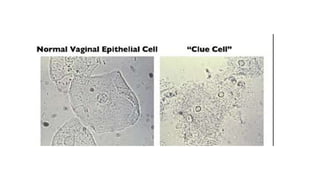
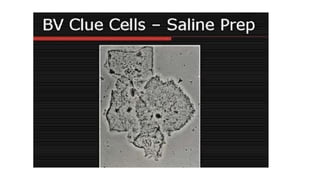
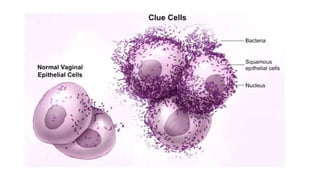
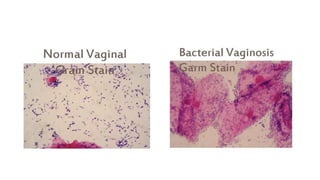
Clue cells:
• Wet mount and Gram's stain of vaginal secretions should be done to
look for 'clue cells( epithelial cells covered with G. vaginalis ) to the
diagnosis of BV.
• Detection of clue cells is the most useful single procedure for
diagnosis of BV
• Gram's staining is superior over wet mount, reveals characteristic
morphology of bacteria and clue cells
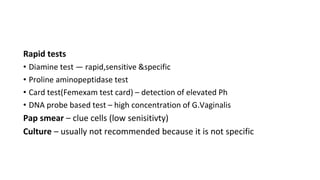
Rapid tests
• Diamine test — rapid,sensitive &specific
• Proline aminopeptidase test
• Card test(Femexam test card) – detection of elevated Ph
• DNA probe based test – high concentration of G.Vaginalis
Pap smear – clue cells (low senisitivty)
Culture – usually not recommended because it is not specific
OTHER CRITERIA
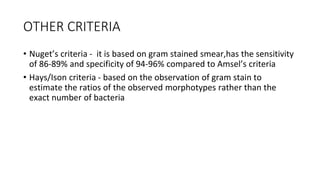
• Nuget’s criteria - it is based on gram stained smear,has the sensitivity
of 86-89% and specificity of 94-96% compared to Amsel’s criteria
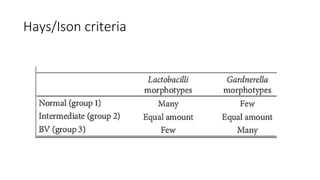
• Hays/Ison criteria - based on the observation of gram stain to
estimate the ratios of the observed morphotypes rather than the
exact number of bacteria
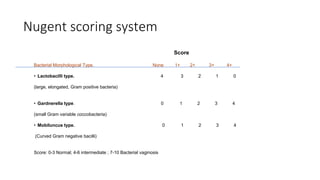
Nugent scoring system
Score
Bacterial Morphological Type. None 1+ 2+ 3+ 4+
• Lactobacilli type. 4 3 2 1 0
(large, elongated, Gram positive bacteria)
• Gardnerella type. 0 1 2 3 4
(small Gram variable coccobacteria)
• Mobiluncus type. 0 1 2 3 4
(Curved Gram negative bacilli)
Score: 0-3 Normal; 4-6 intermediate ; 7-10 Bacterial vaginosis
Hays/Ison criteria
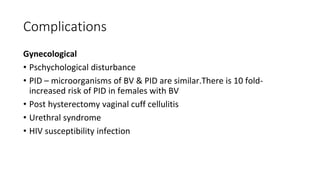
Complications
Gynecological
• Pschychological disturbance
• PID – microorganisms of BV & PID are similar.There is 10 fold-
increased risk of PID in females with BV
• Post hysterectomy vaginal cuff cellulitis
• Urethral syndrome
• HIV susceptibility infection
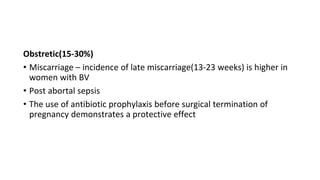
Obstretic(15-30%)
• Miscarriage – incidence of late miscarriage(13-23 weeks) is higher in
women with BV
• Post abortal sepsis
• The use of antibiotic prophylaxis before surgical termination of
pregnancy demonstrates a protective effect
• Preterm labour
• The earlier in pregnancy that BV is detected the greater the risk of
PTL.
• Bactraemia after instrumental delivery
• OTHERS - post partum endometritis,post cesarean wound infection
HIV AND BACTERIAL VAGINOSIS
• BV is characterized by the absence of lactobacilli and thus an elevated pH.
• Lactobacilli produce hydrogen peroxide, which is toxic to a number of microorganisms,
including HIV..
• A low vaginal pH may inhibit CD4 lymphocyte activation and therefore decrease HIV
target cells in the vagina; conversely, an elevated pH may make the vagina more
conducive to HIV survival and adherence.
• BV has also been shown to increase intravaginal levels of interleukin 10, which increases
susceptibility of macrophages to HIV.
• In addition, the mucin degrading enzymes in BV will make it easier for HIV to infect by
breaking down the cervicovaginal mucosa.
• It has also been hypothesized that the level of acidity within the vagina may affect CD4
lymphocyte activation.
• The more alkaline the environment, the more likely it is that CD4 lymphocytes will be
activated and thus act as suitable target cells for HIV
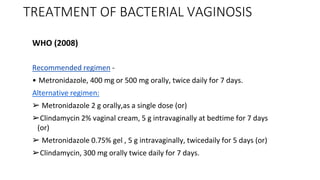
TREATMENT OF BACTERIAL VAGINOSIS
WHO (2008)
Recommended regimen -
• Metronidazole, 400 mg or 500 mg orally, twice daily for 7 days.
Alternative regimen:
➢ Metronidazole 2 g orally,as a single dose (or)
➢Clindamycin 2% vaginal cream, 5 g intravaginally at bedtime for 7 days
(or)
➢ Metronidazole 0.75% gel , 5 g intravaginally, twicedaily for 5 days (or)
➢Clindamycin, 300 mg orally twice daily for 7 days.
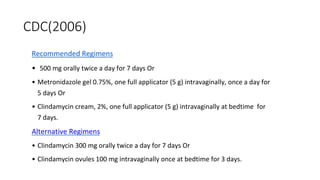
CDC(2006)
Recommended Regimens
• 500 mg orally twice a day for 7 days Or
• Metronidazole gel 0.75%, one full applicator (5 g) intravaginally, once a day for
5 days Or
• Clindamycin cream, 2%, one full applicator (5 g) intravaginally at bedtime for
7 days.
Alternative Regimens
• Clindamycin 300 mg orally twice a day for 7 days Or
• Clindamycin ovules 100 mg intravaginally once at bedtime for 3 days.
NACO(2004)
• Recommended regimens
• Metronidazole 400 mg orally twice daily for 7 days Or
• Metronidazole 2 g orally as a single dose Or
• Tinidazole 2 gm orally as a single dose
However in symptomatic women in the first trimester and those intolerant to
Metronidazole or Tinidazole, Imidazole pessaries cream may be given for 7 days
TREATMENT IN PREGNANT WOMEN
Recommended Regimens
• Metronidazole 250 mg orally thrice a day for 7 days or
• Metronidazole 500 mg orally twice a day for 7 days.
• Clindamycin 300mg orally twice a day for 7 days
Metronidazole not recommended for use in first trimester,but
It may be used during the second and third trimester
TREATMENT OF ASYMPTOTIC INFECTION
• Generally asymptomatic patients are not treated and often they
improve spontaneously
• Treatment indicated for asymptomatic women,who are about to
undergo gynae procedures (particularly termination of pregnancy)
and in HIGH RISK PREGNANCIES
• No evidence that treating sexual partners of women with BV is
beneficial
Bacterial vaginosis - relapse
• 30% recurrence in 3 months
• 50% recurrence in 12 months
• Long term suppresive antibiotics may be indicated when three or
more episodes within a 12 month period
References
• Sexually transmitted diseases and HIV/Aids by
VINOD.K.SHARMA 2nd edition
• Sexually transmitted infections by SOMESH GUPTHA and
BUSHAN KUMAR 2nd edition
• Sexually transmitted diseases by KING.K.HOLMES 4th edition
Thank you

BACTERIAL VAGINOSIS final.pptx

  • 1.
  • 2.
    WHAT IS BACTERIALVAGINOSIS • Polymicrobial vaginal infection involving a reduction in the amount of lactobacilli bacteria and an overgrowth of anerobic bacteria • But in the absence of a demonstrable inflammatory response
  • 3.
    INTRODUCTION • Bacterial vaginosisis the most common cause of abnormal vaginal odour and discharge in women of reproductive age group • It is caused by a change in the type of bacteria found in the vagina.
  • 4.
    • Normally, bacteriabelonging mostly to the Lactobacillus family live harmlessly in the vagina and produce chemicals that keep the vagina mildly acidic. • In bacterial vaginosis, Lactobacillus bacteria are replaced by other types of bacteria that normally are present in smaller concentrations in the vagina.
  • 5.
    HISTORICAL ASPECTS • Gardnerand Dukes first described the syndrome as "Haemophilus vaginalis vaginitis" in 1955. • They concluded that it was a sexually transmitted disease (STD) as the isolated aetiological agent, H. vaginalis (now renamed Gardnerella vaginalis) • How ever Leopold had previously described a gram negative, non-motile rod isolated from women with symptoms characteristic of BV and it is now known that Gardenella.vaginalis • Further research showed wide range of other microorganisms causing BV – Mycoplasma hominis,Mobiluncus spp,Prevotella spp
  • 6.
    SYNONYMS • Haemophilus vaginalisvaginitis • Gardnerella vaginalis vaginitis • Vaginal bacteriosis • Leukorrhea • Anerobic vaginosis
  • 7.
    PREDISPOSING FACTORS 1)Increase vaginalPh Semen After menstruation when estradiol levels increase 2)Decrease lactobacilli Multiple sex partners Vaginal douching 3) Cigarette smoking 4)Use of IUCDS • Women never had vaginal intercourse can also develop bacterial vaginosis
  • 8.
    ETIOlOGY It is polymicrobial •G.vaginalis (coccobacilli,surface pathogen) • Mycoplasma hominis • Anaerobic bacteria (Bacteroids,Mobiluncus,Prevotella) & There is synergistic relationship between the acquired organisms and replace lactobacilli Their metabolism produces volatile amines & organic acids other than lactic acids leading to smell and increase pH
  • 9.
    • Mobiluncus —produce trimethylamine giving the smell of rotting fish • Mobiluncus and Bacteriods — produce succinate(ketoacid) – raises vaginal Ph • Absence of lactic acid & the production of succinate blunt the chemotactic response of polymorphnuclear leukocytes & reduce their killing ability • This explains absence of cellular inflammatory response
  • 11.
  • 12.
    CLINICAL FEATURES • Upto50% of women are asymptomatic. Majority have • Profuse,white/gray discharge Non-viscous homogenous, non-inflammatory discharge that smoothly coats the vaginal walls, often on the labia and fourchette The vaginal mucosa and vulva appear normal and because of this lack of inflammation, it has been called as vaginosis instead of vaginitis.
  • 14.
    • Unpleasant “fishy”vaginal odour The majority of women with BV note a foul odour in the genital area following intercourse It is because when alkalinization of the secretions by semen occurs, leading to volatilization of polyamines. Other symptoms(rare) • pruritus, • pain during coitus, and • lower abdominal pain • Burning sensation
  • 15.
    DIAGNOSIS • The methodof choice for diagnosing BV by — Amsel's clinical criteria • Amsel criteria now often accepted as the "gold standard"
  • 16.
    AMSEL CRITERIA Diagnosis requiresthree or more of the following clinical/diagnostic features • Homogeneous,grayish white,thin,adherent vaginal discharge • Elevated vaginal pH >4.5 • Positive amine test (Whiff test) • 20% "clue cells" (vaginal epithelial cells adhered to by infective microbes) on microscopic examination of direct KOH mount
  • 17.
    Vaginal discharge: • Thedischarge should be thin, homogenous and uniformly adherent to the vaginal walls.
  • 18.
    pH test • Specimencollected from the lateral or posterior fornix is touched directly on the paper Ph indicator strips(3.8-6.0) • Alternatively, the pH paper can be placed on vaginal fluid pooling in the speculum after the removal from the vagina • It has the greatest sensitivity of all four clinical signs,but the lowest specificity
  • 19.
    Amine test(sniff test): Additionof 10% KOH to a sample of vaginal discharge produces fishy odour It has a positive predictive value of 90% & specificity of 70%
  • 20.
    Laboratory methods • DIRECTMICROSCOPY - DETECTION OF CLUE CELLS 1)WET MOUNT 2)GRAM’S STAINING SMEAR
  • 21.
    Clue cells: • Wetmount and Gram's stain of vaginal secretions should be done to look for 'clue cells( epithelial cells covered with G. vaginalis ) to the diagnosis of BV. • Detection of clue cells is the most useful single procedure for diagnosis of BV • Gram's staining is superior over wet mount, reveals characteristic morphology of bacteria and clue cells
  • 26.
    Rapid tests • Diaminetest — rapid,sensitive &specific • Proline aminopeptidase test • Card test(Femexam test card) – detection of elevated Ph • DNA probe based test – high concentration of G.Vaginalis Pap smear – clue cells (low senisitivty) Culture – usually not recommended because it is not specific
  • 27.
    OTHER CRITERIA • Nuget’scriteria - it is based on gram stained smear,has the sensitivity of 86-89% and specificity of 94-96% compared to Amsel’s criteria • Hays/Ison criteria - based on the observation of gram stain to estimate the ratios of the observed morphotypes rather than the exact number of bacteria
  • 28.
    Nugent scoring system Score BacterialMorphological Type. None 1+ 2+ 3+ 4+ • Lactobacilli type. 4 3 2 1 0 (large, elongated, Gram positive bacteria) • Gardnerella type. 0 1 2 3 4 (small Gram variable coccobacteria) • Mobiluncus type. 0 1 2 3 4 (Curved Gram negative bacilli) Score: 0-3 Normal; 4-6 intermediate ; 7-10 Bacterial vaginosis
  • 29.
  • 32.
    Complications Gynecological • Pschychological disturbance •PID – microorganisms of BV & PID are similar.There is 10 fold- increased risk of PID in females with BV • Post hysterectomy vaginal cuff cellulitis • Urethral syndrome • HIV susceptibility infection
  • 33.
    Obstretic(15-30%) • Miscarriage –incidence of late miscarriage(13-23 weeks) is higher in women with BV • Post abortal sepsis • The use of antibiotic prophylaxis before surgical termination of pregnancy demonstrates a protective effect
  • 34.
    • Preterm labour •The earlier in pregnancy that BV is detected the greater the risk of PTL. • Bactraemia after instrumental delivery • OTHERS - post partum endometritis,post cesarean wound infection
  • 35.
    HIV AND BACTERIALVAGINOSIS • BV is characterized by the absence of lactobacilli and thus an elevated pH. • Lactobacilli produce hydrogen peroxide, which is toxic to a number of microorganisms, including HIV.. • A low vaginal pH may inhibit CD4 lymphocyte activation and therefore decrease HIV target cells in the vagina; conversely, an elevated pH may make the vagina more conducive to HIV survival and adherence.
  • 36.
    • BV hasalso been shown to increase intravaginal levels of interleukin 10, which increases susceptibility of macrophages to HIV. • In addition, the mucin degrading enzymes in BV will make it easier for HIV to infect by breaking down the cervicovaginal mucosa. • It has also been hypothesized that the level of acidity within the vagina may affect CD4 lymphocyte activation. • The more alkaline the environment, the more likely it is that CD4 lymphocytes will be activated and thus act as suitable target cells for HIV
  • 38.
    TREATMENT OF BACTERIALVAGINOSIS WHO (2008) Recommended regimen - • Metronidazole, 400 mg or 500 mg orally, twice daily for 7 days. Alternative regimen: ➢ Metronidazole 2 g orally,as a single dose (or) ➢Clindamycin 2% vaginal cream, 5 g intravaginally at bedtime for 7 days (or) ➢ Metronidazole 0.75% gel , 5 g intravaginally, twicedaily for 5 days (or) ➢Clindamycin, 300 mg orally twice daily for 7 days.
  • 39.
    CDC(2006) Recommended Regimens • 500mg orally twice a day for 7 days Or • Metronidazole gel 0.75%, one full applicator (5 g) intravaginally, once a day for 5 days Or • Clindamycin cream, 2%, one full applicator (5 g) intravaginally at bedtime for 7 days. Alternative Regimens • Clindamycin 300 mg orally twice a day for 7 days Or • Clindamycin ovules 100 mg intravaginally once at bedtime for 3 days.
  • 40.
    NACO(2004) • Recommended regimens •Metronidazole 400 mg orally twice daily for 7 days Or • Metronidazole 2 g orally as a single dose Or • Tinidazole 2 gm orally as a single dose However in symptomatic women in the first trimester and those intolerant to Metronidazole or Tinidazole, Imidazole pessaries cream may be given for 7 days
  • 41.
    TREATMENT IN PREGNANTWOMEN Recommended Regimens • Metronidazole 250 mg orally thrice a day for 7 days or • Metronidazole 500 mg orally twice a day for 7 days. • Clindamycin 300mg orally twice a day for 7 days Metronidazole not recommended for use in first trimester,but It may be used during the second and third trimester
  • 42.
    TREATMENT OF ASYMPTOTICINFECTION • Generally asymptomatic patients are not treated and often they improve spontaneously • Treatment indicated for asymptomatic women,who are about to undergo gynae procedures (particularly termination of pregnancy) and in HIGH RISK PREGNANCIES • No evidence that treating sexual partners of women with BV is beneficial
  • 43.
    Bacterial vaginosis -relapse • 30% recurrence in 3 months • 50% recurrence in 12 months • Long term suppresive antibiotics may be indicated when three or more episodes within a 12 month period
  • 44.
    References • Sexually transmitteddiseases and HIV/Aids by VINOD.K.SHARMA 2nd edition • Sexually transmitted infections by SOMESH GUPTHA and BUSHAN KUMAR 2nd edition • Sexually transmitted diseases by KING.K.HOLMES 4th edition
  • 45.